Primitive Data Types

Data Objects
     Memory spaces where data values may be stored and later retrieved.

Two types of data objects:
  • Programmer-defined data object
           Explicitly created and manipulated by the programmer through declarations
           and statements in the program.
  • System-defined data object
           Set up by the virtual computer for housekeeping during program execution
           and one that is not accessible to the programmer.

  • A data object has attributes. One important attribute is the value type.
  • Another attribute is the size.
  • Another important consideration in data objects is their lifetime, that is, how long
    does the data object exists. This is usually related to when the data object is
    created ordestroyed.

                              Data Values and Values Types

Value
        Anything that may be evaluated, stored, passed as argument to a procedure,
        returned by a function; or given as a component of a data structure.

Value Type
     A set of values. In programming language, the types of values are either of
     primitive type or composite type. Other languages have recursive types.

Types of Values:
  • Primitive Type
           One whose value is atomic and therefore cannot be decomposed.
  • Composite Type
           A type whose values are composed or structured from simpler values.
  • Recursive Type
           A special case of composite type where the values are of the same type.
Data Types

Data Type
     A classification of data, which can store a specific type of information. Data types
     are primarily used in computer programming, in which variables are created to
     store data.

Primitive Data Type
      Predefined types of data, which are supported by the programming language. For
      example, integer, character, and string are all primitive data types. Programmers
      can use these data types when creating variables in their programs.

Numeric Data Type
    All programming languages have some form of numeric data types. The most
    common are the integer and real number types.
    An example is C, where the type int (integer) has an added attribute for the
    number of bytes used to represent the integer. This results in two types of integer
    types: long and short.
          Example: short i;
                long k;

Subrange Type
     Introduced to save on storage and for better type checking.

Enumeration Type
    A special data type that enables for a variable to be a set of predefined constants.
    The variable must be equal to one of the values that have been predefined for it.
    Common examples include compass directions (values of NORTH, SOUTH, EAST,
    and WEST) and the days of the week.

Boolean or Truth Value Type
     A data type having one of the two possible values, true or false.

Character Type
     Found in almost programming language. The natural extension is the character-
     string data type.

            Example:char letter;
                letter = 'A';
Declarations
     A declaration statement is used to declare a variable by specifying its data type
     and name.
           Example:int number = 10;
                 booleanisFinished = false;
                 String welcomeMessage = "Hello!";

Two types of declarations:
  1. Explicit-done by the programmer.
  2. Implicit - found in languages where data objects are created whenever they are
     about to be used.

     An explicit declaration serves several purposes both for the programmer and the
     language translator. Some of these purposes are:
     1. Choice of storage representation
     With this information, the translator can make arrangement to allocate the right
     amount of storage for a variable.
     2. Storage management
     This information is very useful for managing the storage during run time.
     3. Generic operations
     With declaration of variables, overloaded operations can easily be supported and
     efficiently implemented.
     4. Type Checking
     The main purpose of a declaration in most languages is to facilitate static type
     checking.

Binding
      Describes how a variable is created and used (or "bound") by and within the given
      program and, possibly, by other programs, as well.

Classes of Binding:
1. Binding performed at execution time
2. Binding performed at translation time
3. Binding performed at language definition time as another class
4. Binding that occurs at implementation time

Type Checking
     Done to ensure that an operation is provided with the correct types.Consider for
example the operation, a := b + c;

Two types of Type Checking:
       1. Static – done during compilation
       2. Dynamic – done during execution

Type Equivalence
     When two data objects are involved in one operation, the issue of type
     equivalence arises.

                            Type Conversion and Coercion

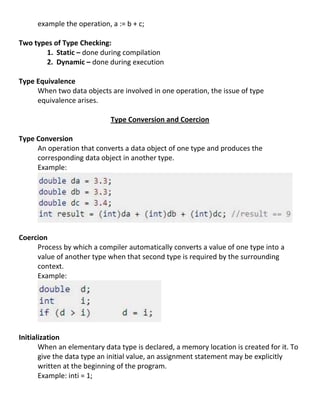
Type Conversion
     An operation that converts a data object of one type and produces the
     corresponding data object in another type.
     Example:


Coercion
     Process by which a compiler automatically converts a value of one type into a
     value of another type when that second type is required by the surrounding
     context.
     Example:


Initialization
       When an elementary data type is declared, a memory location is created for it. To
       give the data type an initial value, an assignment statement may be explicitly
       written at the beginning of the program.
       Example: inti = 1;

Primitive data types

  • 1.
    Primitive Data Types DataObjects Memory spaces where data values may be stored and later retrieved. Two types of data objects: • Programmer-defined data object Explicitly created and manipulated by the programmer through declarations and statements in the program. • System-defined data object Set up by the virtual computer for housekeeping during program execution and one that is not accessible to the programmer. • A data object has attributes. One important attribute is the value type. • Another attribute is the size. • Another important consideration in data objects is their lifetime, that is, how long does the data object exists. This is usually related to when the data object is created ordestroyed. Data Values and Values Types Value Anything that may be evaluated, stored, passed as argument to a procedure, returned by a function; or given as a component of a data structure. Value Type A set of values. In programming language, the types of values are either of primitive type or composite type. Other languages have recursive types. Types of Values: • Primitive Type One whose value is atomic and therefore cannot be decomposed. • Composite Type A type whose values are composed or structured from simpler values. • Recursive Type A special case of composite type where the values are of the same type.
  • 2.
    Data Types Data Type A classification of data, which can store a specific type of information. Data types are primarily used in computer programming, in which variables are created to store data. Primitive Data Type Predefined types of data, which are supported by the programming language. For example, integer, character, and string are all primitive data types. Programmers can use these data types when creating variables in their programs. Numeric Data Type All programming languages have some form of numeric data types. The most common are the integer and real number types. An example is C, where the type int (integer) has an added attribute for the number of bytes used to represent the integer. This results in two types of integer types: long and short. Example: short i; long k; Subrange Type Introduced to save on storage and for better type checking. Enumeration Type A special data type that enables for a variable to be a set of predefined constants. The variable must be equal to one of the values that have been predefined for it. Common examples include compass directions (values of NORTH, SOUTH, EAST, and WEST) and the days of the week. Boolean or Truth Value Type A data type having one of the two possible values, true or false. Character Type Found in almost programming language. The natural extension is the character- string data type. Example:char letter; letter = 'A';
  • 3.
    Declarations A declaration statement is used to declare a variable by specifying its data type and name. Example:int number = 10; booleanisFinished = false; String welcomeMessage = "Hello!"; Two types of declarations: 1. Explicit-done by the programmer. 2. Implicit - found in languages where data objects are created whenever they are about to be used. An explicit declaration serves several purposes both for the programmer and the language translator. Some of these purposes are: 1. Choice of storage representation With this information, the translator can make arrangement to allocate the right amount of storage for a variable. 2. Storage management This information is very useful for managing the storage during run time. 3. Generic operations With declaration of variables, overloaded operations can easily be supported and efficiently implemented. 4. Type Checking The main purpose of a declaration in most languages is to facilitate static type checking. Binding Describes how a variable is created and used (or "bound") by and within the given program and, possibly, by other programs, as well. Classes of Binding: 1. Binding performed at execution time 2. Binding performed at translation time 3. Binding performed at language definition time as another class 4. Binding that occurs at implementation time Type Checking Done to ensure that an operation is provided with the correct types.Consider for
  • 4.
    example the operation,a := b + c; Two types of Type Checking: 1. Static – done during compilation 2. Dynamic – done during execution Type Equivalence When two data objects are involved in one operation, the issue of type equivalence arises. Type Conversion and Coercion Type Conversion An operation that converts a data object of one type and produces the corresponding data object in another type. Example: Coercion Process by which a compiler automatically converts a value of one type into a value of another type when that second type is required by the surrounding context. Example: Initialization When an elementary data type is declared, a memory location is created for it. To give the data type an initial value, an assignment statement may be explicitly written at the beginning of the program. Example: inti = 1;