ICS 313 - Fundamentals of Programming Languages 1
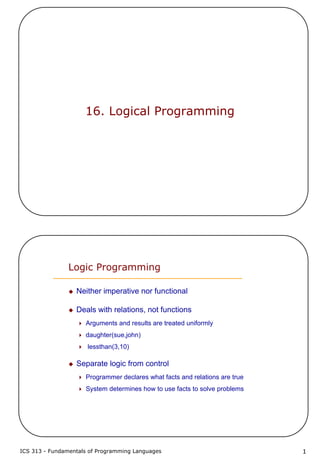
16. Logical Programming
Logic Programming
Neither imperative nor functional
Deals with relations, not functions
Arguments and results are treated uniformly
daughter(sue,john)
lessthan(3,10)
Separate logic from control
Programmer declares what facts and relations are true
System determines how to use facts to solve problems
ICS 313 - Fundamentals of Programming Languages 2
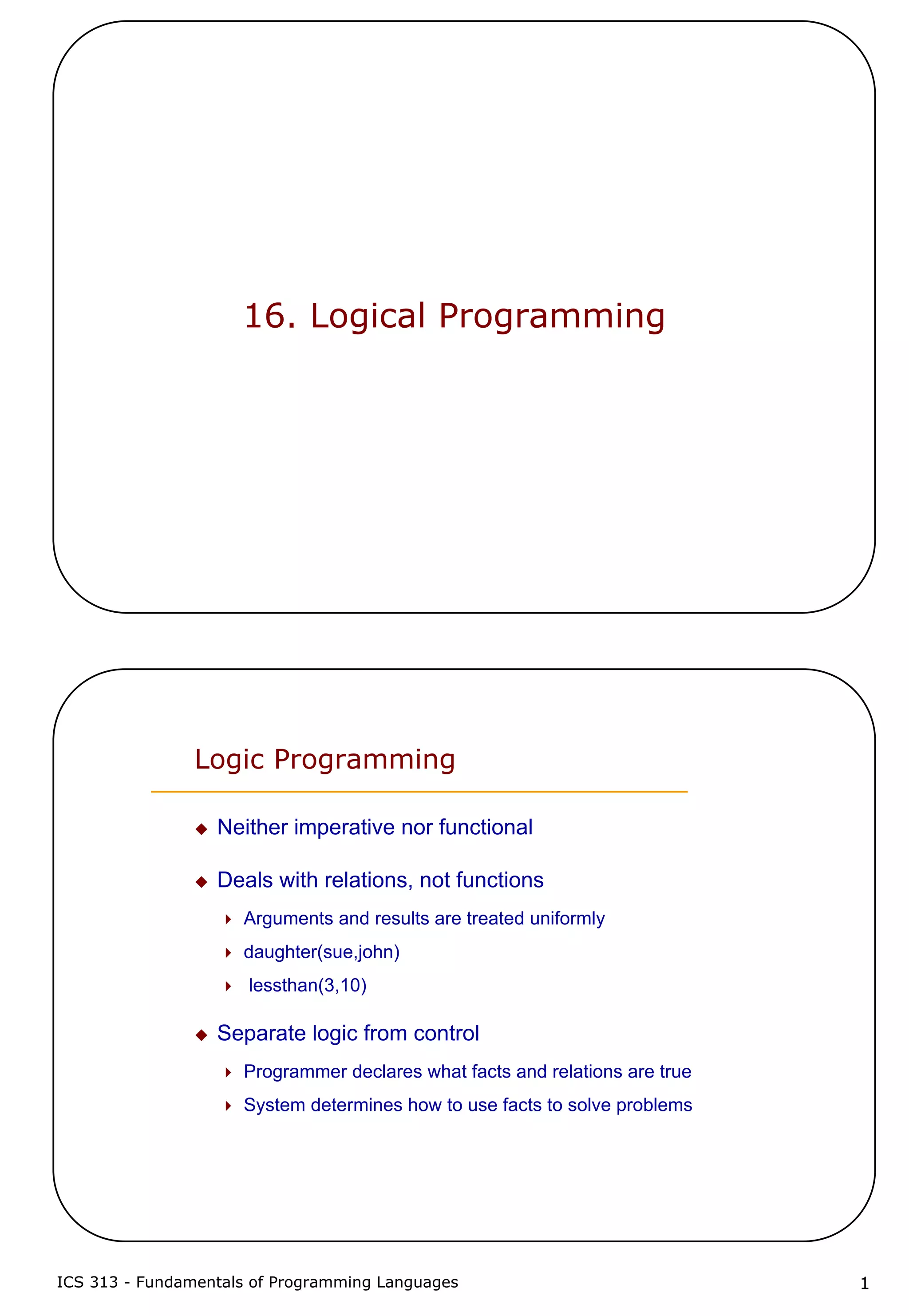
Relations (Predicates)
A table with n ≥ 0 columns and a possibly infinite set
of rows
A tuple (a1,a2,…,an) is in a relation if ai appears in
column i, 1 ≤ i ≤ n
Example: Relation append is a set of tuples of the
form (X,Y,Z), where Z consists of the elements of X
followed by the elements of Y
Relations can be specified using Horn clauses
(rules)
Horn Clauses (Rules)
A Horn clause:
P if Q1 and Q2 and … and Qk, k ≥ 0
can be interpreted as:
The consequent, P, is true if the antecedents Q1,
Q2,…, Qk , k ≥ 0 are all true
Antecedents: conjunction of zero or more conditions that are atomic
formulae in predicate logic
Consequent: an atomic formula in predicate logic
ICS 313 - Fundamentals of Programming Languages 3
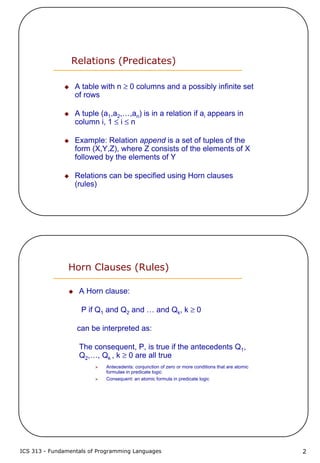
Horn Clause Terminology
Horn Clause Clause
Consequent Goal Head
Antecedents Subgoals Tail
Horn clause with no tail Fact
Horn clause with tail Rule
P if Q1 and Q2 and … and Qk p :- q1 , …, qn
Example: Links Between Languages
Fortran
Algol 60
CPL
BCPL
C
C++
Simula 67
Smalltalk-80
ICS 313 - Fundamentals of Programming Languages 4
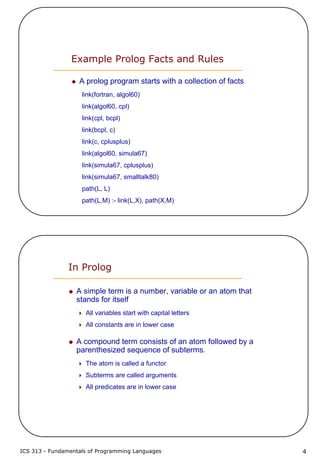
Example Prolog Facts and Rules
A prolog program starts with a collection of facts
link(fortran, algol60)
link(algol60, cpl)
link(cpl, bcpl)
link(bcpl, c)
link(c, cplusplus)
link(algol60, simula67)
link(simula67, cplusplus)
link(simula67, smalltalk80)
path(L, L)
path(L,M) :- link(L,X), path(X,M)
In Prolog
A simple term is a number, variable or an atom that
stands for itself
All variables start with capital letters
All constants are in lower case
A compound term consists of an atom followed by a
parenthesized sequence of subterms.
The atom is called a functor
Subterms are called arguments
All predicates are in lower case
ICS 313 - Fundamentals of Programming Languages 5
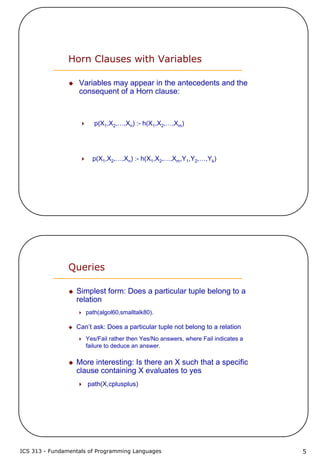
Horn Clauses with Variables
Variables may appear in the antecedents and the
consequent of a Horn clause:
p(X1,X2,…,Xn) :- h(X1,X2,…,Xm)
p(X1,X2,…,Xn) :- h(X1,X2,…,Xm,Y1,Y2,…,Yk)
Queries
Simplest form: Does a particular tuple belong to a
relation
path(algol60,smalltalk80).
Can’t ask: Does a particular tuple not belong to a relation
Yes/Fail rather then Yes/No answers, where Fail indicates a
failure to deduce an answer.
More interesting: Is there an X such that a specific
clause containing X evaluates to yes
path(X,cplusplus)
ICS 313 - Fundamentals of Programming Languages 6
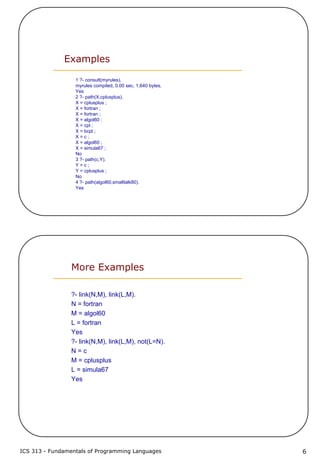
Examples
1 ?- consult(myrules).
myrules compiled, 0.00 sec, 1,640 bytes.
Yes
2 ?- path(X,cplusplus).
X = cplusplus ;
X = fortran ;
X = fortran ;
X = algol60 ;
X = cpl ;
X = bcpl ;
X = c ;
X = algol60 ;
X = simula67 ;
No
3 ?- path(c,Y).
Y = c ;
Y = cplusplus ;
No
4 ?- path(algol60,smalltalk80).
Yes
More Examples
?- link(N,M), link(L,M).
N = fortran
M = algol60
L = fortran
Yes
?- link(N,M), link(L,M), not(L=N).
N = c
M = cplusplus
L = simula67
Yes

16 logical programming

  • 1.
    ICS 313 -Fundamentals of Programming Languages 1 16. Logical Programming Logic Programming Neither imperative nor functional Deals with relations, not functions Arguments and results are treated uniformly daughter(sue,john) lessthan(3,10) Separate logic from control Programmer declares what facts and relations are true System determines how to use facts to solve problems
  • 2.
    ICS 313 -Fundamentals of Programming Languages 2 Relations (Predicates) A table with n ≥ 0 columns and a possibly infinite set of rows A tuple (a1,a2,…,an) is in a relation if ai appears in column i, 1 ≤ i ≤ n Example: Relation append is a set of tuples of the form (X,Y,Z), where Z consists of the elements of X followed by the elements of Y Relations can be specified using Horn clauses (rules) Horn Clauses (Rules) A Horn clause: P if Q1 and Q2 and … and Qk, k ≥ 0 can be interpreted as: The consequent, P, is true if the antecedents Q1, Q2,…, Qk , k ≥ 0 are all true Antecedents: conjunction of zero or more conditions that are atomic formulae in predicate logic Consequent: an atomic formula in predicate logic
  • 3.
    ICS 313 -Fundamentals of Programming Languages 3 Horn Clause Terminology Horn Clause Clause Consequent Goal Head Antecedents Subgoals Tail Horn clause with no tail Fact Horn clause with tail Rule P if Q1 and Q2 and … and Qk p :- q1 , …, qn Example: Links Between Languages Fortran Algol 60 CPL BCPL C C++ Simula 67 Smalltalk-80
  • 4.
    ICS 313 -Fundamentals of Programming Languages 4 Example Prolog Facts and Rules A prolog program starts with a collection of facts link(fortran, algol60) link(algol60, cpl) link(cpl, bcpl) link(bcpl, c) link(c, cplusplus) link(algol60, simula67) link(simula67, cplusplus) link(simula67, smalltalk80) path(L, L) path(L,M) :- link(L,X), path(X,M) In Prolog A simple term is a number, variable or an atom that stands for itself All variables start with capital letters All constants are in lower case A compound term consists of an atom followed by a parenthesized sequence of subterms. The atom is called a functor Subterms are called arguments All predicates are in lower case
  • 5.
    ICS 313 -Fundamentals of Programming Languages 5 Horn Clauses with Variables Variables may appear in the antecedents and the consequent of a Horn clause: p(X1,X2,…,Xn) :- h(X1,X2,…,Xm) p(X1,X2,…,Xn) :- h(X1,X2,…,Xm,Y1,Y2,…,Yk) Queries Simplest form: Does a particular tuple belong to a relation path(algol60,smalltalk80). Can’t ask: Does a particular tuple not belong to a relation Yes/Fail rather then Yes/No answers, where Fail indicates a failure to deduce an answer. More interesting: Is there an X such that a specific clause containing X evaluates to yes path(X,cplusplus)
  • 6.
    ICS 313 -Fundamentals of Programming Languages 6 Examples 1 ?- consult(myrules). myrules compiled, 0.00 sec, 1,640 bytes. Yes 2 ?- path(X,cplusplus). X = cplusplus ; X = fortran ; X = fortran ; X = algol60 ; X = cpl ; X = bcpl ; X = c ; X = algol60 ; X = simula67 ; No 3 ?- path(c,Y). Y = c ; Y = cplusplus ; No 4 ?- path(algol60,smalltalk80). Yes More Examples ?- link(N,M), link(L,M). N = fortran M = algol60 L = fortran Yes ?- link(N,M), link(L,M), not(L=N). N = c M = cplusplus L = simula67 Yes