• Anthropology is the study of humankind. Of all
the disciplines that examine aspects of human
existence and accomplishments -- University of
Florida
• There are now four major fields of anthropology:
biological anthropology, cultural anthropology,
linguistic anthropology, and archaeology.
• Cultural anthropology is the study of human culture,
i.e. human beliefs, behaviors, symbols, etc.
• Linguistic anthropology is a lot like cultural
anthropology in that it studies a specific aspect of
culture: language.
• Biological (or physical) anthropology is the study of
the biology and evolution of humans and closely
related primates.
• Archaeology is the study of humanly altered material
culture, or artifacts.
METHOD OF RESEARCH
• Ethnography is a core modern research
method used in Anthropology as well as in
other modern social sciences. Ethnography is
the case study of one culture, subculture, or
micro-culture made by the researcher
immersing themself in said culture.
A social science that seeks to analyze and
describe the production, distribution, and
consumption of wealth.
• Microeconomics is the branch of economics that
focuses on the choices made by individual decision-
making units in the economy—typically consumers
and firms.
• Macroeconomics is the branch of economics that
focuses on the impact of choices on the total, or
aggregate, level of economic activity.
METHOD OF RESEARCH
• Deductive method
• Inductive method
Geography is the study of places and the
relationships between people and their
environments. Geographers explore both the
physical properties of Earth’s surface and the
human societies spread across it.
• Physical Geography
is the study of Earth’s seasons, climate,
atmosphere, soil, streams, landforms, and
oceans.
• Human Geography
is the study of the distribution of networks of
people and cultures on Earth’s surface.
(THE SCIENTIFIC PROCESS OF GEOGRAPHY)
• Observe a particular feature, phenomenon, or
event in the world that stimulates a series of
questions and thought process.
• Implement the experiment and observe the
results using unbiased data and measurement
techniques.
• Propose a solution, answer, or rule that
explains the hypothesis and experiment.
History – is the discovery, collection, organization,
and presentation of information about past events.
The historian A.J.P. Taylor declared that
“History is not just a catalogue of events put
in the right order like a railway timetable”
The answer is that History is inescapable. It
studies the past and the legacies of the past in
the present. it connects things through time
and encourages its students to take a long
view of such connections.
Linguistics is the scientific study of
language.
In order to study language at a closer
level, scholars have broken down
linguistics into various branches.
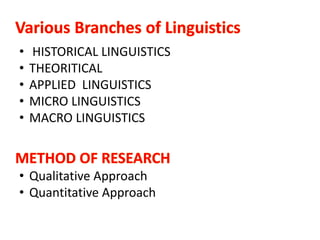
• HISTORICAL LINGUISTICS
• THEORITICAL
• APPLIED LINGUISTICS
• MICRO LINGUISTICS
• MACRO LINGUISTICS
• Qualitative Approach
• Quantitative Approach
• Political science is a social science which
deals with systems of governance, and the
analysis of political activities, political
thoughts, and political behavior.
• It deals extensively with the theory and
practice of politics.
• Comparative Politics
Comparative politics compares systems of
government in other countries
• International Relations
International relations scholars examine the ways in
which nations interact.
• Political Economy
Political economy is the study of how economics and
politics affect each other.
• Political Philosophy
Some political scientists study the tradition of
political philosophies from Plato to the present.
• text analysis
• discourse analysis
• regression analysis
• factor analysis
Psychology is the scientific study of
behavior and the human mind.
A person with a condition that affects their
mental health may benefit from assessment
and treatment with a psychologist or a
psychiatrist.
• A psychologist may offer treatment that
focuses on behavioral adaptations.
• A psychiatrist is a medical doctor who is more
likely to focus on medical management of
mental health issues.
• Clinical psychology
• Cognitive psychology
• Developmental psychology
• Evolutionary psychology
• Forensic psychology
• Health psychology
• Neuropsychology
• Occupational or organizational psychology
• Social psychology
• Case studies, surveys, naturalistic
observation, and laboratory observation are
examples of descriptive or correlational
research methods. Using these methods,
researchers can describe different events,
experiences, or behaviors and look for links
between them.
• Demography is the study of the populations
and the impact of population on different
parts of the world.
• Sociology is the study of human behavior in a
social context; institutions such as goverment
or education; and in groups such as family.
• Applied sociology
• Comparative sociology
• Cultural sociology
• Demography
• Industrial sociology
• Medical sociology
• Military sociology
• Political sociology
• Sociology of Religion
• Urban sociology
• Rural sociology
• Sociology of Education
• METHODS OF DATA COLLECTION
collection is done by the individual by using the
methods such as : • Observation • Interviews •
Questionnaires
• ANALYSIS AND INTERPRETATION OF DATA
The data collected directed from individuals by
face to face survey. Some data are being
collected during census and national surveys.

DISS (Disciplines within Social Sciences)

  • 2.
    • Anthropology isthe study of humankind. Of all the disciplines that examine aspects of human existence and accomplishments -- University of Florida • There are now four major fields of anthropology: biological anthropology, cultural anthropology, linguistic anthropology, and archaeology.
  • 3.
    • Cultural anthropologyis the study of human culture, i.e. human beliefs, behaviors, symbols, etc. • Linguistic anthropology is a lot like cultural anthropology in that it studies a specific aspect of culture: language. • Biological (or physical) anthropology is the study of the biology and evolution of humans and closely related primates. • Archaeology is the study of humanly altered material culture, or artifacts.
  • 4.
    METHOD OF RESEARCH •Ethnography is a core modern research method used in Anthropology as well as in other modern social sciences. Ethnography is the case study of one culture, subculture, or micro-culture made by the researcher immersing themself in said culture.
  • 5.
    A social sciencethat seeks to analyze and describe the production, distribution, and consumption of wealth.
  • 6.
    • Microeconomics isthe branch of economics that focuses on the choices made by individual decision- making units in the economy—typically consumers and firms. • Macroeconomics is the branch of economics that focuses on the impact of choices on the total, or aggregate, level of economic activity. METHOD OF RESEARCH • Deductive method • Inductive method
  • 7.
    Geography is thestudy of places and the relationships between people and their environments. Geographers explore both the physical properties of Earth’s surface and the human societies spread across it.
  • 8.
    • Physical Geography isthe study of Earth’s seasons, climate, atmosphere, soil, streams, landforms, and oceans. • Human Geography is the study of the distribution of networks of people and cultures on Earth’s surface.
  • 9.
    (THE SCIENTIFIC PROCESSOF GEOGRAPHY) • Observe a particular feature, phenomenon, or event in the world that stimulates a series of questions and thought process. • Implement the experiment and observe the results using unbiased data and measurement techniques. • Propose a solution, answer, or rule that explains the hypothesis and experiment.
  • 10.
    History – isthe discovery, collection, organization, and presentation of information about past events. The historian A.J.P. Taylor declared that “History is not just a catalogue of events put in the right order like a railway timetable”
  • 11.
    The answer isthat History is inescapable. It studies the past and the legacies of the past in the present. it connects things through time and encourages its students to take a long view of such connections.
  • 12.
    Linguistics is thescientific study of language. In order to study language at a closer level, scholars have broken down linguistics into various branches.
  • 13.
    • HISTORICAL LINGUISTICS •THEORITICAL • APPLIED LINGUISTICS • MICRO LINGUISTICS • MACRO LINGUISTICS • Qualitative Approach • Quantitative Approach
  • 14.
    • Political scienceis a social science which deals with systems of governance, and the analysis of political activities, political thoughts, and political behavior. • It deals extensively with the theory and practice of politics.
  • 15.
    • Comparative Politics Comparativepolitics compares systems of government in other countries • International Relations International relations scholars examine the ways in which nations interact. • Political Economy Political economy is the study of how economics and politics affect each other. • Political Philosophy Some political scientists study the tradition of political philosophies from Plato to the present.
  • 16.
    • text analysis •discourse analysis • regression analysis • factor analysis
  • 17.
    Psychology is thescientific study of behavior and the human mind.
  • 18.
    A person witha condition that affects their mental health may benefit from assessment and treatment with a psychologist or a psychiatrist. • A psychologist may offer treatment that focuses on behavioral adaptations. • A psychiatrist is a medical doctor who is more likely to focus on medical management of mental health issues.
  • 19.
    • Clinical psychology •Cognitive psychology • Developmental psychology • Evolutionary psychology • Forensic psychology • Health psychology • Neuropsychology • Occupational or organizational psychology • Social psychology
  • 20.
    • Case studies,surveys, naturalistic observation, and laboratory observation are examples of descriptive or correlational research methods. Using these methods, researchers can describe different events, experiences, or behaviors and look for links between them.
  • 21.
    • Demography isthe study of the populations and the impact of population on different parts of the world. • Sociology is the study of human behavior in a social context; institutions such as goverment or education; and in groups such as family.
  • 22.
    • Applied sociology •Comparative sociology • Cultural sociology • Demography • Industrial sociology • Medical sociology • Military sociology • Political sociology • Sociology of Religion • Urban sociology • Rural sociology • Sociology of Education
  • 23.
    • METHODS OFDATA COLLECTION collection is done by the individual by using the methods such as : • Observation • Interviews • Questionnaires • ANALYSIS AND INTERPRETATION OF DATA The data collected directed from individuals by face to face survey. Some data are being collected during census and national surveys.