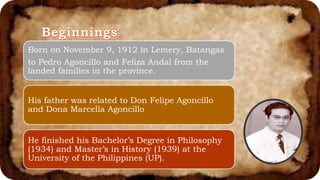
Born on November 9, 1912 in Lemery, Batangas
to Pedro Agoncillo and Feliza Andal from the
landed families in the province.
His father was related to Don Felipe Agoncillo
and Dona Marcella Agoncillo
He finished his Bachelor’s Degree in Philosophy
(1934) and Master’s in History (1939) at the
University of the Philippines (UP).
An essayist and poet and authored 20
books and numerous articles on history
Kicked off his career as a historian at the age of 46
after being a Tagalog poet and writer for 20 years
Earned his living as a linguistic assistant at the
Institute of National Language and as an instructor
at the Far Eastern University and the Manuel L.
Quezon University
Teach Filipino History as a visiting Professor at the
International Christian University in Mikata, Tokyo
Japan for 1 year
Named as a member of the National Historical
Institute in 1963
Chair UP History Department at the same period
that his cousin General Abelardo Andal served as
the Commander of the ROTC of the same
university.
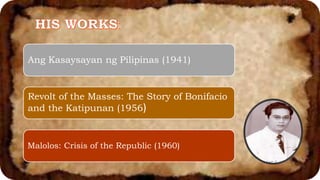
Ang Kasaysayan ng Pilipinas (1941)
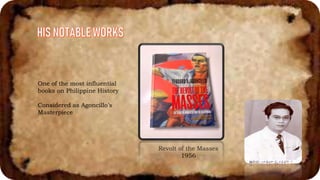
Revolt of the Masses: The Story of Bonifacio
and the Katipunan (1956)
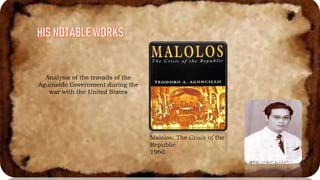
Malolos: Crisis of the Republic (1960)
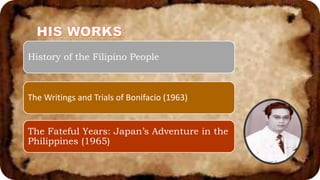
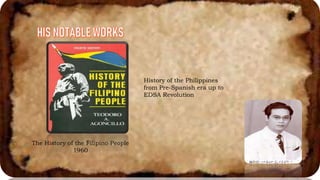
History of the Filipino People
The Writings and Trials of Bonifacio (1963)
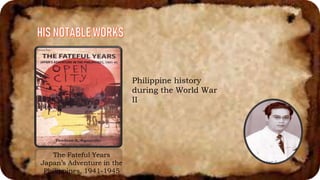
The Fateful Years: Japan’s Adventure in the
Philippines (1965)
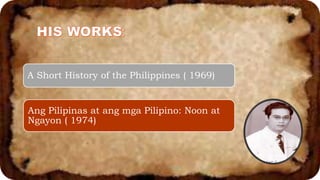
A Short History of the Philippines ( 1969)
Ang Pilipinas at ang mga Pilipino: Noon at
Ngayon ( 1974)
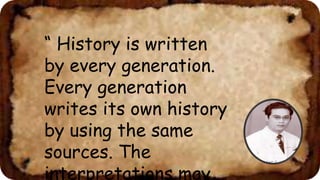
“ History is written
by every generation.
Every generation
writes its own history
by using the same
sources. The
interpretations may
The Fateful Years
Japan’s Adventure in the
Philippines, 1941-1945
Philippine history
during the World War
II
Analysis of the travails of the
Aguinaldo Government during the
war with the United States
Malolos: The Crisis of the
Republic
1960
The History of the Filipino People
1960
History of the Philippines
from Pre-Spanish era up to
EDSA Revolution
Revolt of the Masses
1956
One of the most influential
books on Philippine History
Considered as Agoncillo’s
Masterpiece
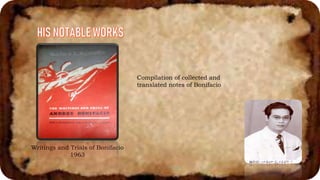
Writings and Trials of Bonifacio
1963
Compilation of collected and
translated notes of Bonifacio
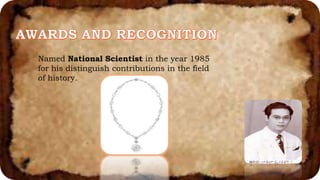
Named National Scientist in the year 1985
for his distinguish contributions in the field
of history.
1950’S started to focus on writing about the
Spanish Era and the Philippine Revolution
1958 joined the UP Department of History as a
faculty member and later became the
Department Head
Late 1950’s when he started publishing
his notable works
History deals with the past,
not with the future.
e use history to avoid the mistakes of the past,
not to recreate the very same events
PERSPECTIVE OF HISTORY
The study of history should serve the purpose of promoting
national consciousness and service.
Challenge the traditional Eurocentric view of the Phillipine history
that portrayed the Phillipines as a passive recipient of Western
influence
Emphasizes the active role of Filipinos in shaping their own
history, particularly in the fight against Spanish colonozation and
struggle for independence.
APPROACH TO HISTORY
Holistic
• Understand history in it’s entirety taking into account
the social, cultural, economic and political factors that
shaped it.
• Evident in the book “ History of the Filipino People”.
Importance of contextualizing historical events
Understand the complexities of Philippine
history and provide nuanced analysis of
the country’s social, economic and political
development.
Importance and the role of language in shaping
national identity.
Critical examination of colonialism and
imperialism
Strong focus on nationalistic and
anti-colonial themes
Tend to rely heavily on secondary
sources
Overly deterministic
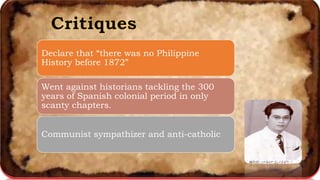
Declare that “there was no Philippine
History before 1872”
Went against historians tackling the 300
years of Spanish colonial period in only
scanty chapters.
Communist sympathizer and anti-catholic
History is not only an
interesting subject;
It is a lively one, for it is
recreation of past,
And the past is always
colorful and exciting
Especially because we view
it from the perspective of
the present.
Presented by:
CHARMAINE C. DE LA
CRUZ
MAED HISTORY

Teodoro-A.-Agoncillo-PPT-for-Discussion.pptx

  • 2.
    Born on November9, 1912 in Lemery, Batangas to Pedro Agoncillo and Feliza Andal from the landed families in the province. His father was related to Don Felipe Agoncillo and Dona Marcella Agoncillo He finished his Bachelor’s Degree in Philosophy (1934) and Master’s in History (1939) at the University of the Philippines (UP).
  • 3.
    An essayist andpoet and authored 20 books and numerous articles on history Kicked off his career as a historian at the age of 46 after being a Tagalog poet and writer for 20 years Earned his living as a linguistic assistant at the Institute of National Language and as an instructor at the Far Eastern University and the Manuel L. Quezon University
  • 4.
    Teach Filipino Historyas a visiting Professor at the International Christian University in Mikata, Tokyo Japan for 1 year Named as a member of the National Historical Institute in 1963 Chair UP History Department at the same period that his cousin General Abelardo Andal served as the Commander of the ROTC of the same university.
  • 5.
    Ang Kasaysayan ngPilipinas (1941) Revolt of the Masses: The Story of Bonifacio and the Katipunan (1956) Malolos: Crisis of the Republic (1960)
  • 6.
    History of theFilipino People The Writings and Trials of Bonifacio (1963) The Fateful Years: Japan’s Adventure in the Philippines (1965)
  • 7.
    A Short Historyof the Philippines ( 1969) Ang Pilipinas at ang mga Pilipino: Noon at Ngayon ( 1974)
  • 8.
    “ History iswritten by every generation. Every generation writes its own history by using the same sources. The interpretations may
  • 9.
    The Fateful Years Japan’sAdventure in the Philippines, 1941-1945 Philippine history during the World War II
  • 10.
    Analysis of thetravails of the Aguinaldo Government during the war with the United States Malolos: The Crisis of the Republic 1960
  • 11.
    The History ofthe Filipino People 1960 History of the Philippines from Pre-Spanish era up to EDSA Revolution
  • 12.
    Revolt of theMasses 1956 One of the most influential books on Philippine History Considered as Agoncillo’s Masterpiece
  • 13.
    Writings and Trialsof Bonifacio 1963 Compilation of collected and translated notes of Bonifacio
  • 14.
    Named National Scientistin the year 1985 for his distinguish contributions in the field of history.
  • 15.
    1950’S started tofocus on writing about the Spanish Era and the Philippine Revolution 1958 joined the UP Department of History as a faculty member and later became the Department Head Late 1950’s when he started publishing his notable works
  • 16.
    History deals withthe past, not with the future. e use history to avoid the mistakes of the past, not to recreate the very same events
  • 17.
    PERSPECTIVE OF HISTORY Thestudy of history should serve the purpose of promoting national consciousness and service. Challenge the traditional Eurocentric view of the Phillipine history that portrayed the Phillipines as a passive recipient of Western influence Emphasizes the active role of Filipinos in shaping their own history, particularly in the fight against Spanish colonozation and struggle for independence.
  • 18.
    APPROACH TO HISTORY Holistic •Understand history in it’s entirety taking into account the social, cultural, economic and political factors that shaped it. • Evident in the book “ History of the Filipino People”. Importance of contextualizing historical events
  • 19.
    Understand the complexitiesof Philippine history and provide nuanced analysis of the country’s social, economic and political development. Importance and the role of language in shaping national identity. Critical examination of colonialism and imperialism
  • 20.
    Strong focus onnationalistic and anti-colonial themes Tend to rely heavily on secondary sources Overly deterministic
  • 21.
    Declare that “therewas no Philippine History before 1872” Went against historians tackling the 300 years of Spanish colonial period in only scanty chapters. Communist sympathizer and anti-catholic
  • 22.
    History is notonly an interesting subject; It is a lively one, for it is recreation of past, And the past is always colorful and exciting Especially because we view it from the perspective of the present.
  • 23.
    Presented by: CHARMAINE C.DE LA CRUZ MAED HISTORY