Gas CleaningChapter 13 in FundamentalsWatch this lecture at www.vimeo.comAlso visit; http://www.midlandit.co.uk/particletechnology.htm for further resources.Course details: Particle Technology, module code: CGB019 and CGB919, 2nd year of study.Professor Richard HoldichR.G.Holdich@Lboro.ac.uk
Gas CleaningInertia
Diffusional collection
Target efficiency
Material balance - e.g. fibrous filter
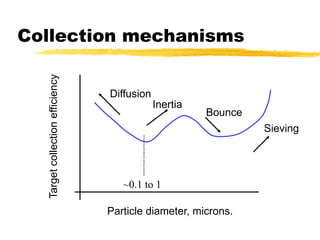
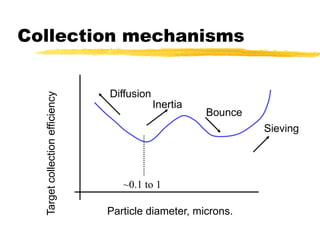
Types of equipmentCollection mechanismsDiffusionInertiaBounceSievingTarget collection efficiency~0.1 to 1Particle diameter, microns.

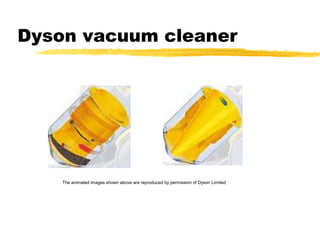
Dyson vacuum cleanerThe animated images shown above are reproduced by permission of Dyson Limited.
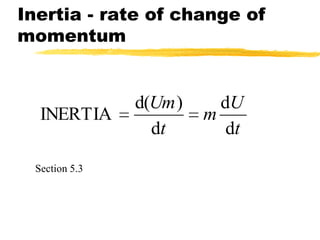
Inertia - rate of change of momentumHow long does it take to reach the terminal settling velocity (gas or liquid)?Inertial collecting devicesStokes’ law and STOKES NUMBER - note the difference!
Inertia - rate of change of momentumSection 5.3
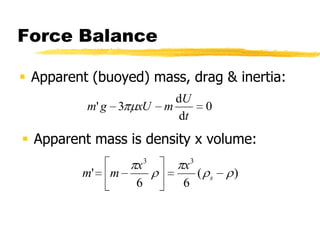
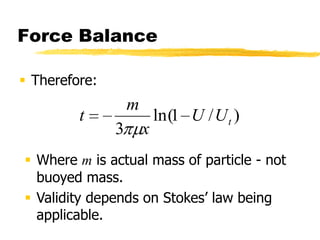
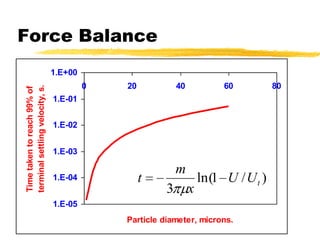
Force BalanceApparent (buoyed) mass, drag & inertia:Apparent mass is density x volume:Force BalanceTherefore:
Where m is actual mass of particle - not buoyed mass.
Validity depends on Stokes’ law being applicable.Force Balance
Acceleration & InertiaParticles reach 99% of their terminal settling velocity very quickly.Can use similar approach to characterise the inertia within a system.Inertia can be used in gas cleaning systems.
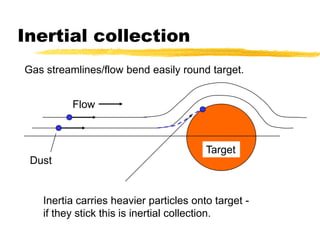
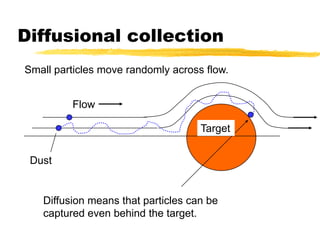
Inertial collectionGas streamlines/flow bend easily round target.FlowTargetDustInertia carries heavier particles onto target - if they stick this is inertial collection.
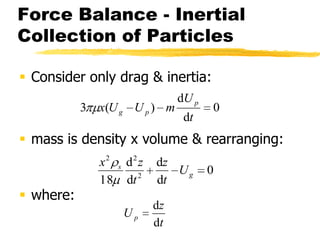
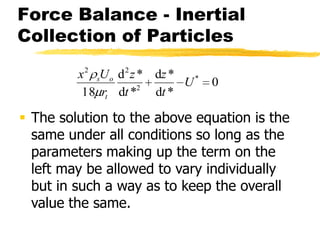
Force Balance - Inertial Collection of ParticlesConsider only drag & inertia:mass is density x volume & rearranging:
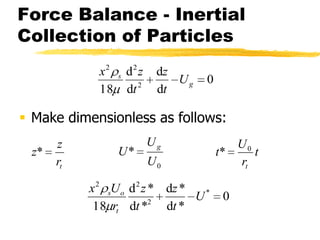
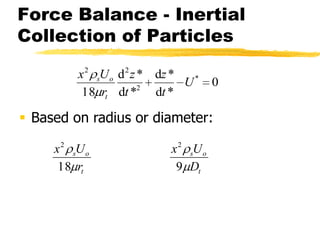
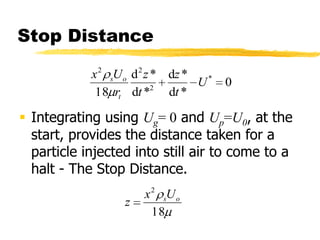
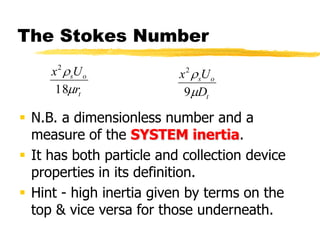
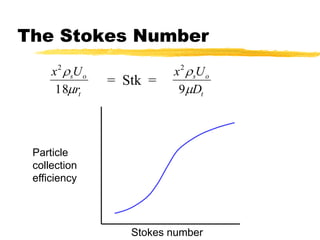
where: Force Balance - Inertial Collection of ParticlesMake dimensionless as follows:Force Balance - Inertial Collection of ParticlesThe solution to the above equation is the same under all conditions so long as the parameters making up the term on the left may be allowed to vary individually but in such a way as to keep the overall value the same.Force Balance - Inertial Collection of ParticlesBased on radius or diameter:Stop DistanceIntegrating using Ug= 0 and Up=U0, at the start, provides the distance taken for a particle injected into still air to come to a halt - The Stop Distance.The Stokes NumberN.B. a dimensionless number and a measure of the SYSTEM inertia.
It has both particle and collection device properties in its definition.
Hint - high inertia given by terms on the top & vice versa for those underneath.The Stokes Number=  Stk  =Particle collectionefficiencyStokes number
Collection mechanismsDiffusionInertiaBounceSievingTarget collection efficiency~0.1 to 1Particle diameter, microns.
Diffusional collectionSmall particles move randomly across flow.FlowTargetDustDiffusion means that particles can be captured even behind the target.
Material BalanceApplicable to any device with a concentration gradient within the collection device. Example quoted is for a fibrous filter of the HEPA (high efficiency particulate air) type - this has a packing density of 2% (ish) fibres, 98% porosity.
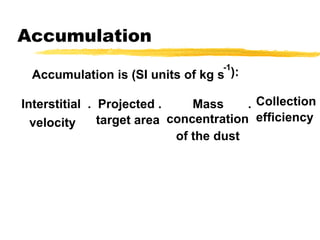
Accumulation-1):Accumulation is (SI units of kg sCollectionInterstitial  .  Projected .         Mass       .				     concentrationefficiencytarget areavelocityof the dust
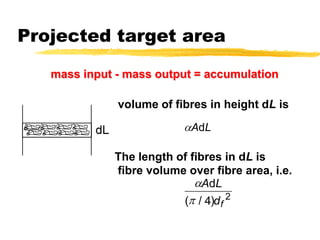
Projected target areaaAdLaAdL2p(/)d4fmass input - mass output = accumulationvolume of fibres in height dL isThe length of fibres in dL is fibre volume over fibre area, i.e.
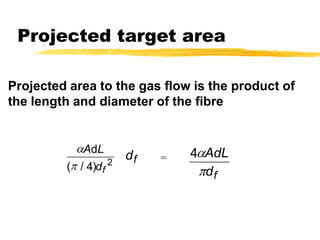
Projected target areaaAdL4pdfaAdL2p(/)d4fProjected area to the gas flow is the product ofthe length and diameter of the fibred=f
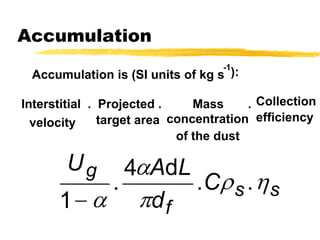
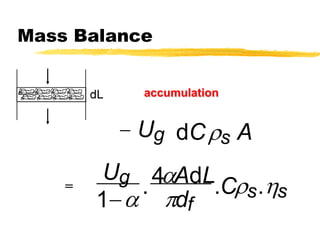
Accumulation-1):Accumulation is (SI units of kg sCollectionInterstitial  .  Projected .         Mass       .				     concentrationefficiencytarget areavelocityof the dustUaAdL4grh...Css-apd1f
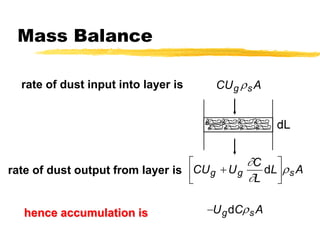
Mass BalancerCUAgs¶Céù+rCUUdLAêúggs¶Lëû-rUdCAgsrate of dust input into layer israte of dust output from layer ishence accumulation is
Mass BalanceUaAdL4grh...Css-apd1faccumulationUdC     Args=
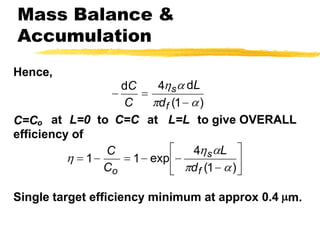
Mass Balance & AccumulationéùhaL4Csh=-=--exp11êúpa-Cd()1ëûofHence,dLha4dCs-=-paCd()1f atL=0  toC=C atL=Lto give OVERALLC=Coefficiency ofmSingle target efficiency minimum at approx 0.4m.
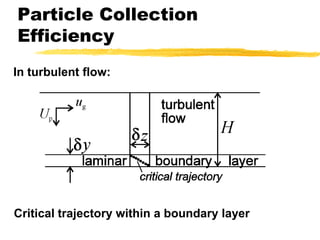
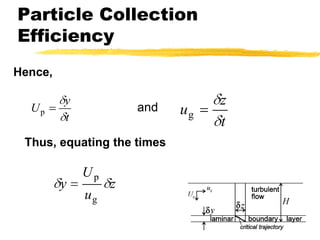
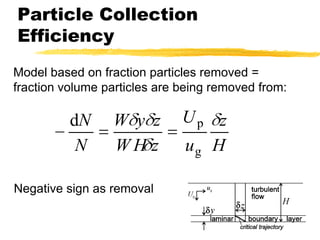
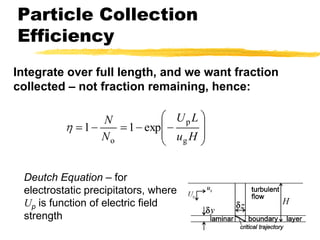
In turbulent flow:Critical trajectory within a boundary layerParticle Collection Efficiency
Hence,	and 	Thus, equating the timesParticle Collection Efficiency
Model based on fraction particles removed = fraction volume particles are being removed from:Particle Collection EfficiencyNegative sign as removal
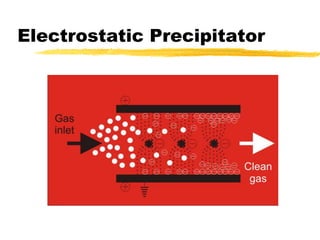
Particle Collection EfficiencyIntegrate over full length, and we want fractioncollected – not fraction remaining, hence:Deutch Equation – forelectrostatic precipitators, whereUpis function of electric fieldstrength
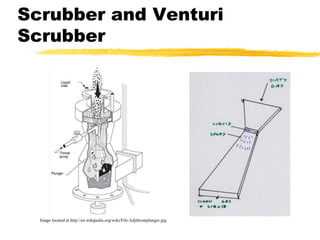
Scrubber and Venturi ScrubberImage located at http://en.wikipedia.org/wiki/File:Adjthroatplunger.jpg
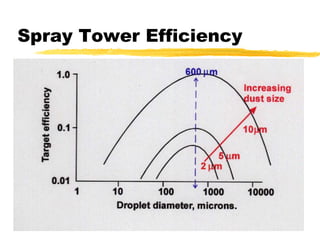
Spray Tower Efficiency
Electrostatic Precipitator
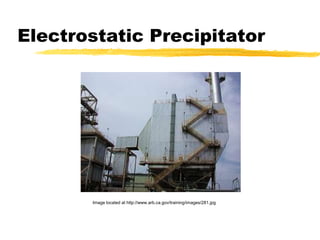
Electrostatic PrecipitatorImage located at http://www.arb.ca.gov/training/images/281.jpg
Electrostatic PrecipitatorImage removed for copyright reasons.For a suitable example see http://www.alentecinc.com/company_profile.htm#Electrostatic%20precipitation.
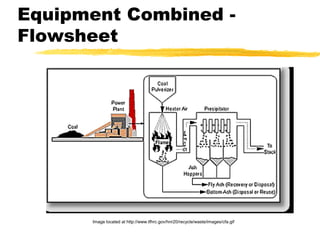
Equipment Combined - FlowsheetImage located at http://www.tfhrc.gov/hnr20/recycle/waste/images/cfa.gif
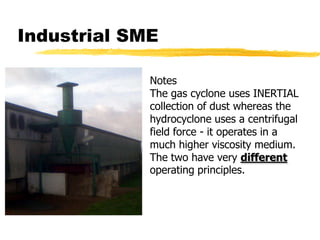
Industrial SMENotesThe gas cyclone uses INERTIAL collection of dust whereas the hydrocyclone uses a centrifugal field force - it operates in a much higher viscosity medium. The two have very different operating principles.
This resource was created by Loughborough University and released as an open educational resource through the Open Engineering Resources project of the HE Academy Engineering Subject Centre. The Open Engineering Resources project was funded by HEFCE and part of the JISC/HE Academy UKOER programme.The animated images shown on slide 4 are reproduced by permission of Dyson Limited.Slide 33. Image of an adjustable throat venturi scrubber located on http://en.wikipedia.org/wiki/File:Adjthroatplunger.jpg. Slide 37. Image of an electrostatic precipitator reproduced with permission from http://www.arb.ca.gov/training/images/281.jpg. Slide 39.  Public domain image located at http://www.tfhrc.gov/hnr20/recycle/waste/images/cfa.gif© 2009 Loughborough UniversityThis work is licensed under a Creative Commons Attribution 2.0 License. The name of Loughborough University, and the Loughborough University logo are the name and registered marks of Loughborough University. To the fullest extent permitted by law Loughborough University reserves all its rights in its name and marks which may not be used except with its written permission.The JISC logo is licensed under the terms of the Creative Commons Attribution-Non-Commercial-No Derivative Works 2.0 UK: England & Wales Licence.  All reproductions must comply with the terms of that licence.The HEA logo is owned by the Higher Education Academy Limited may be freely distributed and copied for educational purposes only, provided that appropriate acknowledgement is given to the Higher Education Academy as the copyright holder and original publisher.

Particle Technology Gas Cleaning

  • 1.
    Gas CleaningChapter 13in FundamentalsWatch this lecture at www.vimeo.comAlso visit; http://www.midlandit.co.uk/particletechnology.htm for further resources.Course details: Particle Technology, module code: CGB019 and CGB919, 2nd year of study.Professor Richard HoldichR.G.Holdich@Lboro.ac.uk
  • 2.
  • 3.
  • 4.
  • 5.
    Material balance -e.g. fibrous filter
  • 6.
    Types of equipmentCollectionmechanismsDiffusionInertiaBounceSievingTarget collection efficiency~0.1 to 1Particle diameter, microns.
  • 7.
    Dyson vacuum cleanerTheanimated images shown above are reproduced by permission of Dyson Limited.
  • 8.
    Inertia - rateof change of momentumHow long does it take to reach the terminal settling velocity (gas or liquid)?Inertial collecting devicesStokes’ law and STOKES NUMBER - note the difference!
  • 9.
    Inertia - rateof change of momentumSection 5.3
  • 10.
    Force BalanceApparent (buoyed)mass, drag & inertia:Apparent mass is density x volume:Force BalanceTherefore:
  • 11.
    Where m isactual mass of particle - not buoyed mass.
  • 12.
    Validity depends onStokes’ law being applicable.Force Balance
  • 13.
    Acceleration & InertiaParticlesreach 99% of their terminal settling velocity very quickly.Can use similar approach to characterise the inertia within a system.Inertia can be used in gas cleaning systems.
  • 14.
    Inertial collectionGas streamlines/flowbend easily round target.FlowTargetDustInertia carries heavier particles onto target - if they stick this is inertial collection.
  • 15.
    Force Balance -Inertial Collection of ParticlesConsider only drag & inertia:mass is density x volume & rearranging:
  • 16.
    where: Force Balance- Inertial Collection of ParticlesMake dimensionless as follows:Force Balance - Inertial Collection of ParticlesThe solution to the above equation is the same under all conditions so long as the parameters making up the term on the left may be allowed to vary individually but in such a way as to keep the overall value the same.Force Balance - Inertial Collection of ParticlesBased on radius or diameter:Stop DistanceIntegrating using Ug= 0 and Up=U0, at the start, provides the distance taken for a particle injected into still air to come to a halt - The Stop Distance.The Stokes NumberN.B. a dimensionless number and a measure of the SYSTEM inertia.
  • 17.
    It has bothparticle and collection device properties in its definition.
  • 18.
    Hint - highinertia given by terms on the top & vice versa for those underneath.The Stokes Number= Stk =Particle collectionefficiencyStokes number
  • 19.
    Collection mechanismsDiffusionInertiaBounceSievingTarget collectionefficiency~0.1 to 1Particle diameter, microns.
  • 20.
    Diffusional collectionSmall particlesmove randomly across flow.FlowTargetDustDiffusion means that particles can be captured even behind the target.
  • 21.
    Material BalanceApplicable toany device with a concentration gradient within the collection device. Example quoted is for a fibrous filter of the HEPA (high efficiency particulate air) type - this has a packing density of 2% (ish) fibres, 98% porosity.
  • 22.
    Accumulation-1):Accumulation is (SIunits of kg sCollectionInterstitial . Projected . Mass . concentrationefficiencytarget areavelocityof the dust
  • 23.
    Projected target areaaAdLaAdL2p(/)d4fmassinput - mass output = accumulationvolume of fibres in height dL isThe length of fibres in dL is fibre volume over fibre area, i.e.
  • 24.
    Projected target areaaAdL4pdfaAdL2p(/)d4fProjectedarea to the gas flow is the product ofthe length and diameter of the fibred=f
  • 25.
    Accumulation-1):Accumulation is (SIunits of kg sCollectionInterstitial . Projected . Mass . concentrationefficiencytarget areavelocityof the dustUaAdL4grh...Css-apd1f
  • 26.
    Mass BalancerCUAgs¶Céù+rCUUdLAêúggs¶Lëû-rUdCAgsrate ofdust input into layer israte of dust output from layer ishence accumulation is
  • 27.
  • 28.
    Mass Balance &AccumulationéùhaL4Csh=-=--exp11êúpa-Cd()1ëûofHence,dLha4dCs-=-paCd()1f atL=0 toC=C atL=Lto give OVERALLC=Coefficiency ofmSingle target efficiency minimum at approx 0.4m.
  • 29.
    In turbulent flow:Criticaltrajectory within a boundary layerParticle Collection Efficiency
  • 30.
    Hence, and Thus, equatingthe timesParticle Collection Efficiency
  • 31.
    Model based onfraction particles removed = fraction volume particles are being removed from:Particle Collection EfficiencyNegative sign as removal
  • 32.
    Particle Collection EfficiencyIntegrateover full length, and we want fractioncollected – not fraction remaining, hence:Deutch Equation – forelectrostatic precipitators, whereUpis function of electric fieldstrength
  • 33.
    Scrubber and VenturiScrubberImage located at http://en.wikipedia.org/wiki/File:Adjthroatplunger.jpg
  • 34.
  • 36.
  • 37.
    Electrostatic PrecipitatorImage locatedat http://www.arb.ca.gov/training/images/281.jpg
  • 38.
    Electrostatic PrecipitatorImage removedfor copyright reasons.For a suitable example see http://www.alentecinc.com/company_profile.htm#Electrostatic%20precipitation.
  • 39.
    Equipment Combined -FlowsheetImage located at http://www.tfhrc.gov/hnr20/recycle/waste/images/cfa.gif
  • 40.
    Industrial SMENotesThe gascyclone uses INERTIAL collection of dust whereas the hydrocyclone uses a centrifugal field force - it operates in a much higher viscosity medium. The two have very different operating principles.
  • 41.
    This resource wascreated by Loughborough University and released as an open educational resource through the Open Engineering Resources project of the HE Academy Engineering Subject Centre. The Open Engineering Resources project was funded by HEFCE and part of the JISC/HE Academy UKOER programme.The animated images shown on slide 4 are reproduced by permission of Dyson Limited.Slide 33. Image of an adjustable throat venturi scrubber located on http://en.wikipedia.org/wiki/File:Adjthroatplunger.jpg. Slide 37. Image of an electrostatic precipitator reproduced with permission from http://www.arb.ca.gov/training/images/281.jpg. Slide 39. Public domain image located at http://www.tfhrc.gov/hnr20/recycle/waste/images/cfa.gif© 2009 Loughborough UniversityThis work is licensed under a Creative Commons Attribution 2.0 License. The name of Loughborough University, and the Loughborough University logo are the name and registered marks of Loughborough University. To the fullest extent permitted by law Loughborough University reserves all its rights in its name and marks which may not be used except with its written permission.The JISC logo is licensed under the terms of the Creative Commons Attribution-Non-Commercial-No Derivative Works 2.0 UK: England & Wales Licence.  All reproductions must comply with the terms of that licence.The HEA logo is owned by the Higher Education Academy Limited may be freely distributed and copied for educational purposes only, provided that appropriate acknowledgement is given to the Higher Education Academy as the copyright holder and original publisher.