Fabric Filters Filtration Fabric Selection Fabric Cleaning Air/Cloth Ratio, Filtration Velocity Filtration Mechanisms Pressure Drop and Design Consideration  Reading: Chap. 6
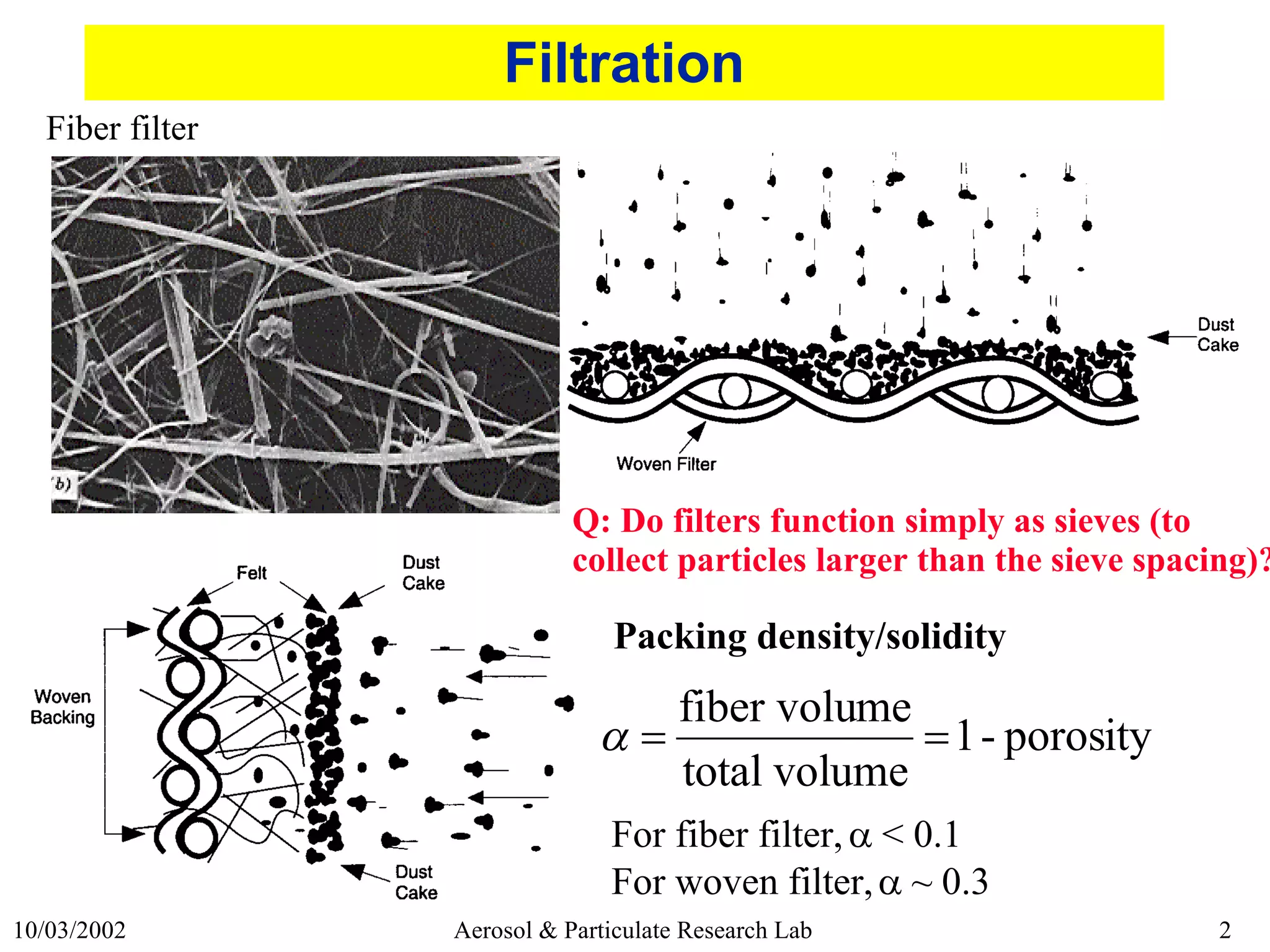
Filtration Packing density/solidity Fiber filter For fiber filter,    < 0.1 For woven filter,    ~ 0.3 Q: Do filters function simply as sieves (to  collect particles larger than the sieve spacing)?
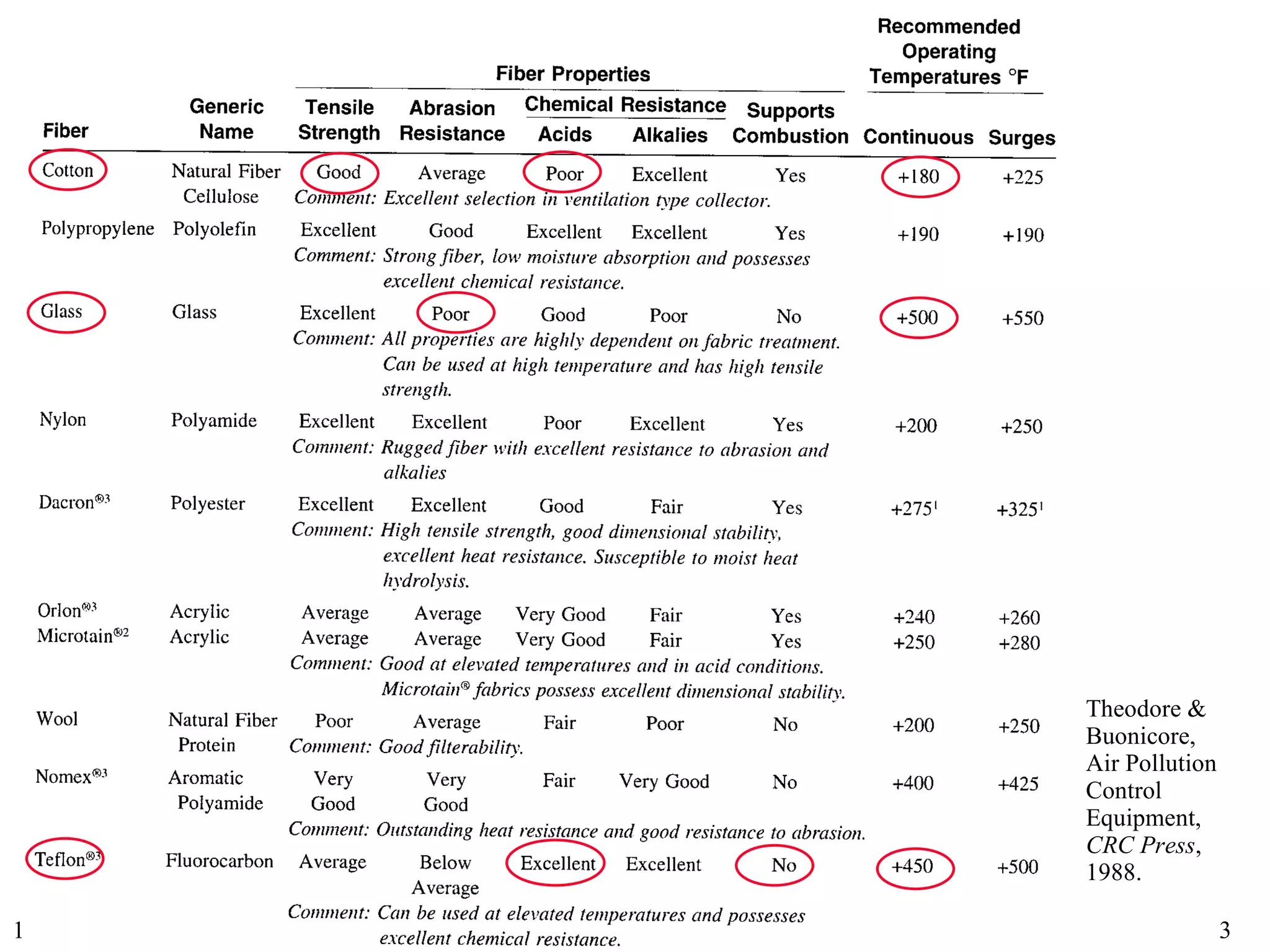
Theodore & Buonicore,  Air Pollution Control Equipment,  CRC Press , 1988.
Shaker Baghouse Theodore & Buonicore,  Air Pollution Control Equipment,  CRC Press , 1988. Shaker Cleaning Parameters Q: What are the common  problems encountered?
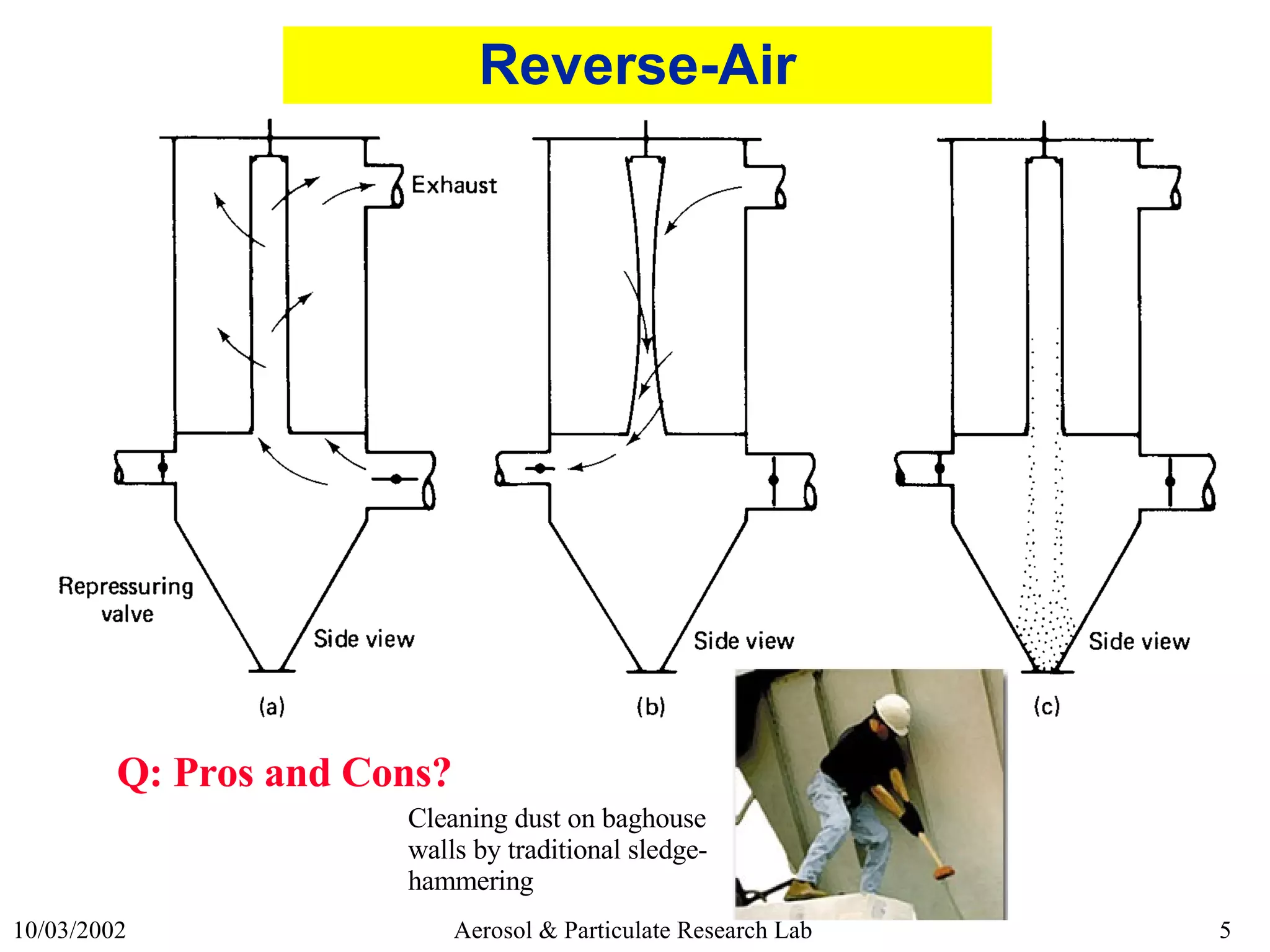
Reverse-Air Q: Pros and Cons? Cleaning dust on baghouse walls by traditional sledge-hammering
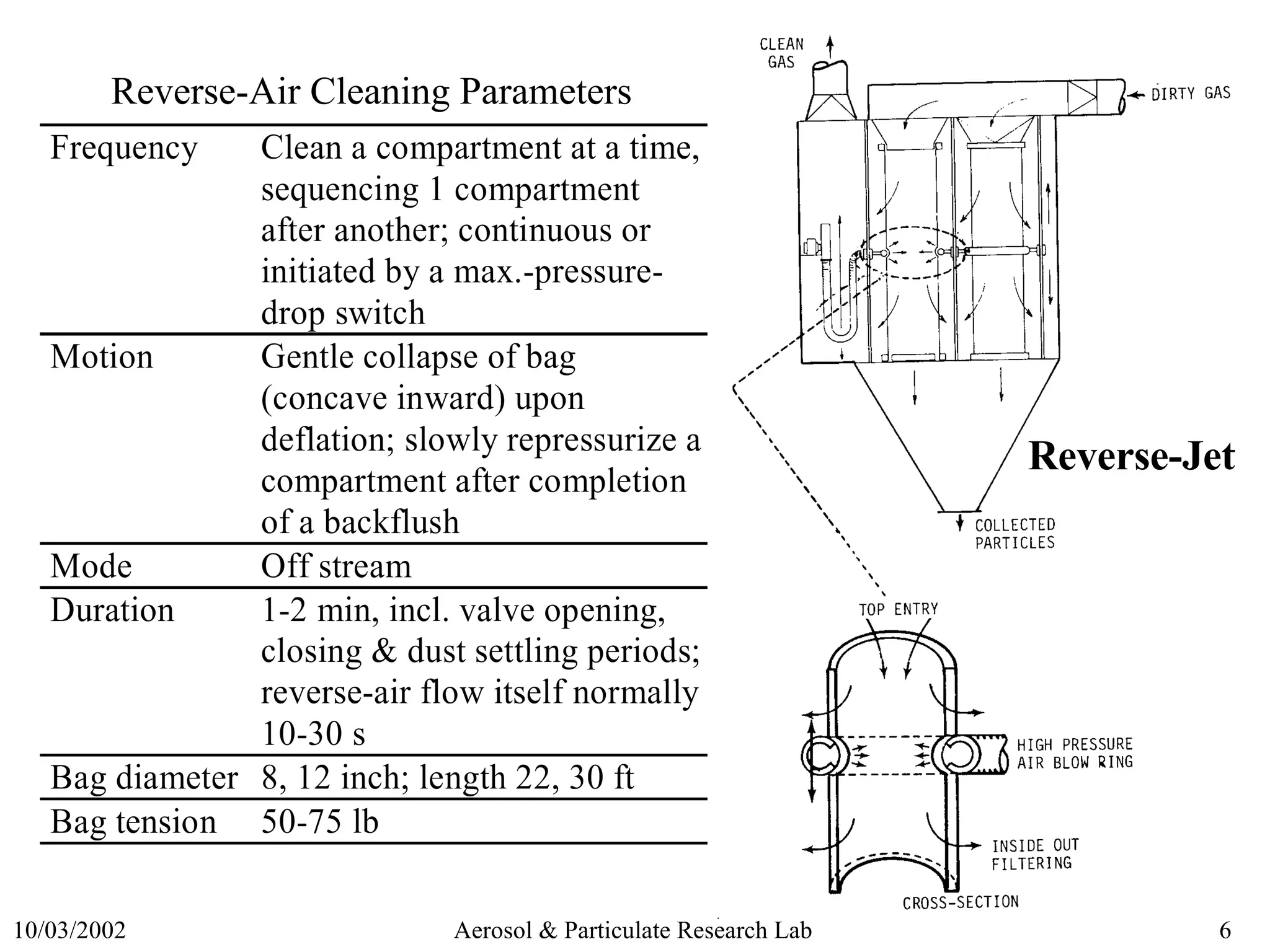
Reverse-Air Cleaning Parameters Reverse-Jet
Pulse-Jet Q: How can the blown-away particles by the on-line cleaning process be collected? Q: Felted fabric or woven fabric?
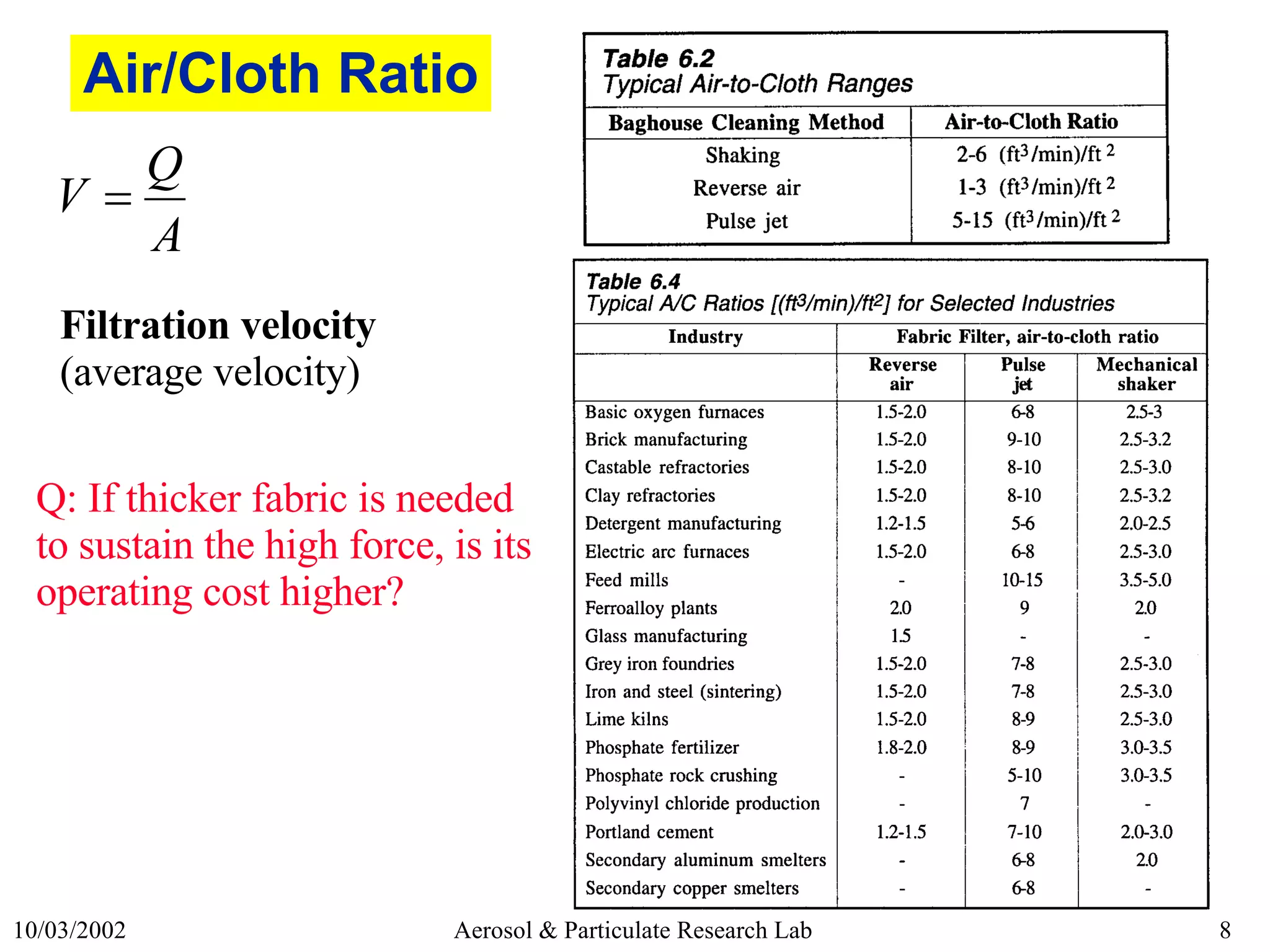
Air/Cloth Ratio Filtration velocity (average velocity) Q: If thicker fabric is needed to sustain the high force, is its operating cost higher?
Filtration Mechanisms Diffusion  (Lee & Liu, 1982) Lee, K.W. & Liu, B.Y.H.,  Aerosol Sci. Technol. , 1 :47-61, 1982 Q: How does efficiency change wrt  d p ? Q: How to increase efficiency by diffusion? http://aerosol.ees.ufl.edu/respiratory/section04.html
Impaction  (Yeh & Liu, 1974) Yeh. H.C. & Liu, B.Y.H.,  J. Aerosol Sci. , 5: 191-217, 1974 Q: How to increase impaction efficiency?  Q: How does efficiency change wrt  dp ? ( J  = 2 for  R  > 0.4)
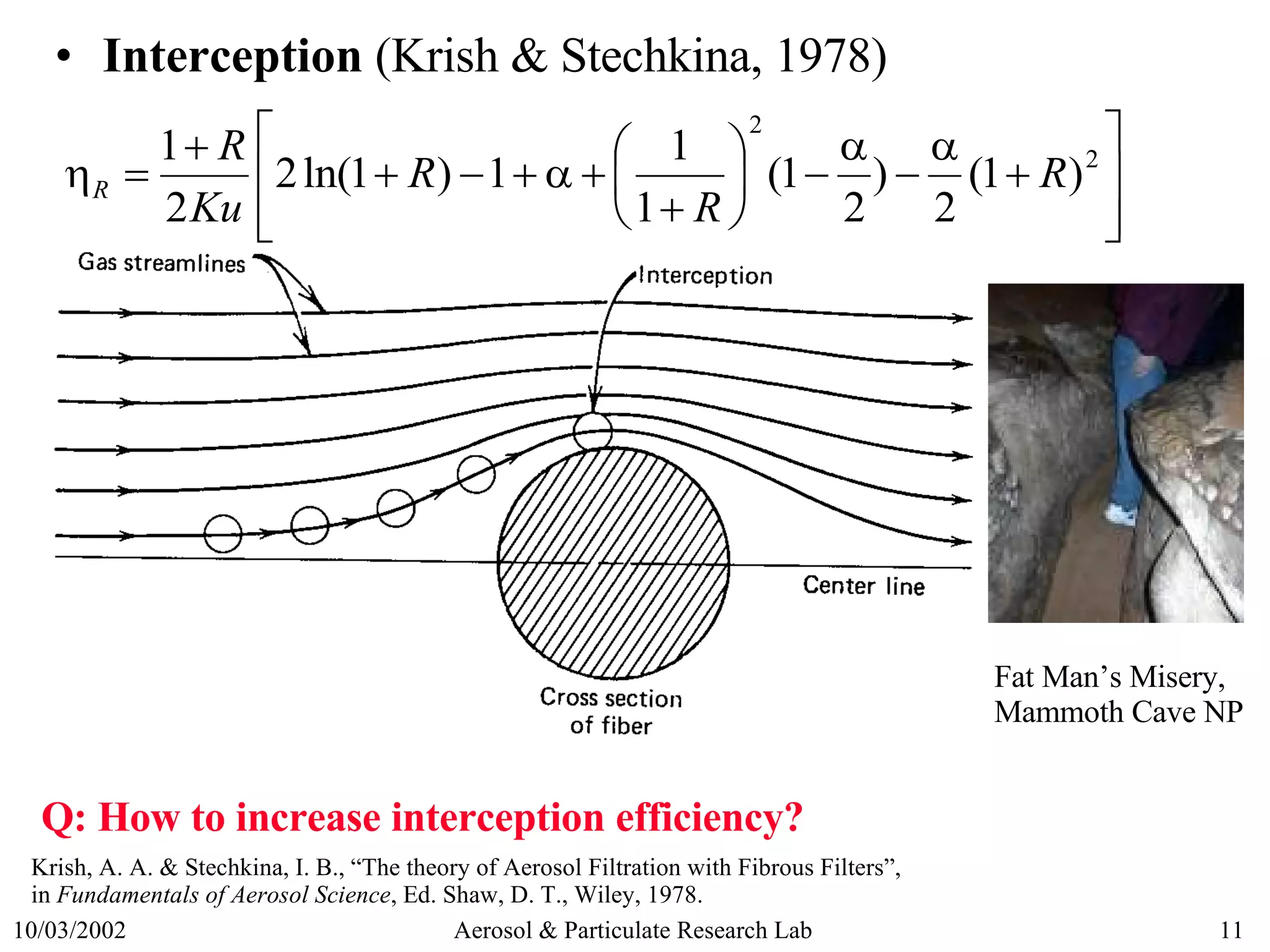
Interception  (Krish & Stechkina, 1978) Krish, A. A. & Stechkina, I. B., “The theory of Aerosol Filtration with Fibrous Filters”,  in  Fundamentals of Aerosol Science , Ed. Shaw, D. T., Wiley, 1978. Q: How to increase interception efficiency? Fat Man’s Misery,  Mammoth Cave NP
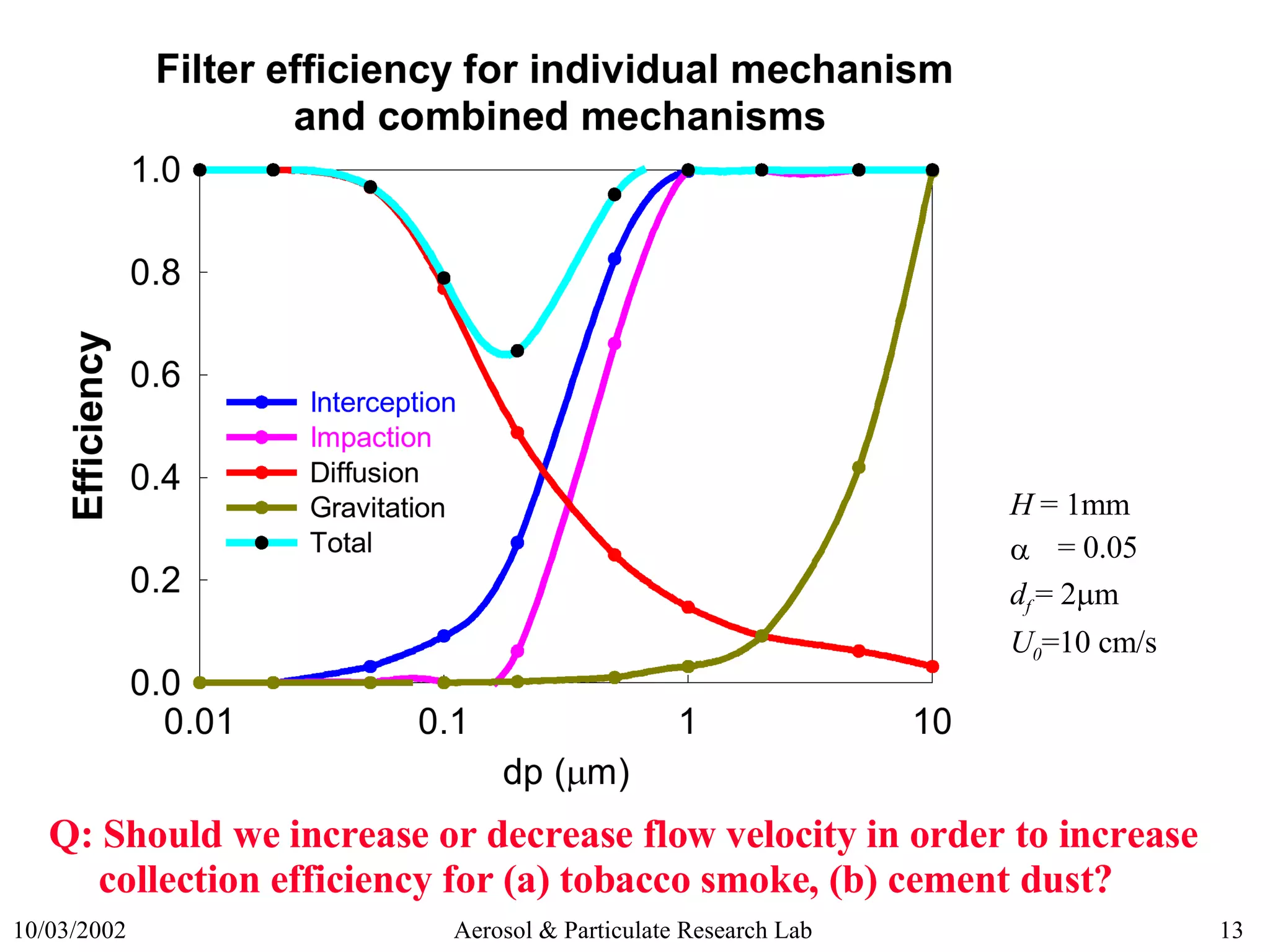
Gravitational Settling Total Single Fiber Efficiency Total Filter Efficiency S f : Solidarity factor Q: How does the filter efficiency change wrt particle size?
H  = 1mm = 0.05 d f  = 2  m U 0 =10 cm/s Q: Should we increase or decrease flow velocity in order to increase collection efficiency for (a) tobacco smoke, (b) cement dust?
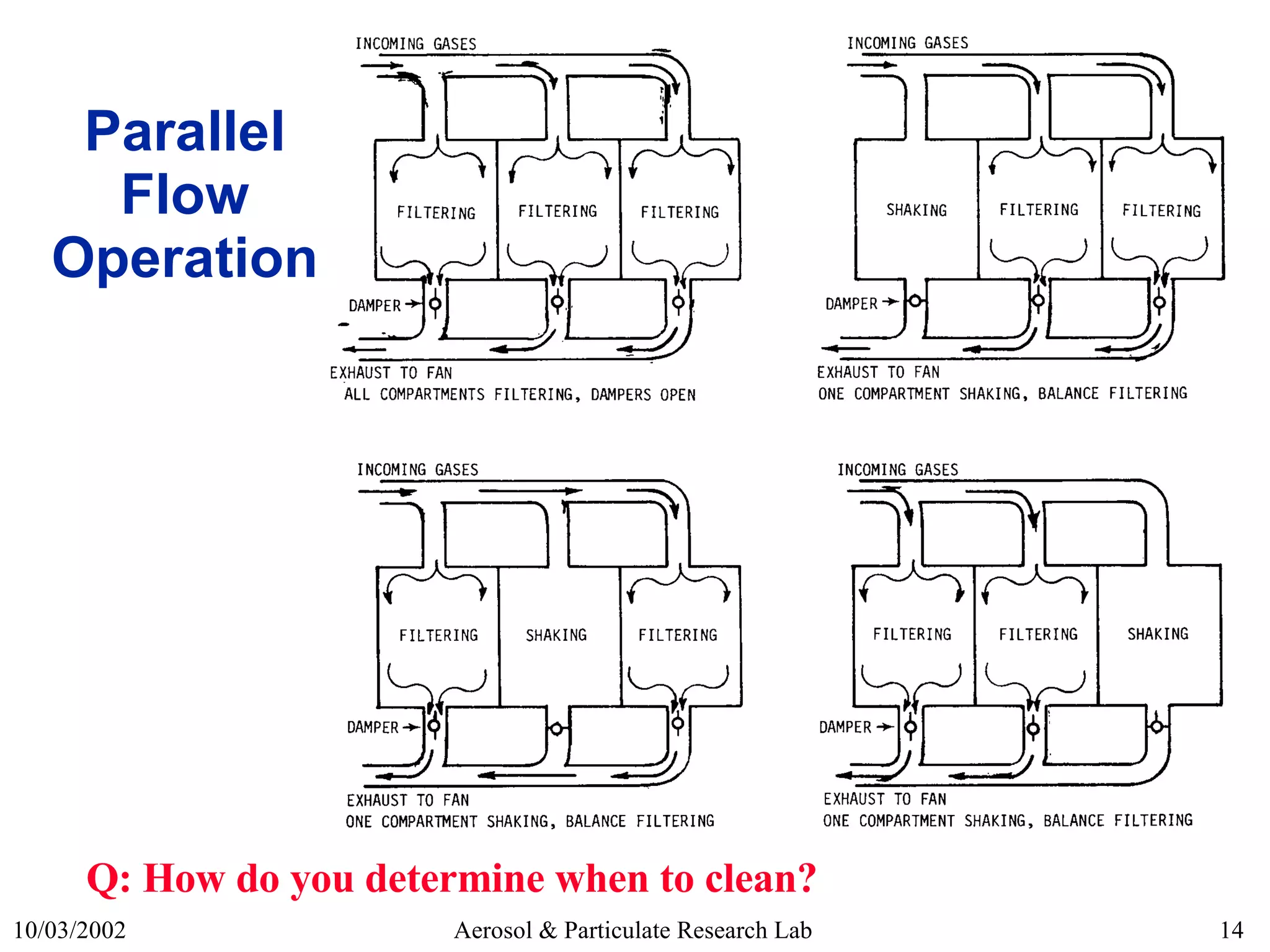
Parallel Flow Operation Q: How do you determine when to clean?
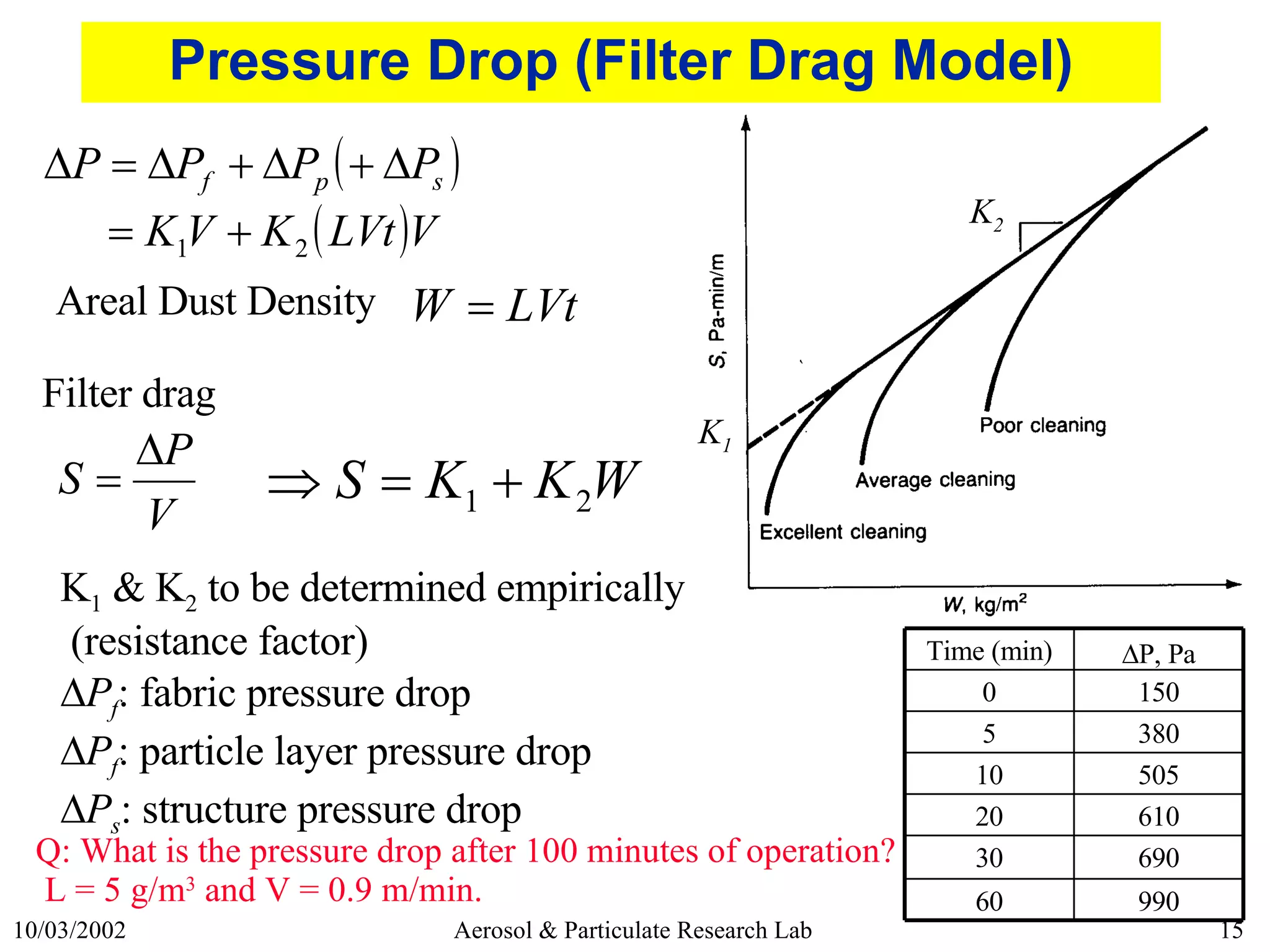
Pressure Drop (Filter Drag Model) Areal Dust Density Filter drag K 1  & K 2  to be determined empirically (resistance factor)  P f : fabric pressure drop  P f : particle layer pressure drop  P s : structure pressure drop Q: What is the pressure drop after 100 minutes of operation?  L = 5 g/m 3  and V = 0.9 m/min. K 2 K 1 990 60 690 30 610 20 505 10 380 5 150 0  P, Pa Time (min)
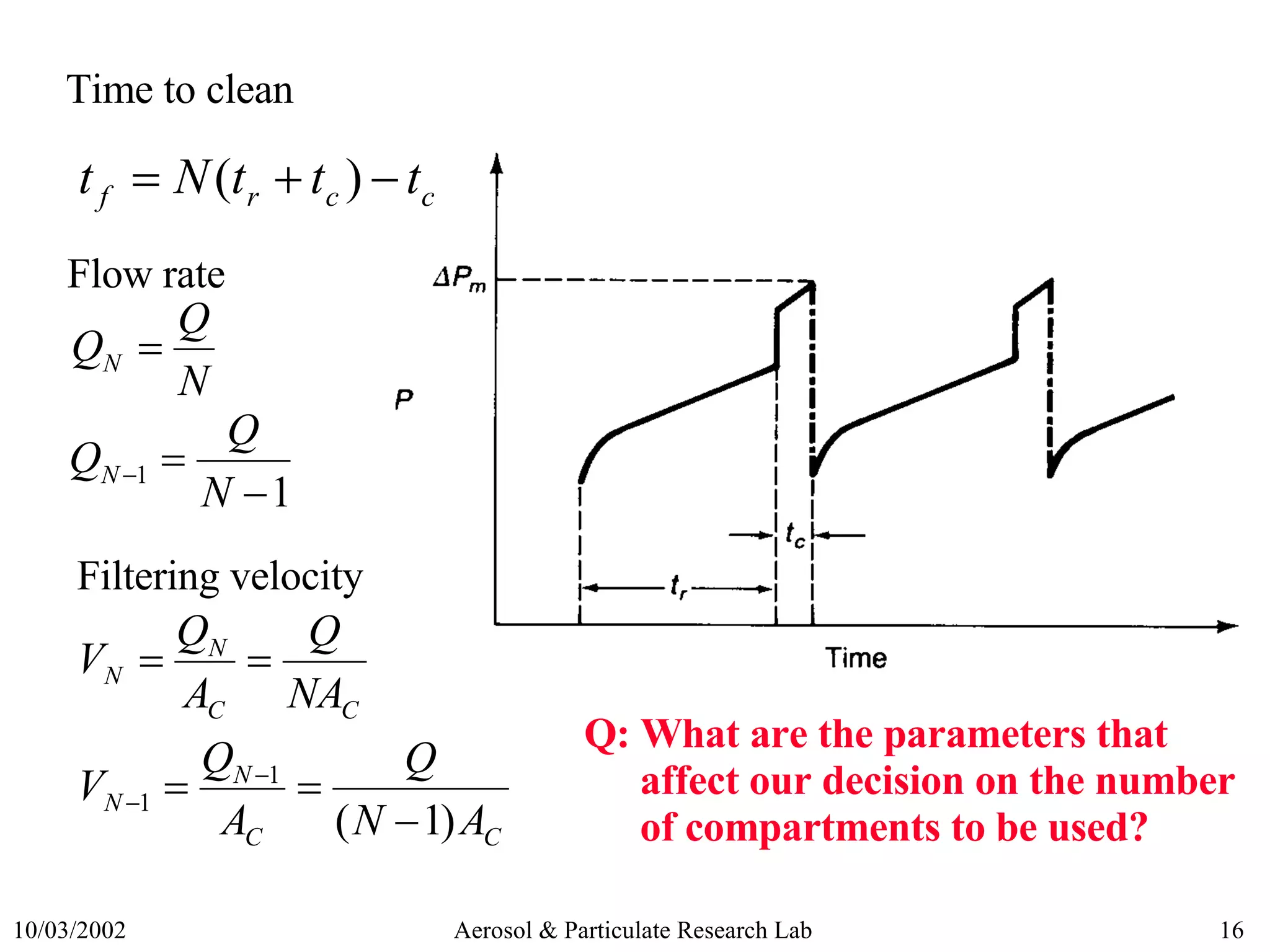
Time to clean Flow rate Filtering velocity Q: What are the parameters that affect our decision on the number of compartments to be used?
Areal dust density Filter drag Actual filtering velocity Pressure drop
Ex. Calculate the max pressure drop that must be supplied for the following baghouse for a filtration time of 60 minutes: K 1  = 1 inch H 2 O-min/ft, K 2  = 0.003 inch H 2 O-min-ft/grain, t c  = 4 min, 5 compartments, L = 10 grain/ft 3 , Q = 40000 ft 3 /min, A c  = 4000 ft 2 /compartment.
Quick Reflection

Filter

  • 1.
    Fabric Filters FiltrationFabric Selection Fabric Cleaning Air/Cloth Ratio, Filtration Velocity Filtration Mechanisms Pressure Drop and Design Consideration Reading: Chap. 6
  • 2.
    Filtration Packing density/solidityFiber filter For fiber filter,  < 0.1 For woven filter,  ~ 0.3 Q: Do filters function simply as sieves (to collect particles larger than the sieve spacing)?
  • 3.
    Theodore & Buonicore, Air Pollution Control Equipment, CRC Press , 1988.
  • 4.
    Shaker Baghouse Theodore& Buonicore, Air Pollution Control Equipment, CRC Press , 1988. Shaker Cleaning Parameters Q: What are the common problems encountered?
  • 5.
    Reverse-Air Q: Prosand Cons? Cleaning dust on baghouse walls by traditional sledge-hammering
  • 6.
  • 7.
    Pulse-Jet Q: Howcan the blown-away particles by the on-line cleaning process be collected? Q: Felted fabric or woven fabric?
  • 8.
    Air/Cloth Ratio Filtrationvelocity (average velocity) Q: If thicker fabric is needed to sustain the high force, is its operating cost higher?
  • 9.
    Filtration Mechanisms Diffusion (Lee & Liu, 1982) Lee, K.W. & Liu, B.Y.H., Aerosol Sci. Technol. , 1 :47-61, 1982 Q: How does efficiency change wrt d p ? Q: How to increase efficiency by diffusion? http://aerosol.ees.ufl.edu/respiratory/section04.html
  • 10.
    Impaction (Yeh& Liu, 1974) Yeh. H.C. & Liu, B.Y.H., J. Aerosol Sci. , 5: 191-217, 1974 Q: How to increase impaction efficiency? Q: How does efficiency change wrt dp ? ( J = 2 for R > 0.4)
  • 11.
    Interception (Krish& Stechkina, 1978) Krish, A. A. & Stechkina, I. B., “The theory of Aerosol Filtration with Fibrous Filters”, in Fundamentals of Aerosol Science , Ed. Shaw, D. T., Wiley, 1978. Q: How to increase interception efficiency? Fat Man’s Misery, Mammoth Cave NP
  • 12.
    Gravitational Settling TotalSingle Fiber Efficiency Total Filter Efficiency S f : Solidarity factor Q: How does the filter efficiency change wrt particle size?
  • 13.
    H =1mm = 0.05 d f = 2  m U 0 =10 cm/s Q: Should we increase or decrease flow velocity in order to increase collection efficiency for (a) tobacco smoke, (b) cement dust?
  • 14.
    Parallel Flow OperationQ: How do you determine when to clean?
  • 15.
    Pressure Drop (FilterDrag Model) Areal Dust Density Filter drag K 1 & K 2 to be determined empirically (resistance factor)  P f : fabric pressure drop  P f : particle layer pressure drop  P s : structure pressure drop Q: What is the pressure drop after 100 minutes of operation? L = 5 g/m 3 and V = 0.9 m/min. K 2 K 1 990 60 690 30 610 20 505 10 380 5 150 0  P, Pa Time (min)
  • 16.
    Time to cleanFlow rate Filtering velocity Q: What are the parameters that affect our decision on the number of compartments to be used?
  • 17.
    Areal dust densityFilter drag Actual filtering velocity Pressure drop
  • 18.
    Ex. Calculate themax pressure drop that must be supplied for the following baghouse for a filtration time of 60 minutes: K 1 = 1 inch H 2 O-min/ft, K 2 = 0.003 inch H 2 O-min-ft/grain, t c = 4 min, 5 compartments, L = 10 grain/ft 3 , Q = 40000 ft 3 /min, A c = 4000 ft 2 /compartment.
  • 19.