
BIU 3022
       ENGLISH LANGUAGE 2
      MR SASIGARAN A/L MONEYAM

              GROUP MEMBERS :
NOR FATIHAH BINTI HASSAN      D20111047402
MOHD TAMIMI BIN SARINGAT      D20111047453
ATIKAH BINTI ABDULLAH         D20111047549
ZAKIAH BINTI MARKAM           D20111047505
NURUL SAFIZA BINTI ROSLAN     D20111047511
PROGRESSIVE TENSES
• a tense of verbs used in describing
  action that is on-going
• a grammatical category of verbs used
  to express distinctions of time
• Form the progressive tenses by
  adding a form of to be to present
  participle (-ing) form of a verb
• First person ( I am hearing , we are hearing)
                  • Second person (you are hearing)
    Present
progressive tense
                  • Third person ( he,she and it is hearing ,they are hearing)


                 • First person ( I was hearing , we were hearing)
Past progressive
                 • Second person (you were hearing)
     tense       • Third person ( he,she and it was hearing , they were hearing)


                    • First person ( I will be hearing, we will be hearing)
                    • Second person (you will be hearing)
     Future         • Third person ( he, she and it will be hearing ,they will be hearing)
progressive tense
Present Progressive tense
• Present progressive tense describes an action
  that is happening right now.
• The –ing form of a verb is call the present
  participle.
• We use the present participle with am , is or
  are to make the present progressive tense.
• The following shows how to form the Present
  Progressive tense:
     i.    am + verb +-ing
      I am sitting in class now.
     ii.   is + verb+-ing
      Sofia is sitting in class now.
     iii. are + verb+-ing
      Sofia and I are sitting in class now.
The Present Progressive Tense is used for :
1) Action taking place in the moment of speaking
Example : It is raining heavily.

2) Action taking place only for a limited period of
    time
Example : I am leaving town for a week.

3) Action arranged for the future
Example : They are taking arts lesson this
   December.
Past Progressive tense
1) You use the Past Progressive tense when you
   refer to :
an action that happened at a specific time in
  the past.
an action that happened over a period of
  time.
E.g.(i) I started reading the novel at 8 p.m.
           last night.
      (ii) I was reading the novel from 8 p.m.
           until 10 p.m. last night.
2) The Past Progressive tense is formed with
   was/were + veb +-ing. It is normally used
   with words like while, when and as. Here are
   some examples :
While I was walking home, it stopped raining.
 The photographer was taking pictures when
   we arrived.
As the men were approaching the house, the
  dogs started to bark.
3) The past progressive tense is used for :

i. Action going on at a certain time in the past.
Examples : They were attending a conference in
   Kuala Lumpur last week.

ii) Two actions taking place at the same time (in
    the past).
Example : I was eating my lunch when my parents
    were watching television.

iii) Action in the past that is interrupted by another
     action.
Example : He was sleeping when his friend knocked
     the door.
Future Progressive tense
1) You use the Future Progressive tense when you
   talk about future plans that you are certain of .
 e.g. I am cooking fish curry tonight.
 Note : You are certain of this because you have
   already bought the fish and the ingredients.

2) Other example :
 She is going to a rock concert tonight.
 Helena is visiting a friend in the hospital this
  evening.
 It is going to be cold in Korea next month.
 Dad will be working all the day tomorrow.
3) The future progressive tense is used for :
i) A continuous action in the future which is
    interrupted by a time or by another.
Example : At eight o’clock, I’ll be eating dinner.

ii) A complete action in the future that will
    happen in the normal course of events.
Example: The Government will be making a
    statement later.

iii) To make a guess about the present.
Example: My mother will be working now.
Auxiliary Verbs be, have, do
• The auxiliary form are used before the
  main verb.
• These forms can also function as main
  verbs.
• The purpose of these auxiliary verbs is to
  change time and significance.
to be            to have           to do

• She is the       • Sarah has      • I do my
  prettiest girl     bought a         laundry
  in campus.         new car.         twice a week
• They are         • I have a new   • Oh no… he
  going home         pet.             does it
  soon.            • They had         again!
• It was             moved to       • Her children
  raining            Penang ten       did well in
  yesterday.         years ago.       the drawing
                                      contest last
                                      year.
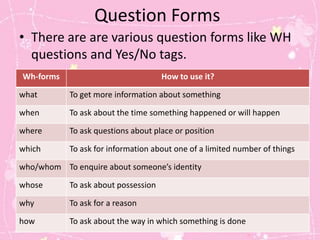
Question Forms
• There are are various question forms like WH
  questions and Yes/No tags.
Wh-forms                              How to use it?

what        To get more information about something

when        To ask about the time something happened or will happen

where       To ask questions about place or position

which       To ask for information about one of a limited number of things

who/whom To enquire about someone’s identity

whose       To ask about possession

why         To ask for a reason

how         To ask about the way in which something is done
Yes / No Tags

• These tags are questions which require short
  answer elicits using yes or no.
• For example:
Q: Architects design buildings, don’t they?
  A: Yes, they do.
 Q: Architects design clothes, don’t they?
  A: No, they don’t.
THANK YOU

Progressive tenses presentation

  • 1.
    BIU 3022 ENGLISH LANGUAGE 2 MR SASIGARAN A/L MONEYAM GROUP MEMBERS : NOR FATIHAH BINTI HASSAN D20111047402 MOHD TAMIMI BIN SARINGAT D20111047453 ATIKAH BINTI ABDULLAH D20111047549 ZAKIAH BINTI MARKAM D20111047505 NURUL SAFIZA BINTI ROSLAN D20111047511
  • 2.
    PROGRESSIVE TENSES • atense of verbs used in describing action that is on-going • a grammatical category of verbs used to express distinctions of time • Form the progressive tenses by adding a form of to be to present participle (-ing) form of a verb
  • 3.
    • First person( I am hearing , we are hearing) • Second person (you are hearing) Present progressive tense • Third person ( he,she and it is hearing ,they are hearing) • First person ( I was hearing , we were hearing) Past progressive • Second person (you were hearing) tense • Third person ( he,she and it was hearing , they were hearing) • First person ( I will be hearing, we will be hearing) • Second person (you will be hearing) Future • Third person ( he, she and it will be hearing ,they will be hearing) progressive tense
  • 4.
    Present Progressive tense •Present progressive tense describes an action that is happening right now. • The –ing form of a verb is call the present participle. • We use the present participle with am , is or are to make the present progressive tense.
  • 5.
    • The followingshows how to form the Present Progressive tense: i. am + verb +-ing  I am sitting in class now. ii. is + verb+-ing  Sofia is sitting in class now. iii. are + verb+-ing  Sofia and I are sitting in class now.
  • 6.
    The Present ProgressiveTense is used for : 1) Action taking place in the moment of speaking Example : It is raining heavily. 2) Action taking place only for a limited period of time Example : I am leaving town for a week. 3) Action arranged for the future Example : They are taking arts lesson this December.
  • 7.
    Past Progressive tense 1)You use the Past Progressive tense when you refer to : an action that happened at a specific time in the past. an action that happened over a period of time. E.g.(i) I started reading the novel at 8 p.m. last night. (ii) I was reading the novel from 8 p.m. until 10 p.m. last night.
  • 8.
    2) The PastProgressive tense is formed with was/were + veb +-ing. It is normally used with words like while, when and as. Here are some examples : While I was walking home, it stopped raining.  The photographer was taking pictures when we arrived. As the men were approaching the house, the dogs started to bark.
  • 9.
    3) The pastprogressive tense is used for : i. Action going on at a certain time in the past. Examples : They were attending a conference in Kuala Lumpur last week. ii) Two actions taking place at the same time (in the past). Example : I was eating my lunch when my parents were watching television. iii) Action in the past that is interrupted by another action. Example : He was sleeping when his friend knocked the door.
  • 10.
    Future Progressive tense 1)You use the Future Progressive tense when you talk about future plans that you are certain of .  e.g. I am cooking fish curry tonight.  Note : You are certain of this because you have already bought the fish and the ingredients. 2) Other example :  She is going to a rock concert tonight.  Helena is visiting a friend in the hospital this evening.  It is going to be cold in Korea next month.  Dad will be working all the day tomorrow.
  • 11.
    3) The futureprogressive tense is used for : i) A continuous action in the future which is interrupted by a time or by another. Example : At eight o’clock, I’ll be eating dinner. ii) A complete action in the future that will happen in the normal course of events. Example: The Government will be making a statement later. iii) To make a guess about the present. Example: My mother will be working now.
  • 12.
    Auxiliary Verbs be,have, do • The auxiliary form are used before the main verb. • These forms can also function as main verbs. • The purpose of these auxiliary verbs is to change time and significance.
  • 13.
    to be to have to do • She is the • Sarah has • I do my prettiest girl bought a laundry in campus. new car. twice a week • They are • I have a new • Oh no… he going home pet. does it soon. • They had again! • It was moved to • Her children raining Penang ten did well in yesterday. years ago. the drawing contest last year.
  • 14.
    Question Forms • Thereare are various question forms like WH questions and Yes/No tags. Wh-forms How to use it? what To get more information about something when To ask about the time something happened or will happen where To ask questions about place or position which To ask for information about one of a limited number of things who/whom To enquire about someone’s identity whose To ask about possession why To ask for a reason how To ask about the way in which something is done
  • 15.
    Yes / NoTags • These tags are questions which require short answer elicits using yes or no. • For example: Q: Architects design buildings, don’t they? A: Yes, they do.  Q: Architects design clothes, don’t they? A: No, they don’t.
  • 16.