1
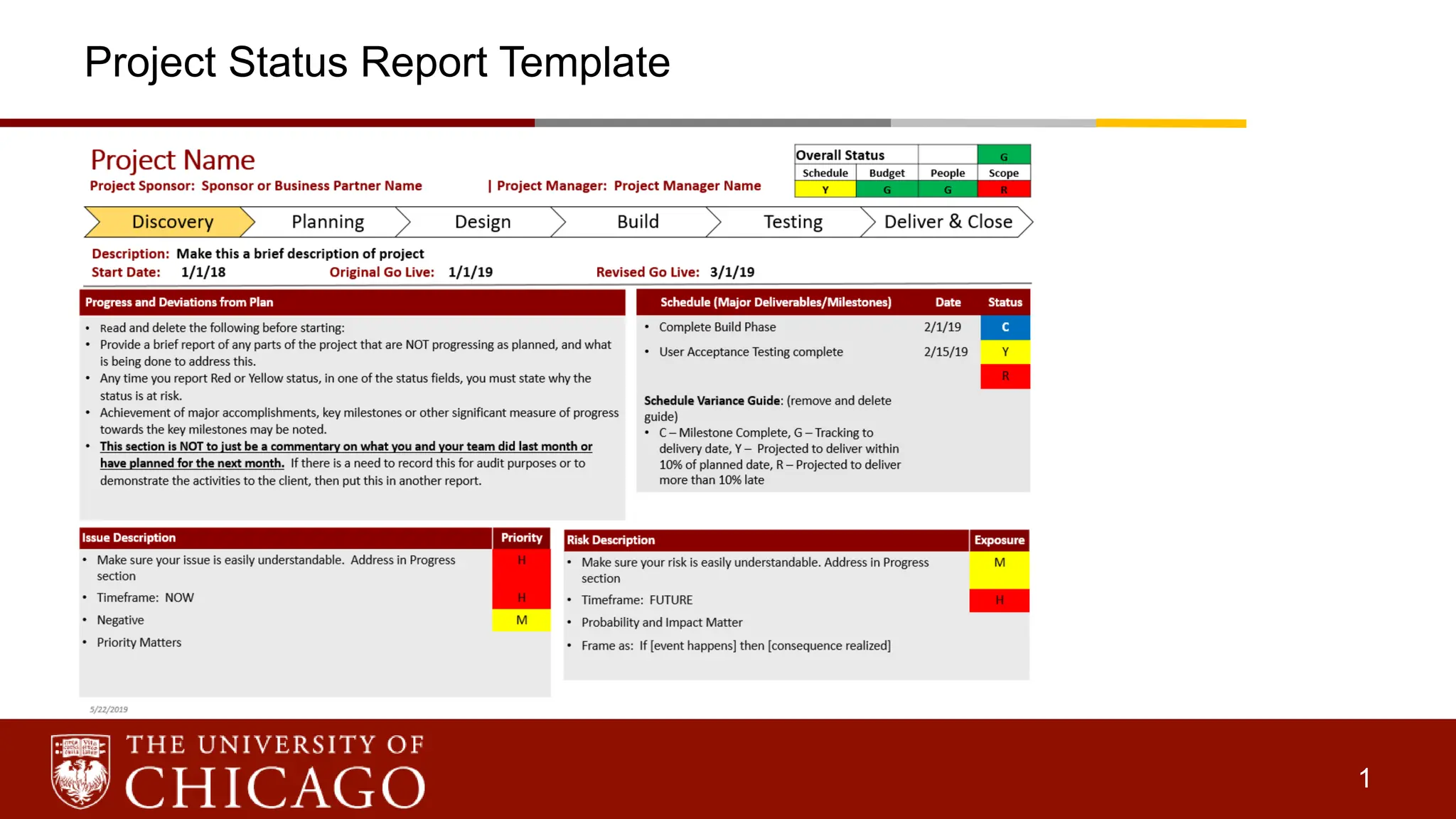
Project Status Report Template
2
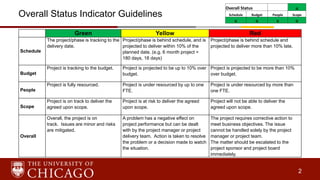
Overall Status Indicator Guidelines
Green Yellow Red
Schedule
The project/phase is tracking to the
delivery date.
Project/phase is behind schedule, and is
projected to deliver within 10% of the
planned date. (e.g. 6 month project =
180 days, 18 days)
Project/phase is behind schedule and
projected to deliver more than 10% late.
Budget
Project is tracking to the budget. Project is projected to be up to 10% over
budget.
Project is projected to be more than 10%
over budget.
People
Project is fully resourced. Project is under resourced by up to one
FTE.
Project is under resourced by more than
one FTE.
Scope
Project is on track to deliver the
agreed upon scope.
Project is at risk to deliver the agreed
upon scope.
Project will not be able to deliver the
agreed upon scope.
Overall
Overall, the project is on
track. Issues are minor and risks
are mitigated.
A problem has a negative effect on
project performance but can be dealt
with by the project manager or project
delivery team. Action is taken to resolve
the problem or a decision made to watch
the situation.
The project requires corrective action to
meet business objectives. The issue
cannot be handled solely by the project
manager or project team.
The matter should be escalated to the
project sponsor and project board
immediately.
Overall Status G
Schedule Budget People Scope
G G G G
3
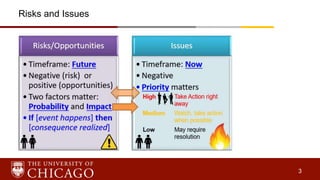
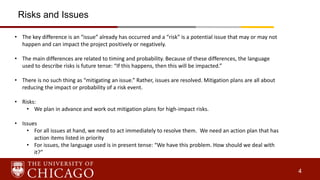
Risks and Issues
4
• The key difference is an “issue” already has occurred and a “risk” is a potential issue that may or may not
happen and can impact the project positively or negatively.
• The main differences are related to timing and probability. Because of these differences, the language
used to describe risks is future tense: “If this happens, then this will be impacted.”
• There is no such thing as “mitigating an issue.” Rather, issues are resolved. Mitigation plans are all about
reducing the impact or probability of a risk event.
• Risks:
• We plan in advance and work out mitigation plans for high-impact risks.
• Issues
• For all issues at hand, we need to act immediately to resolve them. We need an action plan that has
action items listed in priority
• For issues, the language used is in present tense: “We have this problem. How should we deal with
it?”
Risks and Issues
5
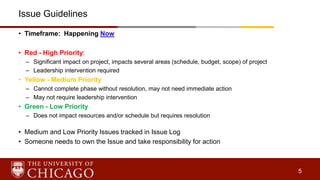
Issue Guidelines
• Timeframe: Happening Now
• Red - High Priority:
– Significant impact on project, impacts several areas (schedule, budget, scope) of project
– Leadership intervention required
• Yellow - Medium Priority
– Cannot complete phase without resolution, may not need immediate action
– May not require leadership intervention
• Green - Low Priority
– Does not impact resources and/or schedule but requires resolution
• Medium and Low Priority Issues tracked in Issue Log
• Someone needs to own the Issue and take responsibility for action
6
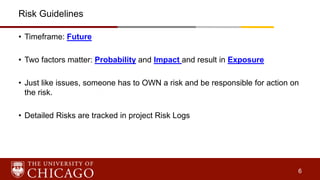
Risk Guidelines
• Timeframe: Future
• Two factors matter: Probability and Impact and result in Exposure
• Just like issues, someone has to OWN a risk and be responsible for action on
the risk.
• Detailed Risks are tracked in project Risk Logs
7
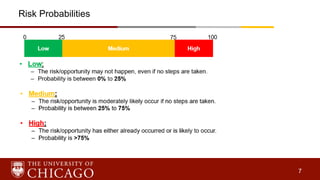
Risk Probabilities
8
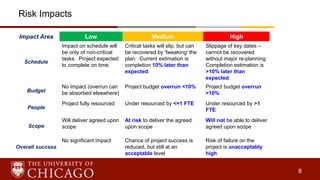
Risk Impacts
Impact Area Low Medium High
Schedule
Impact on schedule will
be only of non-critical
tasks. Project expected
to complete on time.
Critical tasks will slip, but can
be recovered by 'tweaking' the
plan. Current estimation is
completion 10% later than
expected.
Slippage of key dates –
cannot be recovered
without major re-planning.
Completion estimation is
>10% later than
expected.
Budget
No Impact (overrun can
be absorbed elsewhere)
Project budget overrun <10% Project budget overrun
>10%
People
Project fully resourced Under resourced by <=1 FTE Under resourced by >1
FTE
Scope
Will deliver agreed upon
scope
At risk to deliver the agreed
upon scope
Will not be able to deliver
agreed upon scope
Overall success
No significant impact Chance of project success is
reduced, but still at an
acceptable level
Risk of failure on the
project is unacceptably
high
9
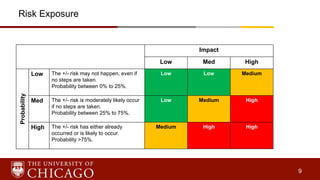
Risk Exposure
Impact
Low Med High
Probability
Low The +/- risk may not happen, even if
no steps are taken.
Probability between 0% to 25%.
Low Low Medium
Med The +/- risk is moderately likely occur
if no steps are taken.
Probability between 25% to 75%.
Low Medium High
High The +/- risk has either already
occurred or is likely to occur.
Probability >75%.
Medium High High

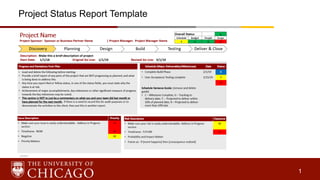
PMO Monthly Status-Report Template for Project manager

  • 1.
  • 2.
    2 Overall Status IndicatorGuidelines Green Yellow Red Schedule The project/phase is tracking to the delivery date. Project/phase is behind schedule, and is projected to deliver within 10% of the planned date. (e.g. 6 month project = 180 days, 18 days) Project/phase is behind schedule and projected to deliver more than 10% late. Budget Project is tracking to the budget. Project is projected to be up to 10% over budget. Project is projected to be more than 10% over budget. People Project is fully resourced. Project is under resourced by up to one FTE. Project is under resourced by more than one FTE. Scope Project is on track to deliver the agreed upon scope. Project is at risk to deliver the agreed upon scope. Project will not be able to deliver the agreed upon scope. Overall Overall, the project is on track. Issues are minor and risks are mitigated. A problem has a negative effect on project performance but can be dealt with by the project manager or project delivery team. Action is taken to resolve the problem or a decision made to watch the situation. The project requires corrective action to meet business objectives. The issue cannot be handled solely by the project manager or project team. The matter should be escalated to the project sponsor and project board immediately. Overall Status G Schedule Budget People Scope G G G G
  • 3.
  • 4.
    4 • The keydifference is an “issue” already has occurred and a “risk” is a potential issue that may or may not happen and can impact the project positively or negatively. • The main differences are related to timing and probability. Because of these differences, the language used to describe risks is future tense: “If this happens, then this will be impacted.” • There is no such thing as “mitigating an issue.” Rather, issues are resolved. Mitigation plans are all about reducing the impact or probability of a risk event. • Risks: • We plan in advance and work out mitigation plans for high-impact risks. • Issues • For all issues at hand, we need to act immediately to resolve them. We need an action plan that has action items listed in priority • For issues, the language used is in present tense: “We have this problem. How should we deal with it?” Risks and Issues
  • 5.
    5 Issue Guidelines • Timeframe:Happening Now • Red - High Priority: – Significant impact on project, impacts several areas (schedule, budget, scope) of project – Leadership intervention required • Yellow - Medium Priority – Cannot complete phase without resolution, may not need immediate action – May not require leadership intervention • Green - Low Priority – Does not impact resources and/or schedule but requires resolution • Medium and Low Priority Issues tracked in Issue Log • Someone needs to own the Issue and take responsibility for action
  • 6.
    6 Risk Guidelines • Timeframe:Future • Two factors matter: Probability and Impact and result in Exposure • Just like issues, someone has to OWN a risk and be responsible for action on the risk. • Detailed Risks are tracked in project Risk Logs
  • 7.
  • 8.
    8 Risk Impacts Impact AreaLow Medium High Schedule Impact on schedule will be only of non-critical tasks. Project expected to complete on time. Critical tasks will slip, but can be recovered by 'tweaking' the plan. Current estimation is completion 10% later than expected. Slippage of key dates – cannot be recovered without major re-planning. Completion estimation is >10% later than expected. Budget No Impact (overrun can be absorbed elsewhere) Project budget overrun <10% Project budget overrun >10% People Project fully resourced Under resourced by <=1 FTE Under resourced by >1 FTE Scope Will deliver agreed upon scope At risk to deliver the agreed upon scope Will not be able to deliver agreed upon scope Overall success No significant impact Chance of project success is reduced, but still at an acceptable level Risk of failure on the project is unacceptably high
  • 9.
    9 Risk Exposure Impact Low MedHigh Probability Low The +/- risk may not happen, even if no steps are taken. Probability between 0% to 25%. Low Low Medium Med The +/- risk is moderately likely occur if no steps are taken. Probability between 25% to 75%. Low Medium High High The +/- risk has either already occurred or is likely to occur. Probability >75%. Medium High High