Application Note

                           860 DSPi VoIP RTP MOS Test
The ITU-T's E-Model is a network planning tool used in the design of hybrid circuit switched and packet-
switched networks for carrying high quality voice applications. The tool estimates the relative impairments
to voice quality when comparing different network equipment and network designs.

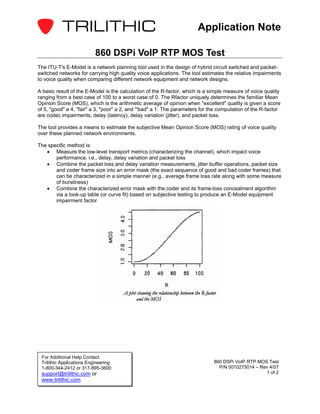
A basic result of the E-Model is the calculation of the R-factor, which is a simple measure of voice quality
ranging from a best case of 100 to a worst case of 0. The Rfactor uniquely determines the familiar Mean
Opinion Score (MOS), which is the arithmetic average of opinion when "excellent" quality is given a score
of 5, "good" a 4, "fair" a 3, "poor" a 2, and "'bad" a 1. The parameters for the computation of the R-factor
are codec impairments, delay (latency), delay variation (jitter), and packet loss.

The tool provides a means to estimate the subjective Mean Opinion Score (MOS) rating of voice quality
over these planned network environments.

The specific method is:
   • Measure the low-level transport metrics (characterizing the channel), which impact voice
       performance, i.e., delay, delay variation and packet loss
   • Combine the packet loss and delay variation measurements, jitter buffer operations, packet size
       and coder frame size into an error mask (the exact sequence of good and bad coder frames) that
       can be characterized in a simple manner (e.g., average frame loss rate along with some measure
       of burstiness)
   • Combine the characterized error mask with the coder and its frame-loss concealment algorithm
       via a look-up table (or curve fit) based on subjective testing to produce an E-Model equipment
       impairment factor


 For Additional Help Contact
 Trilithic Applications Engineering                                           860 DSPi VoIP RTP MOS Test
 1-800-344-2412 or 317-895-3600                                                 P/N 0010275014 – Rev 4/07
 support@trilithic.com or                                                                          1 of 2
 www.trilithic.com
Application Note

The Error Mask characterizes the salient features of the loss distribution as observed by the decoder.
(Note: This loss distribution captures both the transport packet loss and the loss in the decoder's jitter
buffer due to late packet arrivals.) When the Error Mask is combined with the specific loss concealment
algorithm implemented within codec, we generate an Equipment Impairment Factor, which captures the
expected impairment of the codec under the above conditions. From this, the E-Model provides a means
to estimate a quality score for the conversational voice application.

The decoder must intentionally delay the variable delayed, arriving voice packets in its jitter buffer in order
to reconstruct a synchronous bit stream. In some cases this jitter buffer delay is not large enough to
absorb the transport delay variation. The result is jitter buffer losses as observed by the decoder expected
impairment of the codec under the above conditions. From this, the E-Model provides a means to
estimate a quality score for the conversational voice application.

        Note: The parameters in the computation of the R-factor are codec impairments, delay (latency),
        delay variation (jitter), and packet loss.


 For Additional Help Contact
 Trilithic Applications Engineering                                             860 DSPi VoIP RTP MOS Test
 1-800-344-2412 or 317-895-3600                                                   P/N 0010275014 – Rev 4/07
 support@trilithic.com or                                                                            2 of 2
 www.trilithic.com

860 dspi voip_rtp_mos_test

  • 1.
    Application Note 860 DSPi VoIP RTP MOS Test The ITU-T's E-Model is a network planning tool used in the design of hybrid circuit switched and packet- switched networks for carrying high quality voice applications. The tool estimates the relative impairments to voice quality when comparing different network equipment and network designs. A basic result of the E-Model is the calculation of the R-factor, which is a simple measure of voice quality ranging from a best case of 100 to a worst case of 0. The Rfactor uniquely determines the familiar Mean Opinion Score (MOS), which is the arithmetic average of opinion when "excellent" quality is given a score of 5, "good" a 4, "fair" a 3, "poor" a 2, and "'bad" a 1. The parameters for the computation of the R-factor are codec impairments, delay (latency), delay variation (jitter), and packet loss. The tool provides a means to estimate the subjective Mean Opinion Score (MOS) rating of voice quality over these planned network environments. The specific method is: • Measure the low-level transport metrics (characterizing the channel), which impact voice performance, i.e., delay, delay variation and packet loss • Combine the packet loss and delay variation measurements, jitter buffer operations, packet size and coder frame size into an error mask (the exact sequence of good and bad coder frames) that can be characterized in a simple manner (e.g., average frame loss rate along with some measure of burstiness) • Combine the characterized error mask with the coder and its frame-loss concealment algorithm via a look-up table (or curve fit) based on subjective testing to produce an E-Model equipment impairment factor For Additional Help Contact Trilithic Applications Engineering 860 DSPi VoIP RTP MOS Test 1-800-344-2412 or 317-895-3600 P/N 0010275014 – Rev 4/07 support@trilithic.com or 1 of 2 www.trilithic.com
  • 2.
    Application Note The ErrorMask characterizes the salient features of the loss distribution as observed by the decoder. (Note: This loss distribution captures both the transport packet loss and the loss in the decoder's jitter buffer due to late packet arrivals.) When the Error Mask is combined with the specific loss concealment algorithm implemented within codec, we generate an Equipment Impairment Factor, which captures the expected impairment of the codec under the above conditions. From this, the E-Model provides a means to estimate a quality score for the conversational voice application. The decoder must intentionally delay the variable delayed, arriving voice packets in its jitter buffer in order to reconstruct a synchronous bit stream. In some cases this jitter buffer delay is not large enough to absorb the transport delay variation. The result is jitter buffer losses as observed by the decoder expected impairment of the codec under the above conditions. From this, the E-Model provides a means to estimate a quality score for the conversational voice application. Note: The parameters in the computation of the R-factor are codec impairments, delay (latency), delay variation (jitter), and packet loss. For Additional Help Contact Trilithic Applications Engineering 860 DSPi VoIP RTP MOS Test 1-800-344-2412 or 317-895-3600 P/N 0010275014 – Rev 4/07 support@trilithic.com or 2 of 2 www.trilithic.com