Time Division MultiplexingTime Division Multiplexing
Prof. Murat TorlakEE4367 Telecom. Switching & Transmission
Basic Modes of OperationBasic Modes of Operation
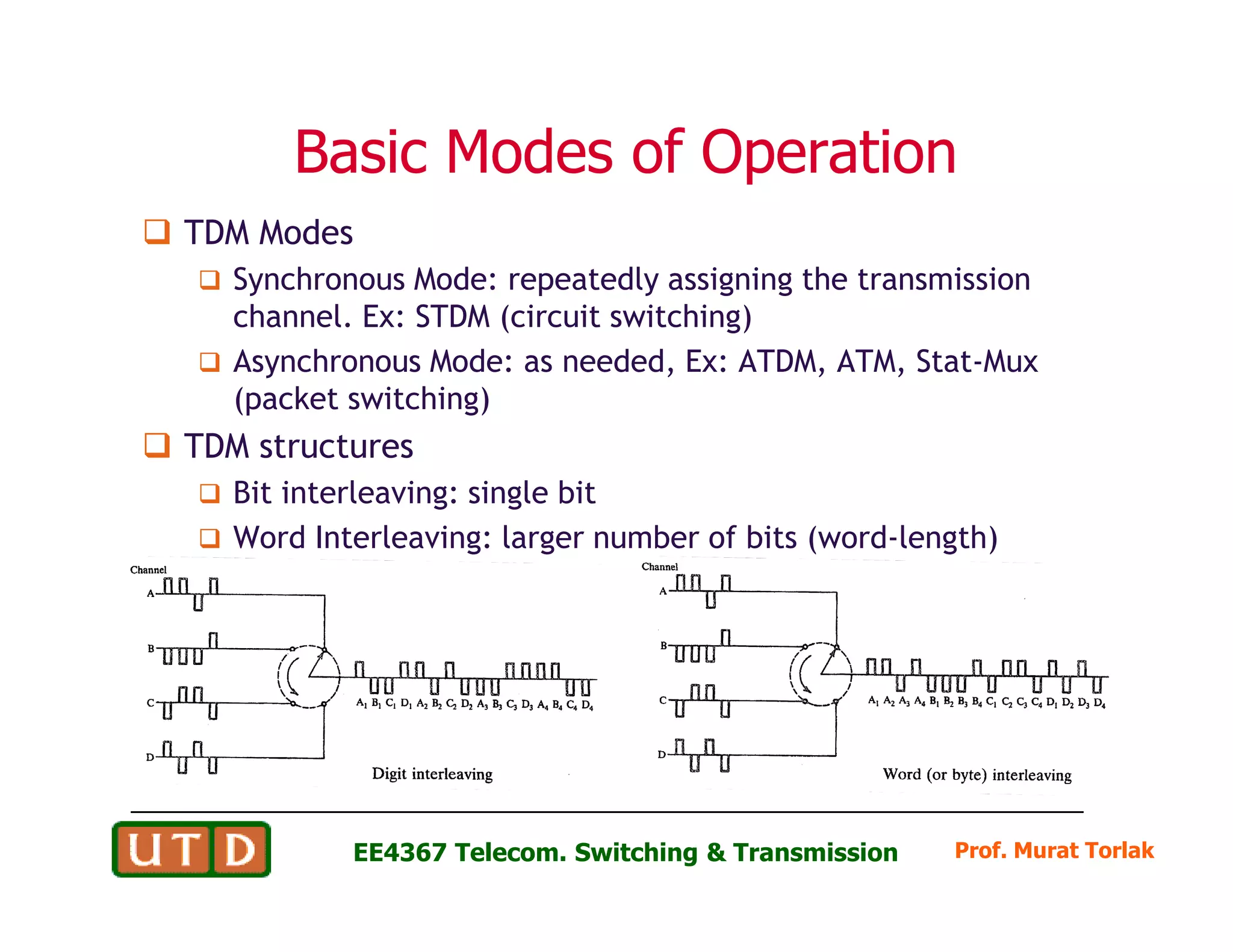
TDM Modes
Synchronous Mode: repeatedly assigning the transmission
channel. Ex: STDM (circuit switching)
Asynchronous Mode: as needed, Ex: ATDM, ATM, Stat-Mux
(packet switching)
TDM structures
Bit interleaving: single bit
Prof. Murat TorlakEE4367 Telecom. Switching & Transmission
Bit interleaving: single bit
Word Interleaving: larger number of bits (word-length)
E1/T1 DifferenceE1/T1 Difference
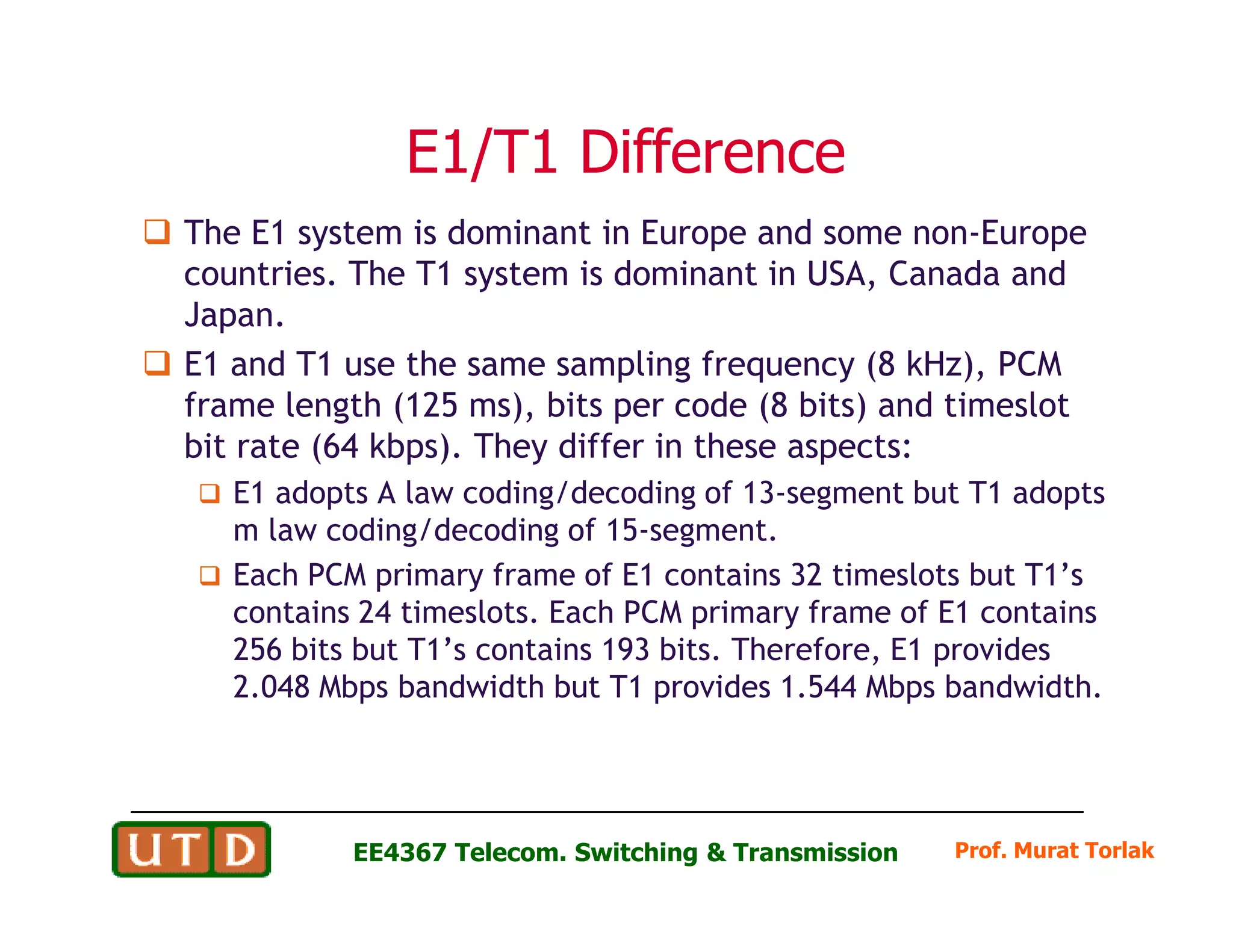
The E1 system is dominant in Europe and some non-Europe
countries. The T1 system is dominant in USA, Canada and
Japan.
E1 and T1 use the same sampling frequency (8 kHz), PCM
frame length (125 ms), bits per code (8 bits) and timeslot
bit rate (64 kbps). They differ in these aspects:
E1 adopts A law coding/decoding of 13-segment but T1 adopts
Prof. Murat Torlak
E1 adopts A law coding/decoding of 13-segment but T1 adopts
m law coding/decoding of 15-segment.
Each PCM primary frame of E1 contains 32 timeslots but T1’s
contains 24 timeslots. Each PCM primary frame of E1 contains
256 bits but T1’s contains 193 bits. Therefore, E1 provides
2.048 Mbps bandwidth but T1 provides 1.544 Mbps bandwidth.
EE4367 Telecom. Switching & Transmission
FramingFraming
To identify individual time slots
Overhead bits are required to establish frame synchronization
Basic means of establishing frame synchronization
Added-bit
Added-channel
Unique line signal
Statistical
Prof. Murat TorlakEE4367 Telecom. Switching & Transmission
Statistical
Loss of framing implies a loss of data on all channels
Reframing time and frequency of accourance
Source of out of frame conditions
Sample clock may lose synchronization with the line clock and
produce a slip in the counter sequence
Channel errors. To prevent channel errors high redundancy in
framing patter is needed.
AddedAdded--Digit FramingDigit Framing
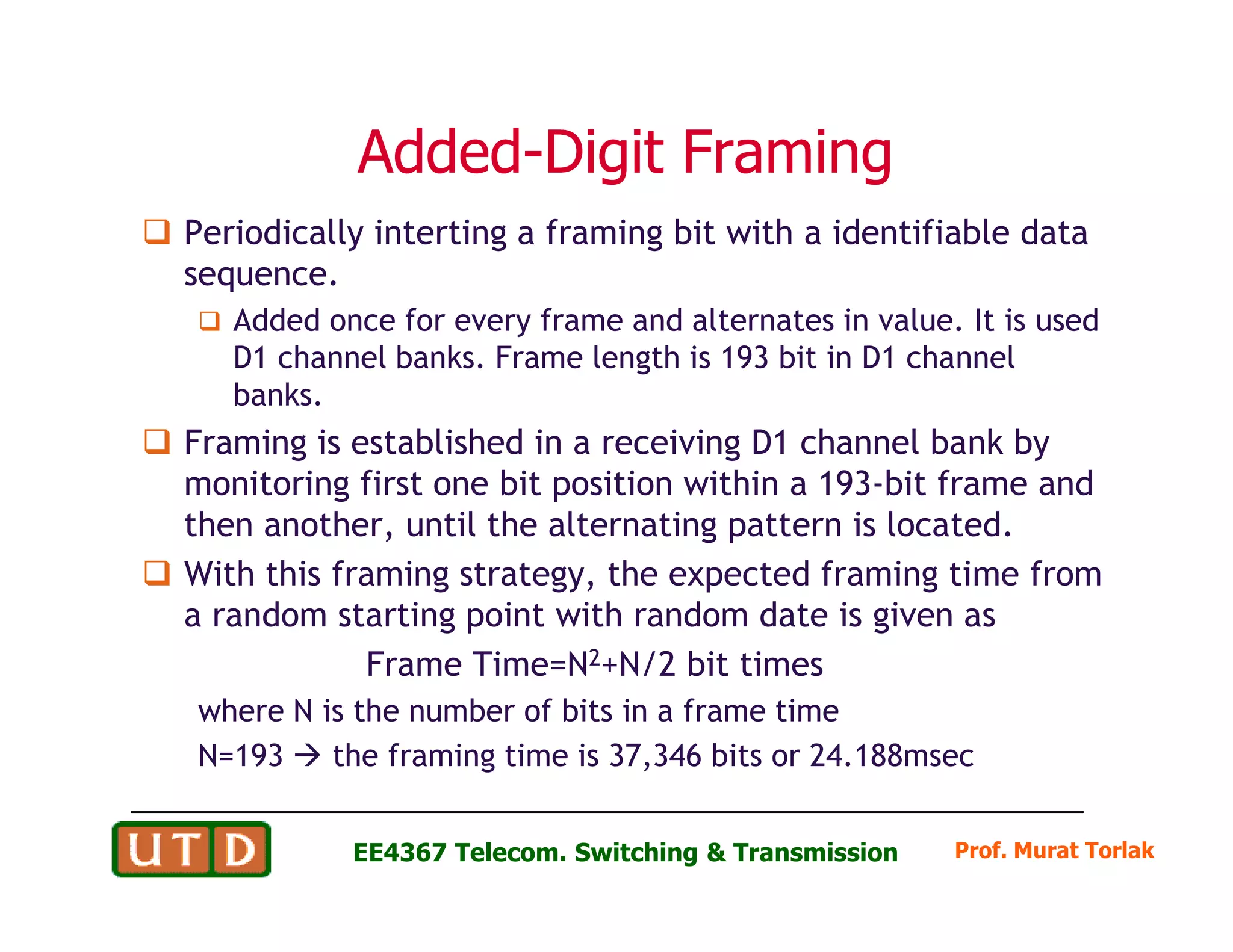
Periodically interting a framing bit with a identifiable data
sequence.
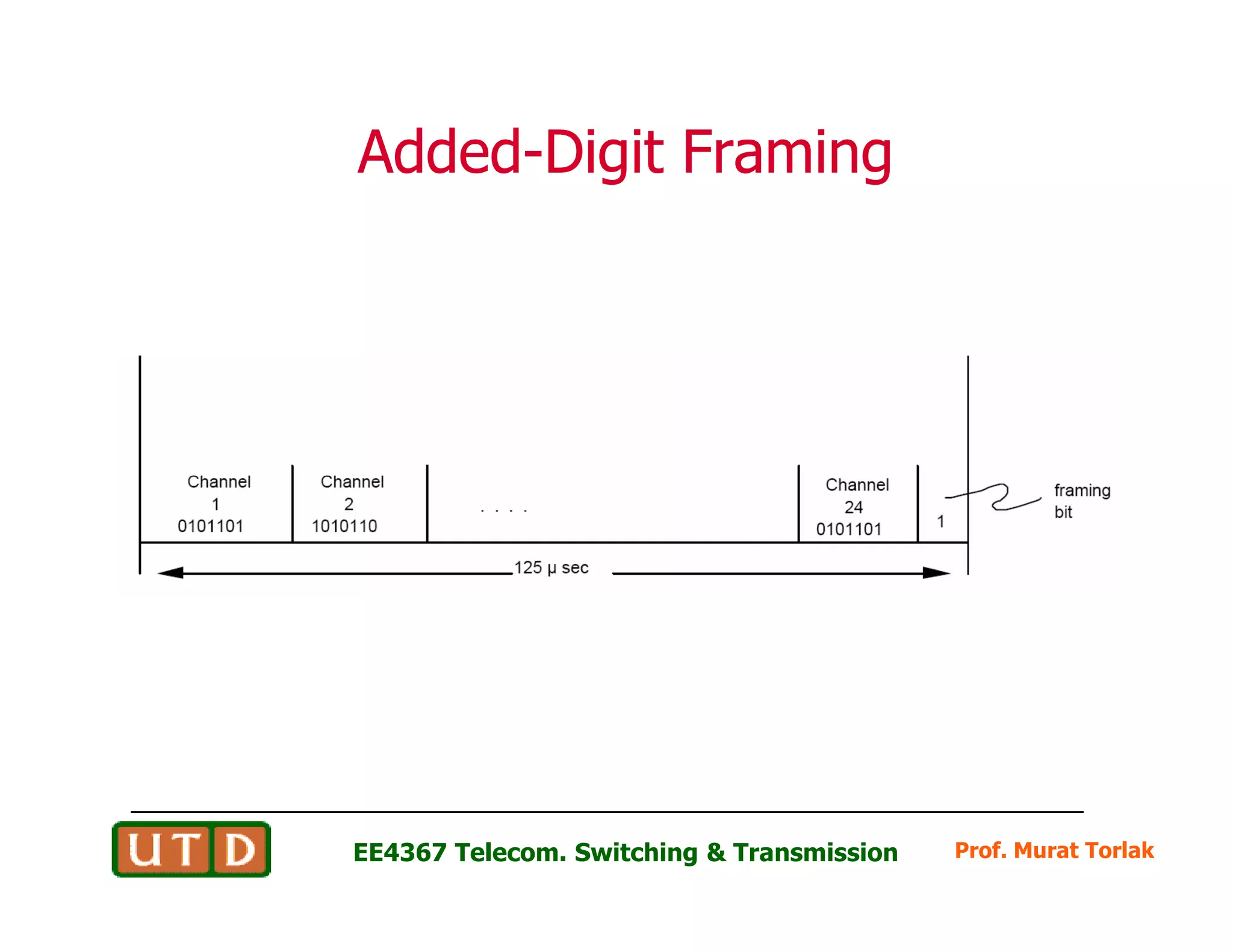
Added once for every frame and alternates in value. It is used
D1 channel banks. Frame length is 193 bit in D1 channel
banks.
Framing is established in a receiving D1 channel bank by
monitoring first one bit position within a 193-bit frame and
Prof. Murat TorlakEE4367 Telecom. Switching & Transmission
monitoring first one bit position within a 193-bit frame and
then another, until the alternating pattern is located.
With this framing strategy, the expected framing time from
a random starting point with random date is given as
Frame Time=N2+N/2 bit times
where N is the number of bits in a frame time
N=193 the framing time is 37,346 bits or 24.188msec
AddedAdded--Digit FramingDigit Framing
Prof. Murat TorlakEE4367 Telecom. Switching & Transmission
AddedAdded--Channel FramingChannel Framing
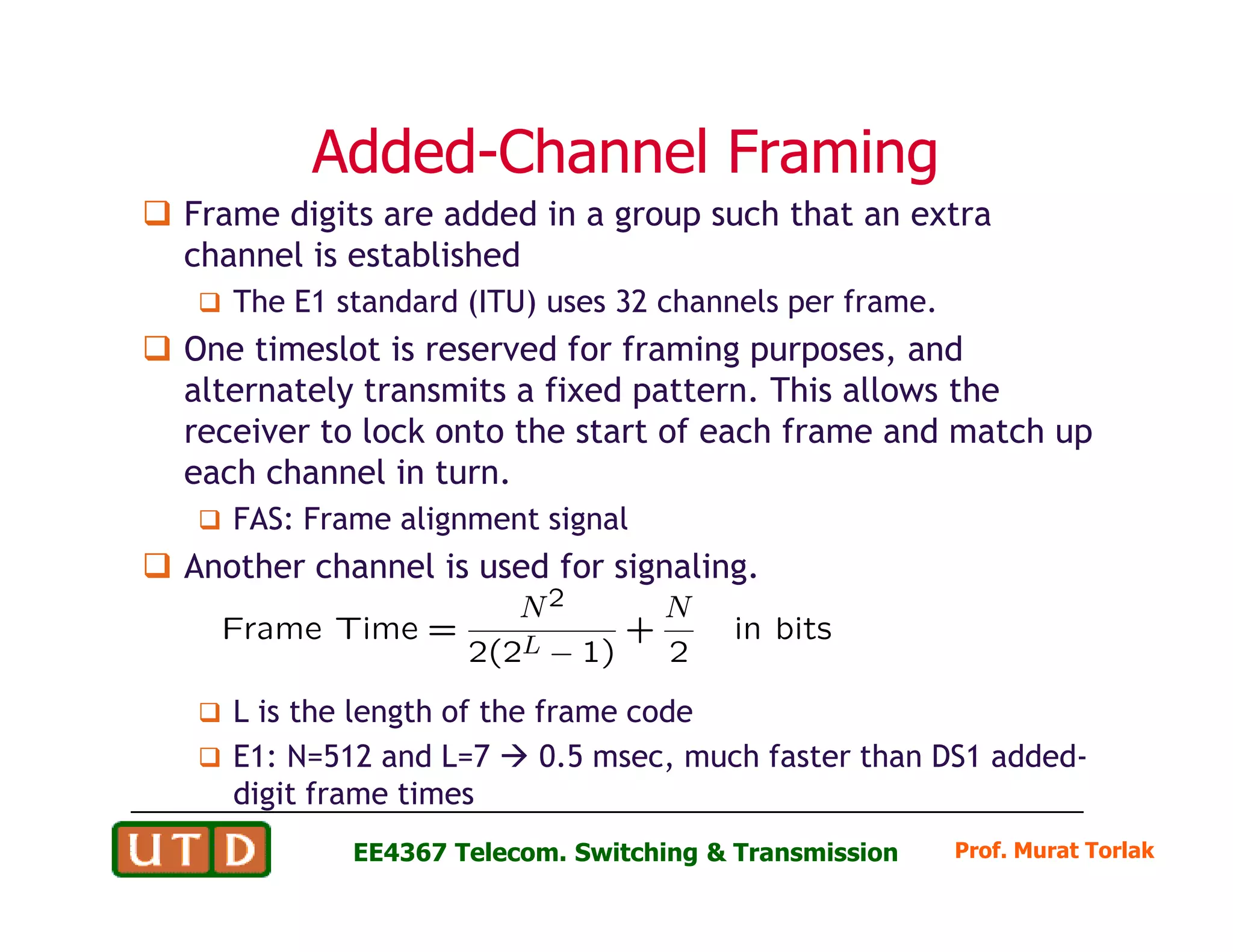
Frame digits are added in a group such that an extra
channel is established
The E1 standard (ITU) uses 32 channels per frame.
One timeslot is reserved for framing purposes, and
alternately transmits a fixed pattern. This allows the
receiver to lock onto the start of each frame and match up
each channel in turn.
Prof. Murat TorlakEE4367 Telecom. Switching & Transmission
each channel in turn.
FAS: Frame alignment signal
Another channel is used for signaling.
L is the length of the frame code
E1: N=512 and L=7 0.5 msec, much faster than DS1 added-
digit frame times

Time division

  • 1.
    Time Division MultiplexingTimeDivision Multiplexing Prof. Murat TorlakEE4367 Telecom. Switching & Transmission
  • 2.
    Basic Modes ofOperationBasic Modes of Operation TDM Modes Synchronous Mode: repeatedly assigning the transmission channel. Ex: STDM (circuit switching) Asynchronous Mode: as needed, Ex: ATDM, ATM, Stat-Mux (packet switching) TDM structures Bit interleaving: single bit Prof. Murat TorlakEE4367 Telecom. Switching & Transmission Bit interleaving: single bit Word Interleaving: larger number of bits (word-length)
  • 3.
    E1/T1 DifferenceE1/T1 Difference TheE1 system is dominant in Europe and some non-Europe countries. The T1 system is dominant in USA, Canada and Japan. E1 and T1 use the same sampling frequency (8 kHz), PCM frame length (125 ms), bits per code (8 bits) and timeslot bit rate (64 kbps). They differ in these aspects: E1 adopts A law coding/decoding of 13-segment but T1 adopts Prof. Murat Torlak E1 adopts A law coding/decoding of 13-segment but T1 adopts m law coding/decoding of 15-segment. Each PCM primary frame of E1 contains 32 timeslots but T1’s contains 24 timeslots. Each PCM primary frame of E1 contains 256 bits but T1’s contains 193 bits. Therefore, E1 provides 2.048 Mbps bandwidth but T1 provides 1.544 Mbps bandwidth. EE4367 Telecom. Switching & Transmission
  • 4.
    FramingFraming To identify individualtime slots Overhead bits are required to establish frame synchronization Basic means of establishing frame synchronization Added-bit Added-channel Unique line signal Statistical Prof. Murat TorlakEE4367 Telecom. Switching & Transmission Statistical Loss of framing implies a loss of data on all channels Reframing time and frequency of accourance Source of out of frame conditions Sample clock may lose synchronization with the line clock and produce a slip in the counter sequence Channel errors. To prevent channel errors high redundancy in framing patter is needed.
  • 5.
    AddedAdded--Digit FramingDigit Framing Periodicallyinterting a framing bit with a identifiable data sequence. Added once for every frame and alternates in value. It is used D1 channel banks. Frame length is 193 bit in D1 channel banks. Framing is established in a receiving D1 channel bank by monitoring first one bit position within a 193-bit frame and Prof. Murat TorlakEE4367 Telecom. Switching & Transmission monitoring first one bit position within a 193-bit frame and then another, until the alternating pattern is located. With this framing strategy, the expected framing time from a random starting point with random date is given as Frame Time=N2+N/2 bit times where N is the number of bits in a frame time N=193 the framing time is 37,346 bits or 24.188msec
  • 6.
    AddedAdded--Digit FramingDigit Framing Prof.Murat TorlakEE4367 Telecom. Switching & Transmission
  • 7.
    AddedAdded--Channel FramingChannel Framing Framedigits are added in a group such that an extra channel is established The E1 standard (ITU) uses 32 channels per frame. One timeslot is reserved for framing purposes, and alternately transmits a fixed pattern. This allows the receiver to lock onto the start of each frame and match up each channel in turn. Prof. Murat TorlakEE4367 Telecom. Switching & Transmission each channel in turn. FAS: Frame alignment signal Another channel is used for signaling. L is the length of the frame code E1: N=512 and L=7 0.5 msec, much faster than DS1 added- digit frame times