Application Note

                       860 DSPi Unsolicited Grant Service
The Unsolicited Grant Service (UGS) provides periodic grants for an upstream service flow without the
need for a cable modem to transmit bandwidth requests. This type of service is suitable for applications
that generate fixed size frames at regular intervals and are intolerant of packet loss. Voice over IP is a
classic example.

Compare the UGS scheduling system to a time slot in a time division multiplexing (TDM) system such as
a T1 or E1 circuit. UGS provides guaranteed throughput and latency, which in turn provides a continuous
stream of fixed periodic intervals to transmit without the need for the client to periodically request or
contend for bandwidth. This system is perfect for VoIP because voice traffic is generally transmitted as a
continuous stream of fixed size periodic data.

UGS was conceived because of the lack of guarantees for latency, jitter and throughput in the best effort
scheduling mode. The best effort scheduling mode does not provide the assurance that a particular frame
can be transmitted at a particular time, and in a congested system there is no assurance that a particular
frame can be transmitted at all.

Note that although UGS style service flows are the most appropriate type of service flow to convey VoIP
bearer traffic, they are not considered to be appropriate for classical internet applications such as web,
email or P2P. This is because classical internet applications do not generate data at fixed periodic
intervals and can, in fact, spend significant periods of time not transmitting data at all. If a UGS service
flow is used to convey classical internet traffic, the service flow can go unused for significant periods
when the application briefly stops transmissions. This leads to unused UGS grants that represent a waste
of upstream bandwidth resources which is not desirable.

UGS service flows are usually established dynamically when they are required rather than being
provisioned in the DOCSIS configuration file. A cable modem with integrated VoIP ports can usually ask
the CMTS to create an appropriate UGS service flow when the modem detects that a VoIP telephone call
is in progress. 1

How Does My 860 DSPi Utilize UGS?
Currently, UGS can be implemented on the 860 DSPi VoIP RTP Test Menu or the VoIP Test Macro Step.
These tests simulate a VoIP call to a Trilithic Data Server using standard VoIP protocols. The user can
activate UGS for this test providing a high priority service flow for the duration of the test.


1
 Upstream Scheduler Mode Configuration for the Cisco uBR CMTS,
http://www.cisco.com/en/US/tech/tk86/tk804/technologies_white_paper09186a0080672b3a.shtml


    For Additional Help Contact
    Trilithic Applications Engineering                                             860 DSPi Unsolicited Grant Service
    1-800-344-2412 or 317-895-3600                                                       P/N 0010275011 – Rev 5/07
    support@trilithic.com or                                                                                   1 of 4
    www.trilithic.com

                                   Copyright © 2007 Trilithic, Inc. All Rights Reserved.
Application Note

How Can I See if My 860 DSPi Supports UGS?
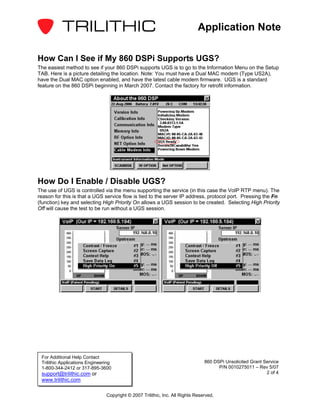
The easiest method to see if your 860 DSPi supports UGS is to go to the Information Menu on the Setup
TAB. Here is a picture detailing the location. Note: You must have a Dual MAC modem (Type US2A),
have the Dual MAC option enabled, and have the latest cable modem firmware. UGS is a standard
feature on the 860 DSPi beginning in March 2007. Contact the factory for retrofit information.


How Do I Enable / Disable UGS?
The use of UGS is controlled via the menu supporting the service (in this case the VoIP RTP menu). The
reason for this is that a UGS service flow is tied to the server IP address, protocol port. Pressing the Fn
(function) key and selecting High Priority On allows a UGS session to be created. Selecting High Priority
Off will cause the test to be run without a UGS session.


 For Additional Help Contact
 Trilithic Applications Engineering                                             860 DSPi Unsolicited Grant Service
 1-800-344-2412 or 317-895-3600                                                       P/N 0010275011 – Rev 5/07
 support@trilithic.com or                                                                                   2 of 4
 www.trilithic.com

                                Copyright © 2007 Trilithic, Inc. All Rights Reserved.
Application Note

How Does UGS Work?
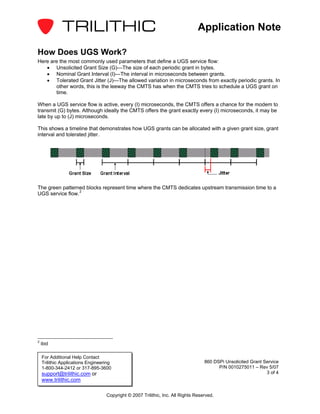
Here are the most commonly used parameters that define a UGS service flow:
   • Unsolicited Grant Size (G)—The size of each periodic grant in bytes.
   • Nominal Grant Interval (I)—The interval in microseconds between grants.
   • Tolerated Grant Jitter (J)—The allowed variation in microseconds from exactly periodic grants. In
       other words, this is the leeway the CMTS has when the CMTS tries to schedule a UGS grant on
       time.

When a UGS service flow is active, every (I) microseconds, the CMTS offers a chance for the modem to
transmit (G) bytes. Although ideally the CMTS offers the grant exactly every (I) microseconds, it may be
late by up to (J) microseconds.

This shows a timeline that demonstrates how UGS grants can be allocated with a given grant size, grant
interval and tolerated jitter.


The green patterned blocks represent time where the CMTS dedicates upstream transmission time to a
UGS service flow. 2


2
    ibid

    For Additional Help Contact
    Trilithic Applications Engineering                                             860 DSPi Unsolicited Grant Service
    1-800-344-2412 or 317-895-3600                                                       P/N 0010275011 – Rev 5/07
    support@trilithic.com or                                                                                   3 of 4
    www.trilithic.com

                                   Copyright © 2007 Trilithic, Inc. All Rights Reserved.
Application Note

Does UGS Really Work?
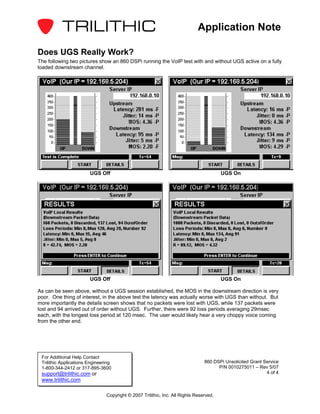
The following two pictures show an 860 DSPi running the VoIP test with and without UGS active on a fully
loaded downstream channel.


                        UGS Off                                                         UGS On


                        UGS Off                                                         UGS On

As can be seen above, without a UGS session established, the MOS in the downstream direction is very
poor. One thing of interest, in the above test the latency was actually worse with UGS than without. But
more importantly the details screen shows that no packets were lost with UGS, while 137 packets were
lost and 94 arrived out of order without UGS. Further, there were 92 loss periods averaging 29msec
each, with the longest loss period at 120 msec. The user would likely hear a very choppy voice coming
from the other end.


 For Additional Help Contact
 Trilithic Applications Engineering                                             860 DSPi Unsolicited Grant Service
 1-800-344-2412 or 317-895-3600                                                       P/N 0010275011 – Rev 5/07
 support@trilithic.com or                                                                                   4 of 4
 www.trilithic.com

                                Copyright © 2007 Trilithic, Inc. All Rights Reserved.

860 dspi unsolicited_grant_service_appnote

  • 1.
    Application Note 860 DSPi Unsolicited Grant Service The Unsolicited Grant Service (UGS) provides periodic grants for an upstream service flow without the need for a cable modem to transmit bandwidth requests. This type of service is suitable for applications that generate fixed size frames at regular intervals and are intolerant of packet loss. Voice over IP is a classic example. Compare the UGS scheduling system to a time slot in a time division multiplexing (TDM) system such as a T1 or E1 circuit. UGS provides guaranteed throughput and latency, which in turn provides a continuous stream of fixed periodic intervals to transmit without the need for the client to periodically request or contend for bandwidth. This system is perfect for VoIP because voice traffic is generally transmitted as a continuous stream of fixed size periodic data. UGS was conceived because of the lack of guarantees for latency, jitter and throughput in the best effort scheduling mode. The best effort scheduling mode does not provide the assurance that a particular frame can be transmitted at a particular time, and in a congested system there is no assurance that a particular frame can be transmitted at all. Note that although UGS style service flows are the most appropriate type of service flow to convey VoIP bearer traffic, they are not considered to be appropriate for classical internet applications such as web, email or P2P. This is because classical internet applications do not generate data at fixed periodic intervals and can, in fact, spend significant periods of time not transmitting data at all. If a UGS service flow is used to convey classical internet traffic, the service flow can go unused for significant periods when the application briefly stops transmissions. This leads to unused UGS grants that represent a waste of upstream bandwidth resources which is not desirable. UGS service flows are usually established dynamically when they are required rather than being provisioned in the DOCSIS configuration file. A cable modem with integrated VoIP ports can usually ask the CMTS to create an appropriate UGS service flow when the modem detects that a VoIP telephone call is in progress. 1 How Does My 860 DSPi Utilize UGS? Currently, UGS can be implemented on the 860 DSPi VoIP RTP Test Menu or the VoIP Test Macro Step. These tests simulate a VoIP call to a Trilithic Data Server using standard VoIP protocols. The user can activate UGS for this test providing a high priority service flow for the duration of the test. 1 Upstream Scheduler Mode Configuration for the Cisco uBR CMTS, http://www.cisco.com/en/US/tech/tk86/tk804/technologies_white_paper09186a0080672b3a.shtml For Additional Help Contact Trilithic Applications Engineering 860 DSPi Unsolicited Grant Service 1-800-344-2412 or 317-895-3600 P/N 0010275011 – Rev 5/07 support@trilithic.com or 1 of 4 www.trilithic.com Copyright © 2007 Trilithic, Inc. All Rights Reserved.
  • 2.
    Application Note How CanI See if My 860 DSPi Supports UGS? The easiest method to see if your 860 DSPi supports UGS is to go to the Information Menu on the Setup TAB. Here is a picture detailing the location. Note: You must have a Dual MAC modem (Type US2A), have the Dual MAC option enabled, and have the latest cable modem firmware. UGS is a standard feature on the 860 DSPi beginning in March 2007. Contact the factory for retrofit information. How Do I Enable / Disable UGS? The use of UGS is controlled via the menu supporting the service (in this case the VoIP RTP menu). The reason for this is that a UGS service flow is tied to the server IP address, protocol port. Pressing the Fn (function) key and selecting High Priority On allows a UGS session to be created. Selecting High Priority Off will cause the test to be run without a UGS session. For Additional Help Contact Trilithic Applications Engineering 860 DSPi Unsolicited Grant Service 1-800-344-2412 or 317-895-3600 P/N 0010275011 – Rev 5/07 support@trilithic.com or 2 of 4 www.trilithic.com Copyright © 2007 Trilithic, Inc. All Rights Reserved.
  • 3.
    Application Note How DoesUGS Work? Here are the most commonly used parameters that define a UGS service flow: • Unsolicited Grant Size (G)—The size of each periodic grant in bytes. • Nominal Grant Interval (I)—The interval in microseconds between grants. • Tolerated Grant Jitter (J)—The allowed variation in microseconds from exactly periodic grants. In other words, this is the leeway the CMTS has when the CMTS tries to schedule a UGS grant on time. When a UGS service flow is active, every (I) microseconds, the CMTS offers a chance for the modem to transmit (G) bytes. Although ideally the CMTS offers the grant exactly every (I) microseconds, it may be late by up to (J) microseconds. This shows a timeline that demonstrates how UGS grants can be allocated with a given grant size, grant interval and tolerated jitter. The green patterned blocks represent time where the CMTS dedicates upstream transmission time to a UGS service flow. 2 2 ibid For Additional Help Contact Trilithic Applications Engineering 860 DSPi Unsolicited Grant Service 1-800-344-2412 or 317-895-3600 P/N 0010275011 – Rev 5/07 support@trilithic.com or 3 of 4 www.trilithic.com Copyright © 2007 Trilithic, Inc. All Rights Reserved.
  • 4.
    Application Note Does UGSReally Work? The following two pictures show an 860 DSPi running the VoIP test with and without UGS active on a fully loaded downstream channel. UGS Off UGS On UGS Off UGS On As can be seen above, without a UGS session established, the MOS in the downstream direction is very poor. One thing of interest, in the above test the latency was actually worse with UGS than without. But more importantly the details screen shows that no packets were lost with UGS, while 137 packets were lost and 94 arrived out of order without UGS. Further, there were 92 loss periods averaging 29msec each, with the longest loss period at 120 msec. The user would likely hear a very choppy voice coming from the other end. For Additional Help Contact Trilithic Applications Engineering 860 DSPi Unsolicited Grant Service 1-800-344-2412 or 317-895-3600 P/N 0010275011 – Rev 5/07 support@trilithic.com or 4 of 4 www.trilithic.com Copyright © 2007 Trilithic, Inc. All Rights Reserved.