

Climate Vulnerability Assessment
- A promising tool for adaptation

Qi ZHENG ,
Oxfam Hong Kong

South Asian Parliamentarians
workshop on climate change
16/12/2013, Islamabad
Outline
- Adaptation and rural livelihood development
- What is CVA?
- How we have applied CVA in China-an undergoing

case in Shaanxi province
- Lessons learnt, challenges so far and opportunities

Page 2
Climate adaptation and
rural livelihood
development
Climate Adaptation and rural livelihood development
• People have always adapted to climate variability through a variety of means

Ex. delaying planting time or switching to other, faster growing crops.
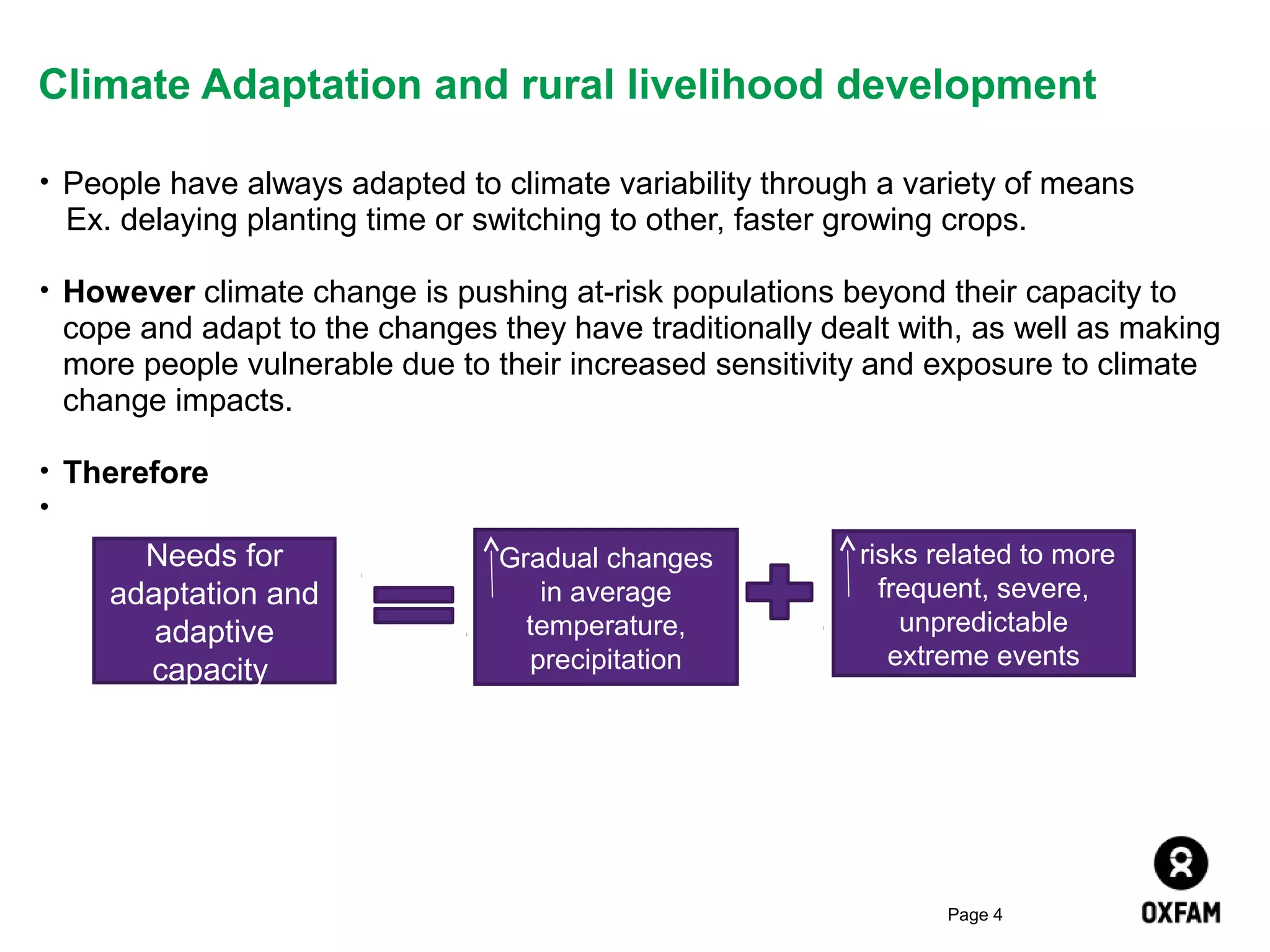
• However climate change is pushing at-risk populations beyond their capacity to

cope and adapt to the changes they have traditionally dealt with, as well as making
more people vulnerable due to their increased sensitivity and exposure to climate
change impacts.
• Therefore
•

Needs for
adaptation and
adaptive
capacity

Gradual changes
in average
temperature,
precipitation

risks related to more
frequent, severe,
unpredictable
extreme events

Page 4
Climate Adaptation and rural livelihood development
Adaptation to CC is NOT fundamentally different from development
activities aiming at reducing vulnerability of people to current stresses,
but adaptation puts emphasis on reducing those vulnerabilities that result
from current and future climate change impacts.
• Adaptation measures should be integrated into policy and programme design

But HOW? Pools of tools and guides…
•

Oxfam’s approach to building the adaptive capacity of people living in

•
•

poverty (Pettengell 2010) combines institutional aspects, socio-economic
factors, and access to knowledge and resources.

• Different aspects of adaptive capacity are determined at different levels and

addressing them all requires a combination of top-down and bottom-up
approaches.
Page 5
What is Climate
vulnerability Assessment?
What is Climate Vulnerability Assessment?
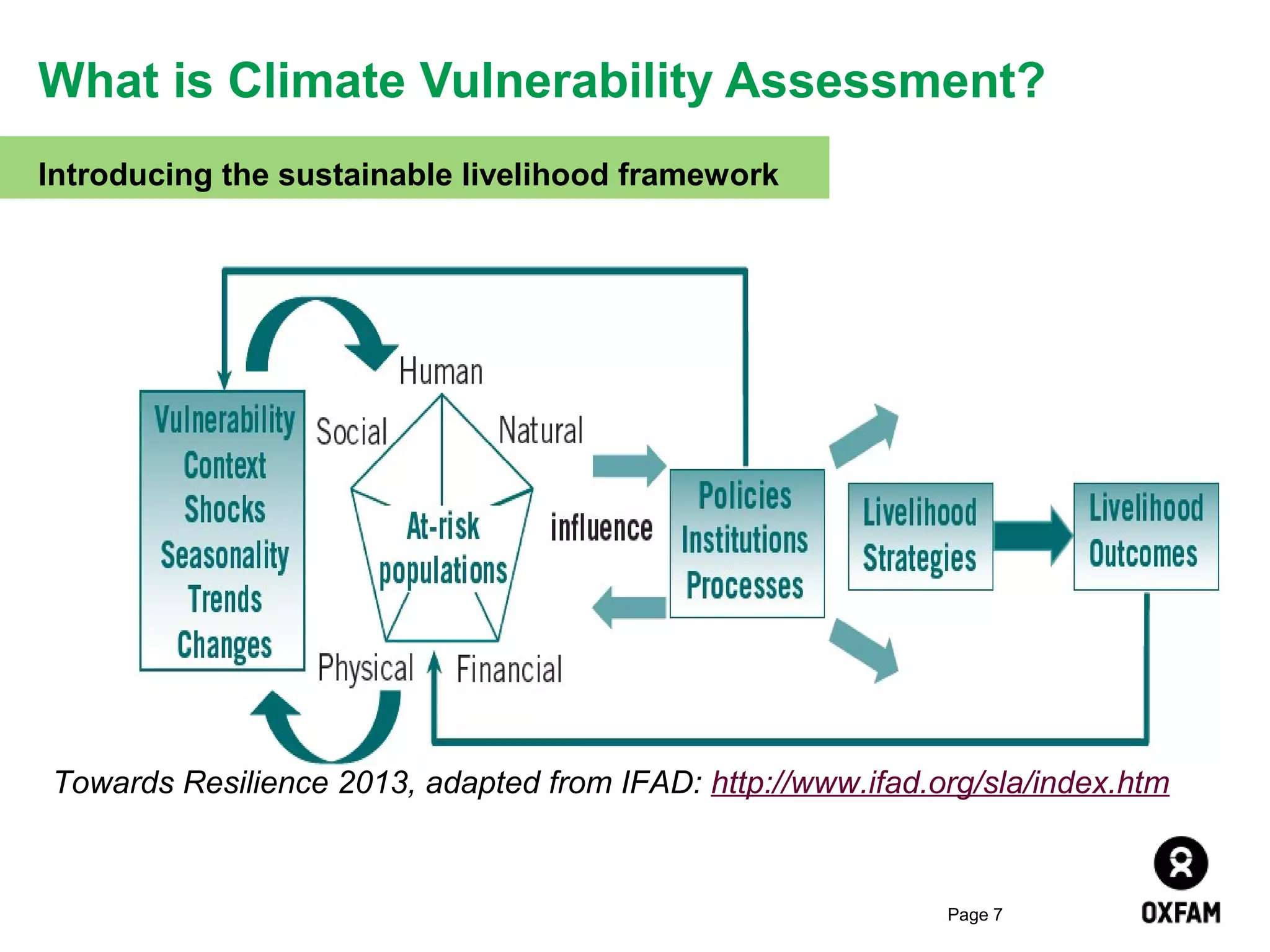
Introducing the sustainable livelihood framework

Towards Resilience 2013, adapted from IFAD: http://www.ifad.org/sla/index.htm

Page 7
What is Climate Vulnerability Assessment?
They might include one of several of the following components
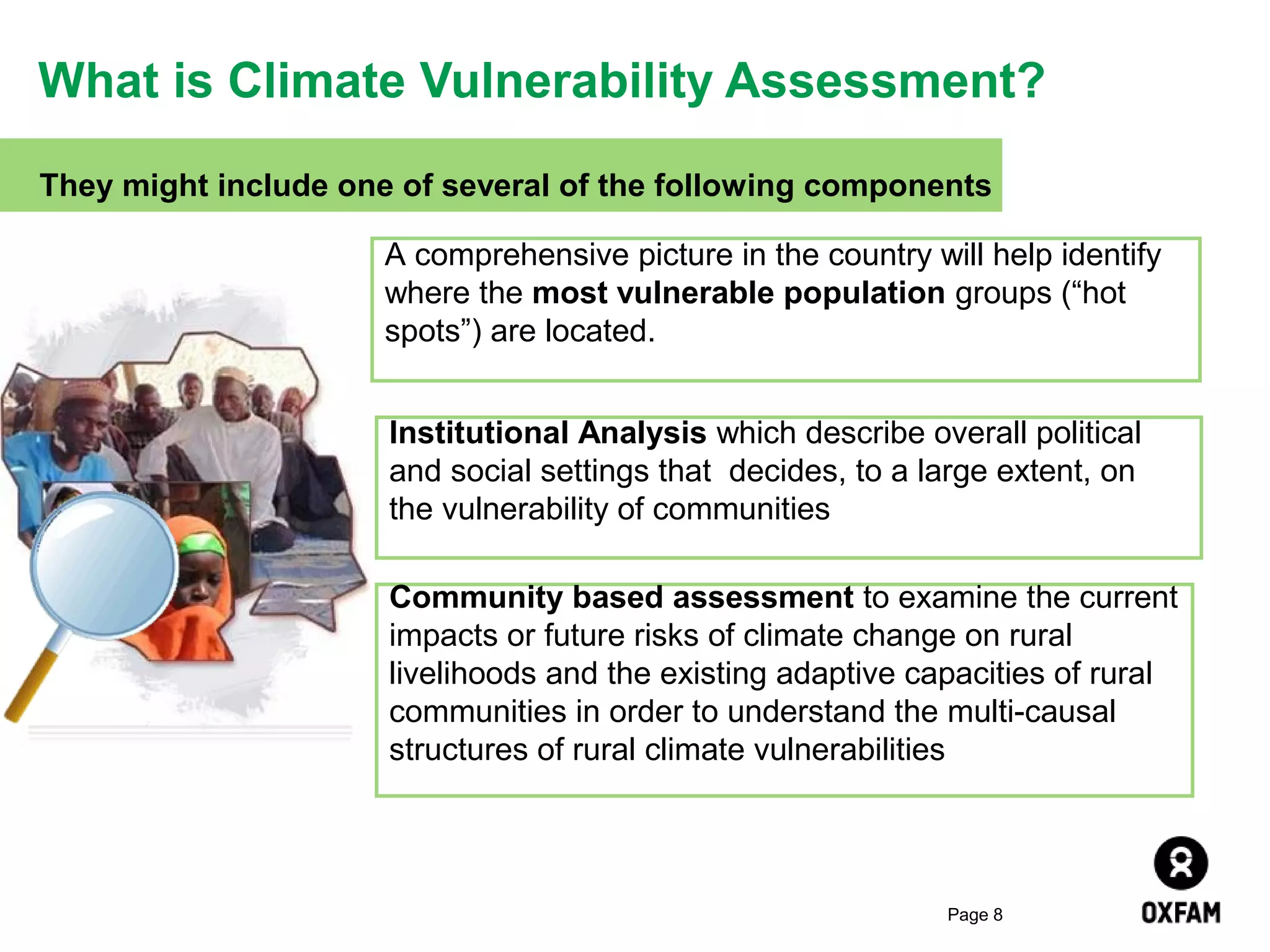
A comprehensive picture in the country will help identify
where the most vulnerable population groups (“hot
spots”) are located.
Institutional Analysis which describe overall political
and social settings that decides, to a large extent, on
the vulnerability of communities
Community based assessment to examine the current
impacts or future risks of climate change on rural
livelihoods and the existing adaptive capacities of rural
communities in order to understand the multi-causal
structures of rural climate vulnerabilities

Page 8
What is Climate Vulnerability Assessment?
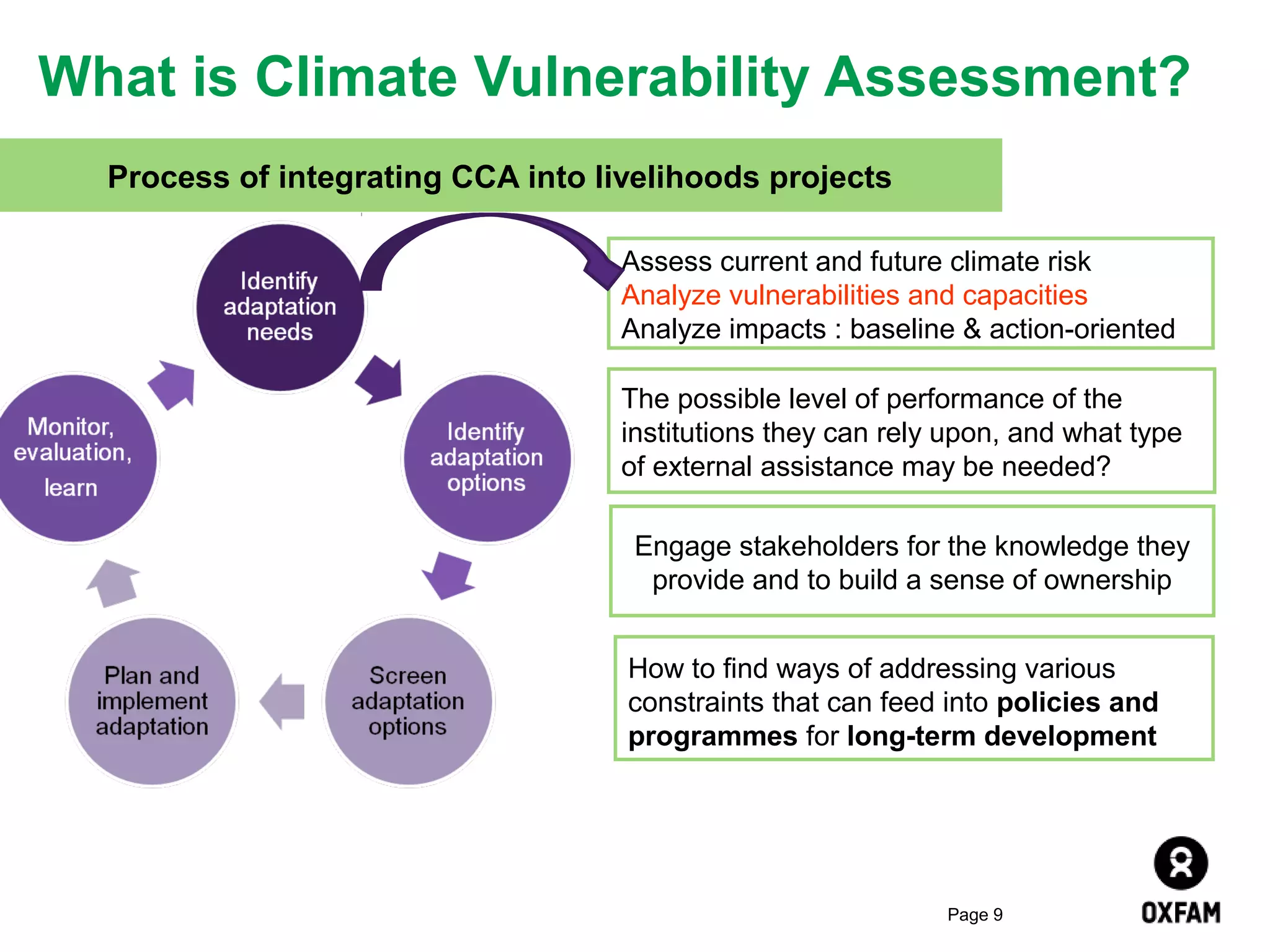
Process of integrating CCA into livelihoods projects
Assess current and future climate risk
Analyze vulnerabilities and capacities
Analyze impacts : baseline & action-oriented
The possible level of performance of the
institutions they can rely upon, and what type
of external assistance may be needed?
Engage stakeholders for the knowledge they
provide and to build a sense of ownership
How to find ways of addressing various
constraints that can feed into policies and
programmes for long-term development

Page 9
How we have applied CVA
in China- an undergoing
case in Shaanxi province
How we have applied CVA in China- an
undergoing case in Shaanxi province
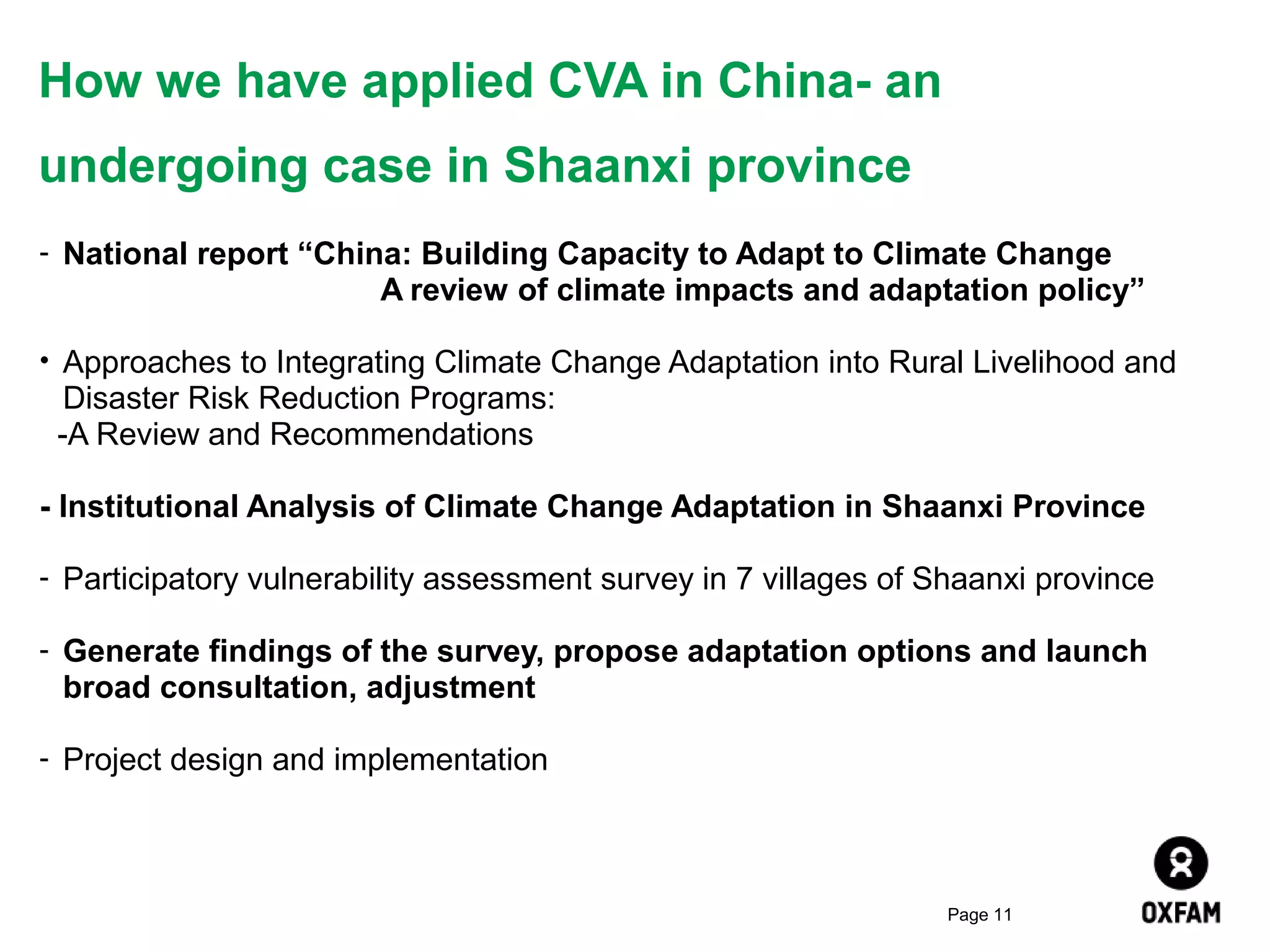
- National report “China: Building Capacity to Adapt to Climate Change

A review of climate impacts and adaptation policy”
• Approaches to Integrating Climate Change Adaptation into Rural Livelihood and

Disaster Risk Reduction Programs:
-A Review and Recommendations
- Institutional Analysis of Climate Change Adaptation in Shaanxi Province
- Participatory vulnerability assessment survey in 7 villages of Shaanxi province
- Generate findings of the survey, propose adaptation options and launch

broad consultation, adjustment
- Project design and implementation

Page 11
How we have applied CVA in China- an undergoing case in Shaanxi province
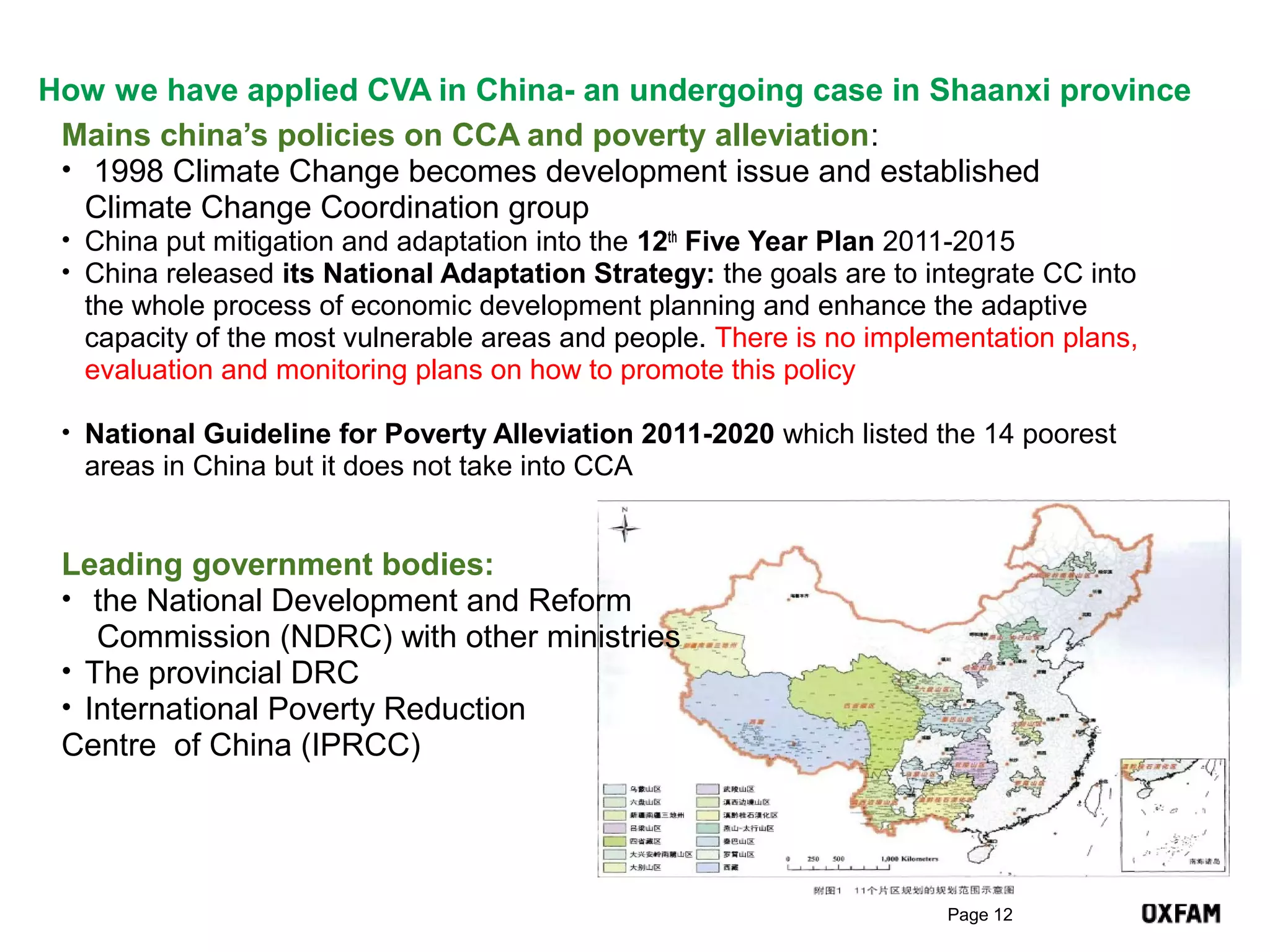
Mains china’s policies on CCA and poverty alleviation:
• 1998 Climate Change becomes development issue and established
Climate Change Coordination group
• China put mitigation and adaptation into the 12th Five Year Plan 2011-2015
• China released its National Adaptation Strategy: the goals are to integrate CC into

the whole process of economic development planning and enhance the adaptive
capacity of the most vulnerable areas and people. There is no implementation plans,
evaluation and monitoring plans on how to promote this policy
• National Guideline for Poverty Alleviation 2011-2020 which listed the 14 poorest

areas in China but it does not take into CCA

Leading government bodies:
• the National Development and Reform
Commission (NDRC) with other ministries
• The provincial DRC
• International Poverty Reduction
Centre of China (IPRCC)

Page 12
How we have applied CVA in China- an undergoing case in Shaanxi province
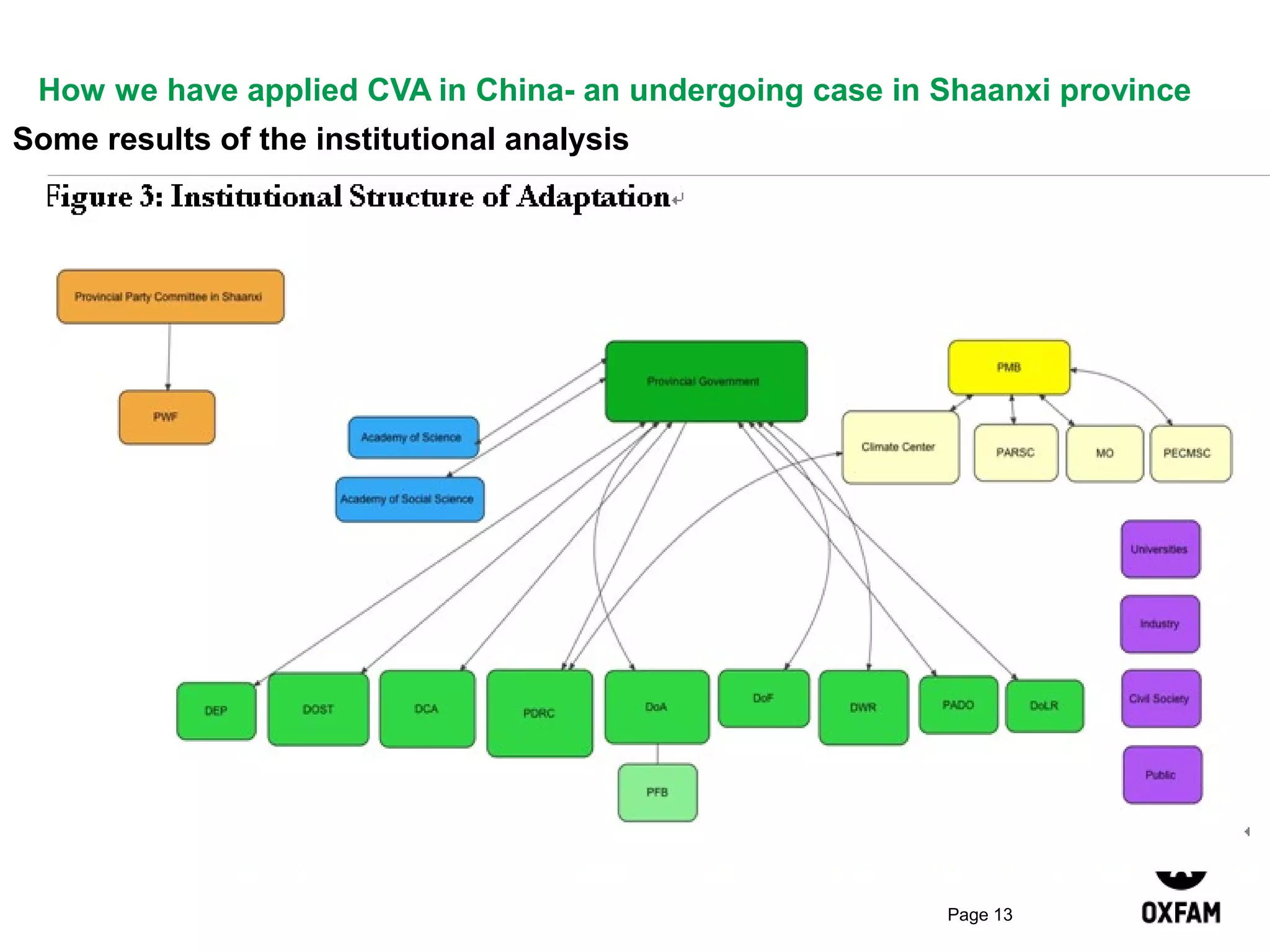
Some results of the institutional analysis
1.“Top-down” & “Silo” approach
2. Despite the progress gained in the climate projections in China limited
capacity of planners at provincial and sub-provincial level on CCA, how to
get access to data and use the information
3. The different time scales - between short to mid-term planning and the
long-term frame of climate change
4. Focus on mitigation and energy sectors, preference for engineering
solutions
5. Research gaps esp. from social-economical perspective, micro-level
evidences
6. Lack of media and public support on CCA and rural poverty – it seems far
away from citizens’ life

Page 13
How we have applied CVA in China- an undergoing case in Shaanxi province
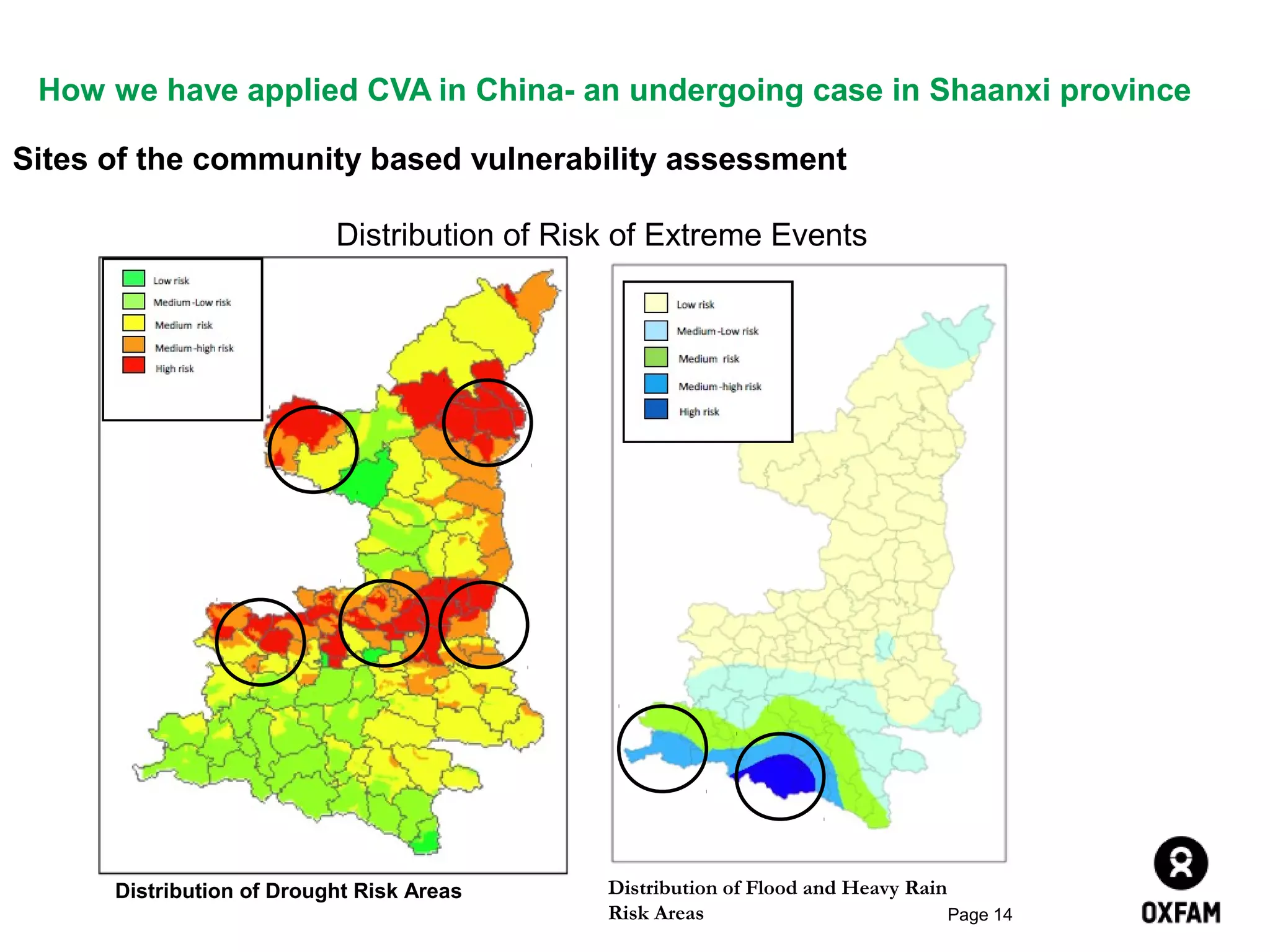
Sites of the community based vulnerability assessment
Distribution of Risk of Extreme Events

Distribution of Drought Risk Areas

Distribution of Flood and Heavy Rain
Risk Areas
Page 14
How we have applied CVA in China- an undergoing case in Shaanxi province
• Scoping workshop: assess current understandings, gaps and discuss research
goals
• Conceptual framework, focus issues and research methodology
• review and analysis of secondary data
• semi-structured interviews with provincial official
• the participatory vulnerability assessment in 7 villages
• data analysis, report writing,
• Workshop to discuss and further analyze research findings
• Options list, prioritization and consultation
• Project design and resource allocation
•
•
•
•
•
•
•
•

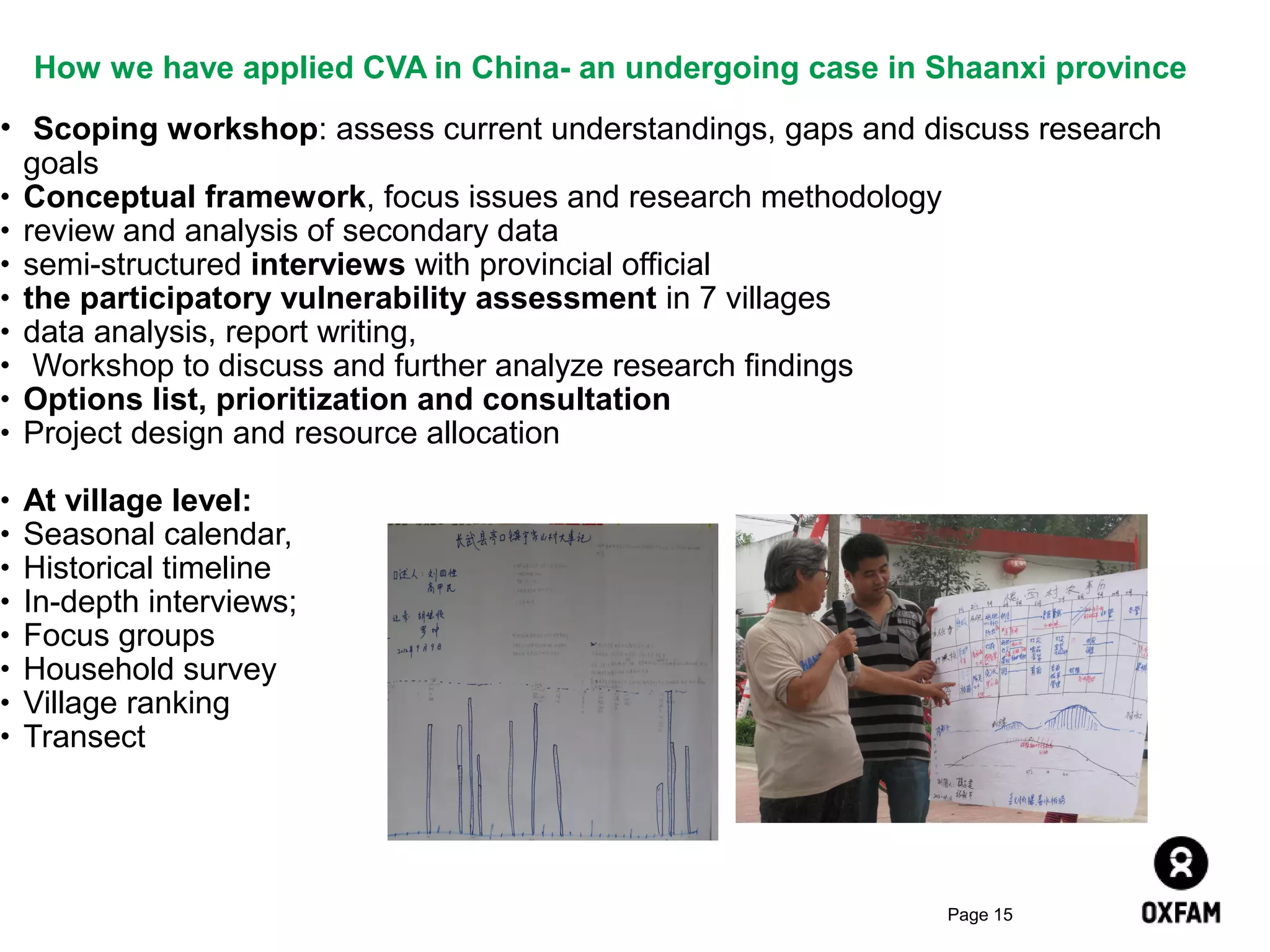
At village level:
Seasonal calendar,
Historical timeline
In-depth interviews;
Focus groups
Household survey
Village ranking
Transect

Page 15
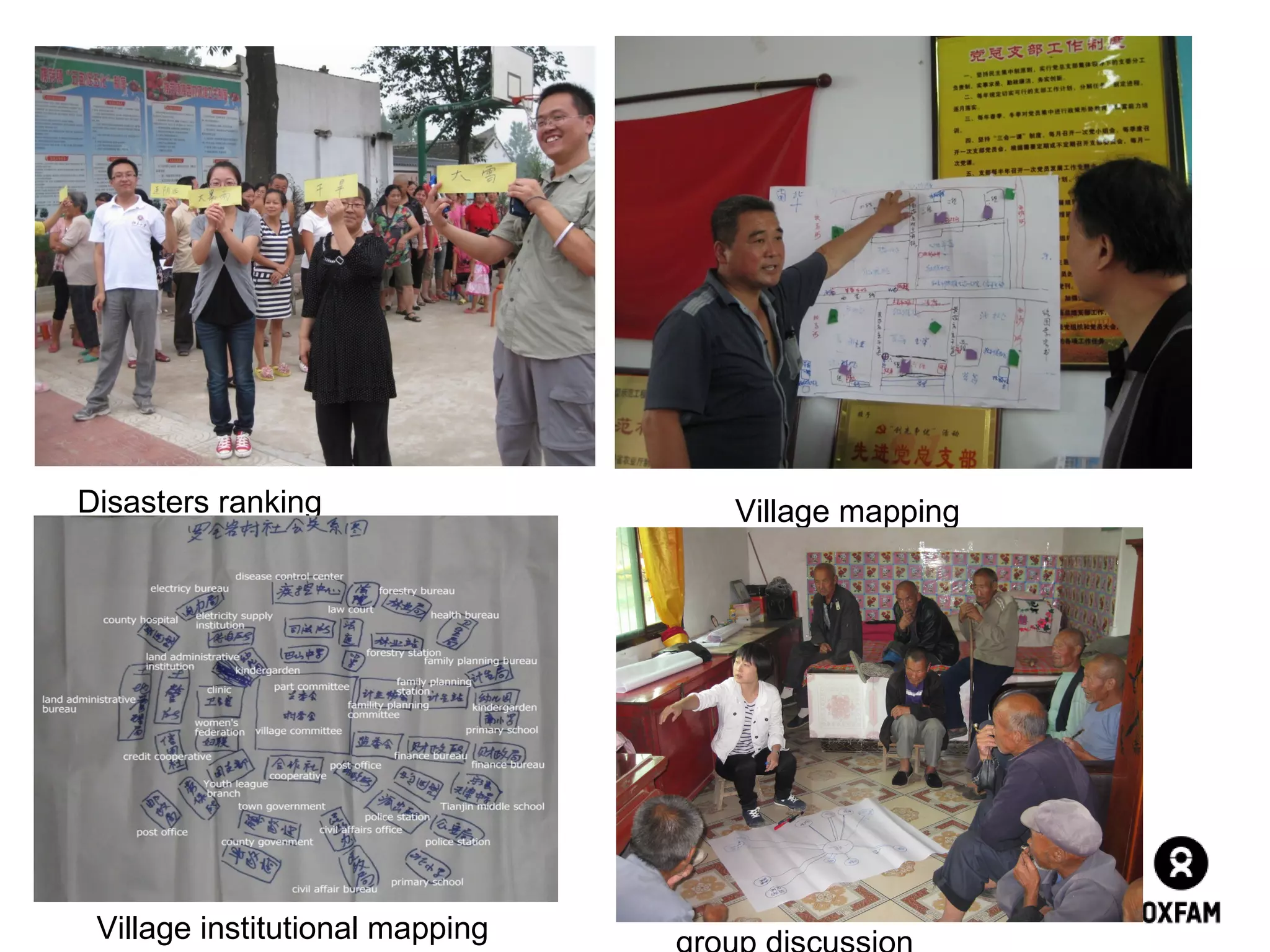
Disasters ranking

Village institutional mapping

Village mapping
How we have applied CVA in China- an undergoing case in Shaanxi province
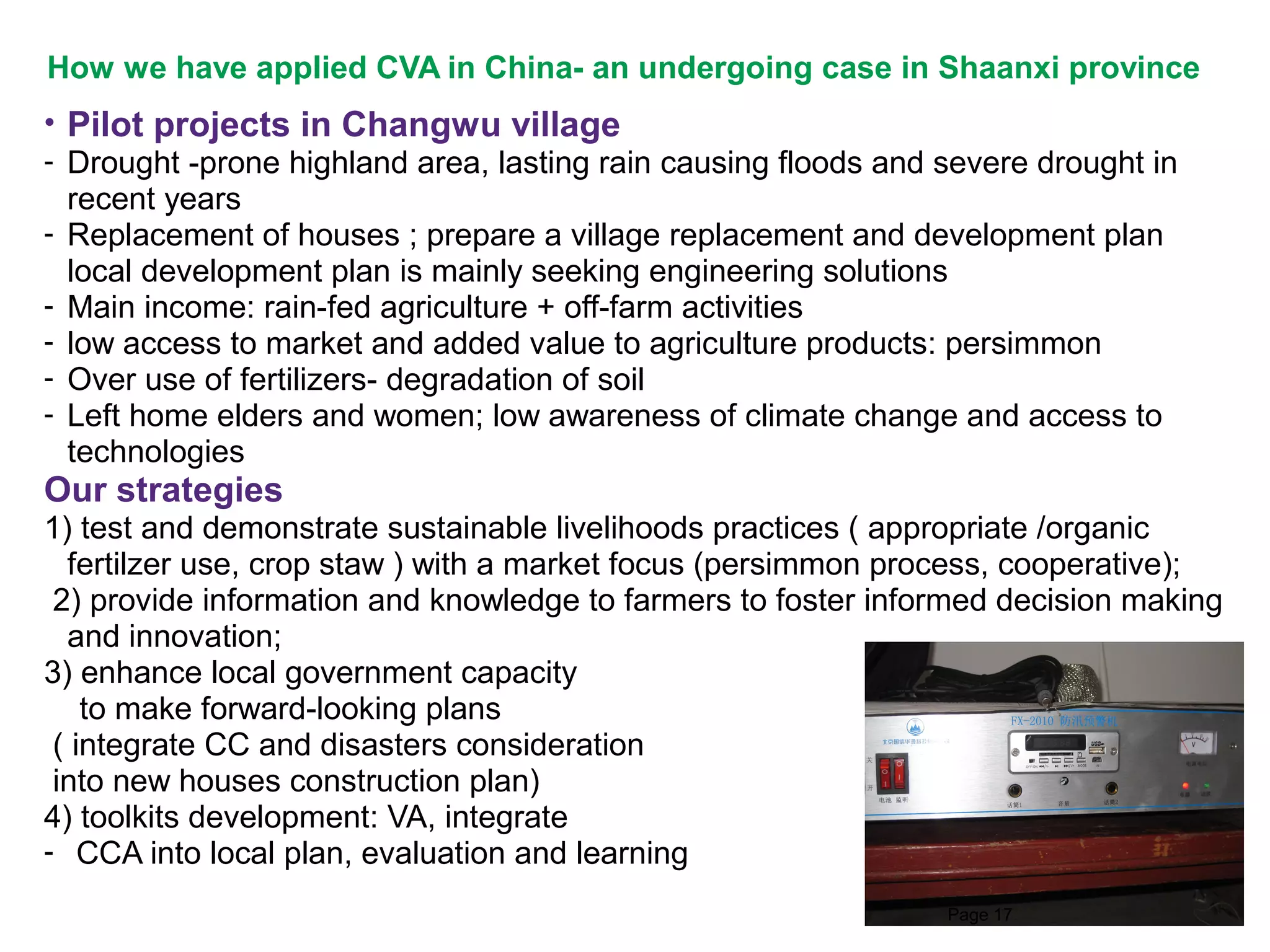
• Pilot projects in Changwu village
- Drought -prone highland area, lasting rain causing floods and severe drought in
recent years
- Replacement of houses ; prepare a village replacement and development plan
local development plan is mainly seeking engineering solutions
- Main income: rain-fed agriculture + off-farm activities
- low access to market and added value to agriculture products: persimmon
- Over use of fertilizers- degradation of soil
- Left home elders and women; low awareness of climate change and access to
technologies

Our strategies
1) test and demonstrate sustainable livelihoods practices ( appropriate /organic
fertilzer use, crop staw ) with a market focus (persimmon process, cooperative);
2) provide information and knowledge to farmers to foster informed decision making
and innovation;
3) enhance local government capacity
to make forward-looking plans
( integrate CC and disasters consideration
into new houses construction plan)
4) toolkits development: VA, integrate
- CCA into local plan, evaluation and learning
Page 17
Lessons learnt ,
challenges so far and
opportunities
Lessons learnt and challenges so far and opportunities
Lessons learnt
- Sound policy and power analysis + keep updating is crucial
- Engage wide partners at different levels and agree upon common goals
- The participation from villagers
- Balance international needs and national situations
- Internal communication and cooperation
Challenges
- Difficult to get buy in from central and provincial governments
- Difficult to get data esp. socio-economical
- Link the field experience with policy makers at top level
- Balance between international needs and national priorities
New opportunities
-International focus: CCA, food and agriculture, Post 2015…
- More voices from the emerging countries and south-south
- Regional platforms

Page 19
LET’S TAKE ACTION!

Cva and adaptation qi zheng

  • 1.
    Climate Vulnerability Assessment -A promising tool for adaptation Qi ZHENG , Oxfam Hong Kong South Asian Parliamentarians workshop on climate change 16/12/2013, Islamabad
  • 2.
    Outline - Adaptation andrural livelihood development - What is CVA? - How we have applied CVA in China-an undergoing case in Shaanxi province - Lessons learnt, challenges so far and opportunities Page 2
  • 3.
    Climate adaptation and rurallivelihood development
  • 4.
    Climate Adaptation andrural livelihood development • People have always adapted to climate variability through a variety of means Ex. delaying planting time or switching to other, faster growing crops. • However climate change is pushing at-risk populations beyond their capacity to cope and adapt to the changes they have traditionally dealt with, as well as making more people vulnerable due to their increased sensitivity and exposure to climate change impacts. • Therefore • Needs for adaptation and adaptive capacity Gradual changes in average temperature, precipitation risks related to more frequent, severe, unpredictable extreme events Page 4
  • 5.
    Climate Adaptation andrural livelihood development Adaptation to CC is NOT fundamentally different from development activities aiming at reducing vulnerability of people to current stresses, but adaptation puts emphasis on reducing those vulnerabilities that result from current and future climate change impacts. • Adaptation measures should be integrated into policy and programme design But HOW? Pools of tools and guides… • Oxfam’s approach to building the adaptive capacity of people living in • • poverty (Pettengell 2010) combines institutional aspects, socio-economic factors, and access to knowledge and resources. • Different aspects of adaptive capacity are determined at different levels and addressing them all requires a combination of top-down and bottom-up approaches. Page 5
  • 6.
  • 7.
    What is ClimateVulnerability Assessment? Introducing the sustainable livelihood framework Towards Resilience 2013, adapted from IFAD: http://www.ifad.org/sla/index.htm Page 7
  • 8.
    What is ClimateVulnerability Assessment? They might include one of several of the following components A comprehensive picture in the country will help identify where the most vulnerable population groups (“hot spots”) are located. Institutional Analysis which describe overall political and social settings that decides, to a large extent, on the vulnerability of communities Community based assessment to examine the current impacts or future risks of climate change on rural livelihoods and the existing adaptive capacities of rural communities in order to understand the multi-causal structures of rural climate vulnerabilities Page 8
  • 9.
    What is ClimateVulnerability Assessment? Process of integrating CCA into livelihoods projects Assess current and future climate risk Analyze vulnerabilities and capacities Analyze impacts : baseline & action-oriented The possible level of performance of the institutions they can rely upon, and what type of external assistance may be needed? Engage stakeholders for the knowledge they provide and to build a sense of ownership How to find ways of addressing various constraints that can feed into policies and programmes for long-term development Page 9
  • 10.
    How we haveapplied CVA in China- an undergoing case in Shaanxi province
  • 11.
    How we haveapplied CVA in China- an undergoing case in Shaanxi province - National report “China: Building Capacity to Adapt to Climate Change A review of climate impacts and adaptation policy” • Approaches to Integrating Climate Change Adaptation into Rural Livelihood and Disaster Risk Reduction Programs: -A Review and Recommendations - Institutional Analysis of Climate Change Adaptation in Shaanxi Province - Participatory vulnerability assessment survey in 7 villages of Shaanxi province - Generate findings of the survey, propose adaptation options and launch broad consultation, adjustment - Project design and implementation Page 11
  • 12.
    How we haveapplied CVA in China- an undergoing case in Shaanxi province Mains china’s policies on CCA and poverty alleviation: • 1998 Climate Change becomes development issue and established Climate Change Coordination group • China put mitigation and adaptation into the 12th Five Year Plan 2011-2015 • China released its National Adaptation Strategy: the goals are to integrate CC into the whole process of economic development planning and enhance the adaptive capacity of the most vulnerable areas and people. There is no implementation plans, evaluation and monitoring plans on how to promote this policy • National Guideline for Poverty Alleviation 2011-2020 which listed the 14 poorest areas in China but it does not take into CCA Leading government bodies: • the National Development and Reform Commission (NDRC) with other ministries • The provincial DRC • International Poverty Reduction Centre of China (IPRCC) Page 12
  • 13.
    How we haveapplied CVA in China- an undergoing case in Shaanxi province Some results of the institutional analysis 1.“Top-down” & “Silo” approach 2. Despite the progress gained in the climate projections in China limited capacity of planners at provincial and sub-provincial level on CCA, how to get access to data and use the information 3. The different time scales - between short to mid-term planning and the long-term frame of climate change 4. Focus on mitigation and energy sectors, preference for engineering solutions 5. Research gaps esp. from social-economical perspective, micro-level evidences 6. Lack of media and public support on CCA and rural poverty – it seems far away from citizens’ life Page 13
  • 14.
    How we haveapplied CVA in China- an undergoing case in Shaanxi province Sites of the community based vulnerability assessment Distribution of Risk of Extreme Events Distribution of Drought Risk Areas Distribution of Flood and Heavy Rain Risk Areas Page 14
  • 15.
    How we haveapplied CVA in China- an undergoing case in Shaanxi province • Scoping workshop: assess current understandings, gaps and discuss research goals • Conceptual framework, focus issues and research methodology • review and analysis of secondary data • semi-structured interviews with provincial official • the participatory vulnerability assessment in 7 villages • data analysis, report writing, • Workshop to discuss and further analyze research findings • Options list, prioritization and consultation • Project design and resource allocation • • • • • • • • At village level: Seasonal calendar, Historical timeline In-depth interviews; Focus groups Household survey Village ranking Transect Page 15
  • 16.
  • 17.
    How we haveapplied CVA in China- an undergoing case in Shaanxi province • Pilot projects in Changwu village - Drought -prone highland area, lasting rain causing floods and severe drought in recent years - Replacement of houses ; prepare a village replacement and development plan local development plan is mainly seeking engineering solutions - Main income: rain-fed agriculture + off-farm activities - low access to market and added value to agriculture products: persimmon - Over use of fertilizers- degradation of soil - Left home elders and women; low awareness of climate change and access to technologies Our strategies 1) test and demonstrate sustainable livelihoods practices ( appropriate /organic fertilzer use, crop staw ) with a market focus (persimmon process, cooperative); 2) provide information and knowledge to farmers to foster informed decision making and innovation; 3) enhance local government capacity to make forward-looking plans ( integrate CC and disasters consideration into new houses construction plan) 4) toolkits development: VA, integrate - CCA into local plan, evaluation and learning Page 17
  • 18.
    Lessons learnt , challengesso far and opportunities
  • 19.
    Lessons learnt andchallenges so far and opportunities Lessons learnt - Sound policy and power analysis + keep updating is crucial - Engage wide partners at different levels and agree upon common goals - The participation from villagers - Balance international needs and national situations - Internal communication and cooperation Challenges - Difficult to get buy in from central and provincial governments - Difficult to get data esp. socio-economical - Link the field experience with policy makers at top level - Balance between international needs and national priorities New opportunities -International focus: CCA, food and agriculture, Post 2015… - More voices from the emerging countries and south-south - Regional platforms Page 19
  • 20.

Editor's Notes

  • #8 Vulnerability to climate change is structured by economic, social, geographic, demographic, cultural, institutional, governance and environmental factors (IPCC 2012). This includes social inequality, unequal access to resources, poverty, poor infrastructure, lack of representation, lack of social networks, and inadequate systems of social security, early warning, and planning
  • #9 It is not a single direction process, quite often we had to go back to the top in order to link the local problem with political and social settings
  • #10 We describe methods that model climate change impacts as “impact analysis”, and methods that analyse the institutional context of vulnerability – including political, social and economic factors – as “institutional analysis” Indentify adaptation needs involves at least two aspects Analysing observed or expected impacts of climate change (with and without adaptation). Analysing the potential capacity to prevent, moderate or adapt to these impacts. Arguably, if it is known at the outset that socio-economic and institutional factors play a significant role in shaping the magnitude of the risks and opportunities in a given adaptation situation, then capacity analysis will be more important
  • #14 In China, planners work within a time frame (5-10 years) shorter than one that would show the effects of climate change. Planners often prefer engineering solutions for mitigating climate risks which leads them to seek certainty to justify investment. Moreover, the mismatch of time scale may also cause socio-economic dynamics to be overlooked which are crucial in rural China where these socio-economic dynamics are largely driven by poverty alleviation plans orchestrated by the government at central level and implemented at local level. Therefore, a long-term horizon is essential to counteracting these challenges when making plans.