Cedric F. Lam ( [email_address] ) and Winston I. Way ( [email_address] ) SPIE Photonics West, Jan 29, 2009, San Jose, CA A System’s View of Metro and Regional Optical Networks
Outline Introduction Information capacity and digital modulations Challenges beyond 10Gb/s transmission Recent developments DMC technology Scalable ROADM architecture Conclusion
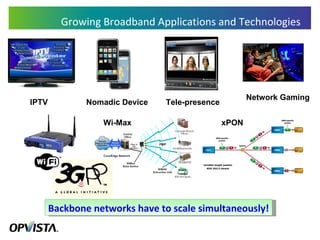
Growing Broadband Applications and Technologies IPTV Nomadic Device  Tele-presence Network Gaming Wi-Max xPON Backbone networks have to scale simultaneously!
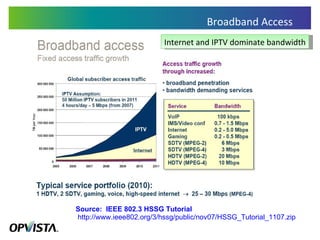
Broadband Access http://www.ieee802.org/3/hssg/public/nov07/HSSG_Tutorial_1107.zip Source:  IEEE 802.3 HSSG Tutorial Internet and IPTV dominate bandwidth
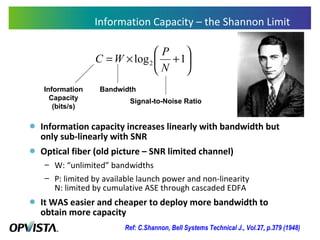
Information Capacity – the Shannon Limit  Information capacity increases linearly with bandwidth but only sub-linearly with SNR Optical fiber (old picture – SNR limited channel) W: “unlimited” bandwidths P: limited by available launch power and non-linearity N: limited by cumulative ASE through cascaded EDFA It WAS easier and cheaper to deploy more bandwidth to obtain more capacity Information Capacity (bits/s) Bandwidth Signal-to-Noise Ratio Ref: C.Shannon, Bell Systems Technical J., Vol.27, p.379 (1948)
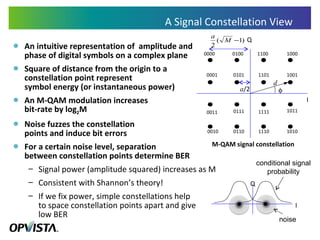
A Signal Constellation View An intuitive representation of  amplitude and phase of digital symbols on a complex plane Square of distance from the origin to a constellation point represent  symbol energy (or instantaneous power) An M-QAM modulation increases bit-rate by log 2 M Noise fuzzes the constellation points and induce bit errors For a certain noise level, separation between constellation points determine BER Signal power (amplitude squared) increases as M Consistent with Shannon’s theory! If we fix power, simple constellations help  to space constellation points apart and give low BER  I Q noise conditional signal probability 0000 0100 a /2 I Q M-QAM signal constellation 1100 1000 0001 0101 1101 1001 1011 1111 0111 0011 0010 0110 1110 1010  d
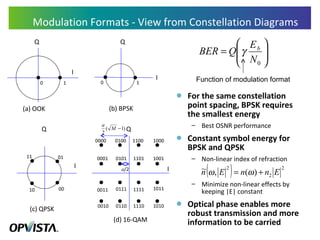
Modulation Formats - View from Constellation Diagrams For the same constellation point spacing, BPSK requires the smallest energy Best OSNR performance Constant symbol energy for BPSK and QPSK Non-linear index of refraction Minimize non-linear effects by keeping |E| constant Optical phase enables more robust transmission and more information to be carried 0000 0100 a /2 I Q I Q I Q I Q (a) OOK (b) BPSK (c) QPSK (d) 16-QAM 0 1 1 0 00 10 11 01 1100 1000 0001 0101 1101 1001 1011 1111 0111 0011 0010 0110 1110 1010 Function of modulation format
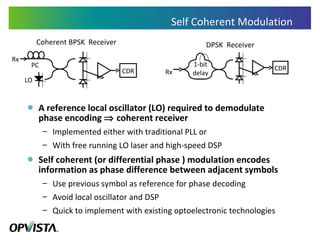
Self Coherent Modulation A reference local oscillator (LO) required to demodulate phase encoding    coherent receiver Implemented either with traditional PLL or With free running LO laser and high-speed DSP Self coherent (or differential phase ) modulation encodes information as phase difference between adjacent symbols Use previous symbol as reference for phase decoding Avoid local oscillator and DSP Quick to implement with existing optoelectronic technologies Coherent BPSK  Receiver DPSK  Receiver PC Rx LO CDR CDR Rx 1-bit delay
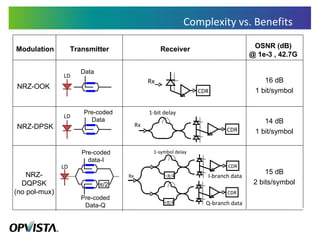
Complexity vs. Benefits Pre-coded Data CDR Rx Modulation Transmitter Receiver OSNR (dB)  @ 1e-3 , 42.7G  NRZ-OOK NRZ-DPSK NRZ- DQPSK (no pol-mux) 16 dB 1 bit/symbol 14 dB 1 bit/symbol 15 dB 2 bits/symbol LD Data LD Pre-coded data-I LD Pre-coded Data-Q  /2 CDR Rx 1-symbol delay  CDR  I-branch data Q-branch data CDR Rx 1-bit delay
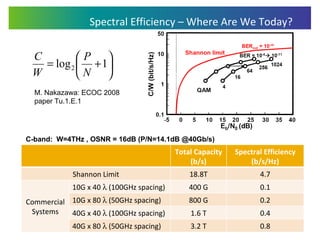
Spectral Efficiency – Where Are We Today? M. Nakazawa: ECOC 2008 paper Tu.1.E.1 C-band:  W=4THz , OSNR = 16dB (P/N=14.1dB @40Gb/s) Total Capacity (b/s) Spectral Efficiency (b/s/Hz) Shannon Limit 18.8T 4.7 Commercial Systems 10G x 40    (100GHz spacing) 400 G 0.1 10G x 80    (50GHz spacing) 800 G 0.2 40G x 40    (100GHz spacing) 1.6 T 0.4 40G x 80    (50GHz spacing) 3.2 T 0.8
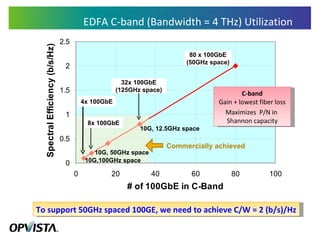
EDFA C-band (Bandwidth = 4 THz) Utilization To support 50GHz spaced 100GE, we need to achieve C/W = 2 (b/s)/Hz 4x 100GbE 10G,100GHz space 10G, 50GHz space 10G, 12.5GHz space 8x 100GbE 32x 100GbE (125GHz space) C-band Gain + lowest fiber loss Maximizes  P/N in  Shannon capacity 80 x 100GbE (50GHz space) Commercially achieved
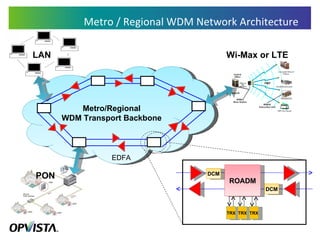
Metro / Regional WDM Network Architecture Metro/Regional WDM Transport Backbone PON LAN Wi-Max or LTE EDFA DCM ROADM DCM TRX TRX TRX
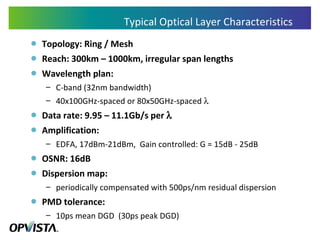
Typical Optical Layer Characteristics Topology: Ring / Mesh Reach: 300km – 1000km, irregular span lengths Wavelength plan: C-band (32nm bandwidth) 40x100GHz-spaced or 80x50GHz-spaced   Data rate: 9.95 – 11.1Gb/s per   Amplification:  EDFA, 17dBm-21dBm,  Gain controlled: G = 15dB - 25dB OSNR: 16dB Dispersion map:  periodically compensated with 500ps/nm residual dispersion PMD tolerance: 10ps mean DGD  (30ps peak DGD)
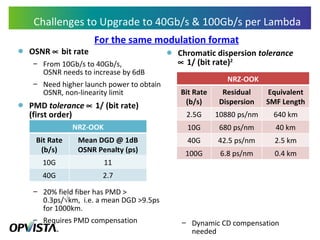
Challenges to Upgrade to 40Gb/s & 100Gb/s per Lambda OSNR    bit rate From 10Gb/s to 40Gb/s,  OSNR needs to increase by 6dB Need higher launch power to obtain OSNR, non-linearity limit PMD  tolerance     1/ (bit rate) (first order) 20% field fiber has PMD > 0.3ps/  km,  i.e. a mean DGD >9.5ps for 1000km. Requires PMD compensation Chromatic dispersion  tolerance     1/ (bit rate) 2 Dynamic CD compensation needed For the same modulation format NRZ-OOK Bit Rate (b/s) Residual Dispersion Equivalent SMF Length 2.5G 10880 ps/nm 640 km 10G 680 ps/nm 40 km 40G 42.5 ps/nm 2.5 km 100G 6.8 ps/nm 0.4 km NRZ-OOK Bit Rate (b/s) Mean DGD @ 1dB OSNR Penalty (ps) 10G 11 40G 2.7
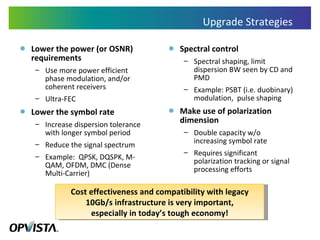
Upgrade Strategies Lower the power (or OSNR) requirements Use more power efficient phase modulation, and/or coherent receivers Ultra-FEC Lower the symbol rate Increase dispersion tolerance with longer symbol period Reduce the signal spectrum Example:  QPSK, DQSPK, M-QAM, OFDM, DMC (Dense Multi-Carrier) Spectral control Spectral shaping, limit dispersion BW seen by CD and PMD Example: PSBT (i.e. duobinary) modulation,  pulse shaping Make use of polarization dimension Double capacity w/o increasing symbol rate Requires significant polarization tracking or signal processing efforts Cost effectiveness and compatibility with legacy 10Gb/s infrastructure is very important, especially in today’s tough economy!
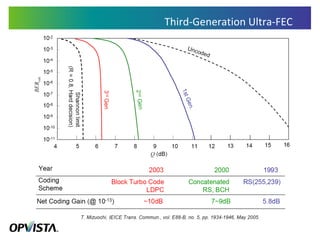
Third-Generation Ultra-FEC
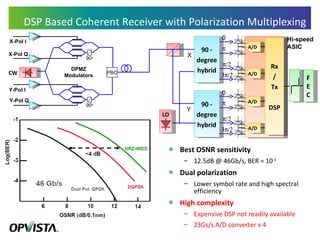
DSP Based Coherent Receiver with Polarization Multiplexing Best OSNR sensitivity 12.5dB @ 46Gb/s, BER = 10 -3 Dual polarization  Lower symbol rate and high spectral efficiency High complexity Expensive DSP not readily available 23Gs/s A/D converter x 4 0    90 - degree hybrid A/D A/D 0    90 - degree hybrid A/D A/D Rx / Tx DSP F EC X Y PBC 90 o CW X-Pol I X-Pol Q Y-Pol I Y-Pol Q DPMZ Modulators Hi-speed  ASIC 90 o LO
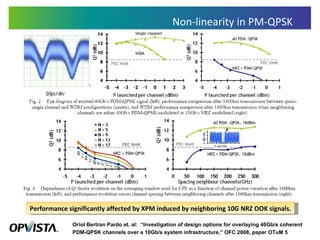
Non-linearity in PM-QPSK Oriol Bertran Pardo et. al:  “Investigation of design options for overlaying 40Gb/s coherent PDM-QPSK channels over a 10Gb/s system infrastructure,” OFC 2008, paper OTuM 5 Performance significantly affected by XPM induced by neighboring 10G NRZ OOK signals.
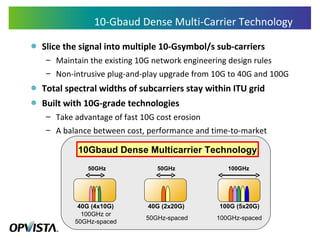
10-Gbaud Dense Multi-Carrier Technology Slice the signal into multiple 10-Gsymbol/s sub-carriers Maintain the existing 10G network engineering design rules Non-intrusive plug-and-play upgrade from 10G to 40G and 100G Total spectral widths of subcarriers stay within ITU grid Built with 10G-grade technologies Take advantage of fast 10G cost erosion A balance between cost, performance and time-to-market  10Gbaud Dense Multicarrier   Technology 40G (4x10G) 100G (5x20G) 100GHz 100GHz or 50GHz-spaced 100GHz-spaced 40G (2x20G) 50GHz 50GHz-spaced 50GHz
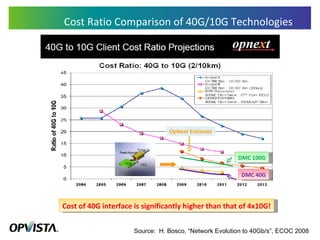
Cost Ratio Comparison of 40G/10G Technologies Source:  H. Bosco, “Network Evolution to 40Gb/s”, ECOC 2008 Cost of 40G interface is significantly higher than that of 4x10G! DMC 40G DMC 100G OpNext Estimate
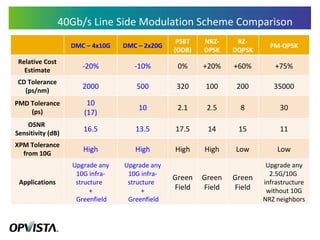
40Gb/s Line Side Modulation Scheme Comparison DMC – 4x10G DMC – 2x20G PSBT (ODB) NRZ-DPSK RZ-DQPSK PM-QPSK Relative Cost Estimate -20% -10% 0% +20% +60% +75% CD Tolerance (ps/nm) 2000 500 320 100 200 35000 PMD Tolerance (ps) 10 (17) 10 2.1 2.5 8 30 OSNR  Sensitivity (dB) 16.5 13.5 17.5 14 15 11 XPM Tolerance from 10G High High High High Low Low Applications Upgrade any 10G infra-structure  +  Greenfield Upgrade any 10G infra-structure  +  Greenfield Green Field Green Field Green Field Upgrade any 2.5G/10G  infrastructure without 10G NRZ neighbors
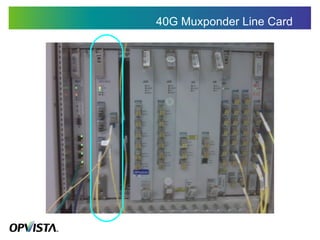
40G Muxponder Line Card
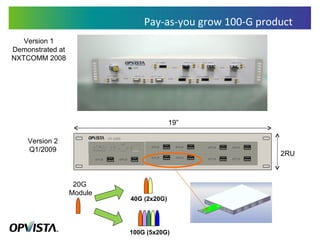
Pay-as-you grow 100-G product Version 1 Demonstrated at NXTCOMM 2008 Version 2 Q1/2009 100G (5x20G) 40G (2x20G) 20G  Module 2RU 19” CX-100G
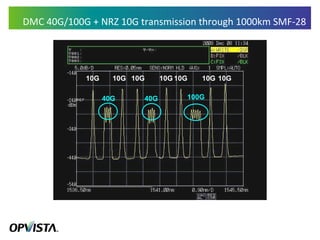
DMC 40G/100G + NRZ 10G transmission through 1000km SMF-28 100G 40G 40G 10G 10G 10G 10G 10G 10G 10G
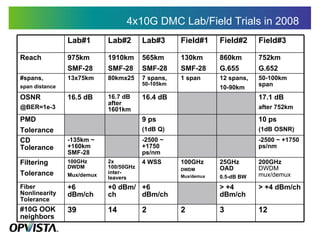
4x10G DMC Lab/Field Trials in 2008 Lab#1 Lab#2 Lab#3 Field#1 Field#2 Field#3 Reach 975km SMF-28 1910km SMF-28 565km SMF-28 130km SMF-28 860km G.655 752km G.652 #spans, span distance 13x75km 80kmx25 7 spans,  50-105km 1 span 12 spans, 10-90km 50-100km span OSNR @BER=1e-3 16.5 dB 16.7 dB after 1601km 16.4 dB 17.1 dB after 752km PMD Tolerance 9 ps (1dB Q) 10 ps (1dB OSNR) CD Tolerance -135km ~ +160km SMF-28 -2500 ~ +1750 ps/nm -2500 ~ +1750 ps/nm Filtering Tolerance 100GHz DWDM Mux/demux 2x 100/50GHz inter-leavers 4 WSS 100GHz DWDM Mux/demux 25GHz OAD 0.5-dB BW 200GHz  DWDM mux/demux Fiber Nonlinearity Tolerance +6 dBm/ch +0 dBm/ch +6 dBm/ch > +4 dBm/ch > +4 dBm/ch #10G OOK neighbors 39 14 2 2 3 12
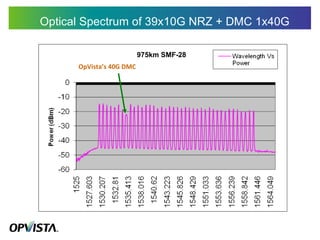
Optical Spectrum of 39x10G NRZ + DMC 1x40G  OpVista’s 40G DMC 975km SMF-28
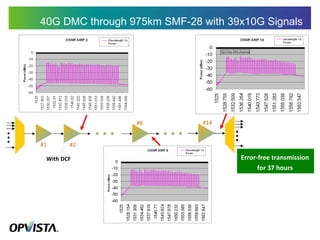
40G DMC through 975km SMF-28 with 39x10G Signals  #1 #2 #8 #14 Error-free transmission for 37 hours With DCF
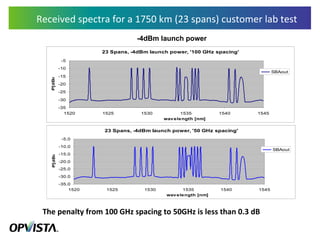
Received spectra for a 1750 km (23 spans) customer lab test  The penalty from 100 GHz spacing to 50GHz is less than 0.3 dB -4dBm launch power
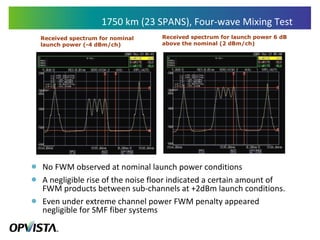
1750 km (23 SPANS), Four-wave Mixing Test No FWM observed at nominal launch power conditions A negligible rise of the noise floor indicated a certain amount of FWM products between sub-channels at +2dBm launch conditions.  Even under extreme channel power FWM penalty appeared negligible for SMF fiber systems Received spectrum for launch power 6 dB above the nominal (2 dBm/ch) Received spectrum for nominal launch power (-4 dBm/ch)
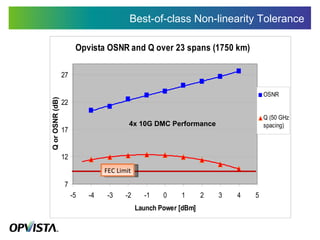
Best-of-class Non-linearity Tolerance FEC Limit 4x 10G DMC Performance Q or OSNR (dB)
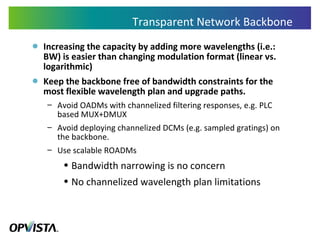
Transparent Network Backbone Increasing the capacity by adding more wavelengths (i.e.: BW) is easier than changing modulation format (linear vs. logarithmic) Keep the backbone free of bandwidth constraints for the most flexible wavelength plan and upgrade paths. Avoid OADMs with channelized filtering responses, e.g. PLC based MUX+DMUX Avoid deploying channelized DCMs (e.g. sampled gratings) on the backbone. Use scalable ROADMs Bandwidth narrowing is no concern No channelized wavelength plan limitations
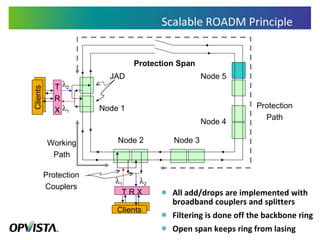
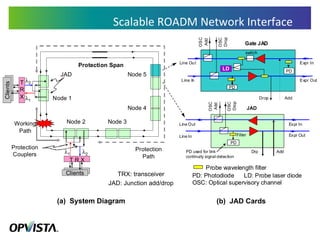
Scalable ROADM Principle All add/drops are implemented with broadband couplers and splitters Filtering is done off the backbone ring Open span keeps ring from lasing  2 T R X T R X  1  2  1 JAD Protection Span Clients Clients Working Path Node 1 Node 2 Node 3 Node 4 Node 5 Protection Path Protection Couplers
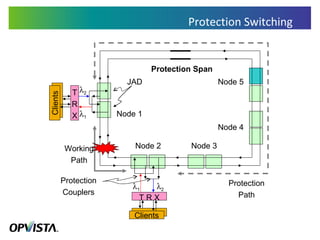
Protection Switching  2 T R X T R X  1  2  1 JAD Protection Span Clients Clients Working Path Node 1 Node 2 Node 3 Node 4 Node 5 Protection Path Protection Couplers
Scalable ROADM Network Interface TRX: transceiver JAD: Junction add/drop (a)  System Diagram (b)  JAD Cards
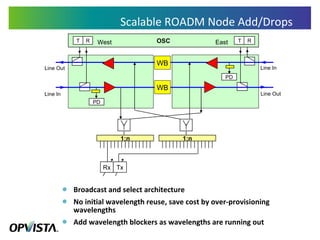
Scalable ROADM Node Add/Drops Broadcast and select architecture No initial wavelength reuse, save cost by over-provisioning wavelengths Add wavelength blockers as wavelengths are running out Line  Out Line  In PD Line In Line Out PD 1:n 1:n Ea st We st Tx Rx WB WB OSC T R T R
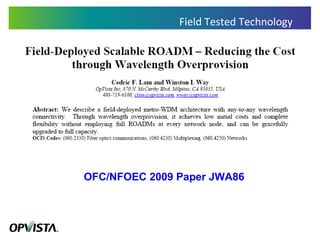
Field Tested Technology OFC/NFOEC 2009 Paper JWA86
Conclusion Ubiquitous  broadband and converged networks are straining the bandwidths in backbone networks. 10G -> 40G upgrade need is imminent, 100G is being actively researched. Bandwidth efficiencies are becoming more and more important as the available fiber bandwidths are being exhausted.  Advanced modulation schemes pave the way for future optical transport networks. DMC provides a cost-effective solution for upgrading embedded 10G infrastructure with good system performance. Scalable ROADM ensures a backbone path for unconstrained bandwidth upgrade.

A System's View of Metro and Regional Optical Networks

  • 1.
    Cedric F. Lam( [email_address] ) and Winston I. Way ( [email_address] ) SPIE Photonics West, Jan 29, 2009, San Jose, CA A System’s View of Metro and Regional Optical Networks
  • 2.
    Outline Introduction Informationcapacity and digital modulations Challenges beyond 10Gb/s transmission Recent developments DMC technology Scalable ROADM architecture Conclusion
  • 3.
    Growing Broadband Applicationsand Technologies IPTV Nomadic Device Tele-presence Network Gaming Wi-Max xPON Backbone networks have to scale simultaneously!
  • 4.
    Broadband Access http://www.ieee802.org/3/hssg/public/nov07/HSSG_Tutorial_1107.zipSource: IEEE 802.3 HSSG Tutorial Internet and IPTV dominate bandwidth
  • 5.
    Information Capacity –the Shannon Limit Information capacity increases linearly with bandwidth but only sub-linearly with SNR Optical fiber (old picture – SNR limited channel) W: “unlimited” bandwidths P: limited by available launch power and non-linearity N: limited by cumulative ASE through cascaded EDFA It WAS easier and cheaper to deploy more bandwidth to obtain more capacity Information Capacity (bits/s) Bandwidth Signal-to-Noise Ratio Ref: C.Shannon, Bell Systems Technical J., Vol.27, p.379 (1948)
  • 6.
    A Signal ConstellationView An intuitive representation of amplitude and phase of digital symbols on a complex plane Square of distance from the origin to a constellation point represent symbol energy (or instantaneous power) An M-QAM modulation increases bit-rate by log 2 M Noise fuzzes the constellation points and induce bit errors For a certain noise level, separation between constellation points determine BER Signal power (amplitude squared) increases as M Consistent with Shannon’s theory! If we fix power, simple constellations help to space constellation points apart and give low BER I Q noise conditional signal probability 0000 0100 a /2 I Q M-QAM signal constellation 1100 1000 0001 0101 1101 1001 1011 1111 0111 0011 0010 0110 1110 1010  d
  • 7.
    Modulation Formats -View from Constellation Diagrams For the same constellation point spacing, BPSK requires the smallest energy Best OSNR performance Constant symbol energy for BPSK and QPSK Non-linear index of refraction Minimize non-linear effects by keeping |E| constant Optical phase enables more robust transmission and more information to be carried 0000 0100 a /2 I Q I Q I Q I Q (a) OOK (b) BPSK (c) QPSK (d) 16-QAM 0 1 1 0 00 10 11 01 1100 1000 0001 0101 1101 1001 1011 1111 0111 0011 0010 0110 1110 1010 Function of modulation format
  • 8.
    Self Coherent ModulationA reference local oscillator (LO) required to demodulate phase encoding  coherent receiver Implemented either with traditional PLL or With free running LO laser and high-speed DSP Self coherent (or differential phase ) modulation encodes information as phase difference between adjacent symbols Use previous symbol as reference for phase decoding Avoid local oscillator and DSP Quick to implement with existing optoelectronic technologies Coherent BPSK Receiver DPSK Receiver PC Rx LO CDR CDR Rx 1-bit delay
  • 9.
    Complexity vs. BenefitsPre-coded Data CDR Rx Modulation Transmitter Receiver OSNR (dB) @ 1e-3 , 42.7G NRZ-OOK NRZ-DPSK NRZ- DQPSK (no pol-mux) 16 dB 1 bit/symbol 14 dB 1 bit/symbol 15 dB 2 bits/symbol LD Data LD Pre-coded data-I LD Pre-coded Data-Q  /2 CDR Rx 1-symbol delay  CDR  I-branch data Q-branch data CDR Rx 1-bit delay
  • 10.
    Spectral Efficiency –Where Are We Today? M. Nakazawa: ECOC 2008 paper Tu.1.E.1 C-band: W=4THz , OSNR = 16dB (P/N=14.1dB @40Gb/s) Total Capacity (b/s) Spectral Efficiency (b/s/Hz) Shannon Limit 18.8T 4.7 Commercial Systems 10G x 40  (100GHz spacing) 400 G 0.1 10G x 80  (50GHz spacing) 800 G 0.2 40G x 40  (100GHz spacing) 1.6 T 0.4 40G x 80  (50GHz spacing) 3.2 T 0.8
  • 11.
    EDFA C-band (Bandwidth= 4 THz) Utilization To support 50GHz spaced 100GE, we need to achieve C/W = 2 (b/s)/Hz 4x 100GbE 10G,100GHz space 10G, 50GHz space 10G, 12.5GHz space 8x 100GbE 32x 100GbE (125GHz space) C-band Gain + lowest fiber loss Maximizes P/N in Shannon capacity 80 x 100GbE (50GHz space) Commercially achieved
  • 12.
    Metro / RegionalWDM Network Architecture Metro/Regional WDM Transport Backbone PON LAN Wi-Max or LTE EDFA DCM ROADM DCM TRX TRX TRX
  • 13.
    Typical Optical LayerCharacteristics Topology: Ring / Mesh Reach: 300km – 1000km, irregular span lengths Wavelength plan: C-band (32nm bandwidth) 40x100GHz-spaced or 80x50GHz-spaced  Data rate: 9.95 – 11.1Gb/s per  Amplification: EDFA, 17dBm-21dBm, Gain controlled: G = 15dB - 25dB OSNR: 16dB Dispersion map: periodically compensated with 500ps/nm residual dispersion PMD tolerance: 10ps mean DGD (30ps peak DGD)
  • 14.
    Challenges to Upgradeto 40Gb/s & 100Gb/s per Lambda OSNR  bit rate From 10Gb/s to 40Gb/s, OSNR needs to increase by 6dB Need higher launch power to obtain OSNR, non-linearity limit PMD tolerance  1/ (bit rate) (first order) 20% field fiber has PMD > 0.3ps/  km, i.e. a mean DGD >9.5ps for 1000km. Requires PMD compensation Chromatic dispersion tolerance  1/ (bit rate) 2 Dynamic CD compensation needed For the same modulation format NRZ-OOK Bit Rate (b/s) Residual Dispersion Equivalent SMF Length 2.5G 10880 ps/nm 640 km 10G 680 ps/nm 40 km 40G 42.5 ps/nm 2.5 km 100G 6.8 ps/nm 0.4 km NRZ-OOK Bit Rate (b/s) Mean DGD @ 1dB OSNR Penalty (ps) 10G 11 40G 2.7
  • 15.
    Upgrade Strategies Lowerthe power (or OSNR) requirements Use more power efficient phase modulation, and/or coherent receivers Ultra-FEC Lower the symbol rate Increase dispersion tolerance with longer symbol period Reduce the signal spectrum Example: QPSK, DQSPK, M-QAM, OFDM, DMC (Dense Multi-Carrier) Spectral control Spectral shaping, limit dispersion BW seen by CD and PMD Example: PSBT (i.e. duobinary) modulation, pulse shaping Make use of polarization dimension Double capacity w/o increasing symbol rate Requires significant polarization tracking or signal processing efforts Cost effectiveness and compatibility with legacy 10Gb/s infrastructure is very important, especially in today’s tough economy!
  • 16.
  • 17.
    DSP Based CoherentReceiver with Polarization Multiplexing Best OSNR sensitivity 12.5dB @ 46Gb/s, BER = 10 -3 Dual polarization Lower symbol rate and high spectral efficiency High complexity Expensive DSP not readily available 23Gs/s A/D converter x 4 0    90 - degree hybrid A/D A/D 0    90 - degree hybrid A/D A/D Rx / Tx DSP F EC X Y PBC 90 o CW X-Pol I X-Pol Q Y-Pol I Y-Pol Q DPMZ Modulators Hi-speed ASIC 90 o LO
  • 18.
    Non-linearity in PM-QPSKOriol Bertran Pardo et. al: “Investigation of design options for overlaying 40Gb/s coherent PDM-QPSK channels over a 10Gb/s system infrastructure,” OFC 2008, paper OTuM 5 Performance significantly affected by XPM induced by neighboring 10G NRZ OOK signals.
  • 19.
    10-Gbaud Dense Multi-CarrierTechnology Slice the signal into multiple 10-Gsymbol/s sub-carriers Maintain the existing 10G network engineering design rules Non-intrusive plug-and-play upgrade from 10G to 40G and 100G Total spectral widths of subcarriers stay within ITU grid Built with 10G-grade technologies Take advantage of fast 10G cost erosion A balance between cost, performance and time-to-market 10Gbaud Dense Multicarrier Technology 40G (4x10G) 100G (5x20G) 100GHz 100GHz or 50GHz-spaced 100GHz-spaced 40G (2x20G) 50GHz 50GHz-spaced 50GHz
  • 20.
    Cost Ratio Comparisonof 40G/10G Technologies Source: H. Bosco, “Network Evolution to 40Gb/s”, ECOC 2008 Cost of 40G interface is significantly higher than that of 4x10G! DMC 40G DMC 100G OpNext Estimate
  • 21.
    40Gb/s Line SideModulation Scheme Comparison DMC – 4x10G DMC – 2x20G PSBT (ODB) NRZ-DPSK RZ-DQPSK PM-QPSK Relative Cost Estimate -20% -10% 0% +20% +60% +75% CD Tolerance (ps/nm) 2000 500 320 100 200 35000 PMD Tolerance (ps) 10 (17) 10 2.1 2.5 8 30 OSNR Sensitivity (dB) 16.5 13.5 17.5 14 15 11 XPM Tolerance from 10G High High High High Low Low Applications Upgrade any 10G infra-structure + Greenfield Upgrade any 10G infra-structure + Greenfield Green Field Green Field Green Field Upgrade any 2.5G/10G infrastructure without 10G NRZ neighbors
  • 22.
  • 23.
    Pay-as-you grow 100-Gproduct Version 1 Demonstrated at NXTCOMM 2008 Version 2 Q1/2009 100G (5x20G) 40G (2x20G) 20G Module 2RU 19” CX-100G
  • 24.
    DMC 40G/100G +NRZ 10G transmission through 1000km SMF-28 100G 40G 40G 10G 10G 10G 10G 10G 10G 10G
  • 25.
    4x10G DMC Lab/FieldTrials in 2008 Lab#1 Lab#2 Lab#3 Field#1 Field#2 Field#3 Reach 975km SMF-28 1910km SMF-28 565km SMF-28 130km SMF-28 860km G.655 752km G.652 #spans, span distance 13x75km 80kmx25 7 spans, 50-105km 1 span 12 spans, 10-90km 50-100km span OSNR @BER=1e-3 16.5 dB 16.7 dB after 1601km 16.4 dB 17.1 dB after 752km PMD Tolerance 9 ps (1dB Q) 10 ps (1dB OSNR) CD Tolerance -135km ~ +160km SMF-28 -2500 ~ +1750 ps/nm -2500 ~ +1750 ps/nm Filtering Tolerance 100GHz DWDM Mux/demux 2x 100/50GHz inter-leavers 4 WSS 100GHz DWDM Mux/demux 25GHz OAD 0.5-dB BW 200GHz DWDM mux/demux Fiber Nonlinearity Tolerance +6 dBm/ch +0 dBm/ch +6 dBm/ch > +4 dBm/ch > +4 dBm/ch #10G OOK neighbors 39 14 2 2 3 12
  • 26.
    Optical Spectrum of39x10G NRZ + DMC 1x40G OpVista’s 40G DMC 975km SMF-28
  • 27.
    40G DMC through975km SMF-28 with 39x10G Signals #1 #2 #8 #14 Error-free transmission for 37 hours With DCF
  • 28.
    Received spectra fora 1750 km (23 spans) customer lab test The penalty from 100 GHz spacing to 50GHz is less than 0.3 dB -4dBm launch power
  • 29.
    1750 km (23SPANS), Four-wave Mixing Test No FWM observed at nominal launch power conditions A negligible rise of the noise floor indicated a certain amount of FWM products between sub-channels at +2dBm launch conditions. Even under extreme channel power FWM penalty appeared negligible for SMF fiber systems Received spectrum for launch power 6 dB above the nominal (2 dBm/ch) Received spectrum for nominal launch power (-4 dBm/ch)
  • 30.
    Best-of-class Non-linearity ToleranceFEC Limit 4x 10G DMC Performance Q or OSNR (dB)
  • 31.
    Transparent Network BackboneIncreasing the capacity by adding more wavelengths (i.e.: BW) is easier than changing modulation format (linear vs. logarithmic) Keep the backbone free of bandwidth constraints for the most flexible wavelength plan and upgrade paths. Avoid OADMs with channelized filtering responses, e.g. PLC based MUX+DMUX Avoid deploying channelized DCMs (e.g. sampled gratings) on the backbone. Use scalable ROADMs Bandwidth narrowing is no concern No channelized wavelength plan limitations
  • 32.
    Scalable ROADM PrincipleAll add/drops are implemented with broadband couplers and splitters Filtering is done off the backbone ring Open span keeps ring from lasing  2 T R X T R X  1  2  1 JAD Protection Span Clients Clients Working Path Node 1 Node 2 Node 3 Node 4 Node 5 Protection Path Protection Couplers
  • 33.
    Protection Switching 2 T R X T R X  1  2  1 JAD Protection Span Clients Clients Working Path Node 1 Node 2 Node 3 Node 4 Node 5 Protection Path Protection Couplers
  • 34.
    Scalable ROADM NetworkInterface TRX: transceiver JAD: Junction add/drop (a) System Diagram (b) JAD Cards
  • 35.
    Scalable ROADM NodeAdd/Drops Broadcast and select architecture No initial wavelength reuse, save cost by over-provisioning wavelengths Add wavelength blockers as wavelengths are running out Line Out Line In PD Line In Line Out PD 1:n 1:n Ea st We st Tx Rx WB WB OSC T R T R
  • 36.
    Field Tested TechnologyOFC/NFOEC 2009 Paper JWA86
  • 37.
    Conclusion Ubiquitous broadband and converged networks are straining the bandwidths in backbone networks. 10G -> 40G upgrade need is imminent, 100G is being actively researched. Bandwidth efficiencies are becoming more and more important as the available fiber bandwidths are being exhausted. Advanced modulation schemes pave the way for future optical transport networks. DMC provides a cost-effective solution for upgrading embedded 10G infrastructure with good system performance. Scalable ROADM ensures a backbone path for unconstrained bandwidth upgrade.