
Workshop_WMH
Trade-offs in the Design of E-
band Transceiver MMICs for
Gigabit Wireless Link
Application
Sushil Kumar
130 Baytech Dr, San Jose, CA, USA
Workshop_WMH
GigOptix Solutions
Workshop_WMH
 Introduction
 GigOptix E-Band Solution
• SiGe Based Tx
• GaAs Based Tx
• GaAs+SiGe Based Rx
• Measured Results
• E-Band Package Options
 Available Semiconductor Technologies for E-Band & Technology
Advantage for a Circuit Design
 Summary
Outline
Workshop_WMH
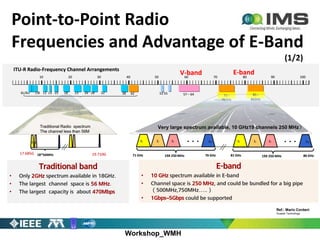
Point-to-Point Radio
Frequencies and Advantage of E-Band
(1/2)
Ref.: Mario Cordani
Huawei Technology
Workshop_WMH
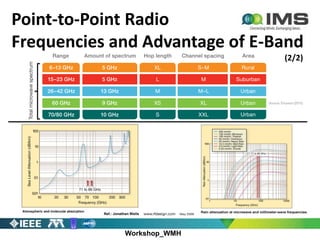
Ref.: Jonathan Wells
Point-to-Point Radio
Frequencies and Advantage of E-Band
(2/2)
Workshop_WMH
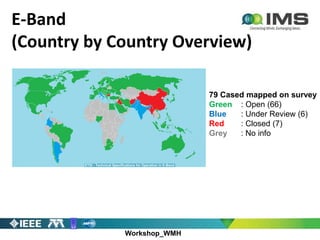
E-Band
(Country by Country Overview)
79 Cased mapped on survey
Green : Open (66)
Blue : Under Review (6)
Red : Closed (7)
Grey : No info
Workshop_WMH
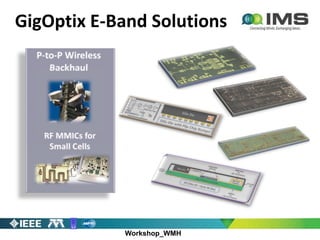
GigOptix E-Band Solutions
Workshop_WMH
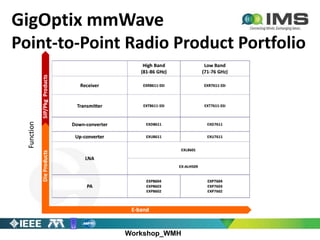
GigOptix mmWave
Point-to-Point Radio Product Portfolio
Workshop_WMH
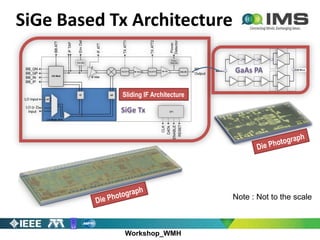
SiGe Based Tx Architecture
Sliding IF Architecture
Note : Not to the scale
Workshop_WMH
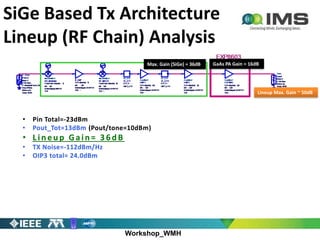
• Pin Total=-23dBm
• Pout_Tot=13dBm (Pout/tone=10dBm)
• L in eu p Gain = 3 6 d B
• TX Noise=-112dBm/Hz
• OIP3 total= 24.0dBm
SiGe Based Tx Architecture
Lineup (RF Chain) Analysis
Max. Gain (SiGe) = 36dB GaAs PA Gain = 16dB
Lineup Max. Gain ~ 50dB
Workshop_WMH
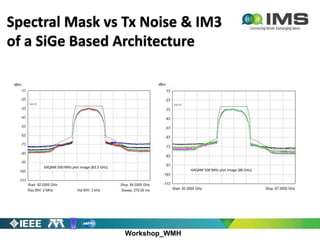
Spectral Mask vs Tx Noise & IM3
of a SiGe Based Architecture
64QAM 500 MHz plot image (86 GHz)
64QAM 500 MHz plot image (83.5 GHz)
Workshop_WMH
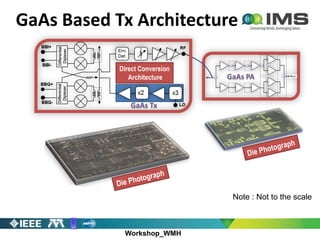
GaAs Based Tx Architecture
Note : Not to the scale
Differential
Diplexer
Differential
Diplexer
Direct Conversion
Architecture
Workshop_WMH
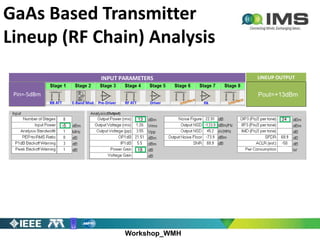
GaAs Based Transmitter
Lineup (RF Chain) Analysis
INPUT PARAMETERS LINEUP OUTPUT
Pin=-5dBm Pout=+16dBmPout=+13dBm
-5
13
18
24
24
24
24
(Output)
Workshop_WMH
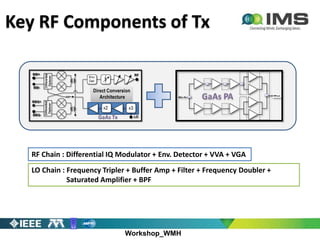
Key RF Components of Tx
RF Chain : Differential IQ Modulator + Env. Detector + VVA + VGA
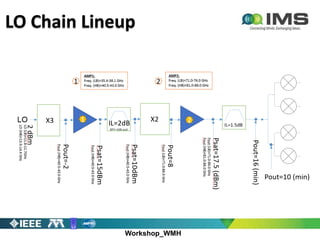
LO Chain : Frequency Tripler + Buffer Amp + Filter + Frequency Doubler +
Saturated Amplifier + BPF
Workshop_WMH
 Integrated Power Detector
 Single Ended LO port
 Designed to meet technical specifications of ETSI document ETSI EN 302 217‐2‐2.
SIP Key Parameters Unit Low Band High Band
Frequency Range GHz 71.0 – 76.0 81.0 – 86.0
LO Frequency GHz 11.8 – 12.7 13.5 – 14.4
Baseband Bandwidth GHz > 2 GHz > 2 GHz
Max Conversion Gain dB 25.0 25.0
OIP3 dBm 27.0 27.0
Psat dBm 22.0 22.0
Carrier Rejection dBc >30 >30
Image Rejection dB >35 >35
Gain Control Dynamic Range dB >35 >35
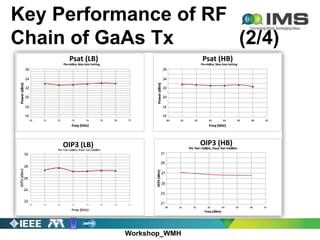
Key Performance of RF
Chain of GaAs Tx (1/4)
Workshop_WMH
22
20
18
16
24
26
22
20
18
16
24
26
27
25
23
21
29
31
28
26
24
22
30
OIP3 (LB)
Psat (HB)Psat (LB)
OIP3 (HB)
Key Performance of RF
Chain of GaAs Tx (2/4)
Workshop_WMH
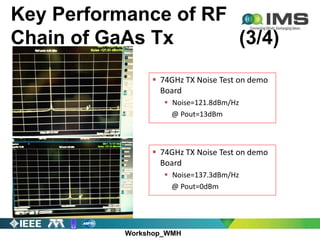
 74GHz TX Noise Test on demo
Board
 Noise=121.8dBm/Hz
@ Pout=13dBm
 74GHz TX Noise Test on demo
Board
 Noise=137.3dBm/Hz
@ Pout=0dBm
Key Performance of RF
Chain of GaAs Tx (3/4)
Workshop_WMH
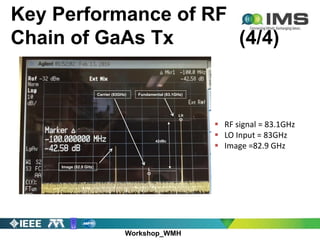
 RF signal = 83.1GHz
 LO Input = 83GHz
 Image =82.9 GHz
Fundamental (83.1GHz)Carrier (83GHz)
42dBc
Image (82.9 GHz)
Key Performance of RF
Chain of GaAs Tx (4/4)
Workshop_WMH
LO Chain Lineup
Workshop_WMH
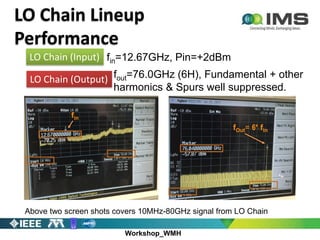
fin
fOut= 6* fin
LO Chain Lineup
Performance
LO Chain (Output)
fin=12.67GHz, Pin=+2dBmLO Chain (Input)
fout=76.0GHz (6H), Fundamental + other
harmonics & Spurs well suppressed.
Above two screen shots covers 10MHz-80GHz signal from LO Chain
Workshop_WMH
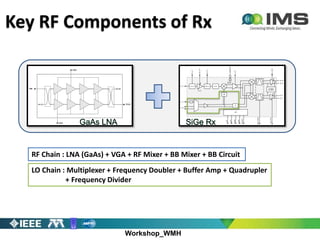
Key RF Components of Rx
RF Chain : LNA (GaAs) + VGA + RF Mixer + BB Mixer + BB Circuit
LO Chain : Multiplexer + Frequency Doubler + Buffer Amp + Quadrupler
+ Frequency Divider
Workshop_WMH
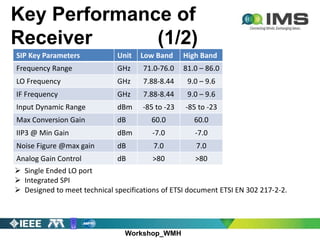
 Single Ended LO port
 Integrated SPI
 Designed to meet technical specifications of ETSI document ETSI EN 302 217‐2‐2.
SIP Key Parameters Unit Low Band High Band
Frequency Range GHz 71.0-76.0 81.0 – 86.0
LO Frequency GHz 7.88-8.44 9.0 – 9.6
IF Frequency GHz 7.88-8.44 9.0 – 9.6
Input Dynamic Range dBm -85 to -23 -85 to -23
Max Conversion Gain dB 60.0 60.0
IIP3 @ Min Gain dBm -7.0 -7.0
Noise Figure @max gain dB 7.0 7.0
Analog Gain Control dB >80 >80
Key Performance of
Receiver (1/2)
Workshop_WMH
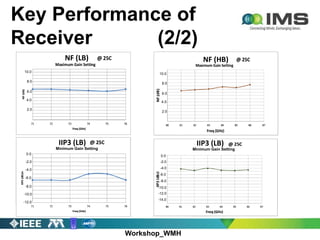
Key Performance of
Receiver (2/2)
2.0
4.0
6.0
8.0
10.0
2.0
4.0
6.0
8.0
10.0
Minimum Gain Setting Minimum Gain Setting
-2.0
0.0
-4.0
-6.0
-8.0
-10.0
-12.0
-2.0
0.0
-4.0
-6.0
-8.0
-10.0
-12.0
-14.0
NF (LB) NF (HB)
IIP3 (LB) IIP3 (LB)
Workshop_WMH
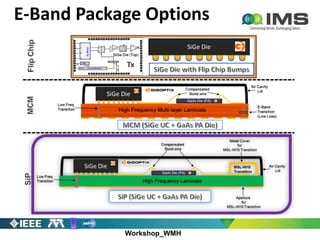
E-Band Package Options
Workshop_WMH
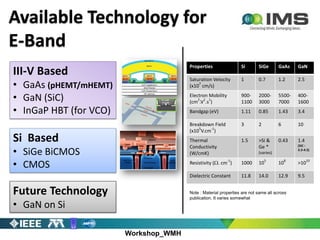
Available Technology for
E-Band
III-V Based
• GaAs (pHEMT/mHEMT)
• GaN (SiC)
• InGaP HBT (for VCO)
Si Based
• SiGe BiCMOS
• CMOS
Future Technology
• GaN on Si
Properties Si SiGe GaAs GaN
Saturation Velocity
(x10
7
cm/s)
1 0.7 1.2 2.5
Electron Mobility
(cm
2
.V
1
.s
1
)
900-
1100
2000-
3000
5500-
7000
400-
1600
Bandgap (eV) 1.11 0.85 1.43 3.4
Breakdown Field
(x10
5
V.cm
-1
)
3 2 6 10
Thermal
Conductivity
(W/cmK)
1.5 >Si &
Ge *
(varies)
0.43 1.4
(SiC :
3.3-4.5)
Resistivity (. cm
-1
) 1000 10
5
10
8
>10
10
Dielectric Constant 11.8 14.0 12.9 9.5
Note : Material properties are not same all across
publication. It varies somewhat
Workshop_WMH
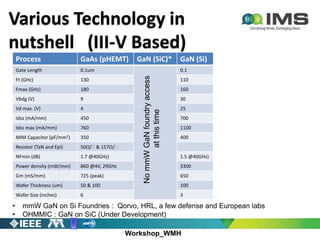
Process GaAs (pHEMT) GaN (SiC)* GaN (Si)
Gate Length 0.1um 0.1
Ft (GHz) 130 110
Fmax (GHz) 180 160
Vbdg (V) 9 30
Vd max. (V) 4 25
Idss (mA/mm) 450 700
Idss max (mA/mm) 760 1100
MIM Capacitor (pF/mm2) 350 400
Resistor (TaN and Epi) 50Ω/ & 157Ω/
NFmin (dB) 1.7 @40GHz) 1.5 @40GHz)
Power density (mW/mm) 860 @4V, 29GHz 3300
Gm (mS/mm) 725 (peak) 650
Wafer Thickness (um) 50 & 100 100
Wafer Size (inches) 6 3
Various Technology in
nutshell (III-V Based)
NommWGaNfoundryaccess
atthistime
• mmW GaN on Si Foundries : Qorvo, HRL, a few defense and European labs
• OHMMIC : GaN on SiC (Under Development)
Workshop_WMH
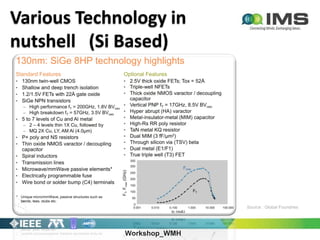
Various Technology in
nutshell (Si Based)
Source : Global Foundries
28
• Success at E-band and above will rely on
technologies that provide increased
performance and higher levels of integration
• WIN’s next generation technologies will
address both market needs
Performance
– Ft above 180 GHz
– Hot Via eliminates bond wires and enables
wafer scale packaging
Integration
– 4-metal back end, front side ground plane
– Monolithic schottky or PIN diodes
– Standard E/D logic gates
– Now with monolithic PN diodes for compact ESD
protection
Beyond PP10: Enabling New Functions
And Higher Integration
BS
via
4mil GaAs substrate
Au/Sn Eutectic
Isolated BS metal
Hot
Via
RF Isolated Through Wafer Via
Workshop_WMH
Why GaN
 High Breakdown Field
 10x of Si or GaAs
 High Power Density
 2-10x of Si or GaAs
 Good Thermal Conductivity
 Higher Impedances
 Best Power Device Figure of Merit
 Low Dielectric Constant
 Lower Intrinsic Capacitances
JFM = Johnson's figure of merit is a measure of suitability of a semiconductor material
for high frequency power transistor applications and requirements
JFM=(Breakdown, electron velocity product) [Eb*Vbr/2π]
 Highest Johnson Figure of Merit
 Si=1.0, GaAs=2.7, SiC=20,
GaN=27.5
Workshop_WMH
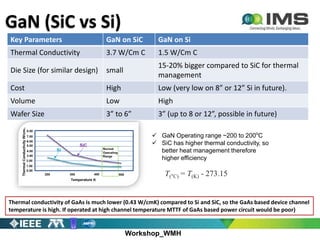
GaN (SiC vs Si)
 GaN Operating range ~200 to 200o
C
 SiC has higher thermal conductivity, so
better heat management therefore
higher efficiency
Key Parameters GaN on SiC GaN on Si
Thermal Conductivity 3.7 W/Cm C 1.5 W/Cm C
Die Size (for similar design) small
15-20% bigger compared to SiC for thermal
management
Cost High Low (very low on 8” or 12” Si in future).
Volume Low High
Wafer Size 3” to 6” 3” (up to 8 or 12”, possible in future)
T(°C) = T(K) - 273.15
Thermal conductivity of GaAs is much lower (0.43 W/cmK) compared to Si and SiC, so the GaAs based device channel
temperature is high. If operated at high channel temperature MTTF of GaAs based power circuit would be poor)
Workshop_WMH
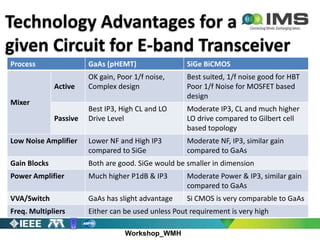
Technology Advantages for a
given Circuit for E-band Transceiver
Process GaAs (pHEMT) SiGe BiCMOS
Mixer
Active
OK gain, Poor 1/f noise,
Complex design
Best suited, 1/f noise good for HBT
Poor 1/f Noise for MOSFET based
design
Passive
Best IP3, High CL and LO
Drive Level
Moderate IP3, CL and much higher
LO drive compared to Gilbert cell
based topology
Low Noise Amplifier Lower NF and High IP3
compared to SiGe
Moderate NF, IP3, similar gain
compared to GaAs
Gain Blocks Both are good. SiGe would be smaller in dimension
Power Amplifier Much higher P1dB & IP3 Moderate Power & IP3, similar gain
compared to GaAs
VVA/Switch GaAs has slight advantage Si CMOS is very comparable to GaAs
Freq. Multipliers Either can be used unless Pout requirement is very high
Workshop_WMH
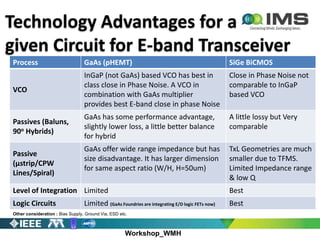
Technology Advantages for a
given Circuit for E-band Transceiver
Process GaAs (pHEMT) SiGe BiCMOS
VCO
InGaP (not GaAs) based VCO has best in
class close in Phase Noise. A VCO in
combination with GaAs multiplier
provides best E-band close in phase Noise
Close in Phase Noise not
comparable to InGaP
based VCO
Passives (Baluns,
90o Hybrids)
GaAs has some performance advantage,
slightly lower loss, a little better balance
for hybrid
A little lossy but Very
comparable
Passive
(µstrip/CPW
Lines/Spiral)
GaAs offer wide range impedance but has
size disadvantage. It has larger dimension
for same aspect ratio (W/H, H=50um)
TxL Geometries are much
smaller due to TFMS.
Limited Impedance range
& low Q
Level of Integration Limited Best
Logic Circuits Limited (GaAs Foundries are integrating E/D logic FETs now) Best
Other consideration : Bias Supply, Ground Via, ESD etc.
Workshop_WMH
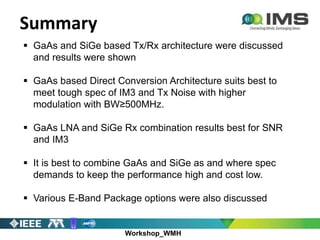
Summary
 GaAs and SiGe based Tx/Rx architecture were discussed
and results were shown
 GaAs based Direct Conversion Architecture suits best to
meet tough spec of IM3 and Tx Noise with higher
modulation with BW≥500MHz.
 GaAs LNA and SiGe Rx combination results best for SNR
and IM3
 It is best to combine GaAs and SiGe as and where spec
demands to keep the performance high and cost low.
 Various E-Band Package options were also discussed
Workshop_WMH
Acknowledgements
Author is thankful to all Team members, especially to Andrea Betti-Berutto
(CTO) for his guidance and design support. Shawn Parker for his outstanding
designs. Neir Chen, Yunzhou, Linda for their tireless effort to provide best
possible test, software development and board designs. James Little, Jeff
Illinger, Jack Kennedy, Chris Saints for IC design and layout support. Steve
Chaote, Matin Vagues, Ratan Chaudhary for their Op & Qual support. Phuong
Vo and Hoa Ho for all their assembly work.
Special thanks to Avi Katz (CEO), Raluca Dinu (EVP), for their constant
encouragement.

IMS2016_Workshop_SK 03232016

  • 1.
    Workshop_WMH Trade-offs in theDesign of E- band Transceiver MMICs for Gigabit Wireless Link Application Sushil Kumar 130 Baytech Dr, San Jose, CA, USA
  • 2.
  • 3.
    Workshop_WMH  Introduction  GigOptixE-Band Solution • SiGe Based Tx • GaAs Based Tx • GaAs+SiGe Based Rx • Measured Results • E-Band Package Options  Available Semiconductor Technologies for E-Band & Technology Advantage for a Circuit Design  Summary Outline
  • 4.
    Workshop_WMH Point-to-Point Radio Frequencies andAdvantage of E-Band (1/2) Ref.: Mario Cordani Huawei Technology
  • 5.
    Workshop_WMH Ref.: Jonathan Wells Point-to-PointRadio Frequencies and Advantage of E-Band (2/2)
  • 6.
    Workshop_WMH E-Band (Country by CountryOverview) 79 Cased mapped on survey Green : Open (66) Blue : Under Review (6) Red : Closed (7) Grey : No info
  • 7.
  • 8.
  • 9.
    Workshop_WMH SiGe Based TxArchitecture Sliding IF Architecture Note : Not to the scale
  • 10.
    Workshop_WMH • Pin Total=-23dBm •Pout_Tot=13dBm (Pout/tone=10dBm) • L in eu p Gain = 3 6 d B • TX Noise=-112dBm/Hz • OIP3 total= 24.0dBm SiGe Based Tx Architecture Lineup (RF Chain) Analysis Max. Gain (SiGe) = 36dB GaAs PA Gain = 16dB Lineup Max. Gain ~ 50dB
  • 11.
    Workshop_WMH Spectral Mask vsTx Noise & IM3 of a SiGe Based Architecture 64QAM 500 MHz plot image (86 GHz) 64QAM 500 MHz plot image (83.5 GHz)
  • 12.
    Workshop_WMH GaAs Based TxArchitecture Note : Not to the scale Differential Diplexer Differential Diplexer Direct Conversion Architecture
  • 13.
    Workshop_WMH GaAs Based Transmitter Lineup(RF Chain) Analysis INPUT PARAMETERS LINEUP OUTPUT Pin=-5dBm Pout=+16dBmPout=+13dBm -5 13 18 24 24 24 24 (Output)
  • 14.
    Workshop_WMH Key RF Componentsof Tx RF Chain : Differential IQ Modulator + Env. Detector + VVA + VGA LO Chain : Frequency Tripler + Buffer Amp + Filter + Frequency Doubler + Saturated Amplifier + BPF
  • 15.
    Workshop_WMH  Integrated PowerDetector  Single Ended LO port  Designed to meet technical specifications of ETSI document ETSI EN 302 217‐2‐2. SIP Key Parameters Unit Low Band High Band Frequency Range GHz 71.0 – 76.0 81.0 – 86.0 LO Frequency GHz 11.8 – 12.7 13.5 – 14.4 Baseband Bandwidth GHz > 2 GHz > 2 GHz Max Conversion Gain dB 25.0 25.0 OIP3 dBm 27.0 27.0 Psat dBm 22.0 22.0 Carrier Rejection dBc >30 >30 Image Rejection dB >35 >35 Gain Control Dynamic Range dB >35 >35 Key Performance of RF Chain of GaAs Tx (1/4)
  • 16.
  • 17.
    Workshop_WMH  74GHz TXNoise Test on demo Board  Noise=121.8dBm/Hz @ Pout=13dBm  74GHz TX Noise Test on demo Board  Noise=137.3dBm/Hz @ Pout=0dBm Key Performance of RF Chain of GaAs Tx (3/4)
  • 18.
    Workshop_WMH  RF signal= 83.1GHz  LO Input = 83GHz  Image =82.9 GHz Fundamental (83.1GHz)Carrier (83GHz) 42dBc Image (82.9 GHz) Key Performance of RF Chain of GaAs Tx (4/4)
  • 19.
  • 20.
    Workshop_WMH fin fOut= 6* fin LOChain Lineup Performance LO Chain (Output) fin=12.67GHz, Pin=+2dBmLO Chain (Input) fout=76.0GHz (6H), Fundamental + other harmonics & Spurs well suppressed. Above two screen shots covers 10MHz-80GHz signal from LO Chain
  • 21.
    Workshop_WMH Key RF Componentsof Rx RF Chain : LNA (GaAs) + VGA + RF Mixer + BB Mixer + BB Circuit LO Chain : Multiplexer + Frequency Doubler + Buffer Amp + Quadrupler + Frequency Divider
  • 22.
    Workshop_WMH  Single EndedLO port  Integrated SPI  Designed to meet technical specifications of ETSI document ETSI EN 302 217‐2‐2. SIP Key Parameters Unit Low Band High Band Frequency Range GHz 71.0-76.0 81.0 – 86.0 LO Frequency GHz 7.88-8.44 9.0 – 9.6 IF Frequency GHz 7.88-8.44 9.0 – 9.6 Input Dynamic Range dBm -85 to -23 -85 to -23 Max Conversion Gain dB 60.0 60.0 IIP3 @ Min Gain dBm -7.0 -7.0 Noise Figure @max gain dB 7.0 7.0 Analog Gain Control dB >80 >80 Key Performance of Receiver (1/2)
  • 23.
    Workshop_WMH Key Performance of Receiver(2/2) 2.0 4.0 6.0 8.0 10.0 2.0 4.0 6.0 8.0 10.0 Minimum Gain Setting Minimum Gain Setting -2.0 0.0 -4.0 -6.0 -8.0 -10.0 -12.0 -2.0 0.0 -4.0 -6.0 -8.0 -10.0 -12.0 -14.0 NF (LB) NF (HB) IIP3 (LB) IIP3 (LB)
  • 24.
  • 25.
    Workshop_WMH Available Technology for E-Band III-VBased • GaAs (pHEMT/mHEMT) • GaN (SiC) • InGaP HBT (for VCO) Si Based • SiGe BiCMOS • CMOS Future Technology • GaN on Si Properties Si SiGe GaAs GaN Saturation Velocity (x10 7 cm/s) 1 0.7 1.2 2.5 Electron Mobility (cm 2 .V 1 .s 1 ) 900- 1100 2000- 3000 5500- 7000 400- 1600 Bandgap (eV) 1.11 0.85 1.43 3.4 Breakdown Field (x10 5 V.cm -1 ) 3 2 6 10 Thermal Conductivity (W/cmK) 1.5 >Si & Ge * (varies) 0.43 1.4 (SiC : 3.3-4.5) Resistivity (. cm -1 ) 1000 10 5 10 8 >10 10 Dielectric Constant 11.8 14.0 12.9 9.5 Note : Material properties are not same all across publication. It varies somewhat
  • 26.
    Workshop_WMH Process GaAs (pHEMT)GaN (SiC)* GaN (Si) Gate Length 0.1um 0.1 Ft (GHz) 130 110 Fmax (GHz) 180 160 Vbdg (V) 9 30 Vd max. (V) 4 25 Idss (mA/mm) 450 700 Idss max (mA/mm) 760 1100 MIM Capacitor (pF/mm2) 350 400 Resistor (TaN and Epi) 50Ω/ & 157Ω/ NFmin (dB) 1.7 @40GHz) 1.5 @40GHz) Power density (mW/mm) 860 @4V, 29GHz 3300 Gm (mS/mm) 725 (peak) 650 Wafer Thickness (um) 50 & 100 100 Wafer Size (inches) 6 3 Various Technology in nutshell (III-V Based) NommWGaNfoundryaccess atthistime • mmW GaN on Si Foundries : Qorvo, HRL, a few defense and European labs • OHMMIC : GaN on SiC (Under Development)
  • 27.
    Workshop_WMH Various Technology in nutshell(Si Based) Source : Global Foundries
  • 28.
    28 • Success atE-band and above will rely on technologies that provide increased performance and higher levels of integration • WIN’s next generation technologies will address both market needs Performance – Ft above 180 GHz – Hot Via eliminates bond wires and enables wafer scale packaging Integration – 4-metal back end, front side ground plane – Monolithic schottky or PIN diodes – Standard E/D logic gates – Now with monolithic PN diodes for compact ESD protection Beyond PP10: Enabling New Functions And Higher Integration BS via 4mil GaAs substrate Au/Sn Eutectic Isolated BS metal Hot Via RF Isolated Through Wafer Via
  • 29.
    Workshop_WMH Why GaN  HighBreakdown Field  10x of Si or GaAs  High Power Density  2-10x of Si or GaAs  Good Thermal Conductivity  Higher Impedances  Best Power Device Figure of Merit  Low Dielectric Constant  Lower Intrinsic Capacitances JFM = Johnson's figure of merit is a measure of suitability of a semiconductor material for high frequency power transistor applications and requirements JFM=(Breakdown, electron velocity product) [Eb*Vbr/2π]  Highest Johnson Figure of Merit  Si=1.0, GaAs=2.7, SiC=20, GaN=27.5
  • 30.
    Workshop_WMH GaN (SiC vsSi)  GaN Operating range ~200 to 200o C  SiC has higher thermal conductivity, so better heat management therefore higher efficiency Key Parameters GaN on SiC GaN on Si Thermal Conductivity 3.7 W/Cm C 1.5 W/Cm C Die Size (for similar design) small 15-20% bigger compared to SiC for thermal management Cost High Low (very low on 8” or 12” Si in future). Volume Low High Wafer Size 3” to 6” 3” (up to 8 or 12”, possible in future) T(°C) = T(K) - 273.15 Thermal conductivity of GaAs is much lower (0.43 W/cmK) compared to Si and SiC, so the GaAs based device channel temperature is high. If operated at high channel temperature MTTF of GaAs based power circuit would be poor)
  • 31.
    Workshop_WMH Technology Advantages fora given Circuit for E-band Transceiver Process GaAs (pHEMT) SiGe BiCMOS Mixer Active OK gain, Poor 1/f noise, Complex design Best suited, 1/f noise good for HBT Poor 1/f Noise for MOSFET based design Passive Best IP3, High CL and LO Drive Level Moderate IP3, CL and much higher LO drive compared to Gilbert cell based topology Low Noise Amplifier Lower NF and High IP3 compared to SiGe Moderate NF, IP3, similar gain compared to GaAs Gain Blocks Both are good. SiGe would be smaller in dimension Power Amplifier Much higher P1dB & IP3 Moderate Power & IP3, similar gain compared to GaAs VVA/Switch GaAs has slight advantage Si CMOS is very comparable to GaAs Freq. Multipliers Either can be used unless Pout requirement is very high
  • 32.
    Workshop_WMH Technology Advantages fora given Circuit for E-band Transceiver Process GaAs (pHEMT) SiGe BiCMOS VCO InGaP (not GaAs) based VCO has best in class close in Phase Noise. A VCO in combination with GaAs multiplier provides best E-band close in phase Noise Close in Phase Noise not comparable to InGaP based VCO Passives (Baluns, 90o Hybrids) GaAs has some performance advantage, slightly lower loss, a little better balance for hybrid A little lossy but Very comparable Passive (µstrip/CPW Lines/Spiral) GaAs offer wide range impedance but has size disadvantage. It has larger dimension for same aspect ratio (W/H, H=50um) TxL Geometries are much smaller due to TFMS. Limited Impedance range & low Q Level of Integration Limited Best Logic Circuits Limited (GaAs Foundries are integrating E/D logic FETs now) Best Other consideration : Bias Supply, Ground Via, ESD etc.
  • 33.
    Workshop_WMH Summary  GaAs andSiGe based Tx/Rx architecture were discussed and results were shown  GaAs based Direct Conversion Architecture suits best to meet tough spec of IM3 and Tx Noise with higher modulation with BW≥500MHz.  GaAs LNA and SiGe Rx combination results best for SNR and IM3  It is best to combine GaAs and SiGe as and where spec demands to keep the performance high and cost low.  Various E-Band Package options were also discussed
  • 34.
    Workshop_WMH Acknowledgements Author is thankfulto all Team members, especially to Andrea Betti-Berutto (CTO) for his guidance and design support. Shawn Parker for his outstanding designs. Neir Chen, Yunzhou, Linda for their tireless effort to provide best possible test, software development and board designs. James Little, Jeff Illinger, Jack Kennedy, Chris Saints for IC design and layout support. Steve Chaote, Matin Vagues, Ratan Chaudhary for their Op & Qual support. Phuong Vo and Hoa Ho for all their assembly work. Special thanks to Avi Katz (CEO), Raluca Dinu (EVP), for their constant encouragement.