Tuesday July 12, 2011


    Hubbs Center - ELL 7
   Agenda and Objectives
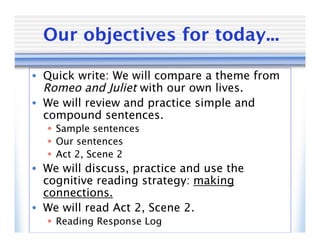
Our objectives for today...

• Quick write: We will compare a theme from
  Romeo and Juliet with our own lives.
• We will review and practice simple and
  compound sentences.
   Sample sentences
   Our sentences
   Act 2, Scene 2
• We will discuss, practice and use the
  cognitive reading strategy: making
  connections.
• We will read Act 2, Scene 2.
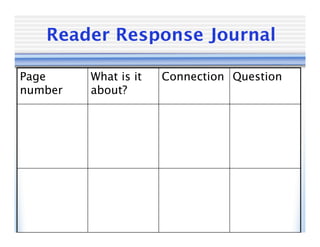
   Reading Response Log
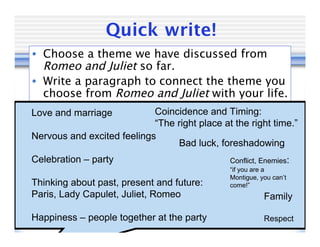
Quick write!
• Choose a theme we have discussed from
  Romeo and Juliet so far.
• Write a paragraph to connect the theme you
  choose from Romeo and Juliet with your life.
Love and marriage           Coincidence and Timing:
                            “The right place at the right time.”
Nervous and excited feelings
                                 Bad luck, foreshadowing
Celebration – party                            Conflict, Enemies:
                                               “if you are a
                                               Montigue, you can’t
Thinking about past, present and future:       come!”
Paris, Lady Capulet, Juliet, Romeo                        Family

Happiness – people together at the party                  Respect
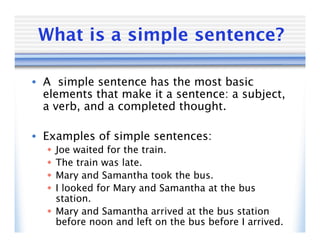
What is a simple sentence?

• A simple sentence has the most basic
  elements that make it a sentence: a subject,
  a verb, and a completed thought.

• Examples of simple sentences:
   Joe waited for the train.
   The train was late.
   Mary and Samantha took the bus.
   I looked for Mary and Samantha at the bus
    station.
   Mary and Samantha arrived at the bus station
    before noon and left on the bus before I arrived.
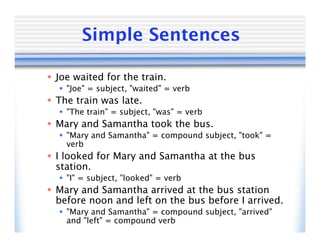
Simple Sentences

 Joe waited for the train.
   "Joe" = subject, "waited" = verb
 The train was late.
   "The train" = subject, "was" = verb
 Mary and Samantha took the bus.
   "Mary and Samantha" = compound subject, "took" =
    verb
 I looked for Mary and Samantha at the bus
  station.
   "I" = subject, "looked" = verb
 Mary and Samantha arrived at the bus station
  before noon and left on the bus before I arrived.
   "Mary and Samantha" = compound subject, "arrived"
    and "left" = compound verb
Our own simple sentences

•
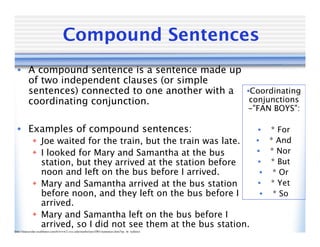
Compound Sentences
  • A compound sentence is a sentence made up
    of two independent clauses (or simple
    sentences) connected to one another with a •Coordinating
    coordinating conjunction.                   conjunctions
                                                                                               -"FAN BOYS":

  • Examples of compound sentences:                                                              • * For
             Joe waited for the train, but the train was late.                                 • * And
             I looked for Mary and Samantha at the bus                                         • * Nor
              station, but they arrived at the station before                                    • * But
              noon and left on the bus before I arrived.                                          • * Or
             Mary and Samantha arrived at the bus station                                       • * Yet
              before noon, and they left on the bus before I                                      • * So
              arrived.
             Mary and Samantha left on the bus before I
              arrived, so I did not see them at the bus station.
http://transcoder.usablenet.com/tt/www2.ivcc.edu/rambo/eng1001/sentences.htm?un_jtt_redirect
Our own compound
        sentences

•
Sentence Hunt!

• We are now going to “hunt”, or look
  for, examples of simple and
  compound sentences...
   in our writing (Quick Write from today)
   in Act 2, Scene 2 of Romeo and Juliet.
• Circle simple sentences
• Underline compound sentences
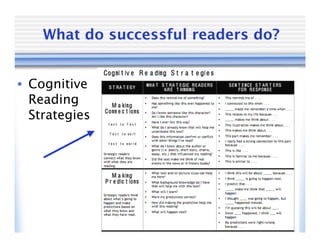
What do successful readers do?


• Cognitive
  Reading
  Strategies
Reader Response Journal

Page     What is it   Connection Question
number   about?
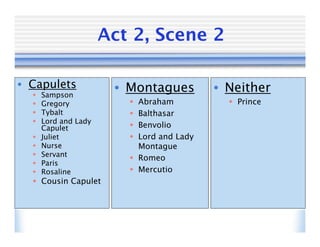
Act 2, Scene 2

• Capulets             • Montagues         • Neither
     Sampson
     Gregory             Abraham            Prince
     Tybalt              Balthasar
     Lord and Lady
      Capulet             Benvolio
     Juliet              Lord and Lady
     Nurse                Montague
     Servant
                          Romeo
     Paris
     Rosaline            Mercutio
   Cousin Capulet

7-12-11

  • 1.
    Tuesday July 12,2011 Hubbs Center - ELL 7 Agenda and Objectives
  • 2.
    Our objectives fortoday... • Quick write: We will compare a theme from Romeo and Juliet with our own lives. • We will review and practice simple and compound sentences.  Sample sentences  Our sentences  Act 2, Scene 2 • We will discuss, practice and use the cognitive reading strategy: making connections. • We will read Act 2, Scene 2.  Reading Response Log
  • 3.
    Quick write! • Choosea theme we have discussed from Romeo and Juliet so far. • Write a paragraph to connect the theme you choose from Romeo and Juliet with your life. Love and marriage Coincidence and Timing: “The right place at the right time.” Nervous and excited feelings Bad luck, foreshadowing Celebration – party Conflict, Enemies: “if you are a Montigue, you can’t Thinking about past, present and future: come!” Paris, Lady Capulet, Juliet, Romeo Family Happiness – people together at the party Respect
  • 4.
    What is asimple sentence? • A simple sentence has the most basic elements that make it a sentence: a subject, a verb, and a completed thought. • Examples of simple sentences:  Joe waited for the train.  The train was late.  Mary and Samantha took the bus.  I looked for Mary and Samantha at the bus station.  Mary and Samantha arrived at the bus station before noon and left on the bus before I arrived.
  • 5.
    Simple Sentences  Joewaited for the train.  "Joe" = subject, "waited" = verb  The train was late.  "The train" = subject, "was" = verb  Mary and Samantha took the bus.  "Mary and Samantha" = compound subject, "took" = verb  I looked for Mary and Samantha at the bus station.  "I" = subject, "looked" = verb  Mary and Samantha arrived at the bus station before noon and left on the bus before I arrived.  "Mary and Samantha" = compound subject, "arrived" and "left" = compound verb
  • 6.
    Our own simplesentences •
  • 7.
    Compound Sentences • A compound sentence is a sentence made up of two independent clauses (or simple sentences) connected to one another with a •Coordinating coordinating conjunction. conjunctions -"FAN BOYS": • Examples of compound sentences: • * For  Joe waited for the train, but the train was late. • * And  I looked for Mary and Samantha at the bus • * Nor station, but they arrived at the station before • * But noon and left on the bus before I arrived. • * Or  Mary and Samantha arrived at the bus station • * Yet before noon, and they left on the bus before I • * So arrived.  Mary and Samantha left on the bus before I arrived, so I did not see them at the bus station. http://transcoder.usablenet.com/tt/www2.ivcc.edu/rambo/eng1001/sentences.htm?un_jtt_redirect
  • 8.
    Our own compound sentences •
  • 9.
    Sentence Hunt! • Weare now going to “hunt”, or look for, examples of simple and compound sentences...  in our writing (Quick Write from today)  in Act 2, Scene 2 of Romeo and Juliet. • Circle simple sentences • Underline compound sentences
  • 10.
    What do successfulreaders do? • Cognitive Reading Strategies
  • 11.
    Reader Response Journal Page What is it Connection Question number about?
  • 12.
    Act 2, Scene2 • Capulets • Montagues • Neither  Sampson  Gregory  Abraham  Prince  Tybalt  Balthasar  Lord and Lady Capulet  Benvolio  Juliet  Lord and Lady  Nurse Montague  Servant  Romeo  Paris  Rosaline  Mercutio  Cousin Capulet