Wednesday August 3, 2011

     Hubbs Center - ELL 7
    Agenda and Objectives
Today’s objectives...
• We will read and discuss how a real life Romeo and
  Juliet story is similar to and different from
  Shakespeare’s Romeo and Juliet.
• We will do a "Who Said What?" match-up activity
  between characters from Act 3 & Act 4 and lines they
  spoke.
• We will read and discuss Act 4, Scenes 1 and 2
  together.
• We will make inferences about what happens in Act
  4, Scene 1.
Warm up:
 Romeo and Juliet...in Miami?
• For our warm up activity, please read the
  article “Missing ‘Romeo and Juliet’ Teens
  Return Home”.
• While you are reading, think about how this
  modern story is similar to and different from
  Shakespeare’s Romeo and Juliet.
• Fill out the Compare-Contrast sheet on the
  back of the article when you finish reading.
• We will discuss your comparisons of the two
  articles and any questions you might have at
  9:30 or so.
Shakespeare’s                                     Miami’s
Romeo and Juliet                                  Romeo and Juliet story

Different from the other   Similar to the other   Different from the other
         story:                   story:                   story:
“Who Said What?”
•   We will complete a Character Study handout to help us remember who did
    and said what in Act 3.
•   Then, we will do a matching activity between the names of characters from
    Act 3 and Act 4 and the lines they spoke.
•   You will get a card with either a character’s name or a line of dialogue from
    Act 3 and Act 4.
•   When I say go, mingle around the room to try to find the person whose card
    matches yours.
•   When you find your partner, sit down together and write down why you think
    the quote on your card is important.

•   Example: If my card says, “There is no world outside Verona. Everything I
    love is here”, I should look for someone with a card that says “Romeo”.
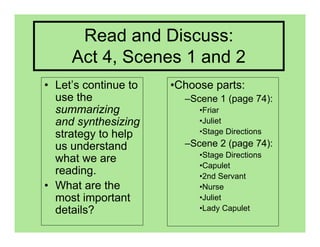
Read and Discuss:
     Act 4, Scenes 1 and 2
• Let’s continue to   •Choose parts:
  use the               –Scene 1 (page 74):
  summarizing              •Friar
  and synthesizing         •Juliet
  strategy to help         •Stage Directions
  us understand         –Scene 2 (page 74):
                           •Stage Directions
  what we are
                           •Capulet
  reading.                 •2nd Servant
• What are the             •Nurse
  most important           •Juliet
  details?                 •Lady Capulet
Understanding Inferences
• What is a prediction?
  – A guess that might be right or wrong. We
    find out the correct answer.
• What is an inference?
  – Logical ideas or an argument for
    something using evidence and background
    knowledge. There are no right or wrong
    answers, and it’s not a guess.


                       http://conclusionsinferencing.blogspot.com/
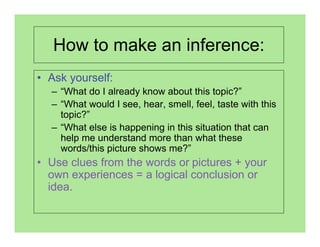
How to make an inference:
• Ask yourself:
  – “What do I already know about this topic?”
  – “What would I see, hear, smell, feel, taste with this
    topic?”
  – “What else is happening in this situation that can
    help me understand more than what these
    words/this picture shows me?”
• Use clues from the words or pictures + your
  own experiences = a logical conclusion or
  idea.
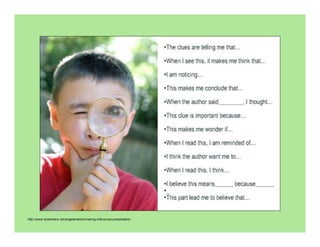
http://www.slideshare.net/angelamaiers/making-inferences-presentation
http://4.bp.blogspot.com/_a1WqrZsEZxA/SvpWJf-2zxI/AAAAAAAACAY/eaHOCR-7Rsk/s320/sad+people.png


http://thesunnygirl.files.wordpress.com/2010/11/happypeople.jpg


    Make inferences about these pictures...


                                                                                                                                                                       http://courses.moodleshare.com/file.php/64/Images/reading_thinking.jpg


   http://philmaharg.files.wordpress.com/2011/06/angry_people_at_work3.jpg


                                                                                        http://www.studyzone.org/testprep/ela4/o/j0092127.gif
Make inferences about R+J
• Let’s look at some of the important things that
  happened in Act 4, Scenes 1 and 2.

• What happened?
• Why do you think this happened?
• What evidence or clues does the story give
  that helped you make your inference?

8-3-11

  • 1.
    Wednesday August 3,2011 Hubbs Center - ELL 7 Agenda and Objectives
  • 2.
    Today’s objectives... • Wewill read and discuss how a real life Romeo and Juliet story is similar to and different from Shakespeare’s Romeo and Juliet. • We will do a "Who Said What?" match-up activity between characters from Act 3 & Act 4 and lines they spoke. • We will read and discuss Act 4, Scenes 1 and 2 together. • We will make inferences about what happens in Act 4, Scene 1.
  • 3.
    Warm up: Romeoand Juliet...in Miami? • For our warm up activity, please read the article “Missing ‘Romeo and Juliet’ Teens Return Home”. • While you are reading, think about how this modern story is similar to and different from Shakespeare’s Romeo and Juliet. • Fill out the Compare-Contrast sheet on the back of the article when you finish reading. • We will discuss your comparisons of the two articles and any questions you might have at 9:30 or so.
  • 4.
    Shakespeare’s Miami’s Romeo and Juliet Romeo and Juliet story Different from the other Similar to the other Different from the other story: story: story:
  • 5.
    “Who Said What?” • We will complete a Character Study handout to help us remember who did and said what in Act 3. • Then, we will do a matching activity between the names of characters from Act 3 and Act 4 and the lines they spoke. • You will get a card with either a character’s name or a line of dialogue from Act 3 and Act 4. • When I say go, mingle around the room to try to find the person whose card matches yours. • When you find your partner, sit down together and write down why you think the quote on your card is important. • Example: If my card says, “There is no world outside Verona. Everything I love is here”, I should look for someone with a card that says “Romeo”.
  • 6.
    Read and Discuss: Act 4, Scenes 1 and 2 • Let’s continue to •Choose parts: use the –Scene 1 (page 74): summarizing •Friar and synthesizing •Juliet strategy to help •Stage Directions us understand –Scene 2 (page 74): •Stage Directions what we are •Capulet reading. •2nd Servant • What are the •Nurse most important •Juliet details? •Lady Capulet
  • 7.
    Understanding Inferences • Whatis a prediction? – A guess that might be right or wrong. We find out the correct answer. • What is an inference? – Logical ideas or an argument for something using evidence and background knowledge. There are no right or wrong answers, and it’s not a guess. http://conclusionsinferencing.blogspot.com/
  • 8.
    How to makean inference: • Ask yourself: – “What do I already know about this topic?” – “What would I see, hear, smell, feel, taste with this topic?” – “What else is happening in this situation that can help me understand more than what these words/this picture shows me?” • Use clues from the words or pictures + your own experiences = a logical conclusion or idea.
  • 9.
  • 10.
    http://4.bp.blogspot.com/_a1WqrZsEZxA/SvpWJf-2zxI/AAAAAAAACAY/eaHOCR-7Rsk/s320/sad+people.png http://thesunnygirl.files.wordpress.com/2010/11/happypeople.jpg Make inferences about these pictures... http://courses.moodleshare.com/file.php/64/Images/reading_thinking.jpg http://philmaharg.files.wordpress.com/2011/06/angry_people_at_work3.jpg http://www.studyzone.org/testprep/ela4/o/j0092127.gif
  • 11.
    Make inferences aboutR+J • Let’s look at some of the important things that happened in Act 4, Scenes 1 and 2. • What happened? • Why do you think this happened? • What evidence or clues does the story give that helped you make your inference?