ZEAL GROUP
OUTLINES Of SDR’s
Introduction
Meaning
Uses
Values
Cost Involved
Interest Rates
Principles
Additional uses
Merits
Critisisms
INTRODUCTION OF SPCIAL DRAWING RIGHTS
SDR were created by the IMF in 1969 and were
intended to be an asset held in foreign exchange
reserve under the Brettonwoods system of fixed
exchange rates
All powers of the IMF are vested in the Board of
Governs.
MENING OF SDR’s
SDR is an interest bearing international
reserve asset created by IMF in 1969 to supplement
other reserve of member
countries.
The SDR based on a basket of International currency
comprising the US Dollar ,Japense,yen,euro &pound
sterling.
It is not a currency not a cliam on the IMF but it is a
potentially a cliam on freely usable currency of IMF
members.
USES OF SDR
• SDR is an international unit of account
• SDR is on international monetary asset
• Transactions in various methods
• SDR used on the means of payment
• They can’t be used for any other purpose
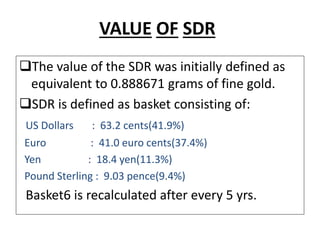
VALUE OF SDR
The value of the SDR was initially defined as
equivalent to 0.888671 grams of fine gold.
SDR is defined as basket consisting of:
US Dollars : 63.2 cents(41.9%)
Euro : 41.0 euro cents(37.4%)
Yen : 18.4 yen(11.3%)
Pound Sterling : 9.03 pence(9.4%)
Basket6 is recalculated after every 5 yrs.
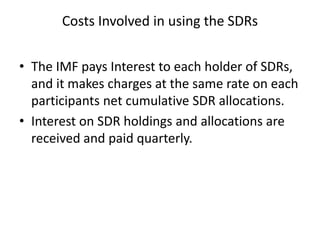
Costs Involved in using the SDRs
• The IMF pays Interest to each holder of SDRs,
and it makes charges at the same rate on each
participants net cumulative SDR allocations.
• Interest on SDR holdings and allocations are
received and paid quarterly.
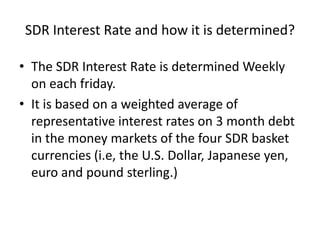
SDR Interest Rate and how it is determined?
• The SDR Interest Rate is determined Weekly
on each friday.
• It is based on a weighted average of
representative interest rates on 3 month debt
in the money markets of the four SDR basket
currencies (i.e, the U.S. Dollar, Japanese yen,
euro and pound sterling.)
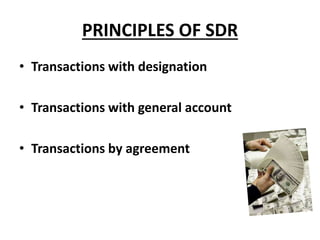
PRINCIPLES OF SDR
• Transactions with designation
• Transactions with general account
• Transactions by agreement
ADDITIONAL USES OF SDR’s
• Swap arrangement
• In forward operation
• In loan
• In the settlement of financial obligation
• As security for the performance or financial
obligation
MERITS OF SDR
1. SDR’s are new form of international
monetory reserve.
2. No dependence on the supply of gold
3. It can’t be demonitized.
4. Unlike gold, SDR’s are costly to process
5. SDR improves international liquidity
6. No need to change domestic economic
policy
7. Easier and more flexible
8. Act as a both unit of account and means of
payment
CRITISISIMS OF SDR
1. In-equitable distribution
2. Not linked with development finance
3. High interest rates
4. Failure to distribute social saving
5. Failure to meet international liquidity requirement
CONCLUSION
Hence SDR is used to solve the international
monetary problems such as balance of
payment.
It holds reserves in central bank and finance the
government.
Presented By
• Divya
• Gowthami
• Nagaratna
• Swathi
• Shambhavi
• Arpitha
• Malashree
• Shruthi
• Sangaiha
• Sai Rama
• Janaki
• Anil
• Supriya

Specal Drawin

  • 2.
    ZEAL GROUP OUTLINES OfSDR’s Introduction Meaning Uses Values Cost Involved Interest Rates Principles Additional uses Merits Critisisms
  • 3.
    INTRODUCTION OF SPCIALDRAWING RIGHTS SDR were created by the IMF in 1969 and were intended to be an asset held in foreign exchange reserve under the Brettonwoods system of fixed exchange rates All powers of the IMF are vested in the Board of Governs.
  • 4.
    MENING OF SDR’s SDRis an interest bearing international reserve asset created by IMF in 1969 to supplement other reserve of member countries. The SDR based on a basket of International currency comprising the US Dollar ,Japense,yen,euro &pound sterling. It is not a currency not a cliam on the IMF but it is a potentially a cliam on freely usable currency of IMF members.
  • 5.
    USES OF SDR •SDR is an international unit of account • SDR is on international monetary asset • Transactions in various methods • SDR used on the means of payment • They can’t be used for any other purpose
  • 6.
    VALUE OF SDR Thevalue of the SDR was initially defined as equivalent to 0.888671 grams of fine gold. SDR is defined as basket consisting of: US Dollars : 63.2 cents(41.9%) Euro : 41.0 euro cents(37.4%) Yen : 18.4 yen(11.3%) Pound Sterling : 9.03 pence(9.4%) Basket6 is recalculated after every 5 yrs.
  • 7.
    Costs Involved inusing the SDRs • The IMF pays Interest to each holder of SDRs, and it makes charges at the same rate on each participants net cumulative SDR allocations. • Interest on SDR holdings and allocations are received and paid quarterly.
  • 8.
    SDR Interest Rateand how it is determined? • The SDR Interest Rate is determined Weekly on each friday. • It is based on a weighted average of representative interest rates on 3 month debt in the money markets of the four SDR basket currencies (i.e, the U.S. Dollar, Japanese yen, euro and pound sterling.)
  • 9.
    PRINCIPLES OF SDR •Transactions with designation • Transactions with general account • Transactions by agreement
  • 10.
    ADDITIONAL USES OFSDR’s • Swap arrangement • In forward operation • In loan • In the settlement of financial obligation • As security for the performance or financial obligation
  • 11.
    MERITS OF SDR 1.SDR’s are new form of international monetory reserve. 2. No dependence on the supply of gold 3. It can’t be demonitized. 4. Unlike gold, SDR’s are costly to process
  • 12.
    5. SDR improvesinternational liquidity 6. No need to change domestic economic policy 7. Easier and more flexible 8. Act as a both unit of account and means of payment
  • 13.
    CRITISISIMS OF SDR 1.In-equitable distribution 2. Not linked with development finance 3. High interest rates 4. Failure to distribute social saving 5. Failure to meet international liquidity requirement
  • 14.
    CONCLUSION Hence SDR isused to solve the international monetary problems such as balance of payment. It holds reserves in central bank and finance the government.
  • 15.
    Presented By • Divya •Gowthami • Nagaratna • Swathi • Shambhavi • Arpitha • Malashree • Shruthi • Sangaiha • Sai Rama • Janaki • Anil • Supriya