Statistical Machine Translation
Part II: Decoding
Trevor Cohn, U. Sheffield
EXPERT winter school
November 2013

Some figures taken from Koehn 2009
Recap

 You’ve seen several models of translation
 word-based models: IBM 1-5
 phrase-based models
 grammar-based models
 Methods for
 learning translation rules from bitexts
 learning rule weights
 learning several other features: language models,
reordering etc
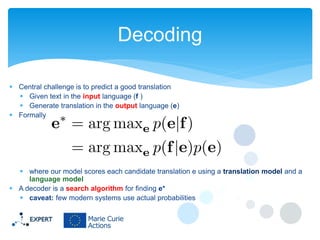
Decoding
 Central challenge is to predict a good translation
 Given text in the input language (f )
 Generate translation in the output language (e)
 Formally

 where our model scores each candidate translation e using a translation model and a
language model
 A decoder is a search algorithm for finding e*
 caveat: few modern systems use actual probabilities
Outline

 Decoding phrase-based models
 linear model
 dynamic programming approach
 approximate beam search
 Decoding grammar-based models
 synchronous grammars
 string-to-string decoding
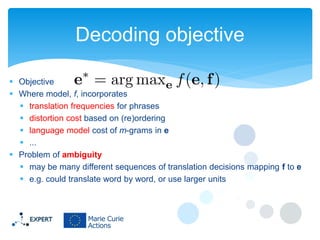
Decoding objective
 Objective
 Where model, f, incorporates
 translation frequencies for phrases
 distortion cost based on (re)ordering
 language model cost of m-grams in e
 ...
 Problem of ambiguity
 may be many different sequences of translation decisions mapping f to e
 e.g. could translate word by word, or use larger units
Decoding for derivations
 A derivation is a sequence of translation decisions
 can “read off” the input string f and output e
 Define model over derivations not translations
 aka Viterbi approximation
 should sum over all derivations within the maximisation
 instead we maximise for tractability
 But see Blunsom, Cohn and Osborne (2008)
 sum out derivational ambiguity (during training)
Decoding

 Includes a coverage constraint
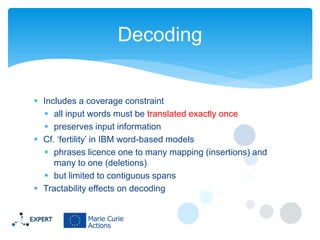
 all input words must be translated exactly once
 preserves input information
 Cf. ‘fertility’ in IBM word-based models
 phrases licence one to many mapping (insertions) and
many to one (deletions)
 but limited to contiguous spans
 Tractability effects on decoding
Translation process
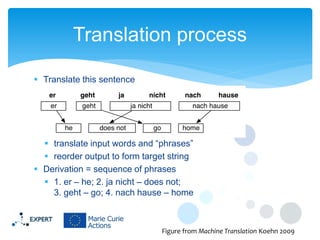
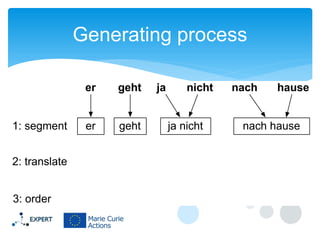
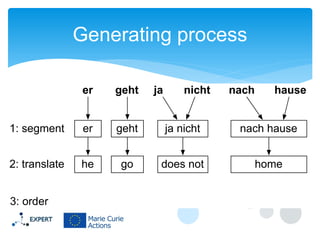
 Translate this sentence

 translate input words and “phrases”
 reorder output to form target string
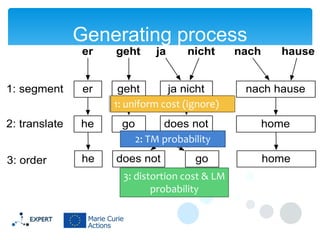
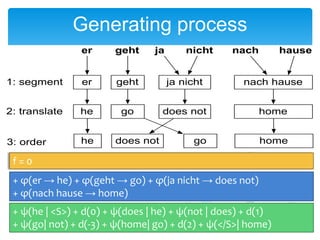
 Derivation = sequence of phrases
 1. er – he; 2. ja nicht – does not;
3. geht – go; 4. nach hause – home

Figure from Machine Translation Koehn 2009
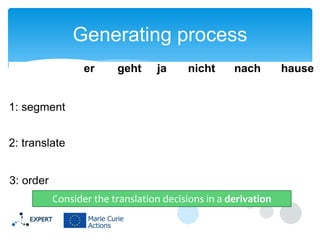
Generating process
er

geht

ja

nicht

nach

1: segment
2: translate
3: order
Consider the translation decisions in a derivation

hause
Generating process
er

1: segment
2: translate
3: order

geht

er

geht

ja

nicht

ja nicht

nach

hause

nach hause
Generating process
er

geht

1: segment

er

geht

ja nicht

nach hause

2: translate

he

go

does not

home

3: order

ja

nicht

nach

hause
Generating process
er

geht

1: segment

er

geht
ja nicht
1: uniform cost (ignore)

2: translate

he

3: order

he

go

ja

nicht

does not
2: TM probability

does not

go

3: distortion cost & LM
probability

nach

hause

nach hause
home
home
Generating process
er

geht

ja

1: segment

er

geht

ja nicht

nach hause

2: translate

he

go

does not

home

3: order

he

go

home

does not

nicht

nach

hause

f=0
+ φ(er → he) + φ(geht → go) + φ(ja nicht → does not)
+ φ(nach hause → home)
+ ψ(he | <S>) + d(0) + ψ(does | he) + ψ(not | does) + d(1)
+ ψ(go| not) + d(-3) + ψ(home| go) + d(2) + ψ(</S>| home)
Linear Model
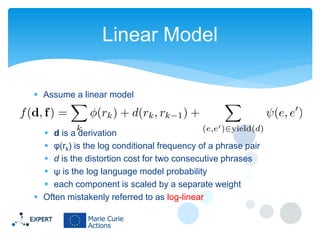
 Assume a linear model

 d is a derivation
 φ(rk) is the log conditional frequency of a phrase pair
 d is the distortion cost for two consecutive phrases
 ψ is the log language model probability
 each component is scaled by a separate weight
 Often mistakenly referred to as log-linear
Model components
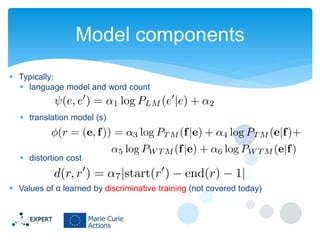
 Typically:
 language model and word count

 translation model (s)

 distortion cost
 Values of α learned by discriminative training (not covered today)
Search problem
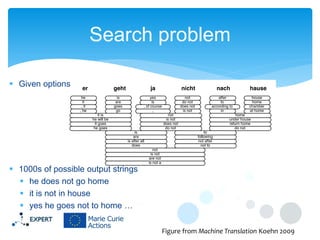
 Given options

 1000s of possible output strings
 he does not go home
 it is not in house
 yes he goes not to home …
Figure from Machine Translation Koehn 2009
Search Complexity

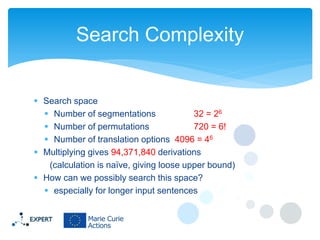
 Search space
 Number of segmentations
32 = 26
 Number of permutations
720 = 6!
 Number of translation options 4096 = 46
 Multiplying gives 94,371,840 derivations
(calculation is naïve, giving loose upper bound)
 How can we possibly search this space?
 especially for longer input sentences
Search insight
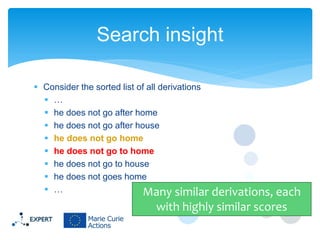
 Consider the sorted list of all derivations
 …
 he does not go after home
 he does not go after house
 he does not go home
 he does not go to home
 he does not go to house
 he does not goes home
 …
Many similar

derivations, each
with highly similar scores
Search insight #1
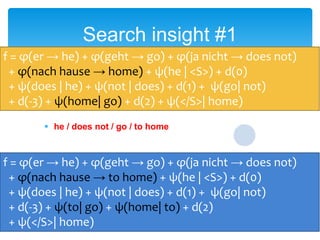
f = φ(er → he) + φ(geht → go) + φ(ja nicht → does not)
+ φ(nach hause → home) + ψ(he | <S>) + d(0)
+ ψ(does | he) + ψ(not | does) + d(1) + ψ(go| not)
+ d(-3)  he / does not / go+/ d(2) + ψ(</S>| home)
+ ψ(home| go) home
 he / does not / go / to home

f = φ(er → he) + φ(geht → go) + φ(ja nicht → does not)
+ φ(nach hause → to home) + ψ(he | <S>) + d(0)
+ ψ(does | he) + ψ(not | does) + d(1) + ψ(go| not)
+ d(-3) + ψ(to| go) + ψ(home| to) + d(2)
+ ψ(</S>| home)
Search insight #1
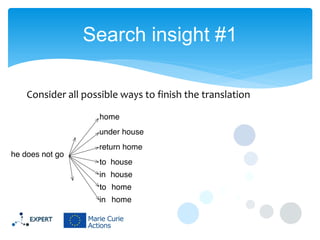
Consider all possible ways to finish the translation
Search insight #1
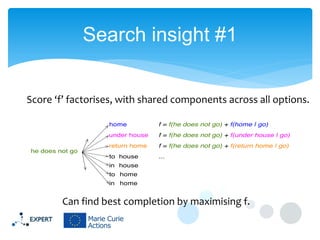
Score ‘f’ factorises, with shared components across all options.

Can find best completion by maximising f.
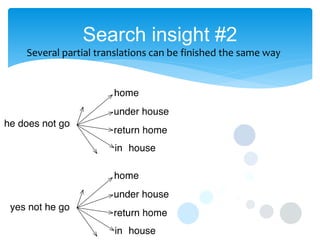
Search insight #2
Several partial translations can be finished the same way
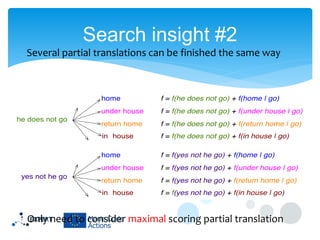
Search insight #2
Several partial translations can be finished the same way

Only need to consider maximal scoring partial translation
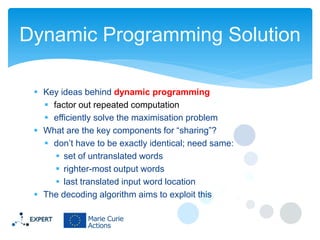
Dynamic Programming Solution
 Key ideas behind dynamic programming
 factor out repeated computation
 efficiently solve the maximisation problem
 What are the key components for “sharing”?
 don’t have to be exactly identical; need same:
 set of untranslated words
 righter-most output words
 last translated input word location
 The decoding algorithm aims to exploit this
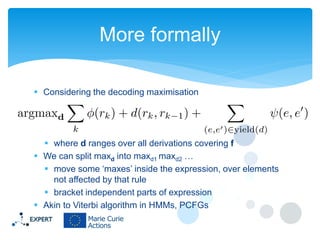
More formally
 Considering the decoding maximisation

 where d ranges over all derivations covering f
 We can split maxd into maxd1 maxd2 …
 move some ‘maxes’ inside the expression, over elements
not affected by that rule
 bracket independent parts of expression
 Akin to Viterbi algorithm in HMMs, PCFGs
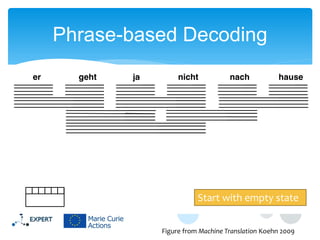
Phrase-based Decoding

Start with empty state
Figure from Machine Translation Koehn 2009
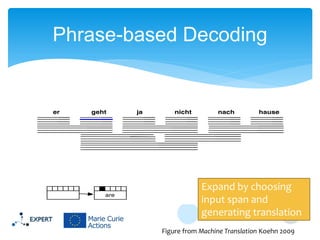
Phrase-based Decoding

Expand by choosing
input span and
generating translation
Figure from Machine Translation Koehn 2009
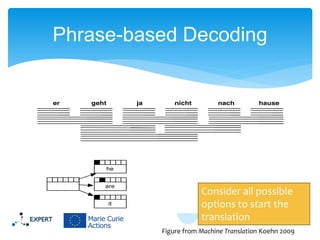
Phrase-based Decoding

Consider all possible
options to start the
translation
Figure from Machine Translation Koehn 2009
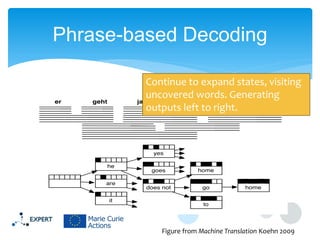
Phrase-based Decoding
Continue to expand states, visiting
uncovered words. Generating
outputs left to right.

Figure from Machine Translation Koehn 2009
Phrase-based Decoding
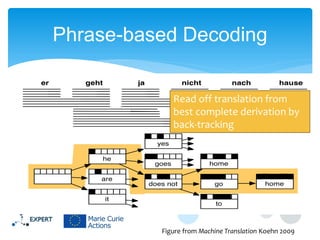
Read off translation from
best complete derivation by
back-tracking

Figure from Machine Translation Koehn 2009
Dynamic Programming
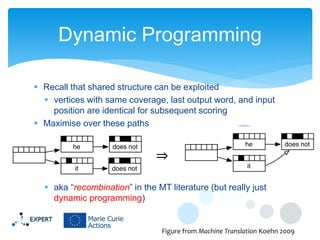
 Recall that shared structure can be exploited
 vertices with same coverage, last output word, and input
position are identical for subsequent scoring
 Maximise over these paths

⇒
 aka “recombination” in the MT literature (but really just
dynamic programming)

Figure from Machine Translation Koehn 2009
Complexity
 Even with DP search is still intractable
 word-based and phrase-based decoding is NP complete
 Knight 99; Zaslavskiy, Dymetman, and Cancedda, 2009
 whereas SCFG decoding is polynomial
 Complexity arises from
 reordering model allowing all permutations (limit)
 no more than 6 uncovered words
 many translation options (limit)
 no more than 20 translations per phrase
 coverage constraints, i.e., all words to be translated once
Pruning

 Limit the size of the search graph by eliminating bad paths
early
 Pharaoh / Moses
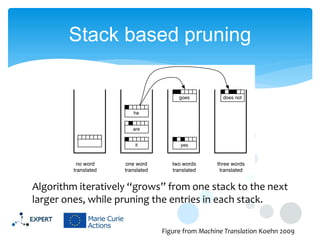
 divide partial derivations into stacks, based on number of
input words translated
 limit the number of derivations in each stack
 limit the score difference in each stack
Stack based pruning

Algorithm iteratively “grows” from one stack to the next
larger ones, while pruning the entries in each stack.
Figure from Machine Translation Koehn 2009
Future cost estimate
 Higher scores for translating easy parts first
 language model prefers common words
 Early pruning will eliminate derivations starting with the difficult words
 pruning must incorporate estimate of the cost of translating the
remaining words
 “future cost estimate” assuming unigram LM and monotone translation
 Related to A* search and admissible heuristics
 but incurs search error (see Chang & Collins, 2011)
Beam search complexity
 Limit the number of translation options per phrase to constant (often 20)
 # translations proportional to input sentence length
 Stack pruning
 number of entries & score ratio
 Reordering limits
 finite number of uncovered words (typically 6)
but see Lopez EACL 2009
 Resulting complexity
 O( stack size x sentence length )
k-best outputs

 Can recover not just the best solution
 but also 2nd, 3rd etc best derivations
 straight-forward extension of beam search
 Useful in discriminative training of feature weights, and other
applications
Alternatives for PBMT decoding
 FST composition (Kumar & Byrne, 2005)
 each process encoded in WFST or WFSA
 simply compose automata, minimise and solve
 A* search (Och, Ueffing & Ney, 2001)
 Sampling (Arun et al, 2009)
 Integer linear programming
 Germann et al, 2001
 Reidel & Clarke, 2009
 Lagrangian relaxation
 Chang & Collins, 2011
Outline
 Decoding phrase-based models
 linear model
 dynamic programming approach
 approximate beam search
 Decoding grammar-based models
 tree-to-string decoding
 string-to-string decoding
 cube pruning
Grammar-based decoding
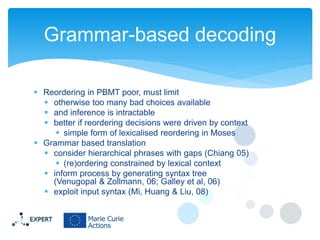
 Reordering in PBMT poor, must limit
 otherwise too many bad choices available
 and inference is intractable
 better if reordering decisions were driven by context
 simple form of lexicalised reordering in Moses
 Grammar based translation
 consider hierarchical phrases with gaps (Chiang 05)
 (re)ordering constrained by lexical context
 inform process by generating syntax tree
(Venugopal & Zollmann, 06; Galley et al, 06)
 exploit input syntax (Mi, Huang & Liu, 08)
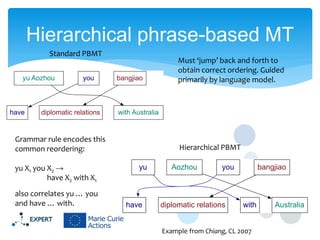
Hierarchical phrase-based MT
Standard PBMT
yu Aozhou

have

you

diplomatic relations

bangjiao

with Australia

Grammar rule encodes this
common reordering:
yu X1 you X2 →
have X2 with X1
also correlates yu … you
and have … with.

Must ‘jump’ back and forth to
obtain correct ordering. Guided
primarily by language model.

Hierarchical PBMT
yu

have

Aozhou

you

diplomatic relations

bangjiao

with

Example from Chiang, CL 2007

Australia
SCFG recap
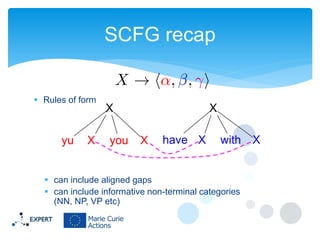
 Rules of form

yu

X

X
you

X
X

have X

with X

 can include aligned gaps
 can include informative non-terminal categories
(NN, NP, VP etc)
SCFG generation
X

X

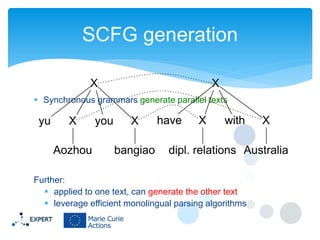
 Synchronous grammars generate parallel texts

yu

X
Aozhou

you

X
bangiao

have

X

with

X

dipl. relations Australia

Further:
 applied to one text, can generate the other text
 leverage efficient monolingual parsing algorithms
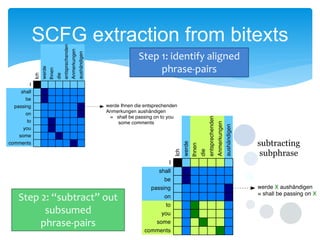
SCFG extraction from bitexts
Step 1: identify aligned
phrase-pairs

Step 2: “subtract” out
subsumed
phrase-pairs
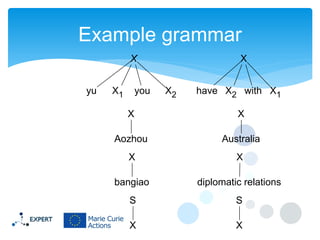
Example grammar
X
yu

X1

you

X
X2

have X2 with X1

X

X

Aozhou

Australia

X

X

bangiao

diplomatic relations

S

S

X

X
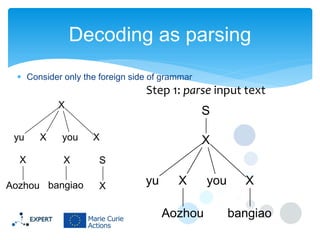
Decoding as parsing
 Consider only the foreign side of grammar

Step 1: parse input text
X
yu

X

X

you

X

Aozhou bangiao

S
X

X

S
X

yu

X
Aozhou

you

X
bangiao
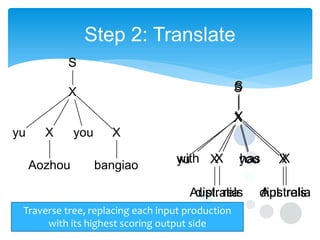
Step 2: Translate
S

S

X

X
yu

X
Aozhou

you

X
bangiao

with X
X
yu

has
you

dipl. rels
Australia
Traverse tree, replacing each input production
with its highest scoring output side

X
X

Australia
dipl. rels
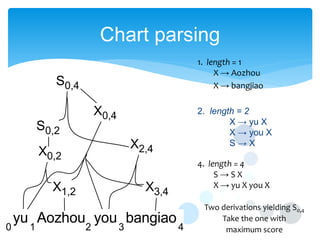
Chart parsing
1. length = 1
X → Aozhou
X → bangjiao

S0,4
X0,4

S0,2

X2,4

X0,2

X1,2
0

4. length = 4
S→SX
X → yu X you X

X3,4

yu Aozhou you bangiao
1

2. length = 2
X → yu X
X → you X
S→X

2

3

4

Two derivations yielding S0,4
Take the one with
maximum score
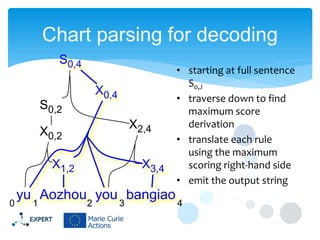
Chart parsing for decoding
S0,4
X0,4

S0,2

X2,4

X0,2
X1,2
0

X3,4

yu Aozhou you bangiao
1

2

3

• starting at full sentence
S0,J
• traverse down to find
maximum score
derivation
• translate each rule
using the maximum
scoring right-hand side
• emit the output string
4
LM intersection
 Very efficient
 cost of parsing, i.e., O(n3)
 reduces to linear if we impose a maximum span limit
 translation step simple O(n) post-processing step
 But what about the language model?
 CYK assumes model scores decompose with the tree
structure
 but the language model must span constituents
Problem: LM doesn’t factorise!
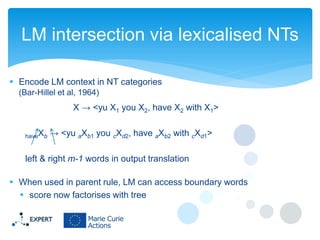
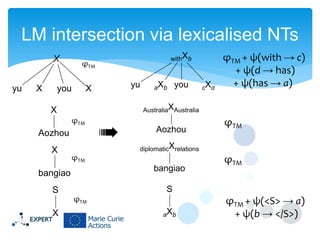
LM intersection via lexicalised NTs
 Encode LM context in NT categories
(Bar-Hillel et al, 1964)

X → <yu X1 you X2, have X2 with X1>
haveXb

→ <yu aXb1 you cXd2, have aXb2 with cXd1>

left & right m-1 words in output translation
 When used in parent rule, LM can access boundary words
 score now factorises with tree
LM intersection via lexicalised NTs
X
yu

X

withXb

φTM

you

yu

X

you

φTM

Aozhou

➠

Aozhou

φTM

diplomaticXrelations

φTM

bangiao

bangiao

φTM

S

S
φTM

X

cXd

AustraliaXAustralia

X

X

aX b

φTM + ψ(with → c)
+ ψ(d → has)
+ ψ(has → a)

aXb

φTM + ψ(<S> → a)
+ ψ(b → </S>)
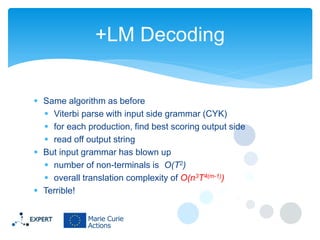
+LM Decoding

 Same algorithm as before
 Viterbi parse with input side grammar (CYK)
 for each production, find best scoring output side
 read off output string
 But input grammar has blown up
 number of non-terminals is O(T2)
 overall translation complexity of O(n3T4(m-1))
 Terrible!
Beam search and pruning
 Resort to beam search
 prune poor entries from chart cells during CYK parsing
 histogram, threshold as in phrase-based MT
 rarely have sufficient context for LM evaluation
 Cube pruning
 lower order LM estimate search heuristic
 follows approximate ‘best first’ order for incorporating child spans into
parent rule
 stops once beam is full
 For more details, see
 Chiang “Hierarchical phrase-based translation”. 2007. Computational
Linguistics 33(2):201–228.
Further work
 Synchronous grammar systems
 SAMT (Venugopal & Zollman, 2006)
 ISI’s syntax system (Marcu et al.,2006)
 HRGG (Chiang et al., 2013)
 Tree to string (Liu, Liu & Lin, 2006)
 Probabilistic grammar induction
 Blunsom & Cohn (2009)
 Decoding and pruning
 cube growing (Huang & Chiang, 2007)
 left to right decoding (Huang & Mi, 2010)
Summary
 What we covered
 word based translation and alignment
 linear phrase-based and grammar-based models
 phrase-based (finite state) decoding
 synchronous grammar decoding
 What we didn’t cover
 rule extraction process
 discriminative training
 tree based models
 domain adaptation
 OOV translation
 …

7. Trevor Cohn (usfd) Statistical Machine Translation

  • 1.
    Statistical Machine Translation PartII: Decoding Trevor Cohn, U. Sheffield EXPERT winter school November 2013 Some figures taken from Koehn 2009
  • 2.
    Recap  You’ve seenseveral models of translation  word-based models: IBM 1-5  phrase-based models  grammar-based models  Methods for  learning translation rules from bitexts  learning rule weights  learning several other features: language models, reordering etc
  • 3.
    Decoding  Central challengeis to predict a good translation  Given text in the input language (f )  Generate translation in the output language (e)  Formally  where our model scores each candidate translation e using a translation model and a language model  A decoder is a search algorithm for finding e*  caveat: few modern systems use actual probabilities
  • 4.
    Outline  Decoding phrase-basedmodels  linear model  dynamic programming approach  approximate beam search  Decoding grammar-based models  synchronous grammars  string-to-string decoding
  • 5.
    Decoding objective  Objective Where model, f, incorporates  translation frequencies for phrases  distortion cost based on (re)ordering  language model cost of m-grams in e  ...  Problem of ambiguity  may be many different sequences of translation decisions mapping f to e  e.g. could translate word by word, or use larger units
  • 6.
    Decoding for derivations A derivation is a sequence of translation decisions  can “read off” the input string f and output e  Define model over derivations not translations  aka Viterbi approximation  should sum over all derivations within the maximisation  instead we maximise for tractability  But see Blunsom, Cohn and Osborne (2008)  sum out derivational ambiguity (during training)
  • 7.
    Decoding  Includes acoverage constraint  all input words must be translated exactly once  preserves input information  Cf. ‘fertility’ in IBM word-based models  phrases licence one to many mapping (insertions) and many to one (deletions)  but limited to contiguous spans  Tractability effects on decoding
  • 8.
    Translation process  Translatethis sentence  translate input words and “phrases”  reorder output to form target string  Derivation = sequence of phrases  1. er – he; 2. ja nicht – does not; 3. geht – go; 4. nach hause – home Figure from Machine Translation Koehn 2009
  • 9.
    Generating process er geht ja nicht nach 1: segment 2:translate 3: order Consider the translation decisions in a derivation hause
  • 10.
    Generating process er 1: segment 2:translate 3: order geht er geht ja nicht ja nicht nach hause nach hause
  • 11.
    Generating process er geht 1: segment er geht janicht nach hause 2: translate he go does not home 3: order ja nicht nach hause
  • 12.
    Generating process er geht 1: segment er geht janicht 1: uniform cost (ignore) 2: translate he 3: order he go ja nicht does not 2: TM probability does not go 3: distortion cost & LM probability nach hause nach hause home home
  • 13.
    Generating process er geht ja 1: segment er geht janicht nach hause 2: translate he go does not home 3: order he go home does not nicht nach hause f=0 + φ(er → he) + φ(geht → go) + φ(ja nicht → does not) + φ(nach hause → home) + ψ(he | <S>) + d(0) + ψ(does | he) + ψ(not | does) + d(1) + ψ(go| not) + d(-3) + ψ(home| go) + d(2) + ψ(</S>| home)
  • 14.
    Linear Model  Assumea linear model  d is a derivation  φ(rk) is the log conditional frequency of a phrase pair  d is the distortion cost for two consecutive phrases  ψ is the log language model probability  each component is scaled by a separate weight  Often mistakenly referred to as log-linear
  • 15.
    Model components  Typically: language model and word count  translation model (s)  distortion cost  Values of α learned by discriminative training (not covered today)
  • 16.
    Search problem  Givenoptions  1000s of possible output strings  he does not go home  it is not in house  yes he goes not to home … Figure from Machine Translation Koehn 2009
  • 17.
    Search Complexity  Searchspace  Number of segmentations 32 = 26  Number of permutations 720 = 6!  Number of translation options 4096 = 46  Multiplying gives 94,371,840 derivations (calculation is naïve, giving loose upper bound)  How can we possibly search this space?  especially for longer input sentences
  • 18.
    Search insight  Considerthe sorted list of all derivations  …  he does not go after home  he does not go after house  he does not go home  he does not go to home  he does not go to house  he does not goes home  … Many similar derivations, each with highly similar scores
  • 19.
    Search insight #1 f= φ(er → he) + φ(geht → go) + φ(ja nicht → does not) + φ(nach hause → home) + ψ(he | <S>) + d(0) + ψ(does | he) + ψ(not | does) + d(1) + ψ(go| not) + d(-3)  he / does not / go+/ d(2) + ψ(</S>| home) + ψ(home| go) home  he / does not / go / to home f = φ(er → he) + φ(geht → go) + φ(ja nicht → does not) + φ(nach hause → to home) + ψ(he | <S>) + d(0) + ψ(does | he) + ψ(not | does) + d(1) + ψ(go| not) + d(-3) + ψ(to| go) + ψ(home| to) + d(2) + ψ(</S>| home)
  • 20.
    Search insight #1 Considerall possible ways to finish the translation
  • 21.
    Search insight #1 Score‘f’ factorises, with shared components across all options. Can find best completion by maximising f.
  • 22.
    Search insight #2 Severalpartial translations can be finished the same way
  • 23.
    Search insight #2 Severalpartial translations can be finished the same way Only need to consider maximal scoring partial translation
  • 24.
    Dynamic Programming Solution Key ideas behind dynamic programming  factor out repeated computation  efficiently solve the maximisation problem  What are the key components for “sharing”?  don’t have to be exactly identical; need same:  set of untranslated words  righter-most output words  last translated input word location  The decoding algorithm aims to exploit this
  • 25.
    More formally  Consideringthe decoding maximisation  where d ranges over all derivations covering f  We can split maxd into maxd1 maxd2 …  move some ‘maxes’ inside the expression, over elements not affected by that rule  bracket independent parts of expression  Akin to Viterbi algorithm in HMMs, PCFGs
  • 26.
    Phrase-based Decoding Start withempty state Figure from Machine Translation Koehn 2009
  • 27.
    Phrase-based Decoding Expand bychoosing input span and generating translation Figure from Machine Translation Koehn 2009
  • 28.
    Phrase-based Decoding Consider allpossible options to start the translation Figure from Machine Translation Koehn 2009
  • 29.
    Phrase-based Decoding Continue toexpand states, visiting uncovered words. Generating outputs left to right. Figure from Machine Translation Koehn 2009
  • 30.
    Phrase-based Decoding Read offtranslation from best complete derivation by back-tracking Figure from Machine Translation Koehn 2009
  • 31.
    Dynamic Programming  Recallthat shared structure can be exploited  vertices with same coverage, last output word, and input position are identical for subsequent scoring  Maximise over these paths ⇒  aka “recombination” in the MT literature (but really just dynamic programming) Figure from Machine Translation Koehn 2009
  • 32.
    Complexity  Even withDP search is still intractable  word-based and phrase-based decoding is NP complete  Knight 99; Zaslavskiy, Dymetman, and Cancedda, 2009  whereas SCFG decoding is polynomial  Complexity arises from  reordering model allowing all permutations (limit)  no more than 6 uncovered words  many translation options (limit)  no more than 20 translations per phrase  coverage constraints, i.e., all words to be translated once
  • 33.
    Pruning  Limit thesize of the search graph by eliminating bad paths early  Pharaoh / Moses  divide partial derivations into stacks, based on number of input words translated  limit the number of derivations in each stack  limit the score difference in each stack
  • 34.
    Stack based pruning Algorithmiteratively “grows” from one stack to the next larger ones, while pruning the entries in each stack. Figure from Machine Translation Koehn 2009
  • 35.
    Future cost estimate Higher scores for translating easy parts first  language model prefers common words  Early pruning will eliminate derivations starting with the difficult words  pruning must incorporate estimate of the cost of translating the remaining words  “future cost estimate” assuming unigram LM and monotone translation  Related to A* search and admissible heuristics  but incurs search error (see Chang & Collins, 2011)
  • 36.
    Beam search complexity Limit the number of translation options per phrase to constant (often 20)  # translations proportional to input sentence length  Stack pruning  number of entries & score ratio  Reordering limits  finite number of uncovered words (typically 6) but see Lopez EACL 2009  Resulting complexity  O( stack size x sentence length )
  • 37.
    k-best outputs  Canrecover not just the best solution  but also 2nd, 3rd etc best derivations  straight-forward extension of beam search  Useful in discriminative training of feature weights, and other applications
  • 38.
    Alternatives for PBMTdecoding  FST composition (Kumar & Byrne, 2005)  each process encoded in WFST or WFSA  simply compose automata, minimise and solve  A* search (Och, Ueffing & Ney, 2001)  Sampling (Arun et al, 2009)  Integer linear programming  Germann et al, 2001  Reidel & Clarke, 2009  Lagrangian relaxation  Chang & Collins, 2011
  • 39.
    Outline  Decoding phrase-basedmodels  linear model  dynamic programming approach  approximate beam search  Decoding grammar-based models  tree-to-string decoding  string-to-string decoding  cube pruning
  • 40.
    Grammar-based decoding  Reorderingin PBMT poor, must limit  otherwise too many bad choices available  and inference is intractable  better if reordering decisions were driven by context  simple form of lexicalised reordering in Moses  Grammar based translation  consider hierarchical phrases with gaps (Chiang 05)  (re)ordering constrained by lexical context  inform process by generating syntax tree (Venugopal & Zollmann, 06; Galley et al, 06)  exploit input syntax (Mi, Huang & Liu, 08)
  • 41.
    Hierarchical phrase-based MT StandardPBMT yu Aozhou have you diplomatic relations bangjiao with Australia Grammar rule encodes this common reordering: yu X1 you X2 → have X2 with X1 also correlates yu … you and have … with. Must ‘jump’ back and forth to obtain correct ordering. Guided primarily by language model. Hierarchical PBMT yu have Aozhou you diplomatic relations bangjiao with Example from Chiang, CL 2007 Australia
  • 42.
    SCFG recap  Rulesof form yu X X you X X have X with X  can include aligned gaps  can include informative non-terminal categories (NN, NP, VP etc)
  • 43.
    SCFG generation X X  Synchronousgrammars generate parallel texts yu X Aozhou you X bangiao have X with X dipl. relations Australia Further:  applied to one text, can generate the other text  leverage efficient monolingual parsing algorithms
  • 44.
    SCFG extraction frombitexts Step 1: identify aligned phrase-pairs Step 2: “subtract” out subsumed phrase-pairs
  • 45.
    Example grammar X yu X1 you X X2 have X2with X1 X X Aozhou Australia X X bangiao diplomatic relations S S X X
  • 46.
    Decoding as parsing Consider only the foreign side of grammar Step 1: parse input text X yu X X you X Aozhou bangiao S X X S X yu X Aozhou you X bangiao
  • 47.
    Step 2: Translate S S X X yu X Aozhou you X bangiao withX X yu has you dipl. rels Australia Traverse tree, replacing each input production with its highest scoring output side X X Australia dipl. rels
  • 48.
    Chart parsing 1. length= 1 X → Aozhou X → bangjiao S0,4 X0,4 S0,2 X2,4 X0,2 X1,2 0 4. length = 4 S→SX X → yu X you X X3,4 yu Aozhou you bangiao 1 2. length = 2 X → yu X X → you X S→X 2 3 4 Two derivations yielding S0,4 Take the one with maximum score
  • 49.
    Chart parsing fordecoding S0,4 X0,4 S0,2 X2,4 X0,2 X1,2 0 X3,4 yu Aozhou you bangiao 1 2 3 • starting at full sentence S0,J • traverse down to find maximum score derivation • translate each rule using the maximum scoring right-hand side • emit the output string 4
  • 50.
    LM intersection  Veryefficient  cost of parsing, i.e., O(n3)  reduces to linear if we impose a maximum span limit  translation step simple O(n) post-processing step  But what about the language model?  CYK assumes model scores decompose with the tree structure  but the language model must span constituents Problem: LM doesn’t factorise!
  • 51.
    LM intersection vialexicalised NTs  Encode LM context in NT categories (Bar-Hillel et al, 1964) X → <yu X1 you X2, have X2 with X1> haveXb → <yu aXb1 you cXd2, have aXb2 with cXd1> left & right m-1 words in output translation  When used in parent rule, LM can access boundary words  score now factorises with tree
  • 52.
    LM intersection vialexicalised NTs X yu X withXb φTM you yu X you φTM Aozhou ➠ Aozhou φTM diplomaticXrelations φTM bangiao bangiao φTM S S φTM X cXd AustraliaXAustralia X X aX b φTM + ψ(with → c) + ψ(d → has) + ψ(has → a) aXb φTM + ψ(<S> → a) + ψ(b → </S>)
  • 53.
    +LM Decoding  Samealgorithm as before  Viterbi parse with input side grammar (CYK)  for each production, find best scoring output side  read off output string  But input grammar has blown up  number of non-terminals is O(T2)  overall translation complexity of O(n3T4(m-1))  Terrible!
  • 54.
    Beam search andpruning  Resort to beam search  prune poor entries from chart cells during CYK parsing  histogram, threshold as in phrase-based MT  rarely have sufficient context for LM evaluation  Cube pruning  lower order LM estimate search heuristic  follows approximate ‘best first’ order for incorporating child spans into parent rule  stops once beam is full  For more details, see  Chiang “Hierarchical phrase-based translation”. 2007. Computational Linguistics 33(2):201–228.
  • 55.
    Further work  Synchronousgrammar systems  SAMT (Venugopal & Zollman, 2006)  ISI’s syntax system (Marcu et al.,2006)  HRGG (Chiang et al., 2013)  Tree to string (Liu, Liu & Lin, 2006)  Probabilistic grammar induction  Blunsom & Cohn (2009)  Decoding and pruning  cube growing (Huang & Chiang, 2007)  left to right decoding (Huang & Mi, 2010)
  • 56.
    Summary  What wecovered  word based translation and alignment  linear phrase-based and grammar-based models  phrase-based (finite state) decoding  synchronous grammar decoding  What we didn’t cover  rule extraction process  discriminative training  tree based models  domain adaptation  OOV translation  …