SPoC: Search-based
Pseudocode to Code
• Sumith Kulal
• Panupong Pasupat
• Kartik Chandra
• Mina Lee
• Oded Padon
• Alex Aiken
• Percy Liang
Presented By
Minhazul Arefin
Abstract
 mapping pseudocode to long programs that are functionally correct
 treat the translation of each pseudocode line as a discrete portion of
the program
 If program fails to compile, an error localization method tries to
identify the portion of the program responsible for the failure
3
Introduction
 map natural language descriptions
 Perform non-trivial computations
 input-output pairs usually give little information about the
intermediate states of the program
4
Data collection
 Programs and test cases: NAPS dataset
 Decomposition: decompose each program into code lines
 Pseudocode: recruited 59 workers on Amazon Mechanical Turk to
write pseudocode
 Statistics: dataset contains 18,356 programs
 Training and test sets: they created two test sets
5
Problem Statement
• The system is given (a) a sequence x of L pseudocode lines 𝑥1; 𝑥2; : : : ; 𝑥𝐿, where
 𝑥𝑖 is a string with indentation level `I
 K public test cases in the form of
input-output string pairs (𝑇𝑖𝑛1 ; 𝑇𝑜𝑢𝑡1);
: : : ; (𝑇𝑖𝑛𝑘 ; 𝑇𝑜𝑢𝑡𝑘).
▸ The task is to synthesize a program y consisting of L code lines 𝑦1; 𝑦1; : : : ; 𝑦𝐿
▸ The program is accepted if it successfully compiles and passes all public test cases
6
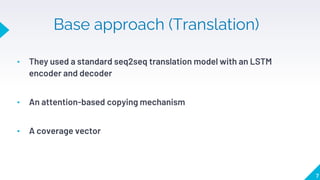
Base approach (Translation)
• They used a standard seq2seq translation model with an LSTM
encoder and decoder
• An attention-based copying mechanism
• A coverage vector
7
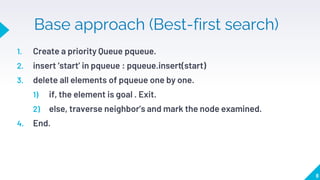
Base approach (Best-first search)
1. Create a priority Queue pqueue.
2. insert ‘start’ in pqueue : pqueue.insert(start)
3. delete all elements of pqueue one by one.
1) if, the element is goal . Exit.
2) else, traverse neighbor’s and mark the node examined.
4. End.
8
Base approach (Best-first search)
Advantages:
▸ Best first search can switch between BFS and DFS by gaining the
advantages of both the algorithms.
▸ This algorithm is more efficient than BFS and DFS algorithms.
Disadvantages:
▸ It can behave as an unguided depth-first search in the worst case
scenario.
▸ It can get stuck in a loop as DFS.
▸ This algorithm is not optimal.
9
Experiments (Translation accuracy)
 Used BELU score in best first search
 only 18.2% of programs in TESTP and 32.0% of programs in TESTW is
correct in every line.
 the top candidate of each line have an even lower success rates of
17.8% on TESTP and 30.7% on TESTW
10
Experiments (Translation accuracy)
11
Figure: (a) While the translation accuracy is high at the line level, we need to consider the
result at the program level. For each program, we count the number of lines i where
(b) the top candidate ci1 is incorrect
(c) none of the candidates 𝑐𝑖𝑗 ꞓ 𝑐𝑖 is correct.
Experiments (Oracle success rate)
▸ count the number of lines i where the candidate list 𝑐𝑖 does not have
any correct candidate
▸ 44.8% of programs in TESTP and 28.6% of programs in TESTW have
least one difficult line where the translation model does not produce
a correct prediction
▸ It achieve a maximum success rate of 55.2% on TESTP and 71.4% on
TESTW
12
Experiments (Synthesis results)
 Error line, 𝑖∗ = 𝑖𝑒𝑟𝑟 - ∆i
 Where,
 𝑖∗
= predicted line
 𝑖𝑒𝑟𝑟 = error in line
 ∆i = corresponding line
13
Experiments (Synthesis results)
14
Figure: Success rates at budgets B of best-first search with different error localization methods
Experiments (Synthesis results)
15
Table: Effects of using error localization methods on all test examples
Experiments (Error analysis)
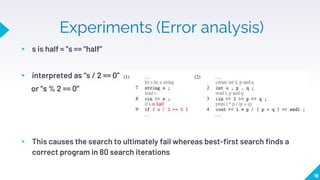
▸ s is half = “s == "half“
▸ interpreted as “s / 2 == 0”
or “s % 2 == 0”
▸ This causes the search to ultimately fail whereas best-first search finds a
correct program in 80 search iterations
16
Related work (Program synthesis)
▸ formulate synthesis as a constraint satisfaction problem
▸ requires that the synthesis problem can be translated to a theory
with effective constraint solvers
▸ brute force enumeration of programs works surprisingly well
▸ when the search space is too large for enumeration, randomized
search guided by a cost function can be effective
17
Related work (Semantic parsing)
 It is a task of converting a NLP text into a logical form (a machine-
understandable format)
 One of its traditional tasks is to parse a given into an executable
database query
 Instead of a single query, some work aims to parse a sequence of
queries that can be sequentially executed (max 5 sentences)
18
Related work (Error localization)
 uses neural models to localize errors focused on localizing and
correcting syntax errors
 semantic errors such as variable misuse and variable replace
 Their work identifies error locations by interpreting compiler error
messages
19

SPoC: search-based pseudocode to code

  • 1.
    SPoC: Search-based Pseudocode toCode • Sumith Kulal • Panupong Pasupat • Kartik Chandra • Mina Lee • Oded Padon • Alex Aiken • Percy Liang
  • 2.
  • 3.
    Abstract  mapping pseudocodeto long programs that are functionally correct  treat the translation of each pseudocode line as a discrete portion of the program  If program fails to compile, an error localization method tries to identify the portion of the program responsible for the failure 3
  • 4.
    Introduction  map naturallanguage descriptions  Perform non-trivial computations  input-output pairs usually give little information about the intermediate states of the program 4
  • 5.
    Data collection  Programsand test cases: NAPS dataset  Decomposition: decompose each program into code lines  Pseudocode: recruited 59 workers on Amazon Mechanical Turk to write pseudocode  Statistics: dataset contains 18,356 programs  Training and test sets: they created two test sets 5
  • 6.
    Problem Statement • Thesystem is given (a) a sequence x of L pseudocode lines 𝑥1; 𝑥2; : : : ; 𝑥𝐿, where  𝑥𝑖 is a string with indentation level `I  K public test cases in the form of input-output string pairs (𝑇𝑖𝑛1 ; 𝑇𝑜𝑢𝑡1); : : : ; (𝑇𝑖𝑛𝑘 ; 𝑇𝑜𝑢𝑡𝑘). ▸ The task is to synthesize a program y consisting of L code lines 𝑦1; 𝑦1; : : : ; 𝑦𝐿 ▸ The program is accepted if it successfully compiles and passes all public test cases 6
  • 7.
    Base approach (Translation) •They used a standard seq2seq translation model with an LSTM encoder and decoder • An attention-based copying mechanism • A coverage vector 7
  • 8.
    Base approach (Best-firstsearch) 1. Create a priority Queue pqueue. 2. insert ‘start’ in pqueue : pqueue.insert(start) 3. delete all elements of pqueue one by one. 1) if, the element is goal . Exit. 2) else, traverse neighbor’s and mark the node examined. 4. End. 8
  • 9.
    Base approach (Best-firstsearch) Advantages: ▸ Best first search can switch between BFS and DFS by gaining the advantages of both the algorithms. ▸ This algorithm is more efficient than BFS and DFS algorithms. Disadvantages: ▸ It can behave as an unguided depth-first search in the worst case scenario. ▸ It can get stuck in a loop as DFS. ▸ This algorithm is not optimal. 9
  • 10.
    Experiments (Translation accuracy) Used BELU score in best first search  only 18.2% of programs in TESTP and 32.0% of programs in TESTW is correct in every line.  the top candidate of each line have an even lower success rates of 17.8% on TESTP and 30.7% on TESTW 10
  • 11.
    Experiments (Translation accuracy) 11 Figure:(a) While the translation accuracy is high at the line level, we need to consider the result at the program level. For each program, we count the number of lines i where (b) the top candidate ci1 is incorrect (c) none of the candidates 𝑐𝑖𝑗 ꞓ 𝑐𝑖 is correct.
  • 12.
    Experiments (Oracle successrate) ▸ count the number of lines i where the candidate list 𝑐𝑖 does not have any correct candidate ▸ 44.8% of programs in TESTP and 28.6% of programs in TESTW have least one difficult line where the translation model does not produce a correct prediction ▸ It achieve a maximum success rate of 55.2% on TESTP and 71.4% on TESTW 12
  • 13.
    Experiments (Synthesis results) Error line, 𝑖∗ = 𝑖𝑒𝑟𝑟 - ∆i  Where,  𝑖∗ = predicted line  𝑖𝑒𝑟𝑟 = error in line  ∆i = corresponding line 13
  • 14.
    Experiments (Synthesis results) 14 Figure:Success rates at budgets B of best-first search with different error localization methods
  • 15.
    Experiments (Synthesis results) 15 Table:Effects of using error localization methods on all test examples
  • 16.
    Experiments (Error analysis) ▸s is half = “s == "half“ ▸ interpreted as “s / 2 == 0” or “s % 2 == 0” ▸ This causes the search to ultimately fail whereas best-first search finds a correct program in 80 search iterations 16
  • 17.
    Related work (Programsynthesis) ▸ formulate synthesis as a constraint satisfaction problem ▸ requires that the synthesis problem can be translated to a theory with effective constraint solvers ▸ brute force enumeration of programs works surprisingly well ▸ when the search space is too large for enumeration, randomized search guided by a cost function can be effective 17
  • 18.
    Related work (Semanticparsing)  It is a task of converting a NLP text into a logical form (a machine- understandable format)  One of its traditional tasks is to parse a given into an executable database query  Instead of a single query, some work aims to parse a sequence of queries that can be sequentially executed (max 5 sentences) 18
  • 19.
    Related work (Errorlocalization)  uses neural models to localize errors focused on localizing and correcting syntax errors  semantic errors such as variable misuse and variable replace  Their work identifies error locations by interpreting compiler error messages 19