THERMAL COMFORT
• ROHIT KUMAR
• ASSSISTANT PROFESSOR
Climatology, Landscape and Environmental studies.
MBS SPA 2016
THERMAL COMFORT
• Our life cycle comprises Activity, fatigue and recovery.
• Recovery is essential to counter balance against mental and 
physical fatigue through recreation, rest and sleep. 
• This can be affected by unfavorable climatic conditions and 
the resulting stress on body and mind causes discomfort, loss 
of efficiency and breakdown of health.
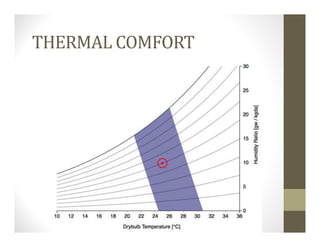
• Thermal comfort is the condition of mind that expresses 
satisfaction with the thermal environment and is assessed by 
subjective evaluation (ANSI/ASHRAE Standard 55).
• The task of the designer is to create the best possible indoor 
climate or even the environment for the users as they judge 
the quality of design based on physical and emotional point of 
view.
THERMAL COMFORT
THERMAL COMFORT
• Interest in establishing thermal comfort criteria dates back to 
Europe to the beginning of the 19th century.
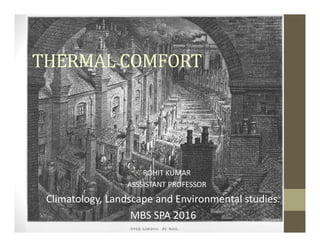
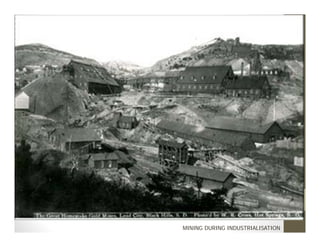
• It started during the Industrial revolution when significant 
reforms to industry and housing were being introduced.
• This was done as heat and humidity stress led to illnesses and 
accidents.
• Factors affecting thermal comfort:
• Air temperature
• Humidity
• Radiation
• Air movement
HOUSING DURING INDUSTRIALISATION
MINING DURING INDUSTRIALISATION
BODY THERMAL BALANCE
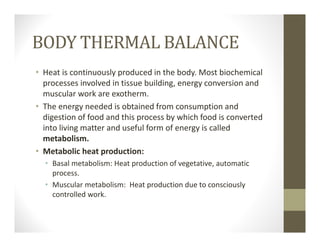
• Heat is continuously produced in the body. Most biochemical 
processes involved in tissue building, energy conversion and 
muscular work are exotherm.
• The energy needed is obtained from consumption and 
digestion of food and this process by which food is converted 
into living matter and useful form of energy is called 
metabolism.
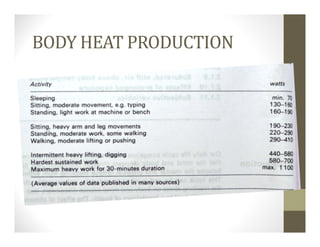
• Metabolic heat production:
• Basal metabolism: Heat production of vegetative, automatic 
process.
• Muscular metabolism:  Heat production due to consciously 
controlled work.
BODY HEAT PRODUCTION
BODY THERMAL BALANCE
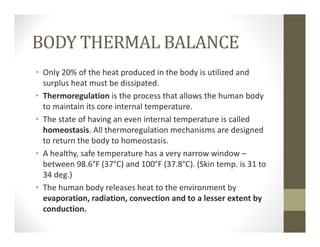
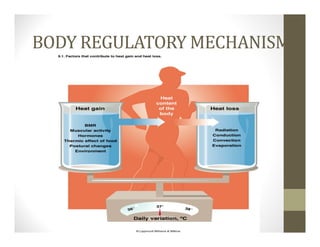
• Only 20% of the heat produced in the body is utilized and 
surplus heat must be dissipated.
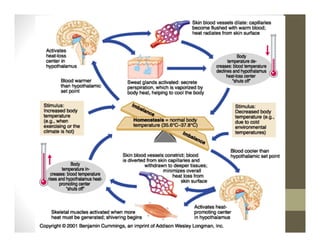
• Thermoregulation is the process that allows the human body 
to maintain its core internal temperature. 
• The state of having an even internal temperature is called 
homeostasis. All thermoregulation mechanisms are designed 
to return the body to homeostasis.
• A healthy, safe temperature has a very narrow window –
between 98.6°F (37°C) and 100°F (37.8°C). (Skin temp. is 31 to 
34 deg.)
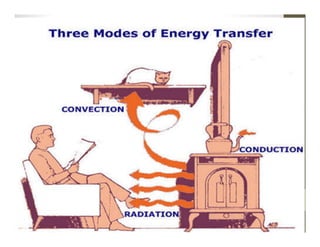
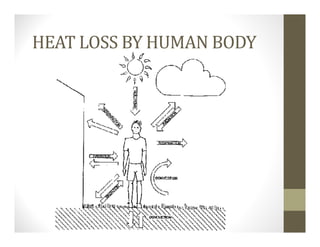
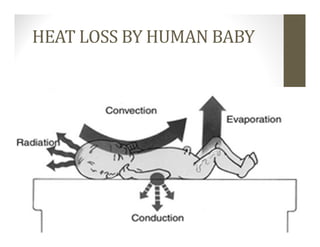
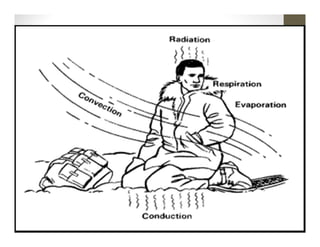
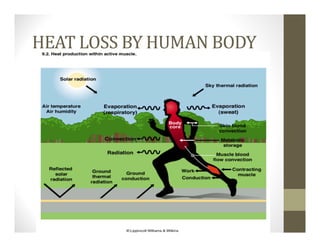
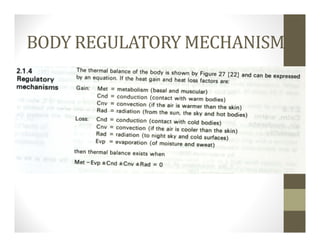
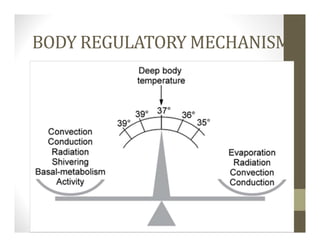
• The human body releases heat to the environment by 
evaporation, radiation, convection and to a lesser extent by 
conduction.
HEAT LOSS BY HUMAN BODY
HEAT LOSS BY HUMAN BABY
HEAT LOSS BY HUMAN BODY
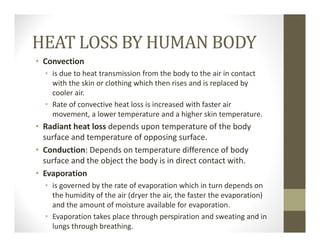
• Convection 
• is due to heat transmission from the body to the air in contact 
with the skin or clothing which then rises and is replaced by 
cooler air. 
• Rate of convective heat loss is increased with faster air 
movement, a lower temperature and a higher skin temperature.
• Radiant heat loss depends upon temperature of the body 
surface and temperature of opposing surface.
• Conduction: Depends on temperature difference of body 
surface and the object the body is in direct contact with.
• Evaporation 
• is governed by the rate of evaporation which in turn depends on 
the humidity of the air (dryer the air, the faster the evaporation) 
and the amount of moisture available for evaporation. 
• Evaporation takes place through perspiration and sweating and in 
lungs through breathing.
HEAT LOSS BY HUMAN BODY
BODY REGULATORY MECHANISM
HEAT LOSS IN VARIOUS
THERMAL ENVIRONMENTS
CALM,	WARM	AIR,	
MODERATE	HUMIDITY:
• In the indoors of temperate climate, when the 
• Air temperature is 18 deg.
• Air velocity does not exceed 0.25 m/s and when 
humidity is 40% to 60%, a person engaged in sedentary 
work will easily dissipate heat as
• By radiation: 45%
• Convection: 30%
• Evaporation: 25 %
(If temperature of bounding surface is same as air 
temperature)
HOT	AIR	AND	
CONSIDERABLE	RADIATION:
• The human body temp. is 37 deg. but skin temp. is 31‐34 
deg.
• As the air temp. approaches skin temp., heat loss by 
convection gradually decreases and the body makes 
vasomotor adjustments  to increase temperature to the 
higher limit (34 deg.) but when air temp. reaches this point, 
there is no more heat loss by convection.
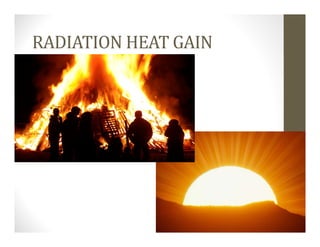
• Body can gain substantial heat by radiation: sun, radiator, 
bonfire. 
• When heat loss is negligible in the above situations, it can 
still take place through evaporation only if thee air is 
sufficiently dry.
RADIATION HEAT GAIN
HOT AIR, RADIATION AND
APPRECIABLE AIR MOVEMENT
• When the air is hot (equal to or above skin temperature), 
surroundings objects are hot (no heat loss by radiation) and 
when air is humid (but less than 100% RH), air movement 
will accelerate evaporation even if air temp. > skin temp.
• Moving air continuously replaces surrounding saturated air. 
• Poorly designed houses can create a fatal situation where 
the air is completely saturated, no air flow and air is 
warmer than skin which may lead to heat stroke.
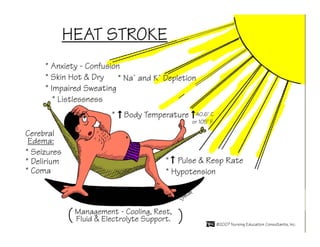
SATURATED STILL AIR, ABOVE
BODY TEMPERATURE
• When the situation is adverse such as
• air is hot (over 34 deg.)
• Unappreciable air movement (<0.25 m/s)
• Humidity is near 100 %.
• This leads to profuse sweating and no evaporation and 
body temperature begins to rise.
• A body temperature of 40 deg. Will cause heat stroke. 
(Failure in circulation system, followed by rapid increase in 
body temp.)
• At 41 deg. , coma sets in and death is imminent.
• At 45 deg., death is unavoidable.
EFFECTS OF PROLONGED
EXPOSURE
• A high wind velocity provides immediate relief, but causes 
irritation and discomfort with long duration.
• Even perfectly comfortable conditions may produce adverse 
effects if there are no change over prolonged periods.
• Change and variation is a basic need of a human.
• The designer must aim at a range of comfort conditions 
within which considerable variations are permitted.
SUBJECTIVE VARIABLES
• Thermal comfort depends upon four climatic variables, but 
preferences can vary among individuals.
• Clothing: A person wearing a suit will require a temperature about 9 
deg. lower than a naked body.
• Acclimatization: A person adjusts to a new set of climatic conditions 
in about 30 days. (A person in London might be comfortable at 18 
deg., but will be comfortable in India at 25 after spending a month.
• Age and sex.: Women have higher metabolic rates and their 
preference is 1 deg. Higher than men.
• Body Shape: A corpulent person with same weight as a thin person 
dissipates more heat due to larger surface area.
• Fat: Excellent insulator.
• State of health.
• Food and drink.
• Skin colour: Dark skin has melanin which prevents higher UV 
penetration than lighter skin.
BIBLIOGRAPHY
• Koenigsberger, O. H., Manual of Tropical Housing and building, 
Orient Longman private limited, 1973. 

4. Thermal comfort

  • 1.
    THERMAL COMFORT • ROHIT KUMAR •ASSSISTANT PROFESSOR Climatology, Landscape and Environmental studies. MBS SPA 2016
  • 2.
    THERMAL COMFORT • Our life cycle comprises Activity, fatigue and recovery. •Recovery is essential to counter balance against mental and  physical fatigue through recreation, rest and sleep.  • This can be affected by unfavorable climatic conditions and  the resulting stress on body and mind causes discomfort, loss  of efficiency and breakdown of health. • Thermal comfort is the condition of mind that expresses  satisfaction with the thermal environment and is assessed by  subjective evaluation (ANSI/ASHRAE Standard 55). • The task of the designer is to create the best possible indoor  climate or even the environment for the users as they judge  the quality of design based on physical and emotional point of  view.
  • 3.
  • 4.
    THERMAL COMFORT • Interest in establishing thermal comfort criteria dates back to  Europe to the beginning of the 19thcentury. • It started during the Industrial revolution when significant  reforms to industry and housing were being introduced. • This was done as heat and humidity stress led to illnesses and  accidents. • Factors affecting thermal comfort: • Air temperature • Humidity • Radiation • Air movement
  • 5.
  • 7.
  • 8.
    BODY THERMAL BALANCE •Heat is continuously produced in the body. Most biochemical  processes involved in tissue building, energy conversion and  muscular work are exotherm. • The energy needed is obtained from consumption and  digestion of food and this process by which food is converted  into living matter and useful form of energy is called  metabolism. • Metabolic heat production: • Basal metabolism: Heat production of vegetative, automatic  process. • Muscular metabolism:  Heat production due to consciously  controlled work.
  • 9.
  • 10.
    BODY THERMAL BALANCE •Only 20% of the heat produced in the body is utilized and  surplus heat must be dissipated. • Thermoregulation is the process that allows the human body  to maintain its core internal temperature.  • The state of having an even internal temperature is called  homeostasis. All thermoregulation mechanisms are designed  to return the body to homeostasis. • A healthy, safe temperature has a very narrow window – between 98.6°F (37°C) and 100°F (37.8°C). (Skin temp. is 31 to  34 deg.) • The human body releases heat to the environment by  evaporation, radiation, convection and to a lesser extent by  conduction.
  • 12.
    HEAT LOSS BYHUMAN BODY
  • 13.
    HEAT LOSS BYHUMAN BABY
  • 15.
    HEAT LOSS BYHUMAN BODY • Convection  • is due to heat transmission from the body to the air in contact  with the skin or clothing which then rises and is replaced by  cooler air.  • Rate of convective heat loss is increased with faster air  movement, a lower temperature and a higher skin temperature. • Radiant heat loss depends upon temperature of the body  surface and temperature of opposing surface. • Conduction: Depends on temperature difference of body  surface and the object the body is in direct contact with. • Evaporation  • is governed by the rate of evaporation which in turn depends on  the humidity of the air (dryer the air, the faster the evaporation)  and the amount of moisture available for evaporation.  • Evaporation takes place through perspiration and sweating and in  lungs through breathing.
  • 16.
    HEAT LOSS BYHUMAN BODY
  • 17.
  • 18.
  • 19.
  • 21.
    HEAT LOSS INVARIOUS THERMAL ENVIRONMENTS
  • 22.
    CALM, WARM AIR, MODERATE HUMIDITY: • In the indoors of temperate climate, when the  • Air temperature is 18 deg. •Air velocity does not exceed 0.25 m/s and when  humidity is 40% to 60%, a person engaged in sedentary  work will easily dissipate heat as • By radiation: 45% • Convection: 30% • Evaporation: 25 % (If temperature of bounding surface is same as air  temperature)
  • 23.
    HOT AIR AND CONSIDERABLE RADIATION: • The human body temp. is 37 deg. but skin temp. is 31‐34  deg. • As the air temp. approaches skin temp., heat loss by  convectiongradually decreases and the body makes  vasomotor adjustments  to increase temperature to the  higher limit (34 deg.) but when air temp. reaches this point,  there is no more heat loss by convection. • Body can gain substantial heat by radiation: sun, radiator,  bonfire.  • When heat loss is negligible in the above situations, it can  still take place through evaporation only if thee air is  sufficiently dry.
  • 24.
  • 25.
    HOT AIR, RADIATIONAND APPRECIABLE AIR MOVEMENT • When the air is hot (equal to or above skin temperature),  surroundings objects are hot (no heat loss by radiation) and  when air is humid (but less than 100% RH), air movement  will accelerate evaporation even if air temp. > skin temp. • Moving air continuously replaces surrounding saturated air.  • Poorly designed houses can create a fatal situation where  the air is completely saturated, no air flow and air is  warmer than skin which may lead to heat stroke.
  • 26.
    SATURATED STILL AIR,ABOVE BODY TEMPERATURE • When the situation is adverse such as • air is hot (over 34 deg.) • Unappreciable air movement (<0.25 m/s) • Humidity is near 100 %. • This leads to profuse sweating and no evaporation and  body temperature begins to rise. • A body temperature of 40 deg. Will cause heat stroke.  (Failure in circulation system, followed by rapid increase in  body temp.) • At 41 deg. , coma sets in and death is imminent. • At 45 deg., death is unavoidable.
  • 28.
    EFFECTS OF PROLONGED EXPOSURE •A high wind velocity provides immediate relief, but causes  irritation and discomfort with long duration. • Even perfectly comfortable conditions may produce adverse  effects if there are no change over prolonged periods. • Change and variation is a basic need of a human. • The designer must aim at a range of comfort conditions  within which considerable variations are permitted.
  • 29.
    SUBJECTIVE VARIABLES • Thermal comfort depends upon four climatic variables, but  preferences can vary among individuals. •Clothing: A person wearing a suit will require a temperature about 9  deg. lower than a naked body. • Acclimatization: A person adjusts to a new set of climatic conditions  in about 30 days. (A person in London might be comfortable at 18  deg., but will be comfortable in India at 25 after spending a month. • Age and sex.: Women have higher metabolic rates and their  preference is 1 deg. Higher than men. • Body Shape: A corpulent person with same weight as a thin person  dissipates more heat due to larger surface area. • Fat: Excellent insulator. • State of health. • Food and drink. • Skin colour: Dark skin has melanin which prevents higher UV  penetration than lighter skin.
  • 30.