Technical writing Or Report Writing
Good Writing: Norms, Writing and Presentation Skills
© 2013 Sherrie Lee http://www.linkedin.com/in/orangecanton
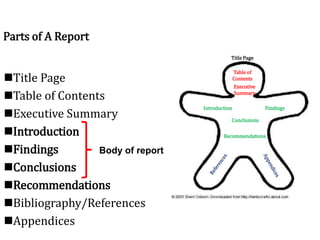
Title Page
Table of Contents
Executive Summary
Introduction
Findings
Conclusions
Recommendations
Bibliography/References
Appendices
Title Page
Table of
Contents
Executive
Summary
Introduction Findings
Recommendations
Conclusions
Body of report
Parts of A Report
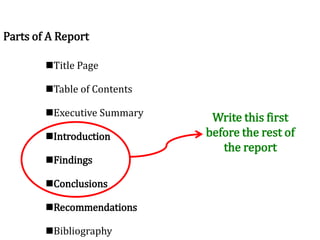
Title Page
Table of Contents
Executive Summary
Introduction
Findings
Conclusions
Recommendations
Bibliography
Write this first
before the rest of
the report
Parts of A Report
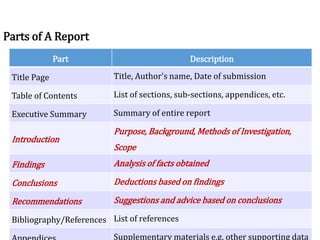
Part Description
Title Page Title, Author’s name, Date of submission
Table of Contents List of sections, sub-sections, appendices, etc.
Executive Summary Summary of entire report
Introduction
Purpose, Background, Methods of Investigation,
Scope
Findings Analysis of facts obtained
Conclusions Deductions based on findings
Recommendations Suggestions and advice based on conclusions
Bibliography/References List of references
Supplementary materials e.g. other supporting data
Parts of A Report
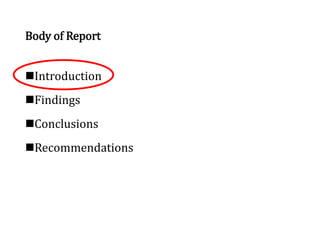
Body of Report
Introduction
Findings
Conclusions
Recommendations
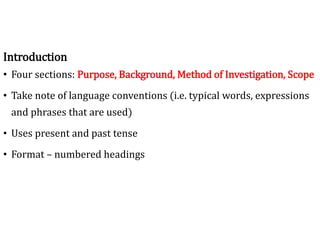
Introduction
• Four sections: Purpose, Background, Method of Investigation, Scope
• Take note of language conventions (i.e. typical words, expressions
and phrases that are used)
• Uses present and past tense
• Format – numbered headings
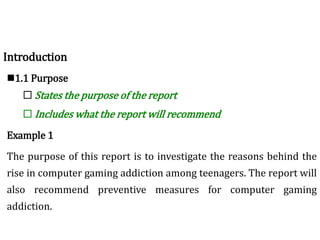
Introduction
1.1 Purpose
 States the purpose of the report
 Includes what the report will recommend
Example 1
The purpose of this report is to investigate the reasons behind the
rise in computer gaming addiction among teenagers. The report will
also recommend preventive measures for computer gaming
addiction.
QUIZ TIME
What tense is the Purpose section written in?
 Past tense
 Present tense
 Present and past tense
QUIZ TIME
What tense is the Purpose section written in?
 Past tense
 Present tense
 Present and past tense
Introduction
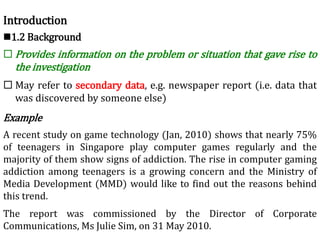
1.2 Background
 Provides information on the problem or situation that gave rise to
the investigation
 May refer to secondary data, e.g. newspaper report (i.e. data that
was discovered by someone else)
Example
A recent study on game technology (Jan, 2010) shows that nearly 75%
of teenagers in Singapore play computer games regularly and the
majority of them show signs of addiction. The rise in computer gaming
addiction among teenagers is a growing concern and the Ministry of
Media Development (MMD) would like to find out the reasons behind
this trend.
The report was commissioned by the Director of Corporate
Communications, Ms Julie Sim, on 31 May 2010.
QUIZ TIME
What tense is the Background section written in?
 Past tense
 Present tense
 Present and past tense
QUIZ TIME
What tense is the Background section written in?
 Past tense
 Present tense
 Present and past tense
1.3 Method of Investigation
 States how investigation was carried out, e.g. questionnaires
issued to [how many people] for [how long]
 This is called primary data (i.e. data that is discovered by you,
the writer of the report)
 May include references to secondary data
Introduction
Introduction
Example
Questionnaires were issued to 100 teenagers from 25 educational
institutions on 25 June 2015. Three teenagers who were former
addicts were also interviewed to get more in-depth views.
References were also made to books and newspaper articles.
QUIZ TIME
There are four sources of data.
Which is primary data? Which is secondary data?
Questionnaires were issued to 100 teenagers from 25
educational institutions on 25 June 2010. Three teenagers
who were former addicts were also interviewed to get
more in-depth views. References were also made to books
and newspaper articles.
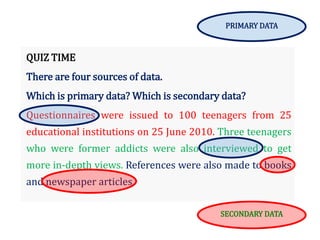
QUIZ TIME
There are four sources of data.
Which is primary data? Which is secondary data?
Questionnaires were issued to 100 teenagers from 25
educational institutions on 25 June 2010. Three teenagers
who were former addicts were also interviewed to get
more in-depth views. References were also made to books
and newspaper articles.
PRIMARY DATA
SECONDARY DATA
Introduction
• 1.4 Scope
• States the areas of investigation, e.g. reasons, consequences, etc.,
i.e. what information you need in order to meet your purpose
• First scope item is respondents’ profile
• There should be at least 3 other scope items
Example
Besides respondents’ profile, this report looks into four possible
reasons for the rise in gaming addiction among teenagers: boredom,
stress, societal influence and addictive game features.
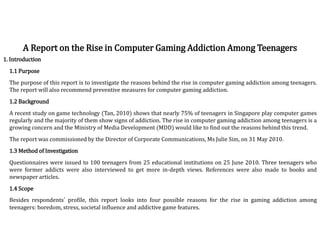
1. Introduction
1.1 Purpose
The purpose of this report is to investigate the reasons behind the rise in computer gaming addiction among teenagers.
The report will also recommend preventive measures for computer gaming addiction.
1.2 Background
A recent study on game technology (Tan, 2010) shows that nearly 75% of teenagers in Singapore play computer games
regularly and the majority of them show signs of addiction. The rise in computer gaming addiction among teenagers is a
growing concern and the Ministry of Media Development (MDD) would like to find out the reasons behind this trend.
The report was commissioned by the Director of Corporate Communications, Ms Julie Sim, on 31 May 2010.
1.3 Method of Investigation
Questionnaires were issued to 100 teenagers from 25 educational institutions on 25 June 2010. Three teenagers who
were former addicts were also interviewed to get more in-depth views. References were also made to books and
newspaper articles.
1.4 Scope
Besides respondents’ profile, this report looks into four possible reasons for the rise in gaming addiction among
teenagers: boredom, stress, societal influence and addictive game features.
A Report on the Rise in Computer Gaming Addiction Among Teenagers
1. Introduction
1.1 Purpose
The purpose of this report is to investigate the reasons behind the rise in computer gaming addiction among teenagers.
The report will also recommend preventive measures for computer gaming addiction.
1.2 Background
A recent study on game technology (Tan, 2010) shows that nearly 75% of teenagers in Singapore play computer games
regularly and the majority of them show signs of addiction. The rise in computer gaming addiction among teenagers is a
growing concern and the Ministry of Media Development (MDD) would like to find out the reasons behind this trend.
The report was commissioned by the Director of Corporate Communications, Ms Julie Sim, on 31 May 2010.
1.3 Method of Investigation
Questionnaires were issued to 100 teenagers from 25 educational institutions on 25 June 2010. Three teenagers who
were former addicts were also interviewed to get more in-depth views. References were also made to books and
newspaper articles.
1.4 Scope
Besides respondents’ profile, this report looks into four possible reasons for the rise in gaming addiction among
teenagers: boredom, stress, societal influence and addictive game features.
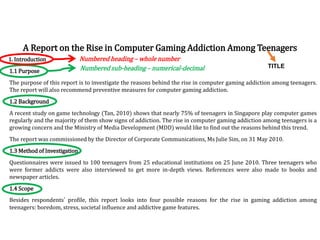
A Report on the Rise in Computer Gaming Addiction Among Teenagers
Numbered heading – whole number
Numbered sub-heading – numerical-decimal TITLE
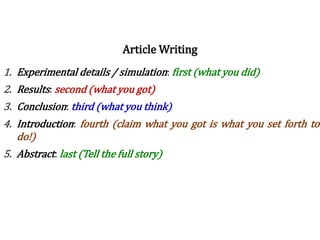
Writing order
1. Experimental details / simulation: first (what you did)
2. Results: second (what you got)
3. Conclusion: third (what you think)
4. Introduction: fourth (claim what you got is what you set forth to
do!)
5. Abstract: last (Tell the full story)
Article Writing
Norms of good writing● Abbreviations: first time in expanded form with abbreviation in
brackets
● Equations: neatly labelled; every term should be explicitly
explained
● Figures: clean, with axes labeled, proper title
● Any claim – support with references to the literature
● Do not use informal words/expressions (OK, don't, can't, …) or
informal spelling (density & temperature, ...) in technical writing
Article Writing
Norms of good writingSome Tricks!
 Writing: Top down or Bottom Up – depends on your philosophy of
writing!
 Write the section titles, sub-section titles, sub-sub-section titles,
paragraphs – a line for each; build on this
 Write everything that comes to your mind indiscriminately. Edit,
move around passages and modify – never delete till the end
Article Writing
Tools of the trade
● Buy a good dictionary
● Subscribe to a good technical journal: wired, economist,
resonance, ...
● Learn LaTeX / gnuplot ...
● Use lab notebook extensively
● Learn to use a spell checker
● Do a MOOC course :-)
Tools of the Trade - Technical writing
Good technical writing
Good technical writing:
● Flows from a scientific attitude
● Curiosity
● Commitment to follow truth wherever it takes you
● Commitment to communication
● Enthusiasm for what you are doing
● Respect for those who worked before you
● The urge to push the boundaries!
Internet communication
Emails : Start and End
● Emails
● Blogs
● Wikipedia
● Twitter for technical communication?
Emails
Your Email id: Preferably, your name
Why write Emails?
● To get information
● To communicate information
● To collaborate
● To resolve disputes
● To complain
● To explain: because you are complained against
Internet communication
Format
● Subject
● Address
● Greet / Introduce yourself
● Describe: in as many paragraphs as needed
● Sign off
● Signature file
Internet communication
Email Subject
● Short
● Contains all vital information
● Know your recipient(s)
● Tune subject according to your recipient(s)
● Never leave blank
● Forwarding: format if necessary
Internet communication
Address
● Dear ______
● Ms. / Mr.
● Prof. / Dr.
● Dear Prof. Veeru, or Dear Prof. Veeru :?
● Dear Prof. Veeresh or Dear Prof. Veeru?
● Never Dear Mr. or Dear Ms. Or just Dear
● Dear Professor, Dear Director, Dear Dean – allowed
● Avoid Respected, Esteemed etc
Internet communication
Sign off
Email End
● With regards / With best regards
● Yours sincerely
● With best wishes
● Thanking you / Looking forward to hearing from you
● Sign off with full name
● Shorter version name signoff – sometimes may mean to tell the
receiver that he/she should address you
● Don't sign off with a title (Prof. Veeresh)
● No messy quotes / jokes in formal sign-off
Internet communication
Signature file
● Most email programs allow you to have a signature file
● Prepare a proper signature file
● Can serve the function of From in more formal letters
● Postal address, phone numbers, alternate email address,
designation and any other information – homepage, blog address,
twitter handle ...
Internet communication
Email protocol
● Be prompt in your replies
● Be simple, direct and short
● Do not sign up for services which flood your contacts' mailboxes with
unnecessary emails
● Be careful while signing up for services which offer to send a mail to all your
contacts
● Keep people posted: if there will be delay, let them know in advance
● Keep to your timeline
● Be careful with attachments
● Do not click send more than once
● Use email cautiously and professionally
Emails: Do’s and Don'ts
Internet communication
Greet / Introduce yourselfEmails : The Body
● Thank you very much for your mail.
● I am sorry for the delay in writing to you.
● I am Veeresh. I am a faculty member in the Department of ME and MS at ASEB.
● I am Vibhaan. I am a Ph D student at the Department of ME and MS at ASEB.
● I am writing in my capacity as the secretary of the Department Seminar
Committee.
Internet communication
Start a separate paragraph
 I am writing to recommend …
 I am writing to explain …
 I am writing to congratulate …
 I am writing to thank …
 I am writing to complain …
 I am writing to bring to your notice …
 I am writing to urge you ...
Norms of good writing
● No unexplained abbreviations
● No bad spelling – always run a spell check
● Auto-spellers and completions: very dangerous
● No single mass of writing – paragraph structure is important
● Punctuations are very important
● Email structure is very important: leave enough space between
different parts of the mail
Internet communication
To be safe
● Never mail any important mail immediately after writing: save the draft, come
back after a break, read and send
● Switch-on the retract email option
● If possible, compose elsewhere, cut-and-paste and mail
● If possible, ask somebody to read before hitting send
● Never send a mail when you are angry, upset or in a hurry
Internet communication
Safety: at next level
● Email id-s and accounts are like your credit cards: should be treated with care
● Email id-s and account are like credit cards: unauthorized use is not allowed
● Emails are not playthings: don't play pranks
● Emails are legal documents: that you will not write down or say in public – do
not say in emails either
Writing Difficult Emails
● Your paper is rejected by the editor. You believe that the review is
not fair. Write an email to the editor explaining why you want a
second review.
● You want to go for a conference. The registration fee is too high
and your approved budget cannot cover it. Write a mail to the
organizers requesting fee waiver.
● You attended a conference and met some very interesting
researchers in your area of interest. Write an email to thank them
for the interactions. The purpose of the email is to keep the
contacts alive. How would you do it without overt signaling?
Internet communication
Rules of writing1. Write every day: at least five sentences
2. Read every day: at least five sentences
3. Never take sentences from elsewhere with or without modification
-- and pass it off as your own
4. Write to communicate concepts and help others take off from
where you leave
Technical writing : The Four Rules
Rule 1: Write everyday
● Write on your own – without looking at any other document.
● Write what you did -- in your lab notebook
● Write what you think!
● Write what you do not understand!
● Write something!
Rule Two : Read
● To write well, you should have read good writing.
● How to identify good reading material in your area of interest?
● Backtracking method (as well as track into future!)
Technical writing : The Four Rules
7 rm technical writing

7 rm technical writing

  • 1.
    Technical writing OrReport Writing Good Writing: Norms, Writing and Presentation Skills © 2013 Sherrie Lee http://www.linkedin.com/in/orangecanton
  • 2.
    Title Page Table ofContents Executive Summary Introduction Findings Conclusions Recommendations Bibliography/References Appendices Title Page Table of Contents Executive Summary Introduction Findings Recommendations Conclusions Body of report Parts of A Report
  • 3.
    Title Page Table ofContents Executive Summary Introduction Findings Conclusions Recommendations Bibliography Write this first before the rest of the report Parts of A Report
  • 4.
    Part Description Title PageTitle, Author’s name, Date of submission Table of Contents List of sections, sub-sections, appendices, etc. Executive Summary Summary of entire report Introduction Purpose, Background, Methods of Investigation, Scope Findings Analysis of facts obtained Conclusions Deductions based on findings Recommendations Suggestions and advice based on conclusions Bibliography/References List of references Supplementary materials e.g. other supporting data Parts of A Report
  • 5.
  • 6.
    Introduction • Four sections:Purpose, Background, Method of Investigation, Scope • Take note of language conventions (i.e. typical words, expressions and phrases that are used) • Uses present and past tense • Format – numbered headings
  • 7.
    Introduction 1.1 Purpose  Statesthe purpose of the report  Includes what the report will recommend Example 1 The purpose of this report is to investigate the reasons behind the rise in computer gaming addiction among teenagers. The report will also recommend preventive measures for computer gaming addiction.
  • 8.
    QUIZ TIME What tenseis the Purpose section written in?  Past tense  Present tense  Present and past tense
  • 9.
    QUIZ TIME What tenseis the Purpose section written in?  Past tense  Present tense  Present and past tense
  • 10.
    Introduction 1.2 Background  Providesinformation on the problem or situation that gave rise to the investigation  May refer to secondary data, e.g. newspaper report (i.e. data that was discovered by someone else) Example A recent study on game technology (Jan, 2010) shows that nearly 75% of teenagers in Singapore play computer games regularly and the majority of them show signs of addiction. The rise in computer gaming addiction among teenagers is a growing concern and the Ministry of Media Development (MMD) would like to find out the reasons behind this trend. The report was commissioned by the Director of Corporate Communications, Ms Julie Sim, on 31 May 2010.
  • 11.
    QUIZ TIME What tenseis the Background section written in?  Past tense  Present tense  Present and past tense
  • 12.
    QUIZ TIME What tenseis the Background section written in?  Past tense  Present tense  Present and past tense
  • 13.
    1.3 Method ofInvestigation  States how investigation was carried out, e.g. questionnaires issued to [how many people] for [how long]  This is called primary data (i.e. data that is discovered by you, the writer of the report)  May include references to secondary data Introduction
  • 14.
    Introduction Example Questionnaires were issuedto 100 teenagers from 25 educational institutions on 25 June 2015. Three teenagers who were former addicts were also interviewed to get more in-depth views. References were also made to books and newspaper articles.
  • 15.
    QUIZ TIME There arefour sources of data. Which is primary data? Which is secondary data? Questionnaires were issued to 100 teenagers from 25 educational institutions on 25 June 2010. Three teenagers who were former addicts were also interviewed to get more in-depth views. References were also made to books and newspaper articles.
  • 16.
    QUIZ TIME There arefour sources of data. Which is primary data? Which is secondary data? Questionnaires were issued to 100 teenagers from 25 educational institutions on 25 June 2010. Three teenagers who were former addicts were also interviewed to get more in-depth views. References were also made to books and newspaper articles. PRIMARY DATA SECONDARY DATA
  • 17.
    Introduction • 1.4 Scope •States the areas of investigation, e.g. reasons, consequences, etc., i.e. what information you need in order to meet your purpose • First scope item is respondents’ profile • There should be at least 3 other scope items Example Besides respondents’ profile, this report looks into four possible reasons for the rise in gaming addiction among teenagers: boredom, stress, societal influence and addictive game features.
  • 18.
    1. Introduction 1.1 Purpose Thepurpose of this report is to investigate the reasons behind the rise in computer gaming addiction among teenagers. The report will also recommend preventive measures for computer gaming addiction. 1.2 Background A recent study on game technology (Tan, 2010) shows that nearly 75% of teenagers in Singapore play computer games regularly and the majority of them show signs of addiction. The rise in computer gaming addiction among teenagers is a growing concern and the Ministry of Media Development (MDD) would like to find out the reasons behind this trend. The report was commissioned by the Director of Corporate Communications, Ms Julie Sim, on 31 May 2010. 1.3 Method of Investigation Questionnaires were issued to 100 teenagers from 25 educational institutions on 25 June 2010. Three teenagers who were former addicts were also interviewed to get more in-depth views. References were also made to books and newspaper articles. 1.4 Scope Besides respondents’ profile, this report looks into four possible reasons for the rise in gaming addiction among teenagers: boredom, stress, societal influence and addictive game features. A Report on the Rise in Computer Gaming Addiction Among Teenagers
  • 19.
    1. Introduction 1.1 Purpose Thepurpose of this report is to investigate the reasons behind the rise in computer gaming addiction among teenagers. The report will also recommend preventive measures for computer gaming addiction. 1.2 Background A recent study on game technology (Tan, 2010) shows that nearly 75% of teenagers in Singapore play computer games regularly and the majority of them show signs of addiction. The rise in computer gaming addiction among teenagers is a growing concern and the Ministry of Media Development (MDD) would like to find out the reasons behind this trend. The report was commissioned by the Director of Corporate Communications, Ms Julie Sim, on 31 May 2010. 1.3 Method of Investigation Questionnaires were issued to 100 teenagers from 25 educational institutions on 25 June 2010. Three teenagers who were former addicts were also interviewed to get more in-depth views. References were also made to books and newspaper articles. 1.4 Scope Besides respondents’ profile, this report looks into four possible reasons for the rise in gaming addiction among teenagers: boredom, stress, societal influence and addictive game features. A Report on the Rise in Computer Gaming Addiction Among Teenagers Numbered heading – whole number Numbered sub-heading – numerical-decimal TITLE
  • 20.
    Writing order 1. Experimentaldetails / simulation: first (what you did) 2. Results: second (what you got) 3. Conclusion: third (what you think) 4. Introduction: fourth (claim what you got is what you set forth to do!) 5. Abstract: last (Tell the full story) Article Writing
  • 21.
    Norms of goodwriting● Abbreviations: first time in expanded form with abbreviation in brackets ● Equations: neatly labelled; every term should be explicitly explained ● Figures: clean, with axes labeled, proper title ● Any claim – support with references to the literature ● Do not use informal words/expressions (OK, don't, can't, …) or informal spelling (density & temperature, ...) in technical writing Article Writing
  • 22.
    Norms of goodwritingSome Tricks!  Writing: Top down or Bottom Up – depends on your philosophy of writing!  Write the section titles, sub-section titles, sub-sub-section titles, paragraphs – a line for each; build on this  Write everything that comes to your mind indiscriminately. Edit, move around passages and modify – never delete till the end Article Writing
  • 23.
    Tools of thetrade ● Buy a good dictionary ● Subscribe to a good technical journal: wired, economist, resonance, ... ● Learn LaTeX / gnuplot ... ● Use lab notebook extensively ● Learn to use a spell checker ● Do a MOOC course :-) Tools of the Trade - Technical writing
  • 24.
    Good technical writing Goodtechnical writing: ● Flows from a scientific attitude ● Curiosity ● Commitment to follow truth wherever it takes you ● Commitment to communication ● Enthusiasm for what you are doing ● Respect for those who worked before you ● The urge to push the boundaries!
  • 25.
    Internet communication Emails :Start and End ● Emails ● Blogs ● Wikipedia ● Twitter for technical communication?
  • 26.
    Emails Your Email id:Preferably, your name Why write Emails? ● To get information ● To communicate information ● To collaborate ● To resolve disputes ● To complain ● To explain: because you are complained against Internet communication
  • 27.
    Format ● Subject ● Address ●Greet / Introduce yourself ● Describe: in as many paragraphs as needed ● Sign off ● Signature file Internet communication
  • 28.
    Email Subject ● Short ●Contains all vital information ● Know your recipient(s) ● Tune subject according to your recipient(s) ● Never leave blank ● Forwarding: format if necessary Internet communication
  • 29.
    Address ● Dear ______ ●Ms. / Mr. ● Prof. / Dr. ● Dear Prof. Veeru, or Dear Prof. Veeru :? ● Dear Prof. Veeresh or Dear Prof. Veeru? ● Never Dear Mr. or Dear Ms. Or just Dear ● Dear Professor, Dear Director, Dear Dean – allowed ● Avoid Respected, Esteemed etc Internet communication
  • 30.
    Sign off Email End ●With regards / With best regards ● Yours sincerely ● With best wishes ● Thanking you / Looking forward to hearing from you ● Sign off with full name ● Shorter version name signoff – sometimes may mean to tell the receiver that he/she should address you ● Don't sign off with a title (Prof. Veeresh) ● No messy quotes / jokes in formal sign-off Internet communication
  • 31.
    Signature file ● Mostemail programs allow you to have a signature file ● Prepare a proper signature file ● Can serve the function of From in more formal letters ● Postal address, phone numbers, alternate email address, designation and any other information – homepage, blog address, twitter handle ... Internet communication
  • 32.
    Email protocol ● Beprompt in your replies ● Be simple, direct and short ● Do not sign up for services which flood your contacts' mailboxes with unnecessary emails ● Be careful while signing up for services which offer to send a mail to all your contacts ● Keep people posted: if there will be delay, let them know in advance ● Keep to your timeline ● Be careful with attachments ● Do not click send more than once ● Use email cautiously and professionally Emails: Do’s and Don'ts Internet communication
  • 33.
    Greet / IntroduceyourselfEmails : The Body ● Thank you very much for your mail. ● I am sorry for the delay in writing to you. ● I am Veeresh. I am a faculty member in the Department of ME and MS at ASEB. ● I am Vibhaan. I am a Ph D student at the Department of ME and MS at ASEB. ● I am writing in my capacity as the secretary of the Department Seminar Committee. Internet communication Start a separate paragraph  I am writing to recommend …  I am writing to explain …  I am writing to congratulate …  I am writing to thank …  I am writing to complain …  I am writing to bring to your notice …  I am writing to urge you ...
  • 34.
    Norms of goodwriting ● No unexplained abbreviations ● No bad spelling – always run a spell check ● Auto-spellers and completions: very dangerous ● No single mass of writing – paragraph structure is important ● Punctuations are very important ● Email structure is very important: leave enough space between different parts of the mail Internet communication
  • 35.
    To be safe ●Never mail any important mail immediately after writing: save the draft, come back after a break, read and send ● Switch-on the retract email option ● If possible, compose elsewhere, cut-and-paste and mail ● If possible, ask somebody to read before hitting send ● Never send a mail when you are angry, upset or in a hurry Internet communication Safety: at next level ● Email id-s and accounts are like your credit cards: should be treated with care ● Email id-s and account are like credit cards: unauthorized use is not allowed ● Emails are not playthings: don't play pranks ● Emails are legal documents: that you will not write down or say in public – do not say in emails either
  • 36.
    Writing Difficult Emails ●Your paper is rejected by the editor. You believe that the review is not fair. Write an email to the editor explaining why you want a second review. ● You want to go for a conference. The registration fee is too high and your approved budget cannot cover it. Write a mail to the organizers requesting fee waiver. ● You attended a conference and met some very interesting researchers in your area of interest. Write an email to thank them for the interactions. The purpose of the email is to keep the contacts alive. How would you do it without overt signaling? Internet communication
  • 37.
    Rules of writing1.Write every day: at least five sentences 2. Read every day: at least five sentences 3. Never take sentences from elsewhere with or without modification -- and pass it off as your own 4. Write to communicate concepts and help others take off from where you leave Technical writing : The Four Rules Rule 1: Write everyday ● Write on your own – without looking at any other document. ● Write what you did -- in your lab notebook ● Write what you think! ● Write what you do not understand! ● Write something!
  • 38.
    Rule Two :Read ● To write well, you should have read good writing. ● How to identify good reading material in your area of interest? ● Backtracking method (as well as track into future!) Technical writing : The Four Rules