WEEK 4
Drafting the
Introduction for a
Descriptive Quantitative
Research Report
At the end of this lecture, students
should be able to
• show understanding on how to start a
descriptive quantitative method of
investigation
• generate ideas for research areas
• draft the background of study for a research
using appropriate language discourse
Before we proceed, let
us look at more
information on
Quantitative Research
A Brief Overview of
Quantitative Research
(Dornyei, 2007)
It was originally inspired by progress of
science in the 19th century and the
’scientific method’ of investigations.
Experiments were commonly conducted
then. Descriptive study was
commonly done by social scientists
who had to cope with the
complexity of human beings in their
studies
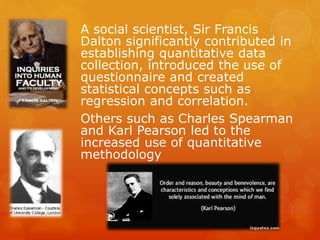
A social scientist, Sir Francis
Dalton significantly contributed in
establishing quantitative data
collection, introduced the use of
questionnaire and created
statistical concepts such as
regression and correlation.
Others such as Charles Spearman
and Karl Pearson led to the
increased use of quantitative
methodology
How should you
approach a research
work?(Dornyei, 2007)
You should start by having the
intention of finding answers to
questions that you have in your
mind and to learn more about the
world around you.
 You should choose something that you are really
interested in or have passion for.
You need to plan and be systematic in your
method of investigation so that you can stand by
your findings with confidence.
You need to engage with the real world, be
realistic, creative and sensible. Your work does
not need to be a complicated one.
Most importantly, you should be responsible
and a have a sense of social responsibility.
Your research should be done to generate
knowledge and further the understanding on
matters.
You must know how to communicate what
you discover from your research
.
Let’s start drafting the
Introduction
The discourse used in the Introduction of a
Descriptive Quantitative Research should give a
sense of focus as below:
Lit Rev on
Variable 1
(misbehaved students)
Lit Rev on
Variable 2
(non-verbal language)
SotP limited research
have been carried out on
the perception of
misbehaving students on
teachers’ non- verbal
language
General Purpose -
to investigate the
perception of misbehaving
students on teachers’ non
verbal language
RQ 1: Which
characteristic of non
verbal language is
preferred most by
students?
RQ 2: What are the
differences of opinion
between male and
female students?
(Possible)Research area:
Classroom management
(Possible) topics/concepts
to read on
1. Students’ behaviour
2. Classroom communication
(Possible) variables derived
after reading on
topics/concepts and their
definitions
1. Misbehaved students
2. Non-verbal language
(Possible)General Issue that
may have initiated interest:
Frequent reports on problems faced
by students or teachers
Background of Study
STEP 1-
Preparing the Background of Study
Generating Ideas for the Research
Area, Topics, the General Issue
and Variables
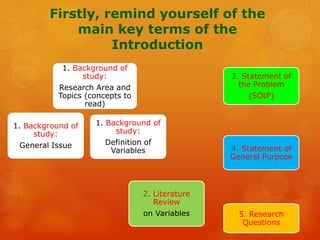
Firstly, remind yourself of the
main key terms of the
Introduction
1. Background of
study:
Research Area and
Topics (concepts to
read)
1. Background of
study:
General Issue
1. Background of
study:
Definition of
Variables
2. Literature
Review
on Variables
3. Statement of
the Problem
(SOtP)
4. Statement of
General Purpose
5. Research
Questions
Then, to start the Introduction,
You must be prepared to do at least two
sets of reading activities.
Set 1 – general reading to identify your
research topics and a related issue
Set 2 – specific readings or literature
review on the topics/variables of your
research to identify the missing information
or gap that tells you what to research on
(Creswell, 1994)
and while you read it is actually important
to observe the methods used in previous
related studies
While reading, you need to also observe the
current General Issue. Brainstorm with your
team and identify the current issue related to
your research area or topics
ENVIRONMENTAL ISSUES?
 Animal abuse?
 Air pollution?
CONCEPTS?
 Recycling?
 Cloning?
 Waste management?
 Employability?
Brainstorming
As you read “you will identify a particular issue and what other people
say or have discovered about them” (Dornyei, 2007, p.16)
Your interest should tell you
your Research Area
 Counselling?
 Eating Disorder?
 Multicultural Communication?
 Media violence?
 Disabilities in aging people?
 Terminal Illnesses?
 Home designs?
 Politics?
 Secularism?
It may not be restricted to specific kulliyah area!
Reading on the area of interest should
tell you 2 possible topics or
2 specific concepts to focus on
After identifying your interest, you should
explore many academic or non
academic materials to identify the
current topics that you can possibly
investigate on. The more your read, the
more you would be able to narrow down
the topics (Observe how the topics are
written in journal articles by other
researchers)
 Read…read…read…
newspapers, magazines
or journals
 Browse the internet
 Discuss
 Write freely
 Ask yourself some wh-
questions
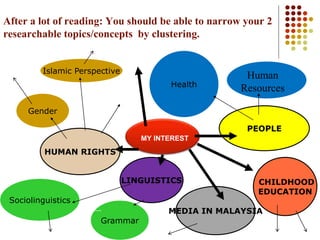
After a lot of reading: You should be able to narrow your 2
researchable topics/concepts by clustering.
MY INTEREST
PEOPLE
CHILDHOOD
EDUCATION
MEDIA IN MALAYSIA
Grammar
Sociolinguistics
Gender
Islamic Perspective
HUMAN RIGHTS
Human
ResourcesHealth
LINGUISTICS
Also, after a lot of reading, you should be able to
identify your Working Research Topics/concepts that
will be the variables of your research.
Take note of their academic definitions.
Muslim Students & Early Marriage?
Educational Background &
Deforestations?
Gender & Occupational Safety?
Co-curriculum Activities and CGPA ?
Identifying your variables
http://korbedpsych.com/R02Variables.html
The variables must be appropriate for a descriptive quantitative research
design. A variable is the characteristic or attribute of an individual, group,
educational system, or the environment that is of interest in a research study.
Variables can be straightforward and easy to measure, such as gender, age, or
course of study. Other variables are more complex, such as socioeconomic
status, academic achievement, or attitude toward school. Variables may also
include an aspect of the educational system, such as a specific teaching method
or counseling program. Characteristics of the environment may also be variables,
such as the amount of school funding or availability of computers.
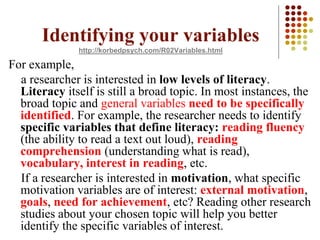
Identifying your variables
http://korbedpsych.com/R02Variables.html
For example,
a researcher is interested in low levels of literacy.
Literacy itself is still a broad topic. In most instances, the
broad topic and general variables need to be specifically
identified. For example, the researcher needs to identify
specific variables that define literacy: reading fluency
(the ability to read a text out loud), reading
comprehension (understanding what is read),
vocabulary, interest in reading, etc.
If a researcher is interested in motivation, what specific
motivation variables are of interest: external motivation,
goals, need for achievement, etc? Reading other research
studies about your chosen topic will help you better
identify the specific variables of interest.
Identifying your variables
http://korbedpsych.com/R02Variables.html
Identifying the variables is important for the following reasons:
 The variables provide focus when writing the Introduction
section.
 The variables are the major terms to use when searching for
research articles for the Literature Review.
 The variables provide focus to the Methods section.
 The Instrument will measure the variables. These variables
must be directly measured or manipulated for the research
study to be valid.
Now, if you are ready to draft your
background of study, you should
remember that in this course…
You need a well supported current issue to relate your research
to
Your research topics must be humanistic in nature
Your research topics (not title) tend to be working RTs as they
may ‘evolve as you read’
You have to be very clear and specific of your variables
(variable 1& 2) and of their relationship that you wish to study in
a descriptive quantitative research.
STEP 2
Language and Organization
for the Background of
Study
Issue
Suggested language for
Background of Study
(based on Creswell, 2009, Howe & Henriksson, 2007)
 Use a formal compositional language
 Open with a statement that stimulates interest and convey a
general issue from the research area which many can relate to
or understand
 Write short sentences and provide numeric information,
statistics or references for impact.
 Use academic terms and words
 Do not use colloquial language such as ‘info’ or tautology like
‘absolutely essential’
 Do not use contracted forms like ‘isn’t’ or clichés such as ‘in my
humble opinion’
 Do not use idiomatic, quotes or emotional expressions
Suggested organization of information
for Background of Study
(based on Creswell, 2009)
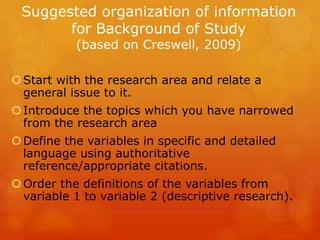
Start with the research area and relate a
general issue to it.
Introduce the topics which you have narrowed
from the research area
Define the variables in specific and detailed
language using authoritative
reference/appropriate citations.
Order the definitions of the variables from
variable 1 to variable 2 (descriptive research).
Examples of phrases to introduce
Research Area or Topicshttp://www.phrasebank.manchester.ac.uk/introductions.htm
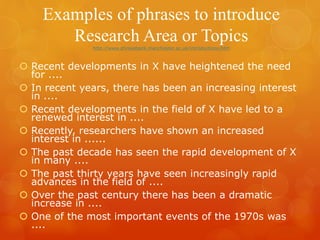
 Recent developments in X have heightened the need
for ....
 In recent years, there has been an increasing interest
in ....
 Recent developments in the field of X have led to a
renewed interest in ....
 Recently, researchers have shown an increased
interest in ......
 The past decade has seen the rapid development of X
in many ....
 The past thirty years have seen increasingly rapid
advances in the field of ....
 Over the past century there has been a dramatic
increase in ....
 One of the most important events of the 1970s was
....
Examples of phrases to highlight an
Issuehttp://www.phrasebank.manchester.ac.uk/introductions.htm
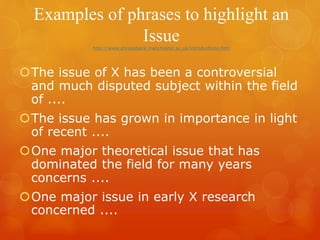
The issue of X has been a controversial
and much disputed subject within the field
of ....
The issue has grown in importance in light
of recent ....
One major theoretical issue that has
dominated the field for many years
concerns ....
One major issue in early X research
concerned ....
The Tenses to be used for
Background of Study
To refer to present facts, you can use the Simple
Present Tense and Present Perfect Tense to
introduce the area, topics, issue and to define the
variables. For instance:
Issue:
As the costs of higher education continue to rise, many institutions are
under pressure to….
Definition:
Judging is the process of coming to conclusions about what has been
perceived as measured by the Myers-Briggs Type Indicator (Myers,
1980)
Tasks:
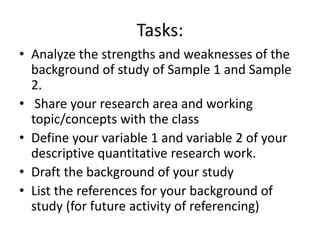
• Analyze the strengths and weaknesses of the
background of study of Sample 1 and Sample
2.
• Share your research area and working
topic/concepts with the class
• Define your variable 1 and variable 2 of your
descriptive quantitative research work.
• Draft the background of your study
• List the references for your background of
study (for future activity of referencing)

Week4a pptslides drafting the introduction - background of study

  • 1.
    WEEK 4 Drafting the Introductionfor a Descriptive Quantitative Research Report
  • 2.
    At the endof this lecture, students should be able to • show understanding on how to start a descriptive quantitative method of investigation • generate ideas for research areas • draft the background of study for a research using appropriate language discourse
  • 3.
    Before we proceed,let us look at more information on Quantitative Research
  • 4.
    A Brief Overviewof Quantitative Research (Dornyei, 2007) It was originally inspired by progress of science in the 19th century and the ’scientific method’ of investigations. Experiments were commonly conducted then. Descriptive study was commonly done by social scientists who had to cope with the complexity of human beings in their studies
  • 5.
    A social scientist,Sir Francis Dalton significantly contributed in establishing quantitative data collection, introduced the use of questionnaire and created statistical concepts such as regression and correlation. Others such as Charles Spearman and Karl Pearson led to the increased use of quantitative methodology
  • 6.
    How should you approacha research work?(Dornyei, 2007) You should start by having the intention of finding answers to questions that you have in your mind and to learn more about the world around you.
  • 7.
     You shouldchoose something that you are really interested in or have passion for. You need to plan and be systematic in your method of investigation so that you can stand by your findings with confidence. You need to engage with the real world, be realistic, creative and sensible. Your work does not need to be a complicated one.
  • 8.
    Most importantly, youshould be responsible and a have a sense of social responsibility. Your research should be done to generate knowledge and further the understanding on matters. You must know how to communicate what you discover from your research .
  • 9.
    Let’s start draftingthe Introduction
  • 10.
    The discourse usedin the Introduction of a Descriptive Quantitative Research should give a sense of focus as below: Lit Rev on Variable 1 (misbehaved students) Lit Rev on Variable 2 (non-verbal language) SotP limited research have been carried out on the perception of misbehaving students on teachers’ non- verbal language General Purpose - to investigate the perception of misbehaving students on teachers’ non verbal language RQ 1: Which characteristic of non verbal language is preferred most by students? RQ 2: What are the differences of opinion between male and female students? (Possible)Research area: Classroom management (Possible) topics/concepts to read on 1. Students’ behaviour 2. Classroom communication (Possible) variables derived after reading on topics/concepts and their definitions 1. Misbehaved students 2. Non-verbal language (Possible)General Issue that may have initiated interest: Frequent reports on problems faced by students or teachers Background of Study
  • 11.
    STEP 1- Preparing theBackground of Study Generating Ideas for the Research Area, Topics, the General Issue and Variables
  • 12.
    Firstly, remind yourselfof the main key terms of the Introduction 1. Background of study: Research Area and Topics (concepts to read) 1. Background of study: General Issue 1. Background of study: Definition of Variables 2. Literature Review on Variables 3. Statement of the Problem (SOtP) 4. Statement of General Purpose 5. Research Questions
  • 13.
    Then, to startthe Introduction, You must be prepared to do at least two sets of reading activities. Set 1 – general reading to identify your research topics and a related issue Set 2 – specific readings or literature review on the topics/variables of your research to identify the missing information or gap that tells you what to research on (Creswell, 1994) and while you read it is actually important to observe the methods used in previous related studies
  • 14.
    While reading, youneed to also observe the current General Issue. Brainstorm with your team and identify the current issue related to your research area or topics ENVIRONMENTAL ISSUES?  Animal abuse?  Air pollution? CONCEPTS?  Recycling?  Cloning?  Waste management?  Employability? Brainstorming As you read “you will identify a particular issue and what other people say or have discovered about them” (Dornyei, 2007, p.16)
  • 15.
    Your interest shouldtell you your Research Area  Counselling?  Eating Disorder?  Multicultural Communication?  Media violence?  Disabilities in aging people?  Terminal Illnesses?  Home designs?  Politics?  Secularism? It may not be restricted to specific kulliyah area!
  • 16.
    Reading on thearea of interest should tell you 2 possible topics or 2 specific concepts to focus on After identifying your interest, you should explore many academic or non academic materials to identify the current topics that you can possibly investigate on. The more your read, the more you would be able to narrow down the topics (Observe how the topics are written in journal articles by other researchers)  Read…read…read… newspapers, magazines or journals  Browse the internet  Discuss  Write freely  Ask yourself some wh- questions
  • 17.
    After a lotof reading: You should be able to narrow your 2 researchable topics/concepts by clustering. MY INTEREST PEOPLE CHILDHOOD EDUCATION MEDIA IN MALAYSIA Grammar Sociolinguistics Gender Islamic Perspective HUMAN RIGHTS Human ResourcesHealth LINGUISTICS
  • 18.
    Also, after alot of reading, you should be able to identify your Working Research Topics/concepts that will be the variables of your research. Take note of their academic definitions. Muslim Students & Early Marriage? Educational Background & Deforestations? Gender & Occupational Safety? Co-curriculum Activities and CGPA ?
  • 19.
    Identifying your variables http://korbedpsych.com/R02Variables.html Thevariables must be appropriate for a descriptive quantitative research design. A variable is the characteristic or attribute of an individual, group, educational system, or the environment that is of interest in a research study. Variables can be straightforward and easy to measure, such as gender, age, or course of study. Other variables are more complex, such as socioeconomic status, academic achievement, or attitude toward school. Variables may also include an aspect of the educational system, such as a specific teaching method or counseling program. Characteristics of the environment may also be variables, such as the amount of school funding or availability of computers.
  • 20.
    Identifying your variables http://korbedpsych.com/R02Variables.html Forexample, a researcher is interested in low levels of literacy. Literacy itself is still a broad topic. In most instances, the broad topic and general variables need to be specifically identified. For example, the researcher needs to identify specific variables that define literacy: reading fluency (the ability to read a text out loud), reading comprehension (understanding what is read), vocabulary, interest in reading, etc. If a researcher is interested in motivation, what specific motivation variables are of interest: external motivation, goals, need for achievement, etc? Reading other research studies about your chosen topic will help you better identify the specific variables of interest.
  • 21.
    Identifying your variables http://korbedpsych.com/R02Variables.html Identifyingthe variables is important for the following reasons:  The variables provide focus when writing the Introduction section.  The variables are the major terms to use when searching for research articles for the Literature Review.  The variables provide focus to the Methods section.  The Instrument will measure the variables. These variables must be directly measured or manipulated for the research study to be valid.
  • 22.
    Now, if youare ready to draft your background of study, you should remember that in this course… You need a well supported current issue to relate your research to Your research topics must be humanistic in nature Your research topics (not title) tend to be working RTs as they may ‘evolve as you read’ You have to be very clear and specific of your variables (variable 1& 2) and of their relationship that you wish to study in a descriptive quantitative research.
  • 23.
    STEP 2 Language andOrganization for the Background of Study Issue
  • 24.
    Suggested language for Backgroundof Study (based on Creswell, 2009, Howe & Henriksson, 2007)  Use a formal compositional language  Open with a statement that stimulates interest and convey a general issue from the research area which many can relate to or understand  Write short sentences and provide numeric information, statistics or references for impact.  Use academic terms and words  Do not use colloquial language such as ‘info’ or tautology like ‘absolutely essential’  Do not use contracted forms like ‘isn’t’ or clichés such as ‘in my humble opinion’  Do not use idiomatic, quotes or emotional expressions
  • 25.
    Suggested organization ofinformation for Background of Study (based on Creswell, 2009) Start with the research area and relate a general issue to it. Introduce the topics which you have narrowed from the research area Define the variables in specific and detailed language using authoritative reference/appropriate citations. Order the definitions of the variables from variable 1 to variable 2 (descriptive research).
  • 26.
    Examples of phrasesto introduce Research Area or Topicshttp://www.phrasebank.manchester.ac.uk/introductions.htm  Recent developments in X have heightened the need for ....  In recent years, there has been an increasing interest in ....  Recent developments in the field of X have led to a renewed interest in ....  Recently, researchers have shown an increased interest in ......  The past decade has seen the rapid development of X in many ....  The past thirty years have seen increasingly rapid advances in the field of ....  Over the past century there has been a dramatic increase in ....  One of the most important events of the 1970s was ....
  • 27.
    Examples of phrasesto highlight an Issuehttp://www.phrasebank.manchester.ac.uk/introductions.htm The issue of X has been a controversial and much disputed subject within the field of .... The issue has grown in importance in light of recent .... One major theoretical issue that has dominated the field for many years concerns .... One major issue in early X research concerned ....
  • 28.
    The Tenses tobe used for Background of Study To refer to present facts, you can use the Simple Present Tense and Present Perfect Tense to introduce the area, topics, issue and to define the variables. For instance: Issue: As the costs of higher education continue to rise, many institutions are under pressure to…. Definition: Judging is the process of coming to conclusions about what has been perceived as measured by the Myers-Briggs Type Indicator (Myers, 1980)
  • 29.
    Tasks: • Analyze thestrengths and weaknesses of the background of study of Sample 1 and Sample 2. • Share your research area and working topic/concepts with the class • Define your variable 1 and variable 2 of your descriptive quantitative research work. • Draft the background of your study • List the references for your background of study (for future activity of referencing)