Introduction to Unit 4:
Literature Review/
Synthesis Essay
Allyn and Bacon Chapters 8 and 13
The Next Step . . .
In past units, you have been asked to reflect, summarize,
and analyze on both the rhetorical and idea levels. You have
been asked to objectively critique a piece of writing with
both “with the grain” and “against the grain”points,
effectively outlining a single author’s argument without
placing yourself into the conversation.

SYNTHESIS asks you to do many of these things but for
multiple sources AND to critique these sources both
individually and within relation to each other (and the
perceived general discourse on the topic). Synthesis asks you
to present what is known about a topic, what is unknown,
what needs to be investigated, and finally what new
perspectives were gained from the investigation.
Asking a Question . . .
“The need to synthesize ideas usually begins when you pose a
problematic question that sends you on an intellectual journey
through a group of texts.”– Ramage, Bean, and Johnson.
Two Types of Questions You’ll
           Need
General Topic Questions:
      What effect is technology having on the quality of human life?
      Should Standardized testing be used in college admissions?
      Is online learning effective?


Critical/Source Questions:
      What are the common assumptions and conclusions?
      What problems and solutions appear?
      What are the differences in presentation/solutions etc.?
      Do you side with a certain source more than others?
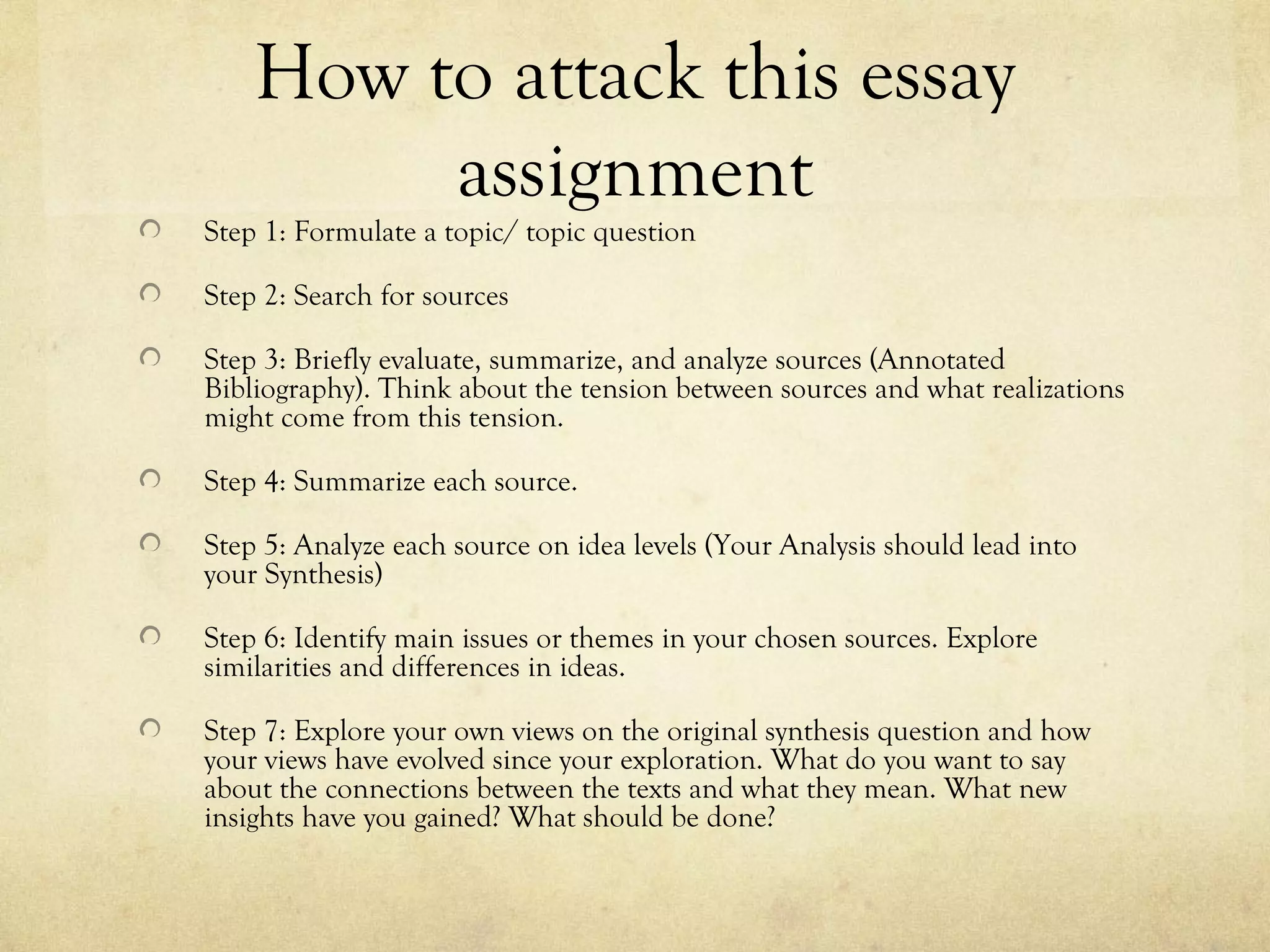
How to attack this essay
         assignment
Step 1: Formulate a topic/ topic question

Step 2: Search for sources

Step 3: Briefly evaluate, summarize, and analyze sources (Annotated
Bibliography). Think about the tension between sources and what realizations
might come from this tension.

Step 4: Summarize each source.

Step 5: Analyze each source on idea levels (Your Analysis should lead into
your Synthesis)

Step 6: Identify main issues or themes in your chosen sources. Explore
similarities and differences in ideas.

Step 7: Explore your own views on the original synthesis question and how
your views have evolved since your exploration. What do you want to say
about the connections between the texts and what they mean. What new
insights have you gained? What should be done?
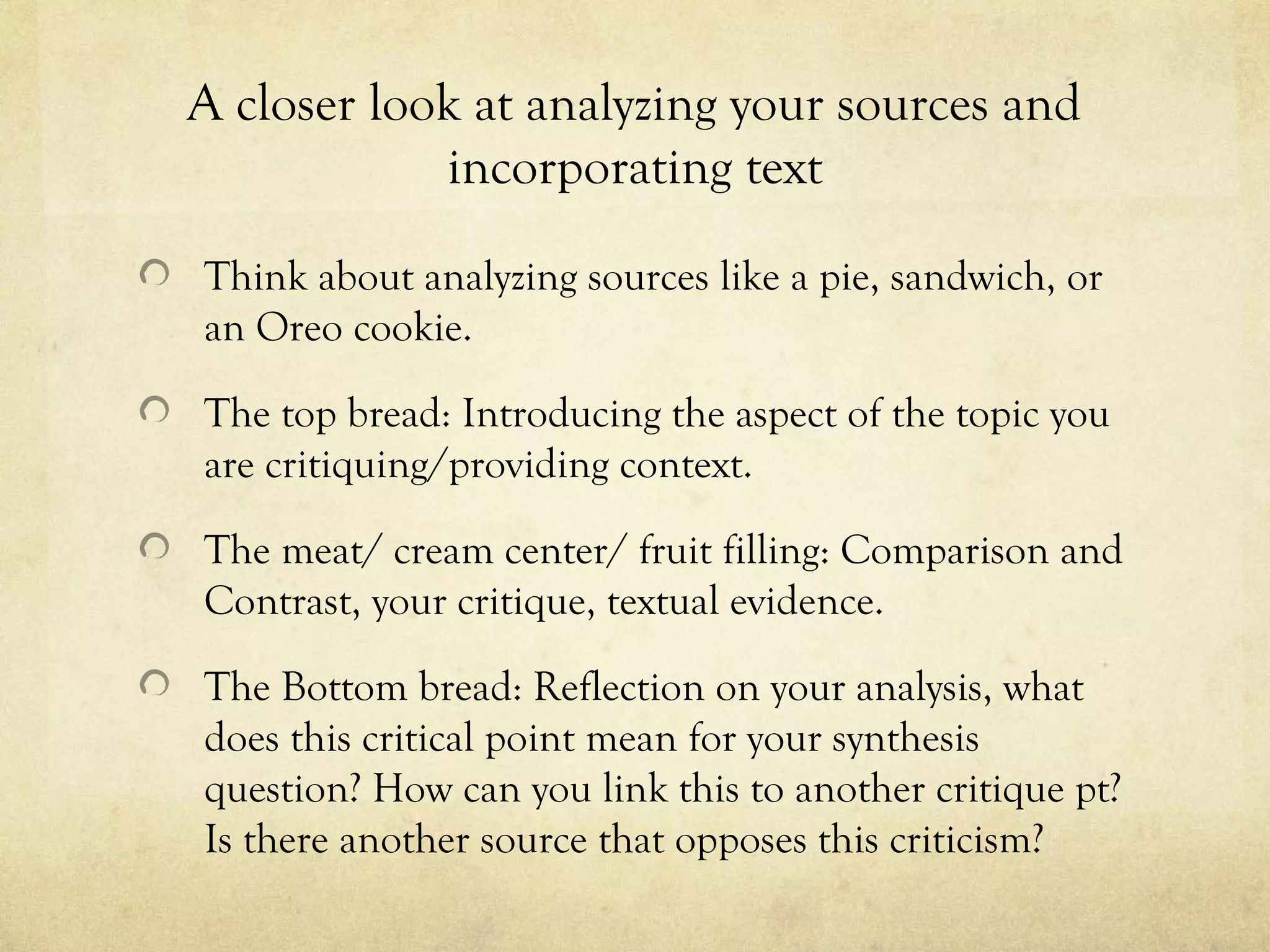
A closer look at analyzing your sources and
            incorporating text

Think about analyzing sources like a pie, sandwich, or
an Oreo cookie.

The top bread: Introducing the aspect of the topic you
are critiquing/providing context.

The meat/ cream center/ fruit filling: Comparison and
Contrast, your critique, textual evidence.

The Bottom bread: Reflection on your analysis, what
does this critical point mean for your synthesis
question? How can you link this to another critique pt?
Is there another source that opposes this criticism?
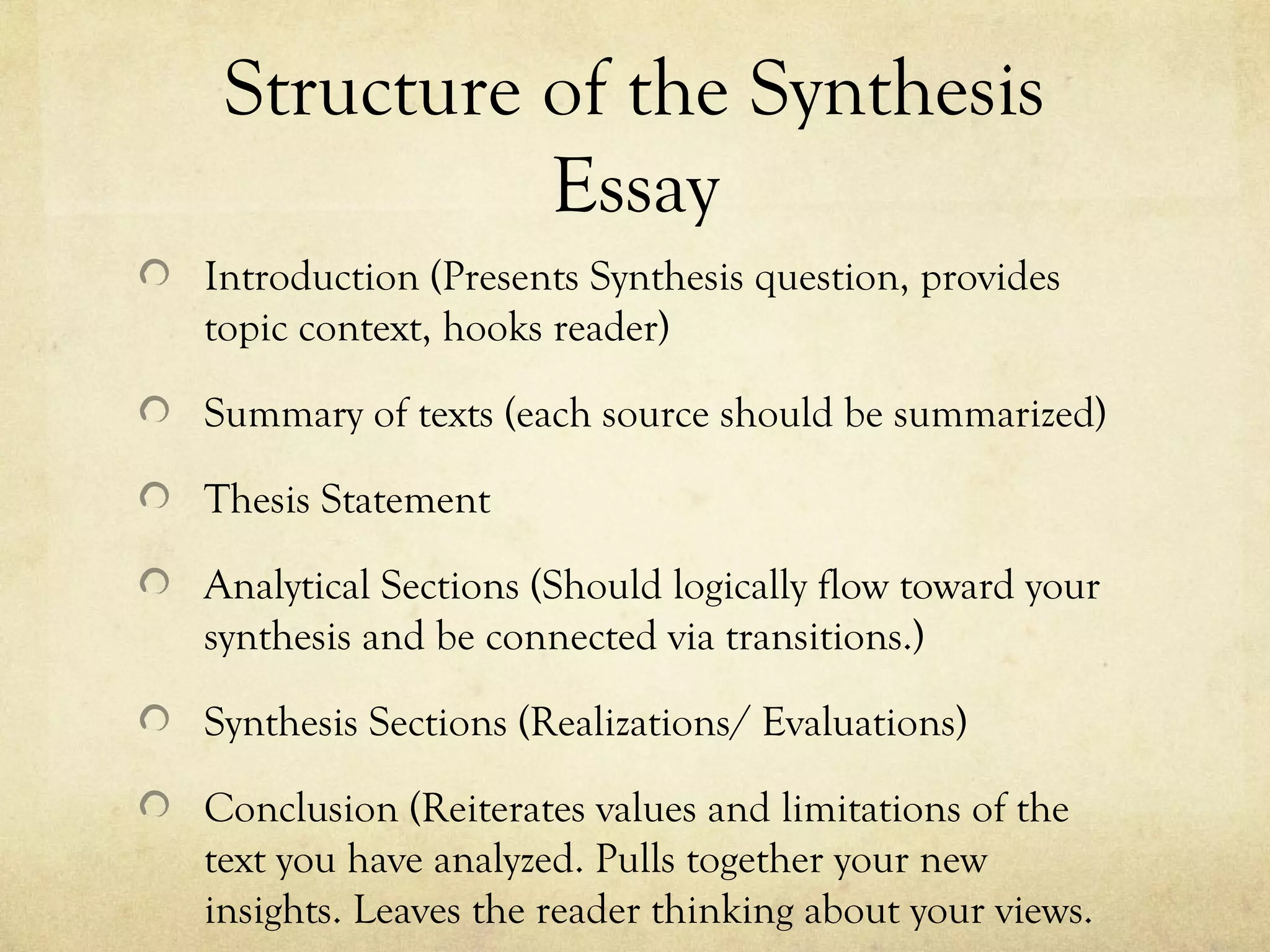
Structure of the Synthesis
           Essay
Introduction (Presents Synthesis question, provides
topic context, hooks reader)

Summary of texts (each source should be summarized)

Thesis Statement

Analytical Sections (Should logically flow toward your
synthesis and be connected via transitions.)

Synthesis Sections (Realizations/ Evaluations)

Conclusion (Reiterates values and limitations of the
text you have analyzed. Pulls together your new
insights. Leaves the reader thinking about your views.
For now, let’s focus specifically on synthesis and how one

pulls together ideas from multiple sources in order to

present a dialogue and forward your views.
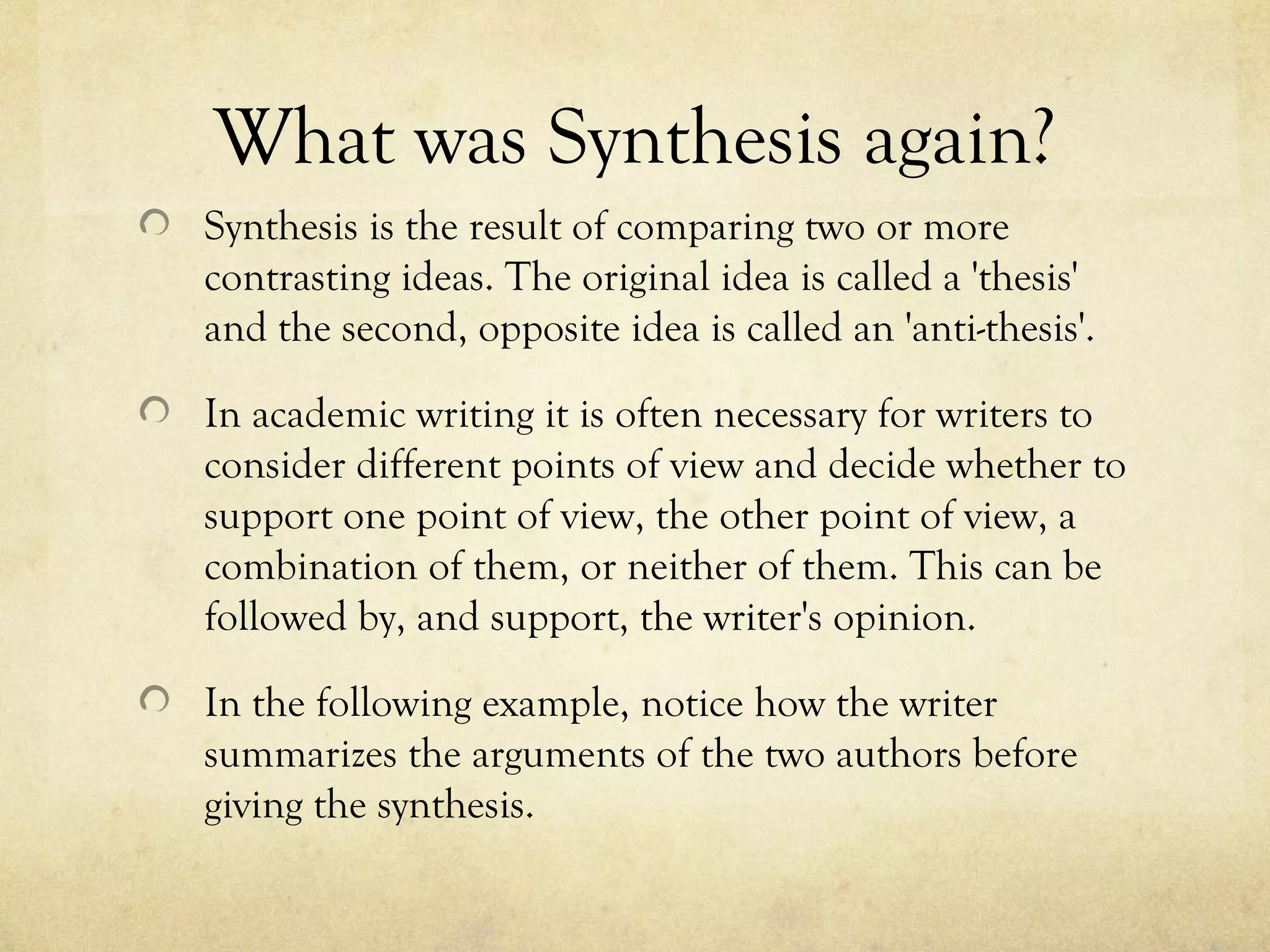
What was Synthesis again?
Synthesis is the result of comparing two or more
contrasting ideas. The original idea is called a 'thesis'
and the second, opposite idea is called an 'anti-thesis'.

In academic writing it is often necessary for writers to
consider different points of view and decide whether to
support one point of view, the other point of view, a
combination of them, or neither of them. This can be
followed by, and support, the writer's opinion.

In the following example, notice how the writer
summarizes the arguments of the two authors before
giving the synthesis.
Example 1:
                    Thesis                              Anti-Thesis
    This study has therefore revealed that       It is claimed that computer games have
    children who play computer games on          negative physical effects on eyesight,
                                                 hands and posture. However, all of these
    a regular basis experience a number          are caused by the computer hardware
    of medical problems. The evidence            and equipment, not by the software.
    suggests that the most serious               The same physical effects occur from
    problem is crooked posture, which is         prolonged usage of computers for any
    caused by their being hunched over           reason, such as word-processing. In fact,
    their computers for considerable             carpal tunnel syndrome was identified
                                                 as a workplace ailment caused by office
    periods of time. Another common              programs, not games. These physical
    problem associated with playing              effects can all be reduced or eliminated
    computer games over long periods             by better hardware and more attention
    (when the same moves are constantly          to ergonomics, such as higher-resolution
    repeated) is that of pain in the hands       and higher-contrast screens, and
                                                 supportive furniture
(Source: Brown)                              (Source: Smith)
Example 1: Synthesis A
The effects of playing computer games on physical
health are controversial (Brown , 2000; Smith, 2003).
Although Brown (2000, p.141) states that computer
games can cause physical problems such as bad posture
and pain in the hands, Smith (2003) argues that these
problems are caused by the hardware, not the games.
In my opinion the games cause physical health
problems because they encourage long periods of
computer use on harmful hardware.
Example 1: Synthesis B
The effects of playing computer games on physical
health are controversial (Brown , 2000; Smith, 2003).
Brown (2000, p.141) suggests that computer games can
cause physical problems such as bad posture and pain
in the hands. However, Smith (2003) points out that
these problems are caused by the hardware, not the
games. I believe that the physical health problems are
caused by games as they encourage long periods of
computer use on harmful hardware.
Example 1: Synthesis C
The effects of playing computer games on physical
health are controversial (Brown , 2000; Smith, 2003).
According to Brown (2000, p.141) computer games
can cause physical problems such as bad posture and
pain in the hands. Smith (2003) disagrees, and argues
that these problems are caused by the hardware, not
the games. I contend that the physical health problems
are due to the long periods of computer use on
harmful hardware which occur when children are
playing computer games.
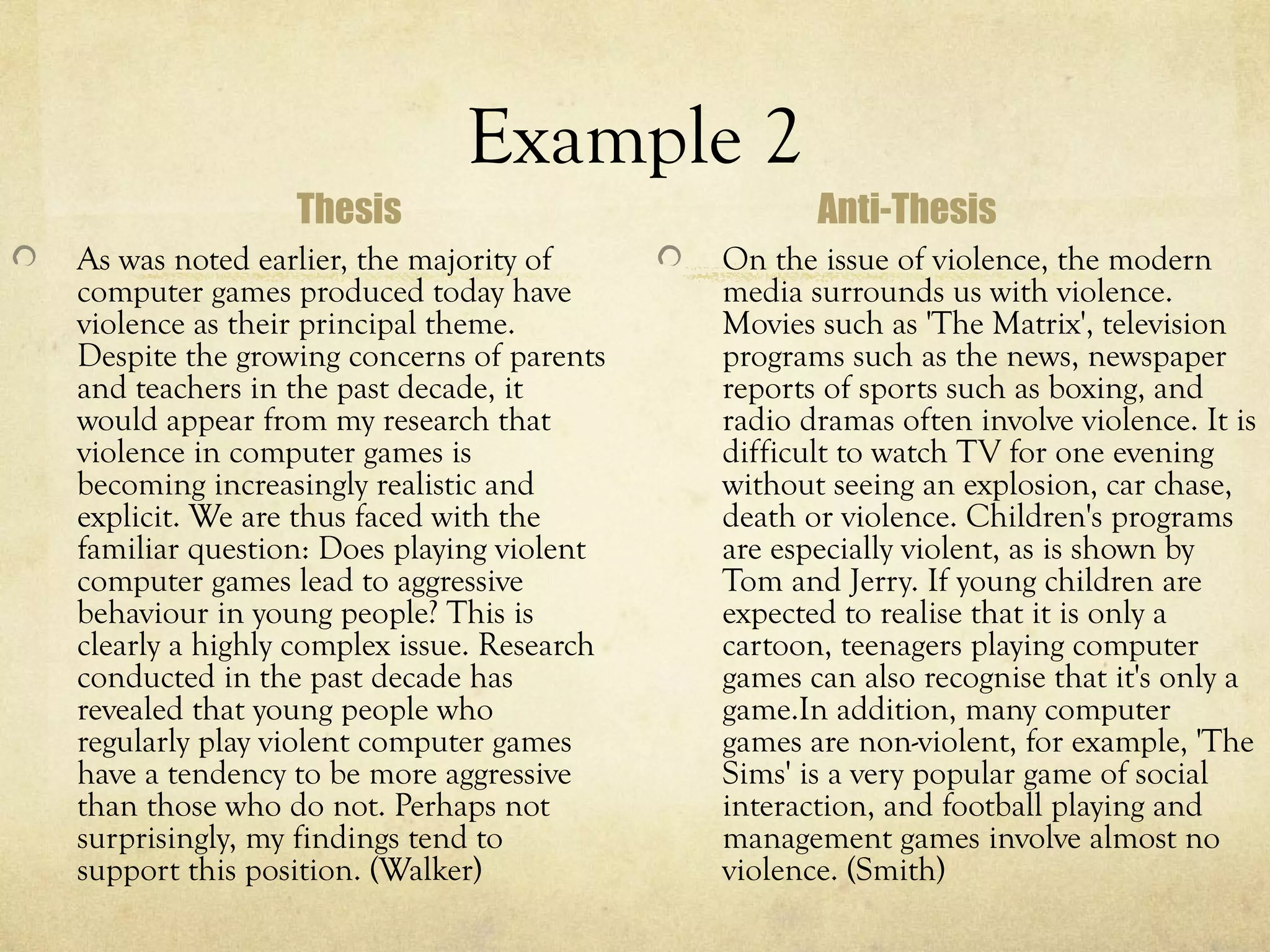
Example 2
                Thesis                            Anti-Thesis
As was noted earlier, the majority of      On the issue of violence, the modern
computer games produced today have         media surrounds us with violence.
violence as their principal theme.         Movies such as 'The Matrix', television
Despite the growing concerns of parents    programs such as the news, newspaper
and teachers in the past decade, it        reports of sports such as boxing, and
would appear from my research that         radio dramas often involve violence. It is
violence in computer games is              difficult to watch TV for one evening
becoming increasingly realistic and        without seeing an explosion, car chase,
explicit. We are thus faced with the       death or violence. Children's programs
familiar question: Does playing violent    are especially violent, as is shown by
computer games lead to aggressive          Tom and Jerry. If young children are
behaviour in young people? This is         expected to realise that it is only a
clearly a highly complex issue. Research   cartoon, teenagers playing computer
conducted in the past decade has           games can also recognise that it's only a
revealed that young people who             game.In addition, many computer
regularly play violent computer games      games are non-violent, for example, 'The
have a tendency to be more aggressive      Sims' is a very popular game of social
than those who do not. Perhaps not         interaction, and football playing and
surprisingly, my findings tend to          management games involve almost no
support this position. (Walker)            violence. (Smith)
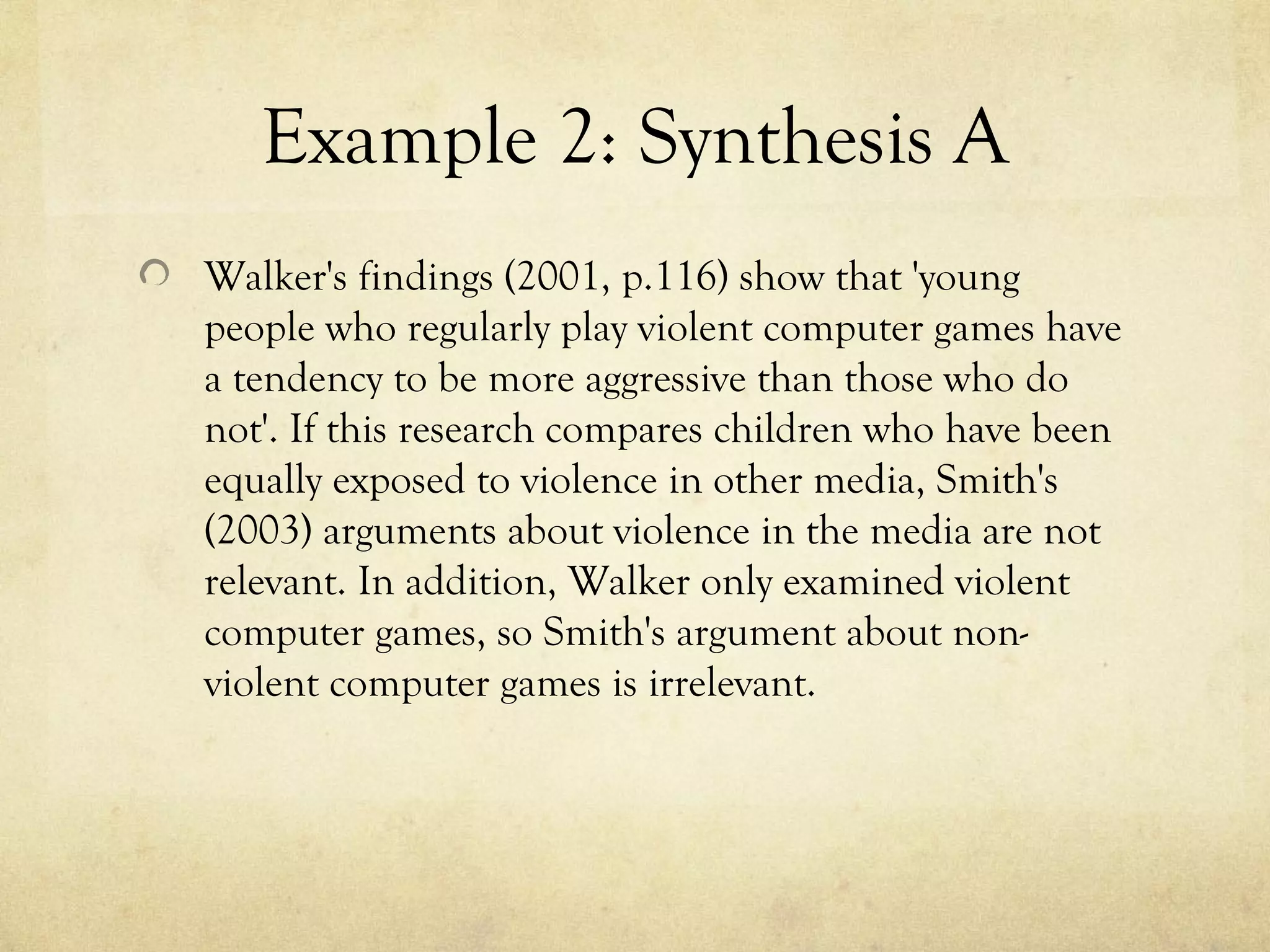
Example 2: Synthesis A
Walker's findings (2001, p.116) show that 'young
people who regularly play violent computer games have
a tendency to be more aggressive than those who do
not'. If this research compares children who have been
equally exposed to violence in other media, Smith's
(2003) arguments about violence in the media are not
relevant. In addition, Walker only examined violent
computer games, so Smith's argument about non-
violent computer games is irrelevant.
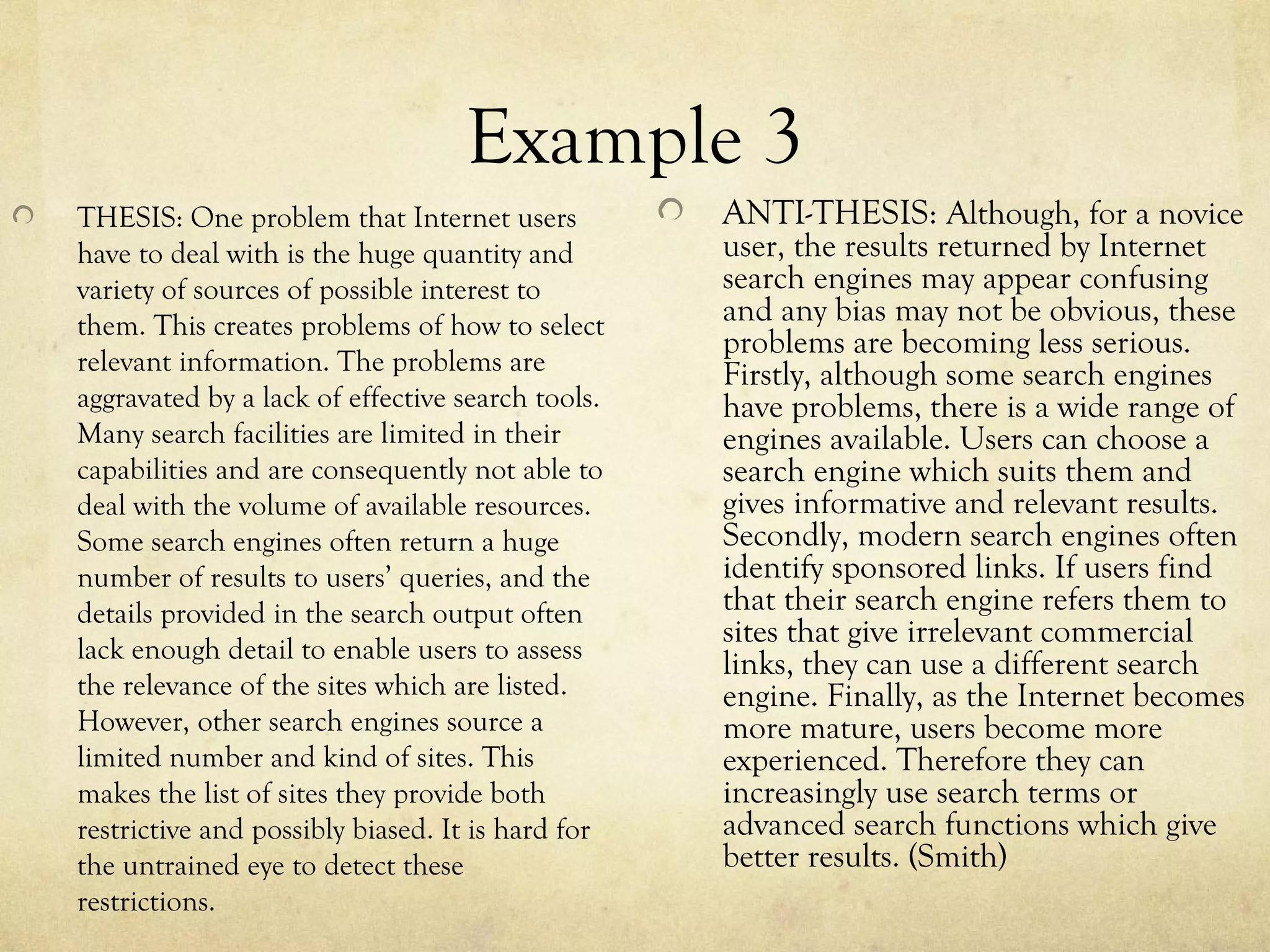
Example 3
THESIS: One problem that Internet users           ANTI-THESIS: Although, for a novice
have to deal with is the huge quantity and        user, the results returned by Internet
variety of sources of possible interest to        search engines may appear confusing
them. This creates problems of how to select      and any bias may not be obvious, these
                                                  problems are becoming less serious.
relevant information. The problems are            Firstly, although some search engines
aggravated by a lack of effective search tools.   have problems, there is a wide range of
Many search facilities are limited in their       engines available. Users can choose a
capabilities and are consequently not able to     search engine which suits them and
deal with the volume of available resources.      gives informative and relevant results.
Some search engines often return a huge           Secondly, modern search engines often
number of results to users’ queries, and the      identify sponsored links. If users find
details provided in the search output often       that their search engine refers them to
                                                  sites that give irrelevant commercial
lack enough detail to enable users to assess
                                                  links, they can use a different search
the relevance of the sites which are listed.      engine. Finally, as the Internet becomes
However, other search engines source a            more mature, users become more
limited number and kind of sites. This            experienced. Therefore they can
makes the list of sites they provide both         increasingly use search terms or
restrictive and possibly biased. It is hard for   advanced search functions which give
the untrained eye to detect these                 better results. (Smith)
restrictions.
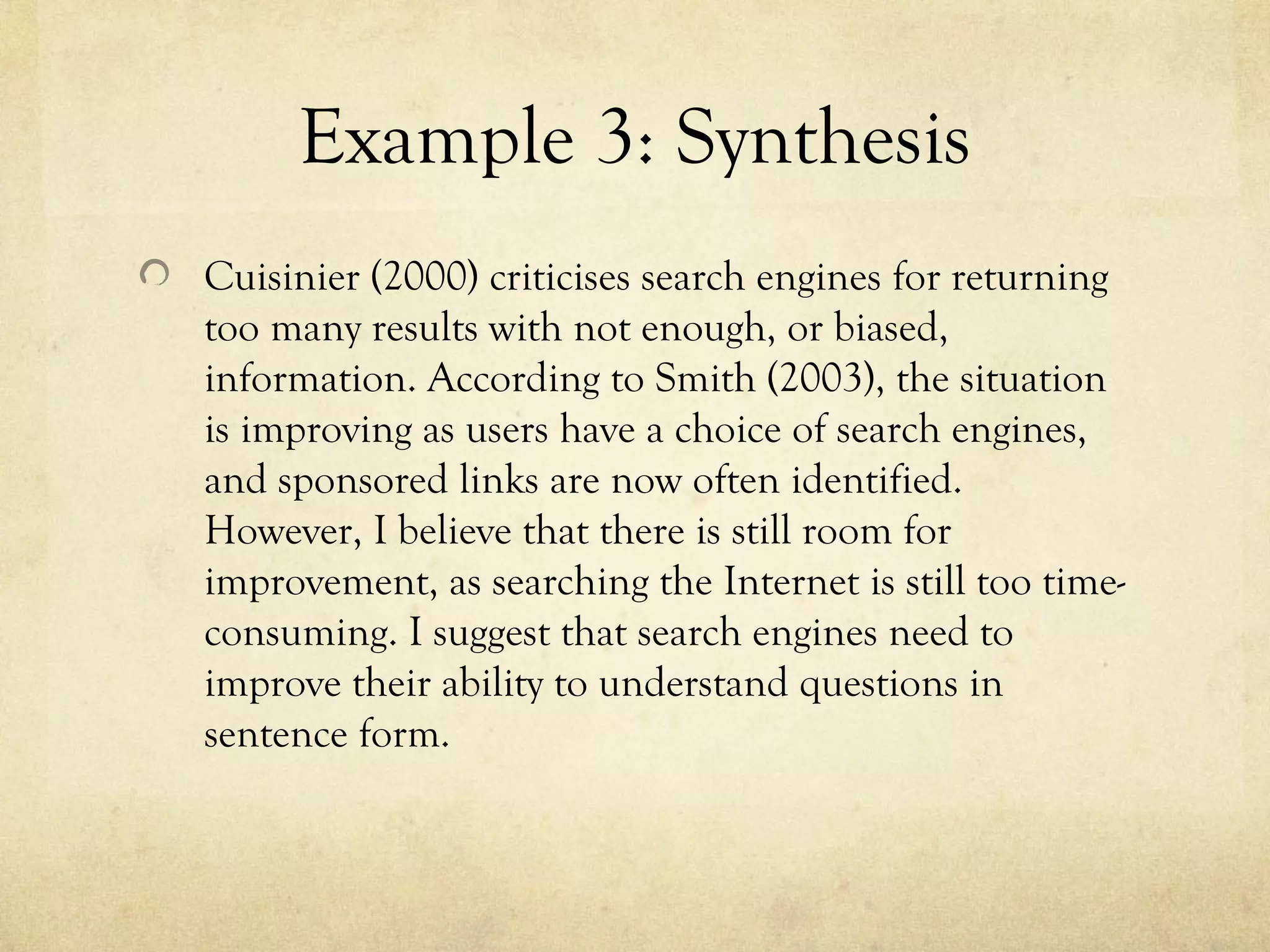
Example 3: Synthesis
Cuisinier (2000) criticises search engines for returning
too many results with not enough, or biased,
information. According to Smith (2003), the situation
is improving as users have a choice of search engines,
and sponsored links are now often identified.
However, I believe that there is still room for
improvement, as searching the Internet is still too time-
consuming. I suggest that search engines need to
improve their ability to understand questions in
sentence form.
Exercise:
Using the sources you have collected:

1)How would you describe each writer’s perspective or
angle of vision? In one or two sentences, summarize the
main points of each article. Come up with a paragraph
in which you cite the main ideas for each source and
come up with an evaluative statement.

2)List ideas that the pieces have in common

3) List contradictions or differences.

4) Free-write your own response to these readings,
exploring what questions they raise for you or personal
experiences that they might remind you of.

Synthesis Essay Presentation

  • 1.
    Introduction to Unit4: Literature Review/ Synthesis Essay Allyn and Bacon Chapters 8 and 13
  • 2.
    The Next Step. . . In past units, you have been asked to reflect, summarize, and analyze on both the rhetorical and idea levels. You have been asked to objectively critique a piece of writing with both “with the grain” and “against the grain”points, effectively outlining a single author’s argument without placing yourself into the conversation. SYNTHESIS asks you to do many of these things but for multiple sources AND to critique these sources both individually and within relation to each other (and the perceived general discourse on the topic). Synthesis asks you to present what is known about a topic, what is unknown, what needs to be investigated, and finally what new perspectives were gained from the investigation.
  • 3.
    Asking a Question. . . “The need to synthesize ideas usually begins when you pose a problematic question that sends you on an intellectual journey through a group of texts.”– Ramage, Bean, and Johnson.
  • 4.
    Two Types ofQuestions You’ll Need General Topic Questions: What effect is technology having on the quality of human life? Should Standardized testing be used in college admissions? Is online learning effective? Critical/Source Questions: What are the common assumptions and conclusions? What problems and solutions appear? What are the differences in presentation/solutions etc.? Do you side with a certain source more than others?
  • 5.
    How to attackthis essay assignment Step 1: Formulate a topic/ topic question Step 2: Search for sources Step 3: Briefly evaluate, summarize, and analyze sources (Annotated Bibliography). Think about the tension between sources and what realizations might come from this tension. Step 4: Summarize each source. Step 5: Analyze each source on idea levels (Your Analysis should lead into your Synthesis) Step 6: Identify main issues or themes in your chosen sources. Explore similarities and differences in ideas. Step 7: Explore your own views on the original synthesis question and how your views have evolved since your exploration. What do you want to say about the connections between the texts and what they mean. What new insights have you gained? What should be done?
  • 6.
    A closer lookat analyzing your sources and incorporating text Think about analyzing sources like a pie, sandwich, or an Oreo cookie. The top bread: Introducing the aspect of the topic you are critiquing/providing context. The meat/ cream center/ fruit filling: Comparison and Contrast, your critique, textual evidence. The Bottom bread: Reflection on your analysis, what does this critical point mean for your synthesis question? How can you link this to another critique pt? Is there another source that opposes this criticism?
  • 7.
    Structure of theSynthesis Essay Introduction (Presents Synthesis question, provides topic context, hooks reader) Summary of texts (each source should be summarized) Thesis Statement Analytical Sections (Should logically flow toward your synthesis and be connected via transitions.) Synthesis Sections (Realizations/ Evaluations) Conclusion (Reiterates values and limitations of the text you have analyzed. Pulls together your new insights. Leaves the reader thinking about your views.
  • 8.
    For now, let’sfocus specifically on synthesis and how one pulls together ideas from multiple sources in order to present a dialogue and forward your views.
  • 9.
    What was Synthesisagain? Synthesis is the result of comparing two or more contrasting ideas. The original idea is called a 'thesis' and the second, opposite idea is called an 'anti-thesis'. In academic writing it is often necessary for writers to consider different points of view and decide whether to support one point of view, the other point of view, a combination of them, or neither of them. This can be followed by, and support, the writer's opinion. In the following example, notice how the writer summarizes the arguments of the two authors before giving the synthesis.
  • 10.
    Example 1: Thesis Anti-Thesis This study has therefore revealed that It is claimed that computer games have children who play computer games on negative physical effects on eyesight, hands and posture. However, all of these a regular basis experience a number are caused by the computer hardware of medical problems. The evidence and equipment, not by the software. suggests that the most serious The same physical effects occur from problem is crooked posture, which is prolonged usage of computers for any caused by their being hunched over reason, such as word-processing. In fact, their computers for considerable carpal tunnel syndrome was identified as a workplace ailment caused by office periods of time. Another common programs, not games. These physical problem associated with playing effects can all be reduced or eliminated computer games over long periods by better hardware and more attention (when the same moves are constantly to ergonomics, such as higher-resolution repeated) is that of pain in the hands and higher-contrast screens, and supportive furniture (Source: Brown) (Source: Smith)
  • 11.
    Example 1: SynthesisA The effects of playing computer games on physical health are controversial (Brown , 2000; Smith, 2003). Although Brown (2000, p.141) states that computer games can cause physical problems such as bad posture and pain in the hands, Smith (2003) argues that these problems are caused by the hardware, not the games. In my opinion the games cause physical health problems because they encourage long periods of computer use on harmful hardware.
  • 12.
    Example 1: SynthesisB The effects of playing computer games on physical health are controversial (Brown , 2000; Smith, 2003). Brown (2000, p.141) suggests that computer games can cause physical problems such as bad posture and pain in the hands. However, Smith (2003) points out that these problems are caused by the hardware, not the games. I believe that the physical health problems are caused by games as they encourage long periods of computer use on harmful hardware.
  • 13.
    Example 1: SynthesisC The effects of playing computer games on physical health are controversial (Brown , 2000; Smith, 2003). According to Brown (2000, p.141) computer games can cause physical problems such as bad posture and pain in the hands. Smith (2003) disagrees, and argues that these problems are caused by the hardware, not the games. I contend that the physical health problems are due to the long periods of computer use on harmful hardware which occur when children are playing computer games.
  • 14.
    Example 2 Thesis Anti-Thesis As was noted earlier, the majority of On the issue of violence, the modern computer games produced today have media surrounds us with violence. violence as their principal theme. Movies such as 'The Matrix', television Despite the growing concerns of parents programs such as the news, newspaper and teachers in the past decade, it reports of sports such as boxing, and would appear from my research that radio dramas often involve violence. It is violence in computer games is difficult to watch TV for one evening becoming increasingly realistic and without seeing an explosion, car chase, explicit. We are thus faced with the death or violence. Children's programs familiar question: Does playing violent are especially violent, as is shown by computer games lead to aggressive Tom and Jerry. If young children are behaviour in young people? This is expected to realise that it is only a clearly a highly complex issue. Research cartoon, teenagers playing computer conducted in the past decade has games can also recognise that it's only a revealed that young people who game.In addition, many computer regularly play violent computer games games are non-violent, for example, 'The have a tendency to be more aggressive Sims' is a very popular game of social than those who do not. Perhaps not interaction, and football playing and surprisingly, my findings tend to management games involve almost no support this position. (Walker) violence. (Smith)
  • 15.
    Example 2: SynthesisA Walker's findings (2001, p.116) show that 'young people who regularly play violent computer games have a tendency to be more aggressive than those who do not'. If this research compares children who have been equally exposed to violence in other media, Smith's (2003) arguments about violence in the media are not relevant. In addition, Walker only examined violent computer games, so Smith's argument about non- violent computer games is irrelevant.
  • 16.
    Example 3 THESIS: Oneproblem that Internet users ANTI-THESIS: Although, for a novice have to deal with is the huge quantity and user, the results returned by Internet variety of sources of possible interest to search engines may appear confusing them. This creates problems of how to select and any bias may not be obvious, these problems are becoming less serious. relevant information. The problems are Firstly, although some search engines aggravated by a lack of effective search tools. have problems, there is a wide range of Many search facilities are limited in their engines available. Users can choose a capabilities and are consequently not able to search engine which suits them and deal with the volume of available resources. gives informative and relevant results. Some search engines often return a huge Secondly, modern search engines often number of results to users’ queries, and the identify sponsored links. If users find details provided in the search output often that their search engine refers them to sites that give irrelevant commercial lack enough detail to enable users to assess links, they can use a different search the relevance of the sites which are listed. engine. Finally, as the Internet becomes However, other search engines source a more mature, users become more limited number and kind of sites. This experienced. Therefore they can makes the list of sites they provide both increasingly use search terms or restrictive and possibly biased. It is hard for advanced search functions which give the untrained eye to detect these better results. (Smith) restrictions.
  • 17.
    Example 3: Synthesis Cuisinier(2000) criticises search engines for returning too many results with not enough, or biased, information. According to Smith (2003), the situation is improving as users have a choice of search engines, and sponsored links are now often identified. However, I believe that there is still room for improvement, as searching the Internet is still too time- consuming. I suggest that search engines need to improve their ability to understand questions in sentence form.
  • 18.
    Exercise: Using the sourcesyou have collected: 1)How would you describe each writer’s perspective or angle of vision? In one or two sentences, summarize the main points of each article. Come up with a paragraph in which you cite the main ideas for each source and come up with an evaluative statement. 2)List ideas that the pieces have in common 3) List contradictions or differences. 4) Free-write your own response to these readings, exploring what questions they raise for you or personal experiences that they might remind you of.