Download to read offline
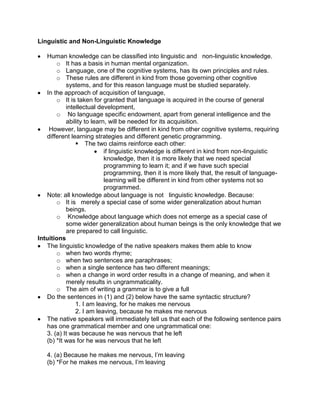
![o Also, languages share syntactic categories such as Nouns, Verbs, etc.
Apart from such universal processes, languages also vary:
o Variation in sound system and sound pattern.
o English and the languages of South Asia (SA) share many sounds but there
are also sounds that are found in English but not in SA languages.
o English [ ,ð] – voiceless and voiced dental fricatives (alphabetically
represented as th) are not found in SA languages. On the other hand, some
SA languages have the sounds such as [ , ] do not exist in English.
Languages also very at syntactic level.
o English has syntactic categories such as Noun, Verb, Adverb, Adjective,
Preposition, Conjunction and Determiners.
o SA languages do not have preposition but postpositions and they do not have
the so called English type of determiners such as articles.
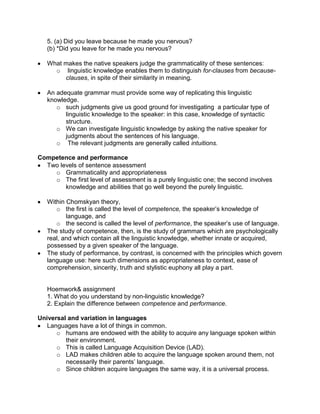
Languages also vary in the arrangements of the words in a phrase or sentence
o English permits SVO order but most SA languages are SOV languages.
Consider the following sentences
6a.Nepali:
6b.English: John bought a book.
o In English, the direct object (a book) follows the verb while in Nepali it
precedes the verb.
o Thus, in English, everything in the verb phrase appears to the right but in
Nepali everything in the Verb Phrase appears to the left.
o English is, thus, Verb-medial while Nepali is Verb-final.
o In parametric variation this phenomenon is referred to as Head Parameter.
Features shared by languages are referred to as the core while those that are
different are referred to as the periphery.
Assignment
Discuss two ways by which languages could vary.
What are Rules?
Rules form an important aspect of Transformational Generative (TG) grammar.
o A native speaker, not only recognizes the words of his language and strings
them, but also adheres to specific rules of the language that make his
utterances fall in line with how other speakers use them.
o These rules help him produce the correct sentences of his language and
make his sentences acceptable to other native speakers.
o These rules predict and reflect the native speaker’s competence of his
language.
Phrase Structure Rules
The basic idea of T G grammar is
o sentences of a language can be divided into constituent parts
o each word in a sentence is a constituent of some phrase that, in turn, is
ultimately a constituent of the sentence.](https://image.slidesharecdn.com/7-131114012442-phpapp02/85/7-ku-gr-sem-2013-Syntax-3-320.jpg)
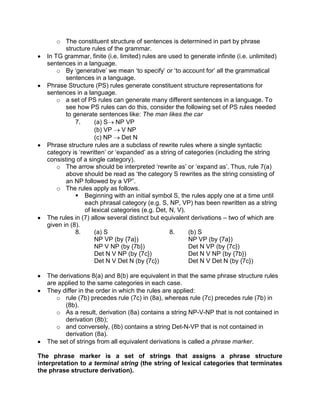

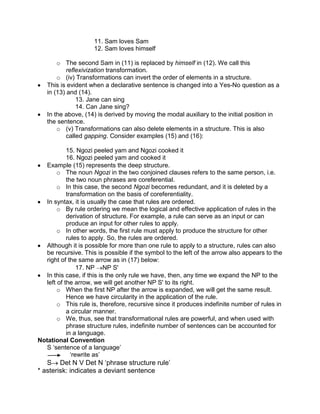
![( ) parentheses: enclose optional elements in a rule
{ } braces: enclose alternative elements in a rule
[ ] square brackets: enclose syntactic features
/ oblique: is used in context-sensitive rules
double arrow: is used in transformational rules
zero: indicates the absence of any element
Assignment
1. Mention and explain two differences between Phrase Structure rules and
Transformational rules.
2. (a) What are the functions of transformational rules?
(b) What transformational rules have applied to derive the following sentences?
(i) The goal was scored by Kanu
(ii) John loves himself
(iii) Did the teacher come?
(iv) Will you finish the work?
For sample papers and guidelines for assignments you can find some of
my papers in this website.
http://ling.uni-konstanz.de/pages/home/tafseer/research.htm](https://image.slidesharecdn.com/7-131114012442-phpapp02/85/7-ku-gr-sem-2013-Syntax-7-320.jpg)

This document discusses different types of human knowledge and how language acquisition works. It begins by distinguishing between linguistic knowledge, which is knowledge about language, and non-linguistic knowledge. It notes that language has its own principles and rules that are different from other cognitive systems. Two approaches to language acquisition are described - one that views language as developing through general intellectual development, and one that argues language may require special genetic programming. The document then discusses how linguistic intuitions of native speakers can provide insights into their linguistic knowledge and syntactic judgments. It defines the difference between competence, a speaker's innate linguistic knowledge, and performance, their actual language use. Finally, it notes both universal aspects of language shared across languages but also areas of variation between


