RISK
MANAGEMENT
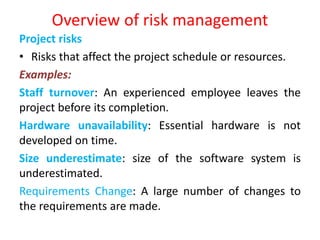
• Risk management is to solve the problem of
identifying & managing the risks associated
with software projects.
• The basic goal of risk management is to avoid
disasters or heavy losses.
• Risk management can be divided into 3
categories :
• Project risks
• Product risks
• Business risks
Overview of risk management
Project risks
• Risks that affect the project schedule or resources.
Examples:
Staff turnover: An experienced employee leaves the
project before its completion.
Hardware unavailability: Essential hardware is not
developed on time.
Size underestimate: size of the software system is
underestimated.
Requirements Change: A large number of changes to
the requirements are made.
Overview of risk management
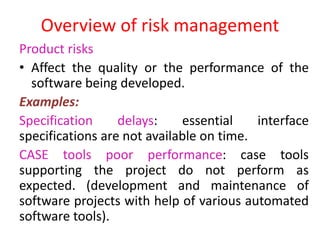
Product risks
• Affect the quality or the performance of the
software being developed.
Examples:
Specification delays: essential interface
specifications are not available on time.
CASE tools poor performance: case tools
supporting the project do not perform as
expected. (development and maintenance of
software projects with help of various automated
software tools).
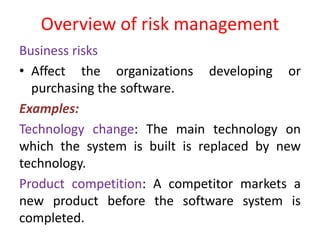
Overview of risk management
Business risks
• Affect the organizations developing or
purchasing the software.
Examples:
Technology change: The main technology on
which the system is built is replaced by new
technology.
Product competition: A competitor markets a
new product before the software system is
completed.
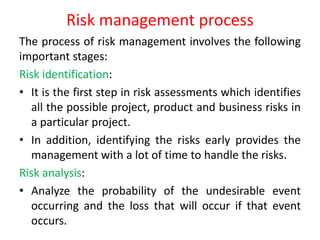
Risk management process
The process of risk management involves the following
important stages:
Risk identification:
• It is the first step in risk assessments which identifies
all the possible project, product and business risks in
a particular project.
• In addition, identifying the risks early provides the
management with a lot of time to handle the risks.
Risk analysis:
• Analyze the probability of the undesirable event
occurring and the loss that will occur if that event
occurs.
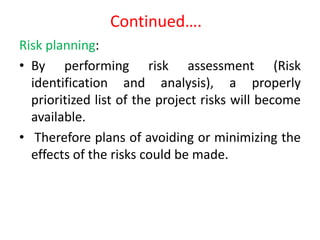
Continued….
Risk planning:
• By performing risk assessment (Risk
identification and analysis), a properly
prioritized list of the project risks will become
available.
• Therefore plans of avoiding or minimizing the
effects of the risks could be made.
Risk monitoring:
• This must be a continuous process. Each
identified risk is regularly assessed.
• Finally the outcome of the risk management
process must be documented.
• It should include the risks faced by the project,
analysis of those risks and plans required to
manage the risks.
Continued….
Process Visibility
• Processes should not only be designed and
implemented but should also be visible.
• The documentation of software systems makes
the software process visible.
• A key step is to ensure that the processes are
visible to all employees and managers who will
be able to implement processes effectively.
Steps required for process visibility
Documentation:
• It offers the most efficient and simple way to
document any process within an organization.
• This could be a process manual or even a simple
list of tasks that need to be performed.
• Process documentation can then be sent to all
employees and decision makers who are involved
in implementing the processes, and kept on
record, to be updated as changes are required.
Continued…
Diagrams
• Diagrams offer a visual representation of the
process steps.
• By adding visual representations within the
process documentation, process steps can also be
simplified and made clearer to all involved.
Sharing
• The most effective way to ensure total visibility
and understanding of processes is done through
training, one-on-one facilitation and through
tools that make it easier for employees to access
the process and understand them fully.
Continued…
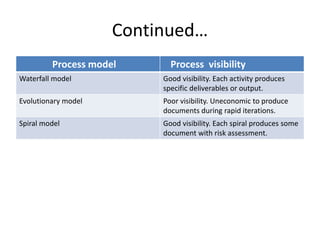
Process model Process visibility
Waterfall model Good visibility. Each activity produces
specific deliverables or output.
Evolutionary model Poor visibility. Uneconomic to produce
documents during rapid iterations.
Spiral model Good visibility. Each spiral produces some
document with risk assessment.
Continued…
Advantages
• Process visibility helps everyone - employees,
customers to see and understand an
organization’s operations from beginning to
end.
• Competency spreads throughout the
organization.
• collaboration increases, and problem solving
becomes easier as a company’s supporting
resources such as training, tools, and policies
become readily available to all.
Continued…
Disadvantages
• The time schedule for management
requirements may not correspond with time
required to complete an activity. This will lead
to extra documents to be produced adding to
the cost of the process.
• Sometimes development continues before the
previous phase documents are completed,
affecting review and approval process.
• Software engineering is bounded by local,
national and international laws.
• Software engineers should uphold normal
standards of honesty and integrity.
• They should not use their skills and abilities to
behave in a dishonest way.
Professional Responsibility
Some of the professional responsibilities are:
1. Confidentiality : Engineers should respect
the confidentiality of their employers or
clients irrespective of whether a
confidentiality agreement has been signed or
not.
2. Competence: They should not misrepresent
their level of competence. They should not
accept work which is outside their
competence.
Continued …
Intellectual property rights:
They should be aware of local laws governing
the use of intellectual property such as patents,
copyright, etc. They should ensure that the
intellectual property of employers and clients is
protected.
Computer misuse:
They should not use their technical skills to
misuse other people’s computers.

6.RISK MANAGEMENT.pptx

  • 1.
  • 2.
    • Risk managementis to solve the problem of identifying & managing the risks associated with software projects. • The basic goal of risk management is to avoid disasters or heavy losses. • Risk management can be divided into 3 categories : • Project risks • Product risks • Business risks Overview of risk management
  • 3.
    Overview of riskmanagement Project risks • Risks that affect the project schedule or resources. Examples: Staff turnover: An experienced employee leaves the project before its completion. Hardware unavailability: Essential hardware is not developed on time. Size underestimate: size of the software system is underestimated. Requirements Change: A large number of changes to the requirements are made.
  • 4.
    Overview of riskmanagement Product risks • Affect the quality or the performance of the software being developed. Examples: Specification delays: essential interface specifications are not available on time. CASE tools poor performance: case tools supporting the project do not perform as expected. (development and maintenance of software projects with help of various automated software tools).
  • 5.
    Overview of riskmanagement Business risks • Affect the organizations developing or purchasing the software. Examples: Technology change: The main technology on which the system is built is replaced by new technology. Product competition: A competitor markets a new product before the software system is completed.
  • 6.
    Risk management process Theprocess of risk management involves the following important stages: Risk identification: • It is the first step in risk assessments which identifies all the possible project, product and business risks in a particular project. • In addition, identifying the risks early provides the management with a lot of time to handle the risks. Risk analysis: • Analyze the probability of the undesirable event occurring and the loss that will occur if that event occurs.
  • 7.
    Continued…. Risk planning: • Byperforming risk assessment (Risk identification and analysis), a properly prioritized list of the project risks will become available. • Therefore plans of avoiding or minimizing the effects of the risks could be made.
  • 8.
    Risk monitoring: • Thismust be a continuous process. Each identified risk is regularly assessed. • Finally the outcome of the risk management process must be documented. • It should include the risks faced by the project, analysis of those risks and plans required to manage the risks. Continued….
  • 9.
    Process Visibility • Processesshould not only be designed and implemented but should also be visible. • The documentation of software systems makes the software process visible. • A key step is to ensure that the processes are visible to all employees and managers who will be able to implement processes effectively.
  • 10.
    Steps required forprocess visibility Documentation: • It offers the most efficient and simple way to document any process within an organization. • This could be a process manual or even a simple list of tasks that need to be performed. • Process documentation can then be sent to all employees and decision makers who are involved in implementing the processes, and kept on record, to be updated as changes are required.
  • 11.
    Continued… Diagrams • Diagrams offera visual representation of the process steps. • By adding visual representations within the process documentation, process steps can also be simplified and made clearer to all involved. Sharing • The most effective way to ensure total visibility and understanding of processes is done through training, one-on-one facilitation and through tools that make it easier for employees to access the process and understand them fully.
  • 12.
    Continued… Process model Processvisibility Waterfall model Good visibility. Each activity produces specific deliverables or output. Evolutionary model Poor visibility. Uneconomic to produce documents during rapid iterations. Spiral model Good visibility. Each spiral produces some document with risk assessment.
  • 13.
    Continued… Advantages • Process visibilityhelps everyone - employees, customers to see and understand an organization’s operations from beginning to end. • Competency spreads throughout the organization. • collaboration increases, and problem solving becomes easier as a company’s supporting resources such as training, tools, and policies become readily available to all.
  • 14.
    Continued… Disadvantages • The timeschedule for management requirements may not correspond with time required to complete an activity. This will lead to extra documents to be produced adding to the cost of the process. • Sometimes development continues before the previous phase documents are completed, affecting review and approval process.
  • 15.
    • Software engineeringis bounded by local, national and international laws. • Software engineers should uphold normal standards of honesty and integrity. • They should not use their skills and abilities to behave in a dishonest way. Professional Responsibility
  • 16.
    Some of theprofessional responsibilities are: 1. Confidentiality : Engineers should respect the confidentiality of their employers or clients irrespective of whether a confidentiality agreement has been signed or not. 2. Competence: They should not misrepresent their level of competence. They should not accept work which is outside their competence.
  • 17.
    Continued … Intellectual propertyrights: They should be aware of local laws governing the use of intellectual property such as patents, copyright, etc. They should ensure that the intellectual property of employers and clients is protected. Computer misuse: They should not use their technical skills to misuse other people’s computers.