• Software projectmanagement is an essential part of software
engineering.
• Projects need to be managed because professional software
engineering is always subject to organizational budget and schedule
constraints.
• The project manager’s job is to ensure that the software project
meets and overcomes these constraints as well as delivering high-
quality software.
• Good management cannot guarantee project success
3.
Important goals
• ■to deliver the software to the customer at the agreed time;
• ■ to keep overall costs within budget;
• ■ to deliver software that meets the customer’s expectations;
• ■ to maintain a coherent and well-functioning development
team.
4.
Software engineering isdifferent from other
types of engineering in a number of ways:
• 1. The product is intangible
A manager of a shipbuilding or a civil engineering project can see the product being
developed. If a schedule slips, the effect on the product is visible—parts of the
structure are obviously unfinished. Software is intangible. It cannot be seen or
touched.
• 2. Large software projects are often “one-off” projects
• Every large software development project is unique because every
environment
where software is developed is, in some ways, different from all others.
Lessons
learned from previous projects may not be readily transferable to new
projects.
• 3. Software processes are variable and organization-specific
The engineering process for some types of system, such as bridges and
buildings, is
well understood. However, different companies use quite different software
5.
Important factors thataffect how software
projects are managed are:
• 1. Company size Small companies have less management overhead than larger organizations.
• 2. Software customers If the customer is an internal customer communications can be and if
software is being developed for an external customer, agreement has to be reached on more
formal communication channels.
• 3. Software size Small systems can be developed by a small team and work in small room
while large systems usually need multiple development teams that may be geographically
distributed and in different companies.
• 4. Software type If the software being developed is a consumer product, formal records of
project management decisions are unnecessary ,else all project management decisions should be
recorded and justified as these may affect the safety of the system.
• 5. Organizational culture Some organizations have a culture that is based on supporting and
encouraging individuals, while others are group focused.
• 6. Software development processes Agile processes typically try to operate with “lightweight”
management. More formal processes require management monitoring to ensure that the
development team is following the defined process
6.
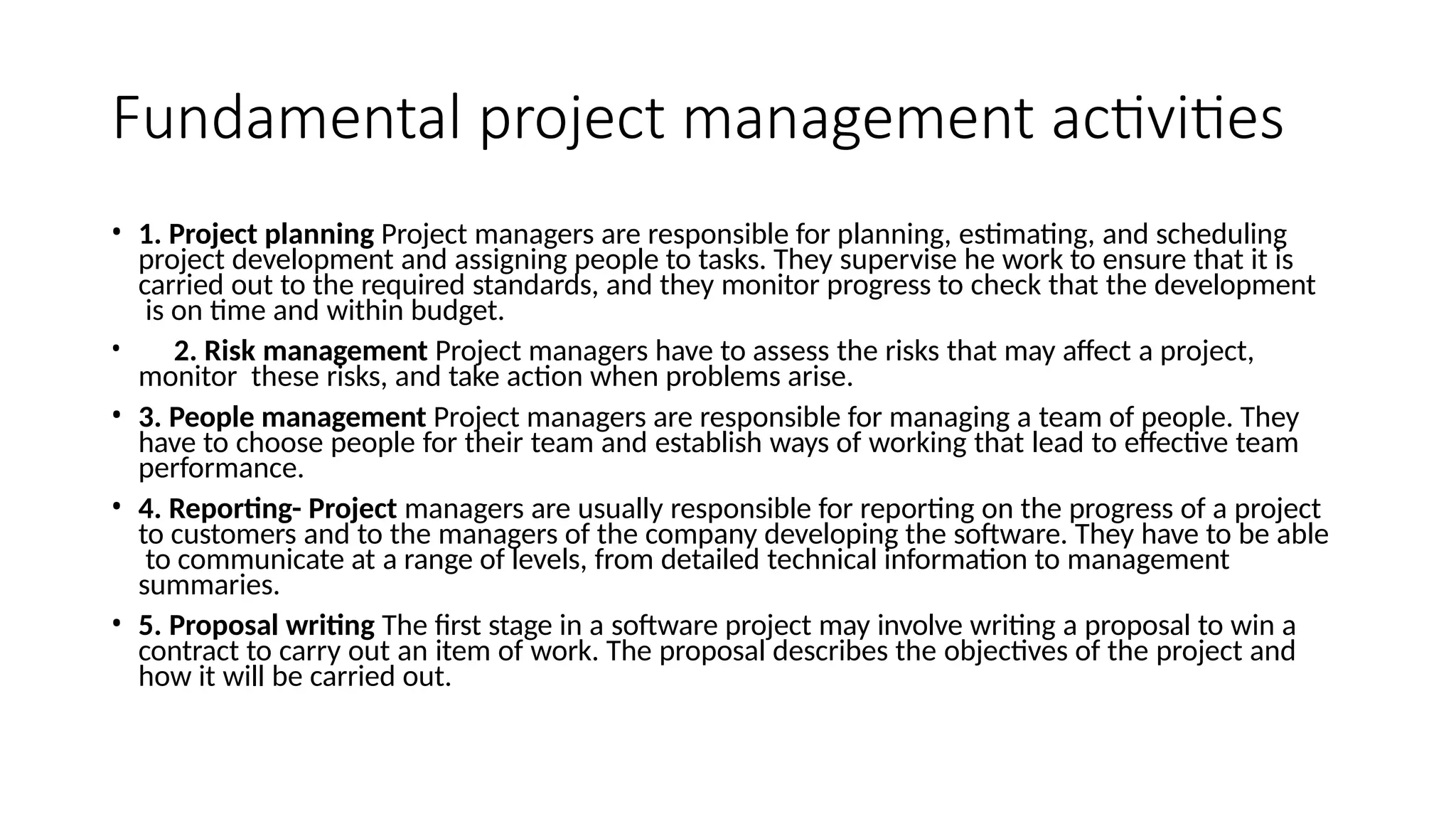
• 1. Projectplanning Project managers are responsible for planning, estimating, and scheduling
project development and assigning people to tasks. They supervise he work to ensure that it is
carried out to the required standards, and they monitor progress to check that the development
is on time and within budget.
• 2. Risk management Project managers have to assess the risks that may affect a project,
monitor these risks, and take action when problems arise.
• 3. People management Project managers are responsible for managing a team of people. They
have to choose people for their team and establish ways of working that lead to effective team
performance.
• 4. Reporting- Project managers are usually responsible for reporting on the progress of a project
to customers and to the managers of the company developing the software. They have to be able
to communicate at a range of levels, from detailed technical information to management
summaries.
• 5. Proposal writing The first stage in a software project may involve writing a proposal to win a
contract to carry out an item of work. The proposal describes the objectives of the project and
how it will be carried out.
Fundamental project management activities
7.
Risk management
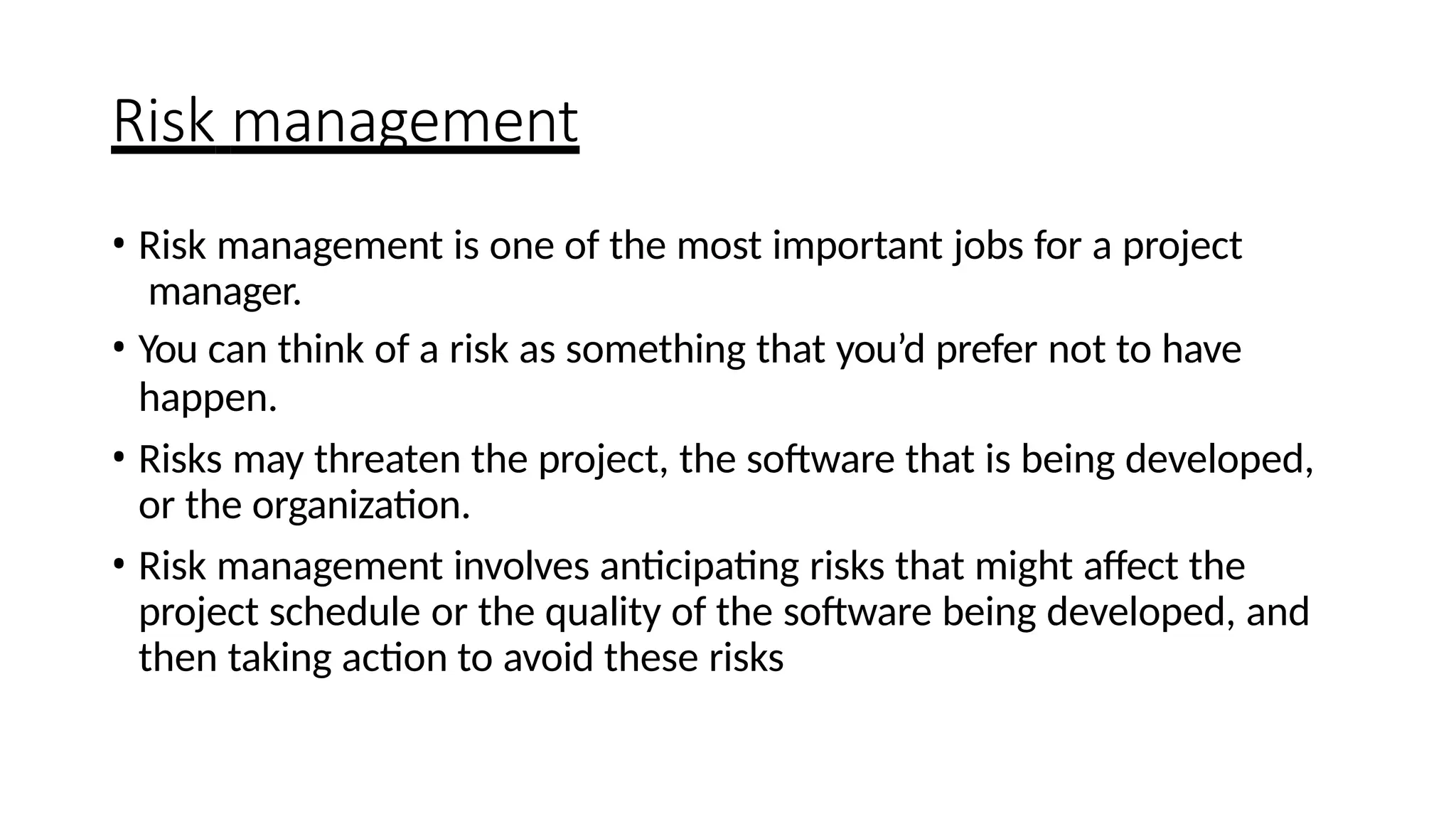
• Riskmanagement is one of the most important jobs for a project
manager.
• You can think of a risk as something that you’d prefer not to have
happen.
• Risks may threaten the project, the software that is being developed,
or the organization.
• Risk management involves anticipating risks that might affect the
project schedule or the quality of the software being developed, and
then taking action to avoid these risks
8.
Risk classification
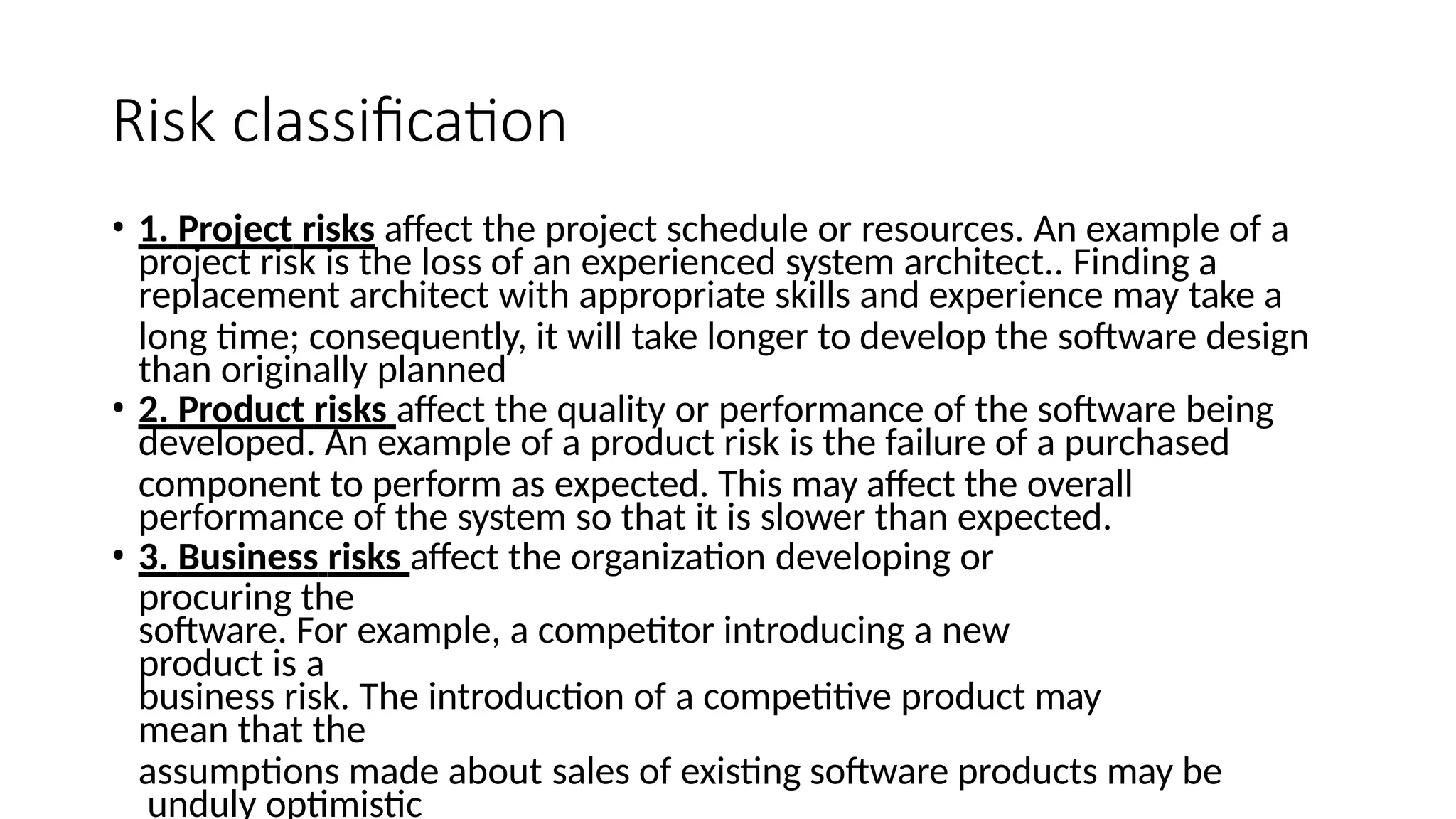
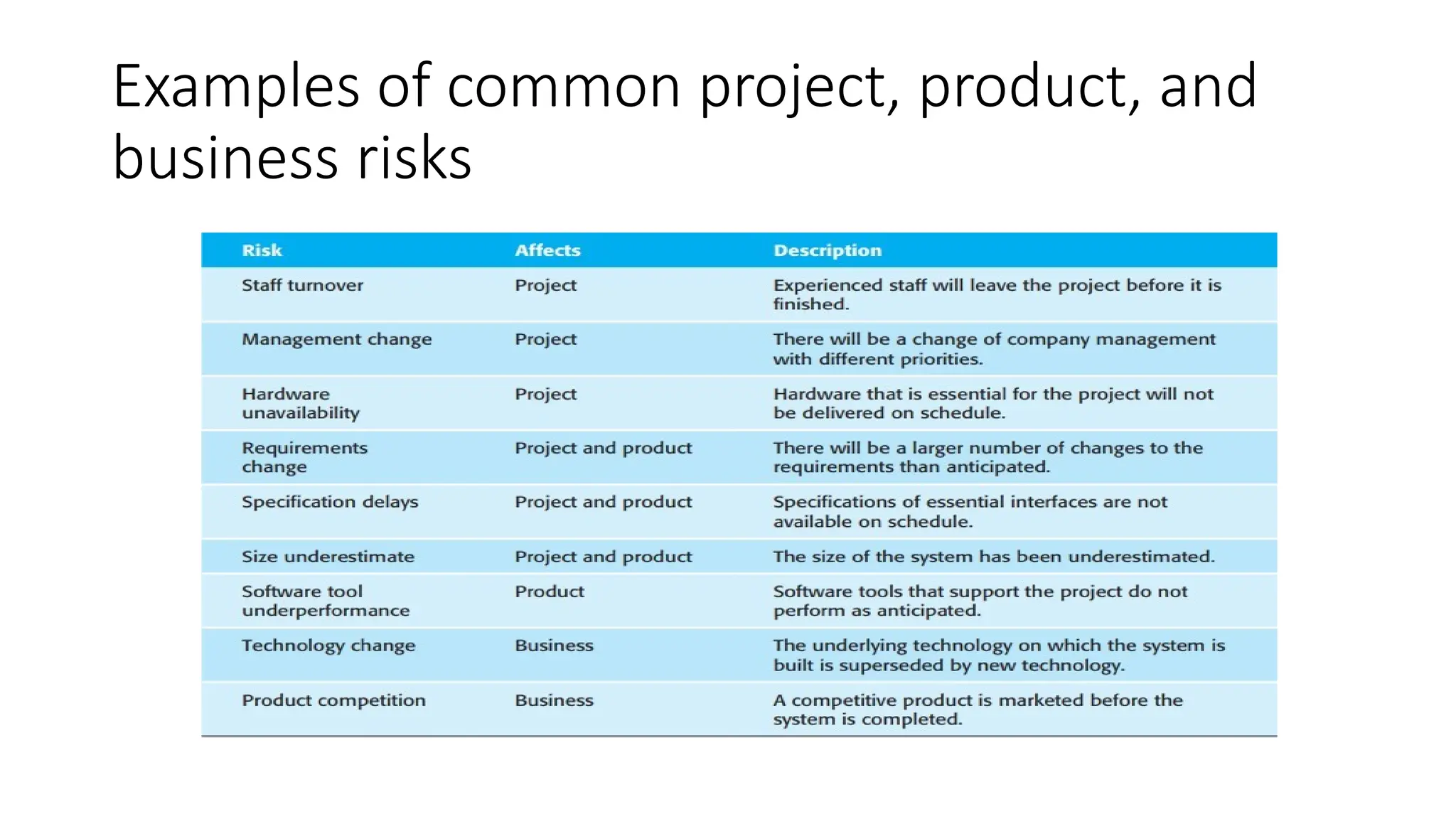
• 1.Project risks affect the project schedule or resources. An example of a
project risk is the loss of an experienced system architect.. Finding a
replacement architect with appropriate skills and experience may take a
long time; consequently, it will take longer to develop the software design
than originally planned
• 2. Product risks affect the quality or performance of the software being
developed. An example of a product risk is the failure of a purchased
component to perform as expected. This may affect the overall
performance of the system so that it is slower than expected.
• 3. Business risks affect the organization developing or
procuring the
software. For example, a competitor introducing a new
product is a
business risk. The introduction of a competitive product may
mean that the
assumptions made about sales of existing software products may be
unduly optimistic
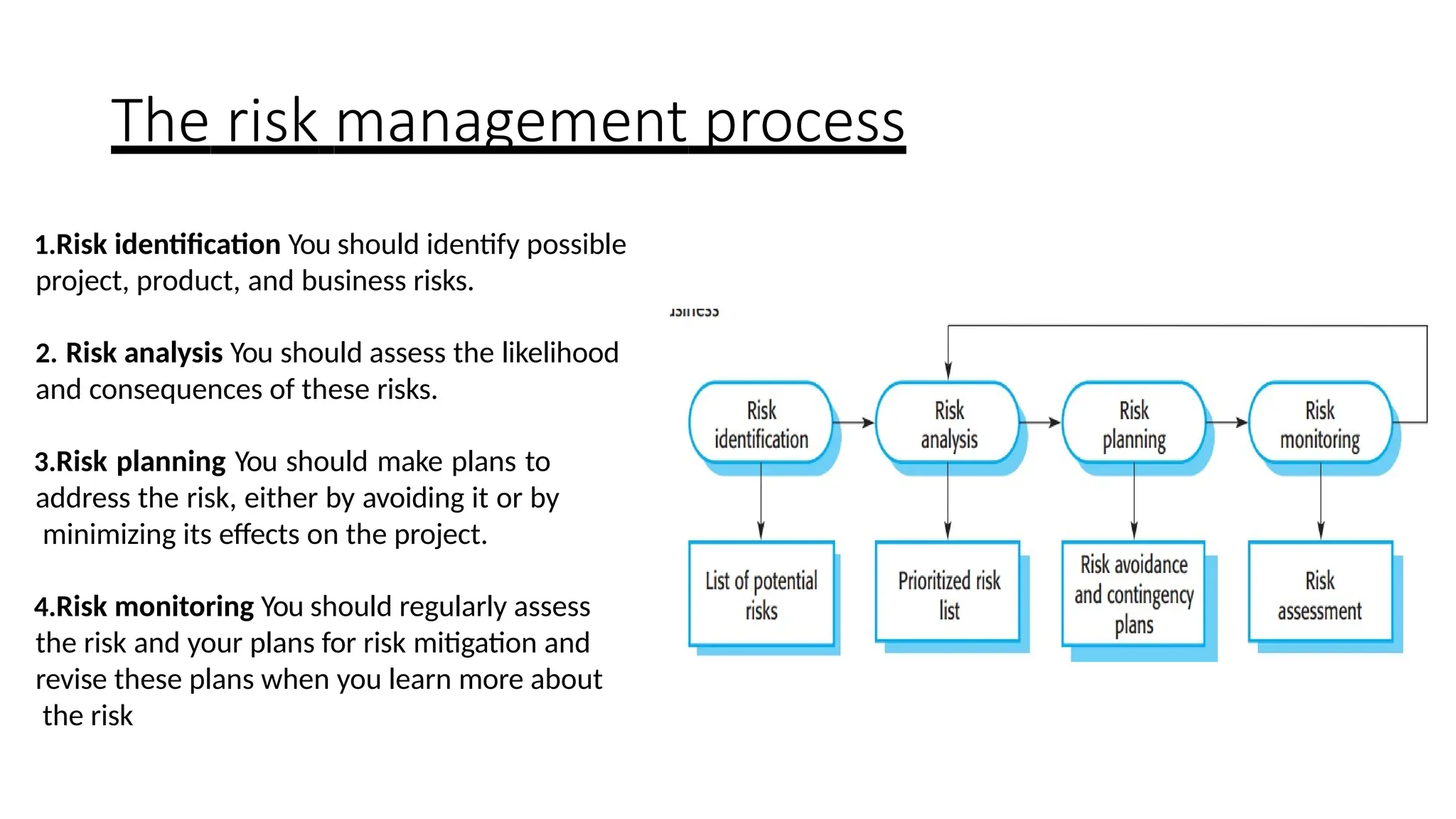
The risk managementprocess
1.Risk identification You should identify possible
project, product, and business risks.
2. Risk analysis You should assess the likelihood
and consequences of these risks.
3.Risk planning You should make plans to
address the risk, either by avoiding it or by
minimizing its effects on the project.
4.Risk monitoring You should regularly assess
the risk and your plans for risk mitigation and
revise these plans when you learn more about
the risk
11.
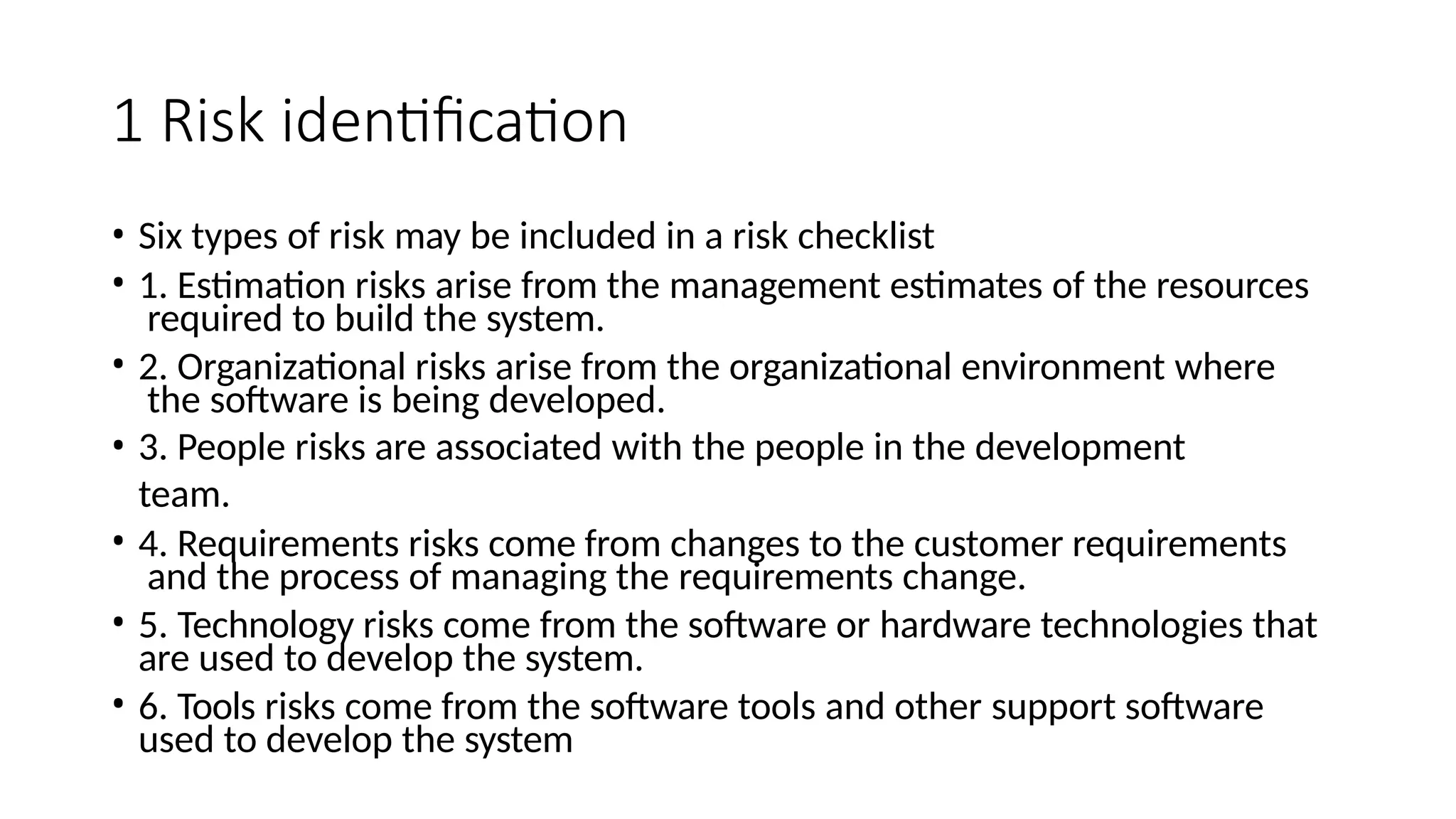
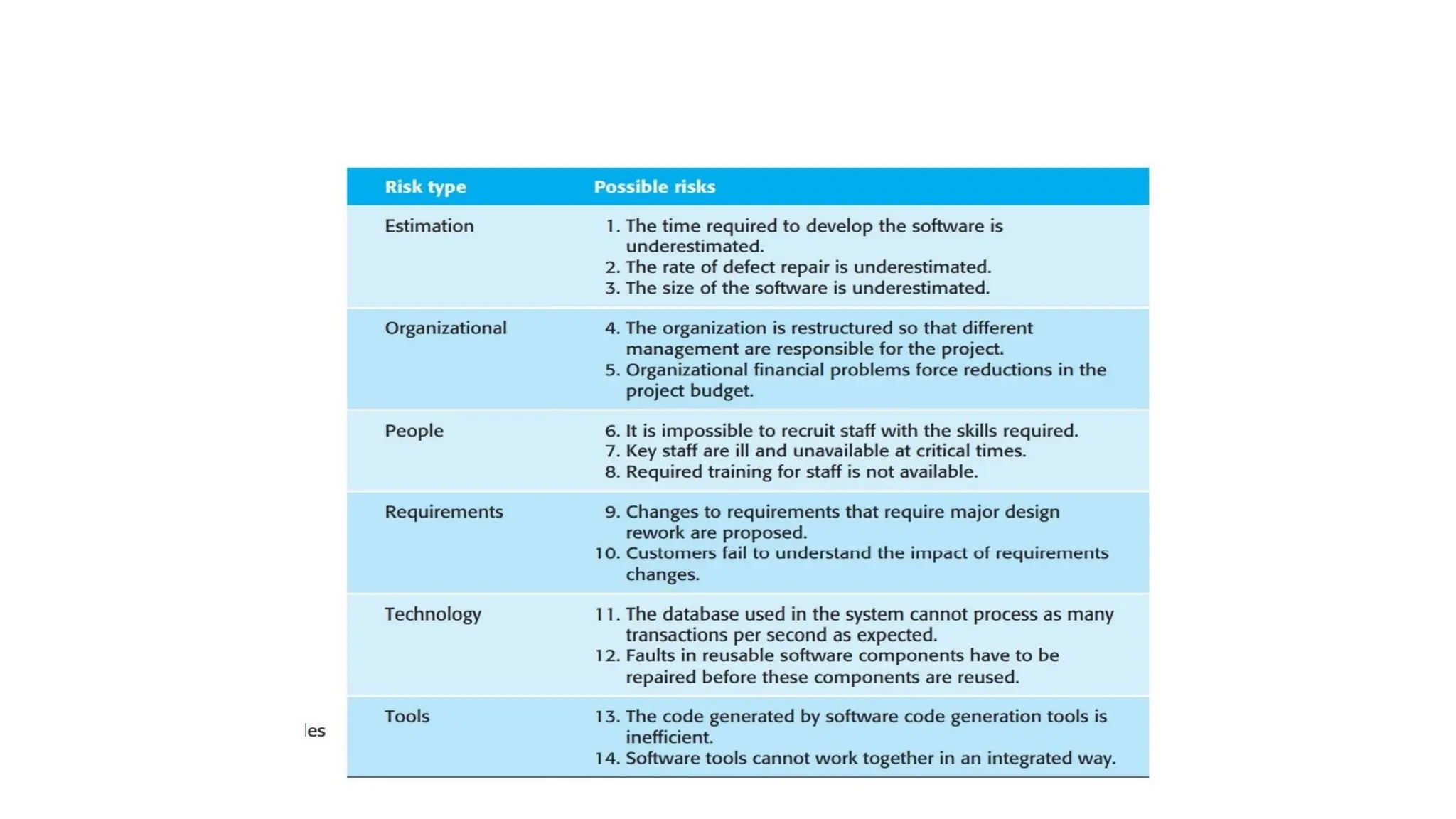
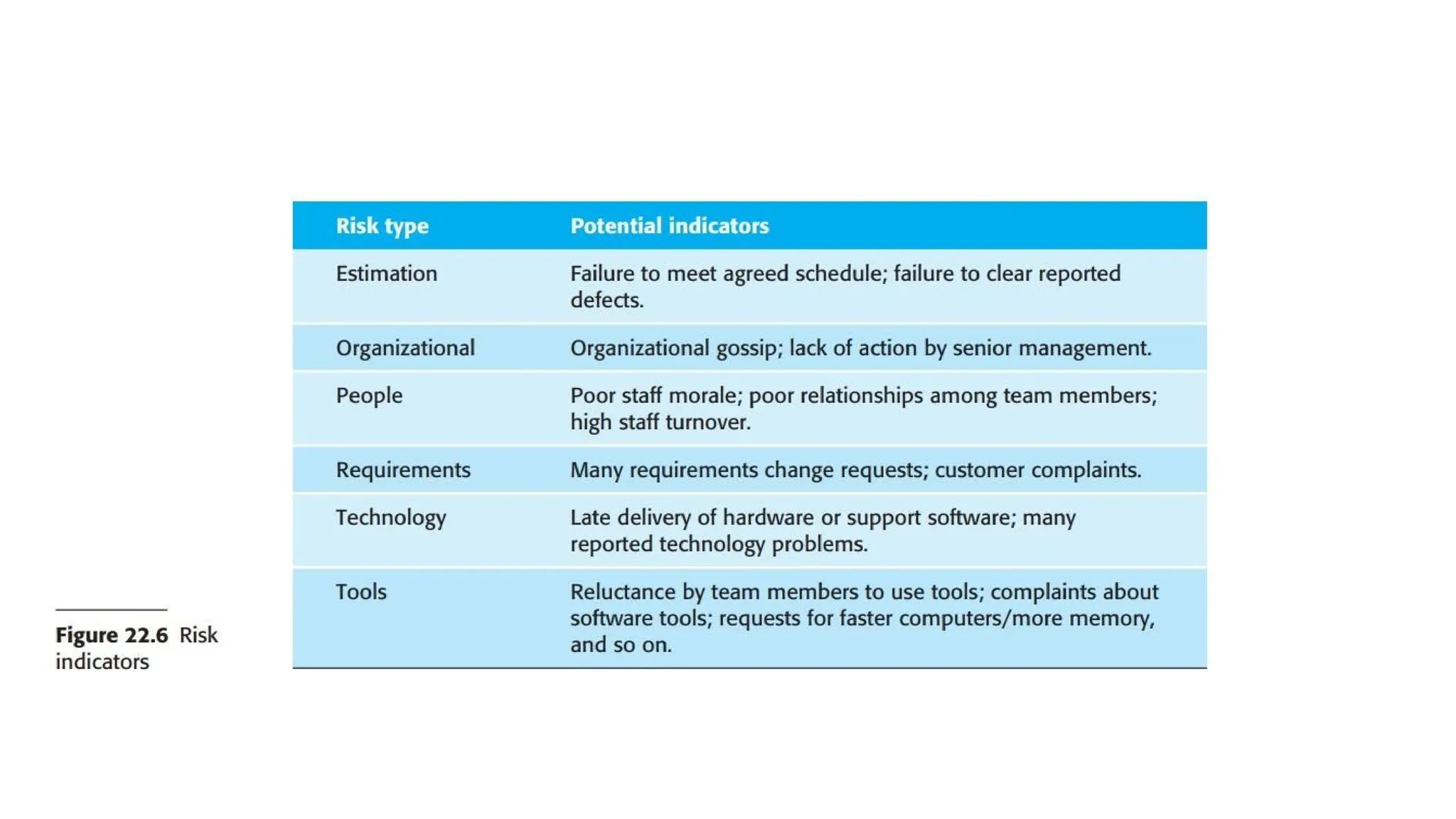
1 Risk identification
•Six types of risk may be included in a risk checklist
• 1. Estimation risks arise from the management estimates of the resources
required to build the system.
• 2. Organizational risks arise from the organizational environment where
the software is being developed.
• 3. People risks are associated with the people in the development
team.
• 4. Requirements risks come from changes to the customer requirements
and the process of managing the requirements change.
• 5. Technology risks come from the software or hardware technologies that
are used to develop the system.
• 6. Tools risks come from the software tools and other support software
used to develop the system
13.
2 Risk analysis
•During the risk analysis process, you have to consider each identified
risk and make a judgment about the probability and seriousness of
that risk. There is no easy way to do so.
• You have to rely on your judgment and experience of previous
projects and the problems that arose in them.
• It is not possible to make precise, numeric assessment of the
probability and seriousness of each risk
14.
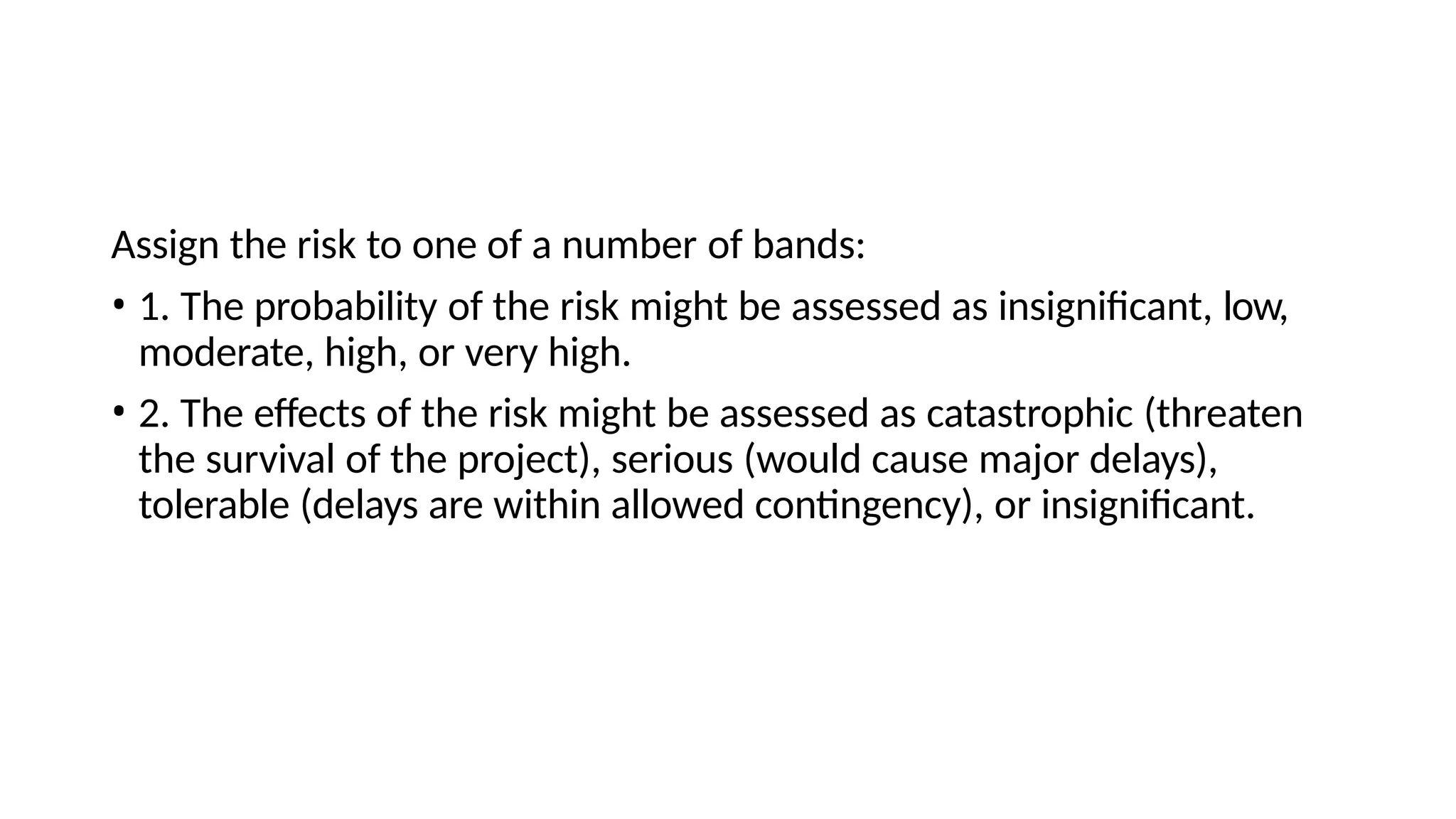
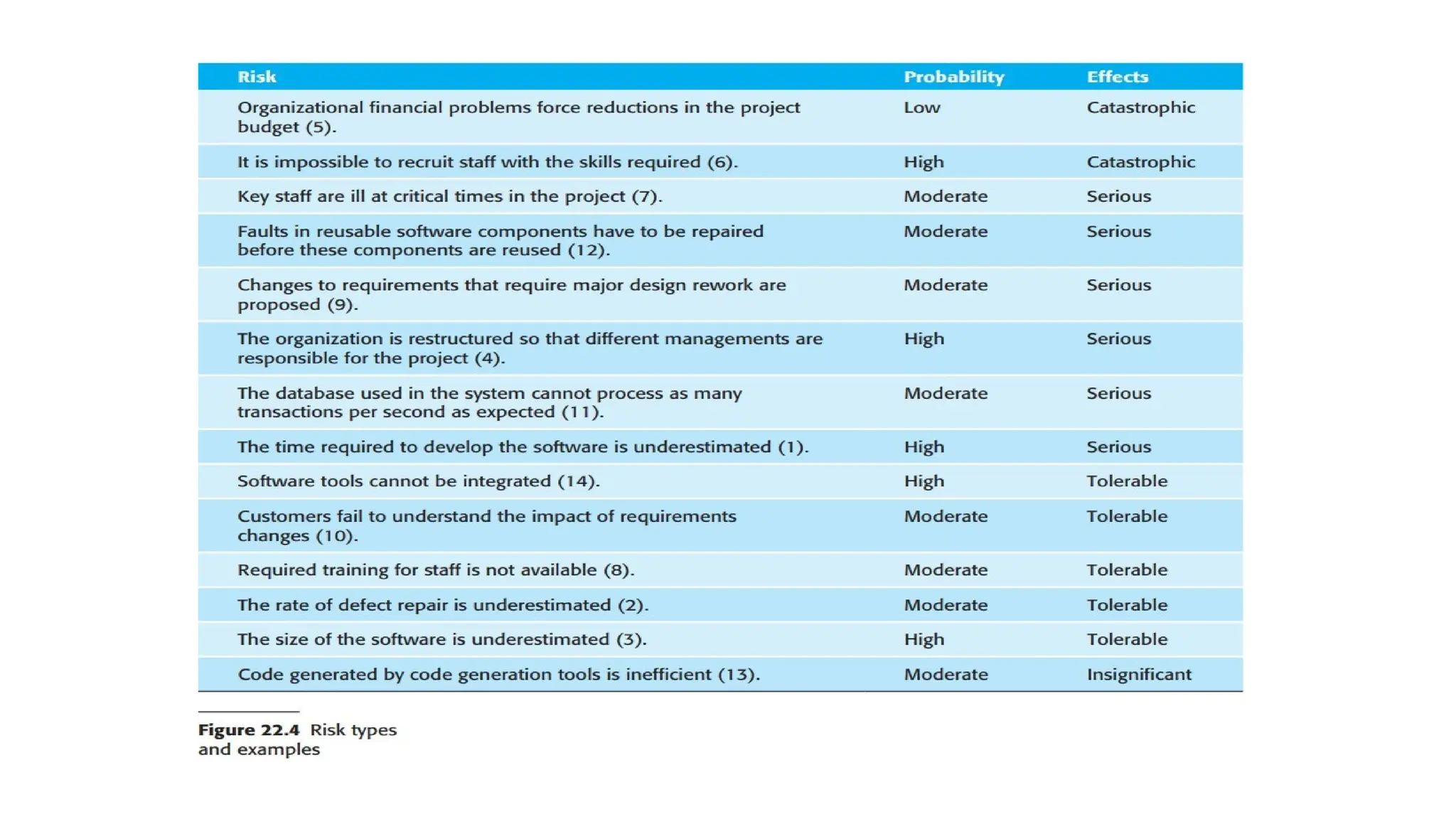
Assign the riskto one of a number of bands:
• 1. The probability of the risk might be assessed as insignificant, low,
moderate, high, or very high.
• 2. The effects of the risk might be assessed as catastrophic (threaten
the survival of the project), serious (would cause major delays),
tolerable (delays are within allowed contingency), or insignificant.
16.
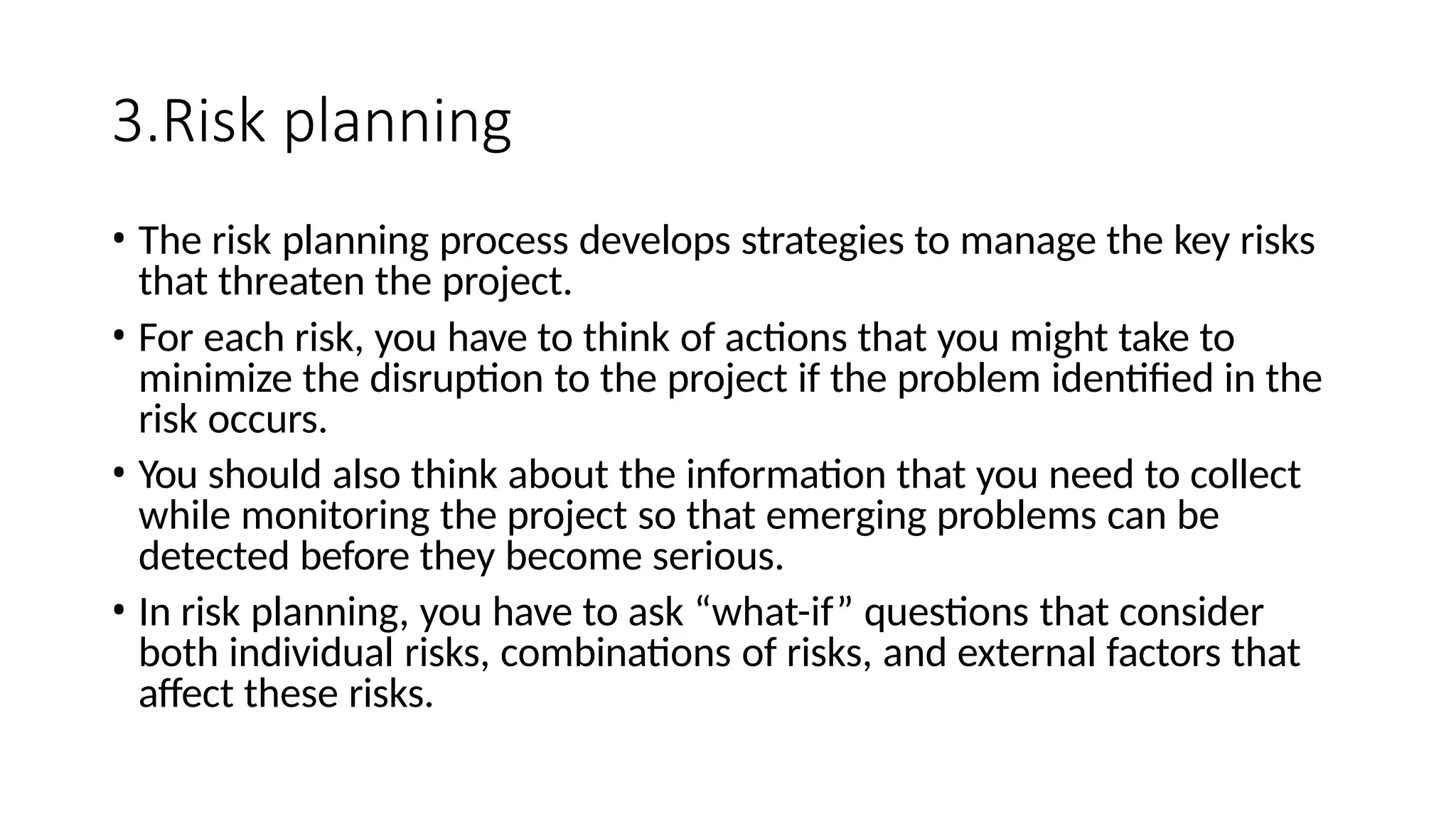
3.Risk planning
• Therisk planning process develops strategies to manage the key risks
that threaten the project.
• For each risk, you have to think of actions that you might take to
minimize the disruption to the project if the problem identified in the
risk occurs.
• You should also think about the information that you need to collect
while monitoring the project so that emerging problems can be
detected before they become serious.
• In risk planning, you have to ask “what-if” questions that consider
both individual risks, combinations of risks, and external factors that
affect these risks.
17.
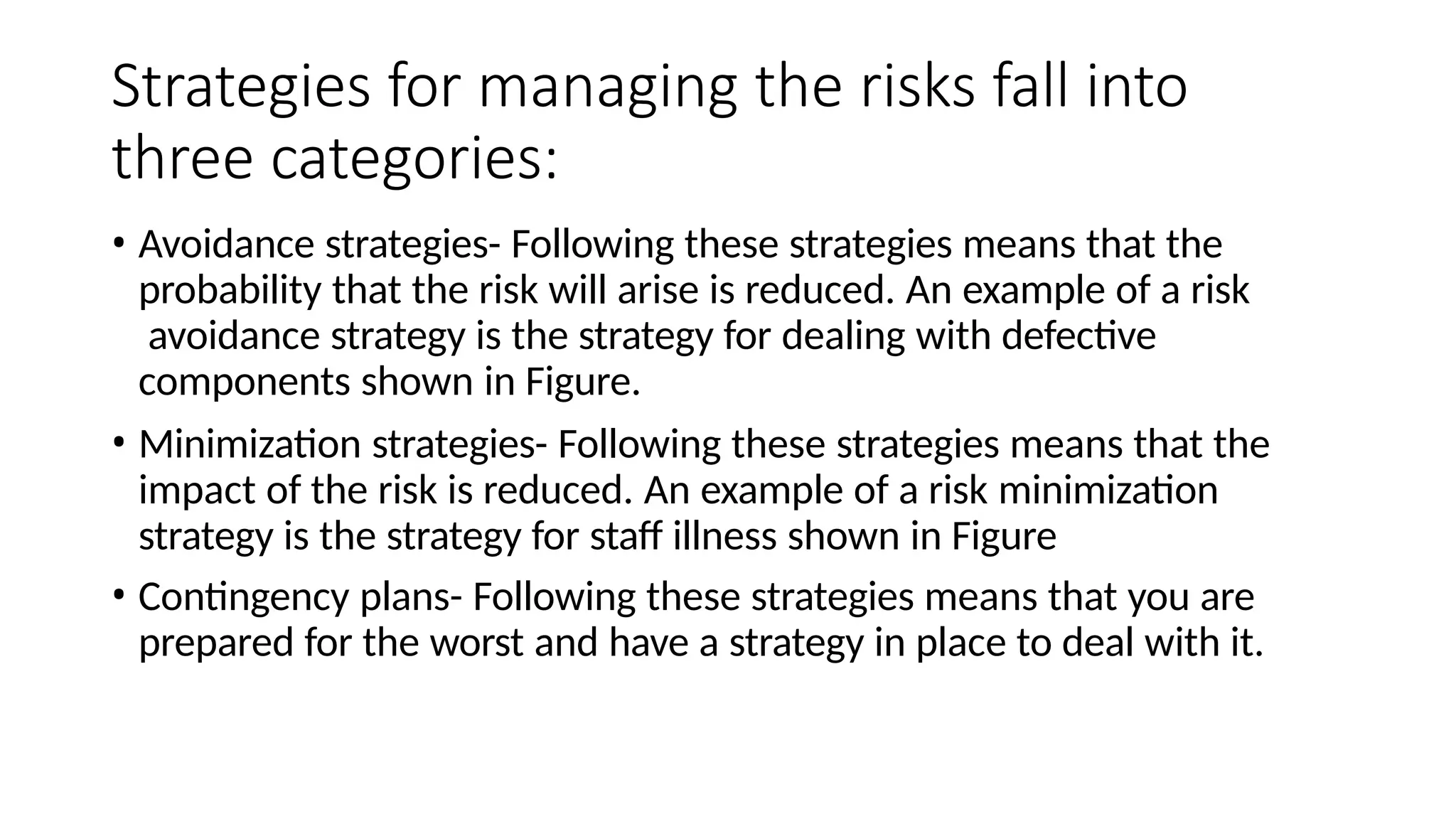
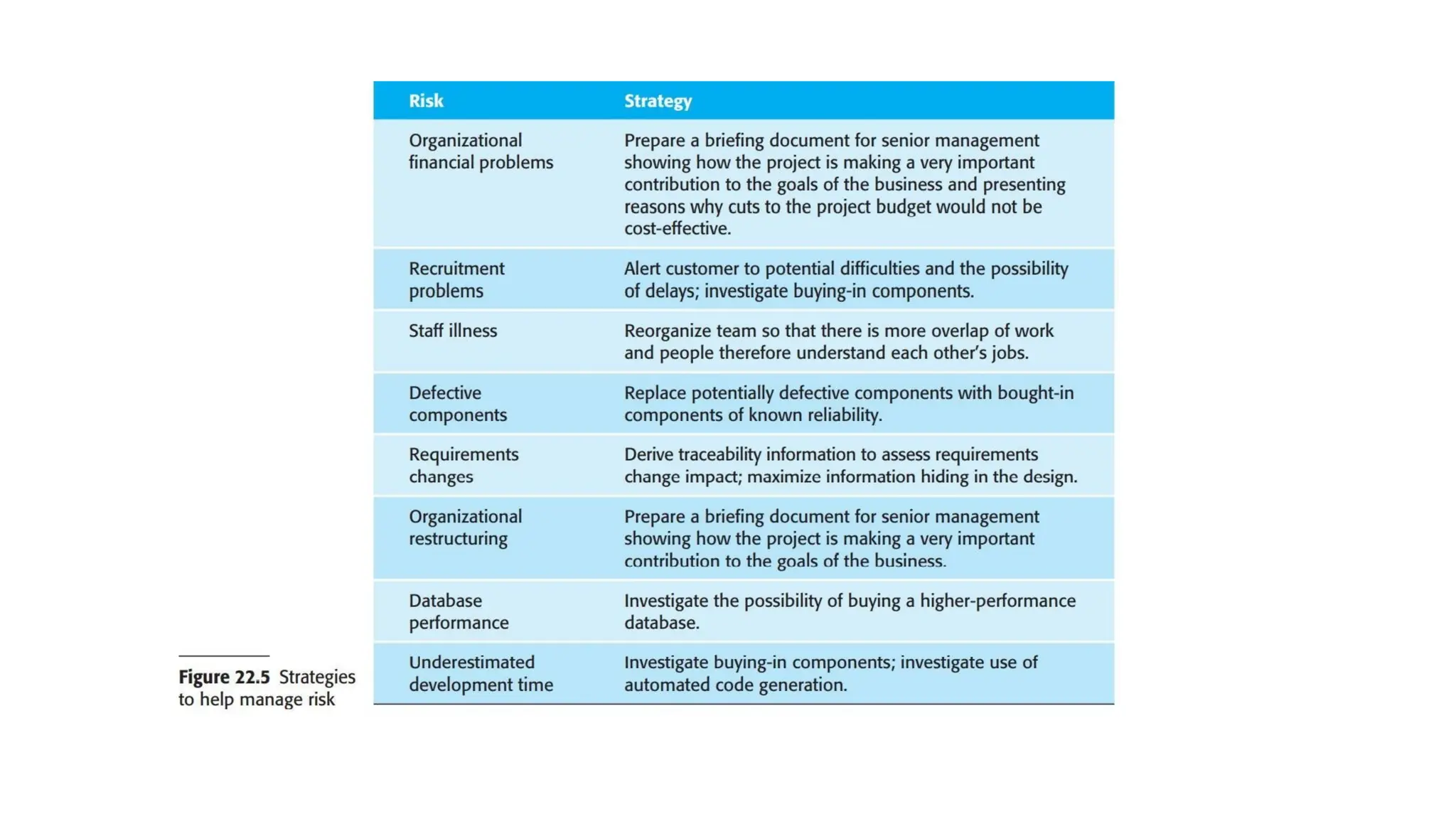
Strategies for managingthe risks fall into
three categories:
• Avoidance strategies- Following these strategies means that the
probability that the risk will arise is reduced. An example of a risk
avoidance strategy is the strategy for dealing with defective
components shown in Figure.
• Minimization strategies- Following these strategies means that the
impact of the risk is reduced. An example of a risk minimization
strategy is the strategy for staff illness shown in Figure
• Contingency plans- Following these strategies means that you are
prepared for the worst and have a strategy in place to deal with it.
19.
4. Risk monitoring
•Risk monitoring is the process of checking that your assumptions
about the product, process, and business risks have not changed.
• You should regularly assess each of the identified risks to decide
whether or not that risk is becoming more or less probable.
• You should also think about whether or not the effects of the risk
have changed.
• To do this, you have to look at other factors, such as the number of
requirements change requests, which give you clues about the risk
probability and its effects.
• These factors are obviously dependent on the types of risk.
21.
2.Managing people
• Thepeople working in a software organization are its greatest assets. It is
expensive to recruit and retain good people, and it is up to software
managers to ensure that the engineers working on a project are as
productive as possible.
• In successful companies and economies, this productivity is achieved when
people are respected by the organization and are assigned responsibilities
that reflect their skills and experience.
• It is important that software project managers understand the
technical issues that influence the work of software development.
• Good software engineers are not always good people managers.
• Software engineers often have strong technical skills but may lack the
softer skills that enable them to motivate and lead a project development
team.
• As a project manager, you should be aware of the potential problems of
people management and should try to develop people management skills
22.
Four critical factorsthat influence the relationship
between a manager and the people that he or she
manages:
• 1. Consistency
• All the people in a project team should be treated in a comparable way.
• 2. Respect
• Different people have different skills, and managers should respect these differences.
All members of the team should be given an opportunity to make a contribution.
• 3. Inclusion
• It is important to develop a working environment where all views, even those of the
least experienced staff, are considered.
• 4. Honesty
• As a manager, you should always be honest about what is going well and
what is going badly in the team. You should also be honest about your level of
technical knowledge and be willing to defer to staff with more knowledge when
necessary.
23.
Motivating people
• motivationmeans organizing work and its environment to encourage
people to work as effectively as possible. If people are not motivated,
they will be less interested in the work they are doing. They will work
slowly, be more likely to make mistakes, and will not contribute to the
broader goals of the team or the organization.
• To provide this encouragement, you should understand a little about
what motivates people. Maslow (Maslow 1954) suggests that people
are motivated by satisfying their needs.
24.
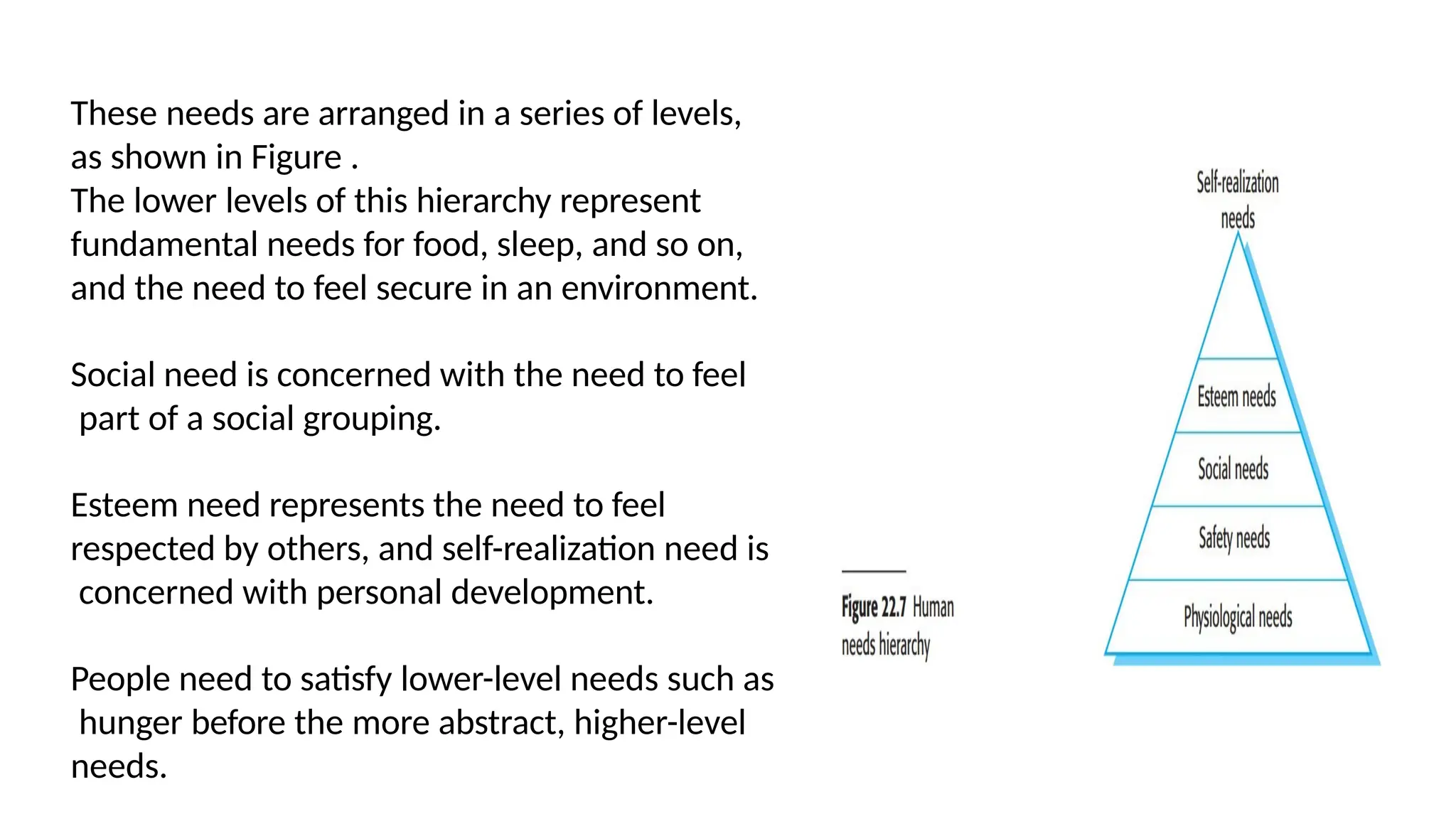
These needs arearranged in a series of levels,
as shown in Figure .
The lower levels of this hierarchy represent
fundamental needs for food, sleep, and so on,
and the need to feel secure in an environment.
Social need is concerned with the need to feel
part of a social grouping.
Esteem need represents the need to feel
respected by others, and self-realization need is
concerned with personal development.
People need to satisfy lower-level needs such as
hunger before the more abstract, higher-level
needs.
25.
Making sure thatpeoples’ social, esteem, and self-realization needs are
satisfied is most important from a management point of view.
1. To satisfy social needs, you need to give people time to meet their co-
workers and provide places for them to meet. Software companies such
as Google provide social space in their offices for people to get together.
This is relatively easy when all of the members of a development team
work in the same place
2. 2. To satisfy esteem needs, you need to show people that they are valued
by the organization. Public recognition of achievements is a simple and
effective way of doing this.
3. 3. Finally, to satisfy self-realization needs, you need to give people
responsibility for their work, assign them demanding (but not
impossible) tasks, and provide opportunities for training and
development where people can enhance their skills. Training is an
important motivating influence as people like to gain new knowledge
and learn new skills
26.
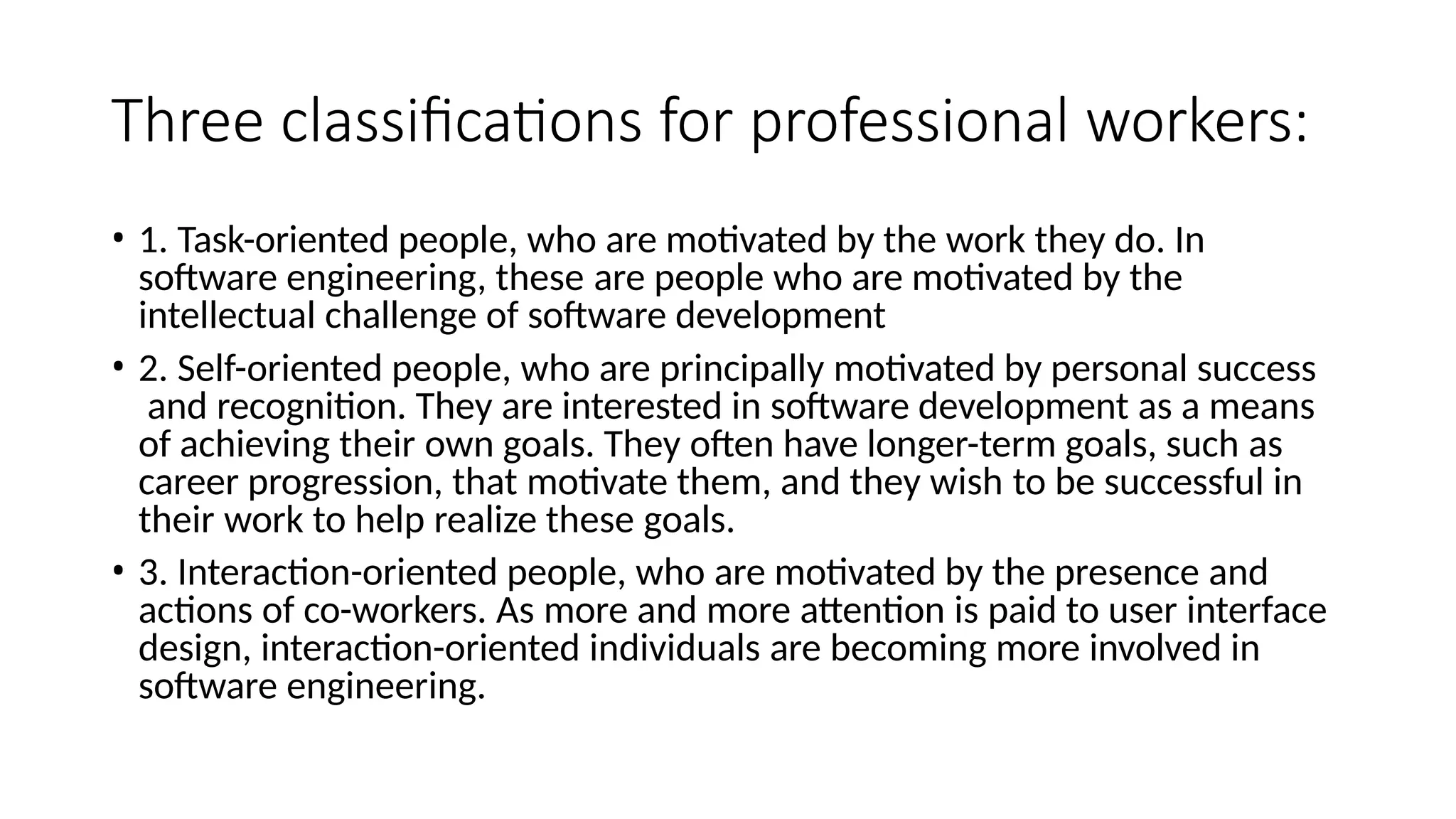
Three classifications forprofessional workers:
• 1. Task-oriented people, who are motivated by the work they do. In
software engineering, these are people who are motivated by the
intellectual challenge of software development
• 2. Self-oriented people, who are principally motivated by personal success
and recognition. They are interested in software development as a means
of achieving their own goals. They often have longer-term goals, such as
career progression, that motivate them, and they wish to be successful in
their work to help realize these goals.
• 3. Interaction-oriented people, who are motivated by the presence and
actions of co-workers. As more and more attention is paid to user interface
design, interaction-oriented individuals are becoming more involved in
software engineering.
27.
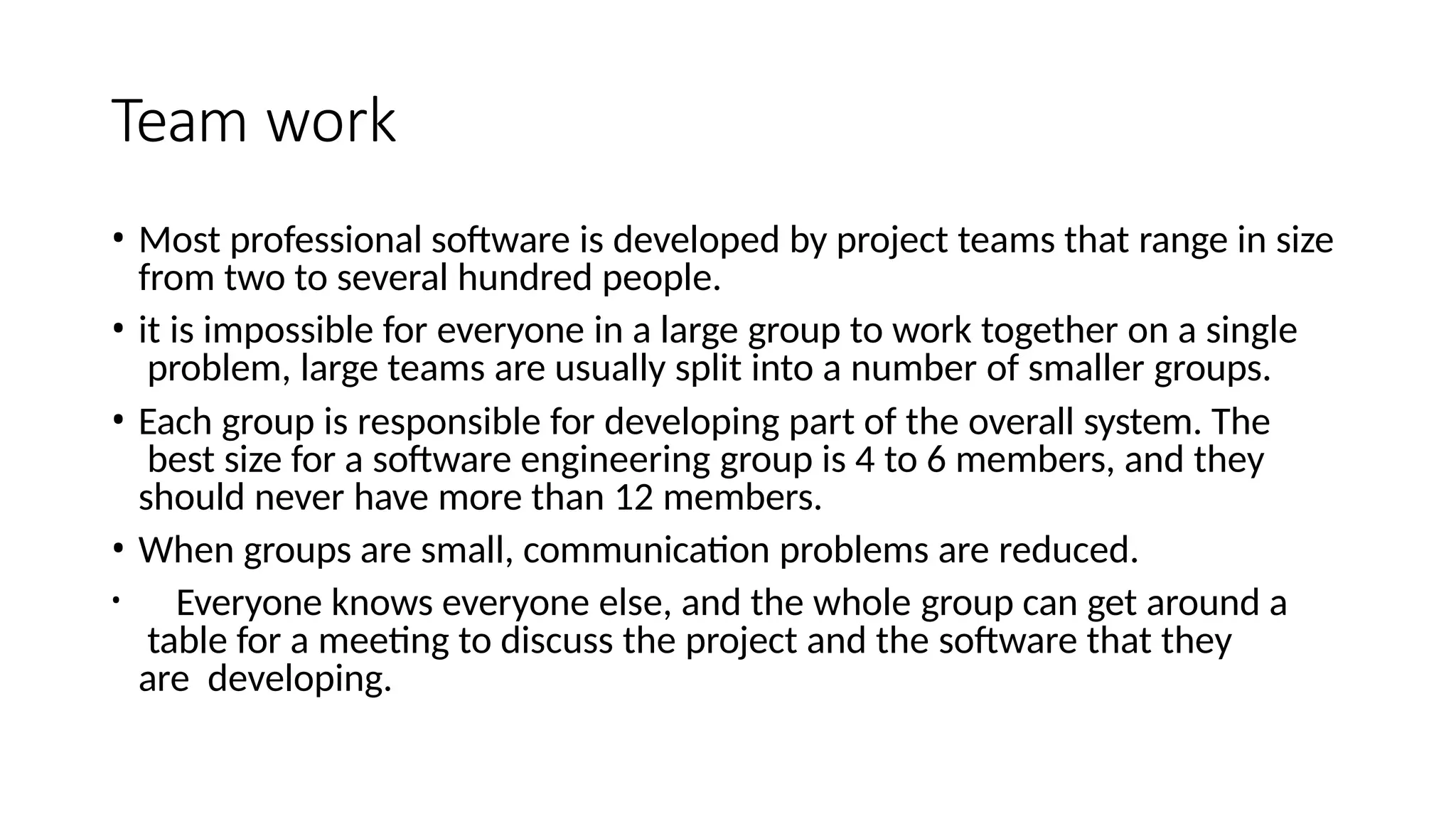
Team work
• Mostprofessional software is developed by project teams that range in size
from two to several hundred people.
• it is impossible for everyone in a large group to work together on a single
problem, large teams are usually split into a number of smaller groups.
• Each group is responsible for developing part of the overall system. The
best size for a software engineering group is 4 to 6 members, and they
should never have more than 12 members.
• When groups are small, communication problems are reduced.
• Everyone knows everyone else, and the whole group can get around a
table for a meeting to discuss the project and the software that they
are developing.
28.
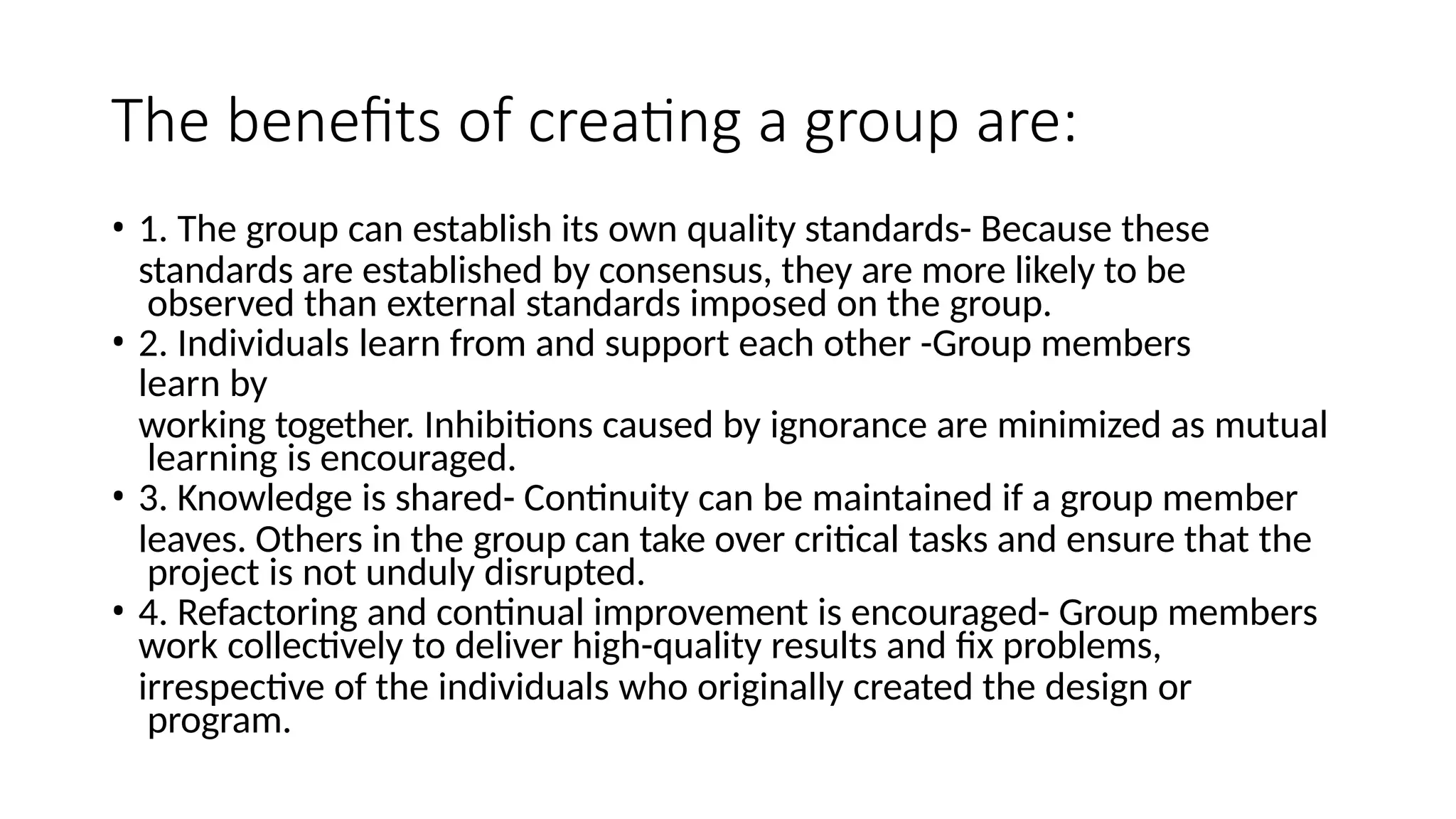
The benefits ofcreating a group are:
• 1. The group can establish its own quality standards- Because these
standards are established by consensus, they are more likely to be
observed than external standards imposed on the group.
• 2. Individuals learn from and support each other -Group members
learn by
working together. Inhibitions caused by ignorance are minimized as mutual
learning is encouraged.
• 3. Knowledge is shared- Continuity can be maintained if a group member
leaves. Others in the group can take over critical tasks and ensure that the
project is not unduly disrupted.
• 4. Refactoring and continual improvement is encouraged- Group members
work collectively to deliver high-quality results and fix problems,
irrespective of the individuals who originally created the design or
program.
29.
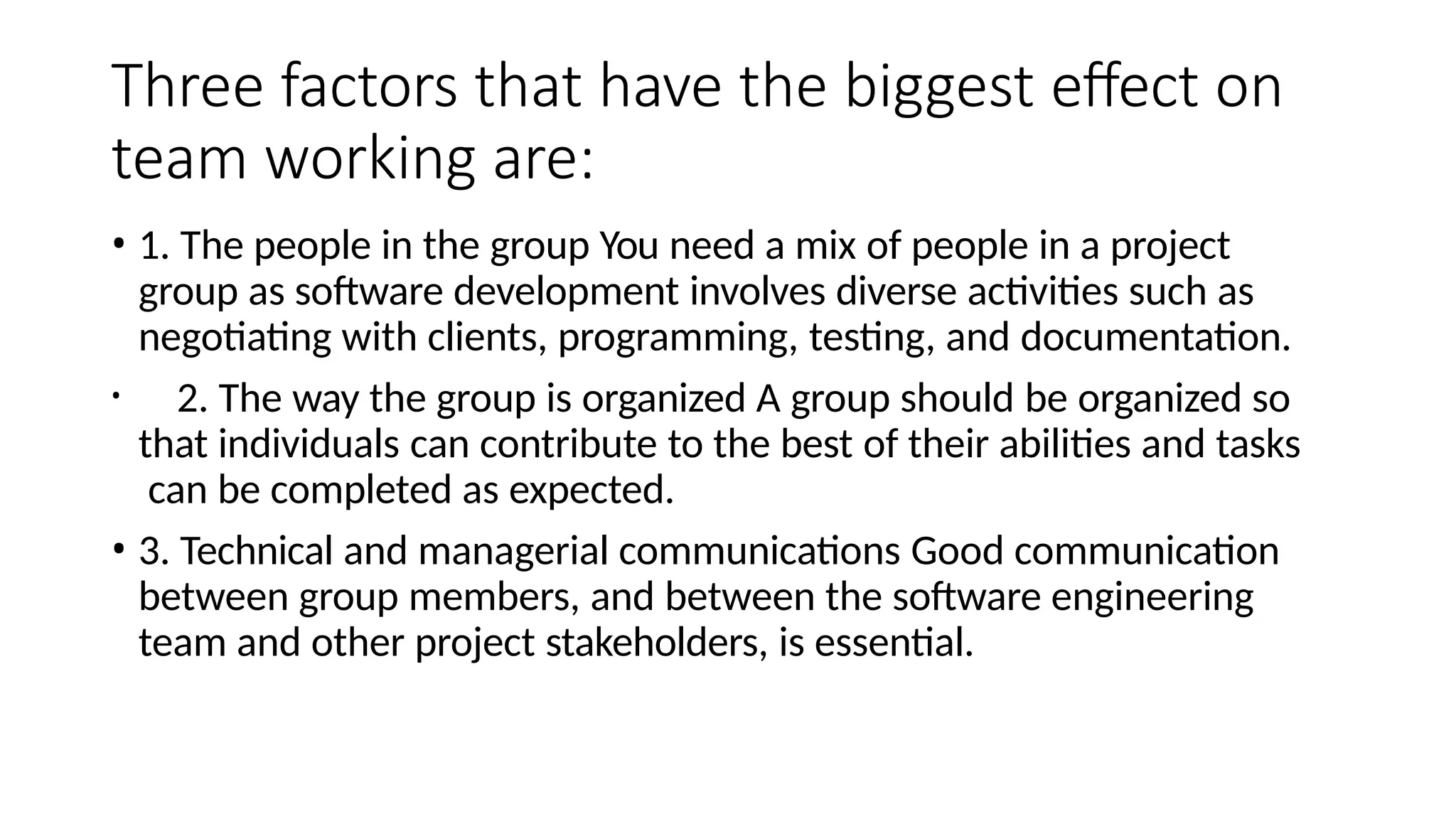
Three factors thathave the biggest effect on
team working are:
• 1. The people in the group You need a mix of people in a project
group as software development involves diverse activities such as
negotiating with clients, programming, testing, and documentation.
• 2. The way the group is organized A group should be organized so
that individuals can contribute to the best of their abilities and tasks
can be completed as expected.
• 3. Technical and managerial communications Good communication
between group members, and between the software engineering
team and other project stakeholders, is essential.
30.
1 Selecting groupmembers
• A manager or team leader’s job is to create a cohesive group and
organize that group so that they work together effectively. This task
involves selecting a group with the right balance of technical skills and
personalities.
• Sometimes people are hired from outside the organization; more
often, software engineering groups are put together from current
employees who have experience on other projects.
• Managers rarely have a completely free hand in team selection. They
often have to use the people who are available in the company, even
if they are not the ideal people for the job.
31.
• Technical knowledgeand ability should not be the only factor used to
select group members.
• The “competing engineers” problem can be reduced if the people in
the group have complementary motivations.
• People who are motivated by the work are likely to be the strongest
technically.
• People who are self-oriented will probably be best at pushing the
work forward to finish the job.
• People who are interaction-oriented help facilitate communications
within the group.
32.
2.Group organization
The waya group is organized affects the group’s decisions, the ways
information is exchanged, and the interactions between the
development group and external project stakeholders.
Important organizational questions for project managers include the
following:
1. Should the project manager be the technical leader of the group?
2. Who will be involved in making critical technical decisions, and how
will these decisions be made? Will decisions be made by the system
architect or the project manager or by reaching consensus among a
wider range of team members?
33.
• 3. Howwill interactions with external stakeholders and senior
company management be handled?
• 4. How can groups integrate people who are not co-located? It is now
common for groups to include members from different organizations
and for people to work from home as well as in a shared office. This
change has to be considered in group decision-making processes.
• 5. How can knowledge be shared across the group? Group
organization affects information sharing as certain methods of
organization are better for sharing than others. However, you should
avoid too much information sharing as people become overloaded
and excessive information distracts them from their work.
34.
3 Group communications
•It is absolutely essential that group members communicate effectively and
efficiently with each other and with other project stakeholders.
• Group members must exchange information on the status of their work,
the design decisions that have been made, and changes to previous design
decisions.
• They have to resolve problems that arise with other stakeholders and
inform these stakeholders of changes to the system, the group, and
delivery plans.
• Good communication also helps strengthen group cohesiveness.
• Group members come to understand the motivations, strengths, and
weaknesses of other people in the group.
35.
The effectiveness andefficiency of
communications are influenced by:
• 1. Group size
• As a group gets bigger, it gets harder for members to communicate effectively. The number of
one-way communication links is n * (n − 1), where n is the group size.For a group of eight
members, there are 56 possible communication pathways. This means that it is quite possible
that some people will rarely communicate with each other.
• 2. Group structure
• People in informally structured groups communicate more effectively than people in groups
with a formal, hierarchical structure. In hierarchical groups, communications tend to flow up
and down the hierarchy. People at the same level may not talk to each other. This is a
particular problem in a large project with several development groups
• 3. Group composition
• People with the same personality types may clash, and, as a result, communications can be
inhibited. Communication is also usually better in mixed-sex groups than in single-sex groups.
Women are often more interaction-oriented than men and may act as interaction controllers
and facilitators for the group.
36.
• 4. Thephysical work environment
• The organization of the workplace is a major factor in facilitating or inhibiting
communications. While some companies use standard open-plan offices for
their staff, others invest in providing a workspace that includes a mixture of
private and group working areas. This allows for both collaborative activities
and individual development that require a high level of concentration.
• 5. The available communication channels
• There are many different forms of communication—face to face, email
messages, formal documents, telephone, and technologies such as social
networking and wikis. As project teams become increasingly distributed, with
team members working remotely, you need to make use of interaction
technologies, such as conferencing systems, to facilitate group
communications.
![Software Project Management -
Risk management, Managing
people, Teamwork
[Book 1 - Chapter 22]](https://image.slidesharecdn.com/4-250427092515-cd00ca7a/75/4-1software-Project-Management-Risk-management-J-Managing-Autosaved-pptx-1-2048.jpg)