Departemen Teknik Industri
TI6121
SISTEM PERENCANAAN &
PENGENDALIAN PRODUKSI
Enterprise Resource
Planning (ERP)(#6)
Departemen Teknik Industri
2
Pendahuluan
• Perkembangan:
▪ Material requirements planning (MRP)
▪ Closed loop MRP
▪ Manufacturing resource planning (MRPII)
▪ Enterprises resource planning (ERP)
• Perusahaan satu lokasi vs. multilokasi
• Sistem informasi dalam sistem MRPPII vs.
ERP
• ERP = sistem MRPII + IT
Departemen Teknik Industri
3
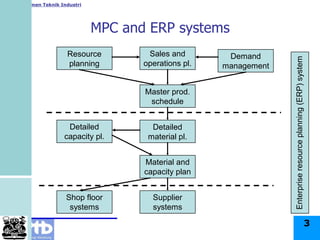
MPC and ERP systems
Enterprise
resource
planning
(ERP)
system
Demand
management
Sales and
operations pl.
Master prod.
schedule
Detailed
material pl.
Material and
capacity plan
Supplier
systems
Shop floor
systems
Detailed
capacity pl.
Resource
planning
Departemen Teknik Industri
4
The scope of ERP application(1)
ERP
Manufacturing and
logistics
Manufacturing
planning &
control:
Front end
Engine
Back end
Enterprise
planning models
Enterprise perf.
measures
Data
warehousing
Report generation
Transaction
processing
Human resource
mangement
Finance
Sales and
marketing
Departemen Teknik Industri
5
The scope of ERP application(2)
Procurement cycle Manufacturing cycle Sales and
distribution cycle
•Purchase cost of
material
•Account payable
•Raw material
•WIP
•Finished goods
inventory
•Distribution inventory
•Account receivable
Departemen Teknik Industri
6
The scope of ERP application(1)
ERP data base
Accounts payable
Inventory
Cost of sales
Sales
Account
receivable
Cash to cash
cycle time
Purchasing
Manufacturing
Sales and
distribution
Departemen Teknik Industri
7
ERP System?
• A packaged business system of Processes
(Methods/ Technology) that allows a
company to:
▪ Automate and integrate the majority of its
business practices.
▪ Share common data and practices across the
entire enterprise.
▪ Produce and access information in a real-time
environment.
Departemen Teknik Industri
8
Pengertian ERP
• Definisi ERP:
▪ ERP covers the techniques and concepts
employed for the integrated management of
business as a whole, from the viewpoint of the
effective use of management resources, to
improve the efficiency of enterprise (Leon,
1999)
• ERP Packages atau sering juga disebut
sebagai enterprise system adalah
perangkat lunak yang digunakan untuk
mendukung implementasi ERP
Departemen Teknik Industri
9
Tujuan ERP
• Enterprise Resource Planning
▪ Process of using integrated application
software to improve the effectiveness and
efficiency of the entire enterprise
• Purpose
▪ To provide best practice functionality within
departments and high level of integration
across all enterprise functions
Departemen Teknik Industri
10
Proses Integrasi
Customer
Request
Sales
Order
Shipping Billing
Cash
Processing
Analysis
Logistics Accounting
Business Process Integration: Customer Order Management
Departemen Teknik Industri
11
Customer Order Management Process Integration
The Three Components of Process Integration
Data
Business
Functions
Organizational
Elements
Customer
Request
Sales
Order
Shipping Billing
Cash
Processing
Analysis
Departemen Teknik Industri
12
Change management
Staff inadequacy
Training
Resource allocation
Obstacles to Integration
PROCESS
TECHNOLOGY
Poor implementation
management
Inadequate reengineering
Poorly planned transition
Inadequate functionality in
integrating systems
Weaknesses in application
portfolio
Weaknesses in data & reporting
PEOPLE
Departemen Teknik Industri
13
Integrasi Informasi dengan ERP
Strategic & Operational
Planning
Manufacturing
Materials management
Quality management
Sales & Distribution
Maintenance
management
Logistic management
Human resource
Finance
ERP
SYSTEM
Departemen Teknik Industri
14
Karakteristik Utama ERP
Departemen Teknik Industri
15
Why ERP?(1)
• Reducing workforce in core transaction
processing systems
• Supporting global business
• Achieving economies of scale
• Reducing information systems development
staff
Departemen Teknik Industri
16
Why ERP? (2)
•Improving customer service
•Improving data integrity
•Improving decision support
Departemen Teknik Industri
17
Costs and Benefits
• ERP may cost several hundred thousand
dollars for a mid-sized firm
• Cost competitive among major vendors
• Payback usually 6-30 months
• Savings based on 30% reduction in
administrative and IS costs
• Consider operating costs
Departemen Teknik Industri
18
Software Komersial
• Banyak tersedia software ERP komersial
antara lain:
▪ SAP
▪ ORACLE
▪ BAAN
▪ J.D. Edwards, dll
Departemen Teknik Industri
19
SAP(1)
Departemen Teknik Industri
20
SAP(2)
• Modular client-server architecture
• Sales and Distribution (SD) → records sales orders
and scheduled deliveries, information about the
customer is maintained and accessed
• Materials Management (MM) → manages the
acquisition of raw materials from suppliers and the
subsequent handling of raw materials inventory
from storage to work-in-progress goods to finished-
goods inventory
• Production Planning (PP) → maintains production
information – production is planned, scheduled,
and actual production activities are recorded
• Quality Management (QM) → plans and records
quality-control activities like product inspection and
material certification
Departemen Teknik Industri
21
SAP(3)
• Plant Maintenance (PM) – allows planning for
preventive maintenance of plant machinery and
managing maintenance resources
• Human Resources (HR) – facilitates employee
recruiting, hiring, training, payroll and benefits
• Financial Accounting (FI) – records general ledger
accounts transactions, generates financial
statements for external reporting
• Controlling (CO) – internal management –
manufacturing costs are assigned to products and
cost centers to facilitate cost analysis
Departemen Teknik Industri
22
SAP(4)
• Asset Management (AM) – helps in managing
fixed-asset purchases (plant and machinery) and
related depreciation
• Project System (PS) – planning and control of new
R&D, construction, marketing as well as ERP
projects
• Workflow (WF) – automates activities in R/3 (e.g.,
prompts employees via e-mail if they need to take
action)
• Industry Solution (IS) – contains R/3 configuration
settings for particular industries – companies
benefit from SAP’s industry experience
Departemen Teknik Industri
23
Typical Basis Systems: Client Server Architecture
Central System
Two - tier
Distributed System
Two - tier
Client/Server
Three - tier
Client/Server
Multi-layer
Cooperative
Client/Server
(w/ release 4.0B)
Presentation Application Database
Departemen Teknik Industri
24
Database Layer
Typically a relational database distributed
across multiple servers.
Departemen Teknik Industri
25
Application Layer(1)
• Application servers are responsible for
specific applications stored as compiled
versions of the application.
• Workload considerations may cause
work to be rerouted to different servers;
e.g. multiple concurrently available
application servers.
• Application servers retain application-
specific data in caches to provide
quicker access to recent versions of that
data.
Departemen Teknik Industri
26
Application Layer(2)
• A work process defined for specific
tasks help coordination between
application servers.
▪ Application components supporting user
interactive access bind to dialog work
processes.
▪ Application components that generate
background work bind to batch processes.
▪ Additional work processes coordinate
activities between servers.
Departemen Teknik Industri
27
Presentation Layer
• The purpose of the presentation layer is to
accept essential data from the user and
provide preformatted reports to the user.
• Presentation Layer Characteristics:
▪ Provides the menu-driven GUI interface between
users and applications.
▪ May reside locally on a user’s desktop computer
or be a completely separate presentation server
on the LAN.
▪ May keep in temporary, local storage a list of
recently invoked transactions and data specific
to the process being supported to alleviate the
need to access the server.
▪ May be customized for a specific user.
Departemen Teknik Industri
28
Packaged Software Implementation
Issues
Departemen Teknik Industri
29
Customization
• Desire is to minimize customization
▪ Best practices built-in already
▪ Unique requirements may exist
• Configuration
▪ Choose among anticipated options
– Payroll cycle
– Fiscal year
• Modification
▪ Change the functionality of the package
• Enhancement
▪ Add to the functionality of the package
Departemen Teknik Industri
30
Customization vs. Reengineering
• Customization
▪ Modification and enhancement are costly, risky
and hard to maintain when underlying
software package is upgraded
• Reengineering
▪ Modify business practices to fit the model of
the software package
• Important to understand the business
model supported by the software before
selecting a package
Departemen Teknik Industri
31
Upgrading Packages
• Upgrades can be challenging
▪ Frequency
▪ Existing level of customization
▪ Integration
• Must be planned and documented
Departemen Teknik Industri
32
Critical Success Factors of ERP(1)
• Strong top management support
• Centralized project management
• Strong IT management and staff support
• Heavy user involvement
• Business process reengineering to
standardize on software capabilities
Departemen Teknik Industri
33
Critical Success Factors of ERP(2)
• Retraining of existing software developers
in ERP
• Extensive training of end users
• Use of consultants to lead implementation
and training
• A respected and effective champion of ERP
within the organization
Departemen Teknik Industri
34
Critical Success Factors of ERP(3)
• Effective and continuous communication
• Top-notch systems analysts
• Retaining analyst throughout project and
beyond
• Sensitivity to user resistance with new
systems
Departemen Teknik Industri
35
Success Stories(1)
• Autodesk (computer aided design software
maker)
▪ Reduced delivery time from two weeks to less than 24
hours
• IBM Storage Systems Division
▪ Reduced time to re-price – 5 days to 5 minutes
▪ Time to ship a replacement part – 22 to 3 days
▪ Time to complete a credit check – 20 minutes to 3
seconds
Departemen Teknik Industri
36
Success Stories(1)
• Fujitsu Microelectronics
▪ Reduced the cycle time for filling orders – from
18 days to 1.5 days
▪ Time to close financial books – from 8 to 4
days
Departemen Teknik Industri
37
Horror Stories
• FoxMeyer Drug – software helped drive the
company into bankruptcy
• Dell computer – software will not fit its
decentralized management model
• Applied Materials – overwhelmed by the
organizational changes involved
• Dow Chemicals – spent seven years and 500
million dollars on R/2 – now starting again with
R/3
• Hershey’s – missed timely deliveries
Departemen Teknik Industri
38
Reasons for failure
• Software logic and the company strategy
may not match!
Departemen Teknik Industri
39
Conclusions
• ERP – has great potentials for integrating
organizational information systems
• Also has great risks
• Enterprise systems need to be
implemented after careful thought and as
a part of a firm’s overall strategy

6(ERP^N6).pdf

  • 1.
    Departemen Teknik Industri TI6121 SISTEMPERENCANAAN & PENGENDALIAN PRODUKSI Enterprise Resource Planning (ERP)(#6)
  • 2.
    Departemen Teknik Industri 2 Pendahuluan •Perkembangan: ▪ Material requirements planning (MRP) ▪ Closed loop MRP ▪ Manufacturing resource planning (MRPII) ▪ Enterprises resource planning (ERP) • Perusahaan satu lokasi vs. multilokasi • Sistem informasi dalam sistem MRPPII vs. ERP • ERP = sistem MRPII + IT
  • 3.
    Departemen Teknik Industri 3 MPCand ERP systems Enterprise resource planning (ERP) system Demand management Sales and operations pl. Master prod. schedule Detailed material pl. Material and capacity plan Supplier systems Shop floor systems Detailed capacity pl. Resource planning
  • 4.
    Departemen Teknik Industri 4 Thescope of ERP application(1) ERP Manufacturing and logistics Manufacturing planning & control: Front end Engine Back end Enterprise planning models Enterprise perf. measures Data warehousing Report generation Transaction processing Human resource mangement Finance Sales and marketing
  • 5.
    Departemen Teknik Industri 5 Thescope of ERP application(2) Procurement cycle Manufacturing cycle Sales and distribution cycle •Purchase cost of material •Account payable •Raw material •WIP •Finished goods inventory •Distribution inventory •Account receivable
  • 6.
    Departemen Teknik Industri 6 Thescope of ERP application(1) ERP data base Accounts payable Inventory Cost of sales Sales Account receivable Cash to cash cycle time Purchasing Manufacturing Sales and distribution
  • 7.
    Departemen Teknik Industri 7 ERPSystem? • A packaged business system of Processes (Methods/ Technology) that allows a company to: ▪ Automate and integrate the majority of its business practices. ▪ Share common data and practices across the entire enterprise. ▪ Produce and access information in a real-time environment.
  • 8.
    Departemen Teknik Industri 8 PengertianERP • Definisi ERP: ▪ ERP covers the techniques and concepts employed for the integrated management of business as a whole, from the viewpoint of the effective use of management resources, to improve the efficiency of enterprise (Leon, 1999) • ERP Packages atau sering juga disebut sebagai enterprise system adalah perangkat lunak yang digunakan untuk mendukung implementasi ERP
  • 9.
    Departemen Teknik Industri 9 TujuanERP • Enterprise Resource Planning ▪ Process of using integrated application software to improve the effectiveness and efficiency of the entire enterprise • Purpose ▪ To provide best practice functionality within departments and high level of integration across all enterprise functions
  • 10.
    Departemen Teknik Industri 10 ProsesIntegrasi Customer Request Sales Order Shipping Billing Cash Processing Analysis Logistics Accounting Business Process Integration: Customer Order Management
  • 11.
    Departemen Teknik Industri 11 CustomerOrder Management Process Integration The Three Components of Process Integration Data Business Functions Organizational Elements Customer Request Sales Order Shipping Billing Cash Processing Analysis
  • 12.
    Departemen Teknik Industri 12 Changemanagement Staff inadequacy Training Resource allocation Obstacles to Integration PROCESS TECHNOLOGY Poor implementation management Inadequate reengineering Poorly planned transition Inadequate functionality in integrating systems Weaknesses in application portfolio Weaknesses in data & reporting PEOPLE
  • 13.
    Departemen Teknik Industri 13 IntegrasiInformasi dengan ERP Strategic & Operational Planning Manufacturing Materials management Quality management Sales & Distribution Maintenance management Logistic management Human resource Finance ERP SYSTEM
  • 14.
  • 15.
    Departemen Teknik Industri 15 WhyERP?(1) • Reducing workforce in core transaction processing systems • Supporting global business • Achieving economies of scale • Reducing information systems development staff
  • 16.
    Departemen Teknik Industri 16 WhyERP? (2) •Improving customer service •Improving data integrity •Improving decision support
  • 17.
    Departemen Teknik Industri 17 Costsand Benefits • ERP may cost several hundred thousand dollars for a mid-sized firm • Cost competitive among major vendors • Payback usually 6-30 months • Savings based on 30% reduction in administrative and IS costs • Consider operating costs
  • 18.
    Departemen Teknik Industri 18 SoftwareKomersial • Banyak tersedia software ERP komersial antara lain: ▪ SAP ▪ ORACLE ▪ BAAN ▪ J.D. Edwards, dll
  • 19.
  • 20.
    Departemen Teknik Industri 20 SAP(2) •Modular client-server architecture • Sales and Distribution (SD) → records sales orders and scheduled deliveries, information about the customer is maintained and accessed • Materials Management (MM) → manages the acquisition of raw materials from suppliers and the subsequent handling of raw materials inventory from storage to work-in-progress goods to finished- goods inventory • Production Planning (PP) → maintains production information – production is planned, scheduled, and actual production activities are recorded • Quality Management (QM) → plans and records quality-control activities like product inspection and material certification
  • 21.
    Departemen Teknik Industri 21 SAP(3) •Plant Maintenance (PM) – allows planning for preventive maintenance of plant machinery and managing maintenance resources • Human Resources (HR) – facilitates employee recruiting, hiring, training, payroll and benefits • Financial Accounting (FI) – records general ledger accounts transactions, generates financial statements for external reporting • Controlling (CO) – internal management – manufacturing costs are assigned to products and cost centers to facilitate cost analysis
  • 22.
    Departemen Teknik Industri 22 SAP(4) •Asset Management (AM) – helps in managing fixed-asset purchases (plant and machinery) and related depreciation • Project System (PS) – planning and control of new R&D, construction, marketing as well as ERP projects • Workflow (WF) – automates activities in R/3 (e.g., prompts employees via e-mail if they need to take action) • Industry Solution (IS) – contains R/3 configuration settings for particular industries – companies benefit from SAP’s industry experience
  • 23.
    Departemen Teknik Industri 23 TypicalBasis Systems: Client Server Architecture Central System Two - tier Distributed System Two - tier Client/Server Three - tier Client/Server Multi-layer Cooperative Client/Server (w/ release 4.0B) Presentation Application Database
  • 24.
    Departemen Teknik Industri 24 DatabaseLayer Typically a relational database distributed across multiple servers.
  • 25.
    Departemen Teknik Industri 25 ApplicationLayer(1) • Application servers are responsible for specific applications stored as compiled versions of the application. • Workload considerations may cause work to be rerouted to different servers; e.g. multiple concurrently available application servers. • Application servers retain application- specific data in caches to provide quicker access to recent versions of that data.
  • 26.
    Departemen Teknik Industri 26 ApplicationLayer(2) • A work process defined for specific tasks help coordination between application servers. ▪ Application components supporting user interactive access bind to dialog work processes. ▪ Application components that generate background work bind to batch processes. ▪ Additional work processes coordinate activities between servers.
  • 27.
    Departemen Teknik Industri 27 PresentationLayer • The purpose of the presentation layer is to accept essential data from the user and provide preformatted reports to the user. • Presentation Layer Characteristics: ▪ Provides the menu-driven GUI interface between users and applications. ▪ May reside locally on a user’s desktop computer or be a completely separate presentation server on the LAN. ▪ May keep in temporary, local storage a list of recently invoked transactions and data specific to the process being supported to alleviate the need to access the server. ▪ May be customized for a specific user.
  • 28.
    Departemen Teknik Industri 28 PackagedSoftware Implementation Issues
  • 29.
    Departemen Teknik Industri 29 Customization •Desire is to minimize customization ▪ Best practices built-in already ▪ Unique requirements may exist • Configuration ▪ Choose among anticipated options – Payroll cycle – Fiscal year • Modification ▪ Change the functionality of the package • Enhancement ▪ Add to the functionality of the package
  • 30.
    Departemen Teknik Industri 30 Customizationvs. Reengineering • Customization ▪ Modification and enhancement are costly, risky and hard to maintain when underlying software package is upgraded • Reengineering ▪ Modify business practices to fit the model of the software package • Important to understand the business model supported by the software before selecting a package
  • 31.
    Departemen Teknik Industri 31 UpgradingPackages • Upgrades can be challenging ▪ Frequency ▪ Existing level of customization ▪ Integration • Must be planned and documented
  • 32.
    Departemen Teknik Industri 32 CriticalSuccess Factors of ERP(1) • Strong top management support • Centralized project management • Strong IT management and staff support • Heavy user involvement • Business process reengineering to standardize on software capabilities
  • 33.
    Departemen Teknik Industri 33 CriticalSuccess Factors of ERP(2) • Retraining of existing software developers in ERP • Extensive training of end users • Use of consultants to lead implementation and training • A respected and effective champion of ERP within the organization
  • 34.
    Departemen Teknik Industri 34 CriticalSuccess Factors of ERP(3) • Effective and continuous communication • Top-notch systems analysts • Retaining analyst throughout project and beyond • Sensitivity to user resistance with new systems
  • 35.
    Departemen Teknik Industri 35 SuccessStories(1) • Autodesk (computer aided design software maker) ▪ Reduced delivery time from two weeks to less than 24 hours • IBM Storage Systems Division ▪ Reduced time to re-price – 5 days to 5 minutes ▪ Time to ship a replacement part – 22 to 3 days ▪ Time to complete a credit check – 20 minutes to 3 seconds
  • 36.
    Departemen Teknik Industri 36 SuccessStories(1) • Fujitsu Microelectronics ▪ Reduced the cycle time for filling orders – from 18 days to 1.5 days ▪ Time to close financial books – from 8 to 4 days
  • 37.
    Departemen Teknik Industri 37 HorrorStories • FoxMeyer Drug – software helped drive the company into bankruptcy • Dell computer – software will not fit its decentralized management model • Applied Materials – overwhelmed by the organizational changes involved • Dow Chemicals – spent seven years and 500 million dollars on R/2 – now starting again with R/3 • Hershey’s – missed timely deliveries
  • 38.
    Departemen Teknik Industri 38 Reasonsfor failure • Software logic and the company strategy may not match!
  • 39.
    Departemen Teknik Industri 39 Conclusions •ERP – has great potentials for integrating organizational information systems • Also has great risks • Enterprise systems need to be implemented after careful thought and as a part of a firm’s overall strategy