Case Analysis
Gastric cancer is the second most common
cancer worldwide, with a frequency that varies
greatly across different geographic locations. It is a
relatively infrequent neoplasm in North America, yet
contributes substantially to the burden of cancer
deaths. In North America, gastric cancer is the third
most common gastrointestinal malignancy after
colorectal and pancreatic cancer, and the third most
lethal neoplasm overall. Despite the decreasing
worldwide incidence, gastric cancer accounts for 3%
to 10% of all cancer-related deaths. Although the survival rate for gastric cancer has
steadily improved in countries such as Japan, it has not in North America. The
substantial mortality associated with gastric cancer has prevailed despite technical
advances in surgery and the use of adjuvant therapy.
Ninety percent of all tumors of the stomach are malignant, and gastric adenocarcinoma
comprises 95% of the total number of malignancies. Curative therapy involves surgical
resection, most commonly a total or subtotal gastrectomy, with an accompanying
lymphadenectomy. The overall 5-year survival rate of patients with resectable gastric
cancer ranges from 10% to 30%
Stomach
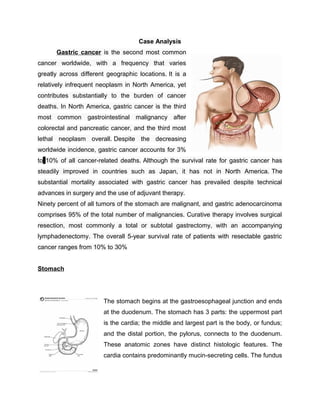
The stomach begins at the gastroesophageal junction and ends
at the duodenum. The stomach has 3 parts: the uppermost part
is the cardia; the middle and largest part is the body, or fundus;
and the distal portion, the pylorus, connects to the duodenum.
These anatomic zones have distinct histologic features. The
cardia contains predominantly mucin-secreting cells. The fundus
contains mucoid cells, chief cells, and parietal cells. The pylorus is composed of mucus-
producing cells and endocrine cells.
The stomach wall is made up of 5 layers. From the lumen out, the layers include the
mucosa, the submucosa, the muscularis layer, the subserosal layer, and the serosal
layer. The peritoneum of the greater sac covers the anterior surface of the stomach. A
portion of the lesser sac drapes posteriorly over the stomach. The gastroesophageal
junction has limited or no serosal covering. The right portion of the anterior gastric
surface is adjacent to the left lobe of the liver and the anterior abdominal wall. The left
portion of the stomach is adjacent to the spleen, the left adrenal gland, the superior
portion of the left kidney, the ventral portion of the pancreas, and the transverse colon.
The site of stomach cancer is classified on the basis of its relationship to the long axis of
the stomach. Approximately 40% of cancers develop in the lower part, 40% in the
middle part, and 15% in the upper part; 10% involve more than one part of the organ.
Most of the decrease in gastric cancer incidence and mortality in the United States has
involved cancer in the lower part of the stomach; the incidence of adenocarcinoma in
the cardia has actually shown a gradual increase.
Case Definition/Description
The diagnosis of gastric cancer requires histopathologic assessment of tissue or
cytologic assessment of gastric brushing/washes. Several classification systems have
been proposed to aid the description of gastric cancer either through macroscopic
features (Borrmann) or on the basis of microscopic configuration (Ming, Carniero, and
Goseki). The 2 most commonly used are the Lauren and World Health Organization
(WHO) systems.
The Lauren classification divides gastric cancer into 2 major histologic types: intestinal
or diffuse. This system describes tumors on the basis of microscopic configuration and
growth pattern. Diffuse-type cancers have noncohesive tumor cells diffusely infiltrating
the stroma of the stomach and often exhibit deep infiltration of the stomach wall with
little or no gland formation. Diffuse tumors may exhibit pronounced desmoplasia and
associated inflammation with relative sparing of the overlying mucosa. In comparison to
intestinal-type gastric cancers, diffuse-type gastric cancers are less related to
environmental influences, have increased in relative incidence, occur more often in
young patients, and are associated with a worse prognosis. These cancers are not
associated with intestinal metaplasia, are not localized to the antrum, and may arise out
of single-cell mutations within normal gastric glands, as is the case for the newly
described hereditary diffuse gastric carcinoma.
Intestinal-type cancers show recognizable gland formation similar in microscopic
appearance to colonic mucosa. Glandular formation ranges from well to poorly
differentiated tumors, which grow in expanding, rather than infiltrative,
patterns. Intestinal-type cancers are believed to arise secondary to chronic atrophic
gastritis.
H. pylori and autoimmune gastritis are the most common etiologic lesions that create an
environment conducive to gastric inflammation. If gastritis persists, gastric atrophy
occurs followed by intestinal metaplasia, which in turn may lead to dysplasia. Dysplasia
can arise in either the native gastric or “intestinalized” gastric epithelium. The term
adenoma is applied when dysplastic proliferation produces a macroscopic protruding
lesion and is described as tubular, tubulovillous, or villous adenoma
morphologically. Adenomas tend to occur in the distal stomach, often have a prolonged
precancerous phase and an expanding growth pattern. Carcinoma is diagnosed when
the tumor invades into the lamina propria or through the muscularis mucosae. Up to
80% of dysplastic lesions may progress to invasion.
The Lauren classification has proven useful in evaluating the natural history of gastric
carcinoma, especially with regard to incidence trends, clinicopathologic correlations,
and etiologic precursors. Despite the apparent use of the Lauren classification, the
WHO has revised the definition of gastric cancer to “malignant epithelial tumors of the
gastric mucosa with glandular differentiation.” The WHO system assigns grades to
adenocarcinoma based on the degree of resemblance to metaplastic intestinal tissue. It
categorizes the histologic patterns into 5 subtypes: adenocarcinoma (intestinal and
diffuse), papillary, tubular, mucinous, and signet-ring cell.
Clinical Manifestations
Gastric carcinoma often produces no specific symptoms when it is superficial and
potentially surgically curable, although up to 50% of patients may have nonspecific
gastrointestinal complaints such as dyspepsia. In Western countries, even with
endoscopic evaluation, gastric cancer is found in only 1% to 2% of patients with
dyspepsia. The lack of early pathognomic symptoms often delays the diagnosis.
Consequently, 80% to 90% of patients with gastric cancer present with locally advanced
or metastatic tumors that have poor rates of resectability. Patients may present with
anorexia and weight loss (95%) as well as abdominal pain that is vague and insidious in
nature. Nausea, vomiting, and early satiety may occur with bulky tumors that obstruct
the gastrointestinal lumen or infiltrative lesions that impair stomach
distension. Ulcerated tumors may cause bleeding that manifest as hematemesis,
melena, or massive upper gastrointestinal hemorrhage.
Physical examination of early gastric cancer is usually uninformative. Patients with
advanced tumors may present with a palpable abdominal mass, cachexia, bowel
obstruction, ascites, hepatomegaly, and lower extremity edema. Peritoneal seeding may
cause involvement of the ovaries (Krukenberg tumor) or pelvic cul-de-sac (Blumer's
shelf) detectable on rectal examination. Metastasis may manifest as an enlarged
supraclavicular lymph node (Virchow's node), left axillary lymph node (Irish's node), or a
periumbilical lymph node (Sister Mary-Joseph's node).
In the early stages of stomach cancer, you may have very few symptoms. These may
include:
• Indigestion and stomach discomfort
• A bloated feeling after eating
• Mild nausea
• Loss of appetite
• Heartburn
These symptoms are similar to those caused by a peptic ulcer. If you are experiencing
any of these symptoms you should see a doctor so that a proper diagnosis can be
made and timely treatment given. A stomach cancer can grow very large before it
causes other symptoms.
In more advanced cancer, you may have:
• Discomfort in the upper or middle part of the abdomen.
• Blood in the stool (which appears as black, tarry stools).
• Vomiting or vomiting blood.
• Weight loss.
• Pain or bloating in the stomach after eating.
• Weakness or fatigue associated with mild anemia (a deficiency in red blood
cells).
Epidemiology
Race
The rates of gastric cancer are higher in Asian and South American countries than in
the United States. Japan, Chile, and Venezuela have developed a very rigorous early
screening program that detects patients with early stage disease (ie, low tumor burden).
These patients appear to do quite well. In fact, in many Asian studies, patients with
resected stage II and III disease tend to have better outcomes than similarly staged
patients treated in Western countries. Some researchers suggest that this reflects a
fundamental biologic difference in the disease as it manifests in Western countries.
In the United States, Asian and Pacific Islander males and females have the highest
incidence of stomach cancer, followed by black, Hispanic, white, American Indian, and
Inuit populations.
Sex
In the United States, gastric cancer affects slightly more men than women; the
American Cancer Society estimates that in 2009, 12,820 new cases will occur in men
and 8,310 in women. Worldwide, however, gastric cancer rates are about twice as high
in men as in women.
Age
Most patients are elderly at diagnosis. The median age for gastric cancer in the United
States is 70 years for males and 74 years for females. The gastric cancers that occur in
younger patients may represent a more aggressive variant or may suggest a genetic
predisposition to development of the disease.
Causes
Gastric cancer may often be multifactorial, involving both inherited predisposition and
environmental factors. Environmental factors implicated in the development of gastric
cancer include diet, Helicobacter pyloriinfection, previous gastric surgery, pernicious
anemia, adenomatous polyps, chronic atrophic gastritis, and radiation exposure.
Diet
A diet rich in pickled vegetables, salted fish, salt, and smoked meats correlates with an
increased incidence of gastric cancer.
A diet that includes fruits and vegetables rich in vitamin C may have a protective effect.
Smoking
Smoking is associated with an increased incidence of stomach cancer in a dose-
dependent manner, both for number of cigarettes and for duration of smoking.
Smoking increases the risk of cardiac and noncardiac forms of stomach
cancer. Cessation of smoking reduces the risk.
A meta-analysis of 40 studies estimated that the risk was increased by approximately
1.5- to 1.6-fold and was higher in men.
Helicobacter pylori infection
Chronic bacterial infection with H pylori is the strongest risk factor for stomach cancer.
H pylori may infect 50% of the world's population, but many fewer than 5% of infected
individuals develop cancer. It may be that only a particular strain of H pylori is strongly
associated with malignancy, probably because it is capable of producing the greatest
amount of inflammation. In addition, full malignant transformation of affected parts of the
stomach may require that the human host have a particular genotype of interleukin (IL)
to cause the increased inflammation and an increased suppression of gastric acid
secretion. For example, IL-17A and IL-17F are inflammatory cytokines that play a critical
role in inflammation. Wu et al found that carriage of IL-17F 7488GA and GG genotypes
were associated with an increased risk of gastric cancer.
H pylori infection is associated with chronic atrophic gastritis, and patients with a history
of prolonged gastritis have a sixfold increased risk of developing gastric cancer.
Interestingly, this association is particularly strong for tumors located in the antrum,
body, and fundus of the stomach but does not seem to hold for tumors originating in the
cardia.
Previous gastric surgery
Previous surgery is implicated as a risk factor. The rationale is that surgery alters the
normal pH of the stomach, which may in turn lead to metaplastic and dysplastic
changes in luminal cells.
Retrospective studies demonstrate that a small percentage of patients who undergo
gastric polyp removal have evidence of invasive carcinoma within the polyp. This
discovery has led some researchers to conclude that polyps might represent
premalignant conditions.
Genetic factors
Some 10% of stomach cancer cases are familial in origin.
Genetic factors involved in gastric cancer remain poorly understood, though specific
mutations have been identified in a subset of gastric cancer patients. For example,
germline truncating mutations of the E-cadherin gene (CDH1) are detected in 50% of
diffuse-type gastric cancers, and families that harbor these mutations have an
autosomal dominant pattern of inheritance with a very high penetrance.
Other hereditary syndromes with a predisposition for stomach cancer include hereditary
nonpolyposis colorectal cancer, Li-Fraumeni syndrome, familial adenomatous polyposis,
and Peutz-Jeghers syndrome.
Epstein-Barr virus
The Epstein-Barr virus may be associated with an unusual (< 1%) form of stomach
cancer, lymphoepithelioma-like carcinoma.
Pernicious anemia
Pernicious anemia associated with advanced atrophic gastritis and intrinsic factor
deficiency is a risk factor for gastric carcinoma.
Gastric ulcers
Gastric cancer may develop in the remaining portion of the stomach following a partial
gastrectomy for gastric ulcer.
Benign gastric ulcers may themselves develop into malignancy.
Obesity
Obesity increases the risk of gastric cardia cancer.
Radiation exposure
Survivors of atomic bomb blasts have had an increased rate of stomach cancer. Other
populations exposed to radiation may also have an increased rate of stomach cancer.
Bisphosphonates
A large cohort study examined whether use of oral bisphosphonates was associated
with an increased risk of esophageal or gastric cancers. No significant difference was
observed for increased risk of esophageal or gastric cancers between the
bisphosphonate cohort and the control group.
Diagnostic Procedures
Endoscopy is regarded as the most sensitive and specific diagnostic method in
patients suspected of harboring gastric cancer.
Endoscopy allows direct visualization of
tumor location, the extent of mucosal involvement, and biopsy (or cytologic brushings)
for tissue diagnosis. When combined with endoscopy and radiologic modalities,
endoscopic ultrasound (EUS) can maximize tumor staging by providing information
about depth of tumor invasion and assess the extent of perigastric lymphadenopathy.
Willis et al suggest that EUS is currently the most valuable diagnostic tool for
preoperative staging of gastric cancer (82% accuracy in assessing the depth of tumor
invasion) and for determining tumor resectability. Karpeh et al suggest the combined
use of EUS and laparoscopic staging facilitates patient selection by providing
information about tumor depth and perigastric lymph node involvement. They do
caution, however, that EUS is less accurate (50–87%) in determining lymph node
status.
Esophagogastroduodenoscopy has a diagnostic accuracy of 95%. This relatively
safe and simple procedure provides a permanent color photographic record of the
lesion. This procedure is also the primary method for obtaining a tissue diagnosis of
suspected lesions. Biopsy of any ulcerated lesion should include at least 6 specimens
taken from around the lesion because of variable malignant transformation. In selected
cases, endoscopic ultrasound may be helpful in assessing depth of penetration of the
tumor or involvement of adjacent structures.
An upper gastrointestinal barium study (UGI) involves the instillation of liquid barium
into the stomach and a combination of 4 techniques: barium-filled evaluation, double-
contrast, mucosal relief views, and compression views of the stomach. The procedure
permits identification of mucosal irregularities. Halvorsen et al have suggested that,
although endoscopy is increasingly becoming the method of choice, the 2 methods are
complementary and have equivalent diagnostic efficacy.
Computed tomography (CT) is the most frequently used modality for staging gastric
cancer. CT can detect liver metastases, regional and distant lymphadenopathy, and can
predict direct invasion of adjacent structures. Kuntz et al suggested that CT has a
sensitivity of 88% for tumor detection. The ability of CT to accurately determine either
tumor infiltration (T stage 58%) or perigastric lymph node status (25–86%) varied widely
and was not considered a reliable predictor of disease extent in several studies.
Magnetic resonance imaging (MRI) has had limited use in the staging of gastric
cancer primarily as a result of difficulties with motion artifact, cost, time required for
examination, and lack of an appropriate oral contrast agent. However, in a recent study
comparing MRI with CT, Sohn et aldocumented advanced gastric cancers were easily
detected with both techniques. They showed MRI was slightly better than CT in the T
staging of gastric cancer. Similarly, Kim et al documented T staging accuracy of MRI
was superior to CT (81% vs. 73%, P <0.05). This study suggested MRI was prone to
overstaging pathologic tumor thickness. Overall T staging accuracy has been reported
to be between 73% and 88%. The use of MRI in N staging has been hindered by the
same difficulties encountered with CT staging, in which nodal status is judged on the
basis of lymph node size. Several studies show the accuracy of MRI nodal staging is
inferior to CT staging (65% vs. 73% respectively, P >0.05), with both techniques tending
to understage nodal status. Finally, Motohara et al reviewed the ability of MRI to detect
extragastric metastases and concluded MRI had a greater sensitivity than CT in
detecting liver, bone, and peritoneal dissemination. The obvious advantage of MRI
staging lies predominantly with its multiplanar capabilities, lack of ionizing radiation, and
use in patients with contrast hypersensitivity.44
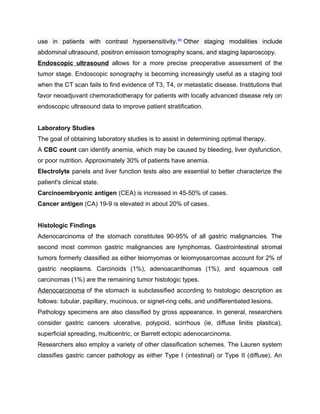
Other staging modalities include
abdominal ultrasound, positron emission tomography scans, and staging laparoscopy.
Endoscopic ultrasound allows for a more precise preoperative assessment of the
tumor stage. Endoscopic sonography is becoming increasingly useful as a staging tool
when the CT scan fails to find evidence of T3, T4, or metastatic disease. Institutions that
favor neoadjuvant chemoradiotherapy for patients with locally advanced disease rely on
endoscopic ultrasound data to improve patient stratification.
Laboratory Studies
The goal of obtaining laboratory studies is to assist in determining optimal therapy.
A CBC count can identify anemia, which may be caused by bleeding, liver dysfunction,
or poor nutrition. Approximately 30% of patients have anemia.
Electrolyte panels and liver function tests also are essential to better characterize the
patient's clinical state.
Carcinoembryonic antigen (CEA) is increased in 45-50% of cases.
Cancer antigen (CA) 19-9 is elevated in about 20% of cases.
Histologic Findings
Adenocarcinoma of the stomach constitutes 90-95% of all gastric malignancies. The
second most common gastric malignancies are lymphomas. Gastrointestinal stromal
tumors formerly classified as either leiomyomas or leiomyosarcomas account for 2% of
gastric neoplasms. Carcinoids (1%), adenoacanthomas (1%), and squamous cell
carcinomas (1%) are the remaining tumor histologic types.
Adenocarcinoma of the stomach is subclassified according to histologic description as
follows: tubular, papillary, mucinous, or signet-ring cells, and undifferentiated lesions.
Pathology specimens are also classified by gross appearance. In general, researchers
consider gastric cancers ulcerative, polypoid, scirrhous (ie, diffuse linitis plastica),
superficial spreading, multicentric, or Barrett ectopic adenocarcinoma.
Researchers also employ a variety of other classification schemes. The Lauren system
classifies gastric cancer pathology as either Type I (intestinal) or Type II (diffuse). An
appealing feature of classifying patients according to the Lauren system is that the
descriptive pathologic entities have clinically relevant differences.
Intestinal, expansive, epidemic-type gastric cancer is associated with chronic atrophic
gastritis, retained glandular structure, little invasiveness, and a sharp margin. The
pathologic presentation classified as epidemic by the Lauren system is associated with
most environmental risk factors, carries a better prognosis, and shows no familial
history.
The second type, diffuse, infiltrative, endemic cancer, consists of scattered cell clusters
with poor differentiation and dangerously deceptive margins. Margins that appear clear
to the operating surgeon and examining pathologist often are determined retrospectively
to be involved. The endemic-type tumor invades large areas of the stomach. This type
of tumor is also not recognizably influenced by environment or diet, is more virulent in
women, and occurs more often in relatively young patients. This pathologic entity is
associated with genetic factors (such as E-cadherin), blood groups, and a family history
of gastric cancer.
Staging
The 2006 American Joint Committee on Cancer (AJCC) Cancer Staging
Manual presents the following TNM classification system for staging gastric carcinoma:
[16]
Primary tumor
• TX - Primary tumor (T) cannot be assessed
• T0 - No evidence of primary tumor
• Tis - Carcinoma in situ, intraepithelial tumor without invasion of lamina propria
• T1 - Tumor invades lamina propria or submucosa
• T2 - Tumor invades muscularis propria or subserosa
• T3 - Tumor penetrates serosa (ie, visceral peritoneum) without invasion of
adjacent structures
• T4 - Tumor invades adjacent structures
Regional lymph nodes
• NX - Regional lymph nodes (N) cannot be assessed
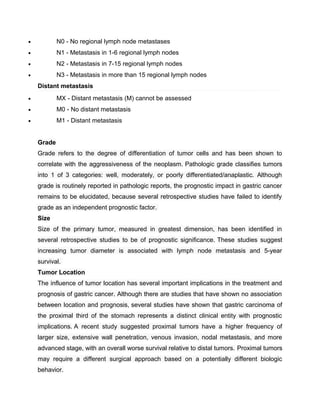
• N0 - No regional lymph node metastases
• N1 - Metastasis in 1-6 regional lymph nodes
• N2 - Metastasis in 7-15 regional lymph nodes
• N3 - Metastasis in more than 15 regional lymph nodes
Distant metastasis
• MX - Distant metastasis (M) cannot be assessed
• M0 - No distant metastasis
• M1 - Distant metastasis
Grade
Grade refers to the degree of differentiation of tumor cells and has been shown to
correlate with the aggressiveness of the neoplasm. Pathologic grade classifies tumors
into 1 of 3 categories: well, moderately, or poorly differentiated/anaplastic. Although
grade is routinely reported in pathologic reports, the prognostic impact in gastric cancer
remains to be elucidated, because several retrospective studies have failed to identify
grade as an independent prognostic factor.
Size
Size of the primary tumor, measured in greatest dimension, has been identified in
several retrospective studies to be of prognostic significance. These studies suggest
increasing tumor diameter is associated with lymph node metastasis and 5-year
survival.
Tumor Location
The influence of tumor location has several important implications in the treatment and
prognosis of gastric cancer. Although there are studies that have shown no association
between location and prognosis, several studies have shown that gastric carcinoma of
the proximal third of the stomach represents a distinct clinical entity with prognostic
implications. A recent study suggested proximal tumors have a higher frequency of
larger size, extensive wall penetration, venous invasion, nodal metastasis, and more
advanced stage, with an overall worse survival relative to distal tumors. Proximal tumors
may require a different surgical approach based on a potentially different biologic
behavior.
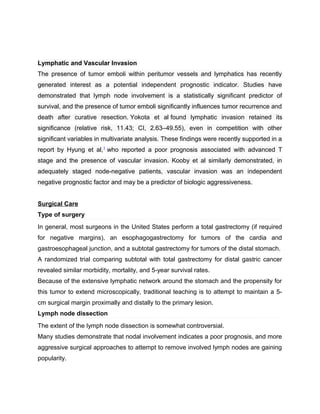
Lymphatic and Vascular Invasion
The presence of tumor emboli within peritumor vessels and lymphatics has recently
generated interest as a potential independent prognostic indicator. Studies have
demonstrated that lymph node involvement is a statistically significant predictor of
survival, and the presence of tumor emboli significantly influences tumor recurrence and
death after curative resection. Yokota et al found lymphatic invasion retained its
significance (relative risk, 11.43; CI, 2.63–49.55), even in competition with other
significant variables in multivariate analysis. These findings were recently supported in a
report by Hyung et al,1
who reported a poor prognosis associated with advanced T
stage and the presence of vascular invasion. Kooby et al similarly demonstrated, in
adequately staged node-negative patients, vascular invasion was an independent
negative prognostic factor and may be a predictor of biologic aggressiveness.
Surgical Care
Type of surgery
In general, most surgeons in the United States perform a total gastrectomy (if required
for negative margins), an esophagogastrectomy for tumors of the cardia and
gastroesophageal junction, and a subtotal gastrectomy for tumors of the distal stomach.
A randomized trial comparing subtotal with total gastrectomy for distal gastric cancer
revealed similar morbidity, mortality, and 5-year survival rates.
Because of the extensive lymphatic network around the stomach and the propensity for
this tumor to extend microscopically, traditional teaching is to attempt to maintain a 5-
cm surgical margin proximally and distally to the primary lesion.
Lymph node dissection
The extent of the lymph node dissection is somewhat controversial.
Many studies demonstrate that nodal involvement indicates a poor prognosis, and more
aggressive surgical approaches to attempt to remove involved lymph nodes are gaining
popularity.
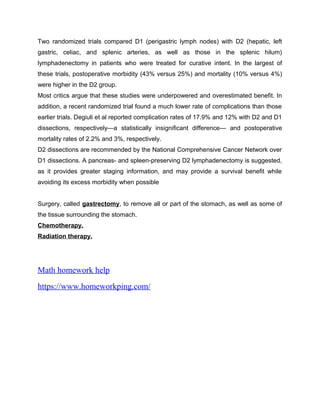
Two randomized trials compared D1 (perigastric lymph nodes) with D2 (hepatic, left
gastric, celiac, and splenic arteries, as well as those in the splenic hilum)
lymphadenectomy in patients who were treated for curative intent. In the largest of
these trials, postoperative morbidity (43% versus 25%) and mortality (10% versus 4%)
were higher in the D2 group.
Most critics argue that these studies were underpowered and overestimated benefit. In
addition, a recent randomized trial found a much lower rate of complications than those
earlier trials. Degiuli et al reported complication rates of 17.9% and 12% with D2 and D1
dissections, respectively—a statistically insignificant difference— and postoperative
mortality rates of 2.2% and 3%, respectively.
D2 dissections are recommended by the National Comprehensive Cancer Network over
D1 dissections. A pancreas- and spleen-preserving D2 lymphadenectomy is suggested,
as it provides greater staging information, and may provide a survival benefit while
avoiding its excess morbidity when possible
Surgery, called gastrectomy, to remove all or part of the stomach, as well as some of
the tissue surrounding the stomach.
Chemotherapy.
Radiation therapy.
Math homework help
https://www.homeworkping.com/

62167148 case-analysis-gastro

  • 1.
    Case Analysis Gastric canceris the second most common cancer worldwide, with a frequency that varies greatly across different geographic locations. It is a relatively infrequent neoplasm in North America, yet contributes substantially to the burden of cancer deaths. In North America, gastric cancer is the third most common gastrointestinal malignancy after colorectal and pancreatic cancer, and the third most lethal neoplasm overall. Despite the decreasing worldwide incidence, gastric cancer accounts for 3% to 10% of all cancer-related deaths. Although the survival rate for gastric cancer has steadily improved in countries such as Japan, it has not in North America. The substantial mortality associated with gastric cancer has prevailed despite technical advances in surgery and the use of adjuvant therapy. Ninety percent of all tumors of the stomach are malignant, and gastric adenocarcinoma comprises 95% of the total number of malignancies. Curative therapy involves surgical resection, most commonly a total or subtotal gastrectomy, with an accompanying lymphadenectomy. The overall 5-year survival rate of patients with resectable gastric cancer ranges from 10% to 30% Stomach The stomach begins at the gastroesophageal junction and ends at the duodenum. The stomach has 3 parts: the uppermost part is the cardia; the middle and largest part is the body, or fundus; and the distal portion, the pylorus, connects to the duodenum. These anatomic zones have distinct histologic features. The cardia contains predominantly mucin-secreting cells. The fundus
  • 2.
    contains mucoid cells,chief cells, and parietal cells. The pylorus is composed of mucus- producing cells and endocrine cells. The stomach wall is made up of 5 layers. From the lumen out, the layers include the mucosa, the submucosa, the muscularis layer, the subserosal layer, and the serosal layer. The peritoneum of the greater sac covers the anterior surface of the stomach. A portion of the lesser sac drapes posteriorly over the stomach. The gastroesophageal junction has limited or no serosal covering. The right portion of the anterior gastric surface is adjacent to the left lobe of the liver and the anterior abdominal wall. The left portion of the stomach is adjacent to the spleen, the left adrenal gland, the superior portion of the left kidney, the ventral portion of the pancreas, and the transverse colon. The site of stomach cancer is classified on the basis of its relationship to the long axis of the stomach. Approximately 40% of cancers develop in the lower part, 40% in the middle part, and 15% in the upper part; 10% involve more than one part of the organ. Most of the decrease in gastric cancer incidence and mortality in the United States has involved cancer in the lower part of the stomach; the incidence of adenocarcinoma in the cardia has actually shown a gradual increase. Case Definition/Description The diagnosis of gastric cancer requires histopathologic assessment of tissue or cytologic assessment of gastric brushing/washes. Several classification systems have been proposed to aid the description of gastric cancer either through macroscopic features (Borrmann) or on the basis of microscopic configuration (Ming, Carniero, and Goseki). The 2 most commonly used are the Lauren and World Health Organization (WHO) systems. The Lauren classification divides gastric cancer into 2 major histologic types: intestinal or diffuse. This system describes tumors on the basis of microscopic configuration and growth pattern. Diffuse-type cancers have noncohesive tumor cells diffusely infiltrating the stroma of the stomach and often exhibit deep infiltration of the stomach wall with little or no gland formation. Diffuse tumors may exhibit pronounced desmoplasia and associated inflammation with relative sparing of the overlying mucosa. In comparison to intestinal-type gastric cancers, diffuse-type gastric cancers are less related to
  • 3.
    environmental influences, haveincreased in relative incidence, occur more often in young patients, and are associated with a worse prognosis. These cancers are not associated with intestinal metaplasia, are not localized to the antrum, and may arise out of single-cell mutations within normal gastric glands, as is the case for the newly described hereditary diffuse gastric carcinoma. Intestinal-type cancers show recognizable gland formation similar in microscopic appearance to colonic mucosa. Glandular formation ranges from well to poorly differentiated tumors, which grow in expanding, rather than infiltrative, patterns. Intestinal-type cancers are believed to arise secondary to chronic atrophic gastritis. H. pylori and autoimmune gastritis are the most common etiologic lesions that create an environment conducive to gastric inflammation. If gastritis persists, gastric atrophy occurs followed by intestinal metaplasia, which in turn may lead to dysplasia. Dysplasia can arise in either the native gastric or “intestinalized” gastric epithelium. The term adenoma is applied when dysplastic proliferation produces a macroscopic protruding lesion and is described as tubular, tubulovillous, or villous adenoma morphologically. Adenomas tend to occur in the distal stomach, often have a prolonged precancerous phase and an expanding growth pattern. Carcinoma is diagnosed when the tumor invades into the lamina propria or through the muscularis mucosae. Up to 80% of dysplastic lesions may progress to invasion. The Lauren classification has proven useful in evaluating the natural history of gastric carcinoma, especially with regard to incidence trends, clinicopathologic correlations, and etiologic precursors. Despite the apparent use of the Lauren classification, the WHO has revised the definition of gastric cancer to “malignant epithelial tumors of the gastric mucosa with glandular differentiation.” The WHO system assigns grades to adenocarcinoma based on the degree of resemblance to metaplastic intestinal tissue. It categorizes the histologic patterns into 5 subtypes: adenocarcinoma (intestinal and diffuse), papillary, tubular, mucinous, and signet-ring cell. Clinical Manifestations
  • 4.
    Gastric carcinoma oftenproduces no specific symptoms when it is superficial and potentially surgically curable, although up to 50% of patients may have nonspecific gastrointestinal complaints such as dyspepsia. In Western countries, even with endoscopic evaluation, gastric cancer is found in only 1% to 2% of patients with dyspepsia. The lack of early pathognomic symptoms often delays the diagnosis. Consequently, 80% to 90% of patients with gastric cancer present with locally advanced or metastatic tumors that have poor rates of resectability. Patients may present with anorexia and weight loss (95%) as well as abdominal pain that is vague and insidious in nature. Nausea, vomiting, and early satiety may occur with bulky tumors that obstruct the gastrointestinal lumen or infiltrative lesions that impair stomach distension. Ulcerated tumors may cause bleeding that manifest as hematemesis, melena, or massive upper gastrointestinal hemorrhage. Physical examination of early gastric cancer is usually uninformative. Patients with advanced tumors may present with a palpable abdominal mass, cachexia, bowel obstruction, ascites, hepatomegaly, and lower extremity edema. Peritoneal seeding may cause involvement of the ovaries (Krukenberg tumor) or pelvic cul-de-sac (Blumer's shelf) detectable on rectal examination. Metastasis may manifest as an enlarged supraclavicular lymph node (Virchow's node), left axillary lymph node (Irish's node), or a periumbilical lymph node (Sister Mary-Joseph's node). In the early stages of stomach cancer, you may have very few symptoms. These may include: • Indigestion and stomach discomfort • A bloated feeling after eating • Mild nausea • Loss of appetite • Heartburn These symptoms are similar to those caused by a peptic ulcer. If you are experiencing any of these symptoms you should see a doctor so that a proper diagnosis can be made and timely treatment given. A stomach cancer can grow very large before it causes other symptoms. In more advanced cancer, you may have:
  • 5.
    • Discomfort inthe upper or middle part of the abdomen. • Blood in the stool (which appears as black, tarry stools). • Vomiting or vomiting blood. • Weight loss. • Pain or bloating in the stomach after eating. • Weakness or fatigue associated with mild anemia (a deficiency in red blood cells). Epidemiology Race The rates of gastric cancer are higher in Asian and South American countries than in the United States. Japan, Chile, and Venezuela have developed a very rigorous early screening program that detects patients with early stage disease (ie, low tumor burden). These patients appear to do quite well. In fact, in many Asian studies, patients with resected stage II and III disease tend to have better outcomes than similarly staged patients treated in Western countries. Some researchers suggest that this reflects a fundamental biologic difference in the disease as it manifests in Western countries. In the United States, Asian and Pacific Islander males and females have the highest incidence of stomach cancer, followed by black, Hispanic, white, American Indian, and Inuit populations. Sex In the United States, gastric cancer affects slightly more men than women; the American Cancer Society estimates that in 2009, 12,820 new cases will occur in men and 8,310 in women. Worldwide, however, gastric cancer rates are about twice as high in men as in women. Age Most patients are elderly at diagnosis. The median age for gastric cancer in the United States is 70 years for males and 74 years for females. The gastric cancers that occur in younger patients may represent a more aggressive variant or may suggest a genetic predisposition to development of the disease. Causes
  • 6.
    Gastric cancer mayoften be multifactorial, involving both inherited predisposition and environmental factors. Environmental factors implicated in the development of gastric cancer include diet, Helicobacter pyloriinfection, previous gastric surgery, pernicious anemia, adenomatous polyps, chronic atrophic gastritis, and radiation exposure. Diet A diet rich in pickled vegetables, salted fish, salt, and smoked meats correlates with an increased incidence of gastric cancer. A diet that includes fruits and vegetables rich in vitamin C may have a protective effect. Smoking Smoking is associated with an increased incidence of stomach cancer in a dose- dependent manner, both for number of cigarettes and for duration of smoking. Smoking increases the risk of cardiac and noncardiac forms of stomach cancer. Cessation of smoking reduces the risk. A meta-analysis of 40 studies estimated that the risk was increased by approximately 1.5- to 1.6-fold and was higher in men. Helicobacter pylori infection Chronic bacterial infection with H pylori is the strongest risk factor for stomach cancer. H pylori may infect 50% of the world's population, but many fewer than 5% of infected individuals develop cancer. It may be that only a particular strain of H pylori is strongly associated with malignancy, probably because it is capable of producing the greatest amount of inflammation. In addition, full malignant transformation of affected parts of the stomach may require that the human host have a particular genotype of interleukin (IL) to cause the increased inflammation and an increased suppression of gastric acid secretion. For example, IL-17A and IL-17F are inflammatory cytokines that play a critical role in inflammation. Wu et al found that carriage of IL-17F 7488GA and GG genotypes were associated with an increased risk of gastric cancer. H pylori infection is associated with chronic atrophic gastritis, and patients with a history of prolonged gastritis have a sixfold increased risk of developing gastric cancer. Interestingly, this association is particularly strong for tumors located in the antrum, body, and fundus of the stomach but does not seem to hold for tumors originating in the cardia.
  • 7.
    Previous gastric surgery Previoussurgery is implicated as a risk factor. The rationale is that surgery alters the normal pH of the stomach, which may in turn lead to metaplastic and dysplastic changes in luminal cells. Retrospective studies demonstrate that a small percentage of patients who undergo gastric polyp removal have evidence of invasive carcinoma within the polyp. This discovery has led some researchers to conclude that polyps might represent premalignant conditions. Genetic factors Some 10% of stomach cancer cases are familial in origin. Genetic factors involved in gastric cancer remain poorly understood, though specific mutations have been identified in a subset of gastric cancer patients. For example, germline truncating mutations of the E-cadherin gene (CDH1) are detected in 50% of diffuse-type gastric cancers, and families that harbor these mutations have an autosomal dominant pattern of inheritance with a very high penetrance. Other hereditary syndromes with a predisposition for stomach cancer include hereditary nonpolyposis colorectal cancer, Li-Fraumeni syndrome, familial adenomatous polyposis, and Peutz-Jeghers syndrome. Epstein-Barr virus The Epstein-Barr virus may be associated with an unusual (< 1%) form of stomach cancer, lymphoepithelioma-like carcinoma. Pernicious anemia Pernicious anemia associated with advanced atrophic gastritis and intrinsic factor deficiency is a risk factor for gastric carcinoma. Gastric ulcers Gastric cancer may develop in the remaining portion of the stomach following a partial gastrectomy for gastric ulcer. Benign gastric ulcers may themselves develop into malignancy.
  • 8.
    Obesity Obesity increases therisk of gastric cardia cancer. Radiation exposure Survivors of atomic bomb blasts have had an increased rate of stomach cancer. Other populations exposed to radiation may also have an increased rate of stomach cancer. Bisphosphonates A large cohort study examined whether use of oral bisphosphonates was associated with an increased risk of esophageal or gastric cancers. No significant difference was observed for increased risk of esophageal or gastric cancers between the bisphosphonate cohort and the control group. Diagnostic Procedures Endoscopy is regarded as the most sensitive and specific diagnostic method in patients suspected of harboring gastric cancer. Endoscopy allows direct visualization of tumor location, the extent of mucosal involvement, and biopsy (or cytologic brushings) for tissue diagnosis. When combined with endoscopy and radiologic modalities, endoscopic ultrasound (EUS) can maximize tumor staging by providing information about depth of tumor invasion and assess the extent of perigastric lymphadenopathy. Willis et al suggest that EUS is currently the most valuable diagnostic tool for preoperative staging of gastric cancer (82% accuracy in assessing the depth of tumor invasion) and for determining tumor resectability. Karpeh et al suggest the combined use of EUS and laparoscopic staging facilitates patient selection by providing information about tumor depth and perigastric lymph node involvement. They do caution, however, that EUS is less accurate (50–87%) in determining lymph node status. Esophagogastroduodenoscopy has a diagnostic accuracy of 95%. This relatively safe and simple procedure provides a permanent color photographic record of the lesion. This procedure is also the primary method for obtaining a tissue diagnosis of suspected lesions. Biopsy of any ulcerated lesion should include at least 6 specimens taken from around the lesion because of variable malignant transformation. In selected
  • 9.
    cases, endoscopic ultrasoundmay be helpful in assessing depth of penetration of the tumor or involvement of adjacent structures. An upper gastrointestinal barium study (UGI) involves the instillation of liquid barium into the stomach and a combination of 4 techniques: barium-filled evaluation, double- contrast, mucosal relief views, and compression views of the stomach. The procedure permits identification of mucosal irregularities. Halvorsen et al have suggested that, although endoscopy is increasingly becoming the method of choice, the 2 methods are complementary and have equivalent diagnostic efficacy. Computed tomography (CT) is the most frequently used modality for staging gastric cancer. CT can detect liver metastases, regional and distant lymphadenopathy, and can predict direct invasion of adjacent structures. Kuntz et al suggested that CT has a sensitivity of 88% for tumor detection. The ability of CT to accurately determine either tumor infiltration (T stage 58%) or perigastric lymph node status (25–86%) varied widely and was not considered a reliable predictor of disease extent in several studies. Magnetic resonance imaging (MRI) has had limited use in the staging of gastric cancer primarily as a result of difficulties with motion artifact, cost, time required for examination, and lack of an appropriate oral contrast agent. However, in a recent study comparing MRI with CT, Sohn et aldocumented advanced gastric cancers were easily detected with both techniques. They showed MRI was slightly better than CT in the T staging of gastric cancer. Similarly, Kim et al documented T staging accuracy of MRI was superior to CT (81% vs. 73%, P <0.05). This study suggested MRI was prone to overstaging pathologic tumor thickness. Overall T staging accuracy has been reported to be between 73% and 88%. The use of MRI in N staging has been hindered by the same difficulties encountered with CT staging, in which nodal status is judged on the basis of lymph node size. Several studies show the accuracy of MRI nodal staging is inferior to CT staging (65% vs. 73% respectively, P >0.05), with both techniques tending to understage nodal status. Finally, Motohara et al reviewed the ability of MRI to detect extragastric metastases and concluded MRI had a greater sensitivity than CT in detecting liver, bone, and peritoneal dissemination. The obvious advantage of MRI staging lies predominantly with its multiplanar capabilities, lack of ionizing radiation, and
  • 10.
    use in patientswith contrast hypersensitivity.44 Other staging modalities include abdominal ultrasound, positron emission tomography scans, and staging laparoscopy. Endoscopic ultrasound allows for a more precise preoperative assessment of the tumor stage. Endoscopic sonography is becoming increasingly useful as a staging tool when the CT scan fails to find evidence of T3, T4, or metastatic disease. Institutions that favor neoadjuvant chemoradiotherapy for patients with locally advanced disease rely on endoscopic ultrasound data to improve patient stratification. Laboratory Studies The goal of obtaining laboratory studies is to assist in determining optimal therapy. A CBC count can identify anemia, which may be caused by bleeding, liver dysfunction, or poor nutrition. Approximately 30% of patients have anemia. Electrolyte panels and liver function tests also are essential to better characterize the patient's clinical state. Carcinoembryonic antigen (CEA) is increased in 45-50% of cases. Cancer antigen (CA) 19-9 is elevated in about 20% of cases. Histologic Findings Adenocarcinoma of the stomach constitutes 90-95% of all gastric malignancies. The second most common gastric malignancies are lymphomas. Gastrointestinal stromal tumors formerly classified as either leiomyomas or leiomyosarcomas account for 2% of gastric neoplasms. Carcinoids (1%), adenoacanthomas (1%), and squamous cell carcinomas (1%) are the remaining tumor histologic types. Adenocarcinoma of the stomach is subclassified according to histologic description as follows: tubular, papillary, mucinous, or signet-ring cells, and undifferentiated lesions. Pathology specimens are also classified by gross appearance. In general, researchers consider gastric cancers ulcerative, polypoid, scirrhous (ie, diffuse linitis plastica), superficial spreading, multicentric, or Barrett ectopic adenocarcinoma. Researchers also employ a variety of other classification schemes. The Lauren system classifies gastric cancer pathology as either Type I (intestinal) or Type II (diffuse). An
  • 11.
    appealing feature ofclassifying patients according to the Lauren system is that the descriptive pathologic entities have clinically relevant differences. Intestinal, expansive, epidemic-type gastric cancer is associated with chronic atrophic gastritis, retained glandular structure, little invasiveness, and a sharp margin. The pathologic presentation classified as epidemic by the Lauren system is associated with most environmental risk factors, carries a better prognosis, and shows no familial history. The second type, diffuse, infiltrative, endemic cancer, consists of scattered cell clusters with poor differentiation and dangerously deceptive margins. Margins that appear clear to the operating surgeon and examining pathologist often are determined retrospectively to be involved. The endemic-type tumor invades large areas of the stomach. This type of tumor is also not recognizably influenced by environment or diet, is more virulent in women, and occurs more often in relatively young patients. This pathologic entity is associated with genetic factors (such as E-cadherin), blood groups, and a family history of gastric cancer. Staging The 2006 American Joint Committee on Cancer (AJCC) Cancer Staging Manual presents the following TNM classification system for staging gastric carcinoma: [16] Primary tumor • TX - Primary tumor (T) cannot be assessed • T0 - No evidence of primary tumor • Tis - Carcinoma in situ, intraepithelial tumor without invasion of lamina propria • T1 - Tumor invades lamina propria or submucosa • T2 - Tumor invades muscularis propria or subserosa • T3 - Tumor penetrates serosa (ie, visceral peritoneum) without invasion of adjacent structures • T4 - Tumor invades adjacent structures Regional lymph nodes • NX - Regional lymph nodes (N) cannot be assessed
  • 12.
    • N0 -No regional lymph node metastases • N1 - Metastasis in 1-6 regional lymph nodes • N2 - Metastasis in 7-15 regional lymph nodes • N3 - Metastasis in more than 15 regional lymph nodes Distant metastasis • MX - Distant metastasis (M) cannot be assessed • M0 - No distant metastasis • M1 - Distant metastasis Grade Grade refers to the degree of differentiation of tumor cells and has been shown to correlate with the aggressiveness of the neoplasm. Pathologic grade classifies tumors into 1 of 3 categories: well, moderately, or poorly differentiated/anaplastic. Although grade is routinely reported in pathologic reports, the prognostic impact in gastric cancer remains to be elucidated, because several retrospective studies have failed to identify grade as an independent prognostic factor. Size Size of the primary tumor, measured in greatest dimension, has been identified in several retrospective studies to be of prognostic significance. These studies suggest increasing tumor diameter is associated with lymph node metastasis and 5-year survival. Tumor Location The influence of tumor location has several important implications in the treatment and prognosis of gastric cancer. Although there are studies that have shown no association between location and prognosis, several studies have shown that gastric carcinoma of the proximal third of the stomach represents a distinct clinical entity with prognostic implications. A recent study suggested proximal tumors have a higher frequency of larger size, extensive wall penetration, venous invasion, nodal metastasis, and more advanced stage, with an overall worse survival relative to distal tumors. Proximal tumors may require a different surgical approach based on a potentially different biologic behavior.
  • 13.
    Lymphatic and VascularInvasion The presence of tumor emboli within peritumor vessels and lymphatics has recently generated interest as a potential independent prognostic indicator. Studies have demonstrated that lymph node involvement is a statistically significant predictor of survival, and the presence of tumor emboli significantly influences tumor recurrence and death after curative resection. Yokota et al found lymphatic invasion retained its significance (relative risk, 11.43; CI, 2.63–49.55), even in competition with other significant variables in multivariate analysis. These findings were recently supported in a report by Hyung et al,1 who reported a poor prognosis associated with advanced T stage and the presence of vascular invasion. Kooby et al similarly demonstrated, in adequately staged node-negative patients, vascular invasion was an independent negative prognostic factor and may be a predictor of biologic aggressiveness. Surgical Care Type of surgery In general, most surgeons in the United States perform a total gastrectomy (if required for negative margins), an esophagogastrectomy for tumors of the cardia and gastroesophageal junction, and a subtotal gastrectomy for tumors of the distal stomach. A randomized trial comparing subtotal with total gastrectomy for distal gastric cancer revealed similar morbidity, mortality, and 5-year survival rates. Because of the extensive lymphatic network around the stomach and the propensity for this tumor to extend microscopically, traditional teaching is to attempt to maintain a 5- cm surgical margin proximally and distally to the primary lesion. Lymph node dissection The extent of the lymph node dissection is somewhat controversial. Many studies demonstrate that nodal involvement indicates a poor prognosis, and more aggressive surgical approaches to attempt to remove involved lymph nodes are gaining popularity.
  • 14.
    Two randomized trialscompared D1 (perigastric lymph nodes) with D2 (hepatic, left gastric, celiac, and splenic arteries, as well as those in the splenic hilum) lymphadenectomy in patients who were treated for curative intent. In the largest of these trials, postoperative morbidity (43% versus 25%) and mortality (10% versus 4%) were higher in the D2 group. Most critics argue that these studies were underpowered and overestimated benefit. In addition, a recent randomized trial found a much lower rate of complications than those earlier trials. Degiuli et al reported complication rates of 17.9% and 12% with D2 and D1 dissections, respectively—a statistically insignificant difference— and postoperative mortality rates of 2.2% and 3%, respectively. D2 dissections are recommended by the National Comprehensive Cancer Network over D1 dissections. A pancreas- and spleen-preserving D2 lymphadenectomy is suggested, as it provides greater staging information, and may provide a survival benefit while avoiding its excess morbidity when possible Surgery, called gastrectomy, to remove all or part of the stomach, as well as some of the tissue surrounding the stomach. Chemotherapy. Radiation therapy. Math homework help https://www.homeworkping.com/