COLORECTAL CANCER
Dwi Kartika Rukmi
Morphology of Colon
CANCER
WORLWID
E
COLORECTAL CANCER
 Colorectal cancer (CRC) is a major cause of
morbidity and mortality throughout the
world. It accounts for over 9% of all cancer
incidence.
 CRC is the third most common cancer
worldwide and the fourth most common
cause of death
 In 2012, highest CRC incidence in both female
and male are in Japan (Miyagi Prefecture: ♀
37,2/100.000 and ♂ 62,4/100.000)
Arnold M, Sierra MS, Laversanne M, et al. Gut 2017;66:683–691
COLORECTAL CANCER RISK FACTOR
NON MODIFIABLE (20%)
 Age
 Personal History of Adenomatous Polyps
 Personal History of Inflammatory Bowel
Disease
 Family History of Colorectal Cancer or
Adenomatous Polyps
 Inherited Genetic Risk
MODIFIABLE (80%)
 A diet low in fibre, vegetables, and folate and
high in fat, red meat
 Heavy alcohol consumption
 A sedentary occupation
 Cigarette smoking
Hamza, Aglan, Ahmed,2017; Granados Romero JJ et al. 2017
Cont
 Age: increases progressively from age 40,
rising sharply after 50.
 Personal History of Adenomatous Polyps
: tubular or villous adenomas (life time
risk for adenomas is 19% and 95% CRC
develops from these adenomas)
Villous Adenoma
Tubular AdenomaHamza, Aglan, Ahmed,2017; Granados Romero JJ et al. 2017
Cont
 Personal History of Inflammatory Bowel
Disease :Ulcerative colitis and Crohn
disease usually described as inflammatory
bowel disease (IBD) . The relative risk of
CRC in patients with inflammatory bowel
disease has been estimated between 4-
to 20-fold
 Family History of Colorectal Cancer or
Adenomatous Polyps :People with a
history of CRC or adenomatous polyps in
one or more first-degree relatives are at
increased risk. CRC develop 100% in FAP
untreated by age 45
Ulcerative colitis
Familial
Adenomatous
Polyps (FAP)
Hamza, Aglan, Ahmed,2017
Cont
 Inherited Genetic Risk
 Approximately 5 to 10% of colorectal cancers are a
consequence of recognized hereditary conditions. The most
common inherited conditions are FAP and HNPCC, also
called Lynch syndrome
 HNPCC is associated with mutations in genes involved in the
DNA repair pathway
 FAP is caused by mutations in the tumor suppressor gene
APC
 The lifetime risk of CRC in people with the recognized
HNPCC-related mutations may be as high as 70 to 80%, and
the average age at diagnosis in their mid-40s
Hamza, Aglan, Ahmed,2017
 A diet low in fibre, vegetables, and
folate and high in fat, red meat
Hamza, Aglan, Ahmed,2017
Cont
 Alcohol comsumption
Rossi, M.,Anwar MJ.,Usman A.,et al. 2017
Cont
 A sedentary occupation
Hamza, Aglan, Ahmed,2017
Cont
 Cigarette Smoking
Liang, 2009
Pathophysiology of CRC (Nguyen, Duong, 2018)
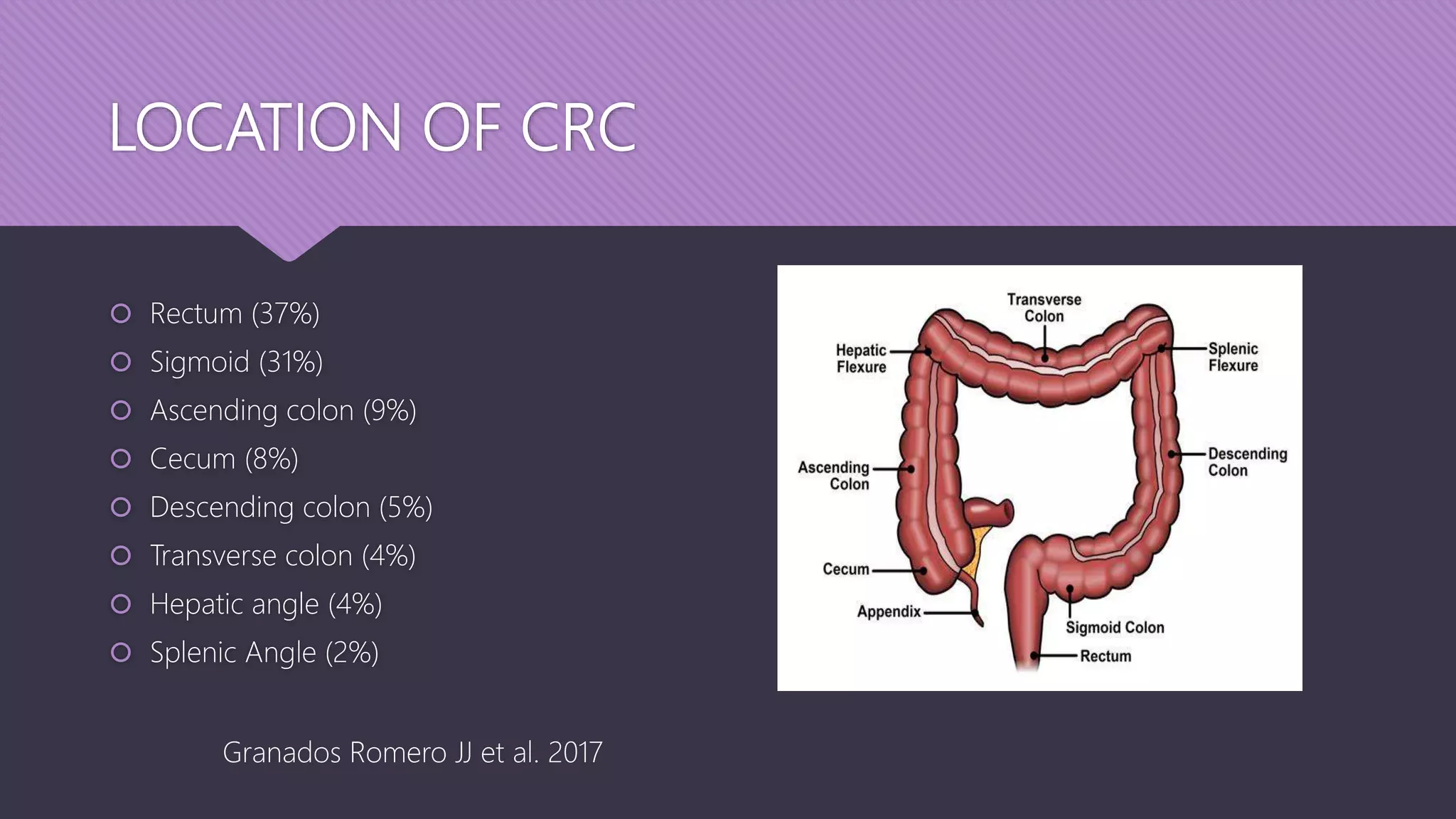
LOCATION OF CRC
 Rectum (37%)
 Sigmoid (31%)
 Ascending colon (9%)
 Cecum (8%)
 Descending colon (5%)
 Transverse colon (4%)
 Hepatic angle (4%)
 Splenic Angle (2%)
Granados Romero JJ et al. 2017
SYMPTOM OF CRC
 Bleeding from the rectum
 Blood in the stool or in the toilet after having a bowel movement
 Dark or black stools
 A change in the shape of the stool (e.g., more narrow than usual)
 Cramping or discomfort in the lower abdomen
 An urge to have a bowel movement when the bowel is empty
 Constipation or diarrhea that lasts for few days
 Decreased appetite
 Unintentional weight loss
 Anemia from blood loss causes weakness and fatique
Hamza, Aglan, Ahmed,2017
DIAGNOSIS OF CRC (Granados Romero JJ et al. 2017)
Cont
Cont
STAGING OF CRC (Venook,2019; Hamza,Aglan ,Ahmed,2017)
STAGING
OF CRC
(AJCC,2010)
TREATMENT OF CRC (Granados Romero JJ et al. 2017)
 Stage 0 cancer can be treated by removing cancer cells by colonoscopy.
 Stage I, II and III Cancer, it is necessary to perform surgery using radical colectomy of the segment involved with margins > 5
cm, lymphadenectomy to the root of the nutrient vessel (minimum 12N), suspicious ganglion biopsy outside the resection
field It has been demonstrated that the laparoscopic approach is as safe as the traditional open approach for colorectal
cancer.
 Stage III: also treatment with radiotherapy combination with chemotherapy
 Chemotherapy (Fluorouracil and Leucovorin)  complementary chemotherapy for Stage III after surgery for 6-8 months for
improving symptom and prolong survival
 The 5 - Fluoracil continues to be the cytostatic mostly used in the treatment of colon cancer, those who make use of it or at
least approach the fulfilment of the therapeutic standard, achieve better percentages of survival.
 Anti angiogenesis therapy: Bevacizumab (lowering vascular endothelial growth factor (VEGF). Anti angiogenesis +
chemotherapy is better than chemotherapy only  improve global survival
 Stage IV with metastatic : various therapy approaches (ablation, chemotherapy, radiotherapy, cryotherapy or surgery)
Colonoscopy
SURGERY OF CRC
TOP TEN REPORT OF CRC PATIENTS
 Worry, anxiety or fear
 Information needs
 Fatigue
 Constipation or diarrhea
 Making plans
 Pain
 Sleep problems
 Tingling in hands and feet
 Work or education
 Other medical condition
NHS,2015
NURSING DIAGNOSIS
 Anxiety
 Deficient knowledge
 Fatigue
 Constipation
 Diarrhea
 Pain
 Disturbed Sleep Pattern
 Fear
NOC
Diagnosis NOC
Anxiety • Anxiety control
• Coping
Deficient knowledge • Diseases Process
• Health behavior
Fatigue • Energy conservation
• Nutritional status: energy
Constipation Bowel elimination
Diarrhea Bowel elimination
Pain • Pain Level
• Pain Control
Disturbed Sleep Pattern • Sleep
• Rest
Fear Fear control
NIC
Diagnosis NIC
Anxiety • Anxiety reduction
Deficient knowledge • Teaching: diseases process
• Teaching: individual
Fatigue • Energy management
Constipation Constipation/Impaction Management
Diarrhea Diarrhea management
Pain • Pain management
• Analgesic administration
Disturbed Sleep Pattern • Sleep enhancement
Fear Coping enhancement
 Arnold M, Sierra MS, Laversanne M, et al. Gut 2017;66:683–691 dalam https://gut.bmj.com/content/gutjnl/66/4/683.full.pdf
 Hamza AH,Aglan AH,Ahmed HH.2017. dalam http://www.avidscience.com/wp-content/uploads/2017/04/RAC0C-15-06.pdf
 Granados Romero JJ et al. 2017. Int J Res Med Sci. Nov 5(11):4667-4676 dalam https://www.researchgate.net/publication/320676335_Colorectal_cancer_a_review
 Rossi, M.,Anwar MJ.,Usman A.,et al. 2017 dalam https://pdfs.semanticscholar.org/a1ae/a03533995169bf2dc3ac66db6ffb6108bcdf.pdf
 Liang,P. 2009. Int. J. Cancer: 124, 2406–2415 dalam
https://www.researchgate.net/publication/23786425_Cigarette_smoking_and_colorectal_cancer_incidence_and_mortality_Systematic_review_and_meta-analysis
 Dulai,PS.,Sunborn,WJ.,Gupta,S.2016 dalam http://cancerpreventionresearch.aacrjournals.org/content/9/12/887
 Venook,AP.2019 dalam https://www.medscape.org/viewarticle/501381
 Nguyen,HT.,Duong,HQ.2018 dalam https://www.spandidos-publications.com/ol/16/1/9
 NHS.2015 dalam https://www.england.nhs.uk/wp-content/uploads/2015/03/colorectal-cancer-proms-report-140314.pdf

Colorectal cancer/ Kanker Kolorektal

  • 1.
  • 2.
  • 3.
  • 4.
    COLORECTAL CANCER  Colorectalcancer (CRC) is a major cause of morbidity and mortality throughout the world. It accounts for over 9% of all cancer incidence.  CRC is the third most common cancer worldwide and the fourth most common cause of death  In 2012, highest CRC incidence in both female and male are in Japan (Miyagi Prefecture: ♀ 37,2/100.000 and ♂ 62,4/100.000) Arnold M, Sierra MS, Laversanne M, et al. Gut 2017;66:683–691
  • 5.
    COLORECTAL CANCER RISKFACTOR NON MODIFIABLE (20%)  Age  Personal History of Adenomatous Polyps  Personal History of Inflammatory Bowel Disease  Family History of Colorectal Cancer or Adenomatous Polyps  Inherited Genetic Risk MODIFIABLE (80%)  A diet low in fibre, vegetables, and folate and high in fat, red meat  Heavy alcohol consumption  A sedentary occupation  Cigarette smoking Hamza, Aglan, Ahmed,2017; Granados Romero JJ et al. 2017
  • 6.
    Cont  Age: increasesprogressively from age 40, rising sharply after 50.  Personal History of Adenomatous Polyps : tubular or villous adenomas (life time risk for adenomas is 19% and 95% CRC develops from these adenomas) Villous Adenoma Tubular AdenomaHamza, Aglan, Ahmed,2017; Granados Romero JJ et al. 2017
  • 7.
    Cont  Personal Historyof Inflammatory Bowel Disease :Ulcerative colitis and Crohn disease usually described as inflammatory bowel disease (IBD) . The relative risk of CRC in patients with inflammatory bowel disease has been estimated between 4- to 20-fold  Family History of Colorectal Cancer or Adenomatous Polyps :People with a history of CRC or adenomatous polyps in one or more first-degree relatives are at increased risk. CRC develop 100% in FAP untreated by age 45 Ulcerative colitis Familial Adenomatous Polyps (FAP) Hamza, Aglan, Ahmed,2017
  • 8.
    Cont  Inherited GeneticRisk  Approximately 5 to 10% of colorectal cancers are a consequence of recognized hereditary conditions. The most common inherited conditions are FAP and HNPCC, also called Lynch syndrome  HNPCC is associated with mutations in genes involved in the DNA repair pathway  FAP is caused by mutations in the tumor suppressor gene APC  The lifetime risk of CRC in people with the recognized HNPCC-related mutations may be as high as 70 to 80%, and the average age at diagnosis in their mid-40s Hamza, Aglan, Ahmed,2017
  • 9.
     A dietlow in fibre, vegetables, and folate and high in fat, red meat Hamza, Aglan, Ahmed,2017
  • 10.
    Cont  Alcohol comsumption Rossi,M.,Anwar MJ.,Usman A.,et al. 2017
  • 11.
    Cont  A sedentaryoccupation Hamza, Aglan, Ahmed,2017
  • 12.
  • 13.
    Pathophysiology of CRC(Nguyen, Duong, 2018)
  • 14.
    LOCATION OF CRC Rectum (37%)  Sigmoid (31%)  Ascending colon (9%)  Cecum (8%)  Descending colon (5%)  Transverse colon (4%)  Hepatic angle (4%)  Splenic Angle (2%) Granados Romero JJ et al. 2017
  • 15.
    SYMPTOM OF CRC Bleeding from the rectum  Blood in the stool or in the toilet after having a bowel movement  Dark or black stools  A change in the shape of the stool (e.g., more narrow than usual)  Cramping or discomfort in the lower abdomen  An urge to have a bowel movement when the bowel is empty  Constipation or diarrhea that lasts for few days  Decreased appetite  Unintentional weight loss  Anemia from blood loss causes weakness and fatique Hamza, Aglan, Ahmed,2017
  • 16.
    DIAGNOSIS OF CRC(Granados Romero JJ et al. 2017)
  • 17.
  • 18.
  • 19.
    STAGING OF CRC(Venook,2019; Hamza,Aglan ,Ahmed,2017)
  • 20.
  • 21.
    TREATMENT OF CRC(Granados Romero JJ et al. 2017)  Stage 0 cancer can be treated by removing cancer cells by colonoscopy.  Stage I, II and III Cancer, it is necessary to perform surgery using radical colectomy of the segment involved with margins > 5 cm, lymphadenectomy to the root of the nutrient vessel (minimum 12N), suspicious ganglion biopsy outside the resection field It has been demonstrated that the laparoscopic approach is as safe as the traditional open approach for colorectal cancer.  Stage III: also treatment with radiotherapy combination with chemotherapy  Chemotherapy (Fluorouracil and Leucovorin)  complementary chemotherapy for Stage III after surgery for 6-8 months for improving symptom and prolong survival  The 5 - Fluoracil continues to be the cytostatic mostly used in the treatment of colon cancer, those who make use of it or at least approach the fulfilment of the therapeutic standard, achieve better percentages of survival.  Anti angiogenesis therapy: Bevacizumab (lowering vascular endothelial growth factor (VEGF). Anti angiogenesis + chemotherapy is better than chemotherapy only  improve global survival  Stage IV with metastatic : various therapy approaches (ablation, chemotherapy, radiotherapy, cryotherapy or surgery)
  • 22.
  • 23.
  • 24.
    TOP TEN REPORTOF CRC PATIENTS  Worry, anxiety or fear  Information needs  Fatigue  Constipation or diarrhea  Making plans  Pain  Sleep problems  Tingling in hands and feet  Work or education  Other medical condition NHS,2015
  • 25.
    NURSING DIAGNOSIS  Anxiety Deficient knowledge  Fatigue  Constipation  Diarrhea  Pain  Disturbed Sleep Pattern  Fear
  • 26.
    NOC Diagnosis NOC Anxiety •Anxiety control • Coping Deficient knowledge • Diseases Process • Health behavior Fatigue • Energy conservation • Nutritional status: energy Constipation Bowel elimination Diarrhea Bowel elimination Pain • Pain Level • Pain Control Disturbed Sleep Pattern • Sleep • Rest Fear Fear control
  • 27.
    NIC Diagnosis NIC Anxiety •Anxiety reduction Deficient knowledge • Teaching: diseases process • Teaching: individual Fatigue • Energy management Constipation Constipation/Impaction Management Diarrhea Diarrhea management Pain • Pain management • Analgesic administration Disturbed Sleep Pattern • Sleep enhancement Fear Coping enhancement
  • 28.
     Arnold M,Sierra MS, Laversanne M, et al. Gut 2017;66:683–691 dalam https://gut.bmj.com/content/gutjnl/66/4/683.full.pdf  Hamza AH,Aglan AH,Ahmed HH.2017. dalam http://www.avidscience.com/wp-content/uploads/2017/04/RAC0C-15-06.pdf  Granados Romero JJ et al. 2017. Int J Res Med Sci. Nov 5(11):4667-4676 dalam https://www.researchgate.net/publication/320676335_Colorectal_cancer_a_review  Rossi, M.,Anwar MJ.,Usman A.,et al. 2017 dalam https://pdfs.semanticscholar.org/a1ae/a03533995169bf2dc3ac66db6ffb6108bcdf.pdf  Liang,P. 2009. Int. J. Cancer: 124, 2406–2415 dalam https://www.researchgate.net/publication/23786425_Cigarette_smoking_and_colorectal_cancer_incidence_and_mortality_Systematic_review_and_meta-analysis  Dulai,PS.,Sunborn,WJ.,Gupta,S.2016 dalam http://cancerpreventionresearch.aacrjournals.org/content/9/12/887  Venook,AP.2019 dalam https://www.medscape.org/viewarticle/501381  Nguyen,HT.,Duong,HQ.2018 dalam https://www.spandidos-publications.com/ol/16/1/9  NHS.2015 dalam https://www.england.nhs.uk/wp-content/uploads/2015/03/colorectal-cancer-proms-report-140314.pdf

Editor's Notes

  • #14 Figure 1. - Colorectal adenoma-carcinoma sequence. The APC mutation is the first step transforming normal colorectal epithelium to adenoma. The adenoma-carcinoma sequence is caused by three major pathways: CIN, MSI and CIMP. CIN, Chromosomal instability; MSI, microsatellite instability; CIMP, CpG island methylator phenotype; APC, adenomatous polyposis; KRAS, KRAS proto-oncogene GTPase; BRAF, B-Raf proto-oncogene serine/threonine kinase; TP53, tumor protein 53; LOH, loss of heterozygosity; HNPPC, hereditary non-polyposis colorectal cancer; MLH1, mutL homolog 1; MSH2, mutS homolog 2; DCC, DCC netrin 1 receptor; TGFBR, transforming growth factor-β receptor; BAX, BCL2 associated X apoptosis regulator; IGF2R, insulin like growth factor 2 receptor; CDC4, cell division control protein 4