The Roman Republic
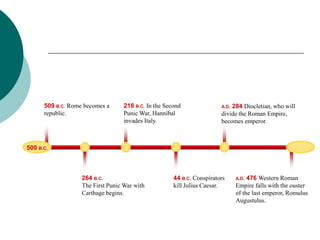
509 B.C. Rome becomes a 
republic. 
218 B.C. In the Second 
Punic War, Hannibal 
invades Italy. 
264 B.C. 
The First Punic War with 
Carthage begins. 
A.D. 284 Diocletian, who will 
divide the Roman Empire, 
becomes emperor. 
44 B.C. Conspirators 
kill Julius Caesar. 
A.D. 476 Western Roman 
Empire falls with the ouster 
of the last emperor, Romulus 
Augustulus. 
500 B.C.
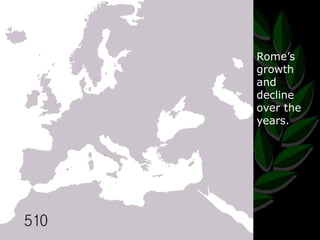
Rome’s 
growth 
and 
decline 
over the 
years.
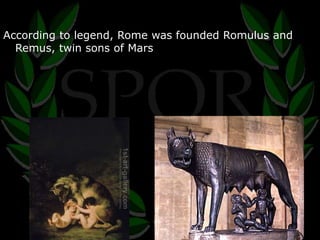
According to legend, Rome was founded Romulus and 
Remus, twin sons of Mars
Ancient Rome-3 Groups 
• Latins-Farmers, Shepherds 
• Settled Latium (on Tiber River) 
• Built original settlement at Rome 
• First “Romans”
Ancient Rome-3 Groups 
• Greeks-Settled southern Italy and Sicily 
• Prosperous in trade and business
Ancient Rome-3 Groups 
• Etruscans-Northern Italy 
• Skilled metalworkers/engineers
Rome, in the beginning, was a monarchy 
• King was the head of the religion and held most of the 
power. Etruscan Kings 
• Romans declared they would never again be ruled by a 
king! 
• Romans establish a new government called a republic 
“res publica”-public affairs. 
• Power rests with the citizens who vote to select 
leaders.
Early Roman Republic 
• Patricians-Wealthy landowners who held most of 
the power. Inherited wealth and social status. 
• Plebeians- Commoners, artisans, and 
merchants who made up the majority of the 
population. They were citizens of Rome who 
could vote. 
• Tribunes-representatives of the Plebeians who 
protected them from power of the Patricians.
So instead of a king, they had two consuls-this was the 
executive branch of the government. 
• Each consul had to consult the other before acting and 
one could veto the other. 
• Were patricians elected to one year terms
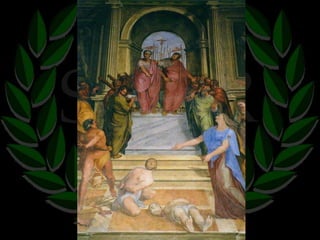
• Supreme commanders of the military 
• Took care of daily affairs and kept other officials in line. 
Also presided over the Senate.
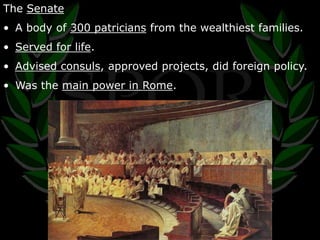
The Senate 
• A body of 300 patricians from the wealthiest families. 
• Served for life. 
• Advised consuls, approved projects, did foreign policy. 
• Was the main power in Rome.
The Twelve Tables 
• The first written Roman law. 
• Made around 450 BC in response to plebians’ 
complaints that the patricians were forming and 
interpreting laws to their own benefit. 
• They were written down on 12 bronze tablets that were 
posted in the Roman forum.
Here’s a sampling from the Twelve Tables: 
• If someone is called to go to court, he is to go. If he 
doesn't go, a witness should be called. Only then 
should he be captured. If he shirks or flees, he should 
be captured. If illness or old age is an impediment, let 
him be given a carriage. If he doesn't want it, it should 
not be covered. 
• An obviously deformed child must be put to death. 
• If a father sells his son into slavery three times, the 
son shall be free of his father. 
• If a person dies intestate without heirs, the nearest 
male kinsman shall inherit. If there is no near male 
kinsmen, his clansmen shall inherit. 
• If one has maimed another and does not buy his 
peace, let there be retaliation in kind.
• Someone who breaks another's bone by hand or club 
must pay 300 sesterces; for a slave, 150; if he has 
done simple harm against another, 25. 
• No dead man may be cremated nor buried in the City. 
• Marriages between plebeians and patricians are 
forbidden. 
• Men in the army may not wed until training is 
complete. 
• Someone who has brought a false claim shall be 
brought before three judges, and shall pay a double 
penalty.
Rome 
• Expands through trade and conquest! 
• Romans defeat Etruscans in the North and 
Greek City-States in the South 
• They now control the Italian Peninsula! 
• 265 B.C.E.
Rome 
• Treatment of conquered territories varied, 
but was lenient: 
• Some given full citizenship 
• All rights except to vote 
• “Allies”-must send troops to Rome and 
could not make treaties with any other 
state.
Rome-Trade 
• Location of Rome essential to trade-merchants 
moved by land and sea 
• Traded Roman wine and olive oil for other 
foods, raw materials, and manufactured 
goods from other lands. 
• Biggest competitor-CARTHAGE!
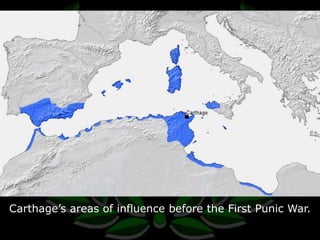
Carthage’s areas of influence before the First Punic War.
The Punic Wars (3 of them) 
• 264 B.C.-1st Punic War for control of Sicily 
(grain growing) and control of western 
Mediterranean Sea. 
• Lasted 23 years 
• Rome-VICTOR!
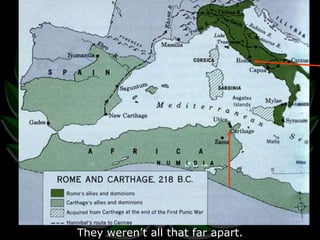
They weren’t all that far apart.
The Punic Wars (3 of them) 
• 218 B.C.-2nd Punic War 
• Hannibal (Carthage)-wanted revenge! 
• 50,000 infantry, 9000 cavalry, and 60 elephants. 
• Went through Spain and France to cross Alps 
and invade Rome. 
• Defeated in 202 B.C. by Scipio Africanus 
(Rome)-attacked Carthage forcing Hannibal to 
return from Italy-VICTOR ROME!
The Punic Wars (3 of them) 
• 149-146 B.C.E.-3rd Punic War 
• Carthage no longer threat, but Romans 
wanted revenge. 
• Siege of Carthage-set afire and its 50,000 
residents sold into slavery-land salted
Results 
• Rome’s victory over Carthage gave it 
control over the western Mediterranean 
• Rome then took over eastern half- 
Macedonia, Greece, and parts of Anatolia. 
• By 70 B.C.E. the empire stretched from 
Anatolia to Spain! 
• #2 on p. 145
Answer the Following 
Questions: 6.1 
• How did geography affect the development 
of Rome? 
• Which were the main groups that competed 
for power in early Rome? 
• What is the significance of the Twelve 
Tables? 
• What were the causes of the 1st Punic War? 
• What was the significance of the Punic 
Wars for Rome?
The Roman Empire brings 
Change! 
• Problems with expansion 
• Gap between rich and poor! 
• 1/3 of the population were slaves 
• Small farmers could not compete with 
large landowners 
• Class tensions lead to collapse of the 
Republic.
Gracchus Brothers 
• Tiberius and Gaius 
• Their mother was the daughter of Scipio 
• Tribunes (Plebians) 
• Proposed reforms to help the poor 
• Both met violent deaths 
• Period of Civil War followed! 
• Rise of politically powerful military leaders- 
Julius Caesar.
Julius Caesar 
• At first, ruled with Crassus and Pompey as 
the first Triumvirate. 
• Caesar-strong leader and military genius-conquered 
all of Gaul-popular with the 
people of Rome. 
• Ordered by Senate to disband his legions 
and return home-he defies Senate and 
leads a civil war against Pompey. 
• Wins-appointed Dictator for Life by Senate
Julius Caesar 
• Rules with Absolute Power-total control 
• Reforms: 
• Citizenship to people in the provinces 
• Expanded the Senate 
• Helped poor by creating jobs through 
construction of new buildings 
• Started colonies so landless could have land 
• Increased pay for soldiers. 
• Caesar assassinated in Senate chamber- 
Brutus and Cassius-many troubled by his 
growing power and feared losing their own 
power!
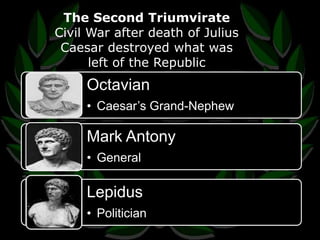
The Second Triumvirate 
Civil War after death of Julius 
Caesar destroyed what was 
left of the Republic 
Octavian 
• Caesar’s Grand-Nephew 
Mark Antony 
• General 
Lepidus 
• Politician
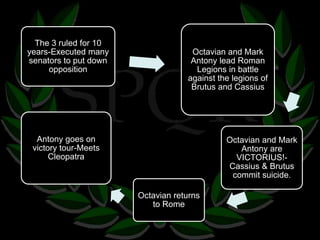
The 3 ruled for 10 
years-Executed many 
senators to put down 
opposition 
Octavian and Mark 
Antony lead Roman 
Legions in battle 
against the legions of 
Brutus and Cassius 
Octavian returns 
to Rome 
Antony goes on 
victory tour-Meets 
Cleopatra 
Octavian and Mark 
Antony are 
VICTORIUS!- 
Cassius & Brutus 
commit suicide.
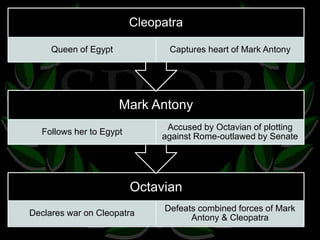
Cleopatra 
Queen of Egypt Captures heart of Mark Antony 
Mark Antony 
Octavian 
Declares war on Cleopatra 
Defeats combined forces of Mark 
Antony & Cleopatra 
Follows her to Egypt 
Accused by Octavian of plotting 
against Rome-outlawed by Senate
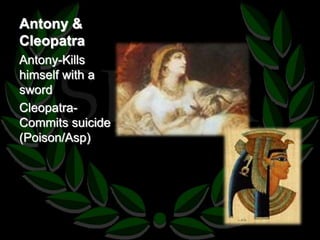
Antony & 
Cleopatra 
Antony-Kills 
himself with a 
sword 
Cleopatra- 
Commits suicide 
(Poison/Asp)
PAX ROMANA 
• Octavian-The unchallenged ruler of Rome 
• Becomes AUGUSTUS-The “exalted one” 
• 27 B.C.E. to 180 C.E. – Peace reigned 
throughout the Empire “Pax Romana” 
• During this time: 
• Empire was 3 million square miles, 
population of 60-80 million, 1 million in 
Rome itself!
p. 150-152 
• Who were the 5 “good” emperors? How did they 
appoint their successors? Who were 3 of the 
“bad” emperors? What was wrong with them? 
• What is the paterfamilias? What could he do? 
• What rights did women have? 
• How were female children named? 
• How was education different for boys and girls? 
• How were government and religion linked? 
• What are “bread and circuses?” Why were they 
necessary? By A.D. 250, how many holidays per 
year were there?

6.1 the roman republic

  • 1.
  • 2.
    509 B.C. Romebecomes a republic. 218 B.C. In the Second Punic War, Hannibal invades Italy. 264 B.C. The First Punic War with Carthage begins. A.D. 284 Diocletian, who will divide the Roman Empire, becomes emperor. 44 B.C. Conspirators kill Julius Caesar. A.D. 476 Western Roman Empire falls with the ouster of the last emperor, Romulus Augustulus. 500 B.C.
  • 6.
    Rome’s growth and decline over the years.
  • 7.
    According to legend,Rome was founded Romulus and Remus, twin sons of Mars
  • 8.
    Ancient Rome-3 Groups • Latins-Farmers, Shepherds • Settled Latium (on Tiber River) • Built original settlement at Rome • First “Romans”
  • 9.
    Ancient Rome-3 Groups • Greeks-Settled southern Italy and Sicily • Prosperous in trade and business
  • 10.
    Ancient Rome-3 Groups • Etruscans-Northern Italy • Skilled metalworkers/engineers
  • 11.
    Rome, in thebeginning, was a monarchy • King was the head of the religion and held most of the power. Etruscan Kings • Romans declared they would never again be ruled by a king! • Romans establish a new government called a republic “res publica”-public affairs. • Power rests with the citizens who vote to select leaders.
  • 12.
    Early Roman Republic • Patricians-Wealthy landowners who held most of the power. Inherited wealth and social status. • Plebeians- Commoners, artisans, and merchants who made up the majority of the population. They were citizens of Rome who could vote. • Tribunes-representatives of the Plebeians who protected them from power of the Patricians.
  • 13.
    So instead ofa king, they had two consuls-this was the executive branch of the government. • Each consul had to consult the other before acting and one could veto the other. • Were patricians elected to one year terms
  • 14.
    • Supreme commandersof the military • Took care of daily affairs and kept other officials in line. Also presided over the Senate.
  • 16.
    The Senate •A body of 300 patricians from the wealthiest families. • Served for life. • Advised consuls, approved projects, did foreign policy. • Was the main power in Rome.
  • 17.
    The Twelve Tables • The first written Roman law. • Made around 450 BC in response to plebians’ complaints that the patricians were forming and interpreting laws to their own benefit. • They were written down on 12 bronze tablets that were posted in the Roman forum.
  • 18.
    Here’s a samplingfrom the Twelve Tables: • If someone is called to go to court, he is to go. If he doesn't go, a witness should be called. Only then should he be captured. If he shirks or flees, he should be captured. If illness or old age is an impediment, let him be given a carriage. If he doesn't want it, it should not be covered. • An obviously deformed child must be put to death. • If a father sells his son into slavery three times, the son shall be free of his father. • If a person dies intestate without heirs, the nearest male kinsman shall inherit. If there is no near male kinsmen, his clansmen shall inherit. • If one has maimed another and does not buy his peace, let there be retaliation in kind.
  • 19.
    • Someone whobreaks another's bone by hand or club must pay 300 sesterces; for a slave, 150; if he has done simple harm against another, 25. • No dead man may be cremated nor buried in the City. • Marriages between plebeians and patricians are forbidden. • Men in the army may not wed until training is complete. • Someone who has brought a false claim shall be brought before three judges, and shall pay a double penalty.
  • 20.
    Rome • Expandsthrough trade and conquest! • Romans defeat Etruscans in the North and Greek City-States in the South • They now control the Italian Peninsula! • 265 B.C.E.
  • 21.
    Rome • Treatmentof conquered territories varied, but was lenient: • Some given full citizenship • All rights except to vote • “Allies”-must send troops to Rome and could not make treaties with any other state.
  • 22.
    Rome-Trade • Locationof Rome essential to trade-merchants moved by land and sea • Traded Roman wine and olive oil for other foods, raw materials, and manufactured goods from other lands. • Biggest competitor-CARTHAGE!
  • 23.
    Carthage’s areas ofinfluence before the First Punic War.
  • 24.
    The Punic Wars(3 of them) • 264 B.C.-1st Punic War for control of Sicily (grain growing) and control of western Mediterranean Sea. • Lasted 23 years • Rome-VICTOR!
  • 25.
    They weren’t allthat far apart.
  • 26.
    The Punic Wars(3 of them) • 218 B.C.-2nd Punic War • Hannibal (Carthage)-wanted revenge! • 50,000 infantry, 9000 cavalry, and 60 elephants. • Went through Spain and France to cross Alps and invade Rome. • Defeated in 202 B.C. by Scipio Africanus (Rome)-attacked Carthage forcing Hannibal to return from Italy-VICTOR ROME!
  • 27.
    The Punic Wars(3 of them) • 149-146 B.C.E.-3rd Punic War • Carthage no longer threat, but Romans wanted revenge. • Siege of Carthage-set afire and its 50,000 residents sold into slavery-land salted
  • 28.
    Results • Rome’svictory over Carthage gave it control over the western Mediterranean • Rome then took over eastern half- Macedonia, Greece, and parts of Anatolia. • By 70 B.C.E. the empire stretched from Anatolia to Spain! • #2 on p. 145
  • 29.
    Answer the Following Questions: 6.1 • How did geography affect the development of Rome? • Which were the main groups that competed for power in early Rome? • What is the significance of the Twelve Tables? • What were the causes of the 1st Punic War? • What was the significance of the Punic Wars for Rome?
  • 30.
    The Roman Empirebrings Change! • Problems with expansion • Gap between rich and poor! • 1/3 of the population were slaves • Small farmers could not compete with large landowners • Class tensions lead to collapse of the Republic.
  • 31.
    Gracchus Brothers •Tiberius and Gaius • Their mother was the daughter of Scipio • Tribunes (Plebians) • Proposed reforms to help the poor • Both met violent deaths • Period of Civil War followed! • Rise of politically powerful military leaders- Julius Caesar.
  • 32.
    Julius Caesar •At first, ruled with Crassus and Pompey as the first Triumvirate. • Caesar-strong leader and military genius-conquered all of Gaul-popular with the people of Rome. • Ordered by Senate to disband his legions and return home-he defies Senate and leads a civil war against Pompey. • Wins-appointed Dictator for Life by Senate
  • 33.
    Julius Caesar •Rules with Absolute Power-total control • Reforms: • Citizenship to people in the provinces • Expanded the Senate • Helped poor by creating jobs through construction of new buildings • Started colonies so landless could have land • Increased pay for soldiers. • Caesar assassinated in Senate chamber- Brutus and Cassius-many troubled by his growing power and feared losing their own power!
  • 34.
    The Second Triumvirate Civil War after death of Julius Caesar destroyed what was left of the Republic Octavian • Caesar’s Grand-Nephew Mark Antony • General Lepidus • Politician
  • 35.
    The 3 ruledfor 10 years-Executed many senators to put down opposition Octavian and Mark Antony lead Roman Legions in battle against the legions of Brutus and Cassius Octavian returns to Rome Antony goes on victory tour-Meets Cleopatra Octavian and Mark Antony are VICTORIUS!- Cassius & Brutus commit suicide.
  • 36.
    Cleopatra Queen ofEgypt Captures heart of Mark Antony Mark Antony Octavian Declares war on Cleopatra Defeats combined forces of Mark Antony & Cleopatra Follows her to Egypt Accused by Octavian of plotting against Rome-outlawed by Senate
  • 37.
    Antony & Cleopatra Antony-Kills himself with a sword Cleopatra- Commits suicide (Poison/Asp)
  • 38.
    PAX ROMANA •Octavian-The unchallenged ruler of Rome • Becomes AUGUSTUS-The “exalted one” • 27 B.C.E. to 180 C.E. – Peace reigned throughout the Empire “Pax Romana” • During this time: • Empire was 3 million square miles, population of 60-80 million, 1 million in Rome itself!
  • 39.
    p. 150-152 •Who were the 5 “good” emperors? How did they appoint their successors? Who were 3 of the “bad” emperors? What was wrong with them? • What is the paterfamilias? What could he do? • What rights did women have? • How were female children named? • How was education different for boys and girls? • How were government and religion linked? • What are “bread and circuses?” Why were they necessary? By A.D. 250, how many holidays per year were there?