Plan for Today:
• Look at the Early Italian Peninsula
• Examine the Rise of Rome
• Roman Expansion
• Punic Wars and the Rivalry with Carthage
• Julius Caesar and the end of the Republic
• The Beginning of the Roman Empire
• Look at Test Data
• Discuss Rubrics for Studying
• Next Time
• Eastern and Western Empires – Rome and Byzantium
• The Development and Spread of Christianity
• Contributions of the Romans
• Developing Civilizations Elsewhere in Europe
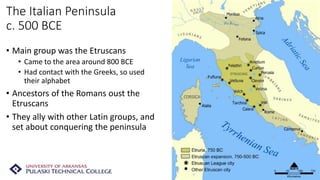
The Italian Peninsula
c. 500 BCE
• Main group was the Etruscans
• Came to the area around 800 BCE
• Had contact with the Greeks, so used
their alphabet
• Ancestors of the Romans oust the
Etruscans
• They ally with other Latin groups, and
set about conquering the peninsula
Early Rome
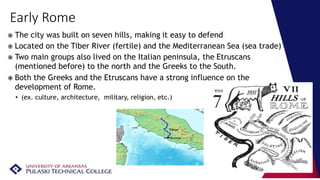
 The city was built on seven hills, making it easy to defend
 Located on the Tiber River (fertile) and the Mediterranean Sea (sea trade)
 Two main groups also lived on the Italian peninsula, the Etruscans
(mentioned before) to the north and the Greeks to the South.
 Both the Greeks and the Etruscans have a strong influence on the
development of Rome.
• (ex. culture, architecture, military, religion, etc.)
The Republic
• After ousting the Etruscan Kings (there is a legend about this) they
form the Republic
• Only free-born, citizens of the city were given the right to vote
• Three groups of people in Rome
• Patricians – land-owning, wealthy class (aristocracy)
• Plebeians – Farmers, merchants, artisan, landless city-dwellers, etc.
• Slaves
• Initially the Patricians exercised the majority of the power, but
eventually the Plebeians get representation in government as well
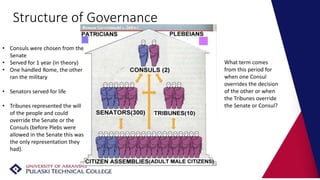
Structure of Governance
What term comes
from this period for
when one Consul
overrides the decision
of the other or when
the Tribunes override
the Senate or Consul?
• Consuls were chosen from the
Senate
• Served for 1 year (in theory)
• One handled Rome, the other
ran the military
• Senators served for life
• Tribunes represented the will
of the people and could
override the Senate or the
Consuls (before Plebs were
allowed in the Senate this was
the only representation they
had).
Dictators
• Dictators were appointed to rule in times of crisis (mainly war)
• Chosen by the Consuls and approved by the Senate
• Were military generals
• Granted absolute power for 6 months, or the duration of the crisis
• The most famous story was of Cincinnatus
• Retired general asked to leave his farm and lead Rome during an invasion
• Asked to be dictator again during the time of an insurrection
• Both times he returned power to the Senate after the danger had passed
• Becomes a legend of honor and integrity – well known to Europeans and even
George Washington (Cincinnati was sort-of named after him)
Roman Military
• Landowning citizens were required to serve in the military
• Common for politicians to serve over 10 years in order to advance
• Units of around 5000 called legions, soldiers called legionaires
• Middle rank officers were called Centurions
• Allowed for the rapid expansion of Roman territory
• Free people in conquered places were often allowed to maintain their
freedom and customs, as long as they subjected themselves to Roman rule
and paid taxes
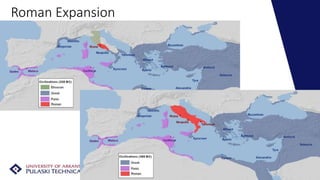
Roman Expansion
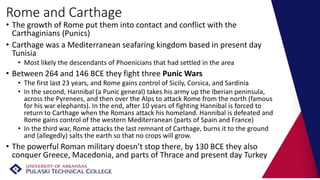
Rome and Carthage
• The growth of Rome put them into contact and conflict with the
Carthaginians (Punics)
• Carthage was a Mediterranean seafaring kingdom based in present day
Tunisia
• Most likely the descendants of Phoenicians that had settled in the area
• Between 264 and 146 BCE they fight three Punic Wars
• The first last 23 years, and Rome gains control of Sicily, Corsica, and Sardinia
• In the second, Hannibal (a Punic general) takes his army up the Iberian peninsula,
across the Pyrenees, and then over the Alps to attack Rome from the north (famous
for his war elephants). In the end, after 10 years of fighting Hannibal is forced to
return to Carthage when the Romans attack his homeland. Hannibal is defeated and
Rome gains control of the western Mediterranean (parts of Spain and France)
• In the third war, Rome attacks the last remnant of Carthage, burns it to the ground
and (allegedly) salts the earth so that no crops will grow.
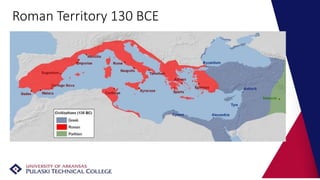
• The powerful Roman military doesn’t stop there, by 130 BCE they also
conquer Greece, Macedonia, and parts of Thrace and present day Turkey
Roman Territory 130 BCE
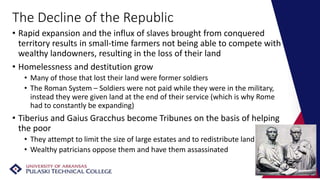
The Decline of the Republic
• Rapid expansion and the influx of slaves brought from conquered
territory results in small-time farmers not being able to compete with
wealthy landowners, resulting in the loss of their land
• Homelessness and destitution grow
• Many of those that lost their land were former soldiers
• The Roman System – Soldiers were not paid while they were in the military,
instead they were given land at the end of their service (which is why Rome
had to constantly be expanding)
• Tiberius and Gaius Gracchus become Tribunes on the basis of helping
the poor
• They attempt to limit the size of large estates and to redistribute land
• Wealthy patricians oppose them and have them assassinated
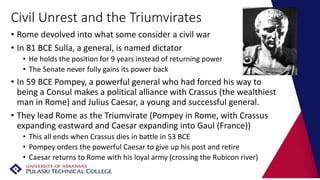
Civil Unrest and the Triumvirates
• Rome devolved into what some consider a civil war
• In 81 BCE Sulla, a general, is named dictator
• He holds the position for 9 years instead of returning power
• The Senate never fully gains its power back
• In 59 BCE Pompey, a powerful general who had forced his way to
being a Consul makes a political alliance with Crassus (the wealthiest
man in Rome) and Julius Caesar, a young and successful general.
• They lead Rome as the Triumvirate (Pompey in Rome, with Crassus
expanding eastward and Caesar expanding into Gaul (France))
• This all ends when Crassus dies in battle in 53 BCE
• Pompey orders the powerful Caesar to give up his post and retire
• Caesar returns to Rome with his loyal army (crossing the Rubicon river)
Julius Caesar
• Pompey flees the city when Caesar’s army enters
• Caesar pursues him to Ptolemaic Egypt
• When he arrives he occupies Alexandria
• Pompey had already been assassinated by the Egyptians and his head was sent to
Caesar
• Here he also meets Cleopatra VII who was in a power struggle with her brother
Ptolemy XIII for the rule of Egypt
• They fall in love and have a child together and return to Rome
• Back in Rome Caesar leads the Senate, which is basically just a formality
• Popular amongst the people, but many Senators thought he had too much power
• Stabbed to death on the Senate floor in 44 BCE
• Sets off another brief Civil War
Second Triumvirate and the (Official)
End of the Republic
• Octavian (grandnephew and chosen heir of Caesar) joins with the General
Mark Antony, and another friend of Caesar, Lepidus to form the Second
Triumvirate
• They end the Civil War and consolidate power until 33 BCE
• Octavian strips Lepidus of power and sends him into exile
• Continues to rule in Rome and the west, Antony rules the east and
becomes more reliant on Cleopatra’s help to pursue his military endeavors
• The two become lovers, and have multiple children together
• This angers Octavian, since Antony was married to his sister, Octavia
• Octavian publicizes Antony’s will in Rome, in which he left his lands to his
children with Cleopatra, Romans had never liked Cleopatra and Octavian
used this as an excuse to send troops to Egypt to remove Antony from
power. The Roman Navy defeats Antony and Cleopatra’s fleet at sea.
Caesar Augustus – First Emperor of Rome
(23 BCE to 14 CE)
• After the defeat of their fleet, Antony and Cleopatra retreat to Egypt
• There, rather than be captured, they commit suicide
• Octavian’s arrival in Egypt essentially adds Ptolemaic Egypt to the
Roman Empire
• He returns to Rome where he essentially has full control of the Senate
• Is named Princeps (first citizen), then takes the title of Caesar
Augustus (Caesar would now be a title, rather than a name)
• The Senate still exists, but they recognize that he has almost complete
power, so they make his position a formal one (which could be
governed by succession, rather than leading to further civil wars in
the event of his death)
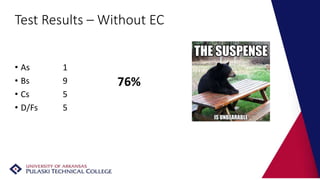
Test Results – Without EC
• As 1
• Bs 9
• Cs 5
• D/Fs 5
76%
Test Results – With EC
• As 8
• Bs 6
• Cs 3
• D/Fs 3
82.5%
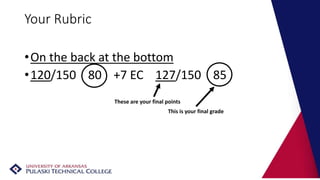
Your Rubric
•On the back at the bottom
•120/150 80 +7 EC 127/150 85
This is your final grade
These are your final points
Using the Rubrics: Short Answers
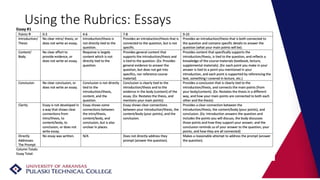
Using the Rubrics: Essays
Wrapping things up
• Nothing to turn in today, since I passed back the test
• For next time - Start Chapter 8
• See you Thursday!

1311 The Roman World

  • 2.
    Plan for Today: •Look at the Early Italian Peninsula • Examine the Rise of Rome • Roman Expansion • Punic Wars and the Rivalry with Carthage • Julius Caesar and the end of the Republic • The Beginning of the Roman Empire • Look at Test Data • Discuss Rubrics for Studying • Next Time • Eastern and Western Empires – Rome and Byzantium • The Development and Spread of Christianity • Contributions of the Romans • Developing Civilizations Elsewhere in Europe
  • 3.
    The Italian Peninsula c.500 BCE • Main group was the Etruscans • Came to the area around 800 BCE • Had contact with the Greeks, so used their alphabet • Ancestors of the Romans oust the Etruscans • They ally with other Latin groups, and set about conquering the peninsula
  • 4.
    Early Rome  Thecity was built on seven hills, making it easy to defend  Located on the Tiber River (fertile) and the Mediterranean Sea (sea trade)  Two main groups also lived on the Italian peninsula, the Etruscans (mentioned before) to the north and the Greeks to the South.  Both the Greeks and the Etruscans have a strong influence on the development of Rome. • (ex. culture, architecture, military, religion, etc.)
  • 5.
    The Republic • Afterousting the Etruscan Kings (there is a legend about this) they form the Republic • Only free-born, citizens of the city were given the right to vote • Three groups of people in Rome • Patricians – land-owning, wealthy class (aristocracy) • Plebeians – Farmers, merchants, artisan, landless city-dwellers, etc. • Slaves • Initially the Patricians exercised the majority of the power, but eventually the Plebeians get representation in government as well
  • 6.
    Structure of Governance Whatterm comes from this period for when one Consul overrides the decision of the other or when the Tribunes override the Senate or Consul? • Consuls were chosen from the Senate • Served for 1 year (in theory) • One handled Rome, the other ran the military • Senators served for life • Tribunes represented the will of the people and could override the Senate or the Consuls (before Plebs were allowed in the Senate this was the only representation they had).
  • 7.
    Dictators • Dictators wereappointed to rule in times of crisis (mainly war) • Chosen by the Consuls and approved by the Senate • Were military generals • Granted absolute power for 6 months, or the duration of the crisis • The most famous story was of Cincinnatus • Retired general asked to leave his farm and lead Rome during an invasion • Asked to be dictator again during the time of an insurrection • Both times he returned power to the Senate after the danger had passed • Becomes a legend of honor and integrity – well known to Europeans and even George Washington (Cincinnati was sort-of named after him)
  • 8.
    Roman Military • Landowningcitizens were required to serve in the military • Common for politicians to serve over 10 years in order to advance • Units of around 5000 called legions, soldiers called legionaires • Middle rank officers were called Centurions • Allowed for the rapid expansion of Roman territory • Free people in conquered places were often allowed to maintain their freedom and customs, as long as they subjected themselves to Roman rule and paid taxes
  • 9.
  • 10.
    Rome and Carthage •The growth of Rome put them into contact and conflict with the Carthaginians (Punics) • Carthage was a Mediterranean seafaring kingdom based in present day Tunisia • Most likely the descendants of Phoenicians that had settled in the area • Between 264 and 146 BCE they fight three Punic Wars • The first last 23 years, and Rome gains control of Sicily, Corsica, and Sardinia • In the second, Hannibal (a Punic general) takes his army up the Iberian peninsula, across the Pyrenees, and then over the Alps to attack Rome from the north (famous for his war elephants). In the end, after 10 years of fighting Hannibal is forced to return to Carthage when the Romans attack his homeland. Hannibal is defeated and Rome gains control of the western Mediterranean (parts of Spain and France) • In the third war, Rome attacks the last remnant of Carthage, burns it to the ground and (allegedly) salts the earth so that no crops will grow. • The powerful Roman military doesn’t stop there, by 130 BCE they also conquer Greece, Macedonia, and parts of Thrace and present day Turkey
  • 11.
  • 12.
    The Decline ofthe Republic • Rapid expansion and the influx of slaves brought from conquered territory results in small-time farmers not being able to compete with wealthy landowners, resulting in the loss of their land • Homelessness and destitution grow • Many of those that lost their land were former soldiers • The Roman System – Soldiers were not paid while they were in the military, instead they were given land at the end of their service (which is why Rome had to constantly be expanding) • Tiberius and Gaius Gracchus become Tribunes on the basis of helping the poor • They attempt to limit the size of large estates and to redistribute land • Wealthy patricians oppose them and have them assassinated
  • 13.
    Civil Unrest andthe Triumvirates • Rome devolved into what some consider a civil war • In 81 BCE Sulla, a general, is named dictator • He holds the position for 9 years instead of returning power • The Senate never fully gains its power back • In 59 BCE Pompey, a powerful general who had forced his way to being a Consul makes a political alliance with Crassus (the wealthiest man in Rome) and Julius Caesar, a young and successful general. • They lead Rome as the Triumvirate (Pompey in Rome, with Crassus expanding eastward and Caesar expanding into Gaul (France)) • This all ends when Crassus dies in battle in 53 BCE • Pompey orders the powerful Caesar to give up his post and retire • Caesar returns to Rome with his loyal army (crossing the Rubicon river)
  • 14.
    Julius Caesar • Pompeyflees the city when Caesar’s army enters • Caesar pursues him to Ptolemaic Egypt • When he arrives he occupies Alexandria • Pompey had already been assassinated by the Egyptians and his head was sent to Caesar • Here he also meets Cleopatra VII who was in a power struggle with her brother Ptolemy XIII for the rule of Egypt • They fall in love and have a child together and return to Rome • Back in Rome Caesar leads the Senate, which is basically just a formality • Popular amongst the people, but many Senators thought he had too much power • Stabbed to death on the Senate floor in 44 BCE • Sets off another brief Civil War
  • 15.
    Second Triumvirate andthe (Official) End of the Republic • Octavian (grandnephew and chosen heir of Caesar) joins with the General Mark Antony, and another friend of Caesar, Lepidus to form the Second Triumvirate • They end the Civil War and consolidate power until 33 BCE • Octavian strips Lepidus of power and sends him into exile • Continues to rule in Rome and the west, Antony rules the east and becomes more reliant on Cleopatra’s help to pursue his military endeavors • The two become lovers, and have multiple children together • This angers Octavian, since Antony was married to his sister, Octavia • Octavian publicizes Antony’s will in Rome, in which he left his lands to his children with Cleopatra, Romans had never liked Cleopatra and Octavian used this as an excuse to send troops to Egypt to remove Antony from power. The Roman Navy defeats Antony and Cleopatra’s fleet at sea.
  • 16.
    Caesar Augustus –First Emperor of Rome (23 BCE to 14 CE) • After the defeat of their fleet, Antony and Cleopatra retreat to Egypt • There, rather than be captured, they commit suicide • Octavian’s arrival in Egypt essentially adds Ptolemaic Egypt to the Roman Empire • He returns to Rome where he essentially has full control of the Senate • Is named Princeps (first citizen), then takes the title of Caesar Augustus (Caesar would now be a title, rather than a name) • The Senate still exists, but they recognize that he has almost complete power, so they make his position a formal one (which could be governed by succession, rather than leading to further civil wars in the event of his death)
  • 17.
    Test Results –Without EC • As 1 • Bs 9 • Cs 5 • D/Fs 5 76%
  • 18.
    Test Results –With EC • As 8 • Bs 6 • Cs 3 • D/Fs 3 82.5%
  • 19.
    Your Rubric •On theback at the bottom •120/150 80 +7 EC 127/150 85 This is your final grade These are your final points
  • 20.
    Using the Rubrics:Short Answers
  • 21.
  • 22.
    Wrapping things up •Nothing to turn in today, since I passed back the test • For next time - Start Chapter 8 • See you Thursday!