In this seminar we discuss about the six stroke
engine. It include Introduction, the types of six stroke
engine than how to work this six stroke, Factors
contributing to increased thermal Efficiency, Reduced
Fuel Consumption and Pollutant Emission Advantages
& Disadvantages of this engine. And last Conclusion
of this seminar: SIX STROKE ENGINE.
 Introduction
 Types of Six stroke Engine
 Working of Six stroke engine
 Advantages & Disadvantages
 Conclusion
 Reference
Nikolaus August Otto first designed what is
known as the Otto engine or simply the 4 stroke internal
combustion engine. Conversion of heat energy liberated
by the combustion of the fuel into mechanical energy
which rotated the crankshaft was the basic principle of
this engine. The 4 stroke engine worked on the principle
of the Otto cycle .The 4 stroke engine comprises of the
intake stroke, compression stroke, power stroke and
finally the exhaust stroke. Fuel was injected in the
intake stroke and power from the fuel was derived in the
3rd stroke.
There are three types of six stroke Engine.
1. Crower six stroke engine.
2. Beare Head Six Stroke engine.
3. Bajulaz six stroke engine.
The details of this three types of six stroke Engine
are given below:-
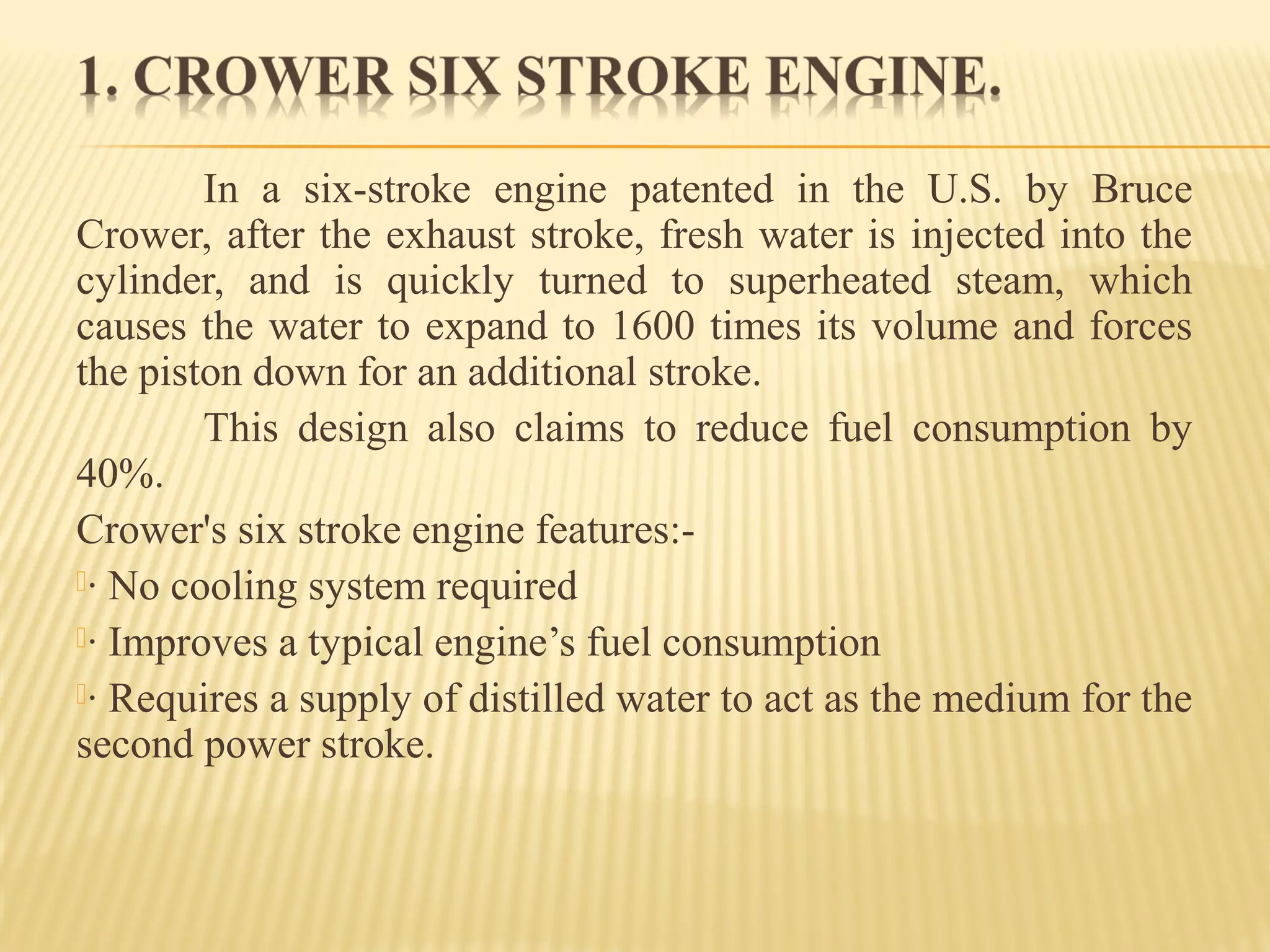
In a six-stroke engine patented in the U.S. by Bruce
Crower, after the exhaust stroke, fresh water is injected into the
cylinder, and is quickly turned to superheated steam, which
causes the water to expand to 1600 times its volume and forces
the piston down for an additional stroke.
This design also claims to reduce fuel consumption by
40%.
Crower's six stroke engine features:-
· No cooling system required
· Improves a typical engine’s fuel consumption
· Requires a supply of distilled water to act as the medium for the
second power stroke.
This engine simply replaces the
conventional Four Stroke Engines
Cylinder Head. The manufacturers Four
Stroke bottom end remains unchanged
The net result is:
Power/torque increases of 35%.
Simpler and less expensive
manufacturing and tooling
Reduction of cylinder head reciprocating
parts
Lower maintenance costs due to less
wearing parts
The Bajulaz six stroke engine is similar
to a regular combustion engine in
design. This Engine was invented in
1989 by the Bajulaz S A .
Bajulaz six stroke engine features:-
Reduction in fuel consumption by at
least 40%
Two expansions (work) in six strokes
Dramatic reduction in pollution
Liquefied Petroleum Gas
Costs comparable to those of a four-
stroke engine combustion engine in
design.
1) Intake valve
2) Heating chamber valve
3) Combustion chamber valve
4) Exhaust valve
5) Cylinder
6) Combustion chamber
7) Air heating chamber
8) Wall of combustion chamber
9) Fuel injector
10) Heating plug
11) Piston
12) Crankshaft
The inlet valve(1) is kept
open. Due to cranking,
the piston moves
downward which results
in the formation of a
pressure difference due
to which pure air enters
the cylinder (5). The
crankshaft completes
rotates for half cycle.
The inlet valve
closes and the heating
chamber valve opens. The
piston moves upwards due
to cranking forcing the
pure air into heating
chamber. The air at this
stage is converted to high
pressure.
The combustion chamber valve opens and the gases of
combustion enter the cylinder.
The exhaust valve
opens. The piston moves
upwards and the exhaust
gases are removed via this
valve. The crankshaft rotates
another half cycle. At this
stage the crankshaft
completes 2 full cycles.
The heating chamber
valve opens and the pure air
now at high pressure and
high temperature enters the
cylinder as shown in the
figure which does work on
the piston and hence it
moves downwards resulting
in the 2nd power stroke. The
crankshaft completes
another half cycle.
Finally the
combustion chamber
valve opens the
piston moves
upwards forcing the
pure air into the
combustion chamber.
The crankshaft will
complete 3 full cycles
at the end of the 6th
stroke.
• Two expansions (work) in six strokes:
• Multifuel:
• Dramatic reduction in pollution:
• Liquefied Petroleum Gas:
• Cost comparable to those of a four-stroke engine:
 Drastically reducing fuel consumption and pollution without
radically affecting performances would allow the current
concept of the automobile to be reassessed.
 There is, at this day, no wonder solution for the replacement of
the internal combustion engine. Only improvements of the
current technology can help it progress within reasonable time
and financial limits.
 Fuel consumption for mid-sized engines should be within 4
and 5 litres per 100km. and 3 to 4 litres for the small-sized
engines.
 Automobiles equipped with the six-stroke engine could appear
in the market within 3 to 5 years.
 www.google.com
 www.scribd.com
 www.wikipedia.com

6 stroke petrol engine

  • 2.
    In this seminarwe discuss about the six stroke engine. It include Introduction, the types of six stroke engine than how to work this six stroke, Factors contributing to increased thermal Efficiency, Reduced Fuel Consumption and Pollutant Emission Advantages & Disadvantages of this engine. And last Conclusion of this seminar: SIX STROKE ENGINE.
  • 3.
     Introduction  Typesof Six stroke Engine  Working of Six stroke engine  Advantages & Disadvantages  Conclusion  Reference
  • 4.
    Nikolaus August Ottofirst designed what is known as the Otto engine or simply the 4 stroke internal combustion engine. Conversion of heat energy liberated by the combustion of the fuel into mechanical energy which rotated the crankshaft was the basic principle of this engine. The 4 stroke engine worked on the principle of the Otto cycle .The 4 stroke engine comprises of the intake stroke, compression stroke, power stroke and finally the exhaust stroke. Fuel was injected in the intake stroke and power from the fuel was derived in the 3rd stroke.
  • 5.
    There are threetypes of six stroke Engine. 1. Crower six stroke engine. 2. Beare Head Six Stroke engine. 3. Bajulaz six stroke engine. The details of this three types of six stroke Engine are given below:-
  • 6.
    In a six-strokeengine patented in the U.S. by Bruce Crower, after the exhaust stroke, fresh water is injected into the cylinder, and is quickly turned to superheated steam, which causes the water to expand to 1600 times its volume and forces the piston down for an additional stroke. This design also claims to reduce fuel consumption by 40%. Crower's six stroke engine features:- · No cooling system required · Improves a typical engine’s fuel consumption · Requires a supply of distilled water to act as the medium for the second power stroke.
  • 7.
    This engine simplyreplaces the conventional Four Stroke Engines Cylinder Head. The manufacturers Four Stroke bottom end remains unchanged The net result is: Power/torque increases of 35%. Simpler and less expensive manufacturing and tooling Reduction of cylinder head reciprocating parts Lower maintenance costs due to less wearing parts
  • 8.
    The Bajulaz sixstroke engine is similar to a regular combustion engine in design. This Engine was invented in 1989 by the Bajulaz S A . Bajulaz six stroke engine features:- Reduction in fuel consumption by at least 40% Two expansions (work) in six strokes Dramatic reduction in pollution Liquefied Petroleum Gas Costs comparable to those of a four- stroke engine combustion engine in design.
  • 9.
    1) Intake valve 2)Heating chamber valve 3) Combustion chamber valve 4) Exhaust valve 5) Cylinder 6) Combustion chamber 7) Air heating chamber 8) Wall of combustion chamber 9) Fuel injector 10) Heating plug 11) Piston 12) Crankshaft
  • 10.
    The inlet valve(1)is kept open. Due to cranking, the piston moves downward which results in the formation of a pressure difference due to which pure air enters the cylinder (5). The crankshaft completes rotates for half cycle.
  • 11.
    The inlet valve closesand the heating chamber valve opens. The piston moves upwards due to cranking forcing the pure air into heating chamber. The air at this stage is converted to high pressure.
  • 12.
    The combustion chambervalve opens and the gases of combustion enter the cylinder.
  • 13.
    The exhaust valve opens.The piston moves upwards and the exhaust gases are removed via this valve. The crankshaft rotates another half cycle. At this stage the crankshaft completes 2 full cycles.
  • 14.
    The heating chamber valveopens and the pure air now at high pressure and high temperature enters the cylinder as shown in the figure which does work on the piston and hence it moves downwards resulting in the 2nd power stroke. The crankshaft completes another half cycle.
  • 15.
    Finally the combustion chamber valveopens the piston moves upwards forcing the pure air into the combustion chamber. The crankshaft will complete 3 full cycles at the end of the 6th stroke.
  • 16.
    • Two expansions(work) in six strokes: • Multifuel: • Dramatic reduction in pollution: • Liquefied Petroleum Gas: • Cost comparable to those of a four-stroke engine:
  • 17.
     Drastically reducingfuel consumption and pollution without radically affecting performances would allow the current concept of the automobile to be reassessed.  There is, at this day, no wonder solution for the replacement of the internal combustion engine. Only improvements of the current technology can help it progress within reasonable time and financial limits.  Fuel consumption for mid-sized engines should be within 4 and 5 litres per 100km. and 3 to 4 litres for the small-sized engines.  Automobiles equipped with the six-stroke engine could appear in the market within 3 to 5 years.
  • 18.