Topic: Six Stroke Engine
Introduction
• Six Stroke Engine is similar to 4 stroke engine but differentiates
itself entirely due to its thermodynamic cycle.
• Six Stroke Engine have 2 power stroke - one by fuel, one by
steam/air
• Few notable six stroke engine Design in this class are:
1. The Velozeta six stroke engine Built by the College of Engineering at Trivendrum in India.
2. The Crower stroke engine, invented by bruce Crower of the U.S.A.
3. The Bajulaz engine by the Bajulaz S A Company of Switzerland.
DISADVANTAGE OF FOUR STROKE
ENGINE
There are many losses in the internal combustion engine as
below:
1. Time loss (6%) : Time req. for mixing of air-fuel & complete
Combustion, as it depends on flame Velocity,
A/F ratio & Shape of Combustion Chamber.
2. Blow Down loss (2%) : Drop in pressure due to early opening
of exhaust valves which results in Loss
of Work o/p in Expansion stroke.
3. High Fuel Consumption
4. Heat loss (12%)
APPROACHES IN SIX STROKE ENGINE
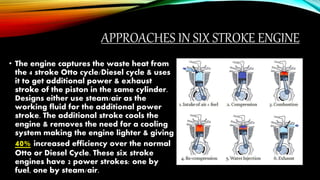
• The engine captures the waste heat from
the 4 stroke Otto cycle/Diesel cycle & uses
it to get additional power & exhaust
stroke of the piston in the same cylinder.
Designs either use steam/air as the
working fluid for the additional power
stroke. The additional stroke cools the
engine & removes the need for a cooling
system making the engine lighter & giving
40% increased efficiency over the normal
Otto or Diesel Cycle. These six stroke
engines have 2 power strokes: one by
fuel, one by steam/air.
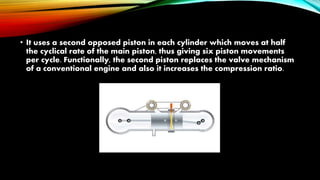
• It uses a second opposed piston in each cylinder which moves at half
the cyclical rate of the main piston, thus giving six piston movements
per cycle. Functionally, the second piston replaces the valve mechanism
of a conventional engine and also it increases the compression ratio.
WORKING OF SIX STROKE ENGINE
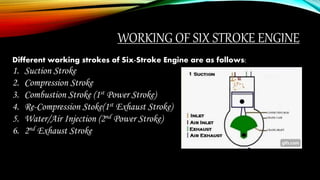
Different working strokes of Six-Stroke Engine are as follows:
1. Suction Stroke
2. Compression Stroke
3. Combustion Stroke (1st Power Stroke)
4. Re-Compression Stoke(1st Exhaust Stroke)
5. Water/Air Injection (2nd Power Stroke)
6. 2nd Exhaust Stroke
• 1st STROKE ( SUCTION STROKE )
The Inlet valves opens and air- fuel mixture from carburetor is sucked into the cylinder through the
inlet valve and piston moves from TDC to BDC.
• 2nd STROKE ( COMPRESSION STROKE )
Piston moves from BDC to TDC. Both the inlet valve and exhaust valves are closed & the air- fuel
mixture is compressed.
• 3rd STROKE ( FIRST POWER STROKE )
Power is obtained from the engine by igniting the compressed air- fuel mixture using a spark plug.
Both valves remain closed. Piston moves from TDC to BDC.
• 4th STROKE ( EXHAUST STROKE )
The exhaust valve opens to remove the burned gases from the engine cylinder. Piston moves from
BDC to TDC.
• 5th STROKE ( SECOND POWER STROKE )
The exhaust valves remains close and the water Inlet valves open. Fresh water from the water Inlet
valves enters the cylinders through the secondary water Induction system. Piston moves from TDC to
BDC.
• 6th STROKE ( SECOND EXHAUST STROKE )
The water exhaust valves remain open. The water sucked into the cylinder during the fifth stroke is
removed to the atmosphere through the water exhaust valve. Piston moves from BDC to TDC and
six stroke is completed.
MODIFICATION IN SIX STROKE ENGINE
• Crankshaft to Camshaft Ratio Modification
4-stroke engine, gear at crankshaft rotate 720◦ for 360◦ Camshaft to complete a cycle 6-
stroke engine, gear at the Crankshaft must rotate 1080◦ to rotate camshaft 360◦ &
complete cycle Their gear ratio is 3:1.
• Camshaft Modification
6-stroke engine 360◦ of cam is divided into 60◦. Exhaust cam has 2 lobes for to 2 exhaust
stroke (4th stroke & 6th stroke to push out steam).
• Cam follower modification
Bottom shape of regular follower has flat pattern, which is suitable with normal
camshaft for 4-stroke engine When reducing duration of valve opening from 9000 to only
6000 shape of follower must be changed from flat to roller/spherical shape.
ADVANTAGES OF THE SIX STROKE
ENGINE
1. Thermal efficiency reaching 50% (30% for the actual Internal combustion
engine).
2. Fuel consumption reduced by more than 40%.
3. Power/torque increases of about 35%. Torque is much more even.
4. Reduction of chemical, noise and thermal pollution up to 65%.
5. Two expansion (work) through six stroke.
6. Better scavenging in fifth stroke
7. Lower engine temperature - easy to maintain the optimum engine
temperature level for better performance
DISADVANTAGES OF SIX STROKE ENGINE
1. High Initial cost Due to change in gear structure.
2. High Manufacturing cost in six stroke engine.
3. Engine size Increases Due to additional stroke in engine, fifth stroke
and sixth stroke.
4. Complex head design.
5. Complex cam design for exhaust (due to 2 exhaust strokes).
6. Thermodynamically the engine is stable, yet the designing of parts
becomes more and more complex as the torque requirement increases
CONCLUSION
Only improvements of the current technology can help it
progress within reasonable time and financial limits. The six
stroke engine fits perfectly into this view. Its adoption by the
automobile industry would have a tremendous impact on the
environment and world economy, assuming up to 40%
reduction in fuel consumption and 60% to 90% in polluting
emissions, depending on the type of the fuel being used. It is
commercially obvious that the big market it for automobile,
heavy goods, construction site and farm vehicle. This is a
priority for the six stroke engine, reducing fuel consumption
and pollution without any effect on performance will
reassessed the concept of the automobile.
Six Stroke Engine

Six Stroke Engine

  • 1.
  • 2.
    Introduction • Six StrokeEngine is similar to 4 stroke engine but differentiates itself entirely due to its thermodynamic cycle. • Six Stroke Engine have 2 power stroke - one by fuel, one by steam/air • Few notable six stroke engine Design in this class are: 1. The Velozeta six stroke engine Built by the College of Engineering at Trivendrum in India. 2. The Crower stroke engine, invented by bruce Crower of the U.S.A. 3. The Bajulaz engine by the Bajulaz S A Company of Switzerland.
  • 3.
    DISADVANTAGE OF FOURSTROKE ENGINE There are many losses in the internal combustion engine as below: 1. Time loss (6%) : Time req. for mixing of air-fuel & complete Combustion, as it depends on flame Velocity, A/F ratio & Shape of Combustion Chamber. 2. Blow Down loss (2%) : Drop in pressure due to early opening of exhaust valves which results in Loss of Work o/p in Expansion stroke. 3. High Fuel Consumption 4. Heat loss (12%)
  • 4.
    APPROACHES IN SIXSTROKE ENGINE • The engine captures the waste heat from the 4 stroke Otto cycle/Diesel cycle & uses it to get additional power & exhaust stroke of the piston in the same cylinder. Designs either use steam/air as the working fluid for the additional power stroke. The additional stroke cools the engine & removes the need for a cooling system making the engine lighter & giving 40% increased efficiency over the normal Otto or Diesel Cycle. These six stroke engines have 2 power strokes: one by fuel, one by steam/air.
  • 5.
    • It usesa second opposed piston in each cylinder which moves at half the cyclical rate of the main piston, thus giving six piston movements per cycle. Functionally, the second piston replaces the valve mechanism of a conventional engine and also it increases the compression ratio.
  • 6.
    WORKING OF SIXSTROKE ENGINE Different working strokes of Six-Stroke Engine are as follows: 1. Suction Stroke 2. Compression Stroke 3. Combustion Stroke (1st Power Stroke) 4. Re-Compression Stoke(1st Exhaust Stroke) 5. Water/Air Injection (2nd Power Stroke) 6. 2nd Exhaust Stroke
  • 7.
    • 1st STROKE( SUCTION STROKE ) The Inlet valves opens and air- fuel mixture from carburetor is sucked into the cylinder through the inlet valve and piston moves from TDC to BDC. • 2nd STROKE ( COMPRESSION STROKE ) Piston moves from BDC to TDC. Both the inlet valve and exhaust valves are closed & the air- fuel mixture is compressed. • 3rd STROKE ( FIRST POWER STROKE ) Power is obtained from the engine by igniting the compressed air- fuel mixture using a spark plug. Both valves remain closed. Piston moves from TDC to BDC. • 4th STROKE ( EXHAUST STROKE ) The exhaust valve opens to remove the burned gases from the engine cylinder. Piston moves from BDC to TDC. • 5th STROKE ( SECOND POWER STROKE ) The exhaust valves remains close and the water Inlet valves open. Fresh water from the water Inlet valves enters the cylinders through the secondary water Induction system. Piston moves from TDC to BDC. • 6th STROKE ( SECOND EXHAUST STROKE ) The water exhaust valves remain open. The water sucked into the cylinder during the fifth stroke is removed to the atmosphere through the water exhaust valve. Piston moves from BDC to TDC and six stroke is completed.
  • 8.
    MODIFICATION IN SIXSTROKE ENGINE • Crankshaft to Camshaft Ratio Modification 4-stroke engine, gear at crankshaft rotate 720◦ for 360◦ Camshaft to complete a cycle 6- stroke engine, gear at the Crankshaft must rotate 1080◦ to rotate camshaft 360◦ & complete cycle Their gear ratio is 3:1. • Camshaft Modification 6-stroke engine 360◦ of cam is divided into 60◦. Exhaust cam has 2 lobes for to 2 exhaust stroke (4th stroke & 6th stroke to push out steam). • Cam follower modification Bottom shape of regular follower has flat pattern, which is suitable with normal camshaft for 4-stroke engine When reducing duration of valve opening from 9000 to only 6000 shape of follower must be changed from flat to roller/spherical shape.
  • 9.
    ADVANTAGES OF THESIX STROKE ENGINE 1. Thermal efficiency reaching 50% (30% for the actual Internal combustion engine). 2. Fuel consumption reduced by more than 40%. 3. Power/torque increases of about 35%. Torque is much more even. 4. Reduction of chemical, noise and thermal pollution up to 65%. 5. Two expansion (work) through six stroke. 6. Better scavenging in fifth stroke 7. Lower engine temperature - easy to maintain the optimum engine temperature level for better performance
  • 10.
    DISADVANTAGES OF SIXSTROKE ENGINE 1. High Initial cost Due to change in gear structure. 2. High Manufacturing cost in six stroke engine. 3. Engine size Increases Due to additional stroke in engine, fifth stroke and sixth stroke. 4. Complex head design. 5. Complex cam design for exhaust (due to 2 exhaust strokes). 6. Thermodynamically the engine is stable, yet the designing of parts becomes more and more complex as the torque requirement increases
  • 11.
    CONCLUSION Only improvements ofthe current technology can help it progress within reasonable time and financial limits. The six stroke engine fits perfectly into this view. Its adoption by the automobile industry would have a tremendous impact on the environment and world economy, assuming up to 40% reduction in fuel consumption and 60% to 90% in polluting emissions, depending on the type of the fuel being used. It is commercially obvious that the big market it for automobile, heavy goods, construction site and farm vehicle. This is a priority for the six stroke engine, reducing fuel consumption and pollution without any effect on performance will reassessed the concept of the automobile.