
TECHNICAL PRESENTATION & SEMINAR
ON
WORKING PRINCIPLE OF 6 STROKE ENGINE
Presented By :-
NEERAJ NAGARKOTI
(19-32-09/11)
1
CONTENTS
• INTRODUCTION
• HISTORY OF 6 STROKE ENGINE
• WORKING PRINCIPLE
• DISCUSSION ON THEORY
• APPLICATIONS
• ADVANTAGES
• DISADVANTAGES
• CONCLUSION
2
INTRODUCTION
Its concept was developed in 1880s.However the rapid
research commenced only after 1990s.
The six stroke engine which having the same or more power
with higher fuel efficiency than the existing engine has
started before many years. As a result of all these researches
a new engine concept is formed, which is a six stroke engine.
Lot of research works are conducting on this topic now a
days and already six stroke engines were discovered
3
History of Six Stroke Engine
The term six stroke engine describes two different
approaches in the internal combustion engine, developed
since the 1990s, to improve its efficiency and reduce
emissions,
First approach
There is two additional strokes by the main piston as fifth
and sixth stroke.
Second approach
It uses a second opposed piston which moves at half the
cyclical rate of the main piston.
4
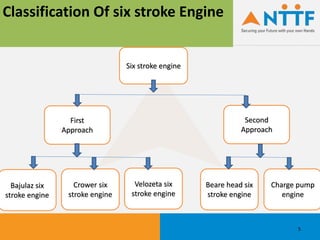
Classification Of six stroke Engine
5
Six stroke engine
Bajulaz six
stroke engine
Crower six
stroke engine
Charge pump
engine
Beare head six
stroke engine
Velozeta six
stroke engine
Second
Approach
First
Approach
FIRST APPROACH
SINGLE PISTON DESIGN
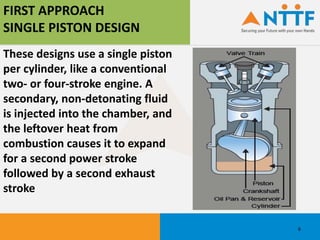
These designs use a single piston
per cylinder, like a conventional
two- or four-stroke engine. A
secondary, non-detonating fluid
is injected into the chamber, and
the leftover heat from
combustion causes it to expand
for a second power stroke
followed by a second exhaust
stroke
6
The Bajulaz Six Stroke Engine
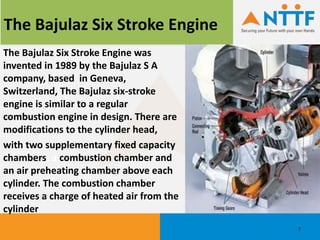
The Bajulaz Six Stroke Engine was
invented in 1989 by the Bajulaz S A
company, based in Geneva,
Switzerland, The Bajulaz six-stroke
engine is similar to a regular
combustion engine in design. There are
modifications to the cylinder head,
with two supplementary fixed capacity
chambers: a combustion chamber and
an air preheating chamber above each
cylinder. The combustion chamber
receives a charge of heated air from the
cylinder
7
This engine is invented by Bruce
crower of California in USA in the
year 2004.
Bruce Crower is actually a race car
mechanic with his own workshop. In
a six-stroke engine prototyped in
the United States by Bruce Crower,
water is injected into the cylinder
after the exhaust stroke and is
instantly turned
to steam, which expands and forces
the piston down for an additional
power stroke.
Crower six stroke engine
8
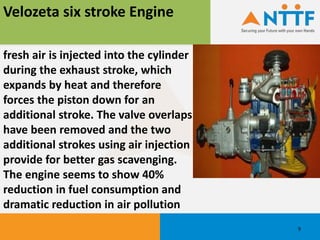
fresh air is injected into the cylinder
during the exhaust stroke, which
expands by heat and therefore
forces the piston down for an
additional stroke. The valve overlaps
have been removed and the two
additional strokes using air injection
provide for better gas scavenging.
The engine seems to show 40%
reduction in fuel consumption and
dramatic reduction in air pollution
Velozeta six stroke Engine
9
Second Approach
Opposed Piston Designs
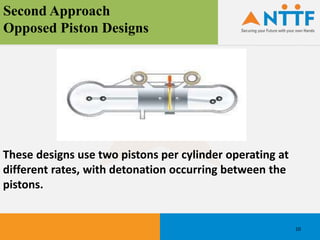
These designs use two pistons per cylinder operating at
different rates, with detonation occurring between the
pistons.
10
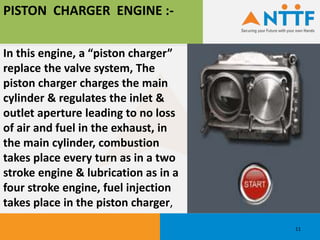
PISTON CHARGER ENGINE :-
In this engine, a “piston charger”
replace the valve system, The
piston charger charges the main
cylinder & regulates the inlet &
outlet aperture leading to no loss
of air and fuel in the exhaust, in
the main cylinder, combustion
takes place every turn as in a two
stroke engine & lubrication as in a
four stroke engine, fuel injection
takes place in the piston charger,
11
WORKING PRINCIPLE
A six stroke engine describes a number of different
approaches in the internal combustion engine to capture the
waste heat from the four stroke Otto cycle and use it to
power an additional power and exhaust stroke of the piston.
Designs either use steam or air as the working fluid for the
additional power stroke. As well as extracting power, the
additional stroke cools the engine and removes the need for
a cooling system making the engine lighter and giving 40%
increased efficiency over the Otto Cycle.
12
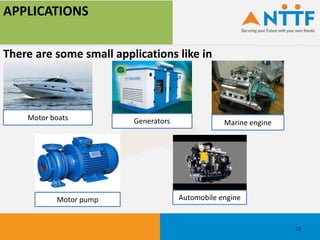
APPLICATIONS
There are some small applications like in
13
Motor boats
Marine engineGenerators
Automobile engineMotor pump
ADVANTAGES AND DISADVANTAGES
ADVANTAGES
Increased torque and
power output
Better fuel economy
Longer service intervals
Higher compression ratio
High torque at low rpm
14
Expensive
Complex structure
Heavier engine
Increase vehicle cost
CONCLUSION
Six stroke engines are the technology for the future
in vehicles. From the above given data it is clear that
six stroke engines are better compared to two stroke
and four stroke engines. The project is well patented
and is undergoing heavy research works. Six stroke
engines with all the desired qualities of a two stroke
and four stroke engines will be hitting the market
soon.
15

SIx stroke engine

  • 1.
    TECHNICAL PRESENTATION &SEMINAR ON WORKING PRINCIPLE OF 6 STROKE ENGINE Presented By :- NEERAJ NAGARKOTI (19-32-09/11) 1
  • 2.
    CONTENTS • INTRODUCTION • HISTORYOF 6 STROKE ENGINE • WORKING PRINCIPLE • DISCUSSION ON THEORY • APPLICATIONS • ADVANTAGES • DISADVANTAGES • CONCLUSION 2
  • 3.
    INTRODUCTION Its concept wasdeveloped in 1880s.However the rapid research commenced only after 1990s. The six stroke engine which having the same or more power with higher fuel efficiency than the existing engine has started before many years. As a result of all these researches a new engine concept is formed, which is a six stroke engine. Lot of research works are conducting on this topic now a days and already six stroke engines were discovered 3
  • 4.
    History of SixStroke Engine The term six stroke engine describes two different approaches in the internal combustion engine, developed since the 1990s, to improve its efficiency and reduce emissions, First approach There is two additional strokes by the main piston as fifth and sixth stroke. Second approach It uses a second opposed piston which moves at half the cyclical rate of the main piston. 4
  • 5.
    Classification Of sixstroke Engine 5 Six stroke engine Bajulaz six stroke engine Crower six stroke engine Charge pump engine Beare head six stroke engine Velozeta six stroke engine Second Approach First Approach
  • 6.
    FIRST APPROACH SINGLE PISTONDESIGN These designs use a single piston per cylinder, like a conventional two- or four-stroke engine. A secondary, non-detonating fluid is injected into the chamber, and the leftover heat from combustion causes it to expand for a second power stroke followed by a second exhaust stroke 6
  • 7.
    The Bajulaz SixStroke Engine The Bajulaz Six Stroke Engine was invented in 1989 by the Bajulaz S A company, based in Geneva, Switzerland, The Bajulaz six-stroke engine is similar to a regular combustion engine in design. There are modifications to the cylinder head, with two supplementary fixed capacity chambers: a combustion chamber and an air preheating chamber above each cylinder. The combustion chamber receives a charge of heated air from the cylinder 7
  • 8.
    This engine isinvented by Bruce crower of California in USA in the year 2004. Bruce Crower is actually a race car mechanic with his own workshop. In a six-stroke engine prototyped in the United States by Bruce Crower, water is injected into the cylinder after the exhaust stroke and is instantly turned to steam, which expands and forces the piston down for an additional power stroke. Crower six stroke engine 8
  • 9.
    fresh air isinjected into the cylinder during the exhaust stroke, which expands by heat and therefore forces the piston down for an additional stroke. The valve overlaps have been removed and the two additional strokes using air injection provide for better gas scavenging. The engine seems to show 40% reduction in fuel consumption and dramatic reduction in air pollution Velozeta six stroke Engine 9
  • 10.
    Second Approach Opposed PistonDesigns These designs use two pistons per cylinder operating at different rates, with detonation occurring between the pistons. 10
  • 11.
    PISTON CHARGER ENGINE:- In this engine, a “piston charger” replace the valve system, The piston charger charges the main cylinder & regulates the inlet & outlet aperture leading to no loss of air and fuel in the exhaust, in the main cylinder, combustion takes place every turn as in a two stroke engine & lubrication as in a four stroke engine, fuel injection takes place in the piston charger, 11
  • 12.
    WORKING PRINCIPLE A sixstroke engine describes a number of different approaches in the internal combustion engine to capture the waste heat from the four stroke Otto cycle and use it to power an additional power and exhaust stroke of the piston. Designs either use steam or air as the working fluid for the additional power stroke. As well as extracting power, the additional stroke cools the engine and removes the need for a cooling system making the engine lighter and giving 40% increased efficiency over the Otto Cycle. 12
  • 13.
    APPLICATIONS There are somesmall applications like in 13 Motor boats Marine engineGenerators Automobile engineMotor pump
  • 14.
    ADVANTAGES AND DISADVANTAGES ADVANTAGES Increasedtorque and power output Better fuel economy Longer service intervals Higher compression ratio High torque at low rpm 14 Expensive Complex structure Heavier engine Increase vehicle cost
  • 15.
    CONCLUSION Six stroke enginesare the technology for the future in vehicles. From the above given data it is clear that six stroke engines are better compared to two stroke and four stroke engines. The project is well patented and is undergoing heavy research works. Six stroke engines with all the desired qualities of a two stroke and four stroke engines will be hitting the market soon. 15