ELETSON CRPORATION  Familiarization and Induction Course
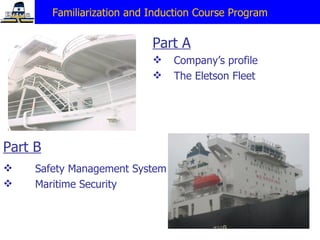
Part A Company’s profile The Eletson Fleet Familiarization and Induction Course Program Safety Management System Maritime Security Part B
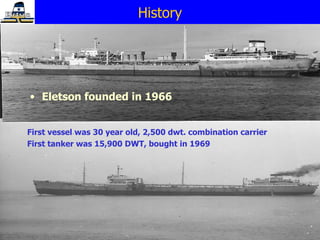
Eletson founded in 1966  History First vessel was 30 year old, 2,500 dwt. combination carrier First tanker was 15,900 DWT, bought in 1969
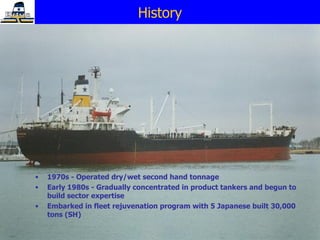
1970s - Operated dry/wet second hand tonnage Early 1980s - Gradually concentrated in product tankers and begun to build sector expertise Embarked in fleet rejuvenation program with 5 Japanese built 30,000 tons (SH) History
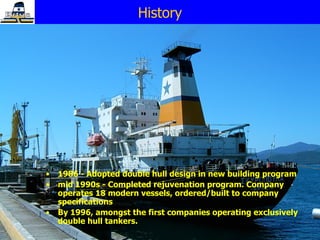
1986 - Adopted double hull design in new building program  mid 1990s - Completed rejuvenation program. Company operates 18 modern vessels, ordered/built to company specifications By 1996, amongst the first companies operating exclusively double hull tankers. History
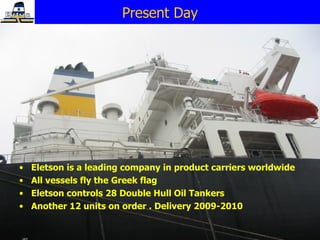
Eletson is a leading company in product carriers worldwide  All vessels fly the Greek flag  Eletson controls 28 Double Hull Oil Tankers Another 12 units on order . Delivery 2009-2010 Present Day
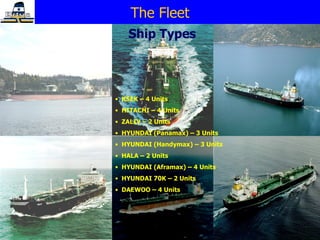
The Fleet Ship Types KSEK – 4 Units HITACHI – 4 Units ZALIV – 2 Units HYUNDAI (Panamax) – 3 Units HYUNDAI (Handymax) – 3 Units HALA – 2 Units HYUNDAI (Aframax) – 4 Units HYUNDAI 70K – 2 Units DAEWOO – 4 Units
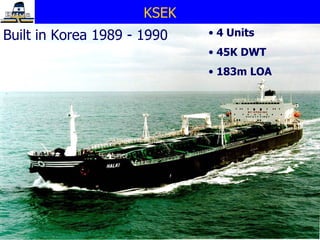
KSEK Built in Korea 1989 - 1990 4 Units 45K DWT 183m LOA
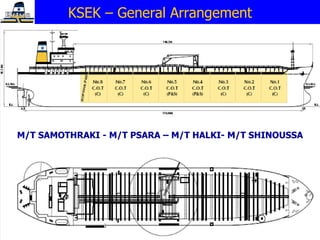
M/T SAMOTHRAKI - M/T PSARA – M/T HALKI- M/T SHINOUSSA KSEK – General Arrangement
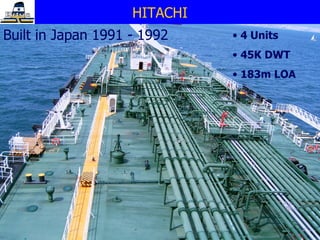
HITACHI Built in Japan 1991 - 1992 4 Units 45K DWT 183m LOA
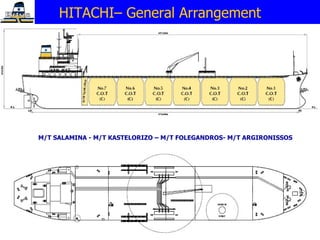
M/T SALAMINA - M/T KASTELORIZO – M/T FOLEGANDROS- M/T ARGIRONISSOS HITACHI– General Arrangement
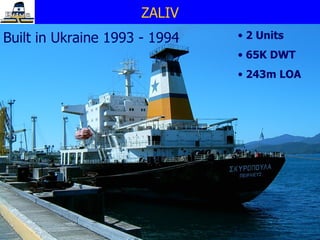
ZALIV Built in Ukraine 1993 - 1994 2 Units 65K DWT 243m LOA
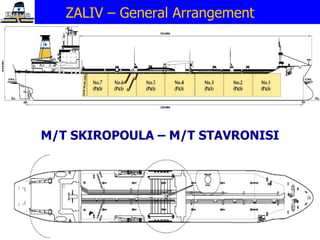
M/T SKIROPOULA – M/T STAVRONISI ZALIV – General Arrangement
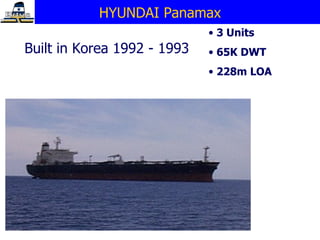
HYUNDAI Panamax Built in Korea 1992 - 1993 3 Units 65K DWT 228m LOA
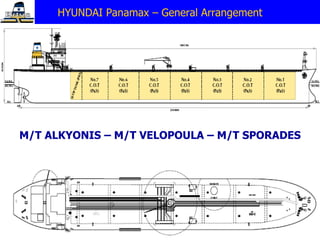
M/T ALKYONIS – M/T VELOPOULA – M/T SPORADES HYUNDAI Panamax – General Arrangement
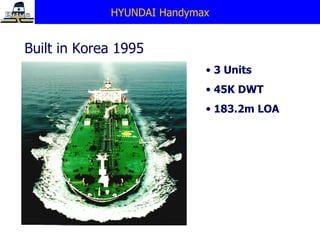
HYUNDAI Handymax Built in Korea 1995 3 Units 45K DWT 183.2m LOA
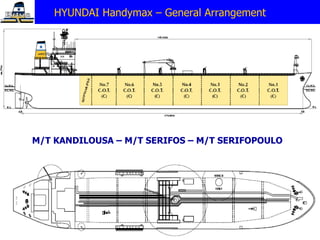
M/T KANDILOUSA – M/T SERIFOS – M/T SERIFOPOULO HYUNDAI Handymax – General Arrangement
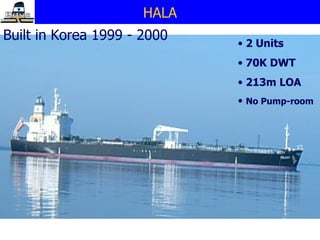
HALA Built in Korea 1999 - 2000 2 Units 70K DWT 213m LOA No Pump-room
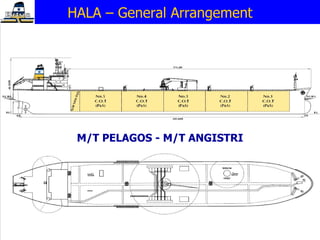
M/T PELAGOS - M/T ANGISTRI HALA – General Arrangement
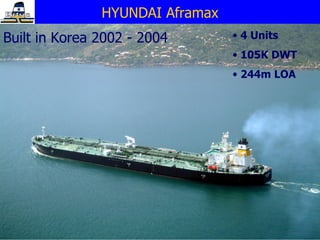
HYUNDAI Aframax Built in Korea 2002 - 2004 4 Units 105K DWT 244m LOA
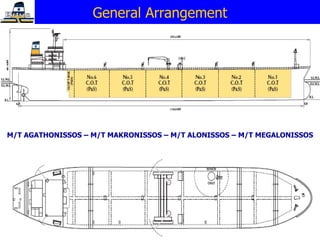
M/T AGATHONISSOS – M/T MAKRONISSOS – M/T ALONISSOS – M/T MEGALONISSOS General Arrangement
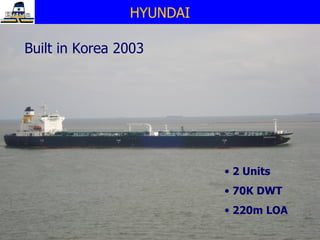
HYUNDAI Built in Korea 2003 2 Units 70K DWT 220m LOA
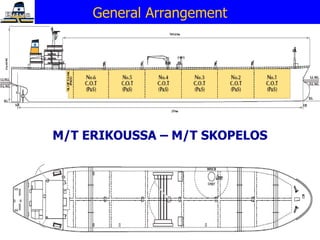
M/T ERIKOUSSA – M/T SKOPELOS General Arrangement
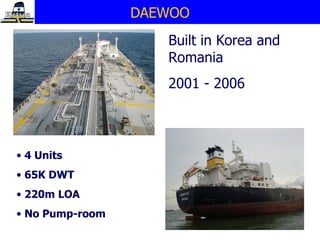
DAEWOO Built in Korea and Romania 2001 - 2006 4 Units 65K DWT 220m LOA No Pump-room
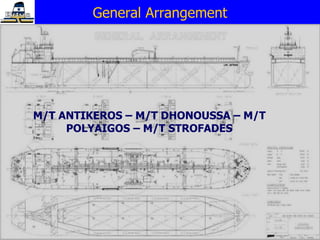
M/T ANTIKEROS – M/T DHONOUSSA – M/T POLYAIGOS – M/T STROFADES General Arrangement
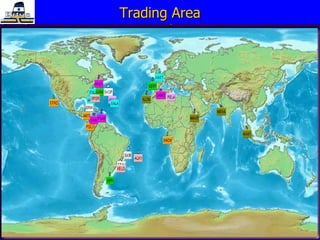
Trading Area
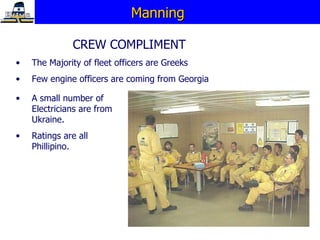
Manning  CREW COMPLIMENT The Majority of fleet officers are Greeks Few engine officers are coming from Georgia A small number of Electricians are from Ukraine. Ratings are all Phillipino.
Part B
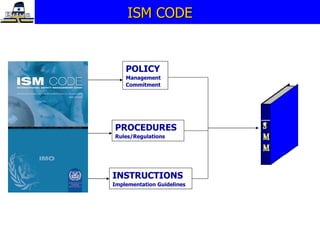
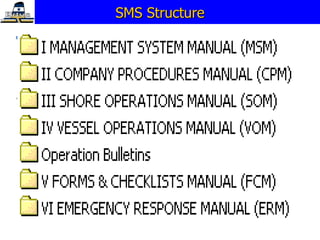
ISM CODE POLICY Management  Commitment PROCEDURES Rules/Regulations INSTRUCTIONS Implementation Guidelines
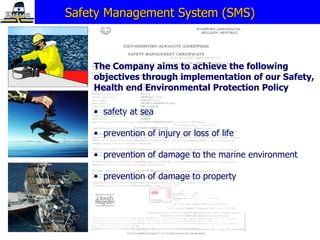
Safety Management System (SMS) The Company aims to achieve the following objectives through implementation of our Safety, Health en d  Environmental Protection Policy safety at sea prevention of injury or loss of life prevention of damage to the marine   environment prevention of damage to property
SMS Structure
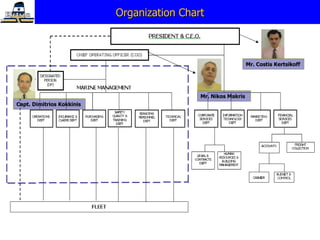
Organization Chart Capt. Dimitrios Kokkinis Mr. Nikos Makris Mr. Costis Kertsikoff
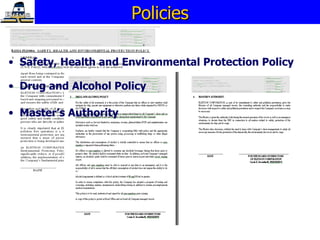
Policies Safety, Health and Environmental Protection Policy Drug and Alcohol Policy Master’s Authority
Safety, Health and Environment Protection Policy  …  The safety and health of all seagoing personnel servicing on board Company’s managed vessels, as well as protection of the environment, is one of our Company’s main concerns and considerations. It is, therefore, ensured that our activities are governed by the need to protect the environment and maintain good  safety and health conditions at work for all our employees,  contracted personnel and any other persons who are directly or indirectly linked with our operations and workplace.
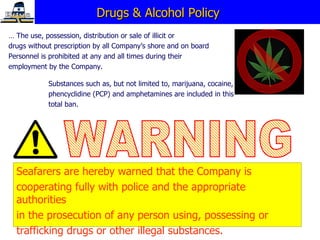
Drugs & Alcohol Policy  …  The use, possession, distribution or sale of illicit or  drugs without prescription by all Company’s shore and on board  Personnel is prohibited at any and all times during their  employment by the Company. Seafarers are hereby warned that the Company is  cooperating fully with police and the appropriate authorities  in the prosecution of any person using, possessing or  trafficking drugs or other illegal substances. Substances such as, but not limited to, marijuana, cocaine,  phencyclidine (PCP) and amphetamines are included in this  total ban. WARNING
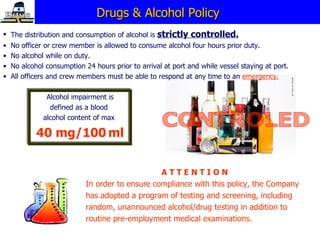
Drugs & Alcohol Policy  The distribution and consumption of alcohol is  strictly controlled. No officer or crew member is allowed to consume alcohol four hours prior duty.  No alcohol while on duty.  No alcohol consumption 24 hours prior to arrival at port and while vessel staying at port. All officers and crew members must be able to respond at any time to an  emergency. A T T E N T I O N   In order to ensure compliance with this policy, the Company has adopted a program of testing and screening, including random, unannounced alcohol/drug testing in addition to routine pre-employment medical examinations. Alcohol impairment is defined as a blood  alcohol content of max  40 mg/100   ml CONTROLED
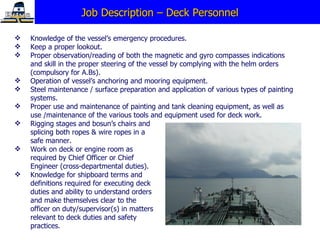
Job Description – Deck Personnel Knowledge of the vessel’s emergency procedures. Keep a proper lookout. Proper observation/reading of both the magnetic and gyro compasses indications and skill in the proper steering of the vessel by complying with the helm orders (compulsory for A.Bs). Operation of vessel’s anchoring and mooring equipment. Steel maintenance / surface preparation and application of various types of painting systems. Proper use and maintenance of painting and tank cleaning equipment, as well as use /maintenance of the various tools and equipment used for deck work. Rigging stages and bosun’s chairs and splicing both ropes & wire ropes in a safe manner. Work on deck or engine room as required by Chief Officer or Chief Engineer (cross-departmental duties).   Knowledge for shipboard terms and definitions required for executing deck duties and ability to understand orders and make themselves clear to the officer on duty/supervisor(s) in matters relevant to deck duties and safety practices.
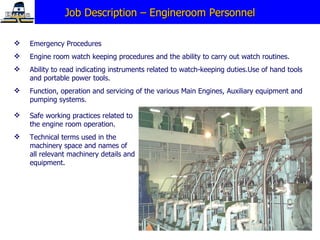
Job Description – Engineroom Personnel Emergency Procedures Engine room watch keeping procedures and the ability to carry out watch routines.  Ability to read indicating instruments related to watch-keeping duties.Use of hand tools and portable power   tools. Function, operation and servicing of the various Main Engines, Auxiliary equipment and pumping systems. Safe working practices related to the engine room operation. Technical terms used in the machinery space and names of all relevant machinery details and equipment.
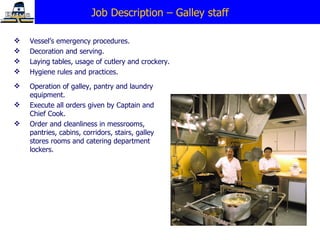
Job Description – Galley staff Vessel’s emergency procedures. Decoration and serving. Laying tables, usage of cutlery and crockery. Hygiene rules and practices. Operation of galley, pantry and laundry equipment. E xecute all orders given by Captain and Chief Cook. Order and cleanliness in messrooms, pantries, cabins, corridors, stairs, galley stores rooms and catering department lockers.
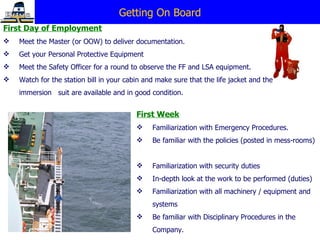
Getting On Board First Day of Employment Meet the Master (or OOW) to deliver documentation. Get your Personal Protective Equipment Meet the Safety Officer for a round to observe the FF and LSA equipment. Watch for the station bill in your cabin and make sure that the life jacket and the immersion  suit are available and in good condition. First Week Familiarization with Emergency Procedures. Be familiar with the policies (posted in mess-rooms)  Familiarization with security duties In-depth look at the work to be performed (duties) Familiarization with all machinery / equipment and systems Be familiar with Disciplinary Procedures in the Company.
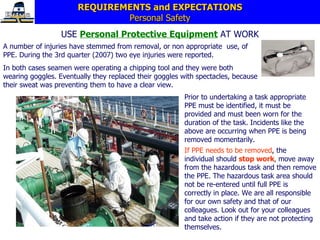
REQUIREMENTS and EXPECTATIONS Personal Safety USE  Personal Protective Equipment   AT WORK A  number of injuries have stemmed from   removal ,   or non appropriate  use,  of PPE.  During the 3rd quarter (2007) two eye injuries were reported. In both cases seamen were operating a chipping tool and they were both wearing goggles. Eventually they replaced their goggles with spectacles, because their sweat was preventing them to have a clear view. If PPE needs to be removed ,  the individual should   s top   work ,   move away from the hazardous task and then   remove the PPE.   The hazardous task area should not be re-entered until full PPE is   correctly in place.   We are all responsible for our   own safety and that of our colleagues .   L ook out   for your   colleagues and take action if they are not protecting themselves. Prior to undertaking a task appropriate PPE must be identified, it must be provided and   must been worn   for the duration of the   task.   Incidents  like the above  are occurring when PPE is being removed momentarily.
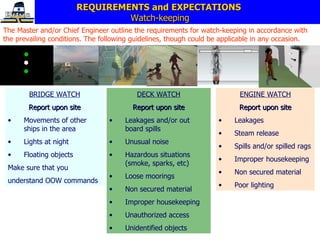
REQUIREMENTS and EXPECTATIONS  Watch-keeping The Master and/or Chief Engineer outline the requirements for watch-keeping in accordance with the prevailing conditions. The following guidelines, though could be applicable in any occasion.  BRIDGE WATCH Report upon site Movements of other ships in the area Lights at night Floating objects Make sure that you understand OOW commands DECK WATCH Report upon site Leakages and/or out board spills Unusual noise Hazardous situations (smoke, sparks, etc) Loose moorings Non secured material Improper housekeeping Unauthorized access Unidentified objects ENGINE WATCH Report upon site Leakages Steam release Spills and/or spilled rags Improper housekeeping Non secured material Poor lighting
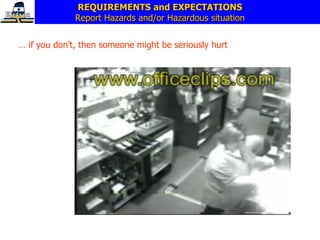
REQUIREMENTS and EXPECTATIONS Report Hazards and/or Hazardous situation …  if you don’t, then someone might be seriously hurt
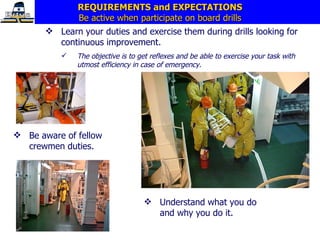
REQUIREMENTS and EXPECTATIONS Be active when participate on board drills Learn your duties and exercise them during drills looking for continuous improvement. The objective is to get reflexes and be able to exercise your task with utmost efficiency in case of emergency. Be aware of fellow crewmen duties. Understand what you do and why you do it.
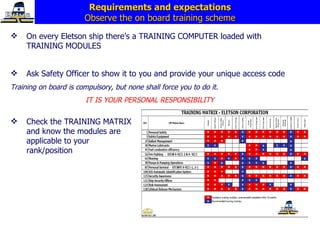
Requirements and expectations Observe the on board training scheme On every Eletson ship there’s a TRAINING COMPUTER loaded with TRAINING MODULES  Ask Safety Officer to show it to you and provide your unique access code Training on board is compulsory, but none shall force you to do it.  IT IS YOUR PERSONAL RESPONSIBILITY   Check the TRAINING MATRIX and know the modules are applicable to your rank/position
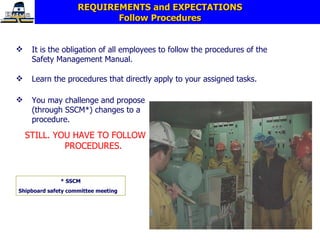
REQUIREMENTS and EXPECTATIONS Follow Procedures It is the obligation of all employees to follow the procedures of the Safety Management Manual. Learn the procedures that directly apply to your assigned tasks.  You may challenge and propose (through SSCM*) changes to a procedure. STILL. YOU HAVE TO FOLLOW PROCEDURES. * SSCM Shipboard safety committee meeting
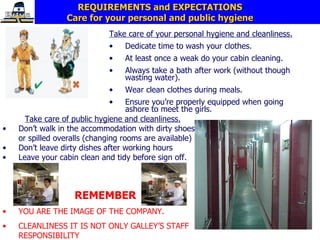
REQUIREMENTS and EXPECTATIONS Care for your personal and public hygiene Take care of your personal hygiene and cleanliness. Dedicate time to wash your clothes. At least once a weak do your cabin cleaning. Always take a bath after work (without though wasting water). Wear clean clothes during meals. Ensure you’re properly equipped when going ashore to meet the girls. Take care of public hygiene and cleanliness. Don’t walk in the accommodation with dirty shoes or spilled overalls (changing rooms are available) Don’t leave dirty dishes after working hours Leave your cabin clean and tidy before sign off.  REMEMBER YOU ARE THE IMAGE OF THE COMPANY. CLEANLINESS IT IS NOT ONLY GALLEY’S STAFF RESPONSIBILITY
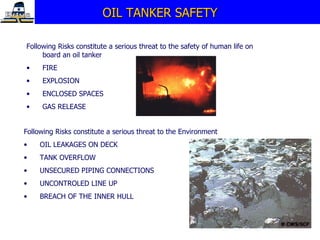
OIL TANKER SAFETY Following Risks constitute a serious threat to the safety of human life on board an oil tanker FIRE EXPLOSION ENCLOSED SPACES GAS RELEASE Following Risks constitute a serious threat to the Environment OIL LEAKAGES ON DECK TANK OVERFLOW UNSECURED PIPING CONNECTIONS  UNCONTROLED LINE UP BREACH OF THE INNER HULL
F I R E   SMS PROCEDURE: VOM-OSP014  (FIRE PREVENTION) Fire Hazards Prevention Measures UNAWARE VISITORS Briefing Escort SMOKING Smoking is strictly prohibited except in designed spaces.  Smoking in bed is strictly prohibited. PORTABLE ELECTRONIC EQUIPMENT Mobile phones are not allowed on deck  (must be switched off before boarding) Cameras, Radios, portable computers, portable gaming devices and generally appliances powered by batteries are strictly forbidden on deck. ONLY INTRINSICALLY SAFE DEVICES ARE ALLOWED  (Special torches, portable VHF, etc)  ELECTRICAL FITTINGS Faulty appliances, fittings or wiring should be reported immediately. Defective equipment should be isolated or disconnected from the power supply. No private electrical appliance may be used by the crew unless approval has been obtained from the Chief Engineer. All portable electrical appliances shall be firmly secured before sailing and are to remain disconnected when not in use.
F I R E   SMS PROCEDURE: VOM-OSP014  (FIRE PREVENTION) SPECIAL NOTICE:  HOT WORK ON DECK The Chief Engineer plans and the Master approves welding, flame cutting or other hot work. NO HOT WORK IS ALLOWED ON DECK  or in adjacent areas ashore  WHEN CARGO OPERATIONS TAKING PLACE . Fire Hazards Prevention Measures SPONTANEOUS COMBUSTION Solid waste, especially if contaminated with oil, shall be safely kept.  (Even dirty blankets or cloth containing hydraulic or other oil and grease are dangerous, as they can ignite when stored on deck). MACHINERY SPACES Oil leakage shall be reported immediately  (especially where exhaust pipes or other hot surfaces are nearby) Waste oil is not to be allowed in the engine room or to accumulate in bilges in the pumproom. Unmanned machinery spaces to be regularly inspected for fire hazards.  Wood, paint, spirits, tins of oil, and other flammable materials shall not be stowed in boiler flats, machinery spaces or the steering flat GALLEY The electric hot plates should be switched off immediately after use. Defective equipment is to be reported immediately and disconnected. All oil and grease spills should be cleaned up promptly. Drying of cloths on stoves and electrical equipment is forbidden. Grease which has settled on exhaust ducts should be cleaned. A fire blanket is readily available to smother fat or cooking oil fires.
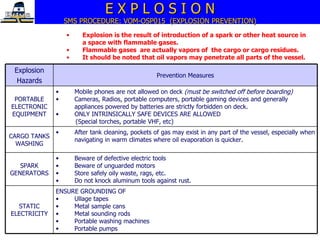
E X P L O S I O N SMS PROCEDURE: VOM-OSP015  (EXPLOSION PREVENTION) Explosion is the result of introduction of a spark or other heat source in a space with flammable gases. Flammable gases  are actually vapors of  the cargo or cargo residues.  It should be noted that oil vapors may penetrate all parts of the vessel. Explosion Hazards Prevention Measures PORTABLE ELECTRONIC EQUIPMENT Mobile phones are not allowed on deck  (must be switched off before boarding) Cameras, Radios, portable computers, portable gaming devices and generally appliances powered by batteries are strictly forbidden on deck. ONLY INTRINSICALLY SAFE DEVICES ARE ALLOWED  (Special torches, portable VHF, etc)  CARGO TANKS WASHING After tank cleaning, pockets of gas may exist in any part of the vessel, especially when navigating in warm climates where oil evaporation is quicker. SPARK GENERATORS Beware of defective electric tools  Beware of unguarded motors Store safely oily waste, rags, etc. Do not knock aluminum tools against rust.  STATIC ELECTRICITY ENSURE GROUNDING OF Ullage tapes Metal sample cans Metal sounding rods Portable washing machines Portable pumps
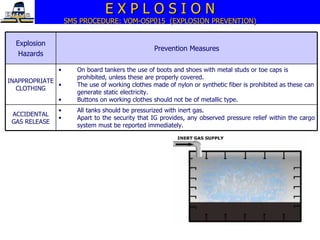
E X P L O S I O N SMS PROCEDURE: VOM-OSP015  (EXPLOSION PREVENTION) Explosion Hazards Prevention Measures INAPPROPRIATE CLOTHING On board tankers the use of boots and shoes with metal studs or toe caps is prohibited, unless these are properly covered.  The use of working clothes made of nylon or synthetic fiber is prohibited as these can generate static electricity.  Buttons on working clothes should not be of metallic type. ACCIDENTAL GAS RELEASE All tanks should be pressurized with inert gas. Apart to the security that IG provides, any observed pressure relief within the cargo system must be reported immediately.
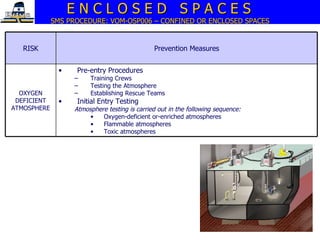
E N C L O S E D  S P A C E S   SMS PROCEDURE: VOM-OSP006 – CONFINED OR ENCLOSED SPACES RISK Prevention Measures OXYGEN DEFICIENT ATMOSPHERE Pre-entry Procedures Training Crews Testing the Atmosphere  Establishing Rescue Teams  Initial Entry Testing Atmosphere testing is carried out in the following sequence:   Oxygen-deficient or-enriched atmospheres  Flammable atmospheres  Toxic atmospheres
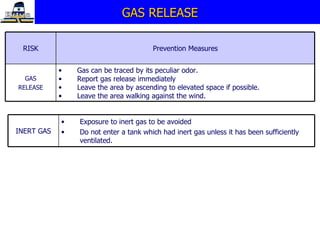
GAS RELEASE RISK Prevention Measures GAS RELEASE Gas can be traced by its peculiar odor. Report gas release immediately Leave the area by ascending to elevated space if possible. Leave the area walking against the wind. INERT GAS Exposure to inert gas to be avoided Do not enter a tank which had inert gas unless it has been sufficiently ventilated.
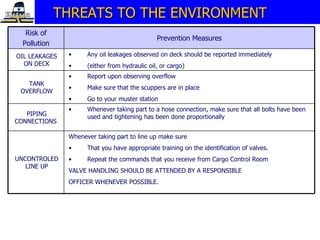
THREATS TO THE ENVIRONMENT Risk of Pollution Prevention Measures OIL LEAKAGES ON DECK Any oil leakages observed on deck should be reported immediately (either from hydraulic oil, or cargo) TANK OVERFLOW Report upon observing overflow Make sure that the scuppers are in place Go to your muster station PIPING CONNECTIONS  Whenever taking part to a hose connection, make sure that all bolts have been used and tightening has been done proportionally  UNCONTROLED LINE UP Whenever taking part to line up make sure That you have appropriate training on the identification of valves. Repeat the commands that you receive from Cargo Control Room VALVE HANDLING SHOULD BE ATTENDED BY A RESPONSIBLE  OFFICER WHENEVER POSSIBLE.
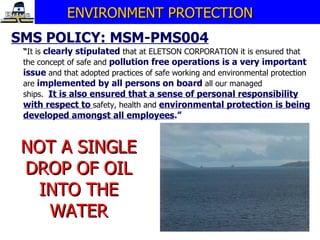
SMS POLICY: MSM-PMS004 “ It is  clearly stipulated  that at ELETSON CORPORATION it is   ensured that the concept of safe and  pollution free   operations is a very important issue  and that adopted   practices of safe working and environmental protection are   implemented by all persons on board  all our managed ships.  It is also ensured that a sense of personal   responsibility   with respect to   safety, health and   environmental protection is being developed   amongst all employees .” ENVIRONMENT PROTECTION NOT A SINGLE DROP OF OIL INTO THE WATER
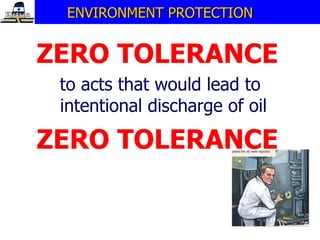
ZERO TOLERANCE to acts that would lead to intentional discharge of oil ZERO TOLERANCE ENVIRONMENT PROTECTION
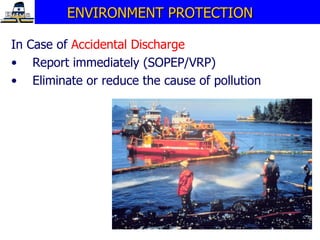
In Case of  Accidental Discharge Report immediately (SOPEP/VRP) Eliminate or reduce the cause of pollution ENVIRONMENT PROTECTION
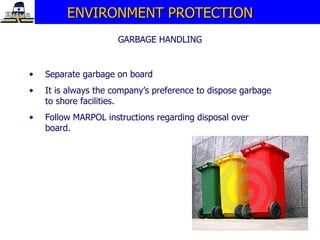
ENVIRONMENT PROTECTION GARBAGE HANDLING Separate garbage on board It is always the company’s preference to dispose garbage to shore facilities. Follow MARPOL instructions regarding disposal over board.
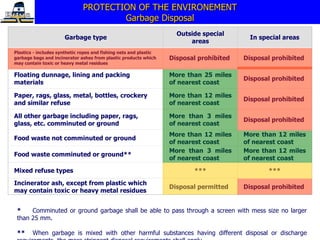
PROTECTION OF THE ENVIRONEMENT Garbage Disposal ** Comminuted or ground garbage shall be able to pass through a screen with mess size no larger than 25 mm. *** When garbage is mixed with other harmful substances having different disposal or discharge requirements, the more stringent disposal requirements shall apply. Garbage type Outside special areas In special areas Plastics - includes synthetic ropes and fishing nets and plastic garbage bags   and incinerator ashes from plastic products which may contain toxic or heavy metal residues  Disposal prohibited Disposal prohibited Floating dunnage, lining and packing materials More than 25 miles of nearest coast Disposal prohibited Paper, rags, glass, metal, bottles, crockery and similar refuse More than 12 miles of nearest coast Disposal prohibited All other garbage including paper, rags, glass, etc. comminuted or ground More than 3 miles of nearest coast Disposal prohibited Food waste not comminuted or ground More than 12 miles of nearest coast More than 12 miles of nearest coast Food waste comminuted or ground** More than 3 miles of nearest coast More than 12 miles of nearest coast Mixed refuse types *** *** Incinerator ash,  except from plastic which may contain toxic or heavy metal residues  Disposal permitted Disposal prohibited
MARITIME SECURITY Company Security Officer: Capt. Gerasimos H. Tsiburlas Ship Security Officer: The Master of the ship
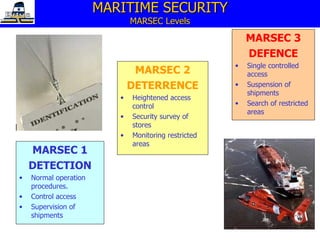
MARITIME SECURITY MARSEC Levels MARSEC 1 DETECTION Normal operation procedures. Control access Supervision of shipments MARSEC 2 DETERRENCE Heightened access control Security survey of stores Monitoring restricted areas MARSEC 3 DEFENCE Single controlled access Suspension of shipments Search of restricted areas
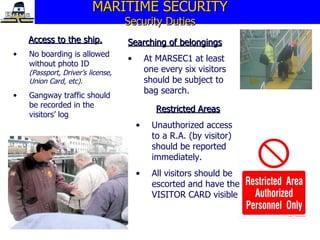
MARITIME SECURITY Security Duties Access to the ship. No boarding is allowed without photo ID   (Passport, Driver’s license, Union Card, etc). Gangway traffic should be recorded in the visitors’ log Searching of belongings At MARSEC1 at least one every six visitors should be subject to bag search. Restricted Areas Unauthorized access to a R.A. (by visitor) should be reported immediately. All visitors should be escorted and have the VISITOR CARD visible
MARITIME SECURITY Security Duties Monitor assigned areas at a set frequency for security breaches; Report security breaches to the Duty Officer or Watch Stander; Attempt to mitigate the impacts of a security breach, to the extent training and standard operating procedures permit; and Ensure the access controls are in place and operating properly (e.g. doors locked, intruder alarms, set). Security Patrols will ful l fil l  the duties specified in this Plan; Security Patrols will be briefed at the start of their duty on the information known regarding potential threats; Security Patrols will be provided with radios and portable lights, as a minimum; Security Patrols will be assigned a specific area to patrol, depending on the potential threat, circumstances and available personnel; Security Patrols will be instructed to report in to the Duty Officer at 15 minute intervals;
ELETSON CORPORATION

Eletson Familiarization

  • 1.
    ELETSON CRPORATION Familiarization and Induction Course
  • 2.
    Part A Company’sprofile The Eletson Fleet Familiarization and Induction Course Program Safety Management System Maritime Security Part B
  • 3.
    Eletson founded in1966 History First vessel was 30 year old, 2,500 dwt. combination carrier First tanker was 15,900 DWT, bought in 1969
  • 4.
    1970s - Operateddry/wet second hand tonnage Early 1980s - Gradually concentrated in product tankers and begun to build sector expertise Embarked in fleet rejuvenation program with 5 Japanese built 30,000 tons (SH) History
  • 5.
    1986 - Adopteddouble hull design in new building program mid 1990s - Completed rejuvenation program. Company operates 18 modern vessels, ordered/built to company specifications By 1996, amongst the first companies operating exclusively double hull tankers. History
  • 6.
    Eletson is aleading company in product carriers worldwide All vessels fly the Greek flag Eletson controls 28 Double Hull Oil Tankers Another 12 units on order . Delivery 2009-2010 Present Day
  • 7.
    The Fleet ShipTypes KSEK – 4 Units HITACHI – 4 Units ZALIV – 2 Units HYUNDAI (Panamax) – 3 Units HYUNDAI (Handymax) – 3 Units HALA – 2 Units HYUNDAI (Aframax) – 4 Units HYUNDAI 70K – 2 Units DAEWOO – 4 Units
  • 8.
    KSEK Built inKorea 1989 - 1990 4 Units 45K DWT 183m LOA
  • 9.
    M/T SAMOTHRAKI -M/T PSARA – M/T HALKI- M/T SHINOUSSA KSEK – General Arrangement
  • 10.
    HITACHI Built inJapan 1991 - 1992 4 Units 45K DWT 183m LOA
  • 11.
    M/T SALAMINA -M/T KASTELORIZO – M/T FOLEGANDROS- M/T ARGIRONISSOS HITACHI– General Arrangement
  • 12.
    ZALIV Built inUkraine 1993 - 1994 2 Units 65K DWT 243m LOA
  • 13.
    M/T SKIROPOULA –M/T STAVRONISI ZALIV – General Arrangement
  • 14.
    HYUNDAI Panamax Builtin Korea 1992 - 1993 3 Units 65K DWT 228m LOA
  • 15.
    M/T ALKYONIS –M/T VELOPOULA – M/T SPORADES HYUNDAI Panamax – General Arrangement
  • 16.
    HYUNDAI Handymax Builtin Korea 1995 3 Units 45K DWT 183.2m LOA
  • 17.
    M/T KANDILOUSA –M/T SERIFOS – M/T SERIFOPOULO HYUNDAI Handymax – General Arrangement
  • 18.
    HALA Built inKorea 1999 - 2000 2 Units 70K DWT 213m LOA No Pump-room
  • 19.
    M/T PELAGOS -M/T ANGISTRI HALA – General Arrangement
  • 20.
    HYUNDAI Aframax Builtin Korea 2002 - 2004 4 Units 105K DWT 244m LOA
  • 21.
    M/T AGATHONISSOS –M/T MAKRONISSOS – M/T ALONISSOS – M/T MEGALONISSOS General Arrangement
  • 22.
    HYUNDAI Built inKorea 2003 2 Units 70K DWT 220m LOA
  • 23.
    M/T ERIKOUSSA –M/T SKOPELOS General Arrangement
  • 24.
    DAEWOO Built inKorea and Romania 2001 - 2006 4 Units 65K DWT 220m LOA No Pump-room
  • 25.
    M/T ANTIKEROS –M/T DHONOUSSA – M/T POLYAIGOS – M/T STROFADES General Arrangement
  • 26.
  • 27.
    Manning CREWCOMPLIMENT The Majority of fleet officers are Greeks Few engine officers are coming from Georgia A small number of Electricians are from Ukraine. Ratings are all Phillipino.
  • 28.
  • 29.
    ISM CODE POLICYManagement Commitment PROCEDURES Rules/Regulations INSTRUCTIONS Implementation Guidelines
  • 30.
    Safety Management System(SMS) The Company aims to achieve the following objectives through implementation of our Safety, Health en d Environmental Protection Policy safety at sea prevention of injury or loss of life prevention of damage to the marine environment prevention of damage to property
  • 31.
  • 32.
    Organization Chart Capt.Dimitrios Kokkinis Mr. Nikos Makris Mr. Costis Kertsikoff
  • 33.
    Policies Safety, Healthand Environmental Protection Policy Drug and Alcohol Policy Master’s Authority
  • 34.
    Safety, Health andEnvironment Protection Policy … The safety and health of all seagoing personnel servicing on board Company’s managed vessels, as well as protection of the environment, is one of our Company’s main concerns and considerations. It is, therefore, ensured that our activities are governed by the need to protect the environment and maintain good safety and health conditions at work for all our employees, contracted personnel and any other persons who are directly or indirectly linked with our operations and workplace.
  • 35.
    Drugs & AlcoholPolicy … The use, possession, distribution or sale of illicit or drugs without prescription by all Company’s shore and on board Personnel is prohibited at any and all times during their employment by the Company. Seafarers are hereby warned that the Company is cooperating fully with police and the appropriate authorities in the prosecution of any person using, possessing or trafficking drugs or other illegal substances. Substances such as, but not limited to, marijuana, cocaine, phencyclidine (PCP) and amphetamines are included in this total ban. WARNING
  • 36.
    Drugs & AlcoholPolicy The distribution and consumption of alcohol is strictly controlled. No officer or crew member is allowed to consume alcohol four hours prior duty. No alcohol while on duty. No alcohol consumption 24 hours prior to arrival at port and while vessel staying at port. All officers and crew members must be able to respond at any time to an emergency. A T T E N T I O N In order to ensure compliance with this policy, the Company has adopted a program of testing and screening, including random, unannounced alcohol/drug testing in addition to routine pre-employment medical examinations. Alcohol impairment is defined as a blood alcohol content of max 40 mg/100 ml CONTROLED
  • 37.
    Job Description –Deck Personnel Knowledge of the vessel’s emergency procedures. Keep a proper lookout. Proper observation/reading of both the magnetic and gyro compasses indications and skill in the proper steering of the vessel by complying with the helm orders (compulsory for A.Bs). Operation of vessel’s anchoring and mooring equipment. Steel maintenance / surface preparation and application of various types of painting systems. Proper use and maintenance of painting and tank cleaning equipment, as well as use /maintenance of the various tools and equipment used for deck work. Rigging stages and bosun’s chairs and splicing both ropes & wire ropes in a safe manner. Work on deck or engine room as required by Chief Officer or Chief Engineer (cross-departmental duties). Knowledge for shipboard terms and definitions required for executing deck duties and ability to understand orders and make themselves clear to the officer on duty/supervisor(s) in matters relevant to deck duties and safety practices.
  • 38.
    Job Description –Engineroom Personnel Emergency Procedures Engine room watch keeping procedures and the ability to carry out watch routines. Ability to read indicating instruments related to watch-keeping duties.Use of hand tools and portable power tools. Function, operation and servicing of the various Main Engines, Auxiliary equipment and pumping systems. Safe working practices related to the engine room operation. Technical terms used in the machinery space and names of all relevant machinery details and equipment.
  • 39.
    Job Description –Galley staff Vessel’s emergency procedures. Decoration and serving. Laying tables, usage of cutlery and crockery. Hygiene rules and practices. Operation of galley, pantry and laundry equipment. E xecute all orders given by Captain and Chief Cook. Order and cleanliness in messrooms, pantries, cabins, corridors, stairs, galley stores rooms and catering department lockers.
  • 40.
    Getting On BoardFirst Day of Employment Meet the Master (or OOW) to deliver documentation. Get your Personal Protective Equipment Meet the Safety Officer for a round to observe the FF and LSA equipment. Watch for the station bill in your cabin and make sure that the life jacket and the immersion suit are available and in good condition. First Week Familiarization with Emergency Procedures. Be familiar with the policies (posted in mess-rooms) Familiarization with security duties In-depth look at the work to be performed (duties) Familiarization with all machinery / equipment and systems Be familiar with Disciplinary Procedures in the Company.
  • 41.
    REQUIREMENTS and EXPECTATIONSPersonal Safety USE Personal Protective Equipment AT WORK A number of injuries have stemmed from removal , or non appropriate use, of PPE. During the 3rd quarter (2007) two eye injuries were reported. In both cases seamen were operating a chipping tool and they were both wearing goggles. Eventually they replaced their goggles with spectacles, because their sweat was preventing them to have a clear view. If PPE needs to be removed , the individual should s top work , move away from the hazardous task and then remove the PPE. The hazardous task area should not be re-entered until full PPE is correctly in place. We are all responsible for our own safety and that of our colleagues . L ook out for your colleagues and take action if they are not protecting themselves. Prior to undertaking a task appropriate PPE must be identified, it must be provided and must been worn for the duration of the task. Incidents like the above are occurring when PPE is being removed momentarily.
  • 42.
    REQUIREMENTS and EXPECTATIONS Watch-keeping The Master and/or Chief Engineer outline the requirements for watch-keeping in accordance with the prevailing conditions. The following guidelines, though could be applicable in any occasion. BRIDGE WATCH Report upon site Movements of other ships in the area Lights at night Floating objects Make sure that you understand OOW commands DECK WATCH Report upon site Leakages and/or out board spills Unusual noise Hazardous situations (smoke, sparks, etc) Loose moorings Non secured material Improper housekeeping Unauthorized access Unidentified objects ENGINE WATCH Report upon site Leakages Steam release Spills and/or spilled rags Improper housekeeping Non secured material Poor lighting
  • 43.
    REQUIREMENTS and EXPECTATIONSReport Hazards and/or Hazardous situation … if you don’t, then someone might be seriously hurt
  • 44.
    REQUIREMENTS and EXPECTATIONSBe active when participate on board drills Learn your duties and exercise them during drills looking for continuous improvement. The objective is to get reflexes and be able to exercise your task with utmost efficiency in case of emergency. Be aware of fellow crewmen duties. Understand what you do and why you do it.
  • 45.
    Requirements and expectationsObserve the on board training scheme On every Eletson ship there’s a TRAINING COMPUTER loaded with TRAINING MODULES Ask Safety Officer to show it to you and provide your unique access code Training on board is compulsory, but none shall force you to do it. IT IS YOUR PERSONAL RESPONSIBILITY Check the TRAINING MATRIX and know the modules are applicable to your rank/position
  • 46.
    REQUIREMENTS and EXPECTATIONSFollow Procedures It is the obligation of all employees to follow the procedures of the Safety Management Manual. Learn the procedures that directly apply to your assigned tasks. You may challenge and propose (through SSCM*) changes to a procedure. STILL. YOU HAVE TO FOLLOW PROCEDURES. * SSCM Shipboard safety committee meeting
  • 47.
    REQUIREMENTS and EXPECTATIONSCare for your personal and public hygiene Take care of your personal hygiene and cleanliness. Dedicate time to wash your clothes. At least once a weak do your cabin cleaning. Always take a bath after work (without though wasting water). Wear clean clothes during meals. Ensure you’re properly equipped when going ashore to meet the girls. Take care of public hygiene and cleanliness. Don’t walk in the accommodation with dirty shoes or spilled overalls (changing rooms are available) Don’t leave dirty dishes after working hours Leave your cabin clean and tidy before sign off. REMEMBER YOU ARE THE IMAGE OF THE COMPANY. CLEANLINESS IT IS NOT ONLY GALLEY’S STAFF RESPONSIBILITY
  • 48.
    OIL TANKER SAFETYFollowing Risks constitute a serious threat to the safety of human life on board an oil tanker FIRE EXPLOSION ENCLOSED SPACES GAS RELEASE Following Risks constitute a serious threat to the Environment OIL LEAKAGES ON DECK TANK OVERFLOW UNSECURED PIPING CONNECTIONS UNCONTROLED LINE UP BREACH OF THE INNER HULL
  • 49.
    F I RE SMS PROCEDURE: VOM-OSP014 (FIRE PREVENTION) Fire Hazards Prevention Measures UNAWARE VISITORS Briefing Escort SMOKING Smoking is strictly prohibited except in designed spaces. Smoking in bed is strictly prohibited. PORTABLE ELECTRONIC EQUIPMENT Mobile phones are not allowed on deck (must be switched off before boarding) Cameras, Radios, portable computers, portable gaming devices and generally appliances powered by batteries are strictly forbidden on deck. ONLY INTRINSICALLY SAFE DEVICES ARE ALLOWED (Special torches, portable VHF, etc) ELECTRICAL FITTINGS Faulty appliances, fittings or wiring should be reported immediately. Defective equipment should be isolated or disconnected from the power supply. No private electrical appliance may be used by the crew unless approval has been obtained from the Chief Engineer. All portable electrical appliances shall be firmly secured before sailing and are to remain disconnected when not in use.
  • 50.
    F I RE SMS PROCEDURE: VOM-OSP014 (FIRE PREVENTION) SPECIAL NOTICE: HOT WORK ON DECK The Chief Engineer plans and the Master approves welding, flame cutting or other hot work. NO HOT WORK IS ALLOWED ON DECK or in adjacent areas ashore WHEN CARGO OPERATIONS TAKING PLACE . Fire Hazards Prevention Measures SPONTANEOUS COMBUSTION Solid waste, especially if contaminated with oil, shall be safely kept. (Even dirty blankets or cloth containing hydraulic or other oil and grease are dangerous, as they can ignite when stored on deck). MACHINERY SPACES Oil leakage shall be reported immediately (especially where exhaust pipes or other hot surfaces are nearby) Waste oil is not to be allowed in the engine room or to accumulate in bilges in the pumproom. Unmanned machinery spaces to be regularly inspected for fire hazards. Wood, paint, spirits, tins of oil, and other flammable materials shall not be stowed in boiler flats, machinery spaces or the steering flat GALLEY The electric hot plates should be switched off immediately after use. Defective equipment is to be reported immediately and disconnected. All oil and grease spills should be cleaned up promptly. Drying of cloths on stoves and electrical equipment is forbidden. Grease which has settled on exhaust ducts should be cleaned. A fire blanket is readily available to smother fat or cooking oil fires.
  • 51.
    E X PL O S I O N SMS PROCEDURE: VOM-OSP015 (EXPLOSION PREVENTION) Explosion is the result of introduction of a spark or other heat source in a space with flammable gases. Flammable gases are actually vapors of the cargo or cargo residues. It should be noted that oil vapors may penetrate all parts of the vessel. Explosion Hazards Prevention Measures PORTABLE ELECTRONIC EQUIPMENT Mobile phones are not allowed on deck (must be switched off before boarding) Cameras, Radios, portable computers, portable gaming devices and generally appliances powered by batteries are strictly forbidden on deck. ONLY INTRINSICALLY SAFE DEVICES ARE ALLOWED (Special torches, portable VHF, etc) CARGO TANKS WASHING After tank cleaning, pockets of gas may exist in any part of the vessel, especially when navigating in warm climates where oil evaporation is quicker. SPARK GENERATORS Beware of defective electric tools Beware of unguarded motors Store safely oily waste, rags, etc. Do not knock aluminum tools against rust. STATIC ELECTRICITY ENSURE GROUNDING OF Ullage tapes Metal sample cans Metal sounding rods Portable washing machines Portable pumps
  • 52.
    E X PL O S I O N SMS PROCEDURE: VOM-OSP015 (EXPLOSION PREVENTION) Explosion Hazards Prevention Measures INAPPROPRIATE CLOTHING On board tankers the use of boots and shoes with metal studs or toe caps is prohibited, unless these are properly covered. The use of working clothes made of nylon or synthetic fiber is prohibited as these can generate static electricity. Buttons on working clothes should not be of metallic type. ACCIDENTAL GAS RELEASE All tanks should be pressurized with inert gas. Apart to the security that IG provides, any observed pressure relief within the cargo system must be reported immediately.
  • 53.
    E N CL O S E D S P A C E S SMS PROCEDURE: VOM-OSP006 – CONFINED OR ENCLOSED SPACES RISK Prevention Measures OXYGEN DEFICIENT ATMOSPHERE Pre-entry Procedures Training Crews Testing the Atmosphere Establishing Rescue Teams Initial Entry Testing Atmosphere testing is carried out in the following sequence: Oxygen-deficient or-enriched atmospheres Flammable atmospheres Toxic atmospheres
  • 54.
    GAS RELEASE RISKPrevention Measures GAS RELEASE Gas can be traced by its peculiar odor. Report gas release immediately Leave the area by ascending to elevated space if possible. Leave the area walking against the wind. INERT GAS Exposure to inert gas to be avoided Do not enter a tank which had inert gas unless it has been sufficiently ventilated.
  • 55.
    THREATS TO THEENVIRONMENT Risk of Pollution Prevention Measures OIL LEAKAGES ON DECK Any oil leakages observed on deck should be reported immediately (either from hydraulic oil, or cargo) TANK OVERFLOW Report upon observing overflow Make sure that the scuppers are in place Go to your muster station PIPING CONNECTIONS Whenever taking part to a hose connection, make sure that all bolts have been used and tightening has been done proportionally UNCONTROLED LINE UP Whenever taking part to line up make sure That you have appropriate training on the identification of valves. Repeat the commands that you receive from Cargo Control Room VALVE HANDLING SHOULD BE ATTENDED BY A RESPONSIBLE OFFICER WHENEVER POSSIBLE.
  • 56.
    SMS POLICY: MSM-PMS004“ It is clearly stipulated that at ELETSON CORPORATION it is ensured that the concept of safe and pollution free operations is a very important issue and that adopted practices of safe working and environmental protection are implemented by all persons on board all our managed ships. It is also ensured that a sense of personal responsibility with respect to safety, health and environmental protection is being developed amongst all employees .” ENVIRONMENT PROTECTION NOT A SINGLE DROP OF OIL INTO THE WATER
  • 57.
    ZERO TOLERANCE toacts that would lead to intentional discharge of oil ZERO TOLERANCE ENVIRONMENT PROTECTION
  • 58.
    In Case of Accidental Discharge Report immediately (SOPEP/VRP) Eliminate or reduce the cause of pollution ENVIRONMENT PROTECTION
  • 59.
    ENVIRONMENT PROTECTION GARBAGEHANDLING Separate garbage on board It is always the company’s preference to dispose garbage to shore facilities. Follow MARPOL instructions regarding disposal over board.
  • 60.
    PROTECTION OF THEENVIRONEMENT Garbage Disposal ** Comminuted or ground garbage shall be able to pass through a screen with mess size no larger than 25 mm. *** When garbage is mixed with other harmful substances having different disposal or discharge requirements, the more stringent disposal requirements shall apply. Garbage type Outside special areas In special areas Plastics - includes synthetic ropes and fishing nets and plastic garbage bags and incinerator ashes from plastic products which may contain toxic or heavy metal residues Disposal prohibited Disposal prohibited Floating dunnage, lining and packing materials More than 25 miles of nearest coast Disposal prohibited Paper, rags, glass, metal, bottles, crockery and similar refuse More than 12 miles of nearest coast Disposal prohibited All other garbage including paper, rags, glass, etc. comminuted or ground More than 3 miles of nearest coast Disposal prohibited Food waste not comminuted or ground More than 12 miles of nearest coast More than 12 miles of nearest coast Food waste comminuted or ground** More than 3 miles of nearest coast More than 12 miles of nearest coast Mixed refuse types *** *** Incinerator ash, except from plastic which may contain toxic or heavy metal residues Disposal permitted Disposal prohibited
  • 61.
    MARITIME SECURITY CompanySecurity Officer: Capt. Gerasimos H. Tsiburlas Ship Security Officer: The Master of the ship
  • 62.
    MARITIME SECURITY MARSECLevels MARSEC 1 DETECTION Normal operation procedures. Control access Supervision of shipments MARSEC 2 DETERRENCE Heightened access control Security survey of stores Monitoring restricted areas MARSEC 3 DEFENCE Single controlled access Suspension of shipments Search of restricted areas
  • 63.
    MARITIME SECURITY SecurityDuties Access to the ship. No boarding is allowed without photo ID (Passport, Driver’s license, Union Card, etc). Gangway traffic should be recorded in the visitors’ log Searching of belongings At MARSEC1 at least one every six visitors should be subject to bag search. Restricted Areas Unauthorized access to a R.A. (by visitor) should be reported immediately. All visitors should be escorted and have the VISITOR CARD visible
  • 64.
    MARITIME SECURITY SecurityDuties Monitor assigned areas at a set frequency for security breaches; Report security breaches to the Duty Officer or Watch Stander; Attempt to mitigate the impacts of a security breach, to the extent training and standard operating procedures permit; and Ensure the access controls are in place and operating properly (e.g. doors locked, intruder alarms, set). Security Patrols will ful l fil l the duties specified in this Plan; Security Patrols will be briefed at the start of their duty on the information known regarding potential threats; Security Patrols will be provided with radios and portable lights, as a minimum; Security Patrols will be assigned a specific area to patrol, depending on the potential threat, circumstances and available personnel; Security Patrols will be instructed to report in to the Duty Officer at 15 minute intervals;
  • 65.