SHIPBOARD
ORGANIZATI
ON
•Explain the working departments of a cargo
ship in terms of their functions relevant to
ensuring safety of operation and life at sea
LESSON OBJECTIVES
•Each of the crew functions based on the ranks
outlined in their job description. The
shipboard organization makes it easy for
everyone to identify the degree of
responsibility of every person on board.
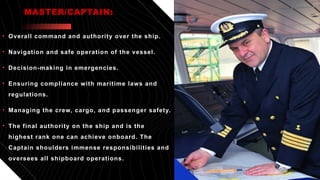
• Overall command and authority over the ship.
• Navigation and safe operation of the vessel.
• Decision-making in emergencies.
• Ensuring compliance with maritime laws and
regulations.
• Managing the crew, cargo, and passenger safety.
• The final authority on the ship and is the
highest rank one can achieve onboard. The
Captain shoulders immense responsibilities and
oversees all shipboard operations.
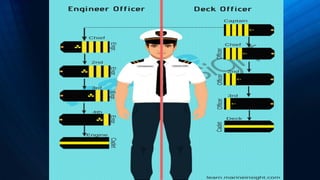
MASTER/CAPTAIN:
Click icon to add picture
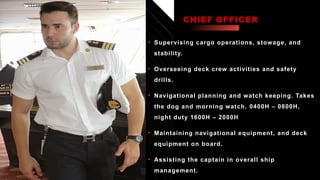
• Supervising cargo operations, stowage, and
stability.
• Overseeing deck crew activities and safety
drills.
• Navigational planning and watch keeping. Takes
the dog and morning watch. 0400H – 0800H,
night duty 1600H – 2000H
• Maintaining navigational equipment, and deck
equipment on board.
• Assisting the captain in overall ship
management.
CHIEF OFFICER
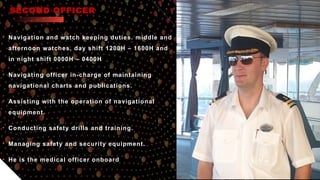
SECOND OFFICER
• Navigation and watch keeping duties. middle and
afternoon watches, day shift 1200H – 1600H and
in night shift 0000H – 0400H
• Navigating officer in-charge of maintaining
navigational charts and publications.
• Assisting with the operation of navigational
equipment.
• Conducting safety drills and training.
• Managing safety and security equipment.
• He is the medical officer onboard
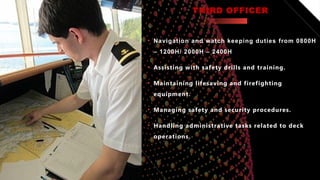
THIRD OFFICER
• Navigation and watch keeping duties from 0800H
– 1200H/ 2000H – 2400H
• Assisting with safety drills and training.
• Maintaining lifesaving and firefighting
equipment.
• Managing safety and security procedures.
• Handling administrative tasks related to deck
operations.
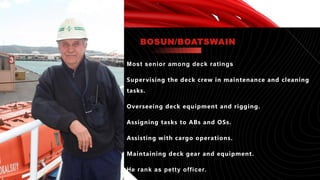
Most senior among deck ratings
Supervising the deck crew in maintenance and cleaning
tasks.
Overseeing deck equipment and rigging.
Assigning tasks to ABs and OSs.
Assisting with cargo operations.
Maintaining deck gear and equipment.
He rank as petty officer.
BOSUN/BOATSWAIN
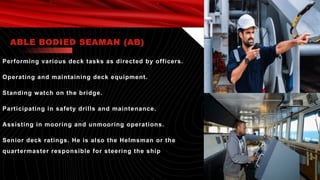
Performing various deck tasks as directed by officers.
Operating and maintaining deck equipment.
Standing watch on the bridge.
Participating in safety drills and maintenance.
Assisting in mooring and unmooring operations.
Senior deck ratings. He is also the Helmsman or the
quartermaster responsible for steering the ship
ABLE BODIED SEAMAN (AB)
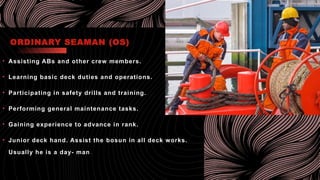
ORDINARY SEAMAN (OS)
• Assisting ABs and other crew members.
• Learning basic deck duties and operations.
• Participating in safety drills and training.
• Performing general maintenance tasks.
• Gaining experience to advance in rank.
• Junior deck hand. Assist the bosun in all deck works.
Usually he is a day- man.
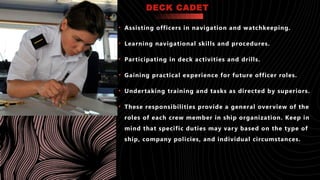
DECK CADET
• Assisting officers in navigation and watchkeeping.
• Learning navigational skills and procedures.
• Participating in deck activities and drills.
• Gaining practical experience for future officer roles.
• Undertaking training and tasks as directed by superiors.
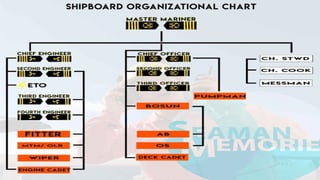
• These responsibilities provide a general overview of the
roles of each crew member in ship organization. Keep in
mind that specific duties may vary based on the type of
ship, company policies, and individual circumstances.
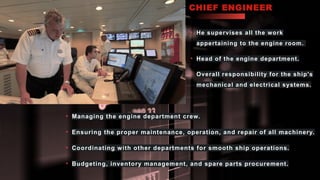
CHIEF ENGINEER
• He supervises all the work
appertaining to the engine room.
• Head of the engine department.
• Overall responsibility for the ship's
mechanical and electrical systems.
• Managing the engine department crew.
• Ensuring the proper maintenance, operation, and repair of all machinery.
• Coordinating with other departments for smooth ship operations.
• Budgeting, inventory management, and spare parts procurement.
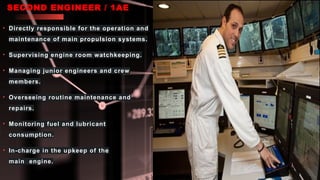
SECOND ENGINEER / 1AE
• Directly responsible for the operation and
maintenance of main propulsion systems.
• Supervising engine room watchkeeping.
• Managing junior engineers and crew
members.
• Overseeing routine maintenance and
repairs.
• Monitoring fuel and lubricant
consumption.
• In-charge in the upkeep of the
main engine.
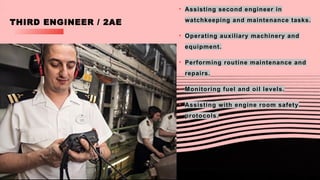
THIRD ENGINEER / 2AE
• Assisting second engineer in
watchkeeping and maintenance tasks.
• Operating auxiliary machinery and
equipment.
• Performing routine maintenance and
repairs.
• Monitoring fuel and oil levels.
• Assisting with engine room safety
protocols.
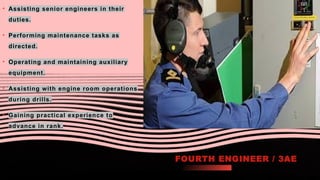
FOURTH ENGINEER / 3AE
• Assisting senior engineers in their
duties.
• Performing maintenance tasks as
directed.
• Operating and maintaining auxiliary
equipment.
• Assisting with engine room operations
during drills.
• Gaining practical experience to
advance in rank.
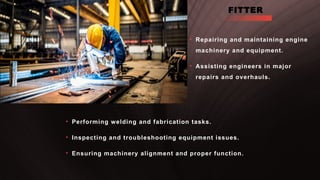
FITTER
• Repairing and maintaining engine
machinery and equipment.
• Assisting engineers in major
repairs and overhauls.
• Performing welding and fabrication tasks.
• Inspecting and troubleshooting equipment issues.
• Ensuring machinery alignment and proper function.
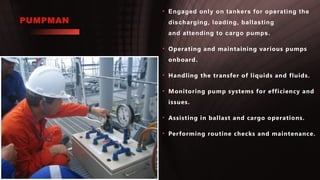
PUMPMAN
• Engaged only on tankers for operating the
discharging, loading, ballasting
and attending to cargo pumps.
• Operating and maintaining various pumps
onboard.
• Handling the transfer of liquids and fluids.
• Monitoring pump systems for efficiency and
issues.
• Assisting in ballast and cargo operations.
• Performing routine checks and maintenance.
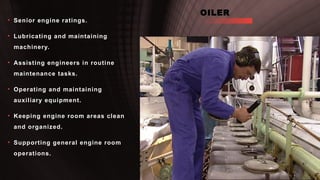
OILER
• Senior engine ratings.
• Lubricating and maintaining
machinery.
• Assisting engineers in routine
maintenance tasks.
• Operating and maintaining
auxiliary equipment.
• Keeping engine room areas clean
and organized.
• Supporting general engine room
operations.
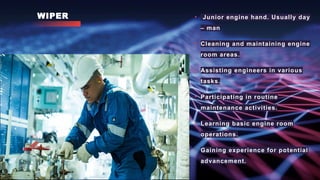
WIPER • Junior engine hand. Usually day
– man
• Cleaning and maintaining engine
room areas.
• Assisting engineers in various
tasks.
• Participating in routine
maintenance activities.
• Learning basic engine room
operations.
• Gaining experience for potential
advancement.
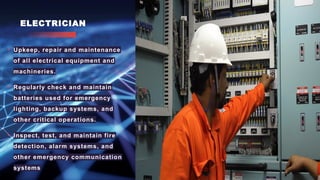
ELECTRICIAN
• Upkeep, repair and maintenance
of all electrical equipment and
machineries.
• Regularly check and maintain
batteries used for emergency
lighting, backup systems, and
other critical operations.
• Inspect, test, and maintain fire
detection, alarm systems, and
other emergency communication
systems
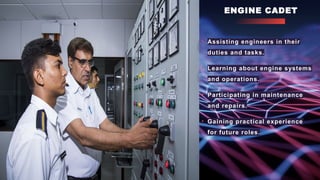
ENGINE CADET
• Assisting engineers in their
duties and tasks.
• Learning about engine systems
and operations.
• Participating in maintenance
and repairs.
• Gaining practical experience
for future roles.
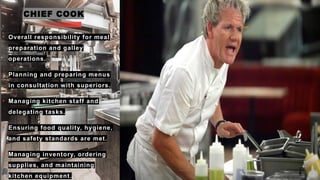
CHIEF COOK
• Overall responsibility for meal
preparation and galley
operations.
• Planning and preparing menus
in consultation with superiors.
• Managing kitchen staff and
delegating tasks.
• Ensuring food quality, hygiene,
and safety standards are met.
• Managing inventory, ordering
supplies, and maintaining
kitchen equipment.
SECOND COOK • Assisting the chief cook in meal
preparation.
• Cooking and preparing meals
according to recipes and
guidelines.
• Handling kitchen tasks as
directed by superiors.
• Assisting in maintaining
cleanliness and organization in
the galley.
• Ensuring food safety and
hygiene practices are followed.
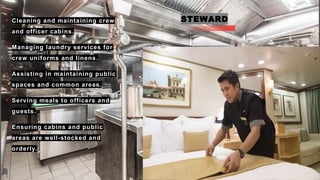
STEWARD
• Cleaning and maintaining crew
and officer cabins.
• Managing laundry services for
crew uniforms and linens.
• Assisting in maintaining public
spaces and common areas.
• Serving meals to officers and
guests.
• Ensuring cabins and public
areas are well-stocked and
orderly.
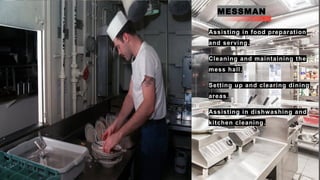
MESSMAN
• Assisting in food preparation
and serving.
• Cleaning and maintaining the
mess hall.
• Setting up and clearing dining
areas.
• Assisting in dishwashing and
kitchen cleaning.
At Sea Watch Keeping
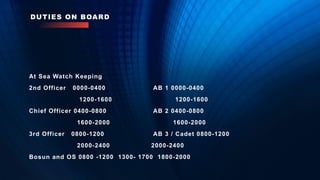
2nd Officer 0000-0400 AB 1 0000-0400
1200-1600 1200-1600
Chief Officer 0400-0800 AB 2 0400-0800
1600-2000 1600-2000
3rd Officer 0800-1200 AB 3 / Cadet 0800-1200
2000-2400 2000-2400
Bosun and OS 0800 -1200 1300- 1700 1800-2000
DUTIES ON BOARD
At Port Watch Keeping
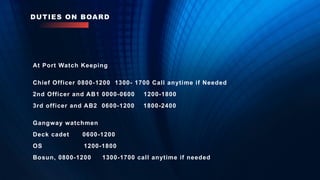
Chief Officer 0800-1200 1300- 1700 Call anytime if Needed
2nd Officer and AB1 0000-0600 1200-1800
3rd officer and AB2 0600-1200 1800-2400
Gangway watchmen
Deck cadet 0600-1200
OS 1200-1800
Bosun, 0800-1200 1300-1700 call anytime if needed
DUTIES ON BOARD
THE END
THANK YOU!

Seamanship 1: SHIPBOARD ORGANIZATION.pptx

  • 1.
  • 2.
    •Explain the workingdepartments of a cargo ship in terms of their functions relevant to ensuring safety of operation and life at sea LESSON OBJECTIVES
  • 3.
    •Each of thecrew functions based on the ranks outlined in their job description. The shipboard organization makes it easy for everyone to identify the degree of responsibility of every person on board.
  • 4.
    • Overall commandand authority over the ship. • Navigation and safe operation of the vessel. • Decision-making in emergencies. • Ensuring compliance with maritime laws and regulations. • Managing the crew, cargo, and passenger safety. • The final authority on the ship and is the highest rank one can achieve onboard. The Captain shoulders immense responsibilities and oversees all shipboard operations. MASTER/CAPTAIN:
  • 5.
    Click icon toadd picture • Supervising cargo operations, stowage, and stability. • Overseeing deck crew activities and safety drills. • Navigational planning and watch keeping. Takes the dog and morning watch. 0400H – 0800H, night duty 1600H – 2000H • Maintaining navigational equipment, and deck equipment on board. • Assisting the captain in overall ship management. CHIEF OFFICER
  • 6.
    SECOND OFFICER • Navigationand watch keeping duties. middle and afternoon watches, day shift 1200H – 1600H and in night shift 0000H – 0400H • Navigating officer in-charge of maintaining navigational charts and publications. • Assisting with the operation of navigational equipment. • Conducting safety drills and training. • Managing safety and security equipment. • He is the medical officer onboard
  • 7.
    THIRD OFFICER • Navigationand watch keeping duties from 0800H – 1200H/ 2000H – 2400H • Assisting with safety drills and training. • Maintaining lifesaving and firefighting equipment. • Managing safety and security procedures. • Handling administrative tasks related to deck operations.
  • 8.
    Most senior amongdeck ratings Supervising the deck crew in maintenance and cleaning tasks. Overseeing deck equipment and rigging. Assigning tasks to ABs and OSs. Assisting with cargo operations. Maintaining deck gear and equipment. He rank as petty officer. BOSUN/BOATSWAIN
  • 9.
    Performing various decktasks as directed by officers. Operating and maintaining deck equipment. Standing watch on the bridge. Participating in safety drills and maintenance. Assisting in mooring and unmooring operations. Senior deck ratings. He is also the Helmsman or the quartermaster responsible for steering the ship ABLE BODIED SEAMAN (AB)
  • 10.
    ORDINARY SEAMAN (OS) •Assisting ABs and other crew members. • Learning basic deck duties and operations. • Participating in safety drills and training. • Performing general maintenance tasks. • Gaining experience to advance in rank. • Junior deck hand. Assist the bosun in all deck works. Usually he is a day- man.
  • 11.
    DECK CADET • Assistingofficers in navigation and watchkeeping. • Learning navigational skills and procedures. • Participating in deck activities and drills. • Gaining practical experience for future officer roles. • Undertaking training and tasks as directed by superiors. • These responsibilities provide a general overview of the roles of each crew member in ship organization. Keep in mind that specific duties may vary based on the type of ship, company policies, and individual circumstances.
  • 12.
    CHIEF ENGINEER • Hesupervises all the work appertaining to the engine room. • Head of the engine department. • Overall responsibility for the ship's mechanical and electrical systems. • Managing the engine department crew. • Ensuring the proper maintenance, operation, and repair of all machinery. • Coordinating with other departments for smooth ship operations. • Budgeting, inventory management, and spare parts procurement.
  • 13.
    SECOND ENGINEER /1AE • Directly responsible for the operation and maintenance of main propulsion systems. • Supervising engine room watchkeeping. • Managing junior engineers and crew members. • Overseeing routine maintenance and repairs. • Monitoring fuel and lubricant consumption. • In-charge in the upkeep of the main engine.
  • 14.
    THIRD ENGINEER /2AE • Assisting second engineer in watchkeeping and maintenance tasks. • Operating auxiliary machinery and equipment. • Performing routine maintenance and repairs. • Monitoring fuel and oil levels. • Assisting with engine room safety protocols.
  • 15.
    FOURTH ENGINEER /3AE • Assisting senior engineers in their duties. • Performing maintenance tasks as directed. • Operating and maintaining auxiliary equipment. • Assisting with engine room operations during drills. • Gaining practical experience to advance in rank.
  • 16.
    FITTER • Repairing andmaintaining engine machinery and equipment. • Assisting engineers in major repairs and overhauls. • Performing welding and fabrication tasks. • Inspecting and troubleshooting equipment issues. • Ensuring machinery alignment and proper function.
  • 17.
    PUMPMAN • Engaged onlyon tankers for operating the discharging, loading, ballasting and attending to cargo pumps. • Operating and maintaining various pumps onboard. • Handling the transfer of liquids and fluids. • Monitoring pump systems for efficiency and issues. • Assisting in ballast and cargo operations. • Performing routine checks and maintenance.
  • 18.
    OILER • Senior engineratings. • Lubricating and maintaining machinery. • Assisting engineers in routine maintenance tasks. • Operating and maintaining auxiliary equipment. • Keeping engine room areas clean and organized. • Supporting general engine room operations.
  • 19.
    WIPER • Juniorengine hand. Usually day – man • Cleaning and maintaining engine room areas. • Assisting engineers in various tasks. • Participating in routine maintenance activities. • Learning basic engine room operations. • Gaining experience for potential advancement.
  • 20.
    ELECTRICIAN • Upkeep, repairand maintenance of all electrical equipment and machineries. • Regularly check and maintain batteries used for emergency lighting, backup systems, and other critical operations. • Inspect, test, and maintain fire detection, alarm systems, and other emergency communication systems
  • 21.
    ENGINE CADET • Assistingengineers in their duties and tasks. • Learning about engine systems and operations. • Participating in maintenance and repairs. • Gaining practical experience for future roles.
  • 22.
    CHIEF COOK • Overallresponsibility for meal preparation and galley operations. • Planning and preparing menus in consultation with superiors. • Managing kitchen staff and delegating tasks. • Ensuring food quality, hygiene, and safety standards are met. • Managing inventory, ordering supplies, and maintaining kitchen equipment.
  • 23.
    SECOND COOK •Assisting the chief cook in meal preparation. • Cooking and preparing meals according to recipes and guidelines. • Handling kitchen tasks as directed by superiors. • Assisting in maintaining cleanliness and organization in the galley. • Ensuring food safety and hygiene practices are followed.
  • 24.
    STEWARD • Cleaning andmaintaining crew and officer cabins. • Managing laundry services for crew uniforms and linens. • Assisting in maintaining public spaces and common areas. • Serving meals to officers and guests. • Ensuring cabins and public areas are well-stocked and orderly.
  • 25.
    MESSMAN • Assisting infood preparation and serving. • Cleaning and maintaining the mess hall. • Setting up and clearing dining areas. • Assisting in dishwashing and kitchen cleaning.
  • 28.
    At Sea WatchKeeping 2nd Officer 0000-0400 AB 1 0000-0400 1200-1600 1200-1600 Chief Officer 0400-0800 AB 2 0400-0800 1600-2000 1600-2000 3rd Officer 0800-1200 AB 3 / Cadet 0800-1200 2000-2400 2000-2400 Bosun and OS 0800 -1200 1300- 1700 1800-2000 DUTIES ON BOARD
  • 29.
    At Port WatchKeeping Chief Officer 0800-1200 1300- 1700 Call anytime if Needed 2nd Officer and AB1 0000-0600 1200-1800 3rd officer and AB2 0600-1200 1800-2400 Gangway watchmen Deck cadet 0600-1200 OS 1200-1800 Bosun, 0800-1200 1300-1700 call anytime if needed DUTIES ON BOARD
  • 31.