Realistic Scheduling and
accurate estimating

Copyright © RLabs 2013
Scheduling is the fundamental
element of any project.

Copyright © RLabs 2013
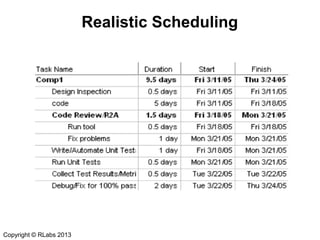
Realistic Scheduling

Copyright © RLabs 2013
Gantt Chart







Technique: Focuses on Schedule
Management
Representing the phases and activities of a
project work breakdown structure (WBS)
Great tool for managing smaller projects
Does not give you a holistic view of a project
magnitude.

Copyright © RLabs 2013
•

•

A realistic schedule takes into consideration
all the objectives of the project .
Each planning step relies on the one
preceding it, and each adds a new element
to the plan .

Copyright © RLabs 2013
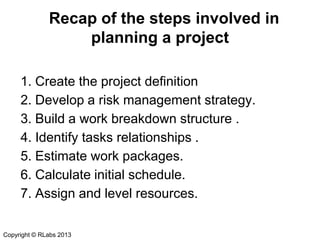
Recap of the steps involved in
planning a project
1. Create the project definition
2. Develop a risk management strategy.
3. Build a work breakdown structure .
4. Identify tasks relationships .
5. Estimate work packages.
6. Calculate initial schedule.
7. Assign and level resources.
Copyright © RLabs 2013
These steps generate all the information
required to understand how a project will be
executed. The steps are systematic, but they
don't necessarily come up with the 'right
answer'.

Copyright © RLabs 2013
Milestones
Milestones have zero duration, so adding them
to a project doesn't affect the schedule at all.
1. Project start and finish milestones are useful
anchor for the network.
2. Milestones can be used to mark input from one
party to one another.
3. A milestone can represent significant events that
aren't already represented by a work package or
summary.

Copyright © RLabs 2013
3 Levels of Accuracy
1. Idea evaluation or "ball park estimate"

2. Project selection or order of magnitude
3. Detailed estimate

Copyright © RLabs 2013
Estimating techniques
1. Phased estimating
2. Apportioning
3. Parametric estimates
4. Bottom- up estimating

Copyright © RLabs 2013

6 project management realistic scheduling and accurate estimating

  • 1.
    Realistic Scheduling and accurateestimating Copyright © RLabs 2013
  • 2.
    Scheduling is thefundamental element of any project. Copyright © RLabs 2013
  • 3.
  • 4.
    Gantt Chart     Technique: Focuseson Schedule Management Representing the phases and activities of a project work breakdown structure (WBS) Great tool for managing smaller projects Does not give you a holistic view of a project magnitude. Copyright © RLabs 2013
  • 5.
    • • A realistic scheduletakes into consideration all the objectives of the project . Each planning step relies on the one preceding it, and each adds a new element to the plan . Copyright © RLabs 2013
  • 6.
    Recap of thesteps involved in planning a project 1. Create the project definition 2. Develop a risk management strategy. 3. Build a work breakdown structure . 4. Identify tasks relationships . 5. Estimate work packages. 6. Calculate initial schedule. 7. Assign and level resources. Copyright © RLabs 2013
  • 7.
    These steps generateall the information required to understand how a project will be executed. The steps are systematic, but they don't necessarily come up with the 'right answer'. Copyright © RLabs 2013
  • 8.
  • 9.
    Milestones Milestones have zeroduration, so adding them to a project doesn't affect the schedule at all. 1. Project start and finish milestones are useful anchor for the network. 2. Milestones can be used to mark input from one party to one another. 3. A milestone can represent significant events that aren't already represented by a work package or summary. Copyright © RLabs 2013
  • 10.
    3 Levels ofAccuracy 1. Idea evaluation or "ball park estimate" 2. Project selection or order of magnitude 3. Detailed estimate Copyright © RLabs 2013
  • 11.
  • 12.
    Estimating techniques 1. Phasedestimating 2. Apportioning 3. Parametric estimates 4. Bottom- up estimating Copyright © RLabs 2013