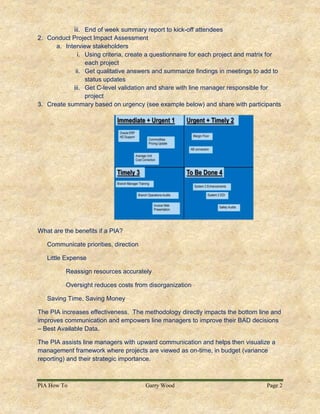
Project Impact Assessment (PIA) methodologyNot all projects are equal, yet they are often assigned resources and managed as if they were.To more effectively manage multiple projects a different executive view offers insight and guidance to line management. Mapping projects to a tiered, four segment matrix is an effective process for sharing information on status and urgency.From personal experience, managing 17 or more projects, many with financial impacts of several millions of dollars, this was also a survival technique for me and my clients.Communication up the ladder usually reflects a literal translation of executives’ directives.  Executives use dashboards that frequently rely on variance reports for simplification.  This tends to flatten project values, especially when there are more than a half dozen or so. The data analysis stresses timeliness and cost management.  Both are absolutely critical; however, another dimension of prioritization can be effective as well.A simple methodology to assessing projects became a best practice.  By categorizing projects to a four box grid, separated by urgency and time to delivery, a way of seeing projects presents a view not available with variance reports.To start this process, set criteria for grading the projects.  Emphasizing the motivation for the project is important so that externally driven projects such as those touching customers are identified easily. A recent client’s criterion appears below:PriorityInternal or external sourceStrategic valueEase to implementFinancial impactCostResource impactCompetitive requirement“Management by objective works - if you know the objectives. Ninety percent of the time you don't.” Peter DruckerGovernance requirementOn time How does the project start?Kick-off session
Eliminate fear to get the truth.
Assure transparency in the process

PIA Process Whte paper

  • 1.
    Project Impact Assessment(PIA) methodologyNot all projects are equal, yet they are often assigned resources and managed as if they were.To more effectively manage multiple projects a different executive view offers insight and guidance to line management. Mapping projects to a tiered, four segment matrix is an effective process for sharing information on status and urgency.From personal experience, managing 17 or more projects, many with financial impacts of several millions of dollars, this was also a survival technique for me and my clients.Communication up the ladder usually reflects a literal translation of executives’ directives. Executives use dashboards that frequently rely on variance reports for simplification. This tends to flatten project values, especially when there are more than a half dozen or so. The data analysis stresses timeliness and cost management. Both are absolutely critical; however, another dimension of prioritization can be effective as well.A simple methodology to assessing projects became a best practice. By categorizing projects to a four box grid, separated by urgency and time to delivery, a way of seeing projects presents a view not available with variance reports.To start this process, set criteria for grading the projects. Emphasizing the motivation for the project is important so that externally driven projects such as those touching customers are identified easily. A recent client’s criterion appears below:PriorityInternal or external sourceStrategic valueEase to implementFinancial impactCostResource impactCompetitive requirement“Management by objective works - if you know the objectives. Ninety percent of the time you don't.” Peter DruckerGovernance requirementOn time How does the project start?Kick-off session
  • 2.
    Eliminate fear toget the truth.
  • 3.