
DESIGN WORK PLAN 
& 
MANAGING THE SCOPE GROWTH 
Onkar Tendulkar 
3rd Sem M.Arch (Project management)
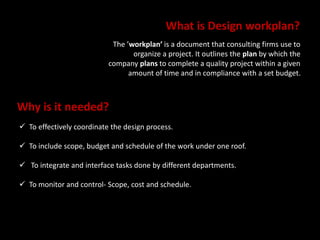
What is Design workplan? 
The ’workplan’ is a document that consulting firms use to 
organize a project. It outlines the plan by which the 
company plans to complete a quality project within a given 
amount of time and in compliance with a set budget. 
Why is it needed? 
 To effectively coordinate the design process. 
 To include scope, budget and schedule of the work under one roof. 
 To integrate and interface tasks done by different departments. 
 To monitor and control- Scope, cost and schedule.
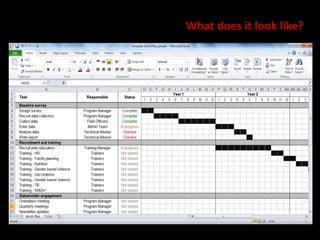
What does it look like?
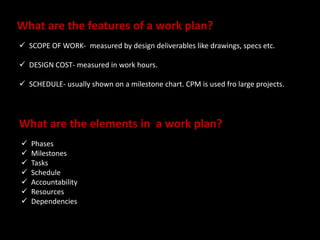
What are the features of a work plan? 
 SCOPE OF WORK- measured by design deliverables like drawings, specs etc. 
 DESIGN COST- measured in work hours. 
 SCHEDULE- usually shown on a milestone chart. CPM is used fro large projects. 
What are the elements in a work plan? 
 Phases 
 Milestones 
 Tasks 
 Schedule 
 Accountability 
 Resources 
 Dependencies
What are the steps in making a work plan? 
Identify the purpose for your work plan 
- Workplan may be made for various purposes and 
for various time periods. 
- The purpose could be official, academic or personal. 
Write the introduction and background 
- An introduction provides the reader an idea of the 
context inside. 
1 
2
What are the steps in making a work plan? 
Determine your goals and objective 
- Goals and objective are related in that, they both 
point to things you hope to accomplish through 
your work plan. 
Order your work plan by SMART objectives 
- Specific- Measurable- Achievable- Relevant- 
Timebound 
3 
4
What are the steps in making a work plan? 
List your resources 
- Include everything that may be necessary to achieve 
the goal and objectives. 
Identify the constraints 
- Constraints are obstacles that may get into your way 
of achieving goals and objectives. 
5 
6
What are the steps in making a work plan? 
Accountability 
- Assigning responsibility to each task. 
Write your strategy 
- Look over your work plan and decide how to use 
resources and overcome your constraints in order to 
achieve the goal. 
7 
8
What could be the common mistakes in work plan? 
 Not identifying the resources for each task. 
 Forgetting to assign resources to tasks may cause delays in final work. 
 Underestimating the amount of time required to complete a task. 
 Forgetting to identify who is responsible for which activity. 
 Forgetting to add dependency relationships between activities.
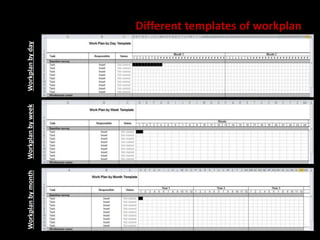
Different templates of workplan 
Workplan by month Workplan by week Workplan by day
Scope Growth 
What is scope growth? 
 The changes made in the design that alter the project’s original scope- which 
was approved before starting the design process. This process is called scope 
growth. 
What are the reasons of scope growth? 
 Tendency of designers to please the client, without regard to budget and 
schedule. 
 Absence of fixed program to control scope and change control. 
 Lack of seriousness about freezing project scope after conceptual stage. 
 Absence of formal review and approval system for any changes and carrying out 
only those changes which are necessary. 
 Poor communication and weak project manager.
What are the implications of scope growth? 
 Cost overruns 
 Project going haywire on schedule 
 Scope creep victimizes mega projects causing them to shut completely. 
How can scope growth be tackled? 
 Freezing project scope after conceptual design stage is the best solution for 
successful scope growth management. 
 Both the owner and the engineer must be committed to scope and change 
control. 
 The owner must be serious about freezing project scope after the conceptual 
design stage. 
 Every proposed change must be subjected to a formal review and approval 
process that considers cost and schedule implications.

Work plan and Scope creep

  • 1.
    DESIGN WORK PLAN & MANAGING THE SCOPE GROWTH Onkar Tendulkar 3rd Sem M.Arch (Project management)
  • 2.
    What is Designworkplan? The ’workplan’ is a document that consulting firms use to organize a project. It outlines the plan by which the company plans to complete a quality project within a given amount of time and in compliance with a set budget. Why is it needed?  To effectively coordinate the design process.  To include scope, budget and schedule of the work under one roof.  To integrate and interface tasks done by different departments.  To monitor and control- Scope, cost and schedule.
  • 3.
    What does itlook like?
  • 4.
    What are thefeatures of a work plan?  SCOPE OF WORK- measured by design deliverables like drawings, specs etc.  DESIGN COST- measured in work hours.  SCHEDULE- usually shown on a milestone chart. CPM is used fro large projects. What are the elements in a work plan?  Phases  Milestones  Tasks  Schedule  Accountability  Resources  Dependencies
  • 5.
    What are thesteps in making a work plan? Identify the purpose for your work plan - Workplan may be made for various purposes and for various time periods. - The purpose could be official, academic or personal. Write the introduction and background - An introduction provides the reader an idea of the context inside. 1 2
  • 6.
    What are thesteps in making a work plan? Determine your goals and objective - Goals and objective are related in that, they both point to things you hope to accomplish through your work plan. Order your work plan by SMART objectives - Specific- Measurable- Achievable- Relevant- Timebound 3 4
  • 7.
    What are thesteps in making a work plan? List your resources - Include everything that may be necessary to achieve the goal and objectives. Identify the constraints - Constraints are obstacles that may get into your way of achieving goals and objectives. 5 6
  • 8.
    What are thesteps in making a work plan? Accountability - Assigning responsibility to each task. Write your strategy - Look over your work plan and decide how to use resources and overcome your constraints in order to achieve the goal. 7 8
  • 9.
    What could bethe common mistakes in work plan?  Not identifying the resources for each task.  Forgetting to assign resources to tasks may cause delays in final work.  Underestimating the amount of time required to complete a task.  Forgetting to identify who is responsible for which activity.  Forgetting to add dependency relationships between activities.
  • 10.
    Different templates ofworkplan Workplan by month Workplan by week Workplan by day
  • 11.
    Scope Growth Whatis scope growth?  The changes made in the design that alter the project’s original scope- which was approved before starting the design process. This process is called scope growth. What are the reasons of scope growth?  Tendency of designers to please the client, without regard to budget and schedule.  Absence of fixed program to control scope and change control.  Lack of seriousness about freezing project scope after conceptual stage.  Absence of formal review and approval system for any changes and carrying out only those changes which are necessary.  Poor communication and weak project manager.
  • 12.
    What are theimplications of scope growth?  Cost overruns  Project going haywire on schedule  Scope creep victimizes mega projects causing them to shut completely. How can scope growth be tackled?  Freezing project scope after conceptual design stage is the best solution for successful scope growth management.  Both the owner and the engineer must be committed to scope and change control.  The owner must be serious about freezing project scope after the conceptual design stage.  Every proposed change must be subjected to a formal review and approval process that considers cost and schedule implications.