ITNU, Chemical Department Process Calculation (2CH405)`
1
INSTITUE OF TECHNOLOGY,
NIRMA UNIVERSITY
Report
on
AMMONIAPRODUCTION
21BCH011-Mit Bhaliya
22BCH505- Aditya Parmar
ITNU, Chemical Department Process Calculation (2CH405)`
2
`
1.1 Introduction
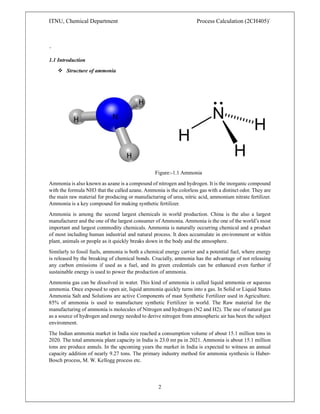
 Structure of ammonia
Figure:-1.1 Ammonia
Ammonia is also known as azane is a compound of nitrogen and hydrogen. It is the inorganic compound
with the formula NH3 that the called azane. Ammonia is the colorless gas with a distinct odor. They are
the main raw material for producing or manufacturing of urea, nitric acid, ammonium nitrate fertilizer.
Ammonia is a key compound for making synthetic fertilizer.
Ammonia is among the second largest chemicals in world production. China is the also a largest
manufacturer and the one of the largest consumer of Ammonia. Ammonia is the one of the world’s most
important and largest commodity chemicals. Ammonia is naturally occurring chemical and a product
of most including human industrial and natural process. It does accumulate in environment or within
plant, animals or people as it quickly breaks down in the body and the atmosphere.
Similarly to fossil fuels, ammonia is both a chemical energy carrier and a potential fuel, where energy
is released by the breaking of chemical bonds. Crucially, ammonia has the advantage of not releasing
any carbon emissions if used as a fuel, and its green credentials can be enhanced even further if
sustainable energy is used to power the production of ammonia.
Ammonia gas can be dissolved in water. This kind of ammonia is called liquid ammonia or aqueous
ammonia. Once exposed to open air, liquid ammonia quickly turns into a gas. In Solid or Liquid States
Ammonia Salt and Solutions are active Components of mast Synthetic Fertilizer used in Agriculture.
85% of ammonia is used to manufacture synthetic Fertilizer in world. The Raw material for the
manufacturing of ammonia is molecules of Nitrogen and hydrogen (N2 and H2). The use of natural gas
as a source of hydrogen and energy needed to derive nitrogen from atmospheric air has been the subject
environment.
The Indian ammonia market in India size reached a consumption volume of about 15.1 million tons in
2020. The total ammonia plant capacity in India is 23.0 mt pa in 2021. Ammonia is about 15.1 million
tons are produce annuls. In the upcoming years the market in India is expected to witness an annual
capacity addition of nearly 9.27 tons. The primary industry method for ammonia synthesis is Haber-
Bosch process, M. W. Kellogg process etc.
ITNU, Chemical Department Process Calculation (2CH405)`
3
1.2 History
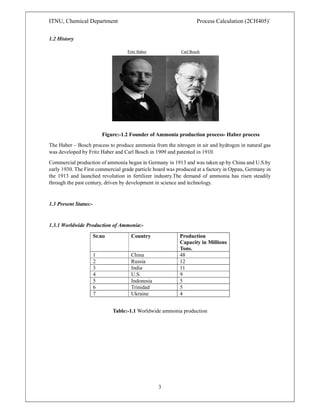
Figure:-1.2 Founder of Ammonia production process- Haber process
The Haber – Bosch process to produce ammonia from the nitrogen in air and hydrogen in natural gas
was developed by Fritz Haber and Carl Bosch in 1909 and patented in 1910.
Commercial production of ammonia began in Germany in 1913 and was taken up by China and U.S.by
early 1930. The First commercial grade particle board was produced at a factory in Oppau, Germany in
the 1913 and launched revolution in fertilizer industry.The demand of ammonia has risen steadily
through the past century, driven by development in science and technology.
1.3 Present Status:-
1.3.1 Worldwide Production of Ammonia:-
Sr.no Country Production
Capacity in Millions
Tons.
1 China 48
2 Russia 12
3 India 11
4 U.S. 9
5 Indonesia 5
6 Trinidad 5
7 Ukraine 4
Table:-1.1 Worldwide ammonia production
ITNU, Chemical Department Process Calculation (2CH405)`
4
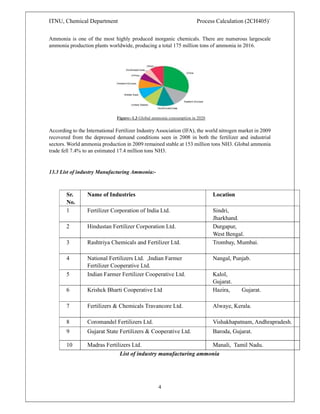
Ammonia is one of the most highly produced inorganic chemicals. There are numerous largescale
ammonia production plants worldwide, producing a total 175 million tons of ammonia in 2016.
According to the International Fertilizer Industry Association (IFA), the world nitrogen market in 2009
recovered from the depressed demand conditions seen in 2008 in both the fertilizer and industrial
sectors. World ammonia production in 2009 remained stable at 153 million tons NH3. Global ammonia
trade fell 7.4% to an estimated 17.4 million tons NH3.
13.3 List of industry Manufacturing Ammonia:-
Sr.
No.
Name of Industries Location
1 Fertilizer Corporation of India Ltd. Sindri,
Jharkhand.
2 Hindustan Fertilizer Corporation Ltd. Durgapur,
West Bengal.
3 Rashtriya Chemicals and Fertilizer Ltd. Trombay, Mumbai.
4 National Fertilizers Ltd. ,Indian Farmer
Fertilizer Cooperative Ltd.
Nangal, Punjab.
5 Indian Farmer Fertilizer Cooperative Ltd. Kalol,
Gujarat.
6 Krishck Bharti Cooperative Ltd Hazira, Gujarat.
7 Fertilizers & Chemicals Travancore Ltd. Alwaye, Kerala.
8 Coromandel Fertilizers Ltd. Vishakhapatnam, Andhrapradesh.
9 Gujarat State Fertilizers & Cooperative Ltd. Baroda, Gujarat.
10 Madras Fertilizers Ltd. Manali, Tamil Nadu.
List of industry manufacturing ammonia
ITNU, Chemical Department Process Calculation (2CH405)`
5
PROPERTIES OF AMMONIA
2.1 Physical properties of Ammonia
 Chemical formula:- NH3
 Molecular weight:- 17.031 gm/mol
 Appearance:- Colorless gas
 Odour:- Strong pungent smell
 Boiling point:- -33.34℃
 Melting point:- -77.73℃
 Density:- 0.769 kg/m3
 Viscocity:-0.276 kg/m.s at 40℃
 Flash point:-500℃
 Vapor pressure:-857.3 kPa
2.2 Chemical properties of Ammonia
 Oxidation of ammonia
When ammonia is made to burnt in an oxygen to form nitrogen gas and steam.
4NH3 + 3O2 → 2N2 + 6H2O
 Dissociation of Ammonia
Dissociation ammonia decomposes into nitrogen and hydrogen at red
heat or when electric sparks are passed through it.
2NH3 → N2 + 3H2
 Reaction with halogens
Ammonia gas reacts with chlorine gas to form nitrogen gas and ammonium
chloride salt.
8NH3 + 3CL2 → N2 + 6NH4Cl
 Formation of Amides:-
When ammonia is passed over heated sodium at 297℃, amides are produces with liberation
of hydrogen.
` 2NH3 + 2Na → 2NaNH2 + H2
ITNU, Chemical Department Process Calculation (2CH405)`
6
2.3 Appliaction of Ammonia:-
 In fertilizer:- 85 % ammonia is used in manufacturing of nitrogenous fertilizer such as Nitric
acid, Urea, Ammonium nitrate, Ammonium sulphate, Ammonium chloride etc. It is also used
for manufacturing mixed fertilizers for making monoammonium phosphate, Nitro phosphate
and Diammonium phosphate.
 As a Hydrogen carrier:-Today’s crisis is climate change. This time, ammonia could come to
the rescue by capturing, storing, and shipping hydrogen for use in emission-free fuel cells and
turbines.
 In The Manufacturing of Explosives:- Ammonia is used in manufacturing of nitric acid and
ammonium nitrate. Nitric acid is used in manufacturing of explosives such as nitroglycerine,
trinitrotoluene etc. Ammonium nitrate is used in manufacturing of astrolite, amatol etc.
 As a Propellant and Fuel:- Ammonia is use as the propellant in the missiles and rocket. It is
used to neutralize pollutant like nitrogen oxides emitted from diesel engines.
 In Fire Extinguisher:- Ammonium bicarbonate has applications in baking powder
formulations, in fire extinguishers.
 As a agent:- Ammonia is used in food products as an antimicrobial agent in food industry. It
is used in beverage industries as a stabilizer, neutralizer. It is used as a cleaning agent in the
many household and industrial – solutions to clean stainless steel and glass and as a
blowing agent in the manufacture of polymers. It is used as a pH adjuster in the fermentation
industry.
 As a Refrigerant:- Ammonia is used as a refrigerant gas in freezing and cold storage systems
and in air conditioning equipment.
 In Polymer Products:- Ammonia is used in the production of hexamethylene diamine
(HMDA) for nylon, acrylonitrile for fibers and plastics, caprolactam for nylon, isocyanates
for polyurethanes, and in manufacturing of hydrazine. It is used as a catalyst in phenol -
formaldehyde condensation and urea-formaldehyde condensation to make synthetic resins.
ITNU, Chemical Department Process Calculation (2CH405)`
7
MANUFACTURING PROCESS for Production of Ammonia
3.1 Haber-process
3.1.1 Chemical Reaction:
N2 + H2 → 2NH3
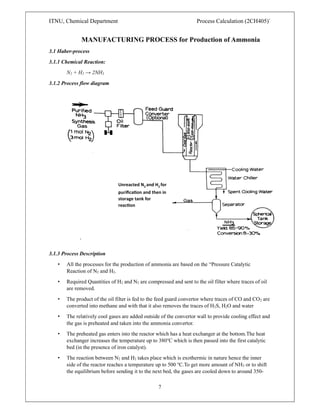
3.1.2 Process flow diagram
3.1.3 Process Description
• All the processes for the production of ammonia are based on the “Pressure Catalytic
Reaction of N2 and H2.
• Required Quantities of H2 and N2 are compressed and sent to the oil filter where traces of oil
are removed.
• The product of the oil filter is fed to the feed guard convertor where traces of CO and CO2 are
converted into methane and with that it also removes the traces of H2S, H2O and water
• The relatively cool gases are added outside of the convertor wall to provide cooling effect and
the gas is preheated and taken into the ammonia convertor.
• The preheated gas enters into the reactor which has a heat exchanger at the bottom.The heat
exchanger increases the temperature up to 380℃ which is then passed into the first catalytic
bed (in the presence of iron catalyst).
• The reaction between N2 and H2 takes place which is exothermic in nature hence the inner
side of the reactor reaches a temperature up to 500 ℃.To get more amount of NH3 or to shift
the equilibrium before sending it to the next bed, the gases are cooled down to around 350-
Unreacted N2 and H2 for
purifica on and then in
storage tank for
reac on
ITNU, Chemical Department Process Calculation (2CH405)`
8
400℃ by using cooling coil or inert gases which helps in shifting the equilibrium in the
forward direction.
• Again, in the second bed the reaction occurs and the same procedure takes place before
entering the third bed.
• Further the NH3 produced along with some unreacted gases is fed to the water chiller to
condense NH3 with the help of cooling water.
• Then, the gas from water chiller is passed to separator, where unreacted gas and NH3 is
separated and stored in storage tank.
3.1 Material balance For Haber-Bosch Process
Sr.
No.
Chemical
Name
Chemical
Formula
Molecular
Weight
1 Nitrogen N2 28.01
2 Hydrogen H2 2
3 Ammonia NH3 17.031
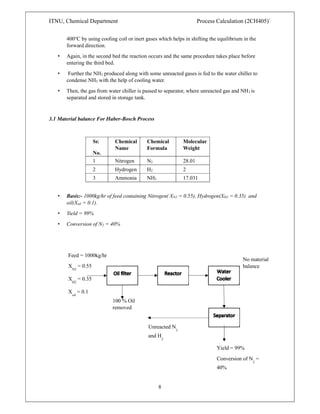
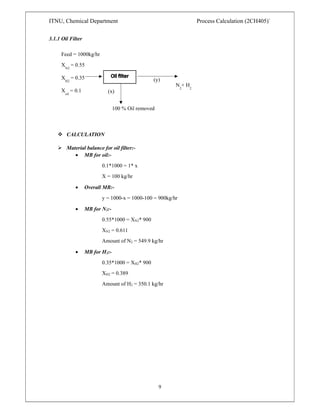
• Basis:- 1000kg/hr of feed containing Nitrogen( XN2 = 0.55), Hydrogen(XH2 = 0.35) and
oil(Xoil = 0.1).
• Yield = 99%
• Conversion of N2 = 40%
Feed = 1000kg/hr
XN2
= 0.55
XH2
= 0.35
Xoil
= 0.1
100 % Oil
removed
Unreacted N2
and H2
Yield = 99%
Conversion of N2
=
40%
No material
balance
ITNU, Chemical Department Process Calculation (2CH405)`
9
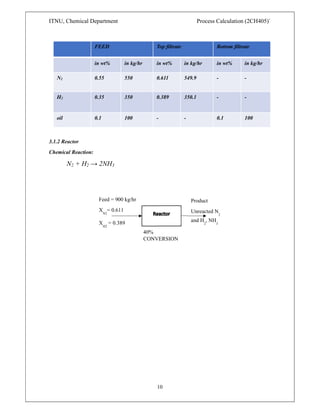
3.1.1 Oil Filter
 CALCULATION
 Material balance for oil filter:-
 MB for oil:-
0.1*1000 = 1* x
X = 100 kg/hr
 Overall MB:-
y = 1000-x = 1000-100 = 900kg/hr
 MB for N2:-
0.55*1000 = XN2* 900
XN2 = 0.611
Amount of N2 = 549.9 kg/hr
 MB for H2:-
0.35*1000 = XH2* 900
XH2 = 0.389
Amount of H2 = 350.1 kg/hr
100 % Oil removed
Feed = 1000kg/hr
XN2
= 0.55
XH2
= 0.35
Xoil
= 0.1
N2
+ H2
(x)
(y)
ITNU, Chemical Department Process Calculation (2CH405)`
10
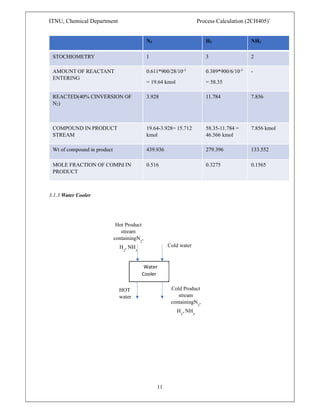
3.1.2 Reactor
Chemical Reaction:
N2 + H2 → 2NH3
FEED Top filtrate Bottom filtrate
in wt% in kg/hr in wt% in kg/hr in wt% in kg/hr
N2 0.55 550 0.611 549.9 - -
H2 0.35 350 0.389 350.1 - -
oil 0.1 100 - - 0.1 100
Feed = 900 kg/hr
X
N2
= 0.611
X
H2
= 0.389
40%
CONVERSION
OF N
Product
Unreacted N2
and H2
, NH3
ITNU, Chemical Department Process Calculation (2CH405)`
11
N2 H2 NH3
STOCHIOMETRY 1 3 2
AMOUNT OF REACTANT
ENTERING
0.611*900/28/10-3
= 19.64 kmol
0.389*900/6/10-3
= 58.35
-
REACTED(40% CINVERSION OF
N2)
3.928 11.784 7.856
COMPOUND IN PRODUCT
STREAM
19.64-3.928= 15.712
kmol
58.35-11.784 =
46.566 kmol
7.856 kmol
Wt of compound in product 439.936 279.396 133.552
MOLE FRACTION OF COMPd IN
PRODUCT
0.516 0.3275 0.1565
3.1.3 Water Cooler
CWater
Cooler
Hot Product
stream
containingN2
,
H2
, NH3
Cold water
HOT
water
Cold Product
stream
containingN2
,
H2
, NH3
ITNU, Chemical Department Process Calculation (2CH405)`
12
MASS BALANCE
• No mass balance required, as mass entering in the cooler is same as the water leaving the
cooler.
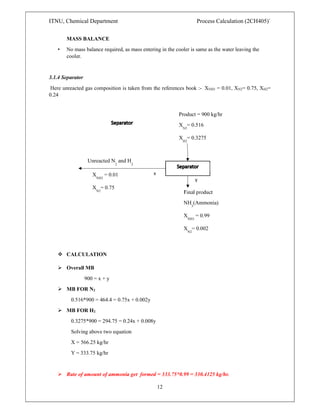
3.1.4 Separator
Here unreacted gas composition is taken from the references book :- XNH3 = 0.01, XN2= 0.75, XH2=
0.24
 CALCULATION
 Overall MB
900 = x + y
 MB FOR N2
0.516*900 = 464.4 = 0.75x + 0.002y
 MB FOR H2
0.3275*900 = 294.75 = 0.24x + 0.008y
Solving above two equation
X = 566.25 kg/hr
Y = 333.75 kg/hr
 Rate of amount of ammonia get formed = 333.75*0.99 = 330.4125 kg/hr.
Unreacted N
2
and H
2
Product = 900 kg/hr
XN2
= 0.516
XH2
= 0.3275
Final product
NH3
(Ammonia)
XNH3
= 0.99
XN2
= 0.002
x
y
X
NH3
= 0.01
X
N2
= 0.75
X = 0.24
ITNU, Chemical Department Process Calculation (2CH405)`
13
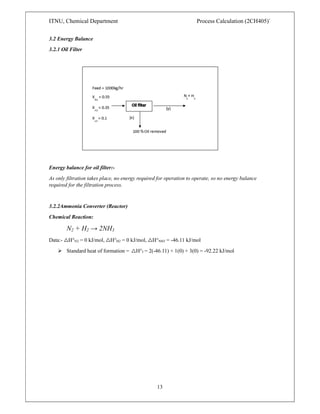
3.2 Energy Balance
3.2.1 Oil Filter
Energy balance for oil filter:-
As only filtration takes place, no energy required for operation to operate, so no energy balance
required for the filtration process.
3.2.2Ammonia Converter (Reactor)
Chemical Reaction:
N2 + H2 → 2NH3
Data:- △H°N2 = 0 kJ/mol, △H°H2 = 0 kJ/mol, △H°NH3 = -46.11 kJ/mol
 Standard heat of formation = △H°f = 2(-46.11) + 1(0) + 3(0) = -92.22 kJ/mol
ITNU, Chemical Department Process Calculation (2CH405)`
14
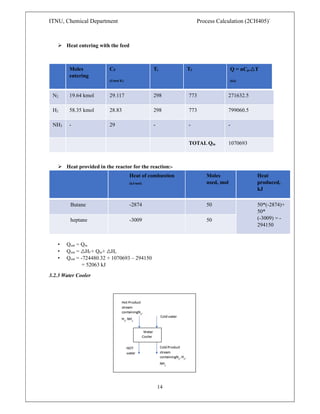
 Heat entering with the feed
Moles
entering
CP
(J/mol K)
Ti Tf Q = nCp.△T
(kJ)
N2 19.64 kmol 29.117 298 773 271632.5
H2 58.35 kmol 28.83 298 773 799060.5
NH3 - 29 - - -
TOTAL Qin 1070693
 Heat provided in the reactor for the reaction:-
Heat of combustion
(kJ/mol)
Moles
used, mol
Heat
produced,
kJ
Butane -2874 50 50*(-2874)+
50*
(-3009) = -
294150
heptane -3009 50
• Qout = Qin
• Qout = △Hf + Qin+ △Hc
• Qout = -724480.32 + 1070693 – 294150
= 52063 kJ
3.2.3 Water Cooler
ITNU, Chemical Department Process Calculation (2CH405)`
15
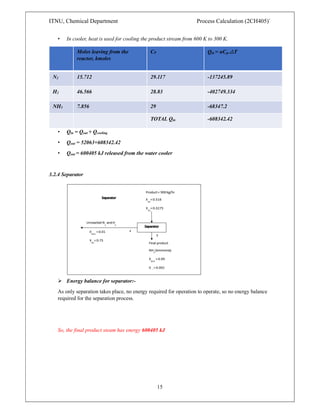
• In cooler, heat is used for cooling the product stream from 600 K to 300 K.
Moles leaving from the
reactor, kmoles
CP Qin = nCp.△T
N2 15.712 29.117 -137245.89
H2 46.566 28.83 -402749.334
NH3 7.856 29 -68347.2
TOTAL Qin -608342.42
• Qin = Qout + Qcooling
• Qout = 52063+608342.42
• Qout = 600405 kJ released from the water cooler
3.2.4 Separator
 Energy balance for separator:-
As only separation takes place, no energy required for operation to operate, so no energy balance
required for the separation process.
So, the final product steam has energy 600405 kJ

21bch011PC Term Paper(ammonia report).pdf

  • 1.
    ITNU, Chemical DepartmentProcess Calculation (2CH405)` 1 INSTITUE OF TECHNOLOGY, NIRMA UNIVERSITY Report on AMMONIAPRODUCTION 21BCH011-Mit Bhaliya 22BCH505- Aditya Parmar
  • 2.
    ITNU, Chemical DepartmentProcess Calculation (2CH405)` 2 ` 1.1 Introduction  Structure of ammonia Figure:-1.1 Ammonia Ammonia is also known as azane is a compound of nitrogen and hydrogen. It is the inorganic compound with the formula NH3 that the called azane. Ammonia is the colorless gas with a distinct odor. They are the main raw material for producing or manufacturing of urea, nitric acid, ammonium nitrate fertilizer. Ammonia is a key compound for making synthetic fertilizer. Ammonia is among the second largest chemicals in world production. China is the also a largest manufacturer and the one of the largest consumer of Ammonia. Ammonia is the one of the world’s most important and largest commodity chemicals. Ammonia is naturally occurring chemical and a product of most including human industrial and natural process. It does accumulate in environment or within plant, animals or people as it quickly breaks down in the body and the atmosphere. Similarly to fossil fuels, ammonia is both a chemical energy carrier and a potential fuel, where energy is released by the breaking of chemical bonds. Crucially, ammonia has the advantage of not releasing any carbon emissions if used as a fuel, and its green credentials can be enhanced even further if sustainable energy is used to power the production of ammonia. Ammonia gas can be dissolved in water. This kind of ammonia is called liquid ammonia or aqueous ammonia. Once exposed to open air, liquid ammonia quickly turns into a gas. In Solid or Liquid States Ammonia Salt and Solutions are active Components of mast Synthetic Fertilizer used in Agriculture. 85% of ammonia is used to manufacture synthetic Fertilizer in world. The Raw material for the manufacturing of ammonia is molecules of Nitrogen and hydrogen (N2 and H2). The use of natural gas as a source of hydrogen and energy needed to derive nitrogen from atmospheric air has been the subject environment. The Indian ammonia market in India size reached a consumption volume of about 15.1 million tons in 2020. The total ammonia plant capacity in India is 23.0 mt pa in 2021. Ammonia is about 15.1 million tons are produce annuls. In the upcoming years the market in India is expected to witness an annual capacity addition of nearly 9.27 tons. The primary industry method for ammonia synthesis is Haber- Bosch process, M. W. Kellogg process etc.
  • 3.
    ITNU, Chemical DepartmentProcess Calculation (2CH405)` 3 1.2 History Figure:-1.2 Founder of Ammonia production process- Haber process The Haber – Bosch process to produce ammonia from the nitrogen in air and hydrogen in natural gas was developed by Fritz Haber and Carl Bosch in 1909 and patented in 1910. Commercial production of ammonia began in Germany in 1913 and was taken up by China and U.S.by early 1930. The First commercial grade particle board was produced at a factory in Oppau, Germany in the 1913 and launched revolution in fertilizer industry.The demand of ammonia has risen steadily through the past century, driven by development in science and technology. 1.3 Present Status:- 1.3.1 Worldwide Production of Ammonia:- Sr.no Country Production Capacity in Millions Tons. 1 China 48 2 Russia 12 3 India 11 4 U.S. 9 5 Indonesia 5 6 Trinidad 5 7 Ukraine 4 Table:-1.1 Worldwide ammonia production
  • 4.
    ITNU, Chemical DepartmentProcess Calculation (2CH405)` 4 Ammonia is one of the most highly produced inorganic chemicals. There are numerous largescale ammonia production plants worldwide, producing a total 175 million tons of ammonia in 2016. According to the International Fertilizer Industry Association (IFA), the world nitrogen market in 2009 recovered from the depressed demand conditions seen in 2008 in both the fertilizer and industrial sectors. World ammonia production in 2009 remained stable at 153 million tons NH3. Global ammonia trade fell 7.4% to an estimated 17.4 million tons NH3. 13.3 List of industry Manufacturing Ammonia:- Sr. No. Name of Industries Location 1 Fertilizer Corporation of India Ltd. Sindri, Jharkhand. 2 Hindustan Fertilizer Corporation Ltd. Durgapur, West Bengal. 3 Rashtriya Chemicals and Fertilizer Ltd. Trombay, Mumbai. 4 National Fertilizers Ltd. ,Indian Farmer Fertilizer Cooperative Ltd. Nangal, Punjab. 5 Indian Farmer Fertilizer Cooperative Ltd. Kalol, Gujarat. 6 Krishck Bharti Cooperative Ltd Hazira, Gujarat. 7 Fertilizers & Chemicals Travancore Ltd. Alwaye, Kerala. 8 Coromandel Fertilizers Ltd. Vishakhapatnam, Andhrapradesh. 9 Gujarat State Fertilizers & Cooperative Ltd. Baroda, Gujarat. 10 Madras Fertilizers Ltd. Manali, Tamil Nadu. List of industry manufacturing ammonia
  • 5.
    ITNU, Chemical DepartmentProcess Calculation (2CH405)` 5 PROPERTIES OF AMMONIA 2.1 Physical properties of Ammonia  Chemical formula:- NH3  Molecular weight:- 17.031 gm/mol  Appearance:- Colorless gas  Odour:- Strong pungent smell  Boiling point:- -33.34℃  Melting point:- -77.73℃  Density:- 0.769 kg/m3  Viscocity:-0.276 kg/m.s at 40℃  Flash point:-500℃  Vapor pressure:-857.3 kPa 2.2 Chemical properties of Ammonia  Oxidation of ammonia When ammonia is made to burnt in an oxygen to form nitrogen gas and steam. 4NH3 + 3O2 → 2N2 + 6H2O  Dissociation of Ammonia Dissociation ammonia decomposes into nitrogen and hydrogen at red heat or when electric sparks are passed through it. 2NH3 → N2 + 3H2  Reaction with halogens Ammonia gas reacts with chlorine gas to form nitrogen gas and ammonium chloride salt. 8NH3 + 3CL2 → N2 + 6NH4Cl  Formation of Amides:- When ammonia is passed over heated sodium at 297℃, amides are produces with liberation of hydrogen. ` 2NH3 + 2Na → 2NaNH2 + H2
  • 6.
    ITNU, Chemical DepartmentProcess Calculation (2CH405)` 6 2.3 Appliaction of Ammonia:-  In fertilizer:- 85 % ammonia is used in manufacturing of nitrogenous fertilizer such as Nitric acid, Urea, Ammonium nitrate, Ammonium sulphate, Ammonium chloride etc. It is also used for manufacturing mixed fertilizers for making monoammonium phosphate, Nitro phosphate and Diammonium phosphate.  As a Hydrogen carrier:-Today’s crisis is climate change. This time, ammonia could come to the rescue by capturing, storing, and shipping hydrogen for use in emission-free fuel cells and turbines.  In The Manufacturing of Explosives:- Ammonia is used in manufacturing of nitric acid and ammonium nitrate. Nitric acid is used in manufacturing of explosives such as nitroglycerine, trinitrotoluene etc. Ammonium nitrate is used in manufacturing of astrolite, amatol etc.  As a Propellant and Fuel:- Ammonia is use as the propellant in the missiles and rocket. It is used to neutralize pollutant like nitrogen oxides emitted from diesel engines.  In Fire Extinguisher:- Ammonium bicarbonate has applications in baking powder formulations, in fire extinguishers.  As a agent:- Ammonia is used in food products as an antimicrobial agent in food industry. It is used in beverage industries as a stabilizer, neutralizer. It is used as a cleaning agent in the many household and industrial – solutions to clean stainless steel and glass and as a blowing agent in the manufacture of polymers. It is used as a pH adjuster in the fermentation industry.  As a Refrigerant:- Ammonia is used as a refrigerant gas in freezing and cold storage systems and in air conditioning equipment.  In Polymer Products:- Ammonia is used in the production of hexamethylene diamine (HMDA) for nylon, acrylonitrile for fibers and plastics, caprolactam for nylon, isocyanates for polyurethanes, and in manufacturing of hydrazine. It is used as a catalyst in phenol - formaldehyde condensation and urea-formaldehyde condensation to make synthetic resins.
  • 7.
    ITNU, Chemical DepartmentProcess Calculation (2CH405)` 7 MANUFACTURING PROCESS for Production of Ammonia 3.1 Haber-process 3.1.1 Chemical Reaction: N2 + H2 → 2NH3 3.1.2 Process flow diagram 3.1.3 Process Description • All the processes for the production of ammonia are based on the “Pressure Catalytic Reaction of N2 and H2. • Required Quantities of H2 and N2 are compressed and sent to the oil filter where traces of oil are removed. • The product of the oil filter is fed to the feed guard convertor where traces of CO and CO2 are converted into methane and with that it also removes the traces of H2S, H2O and water • The relatively cool gases are added outside of the convertor wall to provide cooling effect and the gas is preheated and taken into the ammonia convertor. • The preheated gas enters into the reactor which has a heat exchanger at the bottom.The heat exchanger increases the temperature up to 380℃ which is then passed into the first catalytic bed (in the presence of iron catalyst). • The reaction between N2 and H2 takes place which is exothermic in nature hence the inner side of the reactor reaches a temperature up to 500 ℃.To get more amount of NH3 or to shift the equilibrium before sending it to the next bed, the gases are cooled down to around 350- Unreacted N2 and H2 for purifica on and then in storage tank for reac on
  • 8.
    ITNU, Chemical DepartmentProcess Calculation (2CH405)` 8 400℃ by using cooling coil or inert gases which helps in shifting the equilibrium in the forward direction. • Again, in the second bed the reaction occurs and the same procedure takes place before entering the third bed. • Further the NH3 produced along with some unreacted gases is fed to the water chiller to condense NH3 with the help of cooling water. • Then, the gas from water chiller is passed to separator, where unreacted gas and NH3 is separated and stored in storage tank. 3.1 Material balance For Haber-Bosch Process Sr. No. Chemical Name Chemical Formula Molecular Weight 1 Nitrogen N2 28.01 2 Hydrogen H2 2 3 Ammonia NH3 17.031 • Basis:- 1000kg/hr of feed containing Nitrogen( XN2 = 0.55), Hydrogen(XH2 = 0.35) and oil(Xoil = 0.1). • Yield = 99% • Conversion of N2 = 40% Feed = 1000kg/hr XN2 = 0.55 XH2 = 0.35 Xoil = 0.1 100 % Oil removed Unreacted N2 and H2 Yield = 99% Conversion of N2 = 40% No material balance
  • 9.
    ITNU, Chemical DepartmentProcess Calculation (2CH405)` 9 3.1.1 Oil Filter  CALCULATION  Material balance for oil filter:-  MB for oil:- 0.1*1000 = 1* x X = 100 kg/hr  Overall MB:- y = 1000-x = 1000-100 = 900kg/hr  MB for N2:- 0.55*1000 = XN2* 900 XN2 = 0.611 Amount of N2 = 549.9 kg/hr  MB for H2:- 0.35*1000 = XH2* 900 XH2 = 0.389 Amount of H2 = 350.1 kg/hr 100 % Oil removed Feed = 1000kg/hr XN2 = 0.55 XH2 = 0.35 Xoil = 0.1 N2 + H2 (x) (y)
  • 10.
    ITNU, Chemical DepartmentProcess Calculation (2CH405)` 10 3.1.2 Reactor Chemical Reaction: N2 + H2 → 2NH3 FEED Top filtrate Bottom filtrate in wt% in kg/hr in wt% in kg/hr in wt% in kg/hr N2 0.55 550 0.611 549.9 - - H2 0.35 350 0.389 350.1 - - oil 0.1 100 - - 0.1 100 Feed = 900 kg/hr X N2 = 0.611 X H2 = 0.389 40% CONVERSION OF N Product Unreacted N2 and H2 , NH3
  • 11.
    ITNU, Chemical DepartmentProcess Calculation (2CH405)` 11 N2 H2 NH3 STOCHIOMETRY 1 3 2 AMOUNT OF REACTANT ENTERING 0.611*900/28/10-3 = 19.64 kmol 0.389*900/6/10-3 = 58.35 - REACTED(40% CINVERSION OF N2) 3.928 11.784 7.856 COMPOUND IN PRODUCT STREAM 19.64-3.928= 15.712 kmol 58.35-11.784 = 46.566 kmol 7.856 kmol Wt of compound in product 439.936 279.396 133.552 MOLE FRACTION OF COMPd IN PRODUCT 0.516 0.3275 0.1565 3.1.3 Water Cooler CWater Cooler Hot Product stream containingN2 , H2 , NH3 Cold water HOT water Cold Product stream containingN2 , H2 , NH3
  • 12.
    ITNU, Chemical DepartmentProcess Calculation (2CH405)` 12 MASS BALANCE • No mass balance required, as mass entering in the cooler is same as the water leaving the cooler. 3.1.4 Separator Here unreacted gas composition is taken from the references book :- XNH3 = 0.01, XN2= 0.75, XH2= 0.24  CALCULATION  Overall MB 900 = x + y  MB FOR N2 0.516*900 = 464.4 = 0.75x + 0.002y  MB FOR H2 0.3275*900 = 294.75 = 0.24x + 0.008y Solving above two equation X = 566.25 kg/hr Y = 333.75 kg/hr  Rate of amount of ammonia get formed = 333.75*0.99 = 330.4125 kg/hr. Unreacted N 2 and H 2 Product = 900 kg/hr XN2 = 0.516 XH2 = 0.3275 Final product NH3 (Ammonia) XNH3 = 0.99 XN2 = 0.002 x y X NH3 = 0.01 X N2 = 0.75 X = 0.24
  • 13.
    ITNU, Chemical DepartmentProcess Calculation (2CH405)` 13 3.2 Energy Balance 3.2.1 Oil Filter Energy balance for oil filter:- As only filtration takes place, no energy required for operation to operate, so no energy balance required for the filtration process. 3.2.2Ammonia Converter (Reactor) Chemical Reaction: N2 + H2 → 2NH3 Data:- △H°N2 = 0 kJ/mol, △H°H2 = 0 kJ/mol, △H°NH3 = -46.11 kJ/mol  Standard heat of formation = △H°f = 2(-46.11) + 1(0) + 3(0) = -92.22 kJ/mol
  • 14.
    ITNU, Chemical DepartmentProcess Calculation (2CH405)` 14  Heat entering with the feed Moles entering CP (J/mol K) Ti Tf Q = nCp.△T (kJ) N2 19.64 kmol 29.117 298 773 271632.5 H2 58.35 kmol 28.83 298 773 799060.5 NH3 - 29 - - - TOTAL Qin 1070693  Heat provided in the reactor for the reaction:- Heat of combustion (kJ/mol) Moles used, mol Heat produced, kJ Butane -2874 50 50*(-2874)+ 50* (-3009) = - 294150 heptane -3009 50 • Qout = Qin • Qout = △Hf + Qin+ △Hc • Qout = -724480.32 + 1070693 – 294150 = 52063 kJ 3.2.3 Water Cooler
  • 15.
    ITNU, Chemical DepartmentProcess Calculation (2CH405)` 15 • In cooler, heat is used for cooling the product stream from 600 K to 300 K. Moles leaving from the reactor, kmoles CP Qin = nCp.△T N2 15.712 29.117 -137245.89 H2 46.566 28.83 -402749.334 NH3 7.856 29 -68347.2 TOTAL Qin -608342.42 • Qin = Qout + Qcooling • Qout = 52063+608342.42 • Qout = 600405 kJ released from the water cooler 3.2.4 Separator  Energy balance for separator:- As only separation takes place, no energy required for operation to operate, so no energy balance required for the separation process. So, the final product steam has energy 600405 kJ