Dayananda Sagar College of Engineering
Department of Telecommunication Engineering
5G TECHNOLOGY
Technical Seminar on
Submitted by,
Yogesh Singh Bisht - 1DS17TE088
Under the guidance of
Prof. Saravana Kumar
INTRODUCTION
OBJECTIVES
TOOLS AND TECHNOLOGY
CONCLUSION
REFERENCES
Department of Telecommunication
Engineering 2
CONTENT
• 5G stands for 5th Generation Mobile Technology.
• It is designed to increase speed, reduce latency, and improve
flexibility of wireless services.
• With the swiftness in data sharing, the cell phone manufactures
focused on mobile broadband that can open a new window of
communication and navigation in the world of telecommunication.
• Your office will shrink into your handset with this cell phone that is
going to resemble PDA (personal digital assistant) of the twenty first
century.
Department of Telecommunication
Engineering 3
• To analyse the development of 5G
• To understand the architecture of 5G
• To acquire a knowledge of the application areas of 5G technology
• To learn more about the impact of 5G on global economy
Department of Telecommunication
Engineering
4
Department
of
Telecommunication
Engineering
5
Department of Telecommunication
Engineering
6
1G (1987-1992): It
was PHENOMENAL but
was not enough.
Engineer Neil Papworth
sent the first SMS on
December 3rd, 1992
Inception of AMPS (Advanced
Mobile Phone System)
technology
Seamless mobile
connectivity
Analog voice
Department of Telecommunication
Engineering
7
2G (1991-2001): A
revolutionary milestone
in telecommunication
sector
Voice, Fax, MMS and SMS services
TDMA (Time Division Multiple Access)
supported three times as many voice
channels in the same bandwidth
‘E’ & ‘G’ Symbols
2.5G - GPRS as enhanced Data services
2.75G - EDGE (Enhanced Data rates for
GSM Evolution) technology
Department of Telecommunication
Engineering
8
3G (2001-2009):
Showed us the unending
potential of Data yet did
not fulfil its own
potential
The max speed of 3G was estimated to
be around 2 mbps for stationary devices
and 384 kbps in mobile phones
It was based on CDMA2000 (Code
Division Multiple Access) & EDGE
technologies
3G introduced media streaming
Multimedia, navigation, mobile apps, browsers,
conference calls, mobile TV all saw their inception
in the early 3G era
It was all about data in the 3.5G.
Data transmission rates went up to
14 mbps
Department of Telecommunication
Engineering
9
4G (2010-2019): 4G
introduced us to a faster
world with a greater
Data capacity
Quality that enriched user experience
with advanced gaming services, HD
mobile TV, Video Conferencing, 3D TV etc.
3G features such as the radio spectrum
technology is removed.
MAGIC
4G LTE (Long Term Evolution) was a complete
redesign and simplification of 3G network
architecture
4G bandwidth is 200 mbps
Department of Telecommunication
Engineering
10
5G (2019 and beyond):
5G is more than a
generation, it is a
promise to wonderland.
Faster data rates, higher connection
density, much lower latency
Smaller IoT devices
Variety of spectrum bands, including
millimeter wave (mmWave) radio
spectrum
New immersive experiences such as VR and AR with
faster, more uniform data rates, lower latency, and
lower cost-per-bit
Self-driving cars may yet become a
reality even in India.
Department of Telecommunication
Engineering
11
The computation and communication are
always available and ready for serving the user
in intelligent way.
Nano Sensors: Physical, Chemical and
Biosensor
Access to virtual machines via phones will
become common because of
larger computing and machine-to-machine
communication provided by 5G.
AIPN provides a continued evolution and
optimization of the system concept in order to
provide a competitive edge in terms of both
performance and cost.
NANO
TECHNOLOGY
CLOUD
COMPUTING
AIPN
Department of Telecommunication
Engineering
12
Fig 1. 5G Architecture
Department of Telecommunication
Engineering
13
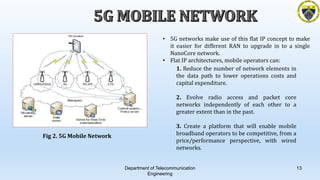
Fig 2. 5G Mobile Network
• 5G networks make use of this flat IP concept to make
it easier for different RAN to upgrade in to a single
NanoCore network.
• Flat IP architectures, mobile operators can:
1. Reduce the number of network elements in
the data path to lower operations costs and
capital expenditure.
2. Evolve radio access and packet core
networks independently of each other to a
greater extent than in the past.
3. Create a platform that will enable mobile
broadband operators to be competitive, from a
price/performance perspective, with wired
networks.
Department of Telecommunication
Engineering
14
SPEED
5G speeds will range
from ~50 Mbits/s to
over a gigabit/s.
The fastest 5G is
known as mmWave.
LATENCY
In 5G, the "air
latency" in
equipment shipping
in 2019 is 8–12
milliseconds.
Verizon reports the
latency on its 5G
early deployment as
30 ms
ERROR RATE
5G uses an adaptive
signal coding system
to keep the bit error
rate low.
If the error rate is too
high the transmitter
will switch to a less
error prone coding
mechanism.
RANGE
The range of 5G
depends on many
factors. A key
factor is the
frequency being
used.
Wave signals tend
to have a range of
only a couple of
hundred metres
Department of Telecommunication
Engineering
15
1. New Radio Frequencies
The air interface defined by 3GPP for 5G is known as New Radio (NR), and the specification is
subdivided into two frequency bands, FR1 (below 6 GHz) and FR2 (mmWave), each with different
capabilities.
2. Massive MIMO
MIMO systems use multiple antennas at the transmitter and receiver ends of a wireless
communication system. Multiple antennas use the spatial dimension in addition to the time and
frequency ones, without changing the bandwidth requirements of the system.
3. Edge computing
Edge computing is delivered by computing servers closer to the ultimate user. It reduces latency
and data traffic congestion.
4. Small cell
Small cells are low-powered cellular radio access nodes that operate in licensed and unlicensed
spectrum that have a range of 10 meters to a few kilometers.
Department of Telecommunication
Engineering
16
5. Beamforming
Beamforming is used to direct radio waves to a target. This is achieved by shaping the radio waves to
point in a specific direction.
6. NOMA (Non-Orthogonal Multiple Access)
NOMA (non-orthogonal multiple access) is a proposed multiple-access technique for future cellular
systems via allocation of power.
7. SDN (Software-Defined Networking)
This pool of applications consists of different domains such as the Internet of Things (IoT), web of
connected autonomous vehicles, remotely controlled robots, and heterogeneous sensors connected to
serve versatile applications.
8. Channel coding
The channel coding techniques for 5G NR have changed from Turbo codes in 4G to polar codes for the
control channels and LDPC (low-density parity check codes) for the data channels.
Department of Telecommunication
Engineering
17
1. 5G is a unified platform that is more capable than 4G
2. 5G uses spectrum better than 4G
3. 5G is faster than 4G
4. 5G has more capacity than 4G
5. 5G has lower latency than 4G
Department of Telecommunication
Engineering
18
On March 6, 2020, the first-ever all-5G
smartphone Samsung Galaxy S20 was
released
Fig 3. Samsung Galaxy S20
On March 19, HMD Global, the
current maker of Nokia-branded
phones, announced the Nokia
8.3 5G
Fig 4. Nokia 8.3
On October 13, 2020, Apple announced
the iPhone 12 and the iPhone 12 Pro,
the first line of Apple phones to support
5G connectivity
Fig 5. iPhone 12
Department of Telecommunication
Engineering
19
• Enhanced Mobile Broadband (eMBB) uses 5G as a progression from 4G LTE. This will benefit areas of higher traffic
such as stadiums, cities, and concert venues.
• Ultra-Reliable Low-Latency Communications (URLLC) refer to using the network for mission critical applications
that require uninterrupted and robust data exchange.
• Massive Machine-Type Communications (mMTC) would be used to connect to a large number of devices.
• Automobiles: 5G Automotive Association have been promoting the CV2X communication technology that will first be
deployed in 4G.
• Public safety: Mission-critical push-to-talk (MCPTT) and mission-critical video and data are expected to be furthered
in 5G.
• Fixed wireless: Fixed wireless connections will offer an alternative to fixed line broadband (ADSL, VDSL, Fiber optic,
and DOCSIS connections) in some locations.
• Wireless video transmission for broadcast applications: Sony has tested the possibility of using local 5G networks
to replace the SDI cables currently used in broadcast camcorders.
Department of Telecommunication
Engineering
20
5G is driving global growth.
• 13.1 Trillion dollars of global economic output
• 22.8 Million new jobs created
• 265B global 5G CAPEX and R&D annually over the next 15 years
Through a landmark 5G Economy study, we found that 5G’s full economic effect will likely be
realized across the globe by 2035—supporting a wide range of industries and potentially
enabling up to $13.1 trillion worth of goods and services.
Department of Telecommunication
Engineering
21
• Yes, 5G is already here today, and global operators started launching new
5G networks in early 2019.
• Also, all major phone manufacturers are commercializing 5G phones. And
soon, even more people may be able to access 5G.
• 5G has been deployed in 60+ countries and counting.
Department of Telecommunication
Engineering
22
• The development of the mobile and wireless networks is going towards higher data rates
and all-IP principle.
• Mobile terminals are obtaining each year more processing power, more memory on board, and
longer battery life for the same applications.
• 5G include latest technologies such as cognitive radio, SDR, nanotechnology, cloud computing
and based on All IP Platform.
• It is expected that the initial Internet philosophy of keeping the network simple as possible,
and giving more functionalities to the end nodes, will become reality in the future generation
of mobile networks, here referred to as 5G.
• The 5G technologies include all type of advanced features which makes 5G mobile technology
most powerful and in huge demand in near future.
Department of Telecommunication
Engineering
23
[1]Ganesh R. Patil, Prashant S Wakhande, 5G Wireless Technology: IJCSMC, Vol. 3, Issue. 10, October
2014, pg.203 – 207.
[2]Suvarna Patil, Vipin Patil, Pallavi Bhat, A Review on 5G Technology: IJEIT, Volume 1, Issue
1,January 2012
[3]T.Venkat Narayana Rao, 5G technologies – an anecdote of network service for the future: Journal
of Global Research in Computer Science Volume 2 No (7), July 2011 164-170.
[4]Mudit Ratana Bhalla, Generations of Mobile Wireless Technology - A Survey: International Journal
of Computer Applications (0975 – 8887) Volume 5– No.4, August 2010.
Abdullah Gani, Xichun Li, Lina Yang, Omar Zakaria, Nor Badrul Anuar, Multi-Bandwidth Data Path
Design for 5G Wireless Mobile Internets: WSEAS Transactions on Information Science and
Applications archive, Volume 6, Issue 2, February 2009. ISSN: 1790-0832.
THANK YOU
24
Department
of
Telecommunication
Engineering

Seminar-Presentation_TE088.pptx

  • 1.
    Dayananda Sagar Collegeof Engineering Department of Telecommunication Engineering 5G TECHNOLOGY Technical Seminar on Submitted by, Yogesh Singh Bisht - 1DS17TE088 Under the guidance of Prof. Saravana Kumar
  • 2.
  • 3.
    • 5G standsfor 5th Generation Mobile Technology. • It is designed to increase speed, reduce latency, and improve flexibility of wireless services. • With the swiftness in data sharing, the cell phone manufactures focused on mobile broadband that can open a new window of communication and navigation in the world of telecommunication. • Your office will shrink into your handset with this cell phone that is going to resemble PDA (personal digital assistant) of the twenty first century. Department of Telecommunication Engineering 3
  • 4.
    • To analysethe development of 5G • To understand the architecture of 5G • To acquire a knowledge of the application areas of 5G technology • To learn more about the impact of 5G on global economy Department of Telecommunication Engineering 4
  • 5.
  • 6.
    Department of Telecommunication Engineering 6 1G(1987-1992): It was PHENOMENAL but was not enough. Engineer Neil Papworth sent the first SMS on December 3rd, 1992 Inception of AMPS (Advanced Mobile Phone System) technology Seamless mobile connectivity Analog voice
  • 7.
    Department of Telecommunication Engineering 7 2G(1991-2001): A revolutionary milestone in telecommunication sector Voice, Fax, MMS and SMS services TDMA (Time Division Multiple Access) supported three times as many voice channels in the same bandwidth ‘E’ & ‘G’ Symbols 2.5G - GPRS as enhanced Data services 2.75G - EDGE (Enhanced Data rates for GSM Evolution) technology
  • 8.
    Department of Telecommunication Engineering 8 3G(2001-2009): Showed us the unending potential of Data yet did not fulfil its own potential The max speed of 3G was estimated to be around 2 mbps for stationary devices and 384 kbps in mobile phones It was based on CDMA2000 (Code Division Multiple Access) & EDGE technologies 3G introduced media streaming Multimedia, navigation, mobile apps, browsers, conference calls, mobile TV all saw their inception in the early 3G era It was all about data in the 3.5G. Data transmission rates went up to 14 mbps
  • 9.
    Department of Telecommunication Engineering 9 4G(2010-2019): 4G introduced us to a faster world with a greater Data capacity Quality that enriched user experience with advanced gaming services, HD mobile TV, Video Conferencing, 3D TV etc. 3G features such as the radio spectrum technology is removed. MAGIC 4G LTE (Long Term Evolution) was a complete redesign and simplification of 3G network architecture 4G bandwidth is 200 mbps
  • 10.
    Department of Telecommunication Engineering 10 5G(2019 and beyond): 5G is more than a generation, it is a promise to wonderland. Faster data rates, higher connection density, much lower latency Smaller IoT devices Variety of spectrum bands, including millimeter wave (mmWave) radio spectrum New immersive experiences such as VR and AR with faster, more uniform data rates, lower latency, and lower cost-per-bit Self-driving cars may yet become a reality even in India.
  • 11.
    Department of Telecommunication Engineering 11 Thecomputation and communication are always available and ready for serving the user in intelligent way. Nano Sensors: Physical, Chemical and Biosensor Access to virtual machines via phones will become common because of larger computing and machine-to-machine communication provided by 5G. AIPN provides a continued evolution and optimization of the system concept in order to provide a competitive edge in terms of both performance and cost. NANO TECHNOLOGY CLOUD COMPUTING AIPN
  • 12.
  • 13.
    Department of Telecommunication Engineering 13 Fig2. 5G Mobile Network • 5G networks make use of this flat IP concept to make it easier for different RAN to upgrade in to a single NanoCore network. • Flat IP architectures, mobile operators can: 1. Reduce the number of network elements in the data path to lower operations costs and capital expenditure. 2. Evolve radio access and packet core networks independently of each other to a greater extent than in the past. 3. Create a platform that will enable mobile broadband operators to be competitive, from a price/performance perspective, with wired networks.
  • 14.
    Department of Telecommunication Engineering 14 SPEED 5Gspeeds will range from ~50 Mbits/s to over a gigabit/s. The fastest 5G is known as mmWave. LATENCY In 5G, the "air latency" in equipment shipping in 2019 is 8–12 milliseconds. Verizon reports the latency on its 5G early deployment as 30 ms ERROR RATE 5G uses an adaptive signal coding system to keep the bit error rate low. If the error rate is too high the transmitter will switch to a less error prone coding mechanism. RANGE The range of 5G depends on many factors. A key factor is the frequency being used. Wave signals tend to have a range of only a couple of hundred metres
  • 15.
    Department of Telecommunication Engineering 15 1.New Radio Frequencies The air interface defined by 3GPP for 5G is known as New Radio (NR), and the specification is subdivided into two frequency bands, FR1 (below 6 GHz) and FR2 (mmWave), each with different capabilities. 2. Massive MIMO MIMO systems use multiple antennas at the transmitter and receiver ends of a wireless communication system. Multiple antennas use the spatial dimension in addition to the time and frequency ones, without changing the bandwidth requirements of the system. 3. Edge computing Edge computing is delivered by computing servers closer to the ultimate user. It reduces latency and data traffic congestion. 4. Small cell Small cells are low-powered cellular radio access nodes that operate in licensed and unlicensed spectrum that have a range of 10 meters to a few kilometers.
  • 16.
    Department of Telecommunication Engineering 16 5.Beamforming Beamforming is used to direct radio waves to a target. This is achieved by shaping the radio waves to point in a specific direction. 6. NOMA (Non-Orthogonal Multiple Access) NOMA (non-orthogonal multiple access) is a proposed multiple-access technique for future cellular systems via allocation of power. 7. SDN (Software-Defined Networking) This pool of applications consists of different domains such as the Internet of Things (IoT), web of connected autonomous vehicles, remotely controlled robots, and heterogeneous sensors connected to serve versatile applications. 8. Channel coding The channel coding techniques for 5G NR have changed from Turbo codes in 4G to polar codes for the control channels and LDPC (low-density parity check codes) for the data channels.
  • 17.
    Department of Telecommunication Engineering 17 1.5G is a unified platform that is more capable than 4G 2. 5G uses spectrum better than 4G 3. 5G is faster than 4G 4. 5G has more capacity than 4G 5. 5G has lower latency than 4G
  • 18.
    Department of Telecommunication Engineering 18 OnMarch 6, 2020, the first-ever all-5G smartphone Samsung Galaxy S20 was released Fig 3. Samsung Galaxy S20 On March 19, HMD Global, the current maker of Nokia-branded phones, announced the Nokia 8.3 5G Fig 4. Nokia 8.3 On October 13, 2020, Apple announced the iPhone 12 and the iPhone 12 Pro, the first line of Apple phones to support 5G connectivity Fig 5. iPhone 12
  • 19.
    Department of Telecommunication Engineering 19 •Enhanced Mobile Broadband (eMBB) uses 5G as a progression from 4G LTE. This will benefit areas of higher traffic such as stadiums, cities, and concert venues. • Ultra-Reliable Low-Latency Communications (URLLC) refer to using the network for mission critical applications that require uninterrupted and robust data exchange. • Massive Machine-Type Communications (mMTC) would be used to connect to a large number of devices. • Automobiles: 5G Automotive Association have been promoting the CV2X communication technology that will first be deployed in 4G. • Public safety: Mission-critical push-to-talk (MCPTT) and mission-critical video and data are expected to be furthered in 5G. • Fixed wireless: Fixed wireless connections will offer an alternative to fixed line broadband (ADSL, VDSL, Fiber optic, and DOCSIS connections) in some locations. • Wireless video transmission for broadcast applications: Sony has tested the possibility of using local 5G networks to replace the SDI cables currently used in broadcast camcorders.
  • 20.
    Department of Telecommunication Engineering 20 5Gis driving global growth. • 13.1 Trillion dollars of global economic output • 22.8 Million new jobs created • 265B global 5G CAPEX and R&D annually over the next 15 years Through a landmark 5G Economy study, we found that 5G’s full economic effect will likely be realized across the globe by 2035—supporting a wide range of industries and potentially enabling up to $13.1 trillion worth of goods and services.
  • 21.
    Department of Telecommunication Engineering 21 •Yes, 5G is already here today, and global operators started launching new 5G networks in early 2019. • Also, all major phone manufacturers are commercializing 5G phones. And soon, even more people may be able to access 5G. • 5G has been deployed in 60+ countries and counting.
  • 22.
    Department of Telecommunication Engineering 22 •The development of the mobile and wireless networks is going towards higher data rates and all-IP principle. • Mobile terminals are obtaining each year more processing power, more memory on board, and longer battery life for the same applications. • 5G include latest technologies such as cognitive radio, SDR, nanotechnology, cloud computing and based on All IP Platform. • It is expected that the initial Internet philosophy of keeping the network simple as possible, and giving more functionalities to the end nodes, will become reality in the future generation of mobile networks, here referred to as 5G. • The 5G technologies include all type of advanced features which makes 5G mobile technology most powerful and in huge demand in near future.
  • 23.
    Department of Telecommunication Engineering 23 [1]GaneshR. Patil, Prashant S Wakhande, 5G Wireless Technology: IJCSMC, Vol. 3, Issue. 10, October 2014, pg.203 – 207. [2]Suvarna Patil, Vipin Patil, Pallavi Bhat, A Review on 5G Technology: IJEIT, Volume 1, Issue 1,January 2012 [3]T.Venkat Narayana Rao, 5G technologies – an anecdote of network service for the future: Journal of Global Research in Computer Science Volume 2 No (7), July 2011 164-170. [4]Mudit Ratana Bhalla, Generations of Mobile Wireless Technology - A Survey: International Journal of Computer Applications (0975 – 8887) Volume 5– No.4, August 2010. Abdullah Gani, Xichun Li, Lina Yang, Omar Zakaria, Nor Badrul Anuar, Multi-Bandwidth Data Path Design for 5G Wireless Mobile Internets: WSEAS Transactions on Information Science and Applications archive, Volume 6, Issue 2, February 2009. ISSN: 1790-0832.
  • 24.