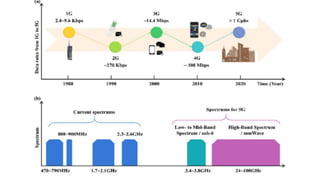
Evolution of GSM
•1G, the first generation of telecom networks (1979), let us talk to each
other and be mobile
•2G digital networks (1991) let us send messages and travel (with roaming
services)
•3G (1998) brought a better mobile internet experience (with limited
success)
•3.5G brought a truly mobile internet experience, unleashing the mobile
apps ecosystem
•4G (2008) networks brought all-IP services (Voice and Data), a fast
broadband internet experience, with unified networks architectures and
protocols
•4G LTE ( for Long Term Evolution), starting in 2009, doubled data speeds
•5G networks (2019) expand broadband wireless services beyond mobile
internet to IoT and critical communications segments
• Wi-Fi offloading
• Wi-fi offloading is one of the main features of future networks. It
allows the user to connect using a wi-fi network and the cellular
network can be allocated to other users. It would be suitable for
some places where cellular network quality is poor and users still
have the option to connect to the network without cellular
reception.
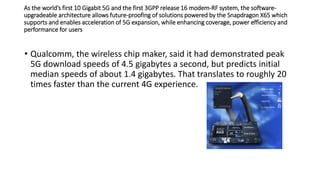
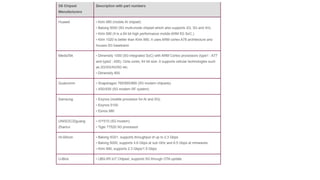
As the world’s first 10 Gigabit 5G and the first 3GPP release 16 modem-RF system, the software-
upgradeable architecture allows future-proofing of solutions powered by the Snapdragon X65 which
supports and enables acceleration of 5G expansion, while enhancing coverage, power efficiency and
performance for users
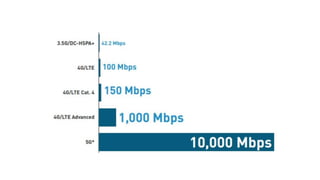
• Qualcomm, the wireless chip maker, said it had demonstrated peak
5G download speeds of 4.5 gigabytes a second, but predicts initial
median speeds of about 1.4 gigabytes. That translates to roughly 20
times faster than the current 4G experience.
• mmWave high-band 5G: About 10x faster than LTE with extremely low
latency, which means individual messages are transmitted almost
instantaneously. But you need to be standing really close to a tower or
transmitter to get those speeds.
• Mid-band 5G: Sprint. About 6x faster than LTE, but with a smaller footprint
than low-band.
• Low-band 5G:. About 20 percent faster than 4G LTE.
• Millimeter wave is the “best” 5G. If you download a 4GB file, like a movie,
you might be able to do that in about 5 minutes and 19 seconds on today’s
fastest 4G LTE networks (assuming a 100Mbps connection). On a mmWave
high-band 5G connection, that same movie would take only 32 seconds
(assuming 1000Mbps)
5G is driving global growth.
• $13.1 Trillion dollars of global economic output
• $22.8 Million new jobs created
• $265B global 5G CAPEX and R&D annually over the next 15 years
Through a landmark 5G Economy study, we found that 5G’s full
economic effect will likely be realized across the globe by 2035—
supporting a wide range of industries and potentially enabling up to
$13.1 trillion worth of goods and services.
This impact is much greater than previous network generations. The
development requirements of the new 5G network are also expanding
beyond the traditional mobile networking players to industries such as
the automotive industry.
The study also revealed that the 5G value chain (including OEMs,
operators, content creators, app developers, and consumers) could
alone support up to 22.8 million jobs, or more than one job for every
person in Beijing, China. And there are many emerging and new
applications that will still be defined in the future. Only time will tell
what the full “5G effect” on the economy is going to be.
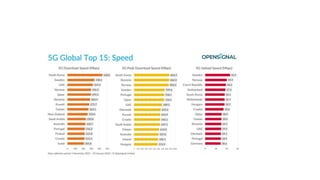
5G download speed may differ widely by area.According to the
February 2020 issue of Fortune Magazine, average 5G speed
measures done in Q3/Q4 2019 range from:
•220 megabytes per second (Mbps) in Las Vegas,
•350 in New York,
•380 in Los Angeles,
•450 in Dallas,
•to 550 Chicago,
•and over 950 in Minneapolis and Providence approximatively.
•That's 10 to 50 times more than 4G LTE.
With 4G, you can combine up to seven, 20MHz channels to use
a total of 140MHz of spectrum. Most of the time, though,
phones are using 60MHz or less.
With new phones in low- and mid-band 5G, you can combine
three 100MHz channels for 300MHz usage—and stack several
more 20MHz 4G channels on top of that. In high-band 5G, you
can use up to eight 100MHz channels
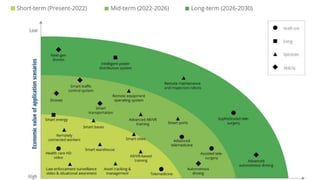
• V2X (Vehicle-to-Everything) communication: V2V: (Vehicle-to-Vehicle), V2I
(Vehicle-to-Infrastructure), autonomous, connected cars
• Immersive Virtual Reality Gaming (5G will bring VR to the masses.)
• Remote surgical operations (aka telesurgery)
• Simultaneous translating.
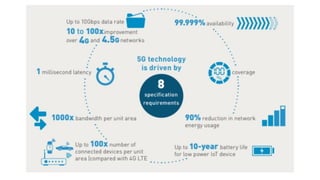
• 5G vs 4G also means at least x100 devices connected. 5G must support 1
million devices for 0.386 square miles or 1 km2.
• Also, low power consumption is what will allow connected objects to
operate for months or years without the need for human assistance.
• Ultra-low-latency 5G also offers the promise of “six nines,” or 99.9999%
reliability
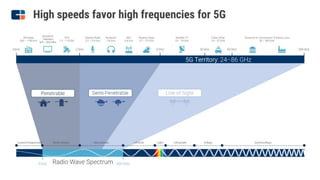
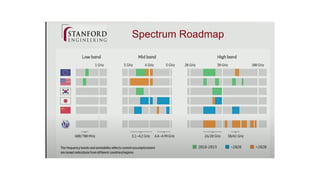
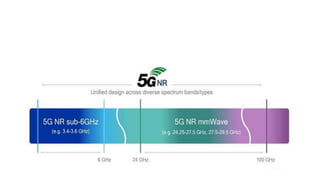
•Low band (under 3GHz) travels long distances with
minimal signal interruption and with better building
penetration. Today’s wireless networks are built primarily
on the low-band spectrum.
•High band (above 24 GHz) travels shorter distances—
meters, not miles—and cannot easily penetrate objects
such as buildings, but offers high capacity and ultra-fast
speeds.
•Mid band (between 3 GHz and 24 GHz) blends the
characteristics of both low- and high-band spectrum,
providing a mix of coverage and capacity
• Some critical applications like self-driving cars require very aggressive
latency (fast response time) while they do not require fast data rates.
• 4G networks use the USIM application to perform strong mutual
authentication between the user and their connected device and the
networks.
• The entity hosting the USIM application can be a removable SIM card or an
embedded UICC chip.
• This strong mutual authentication is crucial to enable trusted services.
• Today, security solutions are already a mix of security at the edge (device)
and security at the core (network).
• Several security frameworks may co-exist in the future, and 5G is likely to
re-use existing solutions used today for 4G networks and the cloud (SEs,
HSM, certification, Over-The-Air provisioning, and KMS).
• virtualized radio access network (vRAN) solution based on an open
architecture that can let rural MNOs expand their network with less
CAPEX cost because the software runs on industry-standard servers
powered by Intel/amd architecture CPUs instead of high-cost fixed-
function appliances.
• A 5G SIM is a tamper-proof secure element, which is the only solution
to secure 5G network access.
• A 5G SIM encompasses all form factors (removable SIM, IoT SIM, 5G
eSIM).
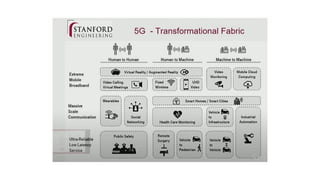
A person in a rural area needs surgery—and soon. The nearest city hospital is almost 200 miles away, so
he checks into a remote surgical facility near his home. A surgeon conducts the operation via robot, from
his city office, and videoconferences with the family to provide post-op feedback.
A firefighter responds to an emergency in a congested neighborhood. He quickly accesses the area’s public
camera and drone feeds to understand the topography, then begins scanning real-time data from embedded
sensors to understand the temperature and air quality before he enters the premises
Transform government operations, providing access to unprecedented levels of real-time information from any
device, anytime and anywhere, especially for field workers such as first responders, food and agricultural
inspectors, law enforcement, and military personnel.
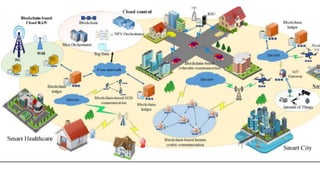
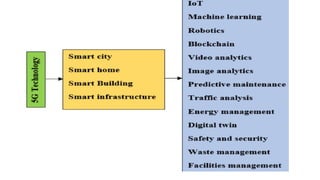
Improve public infrastructure, creating smart, hyperconnected communities.
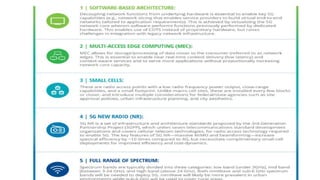
Act as a force multiplier for other innovative technologies such as artificial intelligence (AI) and multiaccess edge
computing (MEC), a network architecture concept that greatly expands the abilities of cloud computing at the
edge or closer to the user. These innovations can transform public services in areas such as health care, law
enforcement, mobility, and more.

5g.pdf

  • 1.
    Evolution of GSM •1G,the first generation of telecom networks (1979), let us talk to each other and be mobile •2G digital networks (1991) let us send messages and travel (with roaming services) •3G (1998) brought a better mobile internet experience (with limited success) •3.5G brought a truly mobile internet experience, unleashing the mobile apps ecosystem •4G (2008) networks brought all-IP services (Voice and Data), a fast broadband internet experience, with unified networks architectures and protocols •4G LTE ( for Long Term Evolution), starting in 2009, doubled data speeds •5G networks (2019) expand broadband wireless services beyond mobile internet to IoT and critical communications segments
  • 12.
    • Wi-Fi offloading •Wi-fi offloading is one of the main features of future networks. It allows the user to connect using a wi-fi network and the cellular network can be allocated to other users. It would be suitable for some places where cellular network quality is poor and users still have the option to connect to the network without cellular reception.
  • 14.
    As the world’sfirst 10 Gigabit 5G and the first 3GPP release 16 modem-RF system, the software- upgradeable architecture allows future-proofing of solutions powered by the Snapdragon X65 which supports and enables acceleration of 5G expansion, while enhancing coverage, power efficiency and performance for users • Qualcomm, the wireless chip maker, said it had demonstrated peak 5G download speeds of 4.5 gigabytes a second, but predicts initial median speeds of about 1.4 gigabytes. That translates to roughly 20 times faster than the current 4G experience.
  • 15.
    • mmWave high-band5G: About 10x faster than LTE with extremely low latency, which means individual messages are transmitted almost instantaneously. But you need to be standing really close to a tower or transmitter to get those speeds. • Mid-band 5G: Sprint. About 6x faster than LTE, but with a smaller footprint than low-band. • Low-band 5G:. About 20 percent faster than 4G LTE. • Millimeter wave is the “best” 5G. If you download a 4GB file, like a movie, you might be able to do that in about 5 minutes and 19 seconds on today’s fastest 4G LTE networks (assuming a 100Mbps connection). On a mmWave high-band 5G connection, that same movie would take only 32 seconds (assuming 1000Mbps)
  • 18.
    5G is drivingglobal growth. • $13.1 Trillion dollars of global economic output • $22.8 Million new jobs created • $265B global 5G CAPEX and R&D annually over the next 15 years Through a landmark 5G Economy study, we found that 5G’s full economic effect will likely be realized across the globe by 2035— supporting a wide range of industries and potentially enabling up to $13.1 trillion worth of goods and services. This impact is much greater than previous network generations. The development requirements of the new 5G network are also expanding beyond the traditional mobile networking players to industries such as the automotive industry. The study also revealed that the 5G value chain (including OEMs, operators, content creators, app developers, and consumers) could alone support up to 22.8 million jobs, or more than one job for every person in Beijing, China. And there are many emerging and new applications that will still be defined in the future. Only time will tell what the full “5G effect” on the economy is going to be.
  • 19.
    5G download speedmay differ widely by area.According to the February 2020 issue of Fortune Magazine, average 5G speed measures done in Q3/Q4 2019 range from: •220 megabytes per second (Mbps) in Las Vegas, •350 in New York, •380 in Los Angeles, •450 in Dallas, •to 550 Chicago, •and over 950 in Minneapolis and Providence approximatively. •That's 10 to 50 times more than 4G LTE. With 4G, you can combine up to seven, 20MHz channels to use a total of 140MHz of spectrum. Most of the time, though, phones are using 60MHz or less. With new phones in low- and mid-band 5G, you can combine three 100MHz channels for 300MHz usage—and stack several more 20MHz 4G channels on top of that. In high-band 5G, you can use up to eight 100MHz channels
  • 20.
    • V2X (Vehicle-to-Everything)communication: V2V: (Vehicle-to-Vehicle), V2I (Vehicle-to-Infrastructure), autonomous, connected cars • Immersive Virtual Reality Gaming (5G will bring VR to the masses.) • Remote surgical operations (aka telesurgery) • Simultaneous translating. • 5G vs 4G also means at least x100 devices connected. 5G must support 1 million devices for 0.386 square miles or 1 km2. • Also, low power consumption is what will allow connected objects to operate for months or years without the need for human assistance. • Ultra-low-latency 5G also offers the promise of “six nines,” or 99.9999% reliability
  • 21.
    •Low band (under3GHz) travels long distances with minimal signal interruption and with better building penetration. Today’s wireless networks are built primarily on the low-band spectrum. •High band (above 24 GHz) travels shorter distances— meters, not miles—and cannot easily penetrate objects such as buildings, but offers high capacity and ultra-fast speeds. •Mid band (between 3 GHz and 24 GHz) blends the characteristics of both low- and high-band spectrum, providing a mix of coverage and capacity
  • 24.
    • Some criticalapplications like self-driving cars require very aggressive latency (fast response time) while they do not require fast data rates. • 4G networks use the USIM application to perform strong mutual authentication between the user and their connected device and the networks. • The entity hosting the USIM application can be a removable SIM card or an embedded UICC chip. • This strong mutual authentication is crucial to enable trusted services. • Today, security solutions are already a mix of security at the edge (device) and security at the core (network). • Several security frameworks may co-exist in the future, and 5G is likely to re-use existing solutions used today for 4G networks and the cloud (SEs, HSM, certification, Over-The-Air provisioning, and KMS).
  • 25.
    • virtualized radioaccess network (vRAN) solution based on an open architecture that can let rural MNOs expand their network with less CAPEX cost because the software runs on industry-standard servers powered by Intel/amd architecture CPUs instead of high-cost fixed- function appliances. • A 5G SIM is a tamper-proof secure element, which is the only solution to secure 5G network access. • A 5G SIM encompasses all form factors (removable SIM, IoT SIM, 5G eSIM).
  • 26.
    A person ina rural area needs surgery—and soon. The nearest city hospital is almost 200 miles away, so he checks into a remote surgical facility near his home. A surgeon conducts the operation via robot, from his city office, and videoconferences with the family to provide post-op feedback. A firefighter responds to an emergency in a congested neighborhood. He quickly accesses the area’s public camera and drone feeds to understand the topography, then begins scanning real-time data from embedded sensors to understand the temperature and air quality before he enters the premises Transform government operations, providing access to unprecedented levels of real-time information from any device, anytime and anywhere, especially for field workers such as first responders, food and agricultural inspectors, law enforcement, and military personnel. Improve public infrastructure, creating smart, hyperconnected communities. Act as a force multiplier for other innovative technologies such as artificial intelligence (AI) and multiaccess edge computing (MEC), a network architecture concept that greatly expands the abilities of cloud computing at the edge or closer to the user. These innovations can transform public services in areas such as health care, law enforcement, mobility, and more.