Welcome To The 
BY 
H.CHAITANYA IV-I CSE 
Presentation 
on 
MULTI-BANDWIDTH DATA PATH 
DESIGN 
FOR 
5G WIRELESS MOBILE 
SYSTEMS
The main points that we are going to discuss 
is 
• Introduction 
• Literature Review 
• Multi Band width data design 
• Performance Analysis 
• Conclusion
1.Introduction 
• Wireless mobile communication networks have been 
evolved for generations 
The generations that are evolved in it are 
• 1G Wireless mobile communication 
• 2G Wireless mobile communication 
• 3G Wireless mobile communication 
• 4G Wireless mobile communication 
• 5G Wireless mobile communication 
•1G Wireless Communication: 
Wireless mobile communication networks have been evolved for 
generations. The first generation (1G) wireless mobile communication 
network is an analog system which is used for public voice services with 
the speed up to 
2.4kbps [1].
• 2G Wireless Communication: 
• The second generation (2G) uses the digital technology and network 
infrastructure. 
• In comparison with the first generation, the second generation supports text 
messaging [2]. 
• Its success and the significant growth of demand for online information via 
the internet have prompted the development of cellular wireless system with 
the 
improvements on data connectivity, which is ultimately led to the third 
generation 
• 3Gsy sWtemisr(e3Gle). ss Communication: 
• The 3G system refers to technology standards for the next generation of mobile 
communications systems. 
• The main goal of standardization efforts of 3G is to create a universal 
infrastructure 
that is able to support existing and future services.
• 4G Wireless Communication: 
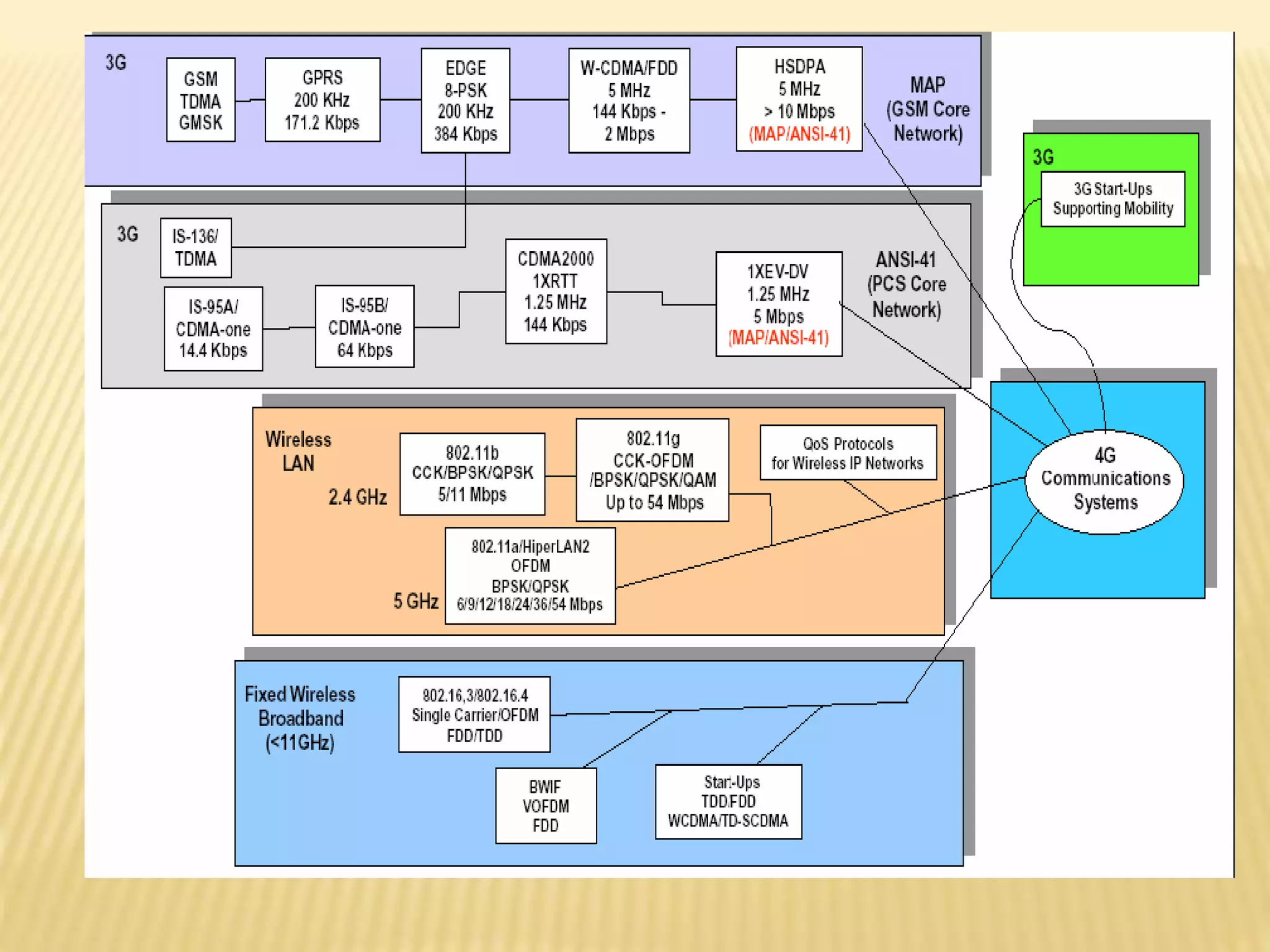
• The 4G mobile system is an all IP-based network system. The features of 4G 
may 
be summarized with one word—integration. The 4G systems are about 
seamlessly integrating different technologies and networks to satisfy increasing 
user demands. 
• 4G technologies combine different existing and future wireless network 
technologies (e.g. IPv6, OFDM, MC-CDMA,LAS-CDMA and Network-LMDS) 
• The 4G networks integrate one core network with several radio access networks. 
A core interface is used for communication with the core network and radio 
access networks and a collection of radio interfaces is used for communication 
with the radio access networks and mobile users.
• 5G Wireless mobile 
communication: 
•The 5G, on the other hands bring us to a perfect real world wireless or so-called 
“WWWW: World Wide Wireless Web” . The idea of WWWW, World Wide 
Wireless Web, originates from the 4G technologies. The next evolution will be 
based on 4G and the completion of this idea results in the formation of a real 
wireless world. 
• Integrating IPv6 and multi-bandwidth data path for 5G WWWW is a challenging 
issue, due to the following factors – 
1) the IPv6 assigns IP address on mobile nodes according to its location 
information, which is related with location management; 
2) multi-bandwidth data path design is based on network resources efficient 
utilization, which is related with network resources management. 
•This paper is organized as in section 1 presents an introduction and 
section 2 discusses the review of literature. The design of multi bandwidth 
data path is presented in section 3 and we describe the implementation in 
section 4, and finally, section 5 is summarization and conclusions.
2.LITERATURE REVIEW 
•The 4G mobile wireless network is a research area for the next generation 
wireless systems which can be supported by Bluetooth, WiFi802.11 family, 
WiMax 802.16 family, cellular and satellite networks. 
•The Bluetooth is designed for personal area, which can cover 10 meters. 
The WiFi 802.11 family is designed for local area, which can cover 100 meters. 
•Bluetooth provides a wireless Airport (802.11b, 802.11g and 802.11n) solution for 
wireless networks, not a replacement for networking. 
•On a technical level, Bluetooth is an open specification for a cutting-edge 
technology that enables short-range wireless connections between desktop 
and 
laptop computers and a host of other peripheral devices- on a globally 
available 
frequency •Many cou nbtarineds (h2a.v4eG cHazr)r ifeodr wouotr lpdrwoijdeect sc ofomrp tahteib dileitvy.elopment of 4G 
systems. The first project was undertaken by the Defense Advanced 
Research Projects Agency (DARPA), which is the same organization that 
developed the wired internet.
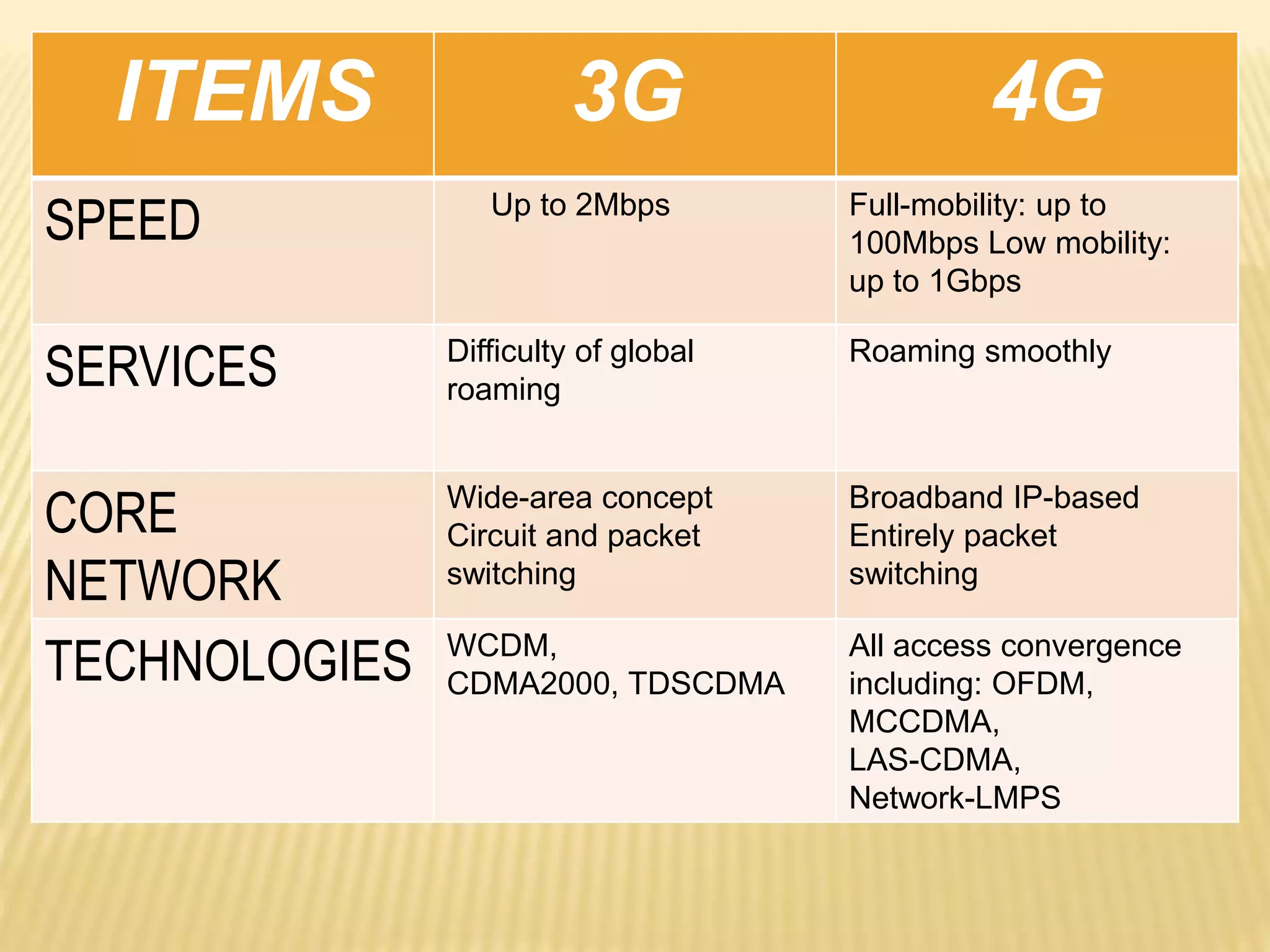
ITEMS 3G 4G 
SPEED Up to 2Mbps Full-mobility: up to 
100Mbps Low mobility: 
up to 1Gbps 
SERVICES Difficulty of global 
roaming 
Roaming smoothly 
CORE 
NETWORK 
Wide-area concept 
Circuit and packet 
switching 
Broadband IP-based 
Entirely packet 
switching 
TECHNOLOGIES WCDM, 
CDMA2000, TDSCDMA 
All access convergence 
including: OFDM, 
MCCDMA, 
LAS-CDMA, 
Network-LMPS
3.MULTI BANDWIDTH DATA DESIGN 
Multi Band Width data design can be categorised into two ways: 
 Multi-Bandwidth Data Path Model Design 
 Multi-bandwidth Data Path Design 
•Multi-Bandwidth Data Path Model Design: 
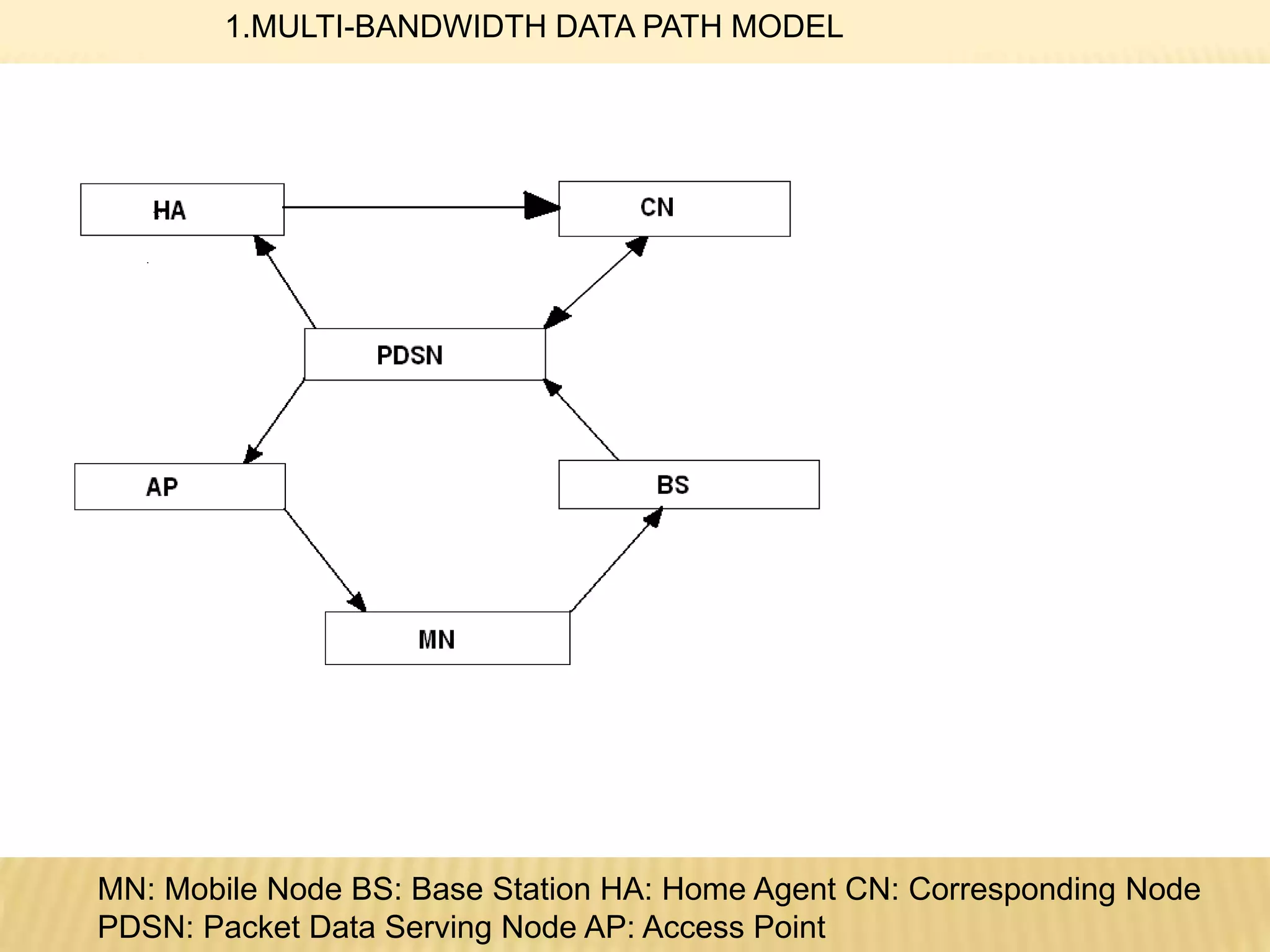
This model is based on overlay area of any two networks. When a mobile node comes 
into the overlay area, both of the two networks can supply services for the mobile node 
simultaneously. Data request can be sent from any one network, and reply can be 
from any other network. 
•MULTI-BANDWIDTH DATA PATH DESIGN: 
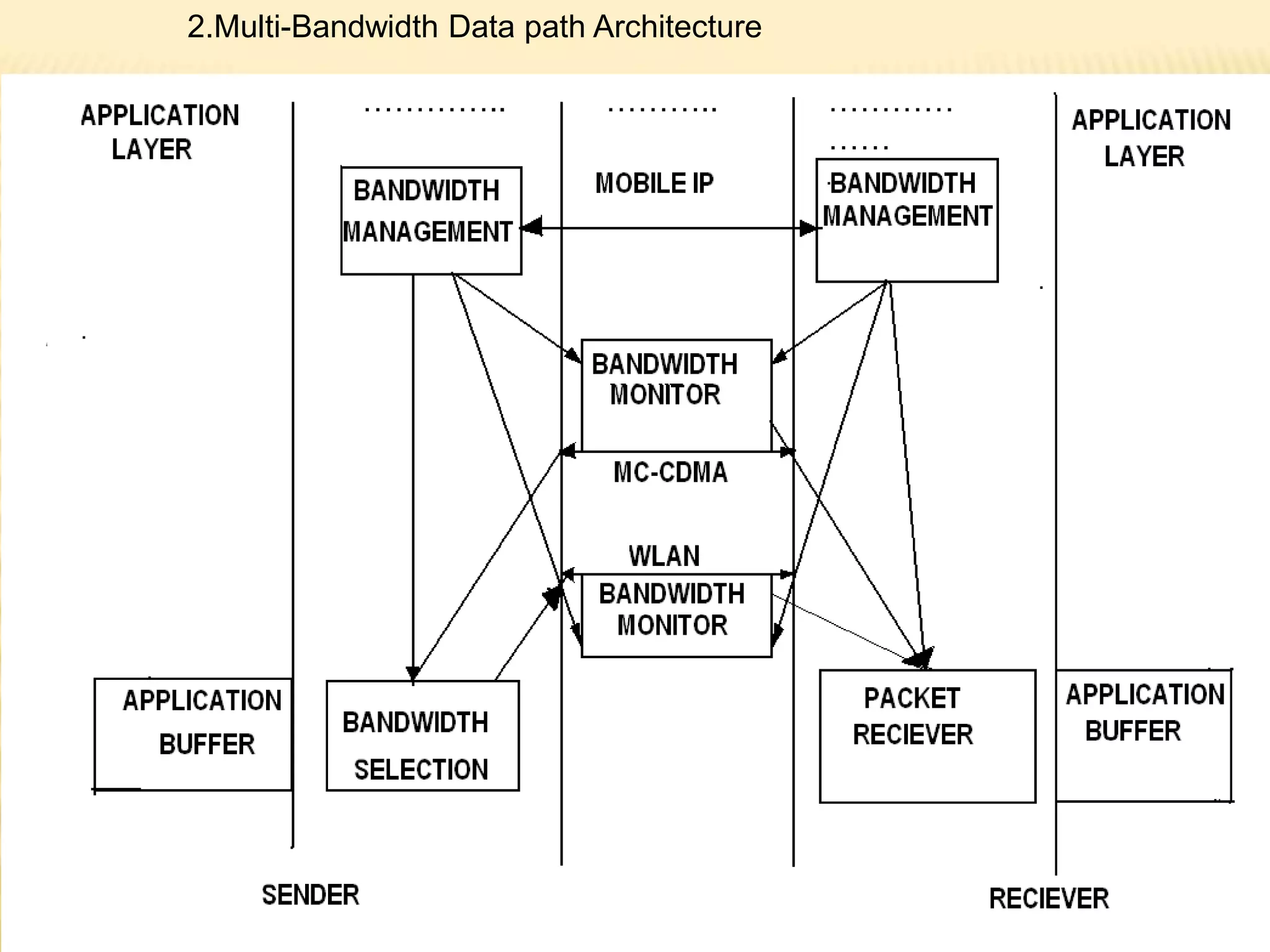
The function of bandwidth management is to install and delete bandwidth 
monitor components dynamically when it receives indication messages from 
the mobile IP protocol.
1.MULTI-BANDWIDTH DATA PATH MODEL 
MN: Mobile Node BS: Base Station HA: Home Agent CN: Corresponding Node 
PDSN: Packet Data Serving Node AP: Access Point
………….. ……….. ………… 
…… 
2.Multi-Bandwidth Data path Architecture
In the following Multi-Bandwidth Data Path Architecture the following existed contents 
that can be explained as follows: 
1.Bandwidth Management 
2.Bandwidth selection 
3.Bandwidth monitor 
4.Packets Receiver 
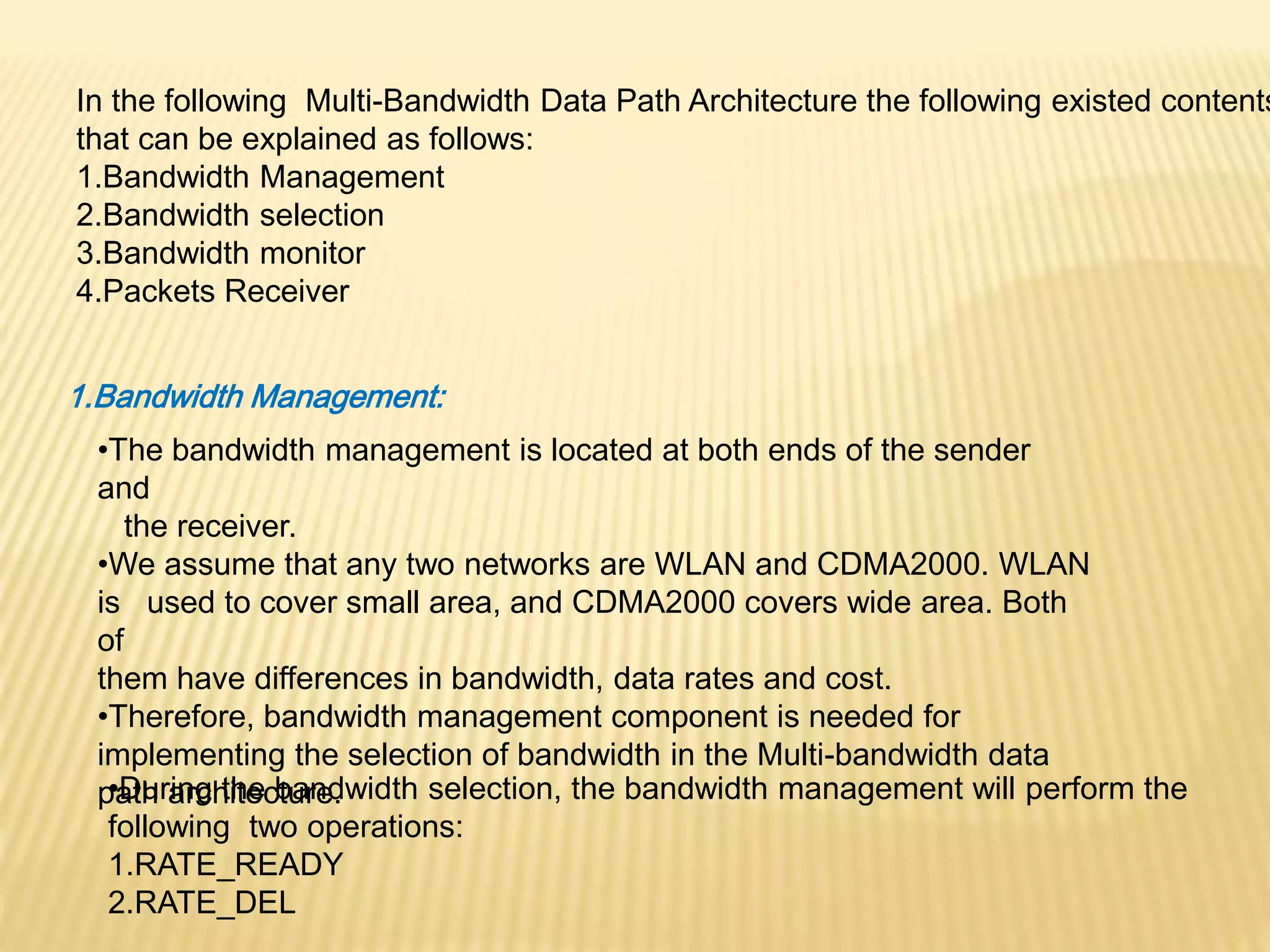
1.Bandwidth Management: 
•The bandwidth management is located at both ends of the sender 
and 
the receiver. 
•We assume that any two networks are WLAN and CDMA2000. WLAN 
is used to cover small area, and CDMA2000 covers wide area. Both 
of 
them have differences in bandwidth, data rates and cost. 
•Therefore, bandwidth management component is needed for 
implementing the selection of bandwidth in the Multi-bandwidth data 
p•aDthu rainrgch tihteec btuarned.width selection, the bandwidth management will perform the 
following two operations: 
1.RATE_READY 
2.RATE_DEL
2.Bandwidth Selection: 
•Bandwidth selection is located at the sender side only. Since 
WLAN has integrated into CDMA2000 networks, the message 
exchange is 
between both networks i.e., from the sender to the receiver. 
•The bandwidth selection is also responsible for assigning 
bandwidth encoded IPv6 application. 
3.Bandwidth Monitor: 
•The function of bandwidth monitor is to calculate the proper transmission 
rates and monitor packet flows on the corresponding path. The bandwidth 
monitor is 
located at both the sender and the receiver on each bandwidth path which is 
installed by the bandwidth management. 
•The data transmission rate is calculated by certain algorithm. From the 
theoretical point, a lot of rate control algorithm can be used in this propose 
architecture to calculate data rates. 
•However, we has selected TCP friendly rate control (TFRC) algorithm [27] 
for the bandwidth monitor.
4.Packets Receiver : 
Packets receiver is located at the receiver side only. The function of packets receiver is 
to buffer and reorder all the packets received from both bandwidth monitor. It is further 
to filter out the redundant packets before delivering them to the target application. 
4.PERFORMANCE ANALYSIS: 
According to the prediction for 4G in [19], the available bandwidth is ranging 
from 5Gbps to 25Gbps, which is enough wide for mobile user. 
Thus, the performance analysis based on two factors: 
1. Buffer Requirement Analysis 
2. Numerical Results 
1.Buffer requirement Analysis: 
According to ITU (International Telecommunication Unit) standards, for a non 
real-time internet session, the buffer time, Bt , is defined as the length of time that 
the packets are released from the existing route to a new route which is established 
and this is calculated as follows
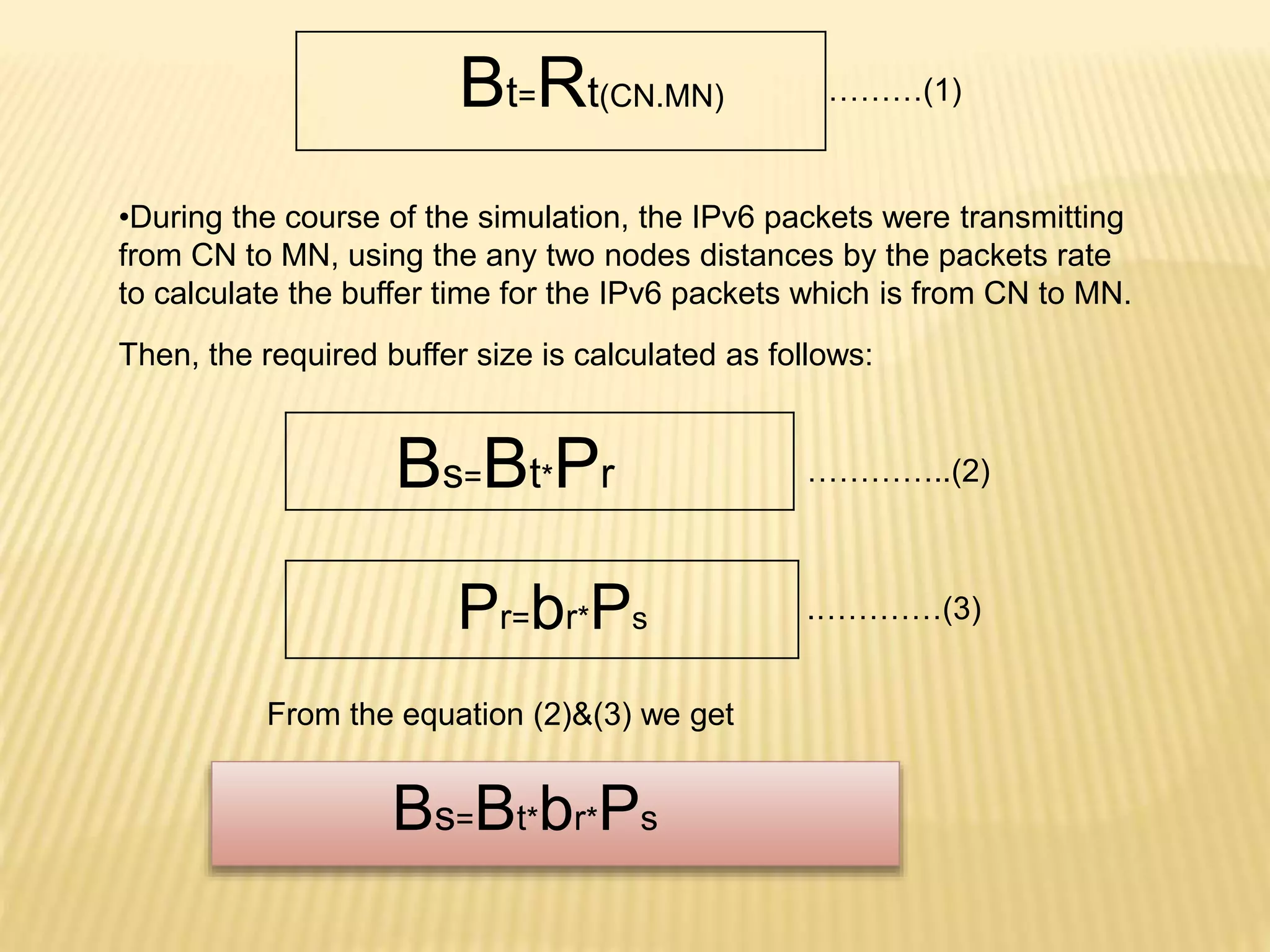
Bt=Rt(CN.MN) 
………(1) 
•During the course of the simulation, the IPv6 packets were transmitting 
from CN to MN, using the any two nodes distances by the packets rate 
to calculate the buffer time for the IPv6 packets which is from CN to MN. 
Then, the required buffer size is calculated as follows: 
Bs=Bt*Pr 
Pr=br*Ps 
…………..(2) 
.…………(3) 
From the equation (2)&(3) we get 
Bs=Bt*br*Ps
2.NUMERICAL RESULTS: 
•The requirements of buffer size in the integration of IPv6 and Multi-bandwidth. 
As the number of internet reselection session increased, the buffer size 
requirement is increased. 
•This is because in formula (4) above, the buffer size is depending on three 
factors: buffer time (Bt), bit rate (br ) and the packet size (Ps ). 
•The buffer requirements are same whatever with bandwidth reselection or 
without bandwidth reselection. 
•This is because that there are same numbers of active data sessions applying for 
buffer spaces in both cases.
5.CONCLUSION AND FUTURE WORK: 
•In this paper, we proposed Multi-bandwidth data path scheme for 5G real wireless 
world. 
•Data requests will be controlled by PCF (Packets Control Function) in the 
CDMA2000 
network and data reply will be controlled by PDIF (Packet Data Interworking 
Function) in 
WLAN. 
•Data traffic is routed through PDSN from CDMA2000 network to WLAN network. 
•The Multi-bandwidth data path scheme has been defined to do bandwidth 
reselection for rerouting so that all network resources can be used efficiently. 
•The new Multi-bandwidth data path scheme does not consider issues 
such as congestion relief, re-negotiated QoS, or the movement pattern of 
the mobile node.
Multi Bandwidth Data path design for 5G Wireless Systems

Multi Bandwidth Data path design for 5G Wireless Systems

  • 1.
    Welcome To The BY H.CHAITANYA IV-I CSE Presentation on MULTI-BANDWIDTH DATA PATH DESIGN FOR 5G WIRELESS MOBILE SYSTEMS
  • 2.
    The main pointsthat we are going to discuss is • Introduction • Literature Review • Multi Band width data design • Performance Analysis • Conclusion
  • 3.
    1.Introduction • Wirelessmobile communication networks have been evolved for generations The generations that are evolved in it are • 1G Wireless mobile communication • 2G Wireless mobile communication • 3G Wireless mobile communication • 4G Wireless mobile communication • 5G Wireless mobile communication •1G Wireless Communication: Wireless mobile communication networks have been evolved for generations. The first generation (1G) wireless mobile communication network is an analog system which is used for public voice services with the speed up to 2.4kbps [1].
  • 4.
    • 2G WirelessCommunication: • The second generation (2G) uses the digital technology and network infrastructure. • In comparison with the first generation, the second generation supports text messaging [2]. • Its success and the significant growth of demand for online information via the internet have prompted the development of cellular wireless system with the improvements on data connectivity, which is ultimately led to the third generation • 3Gsy sWtemisr(e3Gle). ss Communication: • The 3G system refers to technology standards for the next generation of mobile communications systems. • The main goal of standardization efforts of 3G is to create a universal infrastructure that is able to support existing and future services.
  • 5.
    • 4G WirelessCommunication: • The 4G mobile system is an all IP-based network system. The features of 4G may be summarized with one word—integration. The 4G systems are about seamlessly integrating different technologies and networks to satisfy increasing user demands. • 4G technologies combine different existing and future wireless network technologies (e.g. IPv6, OFDM, MC-CDMA,LAS-CDMA and Network-LMDS) • The 4G networks integrate one core network with several radio access networks. A core interface is used for communication with the core network and radio access networks and a collection of radio interfaces is used for communication with the radio access networks and mobile users.
  • 7.
    • 5G Wirelessmobile communication: •The 5G, on the other hands bring us to a perfect real world wireless or so-called “WWWW: World Wide Wireless Web” . The idea of WWWW, World Wide Wireless Web, originates from the 4G technologies. The next evolution will be based on 4G and the completion of this idea results in the formation of a real wireless world. • Integrating IPv6 and multi-bandwidth data path for 5G WWWW is a challenging issue, due to the following factors – 1) the IPv6 assigns IP address on mobile nodes according to its location information, which is related with location management; 2) multi-bandwidth data path design is based on network resources efficient utilization, which is related with network resources management. •This paper is organized as in section 1 presents an introduction and section 2 discusses the review of literature. The design of multi bandwidth data path is presented in section 3 and we describe the implementation in section 4, and finally, section 5 is summarization and conclusions.
  • 8.
    2.LITERATURE REVIEW •The4G mobile wireless network is a research area for the next generation wireless systems which can be supported by Bluetooth, WiFi802.11 family, WiMax 802.16 family, cellular and satellite networks. •The Bluetooth is designed for personal area, which can cover 10 meters. The WiFi 802.11 family is designed for local area, which can cover 100 meters. •Bluetooth provides a wireless Airport (802.11b, 802.11g and 802.11n) solution for wireless networks, not a replacement for networking. •On a technical level, Bluetooth is an open specification for a cutting-edge technology that enables short-range wireless connections between desktop and laptop computers and a host of other peripheral devices- on a globally available frequency •Many cou nbtarineds (h2a.v4eG cHazr)r ifeodr wouotr lpdrwoijdeect sc ofomrp tahteib dileitvy.elopment of 4G systems. The first project was undertaken by the Defense Advanced Research Projects Agency (DARPA), which is the same organization that developed the wired internet.
  • 9.
    ITEMS 3G 4G SPEED Up to 2Mbps Full-mobility: up to 100Mbps Low mobility: up to 1Gbps SERVICES Difficulty of global roaming Roaming smoothly CORE NETWORK Wide-area concept Circuit and packet switching Broadband IP-based Entirely packet switching TECHNOLOGIES WCDM, CDMA2000, TDSCDMA All access convergence including: OFDM, MCCDMA, LAS-CDMA, Network-LMPS
  • 10.
    3.MULTI BANDWIDTH DATADESIGN Multi Band Width data design can be categorised into two ways:  Multi-Bandwidth Data Path Model Design  Multi-bandwidth Data Path Design •Multi-Bandwidth Data Path Model Design: This model is based on overlay area of any two networks. When a mobile node comes into the overlay area, both of the two networks can supply services for the mobile node simultaneously. Data request can be sent from any one network, and reply can be from any other network. •MULTI-BANDWIDTH DATA PATH DESIGN: The function of bandwidth management is to install and delete bandwidth monitor components dynamically when it receives indication messages from the mobile IP protocol.
  • 11.
    1.MULTI-BANDWIDTH DATA PATHMODEL MN: Mobile Node BS: Base Station HA: Home Agent CN: Corresponding Node PDSN: Packet Data Serving Node AP: Access Point
  • 12.
    ………….. ……….. ………… …… 2.Multi-Bandwidth Data path Architecture
  • 13.
    In the followingMulti-Bandwidth Data Path Architecture the following existed contents that can be explained as follows: 1.Bandwidth Management 2.Bandwidth selection 3.Bandwidth monitor 4.Packets Receiver 1.Bandwidth Management: •The bandwidth management is located at both ends of the sender and the receiver. •We assume that any two networks are WLAN and CDMA2000. WLAN is used to cover small area, and CDMA2000 covers wide area. Both of them have differences in bandwidth, data rates and cost. •Therefore, bandwidth management component is needed for implementing the selection of bandwidth in the Multi-bandwidth data p•aDthu rainrgch tihteec btuarned.width selection, the bandwidth management will perform the following two operations: 1.RATE_READY 2.RATE_DEL
  • 14.
    2.Bandwidth Selection: •Bandwidthselection is located at the sender side only. Since WLAN has integrated into CDMA2000 networks, the message exchange is between both networks i.e., from the sender to the receiver. •The bandwidth selection is also responsible for assigning bandwidth encoded IPv6 application. 3.Bandwidth Monitor: •The function of bandwidth monitor is to calculate the proper transmission rates and monitor packet flows on the corresponding path. The bandwidth monitor is located at both the sender and the receiver on each bandwidth path which is installed by the bandwidth management. •The data transmission rate is calculated by certain algorithm. From the theoretical point, a lot of rate control algorithm can be used in this propose architecture to calculate data rates. •However, we has selected TCP friendly rate control (TFRC) algorithm [27] for the bandwidth monitor.
  • 15.
    4.Packets Receiver : Packets receiver is located at the receiver side only. The function of packets receiver is to buffer and reorder all the packets received from both bandwidth monitor. It is further to filter out the redundant packets before delivering them to the target application. 4.PERFORMANCE ANALYSIS: According to the prediction for 4G in [19], the available bandwidth is ranging from 5Gbps to 25Gbps, which is enough wide for mobile user. Thus, the performance analysis based on two factors: 1. Buffer Requirement Analysis 2. Numerical Results 1.Buffer requirement Analysis: According to ITU (International Telecommunication Unit) standards, for a non real-time internet session, the buffer time, Bt , is defined as the length of time that the packets are released from the existing route to a new route which is established and this is calculated as follows
  • 16.
    Bt=Rt(CN.MN) ………(1) •Duringthe course of the simulation, the IPv6 packets were transmitting from CN to MN, using the any two nodes distances by the packets rate to calculate the buffer time for the IPv6 packets which is from CN to MN. Then, the required buffer size is calculated as follows: Bs=Bt*Pr Pr=br*Ps …………..(2) .…………(3) From the equation (2)&(3) we get Bs=Bt*br*Ps
  • 17.
    2.NUMERICAL RESULTS: •Therequirements of buffer size in the integration of IPv6 and Multi-bandwidth. As the number of internet reselection session increased, the buffer size requirement is increased. •This is because in formula (4) above, the buffer size is depending on three factors: buffer time (Bt), bit rate (br ) and the packet size (Ps ). •The buffer requirements are same whatever with bandwidth reselection or without bandwidth reselection. •This is because that there are same numbers of active data sessions applying for buffer spaces in both cases.
  • 18.
    5.CONCLUSION AND FUTUREWORK: •In this paper, we proposed Multi-bandwidth data path scheme for 5G real wireless world. •Data requests will be controlled by PCF (Packets Control Function) in the CDMA2000 network and data reply will be controlled by PDIF (Packet Data Interworking Function) in WLAN. •Data traffic is routed through PDSN from CDMA2000 network to WLAN network. •The Multi-bandwidth data path scheme has been defined to do bandwidth reselection for rerouting so that all network resources can be used efficiently. •The new Multi-bandwidth data path scheme does not consider issues such as congestion relief, re-negotiated QoS, or the movement pattern of the mobile node.