Hamming code is an error-correcting code that uses additional redundant bits to detect and correct errors during data transmission. The number of redundant bits is calculated using a formula and is added to the original data bits in specific bit positions that are powers of 2. Each redundant bit checks a unique set of data bits based on their bit position. The value of the redundant bit is set to 1 if the total number of ones in the checked data bits is odd, and 0 if it is even, following the principle of even parity. This allows the detection and location of single-bit errors when the data is received.
Hamming code
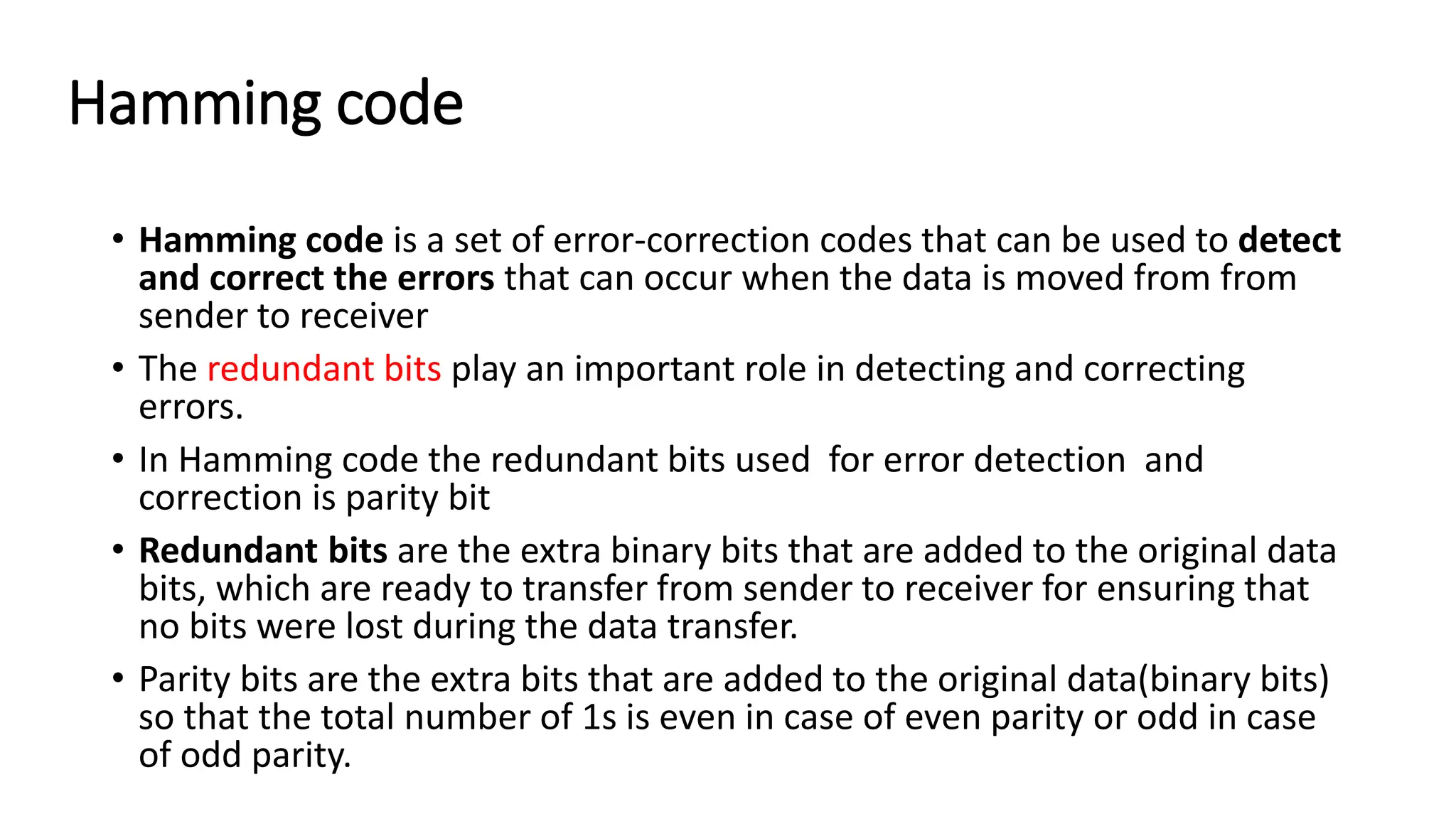
• Hammingcode is a set of error-correction codes that can be used to detect
and correct the errors that can occur when the data is moved from from
sender to receiver
• The redundant bits play an important role in detecting and correcting
errors.
• In Hamming code the redundant bits used for error detection and
correction is parity bit
• Redundant bits are the extra binary bits that are added to the original data
bits, which are ready to transfer from sender to receiver for ensuring that
no bits were lost during the data transfer.
• Parity bits are the extra bits that are added to the original data(binary bits)
so that the total number of 1s is even in case of even parity or odd in case
of odd parity.
3.
Hamming code
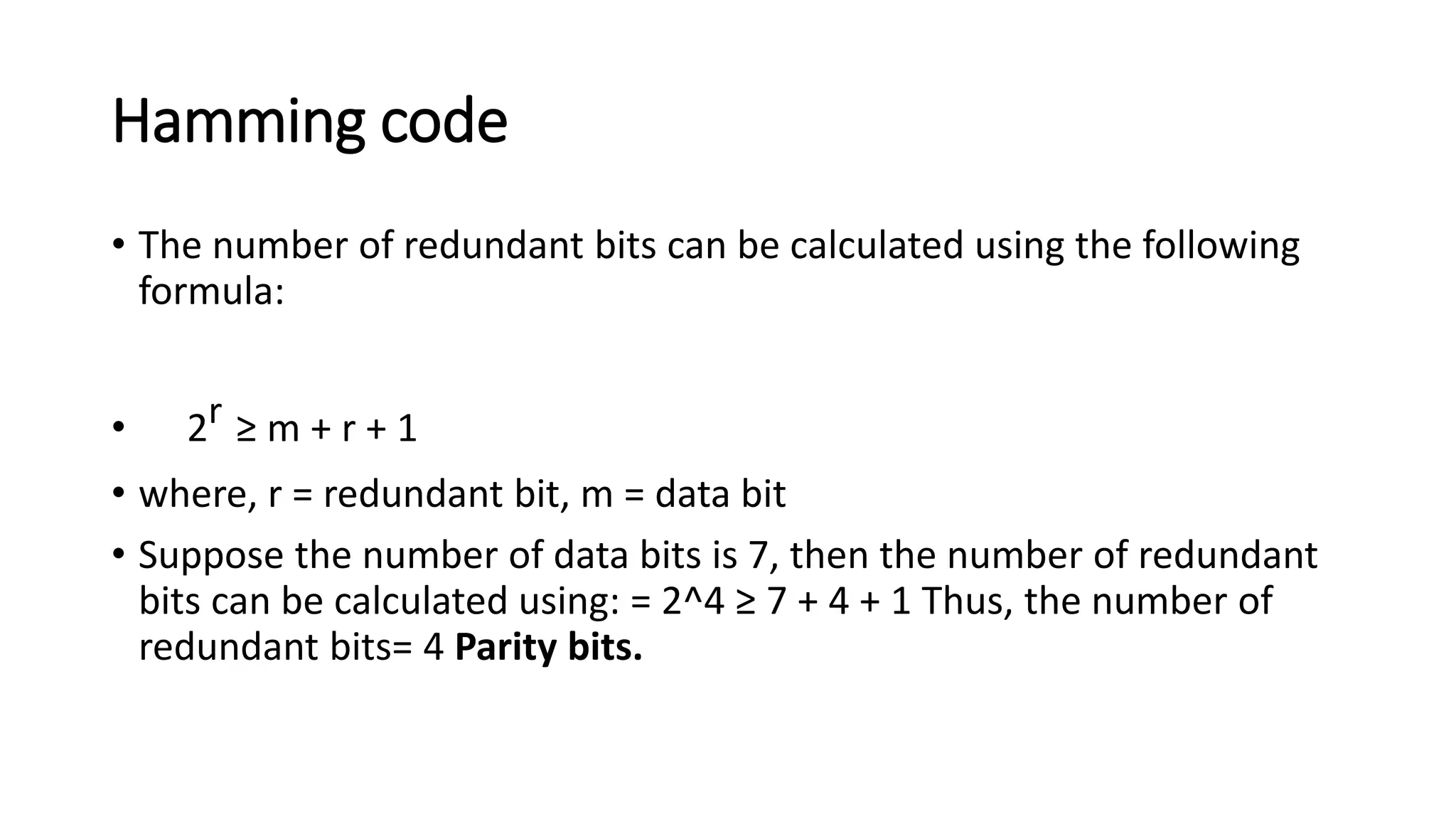
• Thenumber of redundant bits can be calculated using the following
formula:
• 2r ≥ m + r + 1
• where, r = redundant bit, m = data bit
• Suppose the number of data bits is 7, then the number of redundant
bits can be calculated using: = 2^4 ≥ 7 + 4 + 1 Thus, the number of
redundant bits= 4 Parity bits.
4.
Question
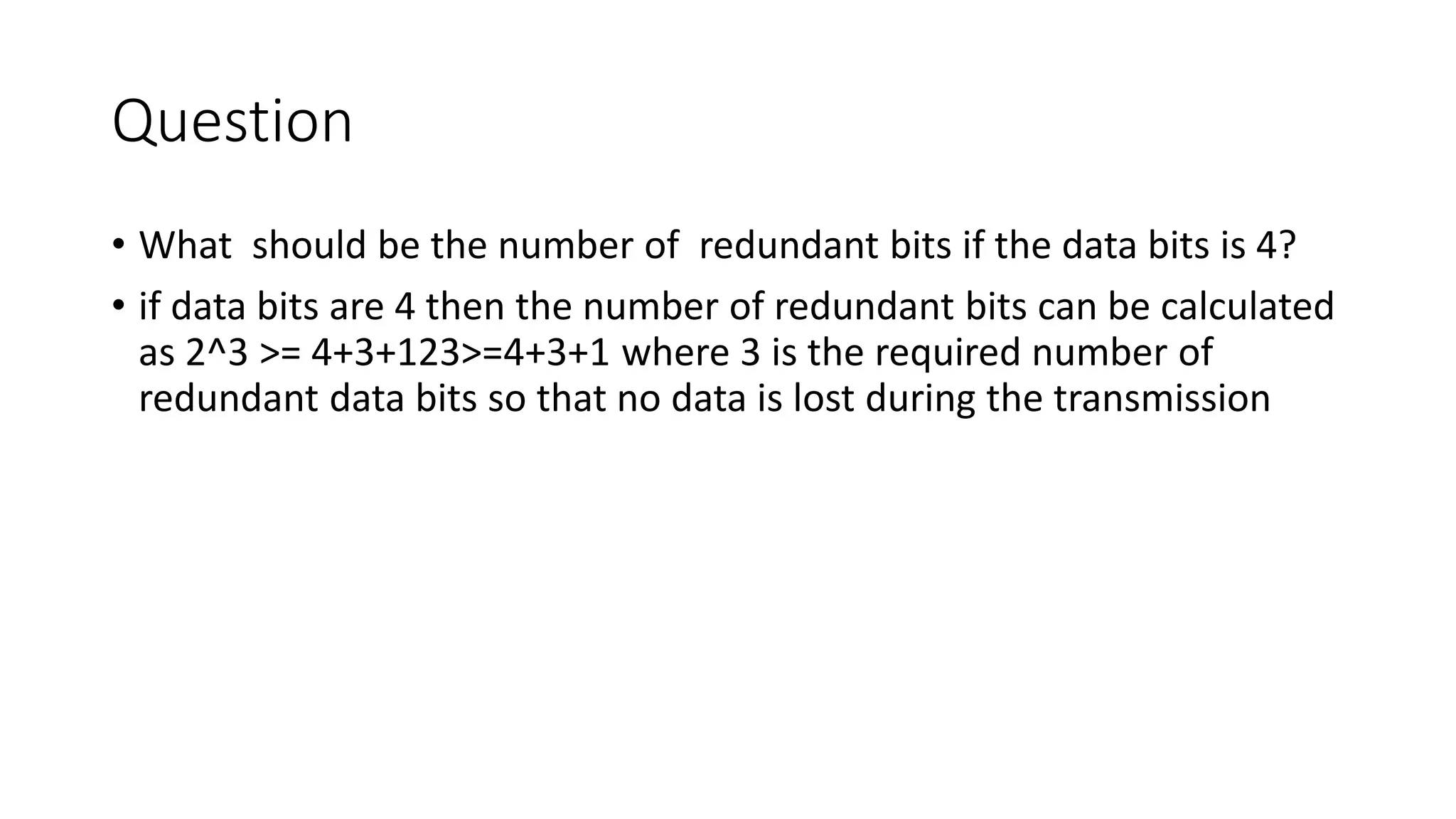
• What shouldbe the number of redundant bits if the data bits is 4?
• if data bits are 4 then the number of redundant bits can be calculated
as 2^3 >= 4+3+123>=4+3+1 where 3 is the required number of
redundant data bits so that no data is lost during the transmission
5.
Determining position ofparity bits:
• Parity bits are placed at the bit position which is the power of 2 i.e,
(2^0 , 2^1, 2^2, 2^3, 2^420,21,22,23,24,.... so on) which are
(1,2,4,8,... so on ).
• So for example, in the 7-bit data transfer we will be having 4 parity
bits which are (1,2,4,8).
• Similarly in the 4-bit data transfer we will be having 3 parity bits
which are (1,2,4).
6.
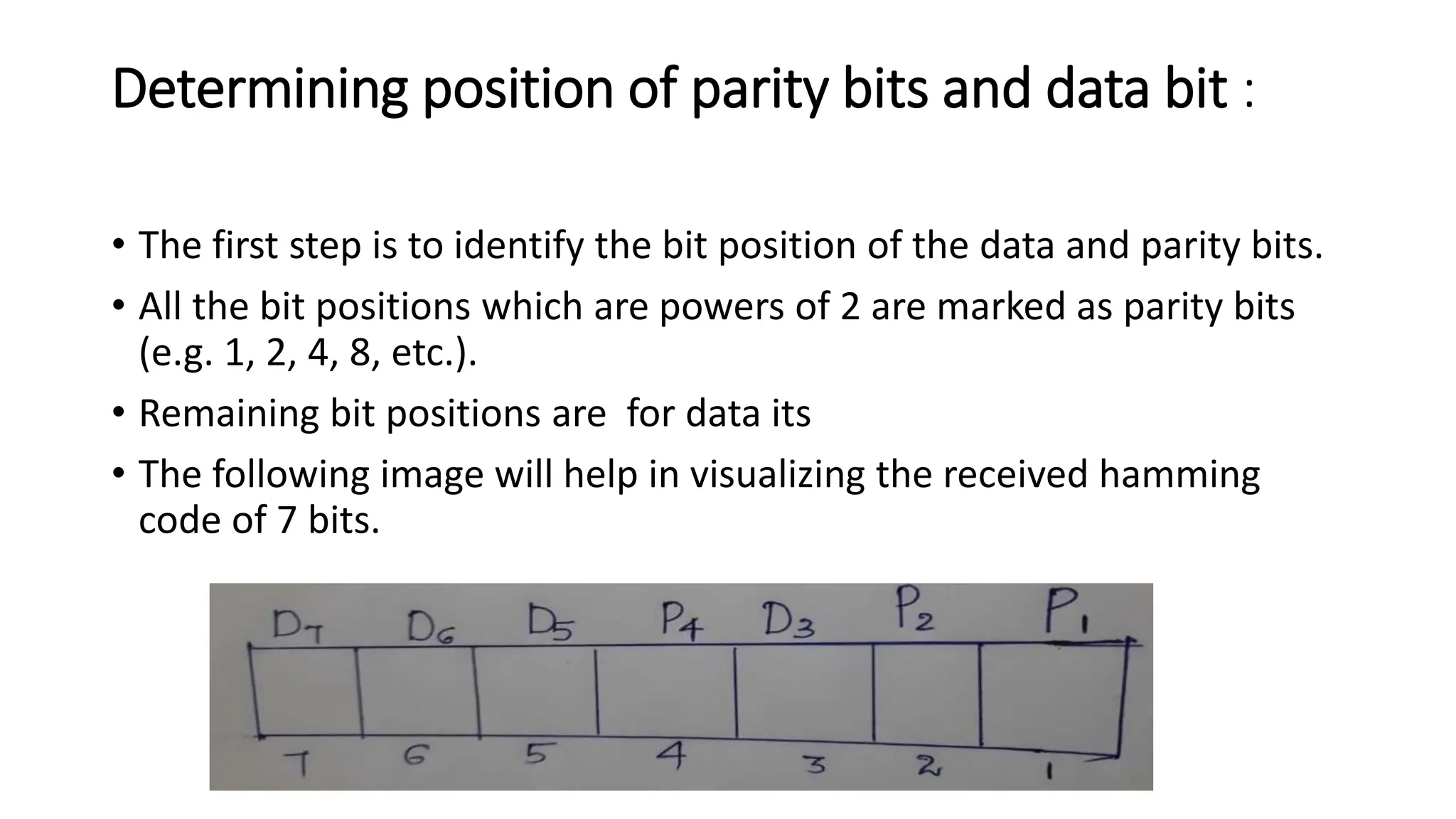
Determining position ofparity bits and data bit :
• The first step is to identify the bit position of the data and parity bits.
• All the bit positions which are powers of 2 are marked as parity bits
(e.g. 1, 2, 4, 8, etc.).
• Remaining bit positions are for data its
• The following image will help in visualizing the received hamming
code of 7 bits.
7.
Determine the parity
•Parity P1 depends on the data bit D3,D5,D7,D9….(Check one ,skip
one)
• Parity P2 depends on the data bit D3,D6,D7,D10,D11.. (Check two
,skip two)
• Parity P4 depends on the data bit D5,D6,D7,D12,D13,D14,D15(Check
four ,skip four)
8.
Question
• Suppose thedata to be transmitted is 1011 using Hamming code
using even parity.
• Since the data bits is 4 bits ,the number of redundant bits is 3.
9.
General Algorithm ofHamming code:
• Hamming Code is simply the use of extra parity bits to allow the
identification of an error.
1. Write the bit positions starting from 1 in binary form (1, 10, 11, 100,
etc).
2. All the bit positions that are a power of 2 are marked as parity bits
(1, 2, 4, 8, etc).
3. All the other bit positions are marked as data bits.
10.
General Algorithm ofHamming code:
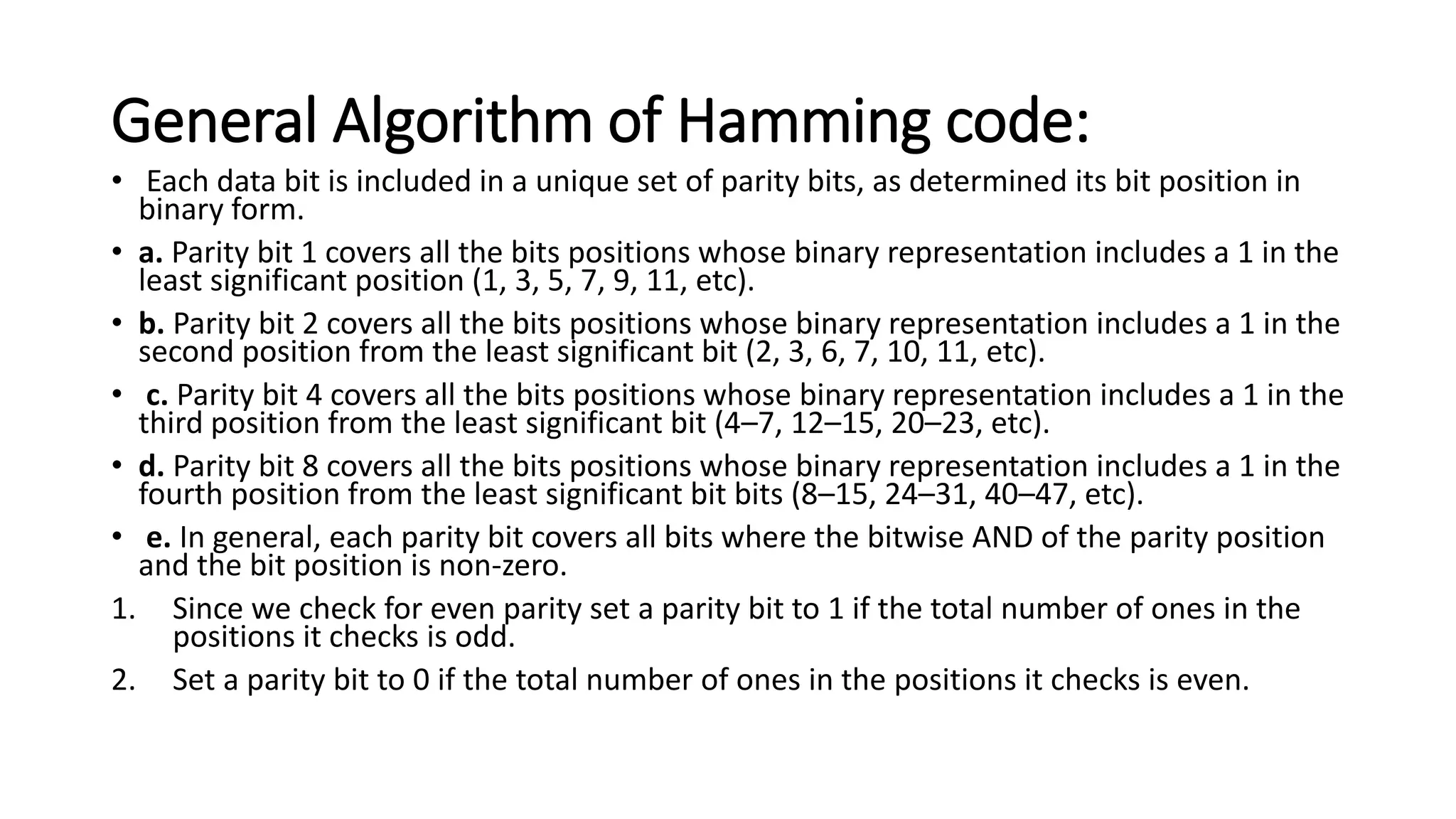
• Each data bit is included in a unique set of parity bits, as determined its bit position in
binary form.
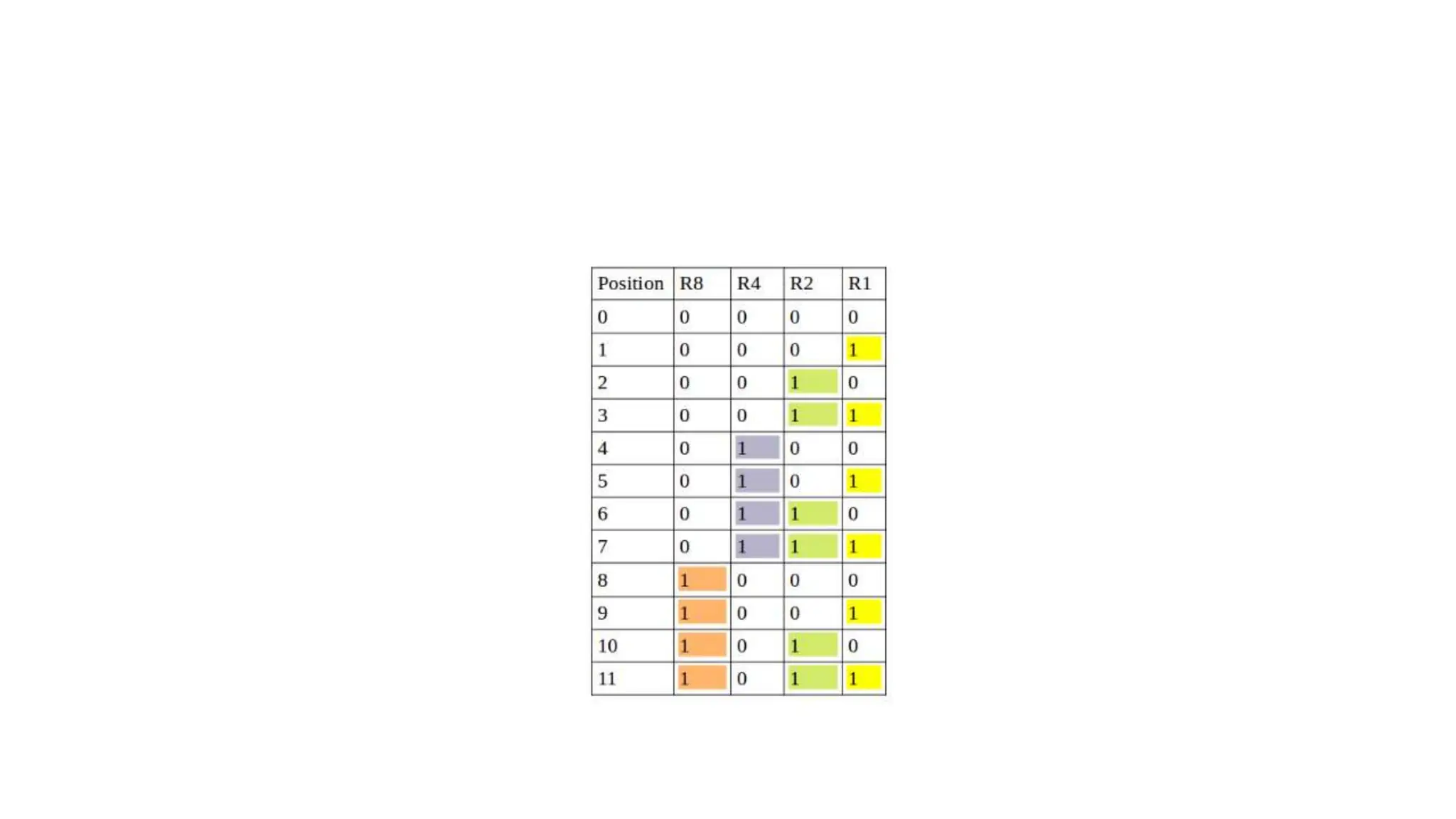
• a. Parity bit 1 covers all the bits positions whose binary representation includes a 1 in the
least significant position (1, 3, 5, 7, 9, 11, etc).
• b. Parity bit 2 covers all the bits positions whose binary representation includes a 1 in the
second position from the least significant bit (2, 3, 6, 7, 10, 11, etc).
• c. Parity bit 4 covers all the bits positions whose binary representation includes a 1 in the
third position from the least significant bit (4–7, 12–15, 20–23, etc).
• d. Parity bit 8 covers all the bits positions whose binary representation includes a 1 in the
fourth position from the least significant bit bits (8–15, 24–31, 40–47, etc).
• e. In general, each parity bit covers all bits where the bitwise AND of the parity position
and the bit position is non-zero.
1. Since we check for even parity set a parity bit to 1 if the total number of ones in the
positions it checks is odd.
2. Set a parity bit to 0 if the total number of ones in the positions it checks is even.
12.
Question
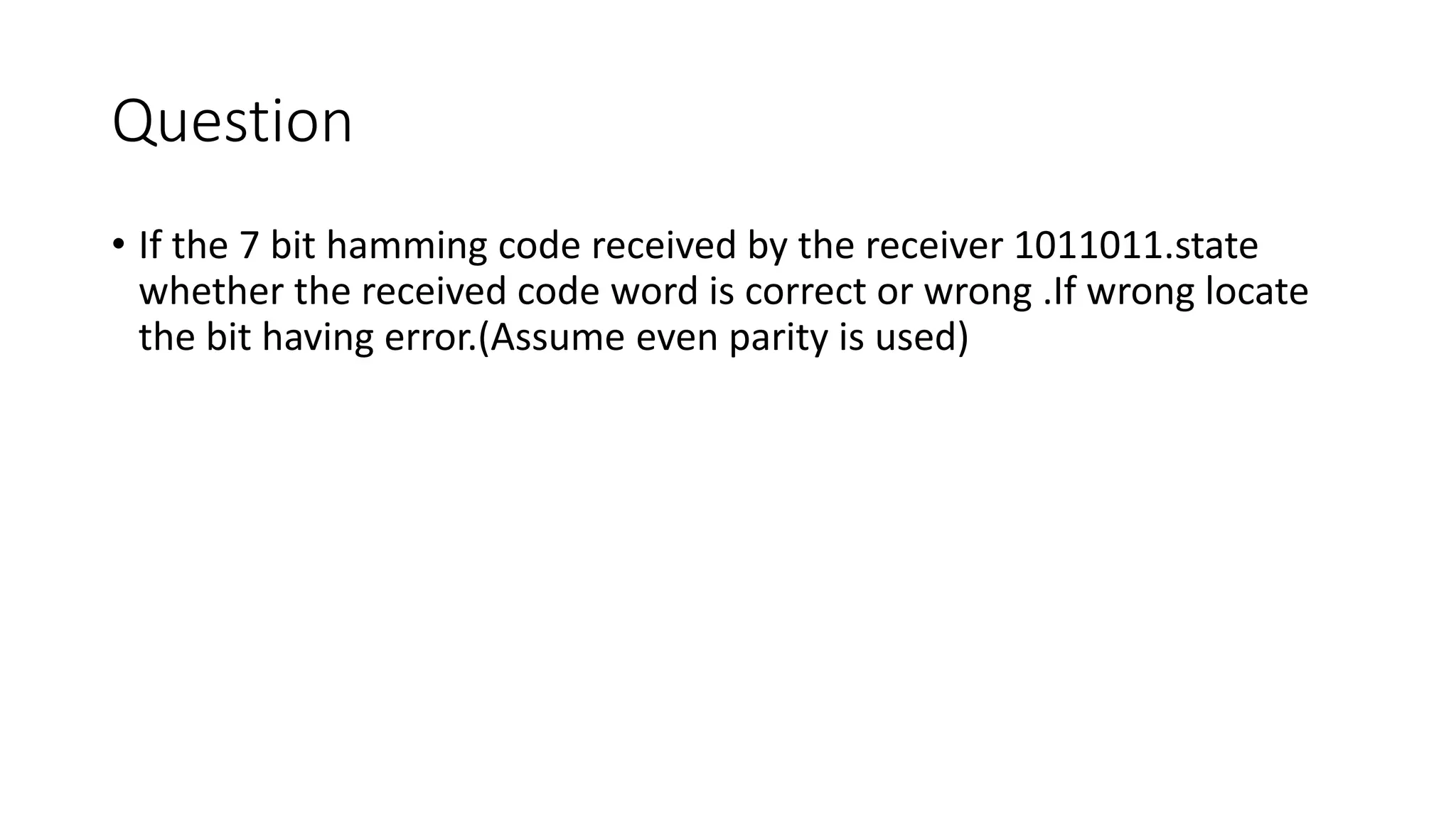
• If the7 bit hamming code received by the receiver 1011011.state
whether the received code word is correct or wrong .If wrong locate
the bit having error.(Assume even parity is used)
13.
Question
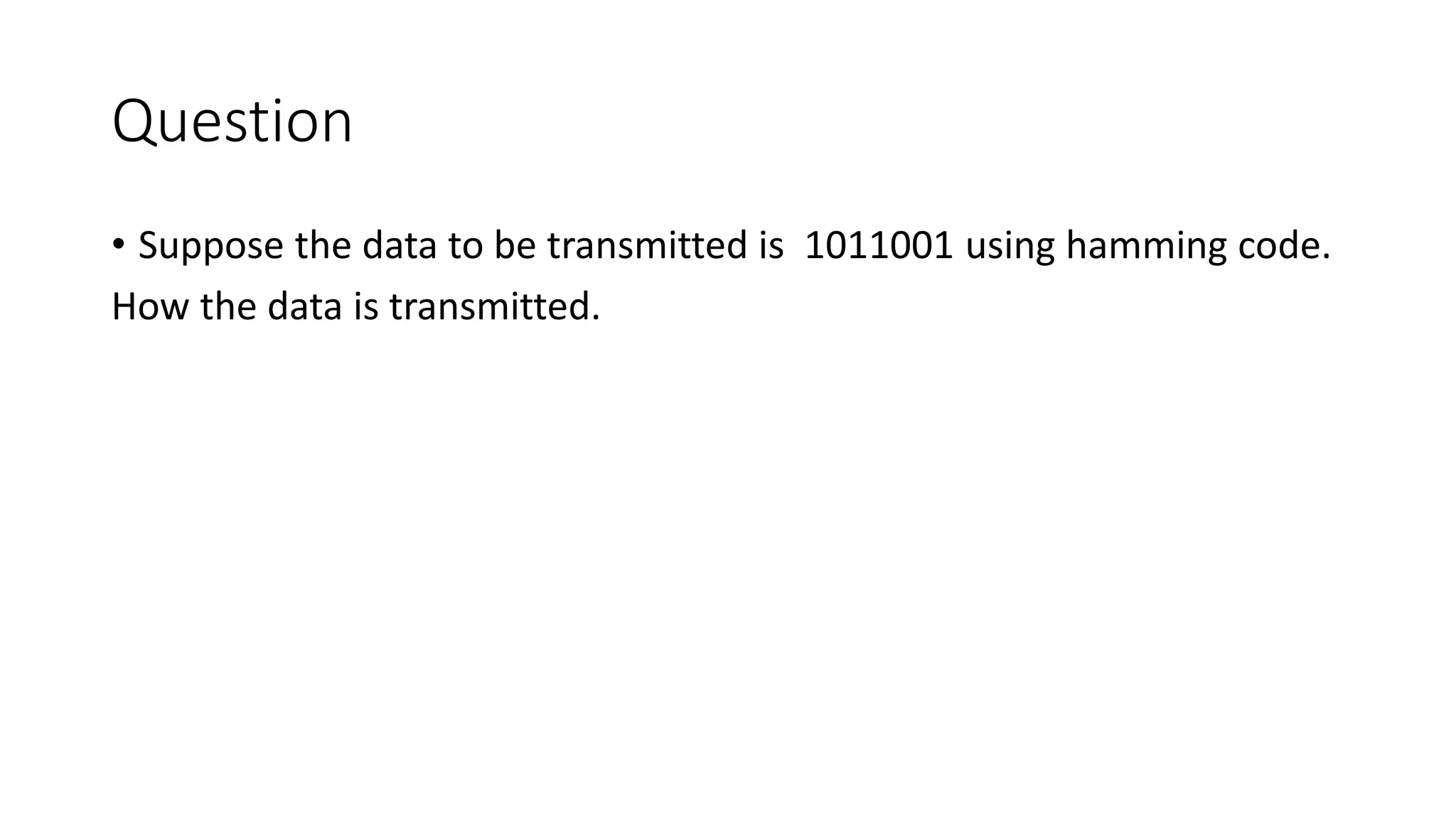
• Suppose thedata to be transmitted is 1011001 using hamming code.
How the data is transmitted.
14.
Question
• The datareceived by the receiver is 10101101110.state whether the
received code word is correct or wrong .If wrong locate the bit having
error.(Assume even parity is used)
15.
Question
• The datareceived by the receiver is 10101101110.state whether the
received code word is correct or wrong .If wrong locate the bit having
error.(Assume even parity is used)
• Solution at
https://www.geeksforgeeks.org/hamming-code-in-computer-network/