The Liver &
Gallbladder
Anatomy & Physiology
By: Vishal Singh, Assistant Professor, KIPS- Kanpur
Introduction
➔ The liver is the largest gland in the body, weighing between 1 and 2.3
kg.
➔ The liver is enclosed in a thin inelastic capsule and incompletely
covered by a layer of peritoneum- that attach the liver to the inferior
surface of the diaphragm.
➔ It is held in position partly by these ligaments and partly by the pressure
of the organs in the abdominal cavity.
➔ The gallbladder is a pear- shaped sac that is located on the depression
of posterior surface of the liver. It is 7-10 cm long and typically hangs
from the anterior inferior margin of liver.
The liver
Histology of liver
The liver is composed of several components –
1) Hepatocytes
2) The hepatic laminae
3) Bile canaliculi
4) Hepatic sinusoids
5) Portal triad
The hepatic lobule is the anatomic unit of the liver. In the anatomic model, liver
lobules are organized into irregular polygons demarcated by connective tissue and
composed of plates of hepatocytes radiating outward from the central vein to the
portal triads.
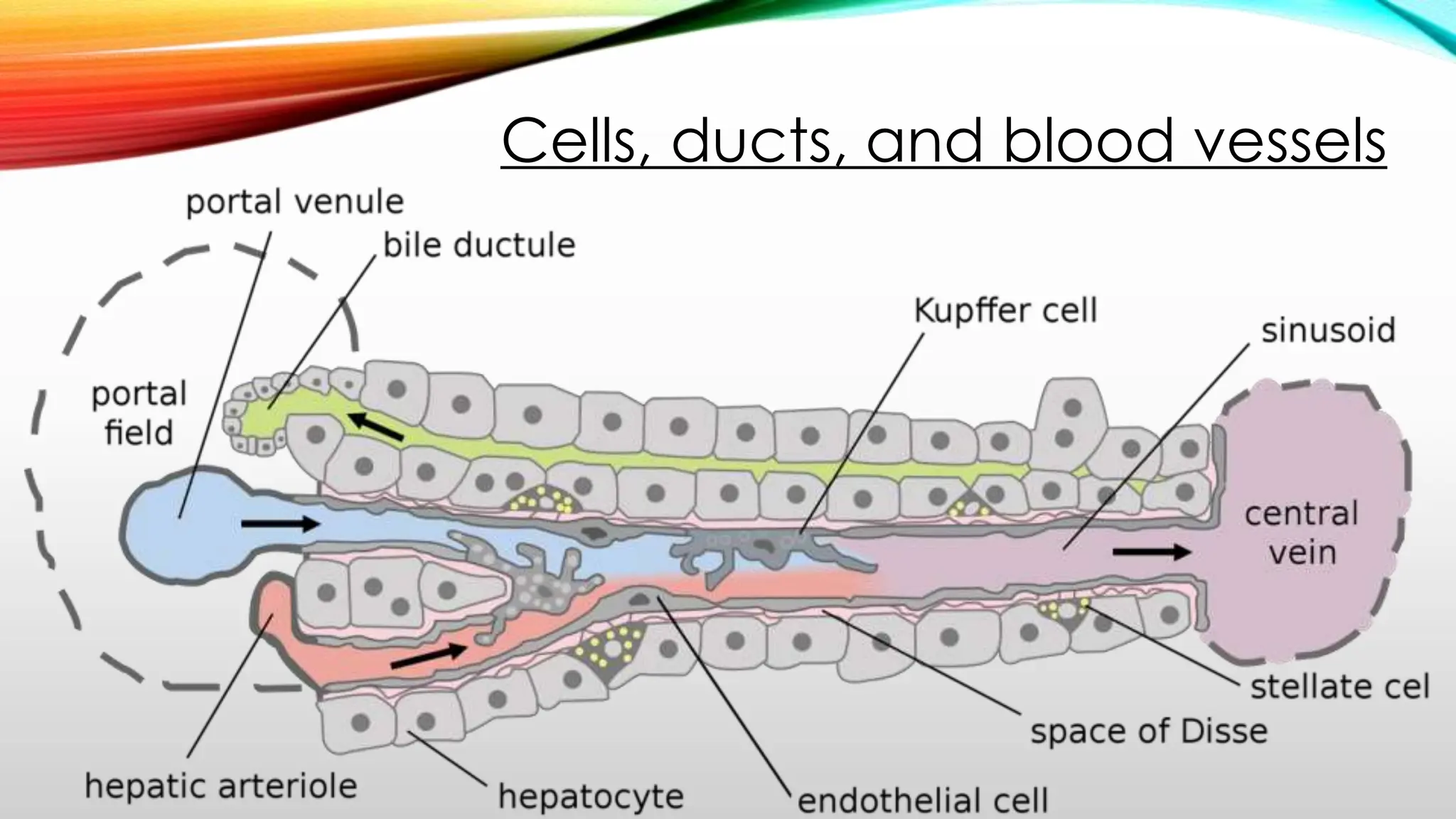
Cells, ducts, and blood vessels
Hepatocytes
➔ Hepatocytes are the major functional cells of the liver and perform a wide array
of metabolic, secretory, and endocrine functions.
➔ These are specialized epithelial cells with 5 to 12 sides that make up about 80%
of the volume of the liver.
➔ Hepatocytes form complex three-dimensional arrangements called hepatic
laminae. The hepatic laminae are plates of hepatocytes one cell thick
bordered on either side by the endothelial-lined vascular spaces called hepatic
sinusoids.
➔ Grooves in the cell membranes between neighboring hepatocytes provide
spaces for canaliculi into which the hepatocytes secrete bile.
➔ Bile, a yellow, brownish, or olive-green liquid secreted by hepatocytes, serves as
both an excretory product and a digestive secretion.
Bile canaliculi
➔ Bile canaliculi are small ducts between hepatocytes that collect bile produced
by the hepatocytes.
➔ From bile canaliculi, bile passes into bile ductules and then bile ducts. The bile
ducts merge and eventually form the larger right and left hepatic ducts, which
unite and exit the liver as the common hepatic duct.
➔ The common hepatic duct joins the cystic duct (cystic bladder) from the
gallbladder to form the common bile duct.
➔ From here, bile enters the duodenum of the small intestine to participate in
digestion.
➔ Together, a bile duct, branch of hepatic artery and branch of the hepatic vein
is called as a portal triad.
Hepatic sinusoids
➔ Hepatic sinusoids are highly permeable blood capillaries between rows of
hepatocytes that receive oxygenated blood from branches of the hepatic
artery and nutrient-rich deoxygenated blood from branches of the hepatic
portal vein.
➔ Hepatic sinusoids converge and deliver blood into a central vein.
➔ From central veins the blood flows into the hepatic veins, which drain into the
inferior vena cava.
➔ Some fixed phagocytes called stellate reticuloendothelial cells or hepatic
macrophages (or Kupffer cells) are also present in the hepatic sinusoids , which
destroy worn-out white and red blood cells, bacteria, and other foreign matter
in the venous blood draining from the gastrointestinal tract.
Blood supply to the liver
The liver receives blood from two sources:
➔ From the hepatic artery it obtains oxygenated blood, and
➔ From the hepatic portal vein it receives deoxygenated blood containing newly
absorbed nutrients, drugs, and possibly microbes and toxins from the
gastrointestinal tract.
➔ Branches of both the hepatic artery and the hepatic portal vein carry blood
into hepatic sinusoids, where oxygen, most of the nutrients, and certain toxic
substances are taken up by the hepatocytes.
➔ Products manufactured by the hepatocytes and nutrients needed by other
cells are secreted back into the blood, which then drains into the central vein
and eventually passes into a hepatic vein. Because blood from the
gastrointestinal tract passes through liver as part of hepatic circulation system.
Functions of liver and gallbladder
➔ Each day, hepatocytes secrete 800-1000 ml of bile, a yellow, brownish, or olive-
green liquid. It has a pH of 7.6-8.6 and consists mostly of water, bile salts,
cholesterol, a phospholipid called lecithin, bile pigments, and several ions.
➔ The principal bile pigment is bilirubin that is secreted into the bile and is
eventually broken down in the intestine. One of its breakdown products-
stercobilin gives feces their normal brown color.
➔ Bile salts, which are sodium salts and potassium salts of bile acids (mostly
chenodeoxycholic acid and cholic acid), play a role in emulsification and the
breakdown of large lipid globules into a suspension of small lipid globules.
➔ Bile salts also help in the absorption of lipids (triglycerides) following their
digestion.
Functions of liver and gallbladder
➔ Hepatocytes continually release bile, they increase production and secretion
when the portal blood contains more bile acids; thus, as digestion and
absorption continue in the small intestine, bile release increases.
➔ Between meals, after most absorption has occurred, bile flows into the
gallbladder for storage because the sphincter of the hepatopancreatic
ampulla (sphincter of Oddi).
Functions of liver
➔ Metabolism of- carbohydrates, protein and lipids
➔ Processing of drugs and hormones
➔ Excretion of bilirubin
➔ Synthesis of bile salts
➔ Storage
➔ Phagocytosis
➔ Activation of vit.-D
Carbohydrate metabolism
➔ When blood glucose is low, the liver can break down glycogen to glucose and
release the glucose into the bloodstream.
➔ The liver can also convert certain amino acids and lactic acid to glucose, and it
can convert other sugars, such as fructose and galactose, into glucose.
➔ When blood glucose is high, as occurs just after eating a meal, the liver
converts glucose to glycogen and triglycerides for storage.
Protein metabolism
➔ Hepatocytes deaminate (remove the amino group, NH2, from) amino acids so
that the amino acids can be used for ATP production or converted to
carbohydrates or fats.
➔ The resulting toxic ammonia (NH3) is then converted into the much less toxic
urea, which is excreted in urine. Hepatocytes also synthesize most plasma
proteins, such as alpha and beta globulins, albumin, pro- thrombin, and
fibrinogen.
Processing of drugs and hormones.
➔ The liver can detoxify substances such as alcohol and excrete drugs such as
penicillin, erythromycin, and sulfonamides into bile. It can also chemically alter
or excrete thyroid hormones and steroid hormones such as estrogens and
aldosterone.
Excretion of bilirubin.
➔ Bilirubin is derived from the heme of aged red blood cells, is absorbed by the
liver from the blood and secreted into bile. Most of the bilirubin in bile is
metabolized in the small intestine by bacteria and eliminated in feces.
Synthesis of bile salts.
Bile salts are used in the small intestine for the emulsification and absorption of lipids.
Storage.
The liver is a prime storage site for certain vitamins (A, B₁₂, D, E, and K) and minerals (iron
and copper), which are released from the liver when needed elsewhere in the body.
Phagocytosis.
The stellate reticuloendothelial (Kupffer) cells of the liver phagocytize aged red blood
cells, white blood cells, and some bacteria.
Activation of vitamin D.
Thank You

The Liver & Gallbladder (Anatomy & Physiology).pptx

  • 1.
    The Liver & Gallbladder Anatomy& Physiology By: Vishal Singh, Assistant Professor, KIPS- Kanpur
  • 2.
    Introduction ➔ The liveris the largest gland in the body, weighing between 1 and 2.3 kg. ➔ The liver is enclosed in a thin inelastic capsule and incompletely covered by a layer of peritoneum- that attach the liver to the inferior surface of the diaphragm. ➔ It is held in position partly by these ligaments and partly by the pressure of the organs in the abdominal cavity. ➔ The gallbladder is a pear- shaped sac that is located on the depression of posterior surface of the liver. It is 7-10 cm long and typically hangs from the anterior inferior margin of liver.
  • 3.
  • 4.
    Histology of liver Theliver is composed of several components – 1) Hepatocytes 2) The hepatic laminae 3) Bile canaliculi 4) Hepatic sinusoids 5) Portal triad The hepatic lobule is the anatomic unit of the liver. In the anatomic model, liver lobules are organized into irregular polygons demarcated by connective tissue and composed of plates of hepatocytes radiating outward from the central vein to the portal triads.
  • 5.
    Cells, ducts, andblood vessels
  • 6.
    Hepatocytes ➔ Hepatocytes arethe major functional cells of the liver and perform a wide array of metabolic, secretory, and endocrine functions. ➔ These are specialized epithelial cells with 5 to 12 sides that make up about 80% of the volume of the liver. ➔ Hepatocytes form complex three-dimensional arrangements called hepatic laminae. The hepatic laminae are plates of hepatocytes one cell thick bordered on either side by the endothelial-lined vascular spaces called hepatic sinusoids. ➔ Grooves in the cell membranes between neighboring hepatocytes provide spaces for canaliculi into which the hepatocytes secrete bile. ➔ Bile, a yellow, brownish, or olive-green liquid secreted by hepatocytes, serves as both an excretory product and a digestive secretion.
  • 7.
    Bile canaliculi ➔ Bilecanaliculi are small ducts between hepatocytes that collect bile produced by the hepatocytes. ➔ From bile canaliculi, bile passes into bile ductules and then bile ducts. The bile ducts merge and eventually form the larger right and left hepatic ducts, which unite and exit the liver as the common hepatic duct. ➔ The common hepatic duct joins the cystic duct (cystic bladder) from the gallbladder to form the common bile duct. ➔ From here, bile enters the duodenum of the small intestine to participate in digestion. ➔ Together, a bile duct, branch of hepatic artery and branch of the hepatic vein is called as a portal triad.
  • 8.
    Hepatic sinusoids ➔ Hepaticsinusoids are highly permeable blood capillaries between rows of hepatocytes that receive oxygenated blood from branches of the hepatic artery and nutrient-rich deoxygenated blood from branches of the hepatic portal vein. ➔ Hepatic sinusoids converge and deliver blood into a central vein. ➔ From central veins the blood flows into the hepatic veins, which drain into the inferior vena cava. ➔ Some fixed phagocytes called stellate reticuloendothelial cells or hepatic macrophages (or Kupffer cells) are also present in the hepatic sinusoids , which destroy worn-out white and red blood cells, bacteria, and other foreign matter in the venous blood draining from the gastrointestinal tract.
  • 10.
    Blood supply tothe liver The liver receives blood from two sources: ➔ From the hepatic artery it obtains oxygenated blood, and ➔ From the hepatic portal vein it receives deoxygenated blood containing newly absorbed nutrients, drugs, and possibly microbes and toxins from the gastrointestinal tract. ➔ Branches of both the hepatic artery and the hepatic portal vein carry blood into hepatic sinusoids, where oxygen, most of the nutrients, and certain toxic substances are taken up by the hepatocytes. ➔ Products manufactured by the hepatocytes and nutrients needed by other cells are secreted back into the blood, which then drains into the central vein and eventually passes into a hepatic vein. Because blood from the gastrointestinal tract passes through liver as part of hepatic circulation system.
  • 11.
    Functions of liverand gallbladder ➔ Each day, hepatocytes secrete 800-1000 ml of bile, a yellow, brownish, or olive- green liquid. It has a pH of 7.6-8.6 and consists mostly of water, bile salts, cholesterol, a phospholipid called lecithin, bile pigments, and several ions. ➔ The principal bile pigment is bilirubin that is secreted into the bile and is eventually broken down in the intestine. One of its breakdown products- stercobilin gives feces their normal brown color. ➔ Bile salts, which are sodium salts and potassium salts of bile acids (mostly chenodeoxycholic acid and cholic acid), play a role in emulsification and the breakdown of large lipid globules into a suspension of small lipid globules. ➔ Bile salts also help in the absorption of lipids (triglycerides) following their digestion.
  • 12.
    Functions of liverand gallbladder ➔ Hepatocytes continually release bile, they increase production and secretion when the portal blood contains more bile acids; thus, as digestion and absorption continue in the small intestine, bile release increases. ➔ Between meals, after most absorption has occurred, bile flows into the gallbladder for storage because the sphincter of the hepatopancreatic ampulla (sphincter of Oddi).
  • 13.
    Functions of liver ➔Metabolism of- carbohydrates, protein and lipids ➔ Processing of drugs and hormones ➔ Excretion of bilirubin ➔ Synthesis of bile salts ➔ Storage ➔ Phagocytosis ➔ Activation of vit.-D
  • 14.
    Carbohydrate metabolism ➔ Whenblood glucose is low, the liver can break down glycogen to glucose and release the glucose into the bloodstream. ➔ The liver can also convert certain amino acids and lactic acid to glucose, and it can convert other sugars, such as fructose and galactose, into glucose. ➔ When blood glucose is high, as occurs just after eating a meal, the liver converts glucose to glycogen and triglycerides for storage.
  • 15.
    Protein metabolism ➔ Hepatocytesdeaminate (remove the amino group, NH2, from) amino acids so that the amino acids can be used for ATP production or converted to carbohydrates or fats. ➔ The resulting toxic ammonia (NH3) is then converted into the much less toxic urea, which is excreted in urine. Hepatocytes also synthesize most plasma proteins, such as alpha and beta globulins, albumin, pro- thrombin, and fibrinogen.
  • 16.
    Processing of drugsand hormones. ➔ The liver can detoxify substances such as alcohol and excrete drugs such as penicillin, erythromycin, and sulfonamides into bile. It can also chemically alter or excrete thyroid hormones and steroid hormones such as estrogens and aldosterone. Excretion of bilirubin. ➔ Bilirubin is derived from the heme of aged red blood cells, is absorbed by the liver from the blood and secreted into bile. Most of the bilirubin in bile is metabolized in the small intestine by bacteria and eliminated in feces.
  • 17.
    Synthesis of bilesalts. Bile salts are used in the small intestine for the emulsification and absorption of lipids. Storage. The liver is a prime storage site for certain vitamins (A, B₁₂, D, E, and K) and minerals (iron and copper), which are released from the liver when needed elsewhere in the body. Phagocytosis. The stellate reticuloendothelial (Kupffer) cells of the liver phagocytize aged red blood cells, white blood cells, and some bacteria. Activation of vitamin D.
  • 18.