• Basic Principles of Sound
• The Audiometer
• Test Environment
• Patient’s Role
• Clinician’s Role
• Air Conduction Audiometry
• Bone Conduction Audiometry
• Audiogram Interpretation
• Masking
Pure Tone Audiometry
• Sound Waves and Propagation of
Sound
• Frequency (Hz)
• Resonance
• Intensity (The Decibel or dB)
Basics of Sound
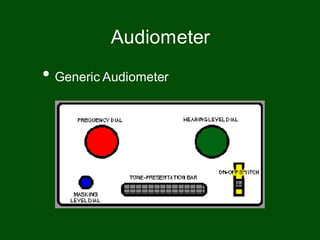
• Generic Audiometer
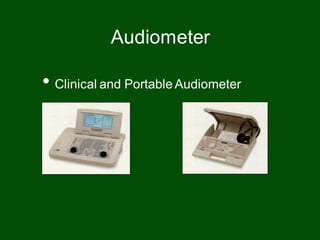
Audiometer
• Clinical and Portable Audiometer
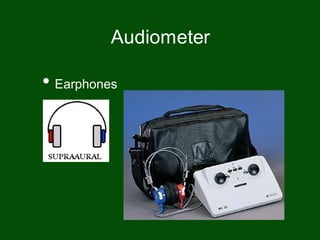
Audiometer
• Earphones
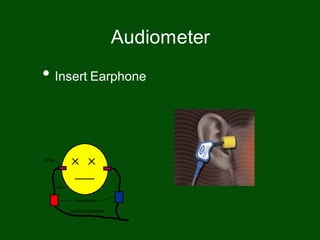
Audiometer
• Insert Earphone
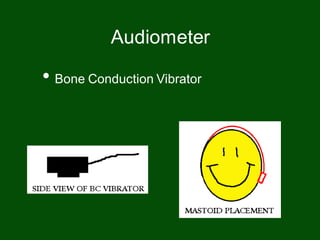
Audiometer
• Bone Conduction Vibrator
Audiometer
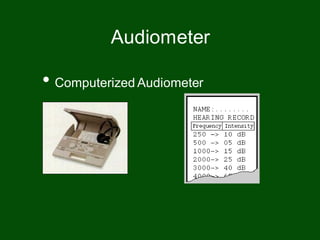
• Computerized Audiometer
Audiometer
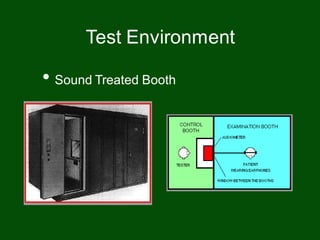
• Sound Treated Booth
Test Environment
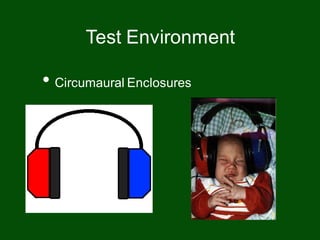
• Circumaural Enclosures
Test Environment
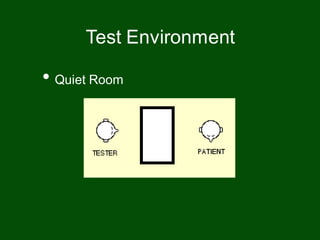
• Quiet Room
Test Environment
• Hand Raising
• Signal Button
• Verbal Response
• False Positives and False Negatives
Patient’s Role
• Instructions
• Patient’s Position
• Placement of Earphones
• Test Procedures for Screening
• Test Procedures for Pure Tone
Thresholds
Clinician’s Role
• Instructions
• What are they listening for
• How to respond
• Verify they understand instructions
Clinician’s Role
• Position of Client - Adults and Children
• Earphone Placement
Clinician’s Role
• Screening Test Procedures (adults)
• Instructions
• Test Frequencies
• Disposition of Failures
Clinician’s Role
• Pure Tone Threshold Procedures
• Self-test
• Place earphones on patient
• Test better ear first
• Order of test frequencies
• Test other ear
• Use ASHA protocol for threshold testing.
Clinician’s Role
• Pure Tone Average (PTA)
• Three tone average
• Two tone average
• Other methods
Clinician’s Role
• Degree of Hearing Loss based on PTA
• None
• Slight
• Mild
• Moderate
• Moderately Severe
• Severe
• Profound
Clinician’s Role
• Role of Bone Conduction
• Purpose
• Mastoid Placement
• Forehead Placement
Clinician’s Role
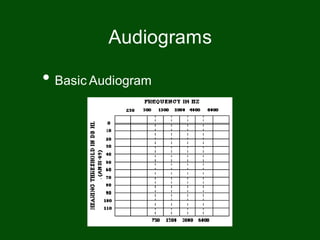
• Basic Audiogram
Audiograms
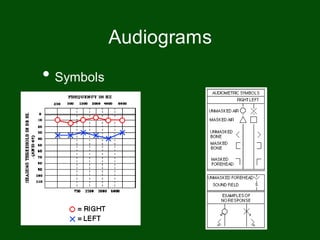
• Symbols
Audiograms
• Type
• Degree
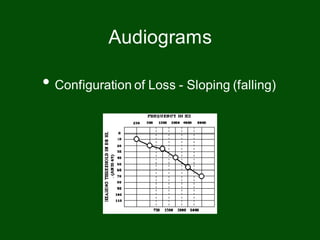
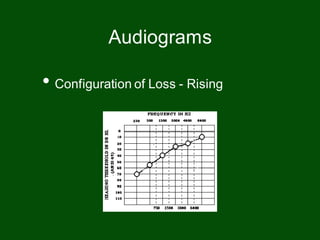
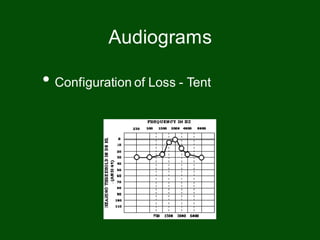
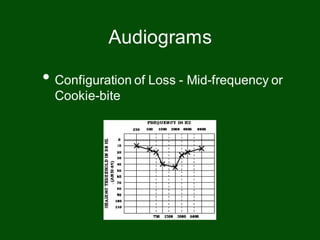
• Configuration
Audiograms
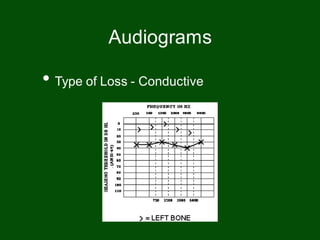
• Type of Loss - Conductive
Audiograms
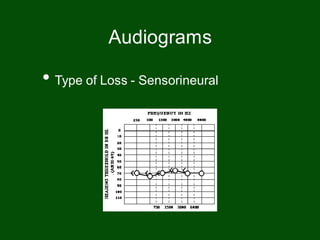
• Type of Loss - Sensorineural
Audiograms
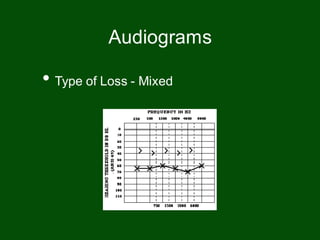
• Type of Loss - Mixed
Audiograms
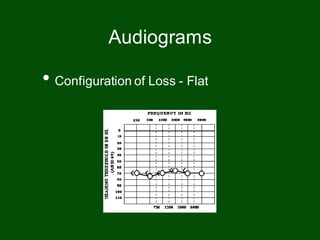
• Configuration of Loss - Flat
Audiograms
• Configuration of Loss - Sloping (falling)
Audiograms
• Configuration of Loss - Rising
Audiograms
• Configuration of Loss - Tent
Audiograms
• Configuration of Loss - Mid-frequency or
Cookie-bite
Audiograms
• Cross Hearing and Interaural
Attenutation
• Masking Defined
• Rules
• Types of Masking Noise
Masking
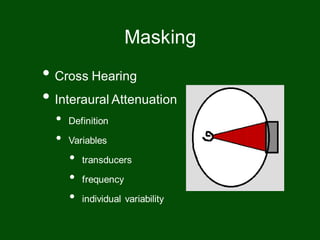
• Cross Hearing
• Interaural Attenuation
• Definition
• Variables
• transducers
• frequency
• individual variability
Masking
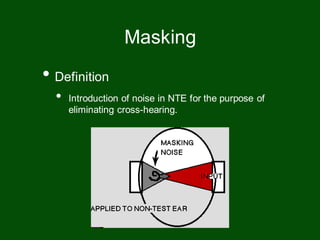
• Definition
• Introduction of noise in NTE for the purpose of
eliminating cross-hearing.
Masking
• Rule
• Apply masking to NTE whenever the AC of the TE
exceeds the BC for the NT cochlea by the amount
of the minimum IA values.
• Minimum IA values
• Supraaural phones = 40 dB
• Insert phones = 70 dB
• Bone conduction = 0 dB
Masking
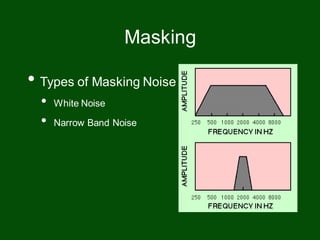
• Types of Masking Noise
• White Noise
• Narrow Band Noise
Masking
Summary

Audio03 audiometry