FUNCTIONAL BRAIN
WAVES
Psychserv Phils., INC
BRAIN WAVES
CLINICAL
Classic EEG
EEG NEUROFEEDBACK (TRADITIONAL
NEUROFEEDBACK)
3D NEUROFEEDBACK (QEEG LORETA
NEUROFEEDBACK)
MODBRAIN ACTIVATION
FORENSIC
BRAIN FINGERPRINTING
Brainwave speed is measured in Hertz (cycles per
second) and they are divided into bands delineating
slow, moderate, and fast waves.
INFRA-LOW (<.5HZ)
Infra-Low brainwaves (also known as Slow Coritical
Potentials), are thought to be the basic cortical
rythms that underlie our higher brain functions. Very
little is known about infra-low brainwaves. Their
slow nature make them difficult to detect and
accurately measure, so few studies have been
done. They appear to take a major role in brain
timing and network function.
DELTA WAVES (.5 TO 3 HZ)
Delta brainwaves are slow, loud brainwaves
(low frequency and deeply penetrating, like a
drum beat). They are generated in deepest
meditation and dreamless sleep. Delta waves
suspend external awareness and are the
source of empathy. Healing and regeneration
are stimulated in this state, and that is why
deep restorative sleep is so essential to the
healing process.
THETA WAVES (3 TO 8 HZ)
Theta brainwaves occur most often in sleep but are
also dominant in deep meditation. It acts as our
gateway to learning and memory. In theta, our
senses are withdrawn from the external world and
focused on signals originating from within. It is that
twilight state which we normally only experience
fleetingly as we wake or drift off to sleep. In theta we
are in a dream; vivid imagery, intuition and
information beyond our normal conscious
awareness. It’s where we hold our ‘stuff’, our fears,
troubled history, and nightmares.
ALPHA WAVES (8 TO 12 HZ)
Alpha brainwaves are dominant during quietly
flowing thoughts, and in some meditative states.
Alpha is ‘the power of now’, being here, in the
present. Alpha is the resting state for the brain.
Alpha waves aid overall mental coordination,
calmness, alertness, mind/body integration and
learning.
BETA WAVES (12 TO 38 HZ)
Beta brainwaves dominate our normal waking state of
consciousness when attention is directed towards cognitive
tasks and the outside world. Beta is a ‘fast’ activity, present
when we are alert, attentive, engaged in problem solving,
judgment, decision making, and engaged in focused mental
activity.
Beta brainwaves are further divided into three bands; Lo-
Beta (Beta1, 12-15Hz) can be thought of as a 'fast idle, or
musing. Beta (Beta2, 15-22Hz) is high engagement or
actively figuring something out. Hi-Beta (Beta3, 22-38Hz)
is highly complex thought, integrating new experiences,
high anxiety, or excitement. Continual high frequency
processing is not a very efficient way to run the brain, as it
takes a tremendous amount of energy.
GAMMA WAVES (38 TO 42 HZ)
Gamma brainwaves are the fastest of brain waves (high
frequency, like a flute), and relate to simultaneous processing
of information from different brain areas. It passes information
rapidly, and as the most subtle of the brainwave frequencies,
the mind has to be quiet to access it. Gamma was dismissed
as 'spare brain noise' until researchers discovered it
was highly active when in states of universal love, altruism,
and the ‘higher virtues’. Gamma is also above the frequency
of neuronal firing, so how it is generated remains a mystery. It
is speculated that Gamma rhythms modulate perception and
consciousness, and that a greater presence of Gamma
relates to expanded consciousness and spiritual emergence.
CLASSIC EEG
diagnostics for
neurological
problems
specifically
seizure problems
German physiologist and psychiatrist Hans Berger
(1873–1941) recorded the first human EEG in 1924.
[7] Expanding on work previously conducted on
animals by Richard Caton and others,
Berger also invented the electroencephalogram
(giving the device its name), an invention described
"as one of the most surprising, remarkable, and
momentous developments in the history of clinical
neurology“
His discoveries were first confirmed by British
scientists Edgar Douglas Adrian and B. H. C.
Matthews in 1934 and developed by them.
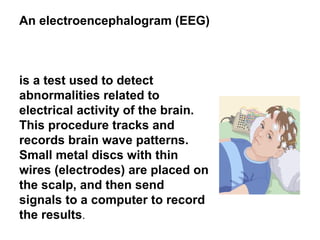
An electroencephalogram (EEG)
is a test used to detect
abnormalities related to
electrical activity of the brain.
This procedure tracks and
records brain wave patterns.
Small metal discs with thin
wires (electrodes) are placed on
the scalp, and then send
signals to a computer to record
the results.
EEG is most often used to diagnose epilepsy,
which causes abnormalities in EEG readings. It
is also used to diagnose sleep disorders, coma,
encephalopathies, and brain death. EEG used to
be a first-line method of diagnosis for tumors,
stroke and other focal brain disorders
The history of EEG is detailed by Barbara E. Swartz
in Electroencephalography and Clinical Neurophysiology.
In 1875, Richard Caton (1842–1926), a physician
practicing in Liverpool, presented his findings about
electrical phenomena of the exposed cerebral
hemispheres of rabbits and monkeys in the
British Medical Journal.
In 1890, Polish physiologist Adolf Beck published an
investigation of spontaneous electrical activity of the
brain of rabbits and dogs that included rhythmic
oscillations altered by light. Beck started experiments on
the electrical brain activity of animals. Beck placed
electrodes directly on the surface of brain to test for
sensory stimulation. His observation of fluctuating brain
activity lead to the conclusion of brain waves.
In 1934, Fisher and Lowenback first demonstrated
epileptiform spikes.
In 1935 Gibbs, Davis and Lennox described inter
ictal spike waves and the three cycles/s pattern of
clinical absence seizures, which began the field of
clinical electroencephalography.
Subsequently, in 1936 Gibbs and Jasper reported
the interictal spike as the focal signature of
epilepsy.
The same year, the first EEG laboratory opened at
Massachusetts General Hospital
NEUROFEEDBACK
brainwaves for
diagnostics
and
therapy/wellness
Neurofeedback (NFB)
also called neurotherapy or 
neurobiofeedback, is a type of biofeedback 
that uses real-time displays of brain activity
—most commonly electroencephalography 
(EEG), to teach self-regulation of brain 
function.
Joe Kamiya popularized neurofeedback in the 
1960s when an article about the alpha brain wave
experiments he had been conducting was 
published in Psychology Today in 1968.
Kamiya’s experiment had two parts.
In the first part, a subject was asked to keep his eyes closed 
and when a tone sounded to say whether he thought he was 
in alpha. He was then told whether he was correct or wrong. 
Initially the subject would get about fifty percent correct, but 
some subjects would eventually develop the ability to better 
distinguish between states
In the second part of the study, subjects were asked to go into 
alpha when a bell rang once and not go into the state when 
the bell rang twice. 
 Once again some subjects were able to 
enter the state on command. Alpha states were connected 
with relaxation, and alpha training had the possibility to 
alleviate stress and stress-related conditions.
The work of Barry Sterman, Joel F. Lubar and others 
has been relevant on the study of beta training, 
involving the role of sensorimotor rhythmic EEG
activity 
This training has been used in the treatment of 
epilepsy  attention deficit disorder and hyperactive 
disorder 
The sensorimotor rhythm (SMR) is rhythmic activity 
between 12 and 16 hertz that can be recorded from 
an area near the sensorimotor cortex. SMR is found 
in waking states and is very similar if not identical to 
the sleep spindles that are recorded in the second 
stage of sleep
Within the last 5–10 years, neurofeedback has taken a new 
approach in taking a look at deep states.
 Alpha-theta training has been tried with patients with 
alcoholism other addictions as well as anxiety This low 
frequency training differs greatly from the high frequency beta 
and SMR training that has been practiced for over thirty years 
and is reminiscent of the original alpha training of Elmer Green 
and Joe Kamiya. Beta and SMR training can be considered a 
more directly physiological approach, strengthening 
sensorimotor inhibition in the cortex and inhibiting alpha 
patterns, which slow metabolism. 
Alpha-theta training, however, derives from the 
psychotherapeutic model and involves accessing of painful or 
repressed memories through the alpha-theta state The alpha-
theta state is a term that comes from the representation on the 
EEG
conceptual approach called the Coordinated
Allocation of Resource Model (CAR) of brain
functioning which states that specific cognitive 
abilities are a function of specific electrophysiological 
variables which can overlap across different cognitive 
tasks
The activation database guided EEG biofeedback 
approach initially involves evaluating the subject on a 
number of academically relevant cognitive tasks and 
compares the subject's values on the QEEG 
measures to a normative database, in particular on 
the variables that are related to success at that task
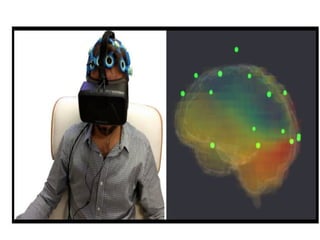
3D NEUROFEEDBACK-
LORETA
LORETA (LOW RESOLUTION
ELECTROMAGNETIC TOMOGRAPHY).
3D Neurofeedback expands on the capabilities of surface 
neurofeedback with a full range of new advances; bringing to 
bear the next generation of 3D brain imaging and training 
tools. In the hands of a skilled clinician, it is the ultimate brain 
training toolkit. 
 
Using a full 19 sensor cap, the clinician is able to train any 
number of areas together (as opposed to individual surface 
areas with the more common 2 sensor neurofeedback). By 
using a medical research database (Z-score) and deep brain 
source imaging (LoRETA), 3D neurofeedback can directly 
train entire brain networks; targeting overall electrical activity 
(amplitude), brain connectivity (coherence), processing speed 
(phase), and more. 
 
This is made possible by more advanced imaging capability 
– if you can detect it, you can train it. Better imaging equals 
better results. Better targeting means better reliability. 
Training multiple areas at once means less sessions.
 
For clinicians, being able to see exactly what is going on 
over the entire brain at all times is a real advantage, and by 
integrating research software the clinician can map, track, 
and keep the training entirely up to date. 
 
3D neurofeedback takes more skill and experience to 
operate, and the equipment required runs at a good twenty 
times the cost of basic equipment. Hence, sessions usually 
cost about a third more than for traditional neurofeedback – 
however one requires far fewer sessions to see results. 
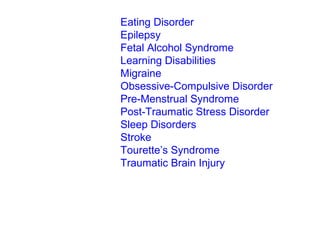
Eating Disorder
Epilepsy
Fetal Alcohol Syndrome
Learning Disabilities
Migraine
Obsessive-Compulsive Disorder
Pre-Menstrual Syndrome
Post-Traumatic Stress Disorder
Sleep Disorders
Stroke
Tourette’s Syndrome
Traumatic Brain Injury
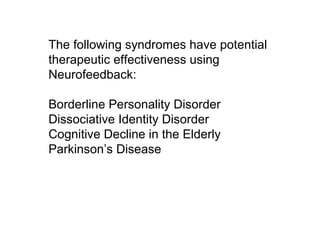
The following syndromes have potential
therapeutic effectiveness using
Neurofeedback:
Borderline Personality Disorder
Dissociative Identity Disorder
Cognitive Decline in the Elderly
Parkinson’s Disease
MIDBRAIN ACTIVATION
The Shichida Method of
Right Brain Training
Dr. Shichida uses the term “right brain education”
to describe his curriculum methods and to
distinguish it as being different and distinct from the
traditional education which utilizes the more linear
left brain approach to learning
Four major functions of the right brain
1: High-speed, high-capacity memory
mechanism. He explains that the left brain turns
data from the external world into language. This
requires "sequential processing," wherein data is
processed one bit at a time. It is a time-
consuming activity. The right brain, on the other
hand, processes information very quickly as
images or pictures.
2) A second function of the right brain is the
combination of memory with imagination to
produce "structures which transcend our
personal experience and knowledge
3) A third right-brain function is the production
of waves which resonate with the universe
4) A fourth function of the Right Brain is -rapid
automatic calculation
Right brain capabilities that all children possess are:
1. The 5 senses of the right brain.
Corresponding to the 5 senses of the left brain (sight, hearing,
touch, taste, smell) the right brain also has its 5 senses
However they are not the senses of sight and hearing in the normal
manner, but the ability to see, hear, sense things through waves
translated into images.
These 5 senses of the right brain are its basic abilities.
When these abilities are released, man becomes capable of seeing
images as motion pictures.
2. The ability to see images in the form of motion pictures.
3. Photographic memory.
4. The ability to do complex mental calculations.
5. The conversion of images to words, numbers, symbols and the reverse.
6. The ability to master foreign languages easily.
7. The ability to receive inspiration and use it towards unique creativity.
8. The ability of photographic speed-reading.
9. The ability to receive information on an intuitive level, and to use that
information accordingly.
The Shichida Method of Right Brain Training
The Characteristics of The Shichida Method Brain Training
The left and right hemispheres of the brain have different capabilities.
The right brain possesses the ability to retain complete image of things
seen at a glance in the memory. Also, it is the receptacle for inspiration
and the site of expression for image abundant creativity.
To create a balance between our human and animal minds, "We
must bring the functions of the brain stem to life, especially those
of its center-the diencephalon."
Shichida Makato says that, strictly speaking, the development of the
right brain is the development of the diencephalon of the brain's
right hemisphere. In other words, it is the development of the deep,
unconscious levels of the brain.
On the subject of activating the diencephalon,
Shichida recommends "imaging training,"
success at which connects the human mind with
the universal mind.
Spiritual education In addition to addressing the
theory and practice of right-brain development and
human learning potential, Shichida stresses
balance and complementarity between the two
sides of the brain. To him, right-brain education is
ultimately spiritual education
Shichida's curricula include games to teach "direct visual imaging,"
speed-reading and the making of mnemonic associations. In class, the
teacher places 10 different pictographic cards against the whiteboard. He or
she then connects the cards to each other with a story, creating a picture in
the mind which facilitates memorization. Shichida says that with practice,
"Kids no longer need the verbal connections. They can easily remember 40
to 50 cards. For many kids even 100 cards aren't a problem."
Another interesting feature of Shichida Makato's classes is that they do
not attempt to present principles underlying knowledge. Instead, they
provide students with large volumes of raw data. The rationale is that when
data is presented quickly, the left brain cannot keep up in its efforts to order
data and turn it into language. Instead, it gives up and takes a break,
allowing the right brain a chance to handle it. "After the right brain has taken
in the data, the brain can search for patterns and systems on its own."
About Brain Waves Brainwaves
•Beta waves are generated by the brains of
adults when fully awake.
•Alpha waves are produced by the brains
of young children.
•Theta waves are generated as we enter
sleep and while we dream.
•Delta waves are produced in deep sleep
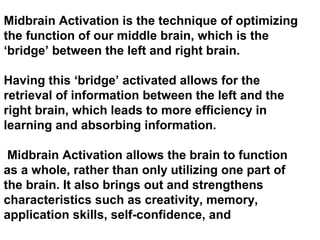
Midbrain Activation is the technique of optimizing
the function of our middle brain, which is the
‘bridge’ between the left and right brain.
Having this ‘bridge’ activated allows for the
retrieval of information between the left and the
right brain, which leads to more efficiency in
learning and absorbing information.
Midbrain Activation allows the brain to function
as a whole, rather than only utilizing one part of
the brain. It also brings out and strengthens
characteristics such as creativity, memory,
application skills, self-confidence, and
BRAIN FINGERPRINTING
brain waves in forensics
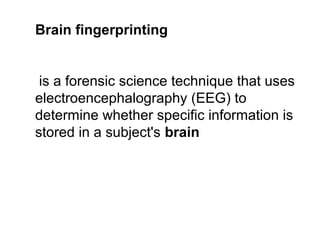
Brain fingerprinting
is a forensic science technique that uses
electroencephalography (EEG) to
determine whether specific information is
stored in a subject's brain
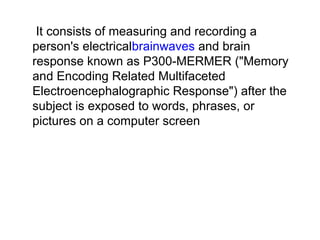
 It consists of measuring and recording a 
person's electricalbrainwaves and brain 
response known as P300-MERMER ("Memory 
and Encoding Related Multifaceted 
Electroencephalographic Response") after the 
subject is exposed to words, phrases, or 
pictures on a computer screen
The P300 (P3) wave is an 
event related potential (ERP) component 
elicited in the process of decision making. It is 
considered to be an endogenous potential, as 
its occurrence links not to the physical 
attributes of a stimulus, but to a person's 
reaction to it
When recorded by electroencephalography (EEG), it 
surfaces as a positive deflection in voltage with a 
latency (delay between stimulus and response) of 
roughly 250 to 500 ms.
The signal is typically measured most strongly by 
the electrodes covering the parietal lobe. The 
presence, magnitude, topography and timing of this 
signal are often used as metrics of 
cognitive function in decision making processes. 
While the neural substrates of this ERP component 
still remain hazy, the reproducibility and ubiquity of 
this signal makes it a common choice for 
psychological tests in both the clinic and laboratory.
Brain fingerprinting was invented by Lawrence Farwell. He 
hypothesized that the brain processes known or relevant information 
differently than unknown or irrelevant information (
Farwell & Donchin 1991). 
The brain's processing of information known to the subject is revealed 
by a specific pattern in the EEG (electroencephalograph) (
Farwell & Smith 2001, Farwell 1994). 
Farwell's brain fingerprinting originally used the P300 brain response to 
detect the recognition of the known information (
Farwell & Donchin 1986, 1991, Farwell 1995a). 
Later, Farwell discovered the P300-MERMER, which extends the basic 
P300 and is reported to provide greater accuracy and statistical 
confidence (Encyclopedia of Forensic Science 2014, 
Farwell & Smith 2001, Farwell 1994, Farwell 1995b, Farwell et al. 2013). 
Brain fingerprinting has an error rate of less than 1%, as well as high 
statistical confidence (Encyclopedia of Forensic Science 2014) in 
Brain fingerprinting has been ruled admissible 
for court use in the United States of 
America (Harrington v. State 
2001,Encyclopedia of Forensic Science 
2014, Farwell & Makeig 2005, Farwell 2012).
 It has been used in a number of high-profile 
criminal cases such as the murder trial of 
Terry Harrington (Harrington v. State 2001) 
and the sentencing of serial killer J. B. 
Grinder (Encyclopedia of Forensic Science 
2014, Farwell et al. 2013).
CLARITY
a new brain imaging technique
by Karl Deisseroth
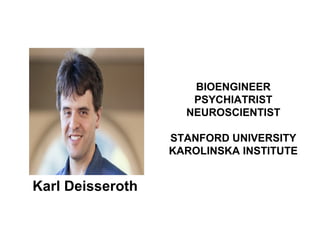
BIOENGINEER
PSYCHIATRIST
NEUROSCIENTIST
STANFORD UNIVERSITY
KAROLINSKA INSTITUTE
Karl Deisseroth
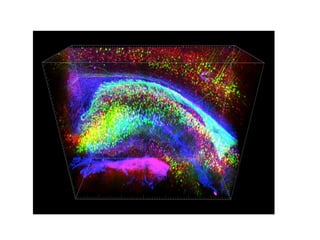
CLARITY is a technique developed in the Deisseroth 
lab at Stanford University.
The method is used to transform an intact tissue into 
an optically transparent and permeable hydrogel-
hybridized form that can undergo immunostaining and 
high resolution 3-D imaging without damage to the 
sample. 
By clearing the tissue while preserving fine structural 
details, CLARITY provides a technique for obtaining 
high-resolution information from complex systems 
while maintaining the global perspective necessary to 
understand system function.
Applications
In terms of brain imaging, the ability for CLARITY
imaging to reveal specific structures in such
unobstructed detail has led to promising avenues of
future applications including
local circuit wiring
relationships between neural cells,
roles of subcellular structures,
better understanding of protein complexes, and
imaging of nucleic acids and neurotransmitters.
An example of a discovery made through CLARITY
imaging is a peculiar 'ladder' pattern where neurons
connected back to themselves and their neighbors,
which has been observed in animals to be connected
to autism-like behaviors
NIH director Francis Collins has already 
expressed his hopes for this emergent 
technology, saying:
"CLARITY is powerful. It will enable 
researchers to study neurological diseases 
and disorders, focusing on diseased or 
damaged structures without losing a global 
perspective. That’s something we’ve never 
before been able to do in three dimensions."
Functional brainwaves final

Functional brainwaves final