
VERTIGO – MAKING
IT SIMPLE
DR.ANITA BHANDARI
CONSULTANT NEUROTOLOGIST
VERTIGO AND EAR CLINIC,
JAIPUR
ETIOLOGY
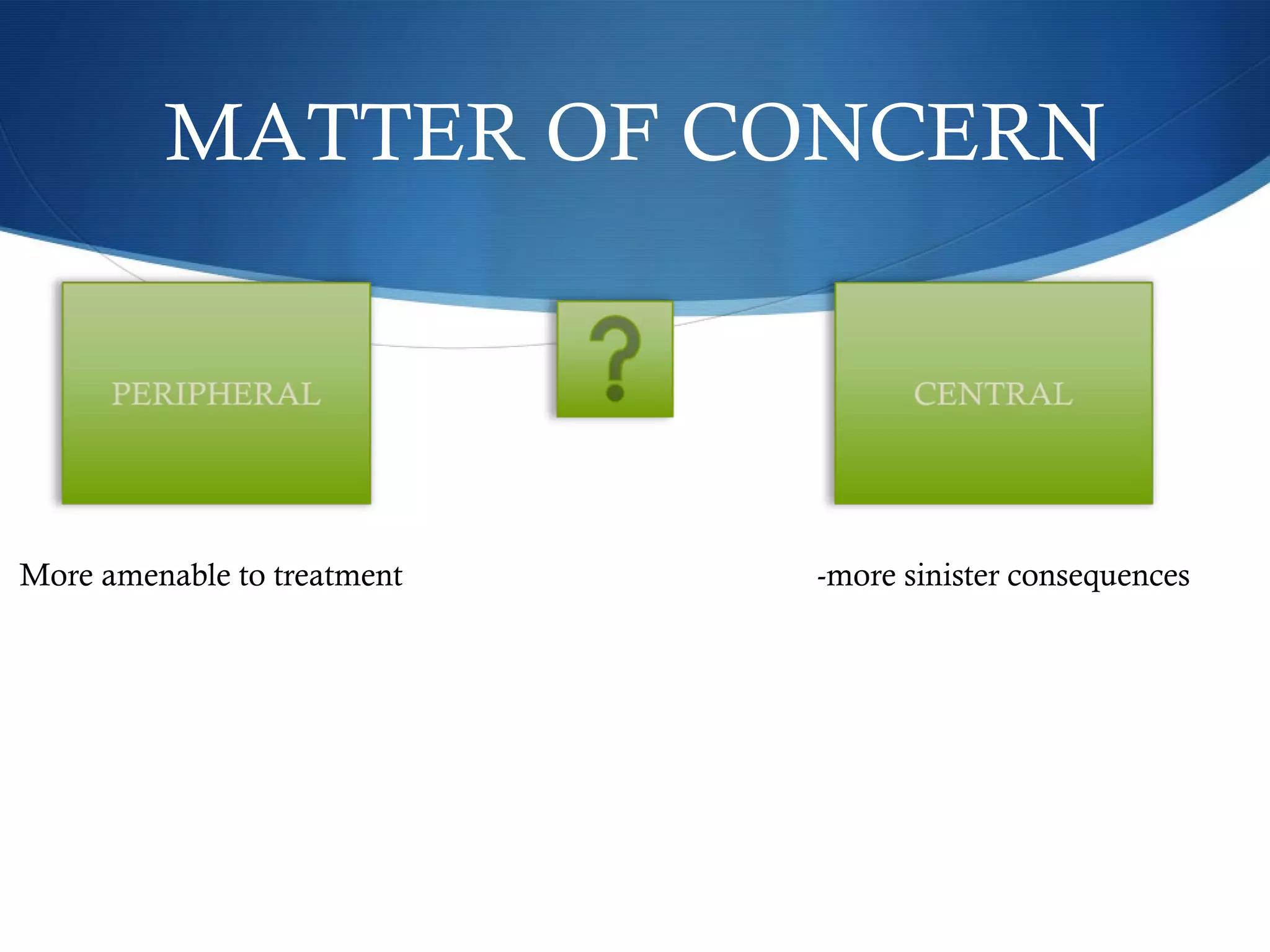
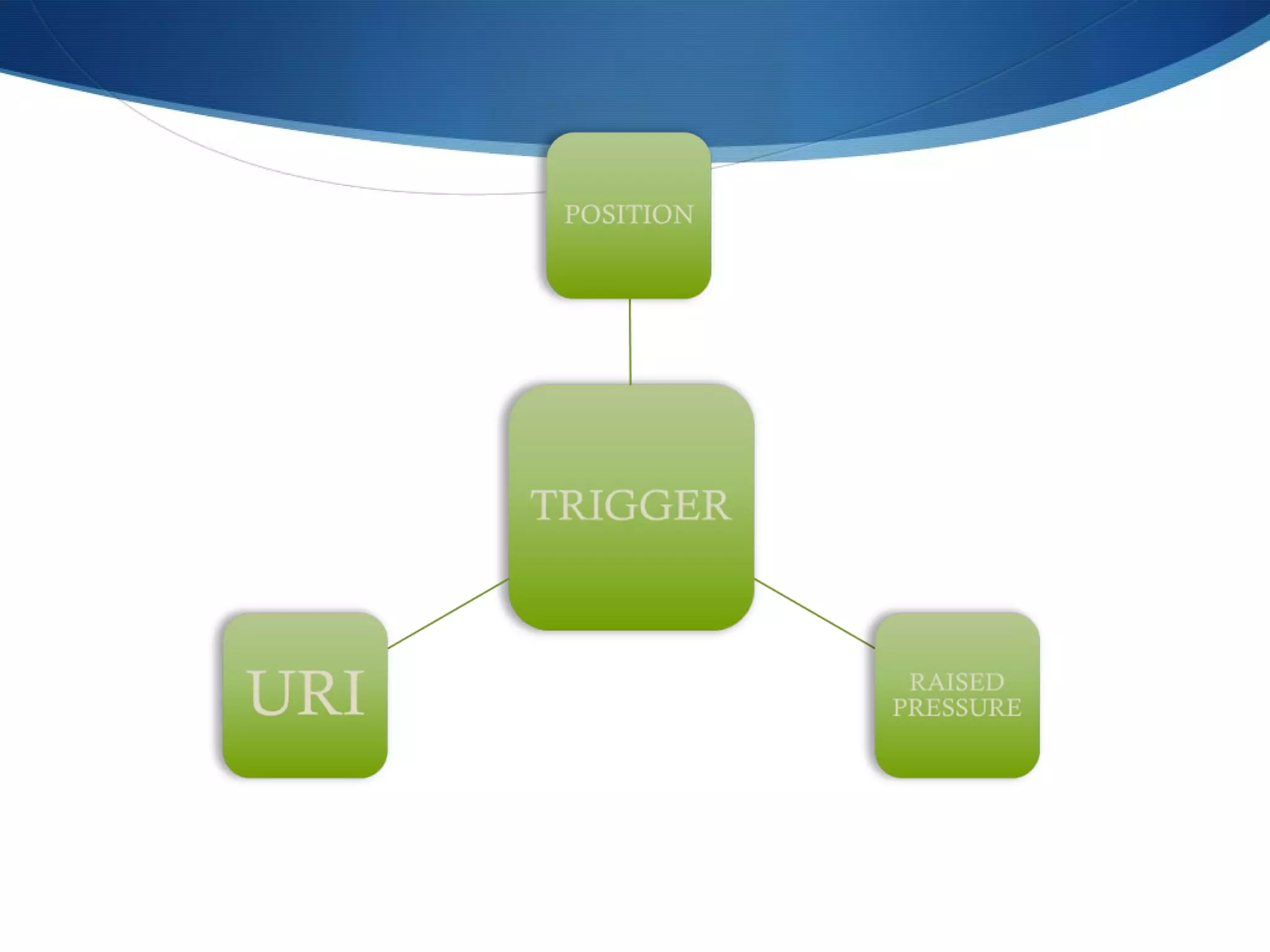
MATTER OF CONCERN
More amenable to treatment -more sinister consequences
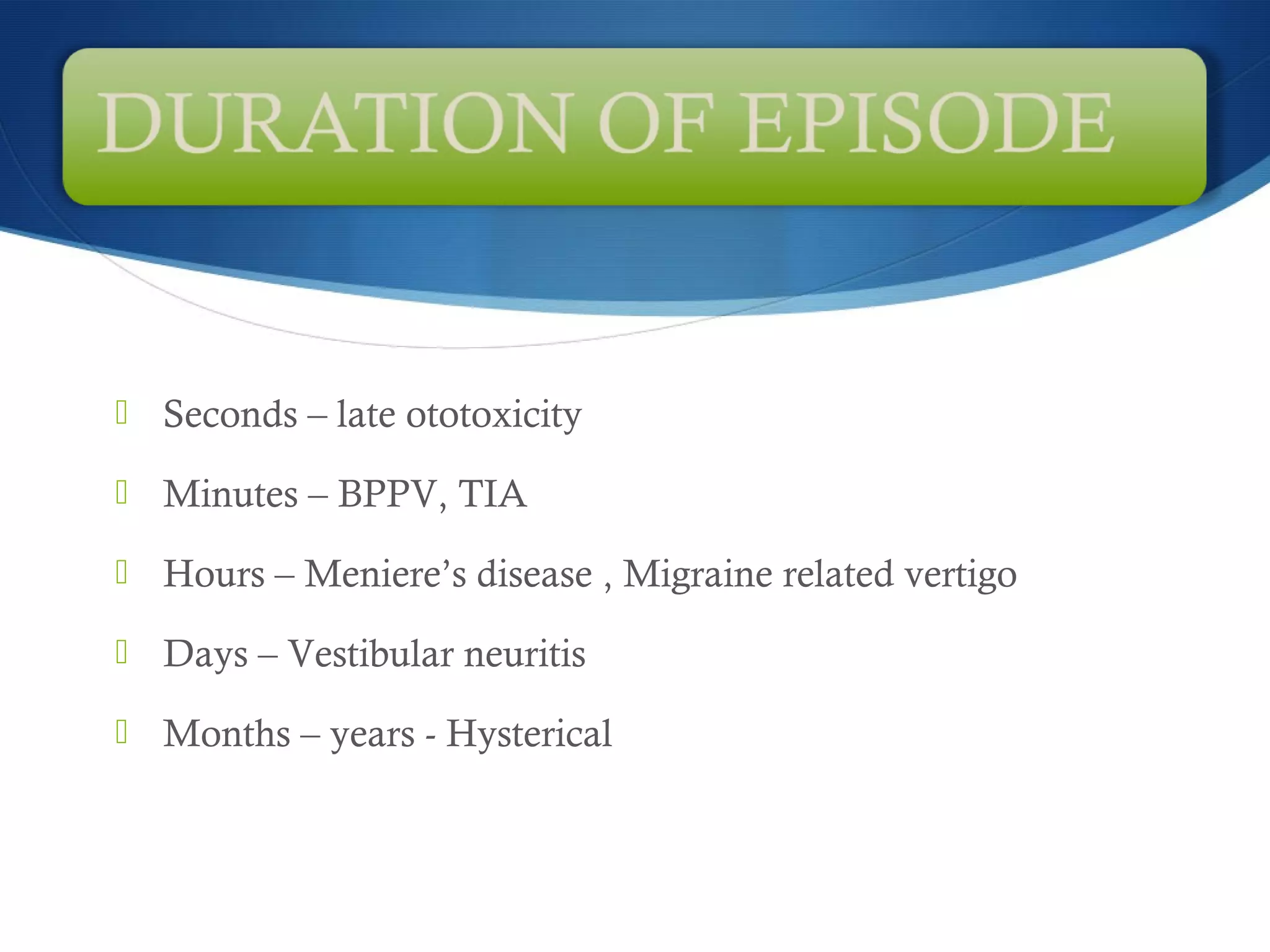
 Seconds – late ototoxicity
 Minutes – BPPV, TIA
 Hours – Meniere’s disease , Migraine related vertigo
 Days – Vestibular neuritis
 Months – years - Hysterical
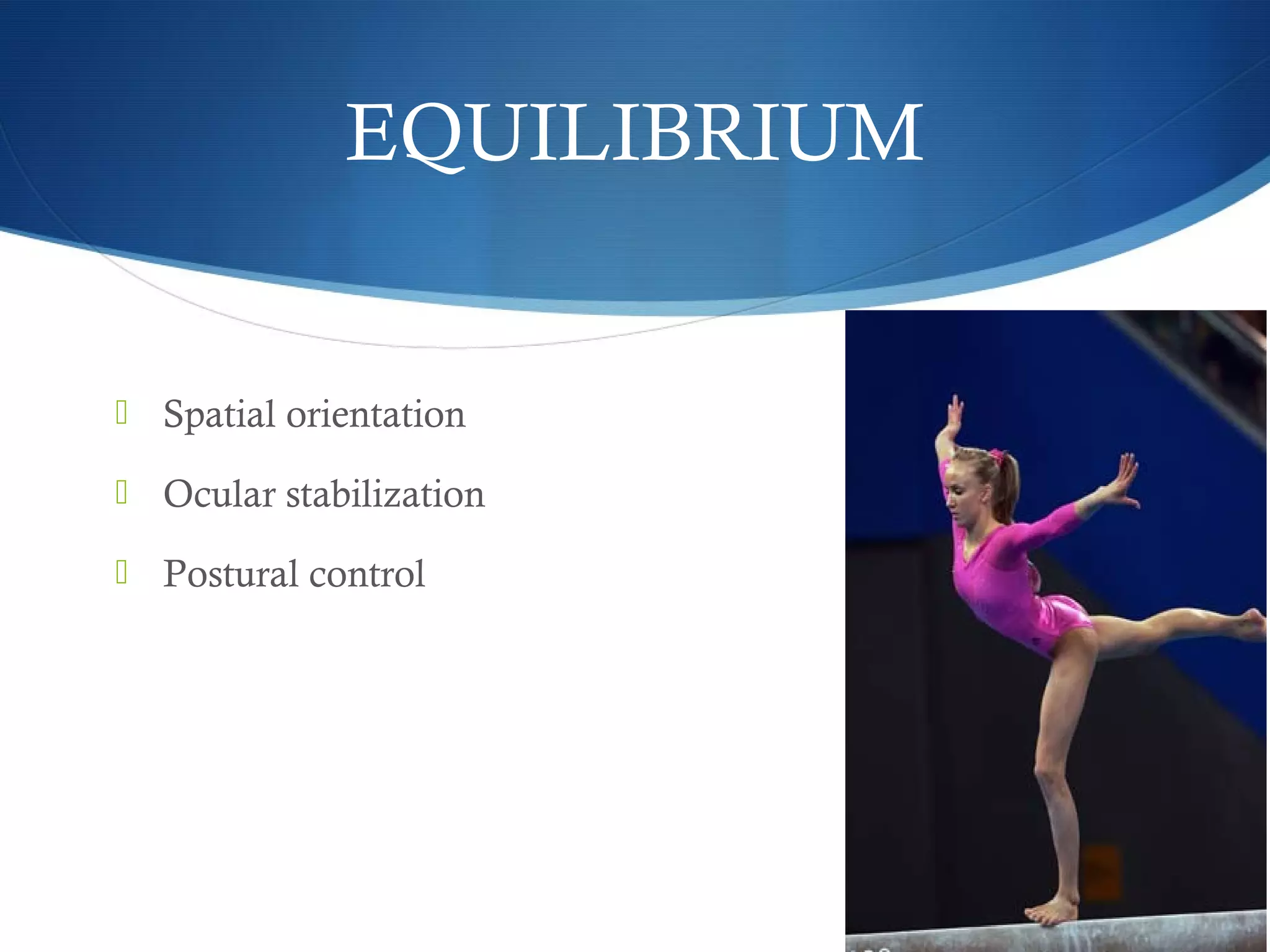
 Spatial orientation
 Ocular stabilization
 Postural control
EQUILIBRIUM
 A battery of tests
 Many systems to be evaluated to assess structural and
functional integrity
NEUROTOLOGICAL
EVALUATION
For An ENT Specialist,
 We look at the ears first.
 In vertigo --> eyes are most important
 Otoliths act as gravito-inertial force detectors
 SVV is a psychophysical measure of the angle between perceptual
vertical and true/gravitational vertical
 Also used to measure vestibular rehabilitation
 Compensated utricular hypofunction may be detected on dynamic
SVV testing. The defect will be unmasked on eccentric rotation
because any otolith function asymmetry will be enhanced.
SVV
 Pt is asked to adjust the orientation of a luminous bar until they
perceive it as vertical
 SVV – saccule and its central pathways
 SVH – utricle and its central pathways
 Pinar et al reported changes in SVV and SVH in >25% pts of
chronic dizziness concluding that evaluation of the otolith system
is mandatory
SUBJECTIVE VISUAL
VERTICAL AND HORIZONTAL
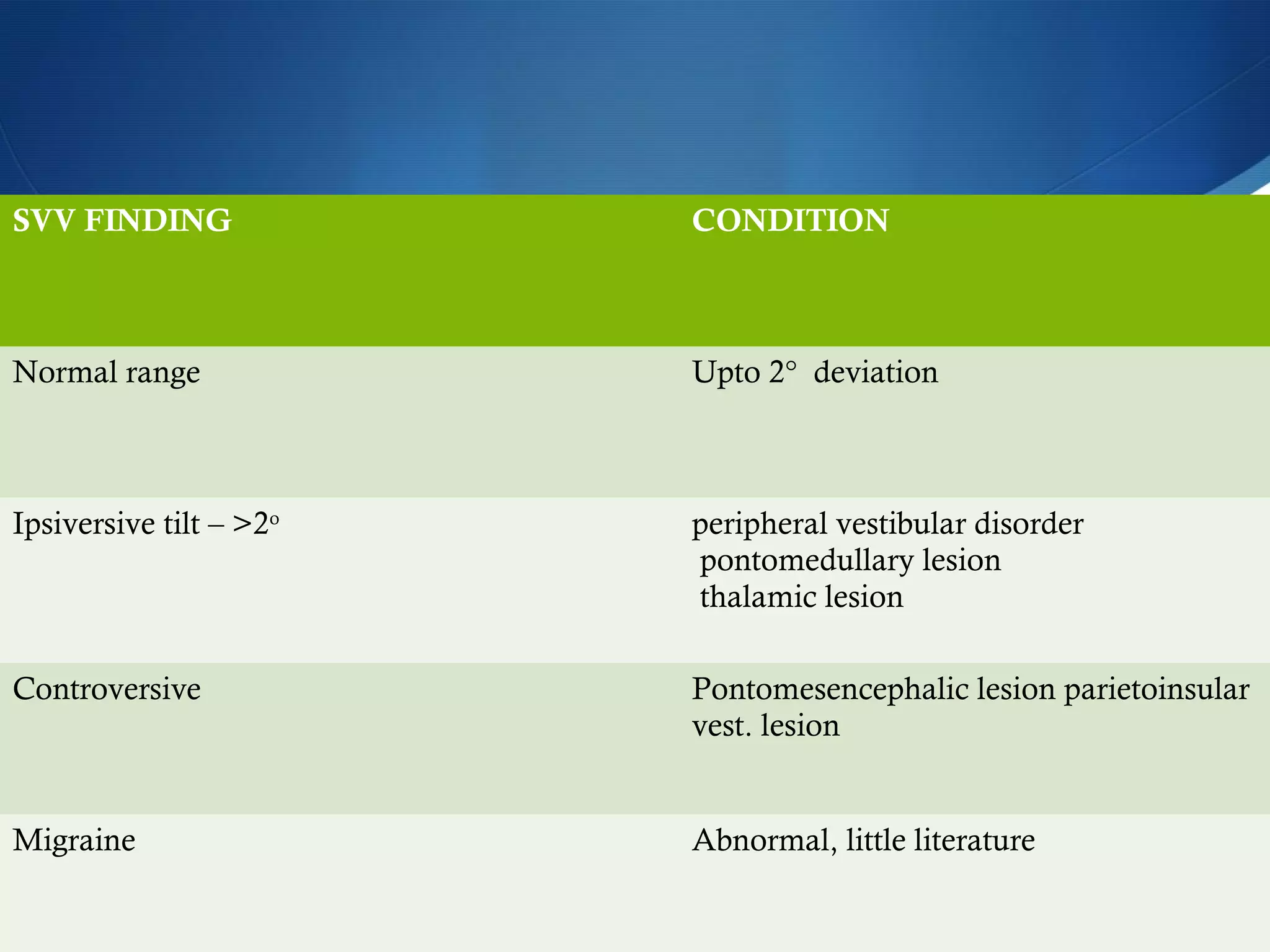
SVV FINDING CONDITION
Normal range Upto 2° deviation
Ipsiversive tilt – >2o
peripheral vestibular disorder
pontomedullary lesion
thalamic lesion
Controversive Pontomesencephalic lesion parietoinsular
vest. lesion
Migraine Abnormal, little literature
CRANIOCORPOGRAPHY
 Developed by Claussen [1968]
 Assessment of vestibulospinal system
 Photographic recording of head and body movement during
gait testing
 Evaluation includes Romberg, Tandem walking and
Unterburger’s test
 Done in dark room
 Pt is blindfolded
 Pt wears a helmet with LED lights
 Path of the pt is recorded using an SLR camera
 Result depends on vestibular system only as visuals cues cut off –
pt is blindfolded and by stepping in one place, the soles
intermittently lose contact with the floor thus reducing
somatosensory input
CCG : PROCEDURE
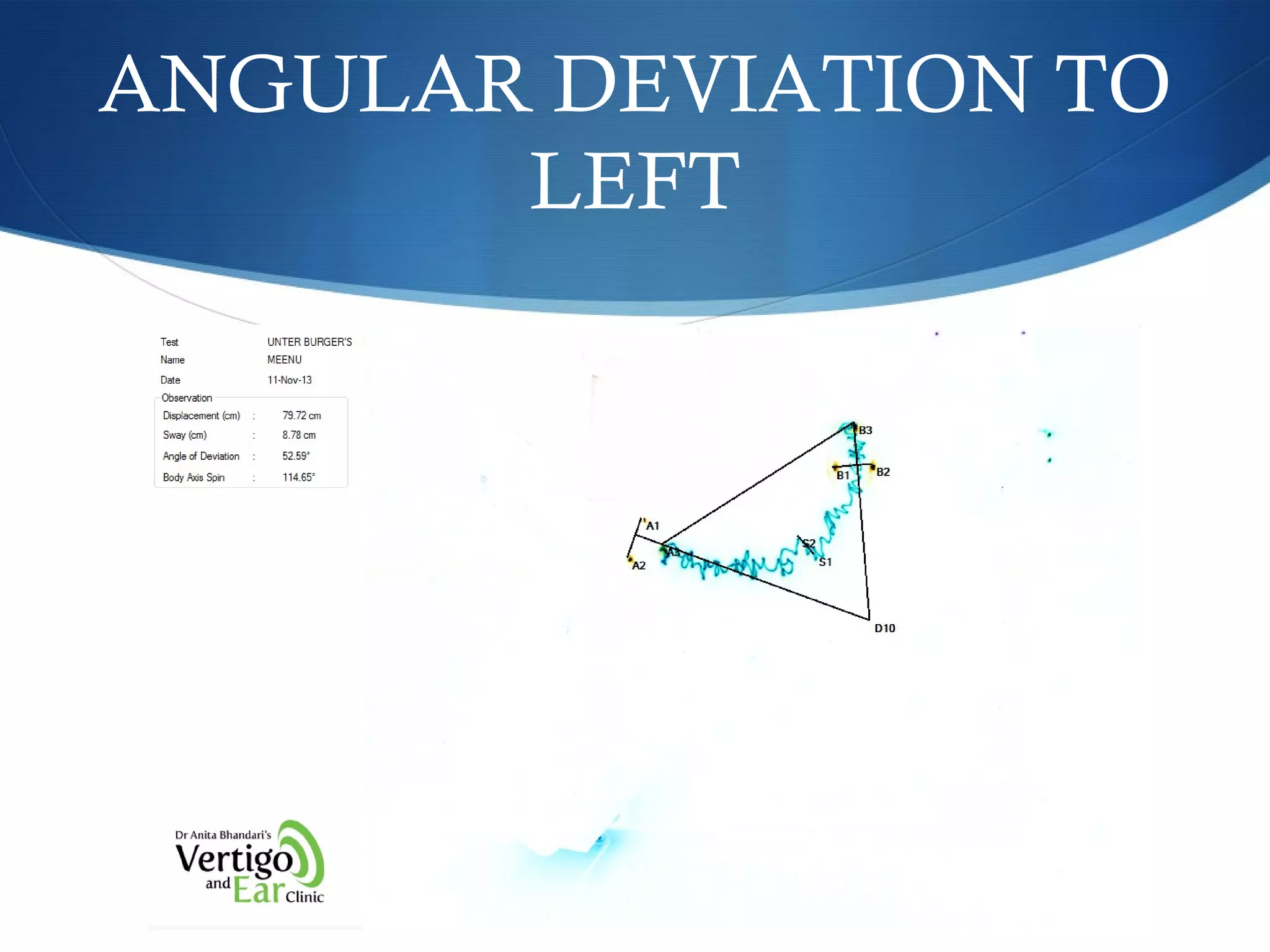
PARAMETER NORMAL RANGE-
LOWER BORDER
NORMAL RANGE-
UPPER BORDER
Longitudinal
displacement
30.03 cm 113.35 cm
Lateral sway 5.17 cm 16.15 cm
Angular deviation 55.13° (right) 48.37° (left)
Body spin 82.21° (right) 82.89° (left)
NORMAL PARAMETER OF
CCG
[CLAUSSEN]
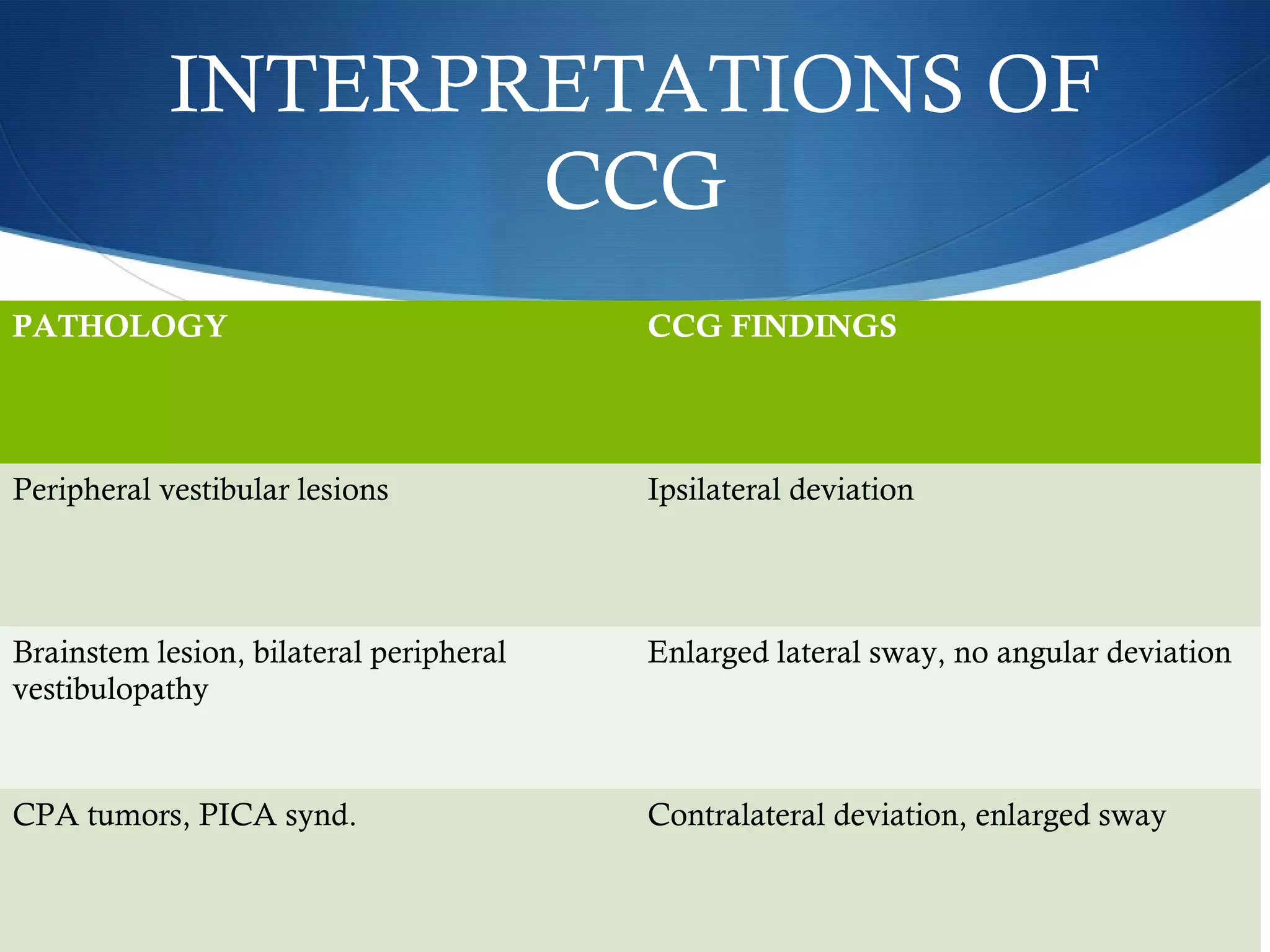
PATHOLOGY CCG FINDINGS
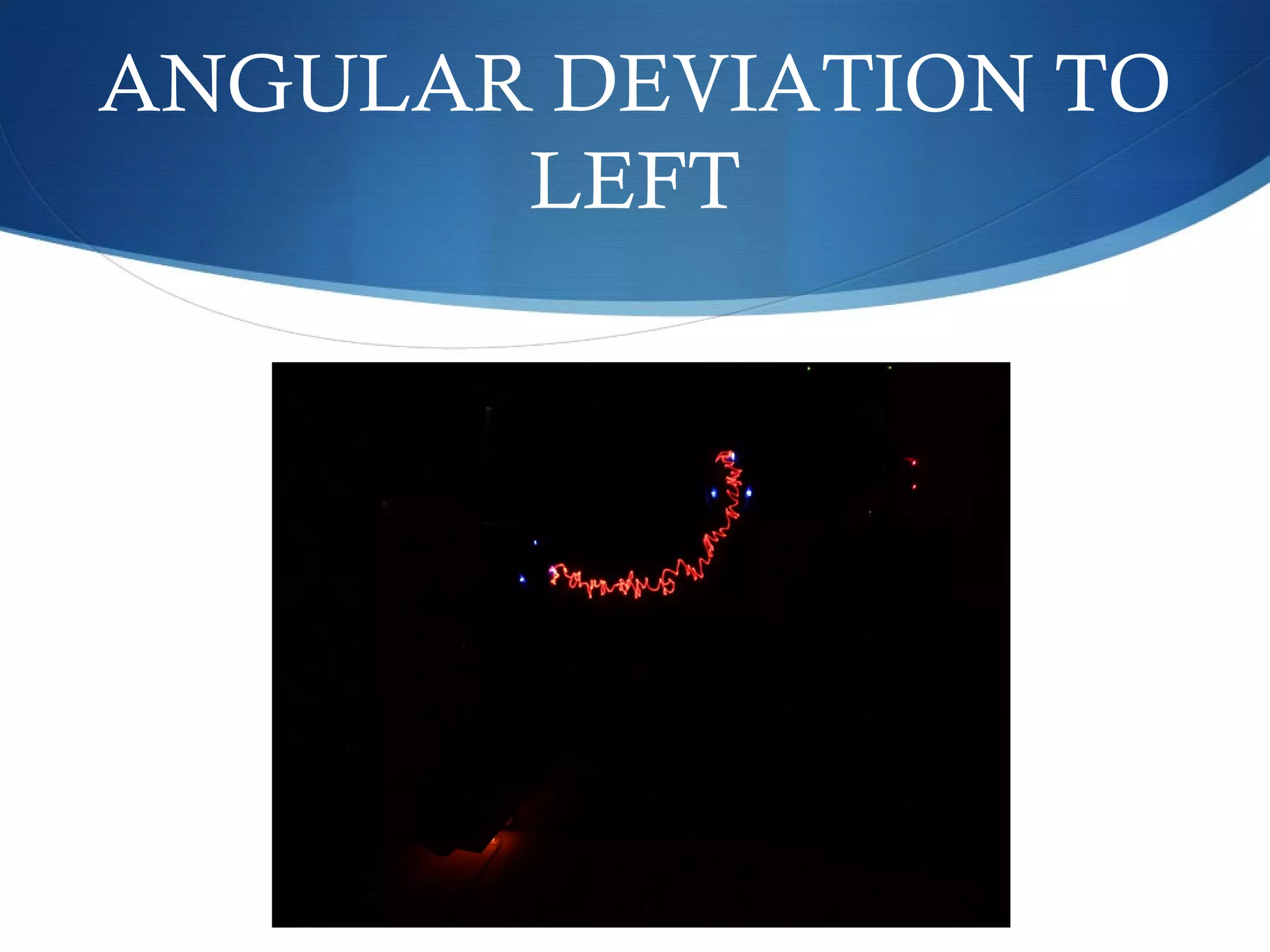
Peripheral vestibular lesions Ipsilateral deviation
Brainstem lesion, bilateral peripheral
vestibulopathy
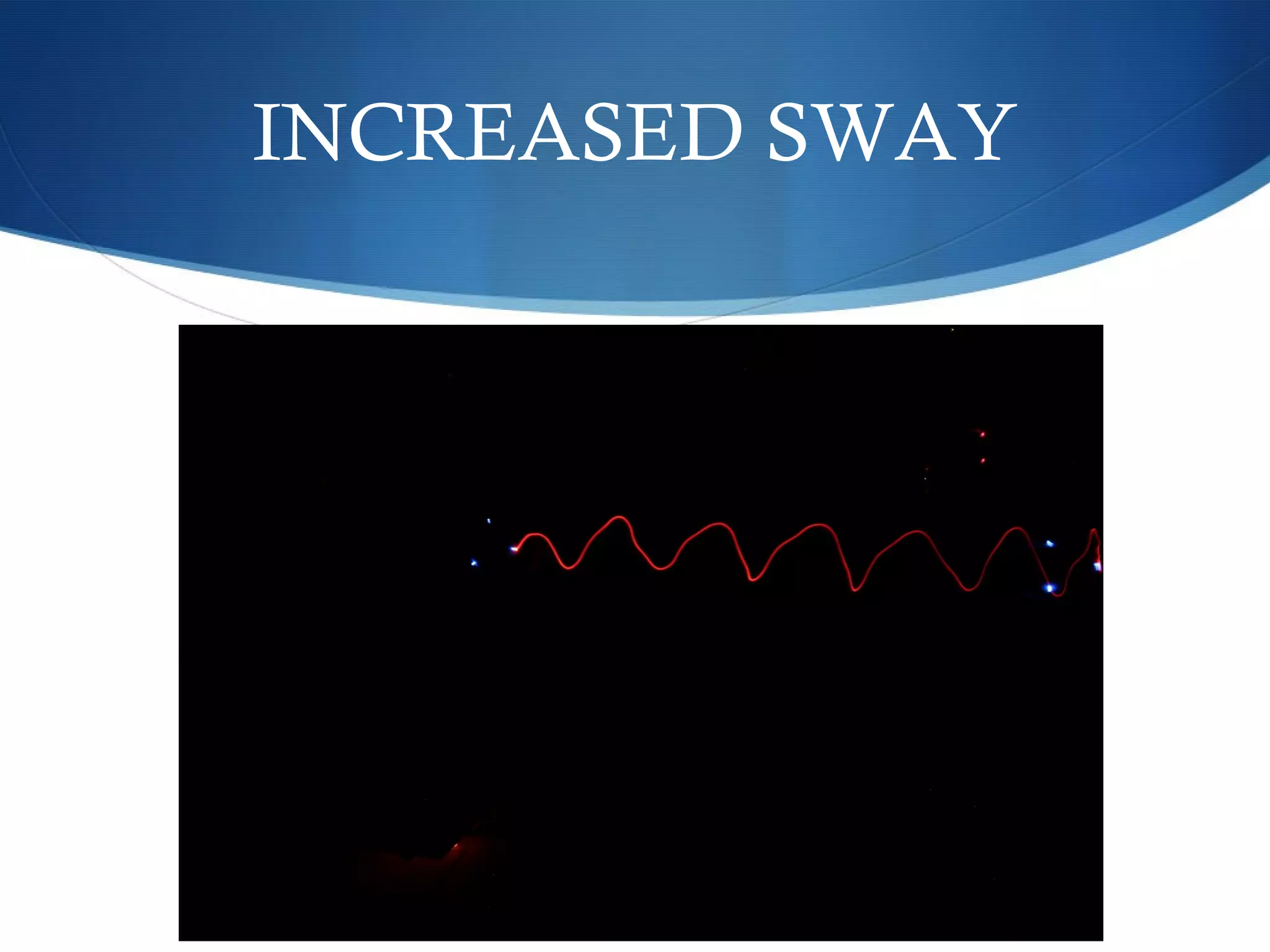
Enlarged lateral sway, no angular deviation
CPA tumors, PICA synd. Contralateral deviation, enlarged sway
INTERPRETATIONS OF
CCG
INCREASED SWAY
ANGULAR DEVIATION TO
LEFT
ANGULAR DEVIATION TO
LEFT
 Introduced by Halmagyi and Curthoy
 Simple, fast, reliable
 Tests scc function – can evaluate all 3 pairs
 Measures high freq. vestibular response in 3 dimensions
HEAD IMPULSE TESTING
 VHIT – using Video Frenzel glasses
 Test for gaze stabilization during rapid translation of head
 Assesses the peripheral utricular system and superior
vestibular N
 A corrective saccade after VHIT indicates hypofunction of
same side
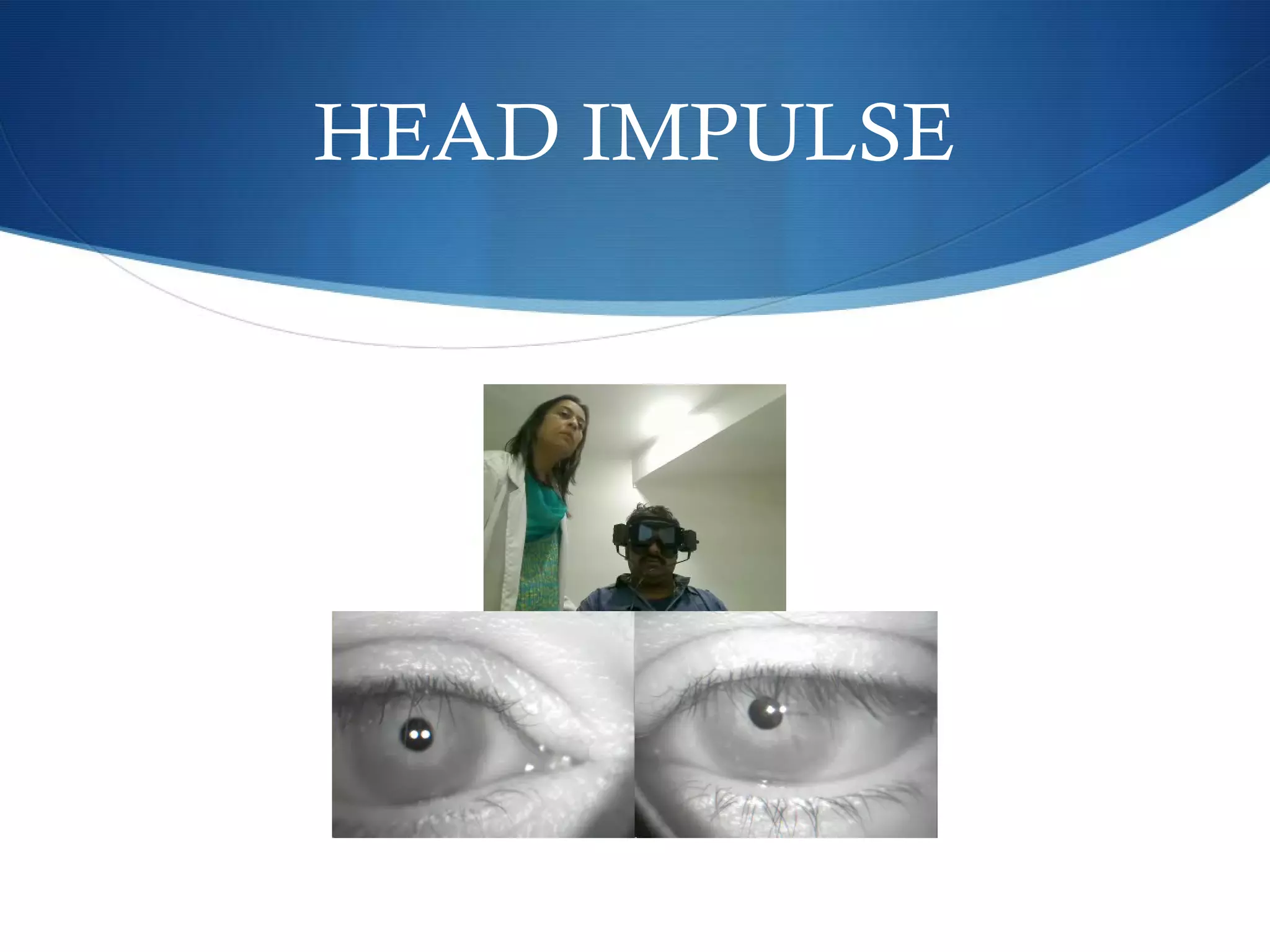
HEAD IMPULSE TEST
 Subject seated upright with eyes focused on an fixed object
 Unpredictable , low amplitude [10 – 20°] head rotation with
high acceleration
 Angular VOR generates compensatory eye movements
equal in amplitude and opposite in direction to stabilize
gaze
HIT : PROCEDURE
HEAD IMPULSE
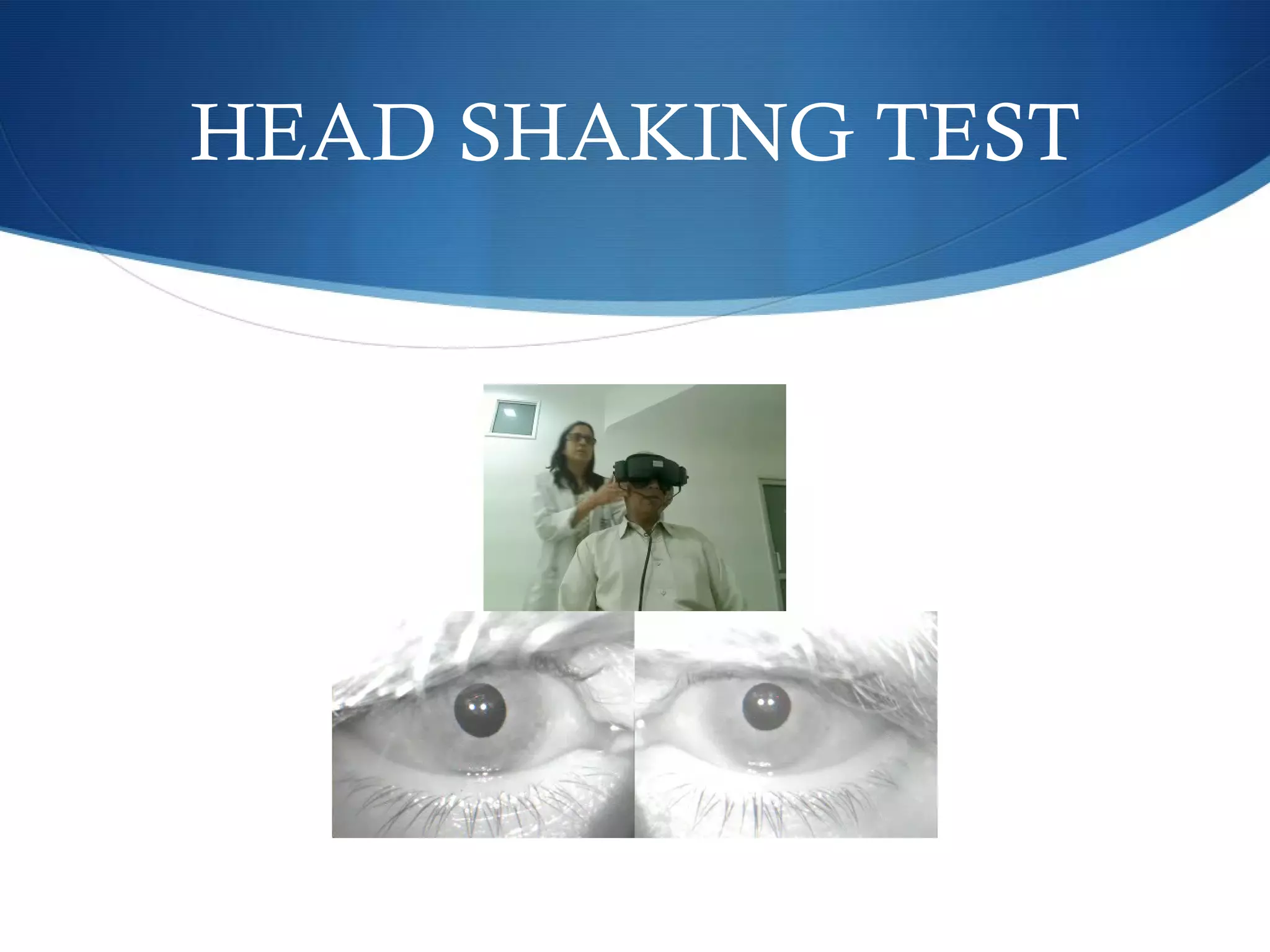
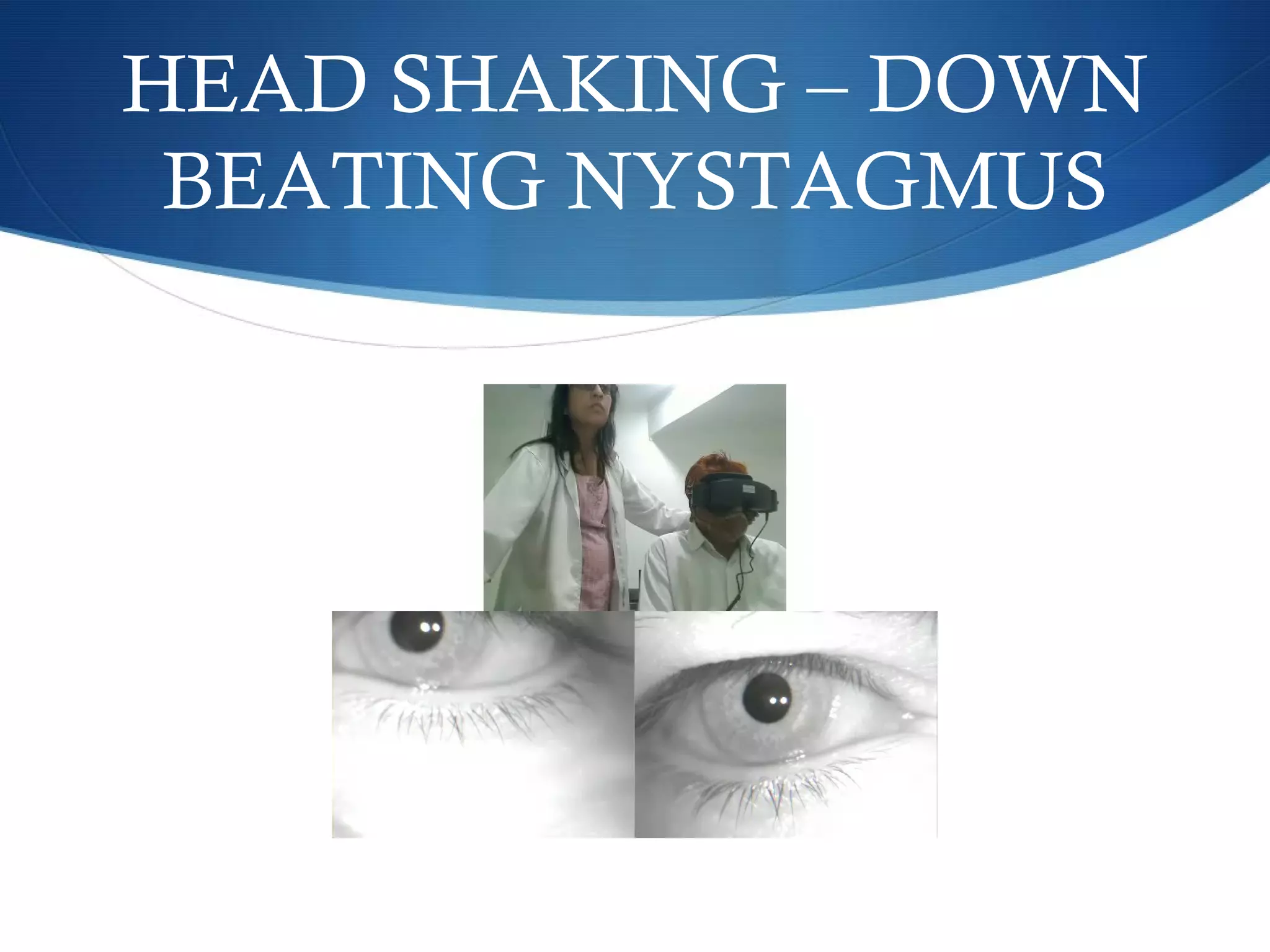
 Nystagmus indicates an imbalance in vestibular tone
between the 2 sides
 Not seen in bilateral vestibular dysfunction
HEAD SHAKING TEST
HEAD SHAKING TEST
HEAD SHAKING – DOWN
BEATING NYSTAGMUS
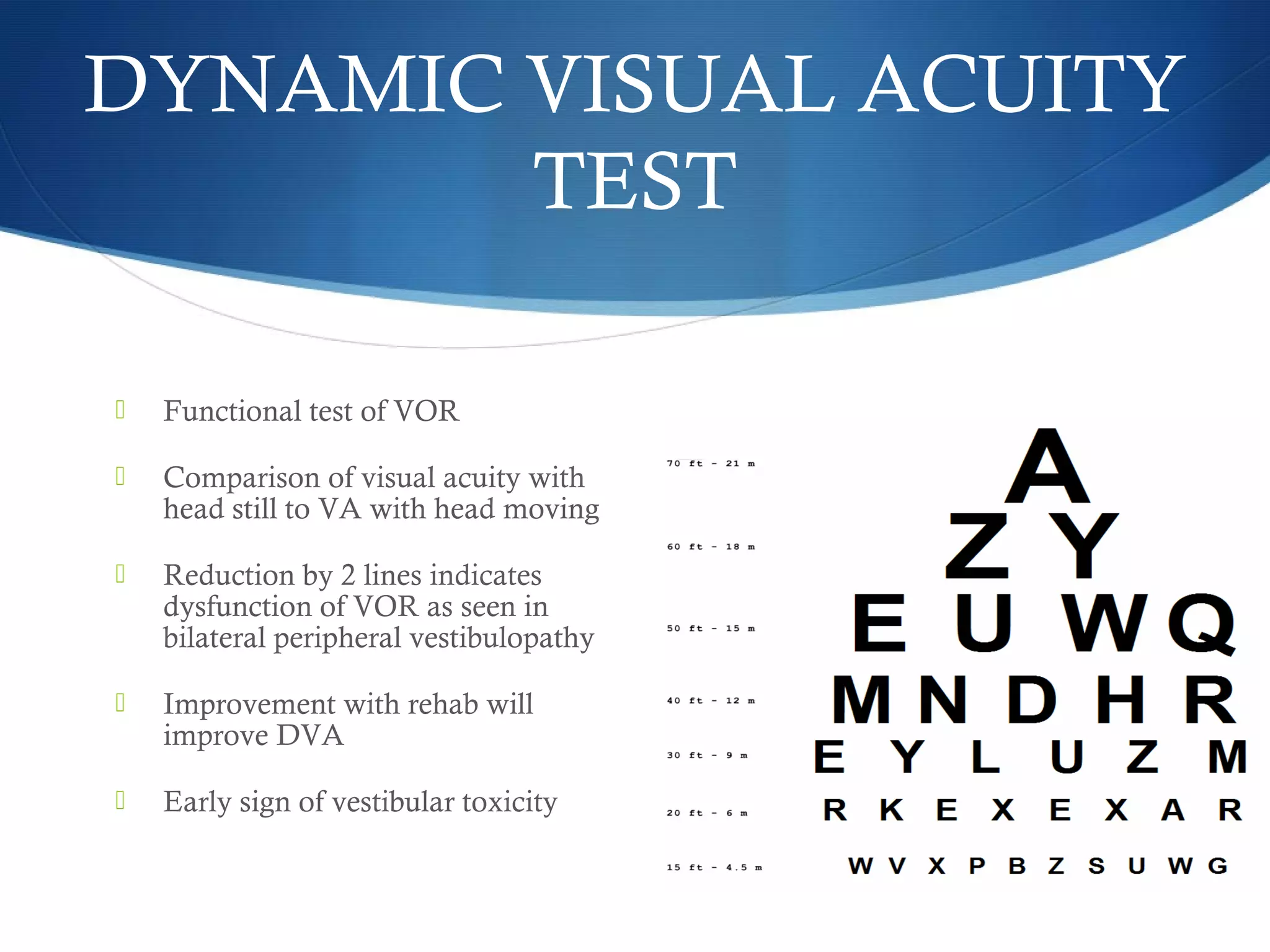
 Functional test of VOR
 Comparison of visual acuity with
head still to VA with head moving
 Reduction by 2 lines indicates
dysfunction of VOR as seen in
bilateral peripheral vestibulopathy
 Improvement with rehab will
improve DVA
 Early sign of vestibular toxicity
DYNAMIC VISUAL ACUITY
TEST

BPPV AND PARTICLE REPOSITIONING
MANEUVERS
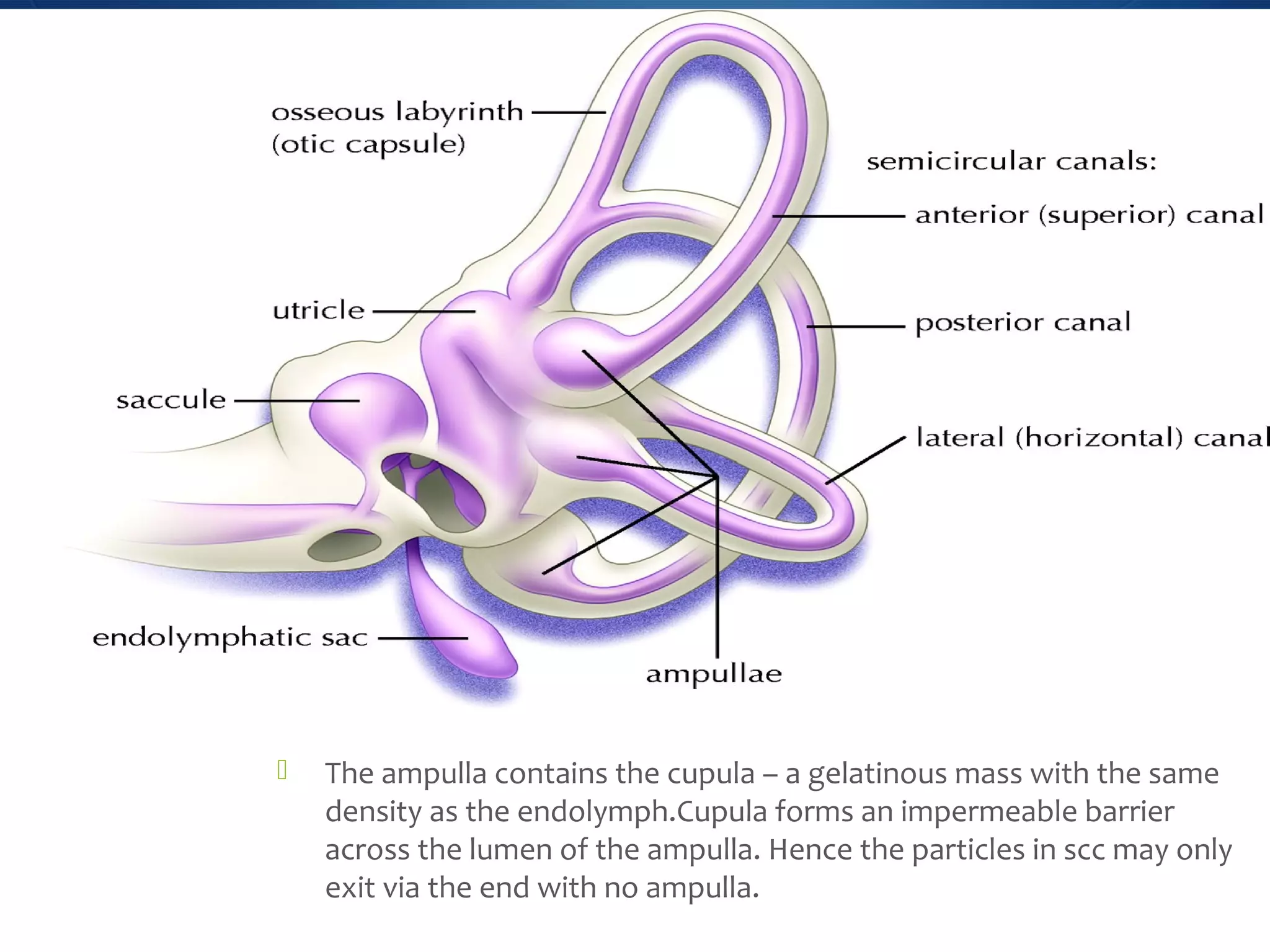
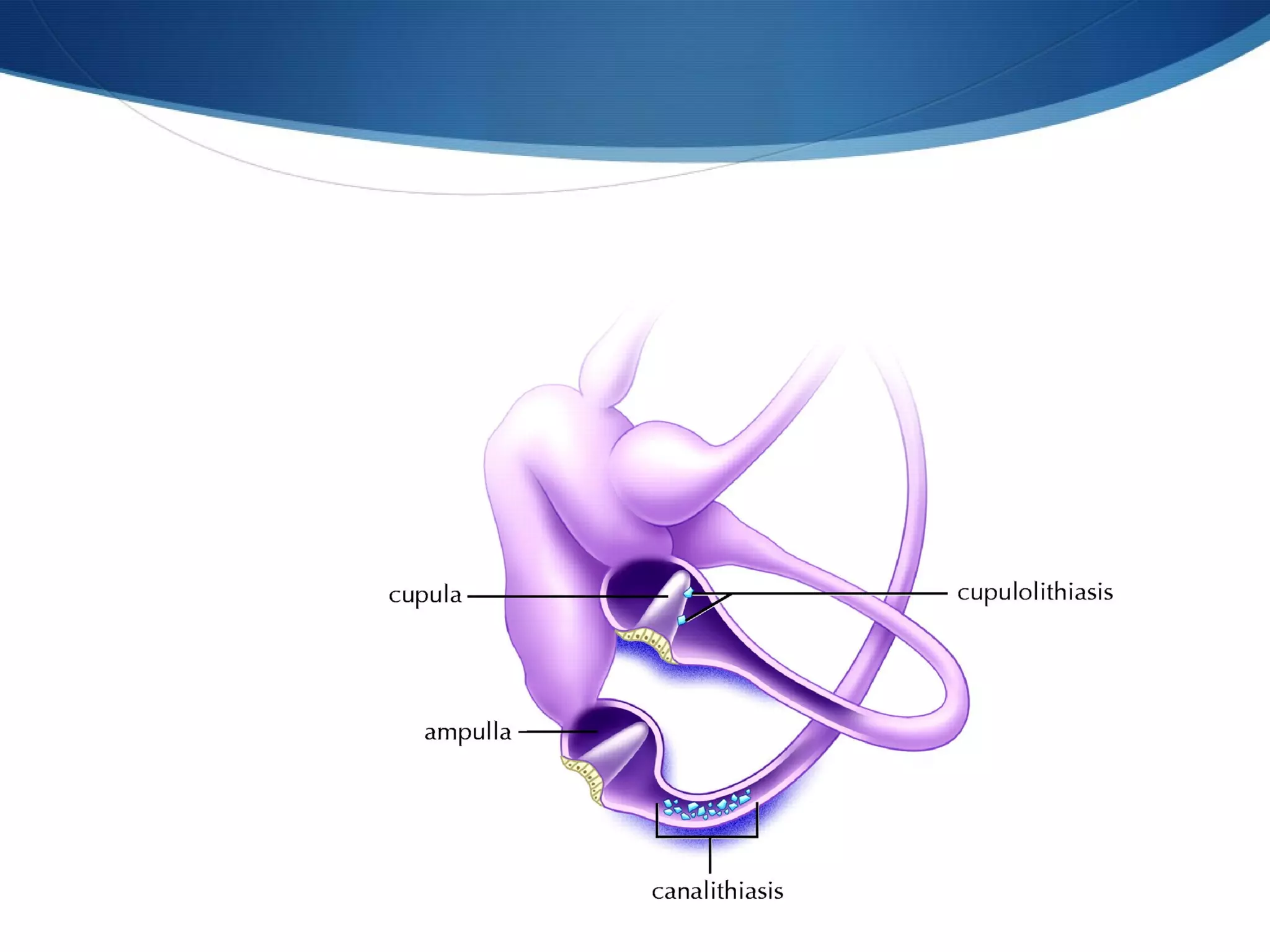
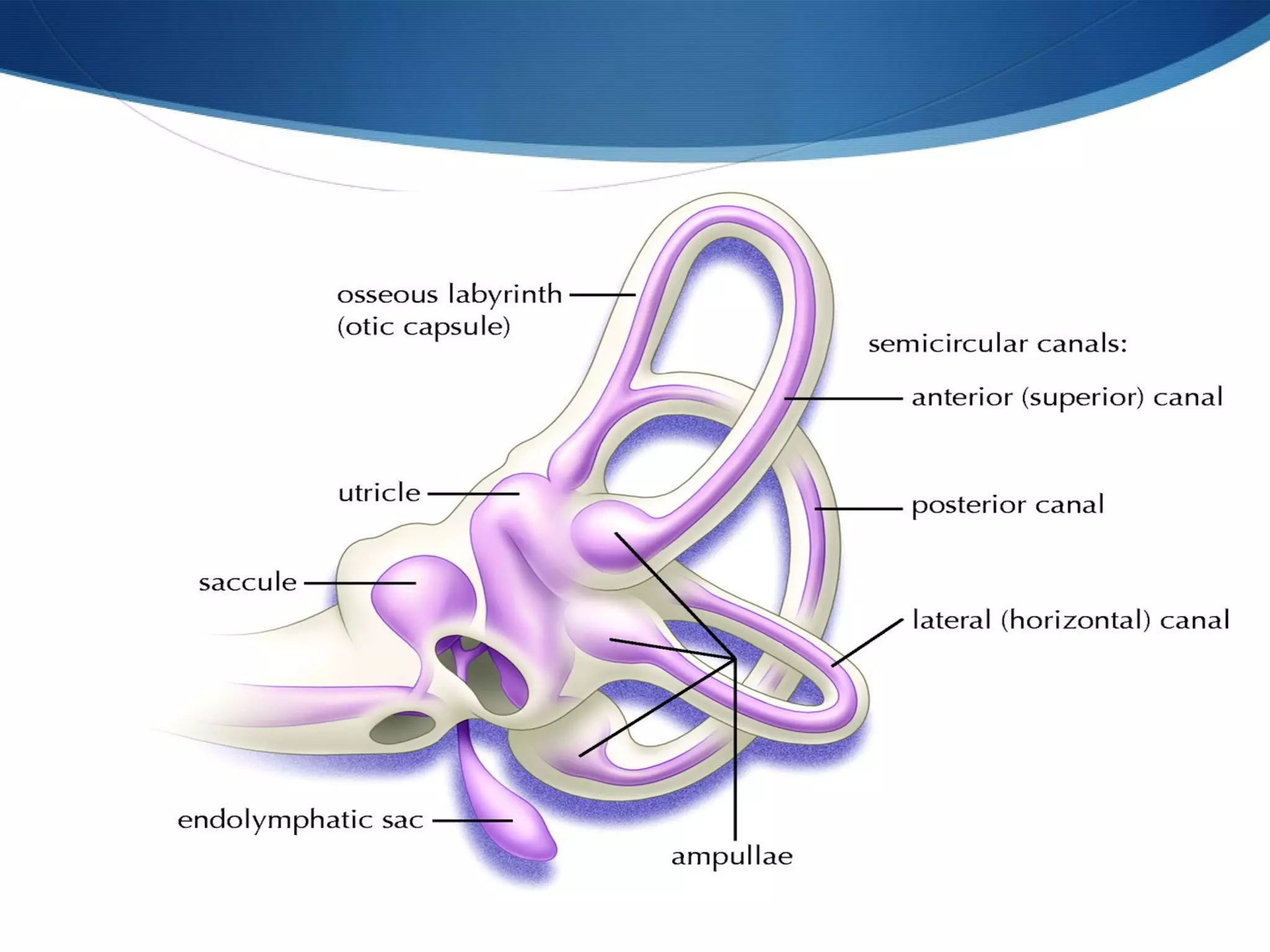
 The ampulla contains the cupula – a gelatinous mass with the same
density as the endolymph.Cupula forms an impermeable barrier
across the lumen of the ampulla. Hence the particles in scc may only
exit via the end with no ampulla.
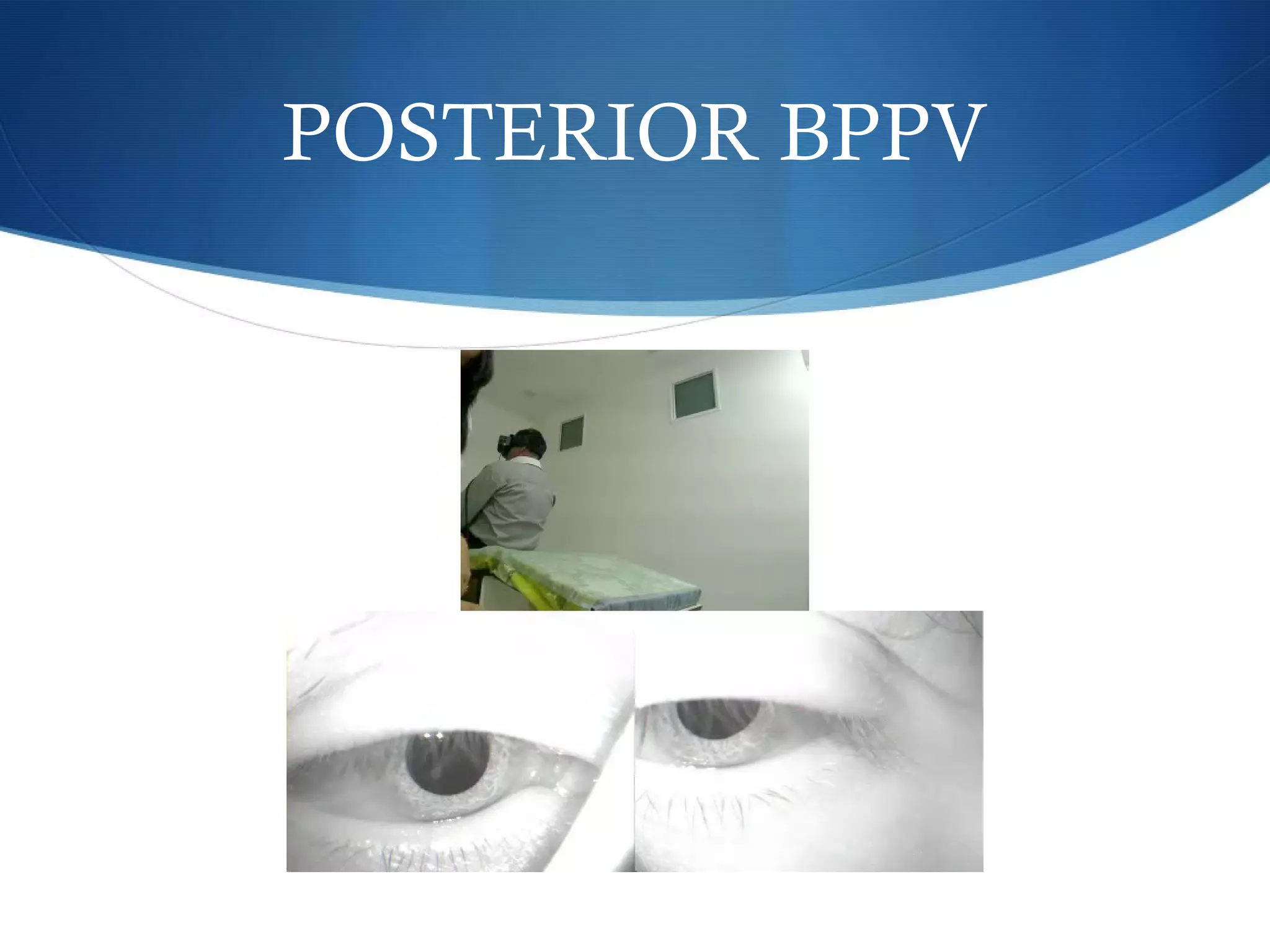
POSTERIOR CANAL BPPVPOSTERIOR CANAL BPPV
 Most common– posterior canal is most gravity dependent in
upright and supine position
 Once debris enter the post. canal ,the cupula at the shorter
most dependent arm trap the debris.
 Debris can exit only through the longer arm through the crus
commune [non-ampullary]
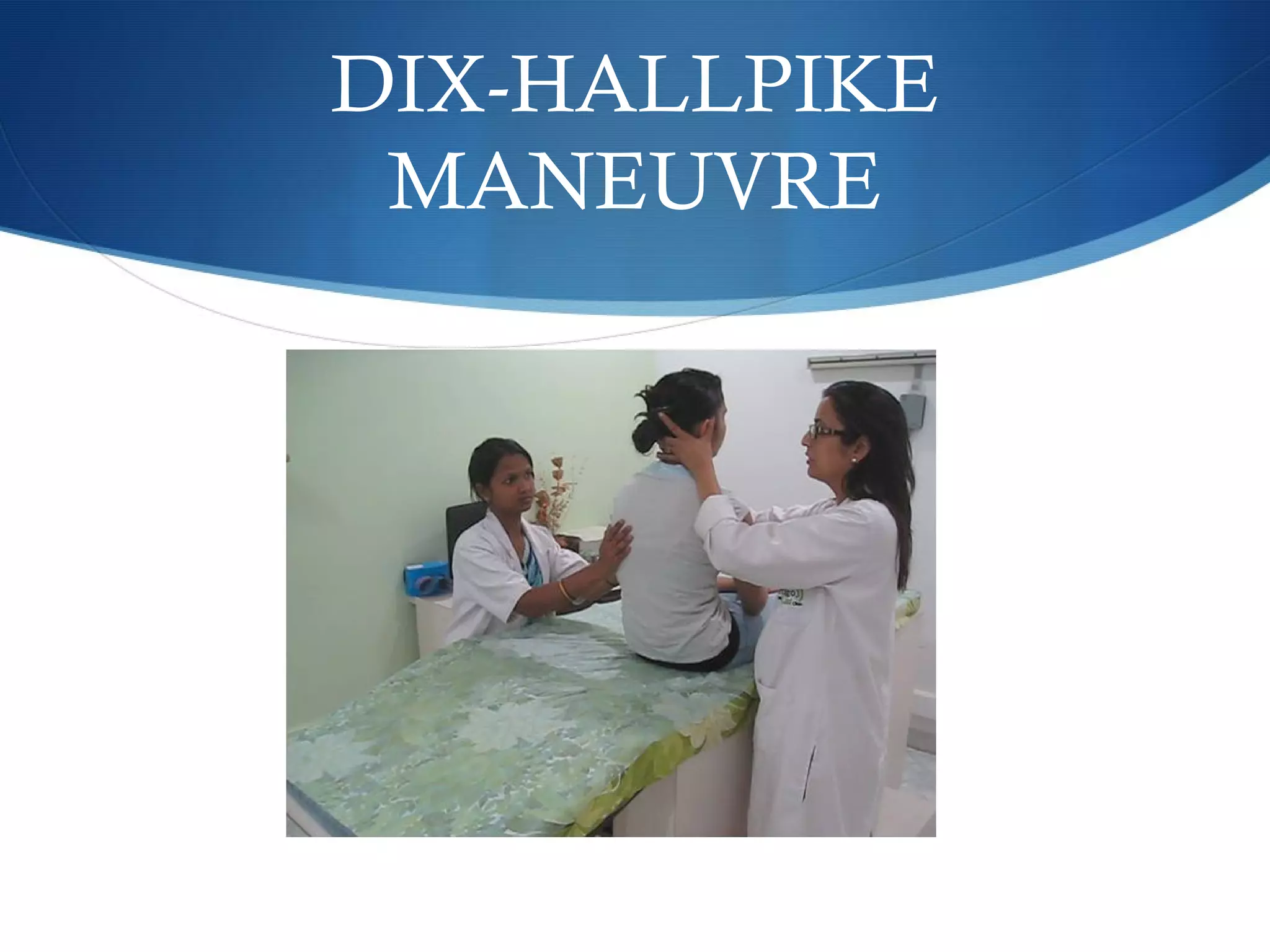
DIX-HALLPIKE
MANEUVRE
POSTERIOR BPPV
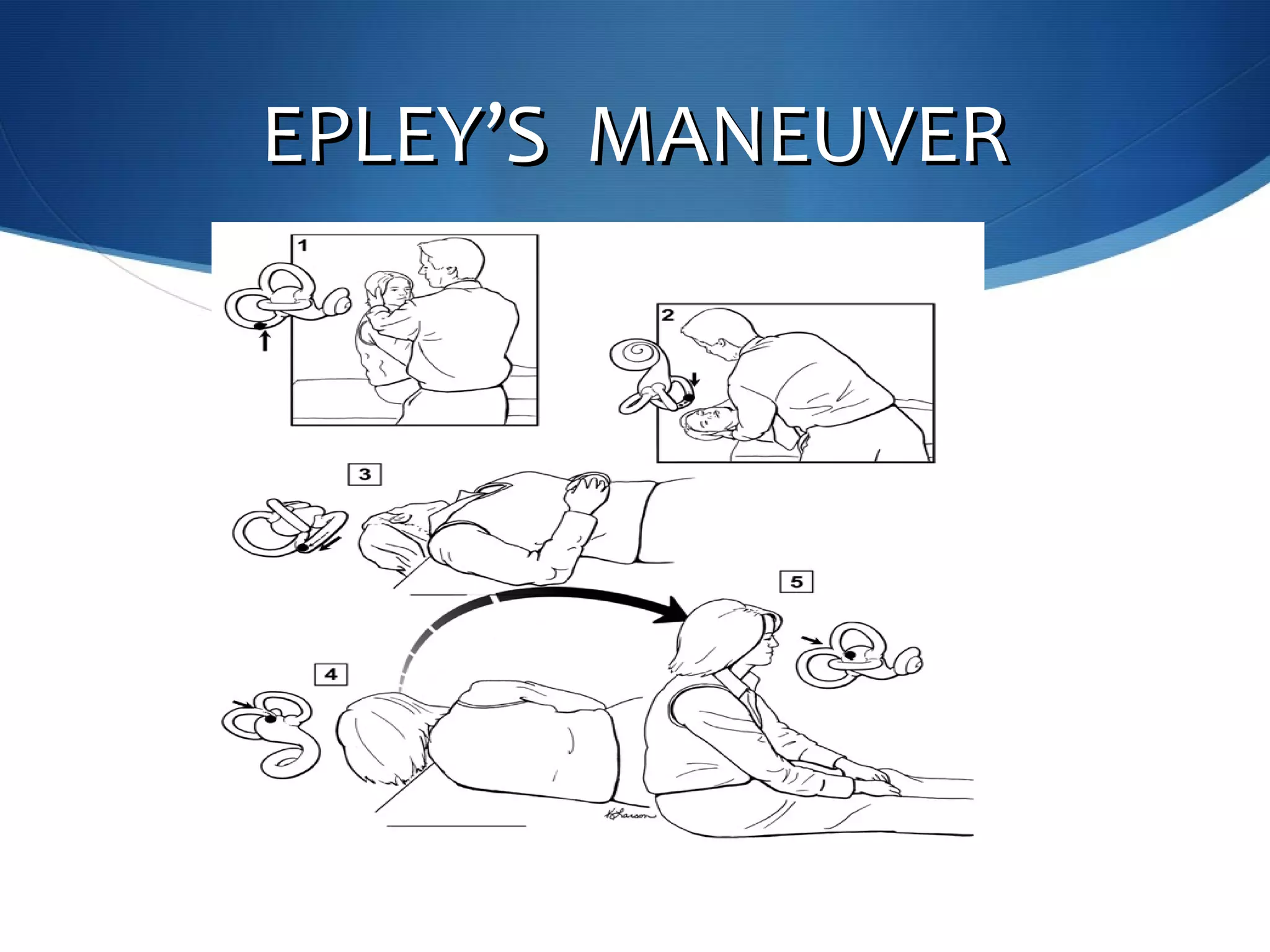
EPLEYEPLEY’’S MANEUVERS MANEUVER
EPLEY’S MANEUVRE
SEMONTSEMONT’’S MANEUVERS MANEUVER
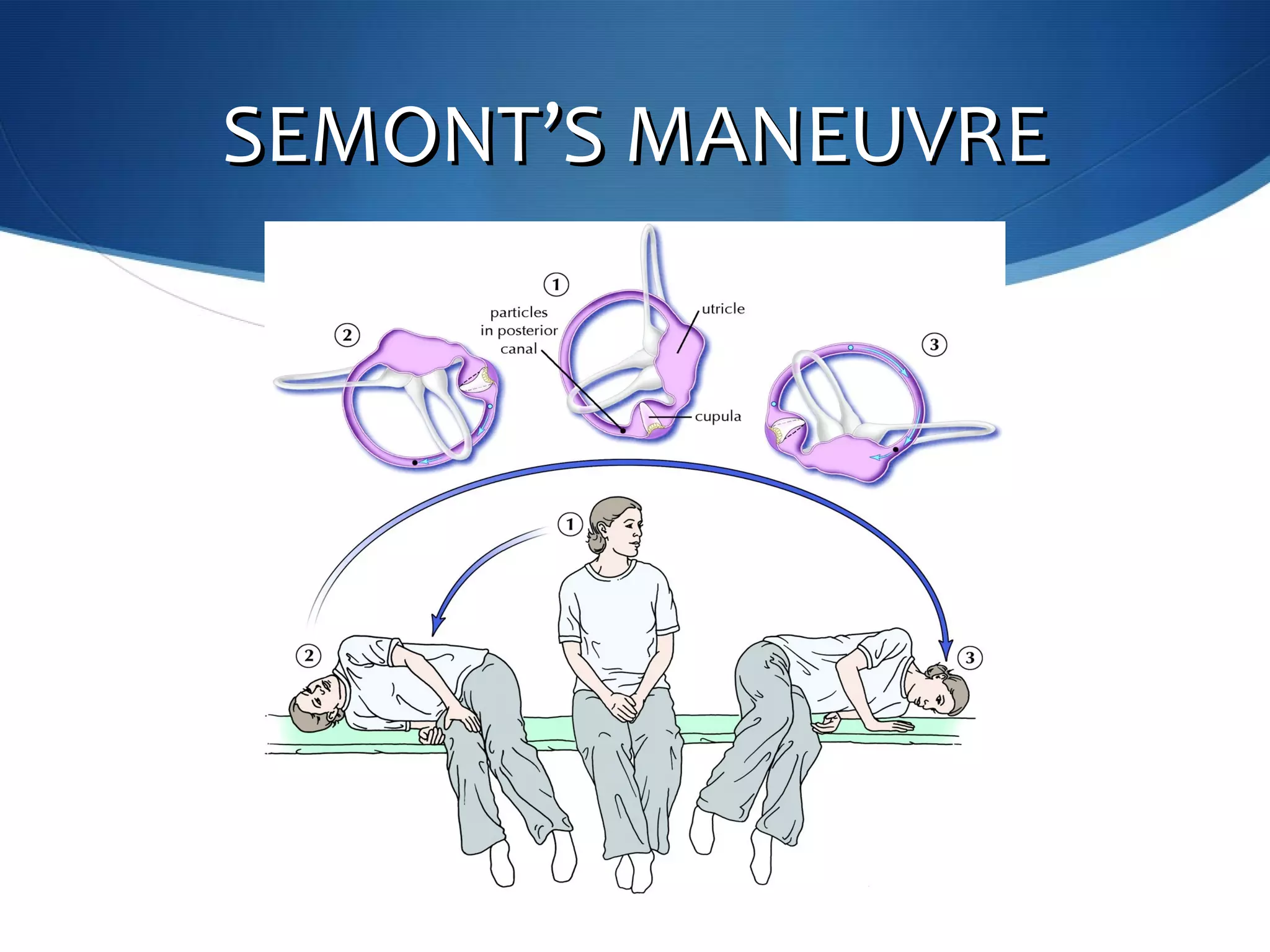
 Liberatory maneuver for pBPPV and cupulolithiasis
 Used to overcome otoconia jam after Epley’s maneuver
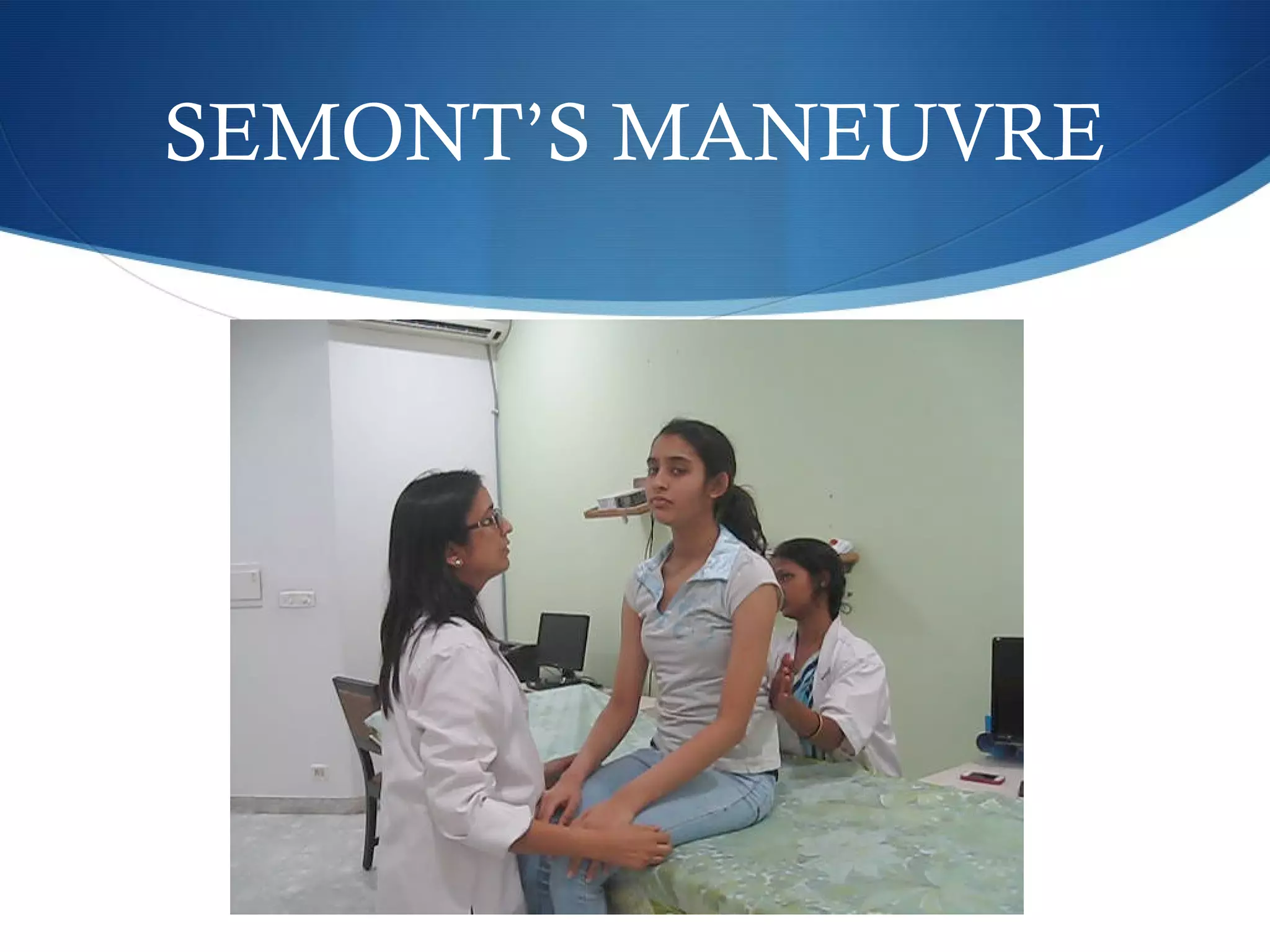
SEMONTSEMONT’’S MANEUVRES MANEUVRE
SEMONT’S MANEUVRE
BRANDT – DAROFF EXERCISESBRANDT – DAROFF EXERCISES
 Used as a home program
 Indications
o Posterior canal cupulolithiasis
o Persistant posterior canal canalithiasis
 Mechanism
o Dislodge debris attached to cupula
o Habituation through central compensation
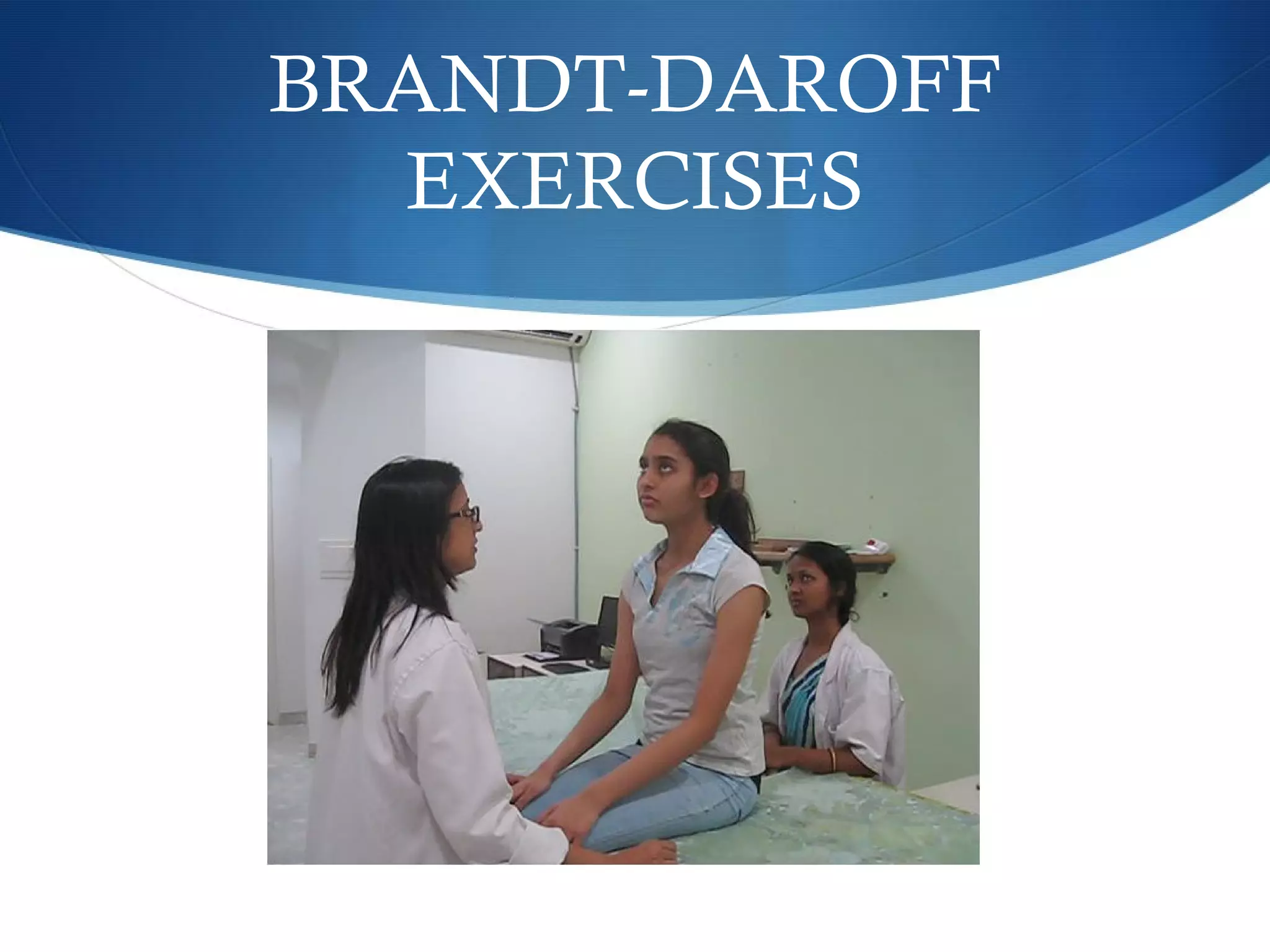
BRANDT-DAROFF
EXERCISES
BRANDT – DAROFF EXERCISESBRANDT – DAROFF EXERCISES
 Things to remember
o The exercises may dislodge more otoconia from the utricle
causing an increase in symptoms.
o May cause multiple canal involvement.
o Important to hold for 30 seconds in each position.
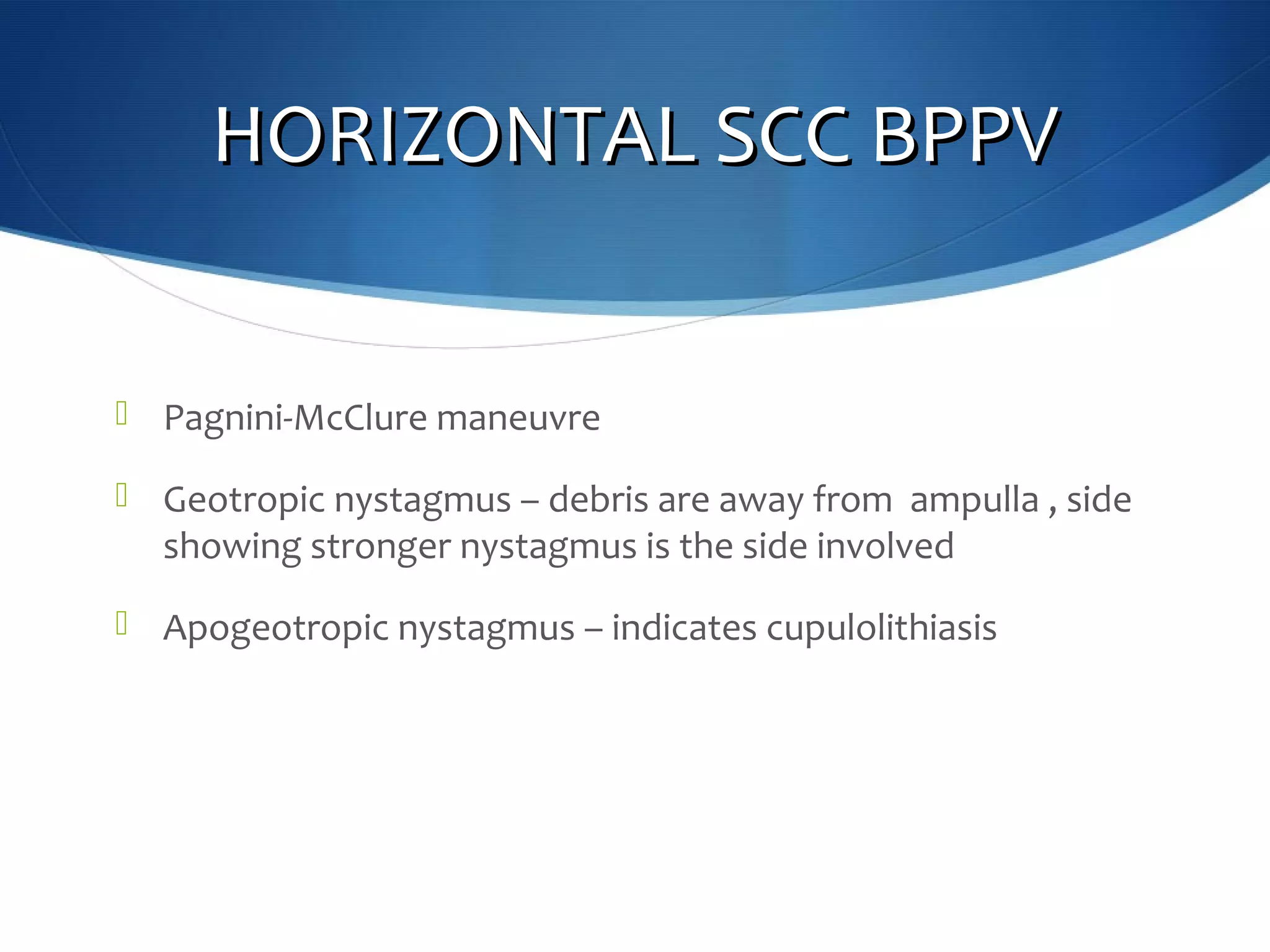
HORIZONTAL SCC BPPVHORIZONTAL SCC BPPV
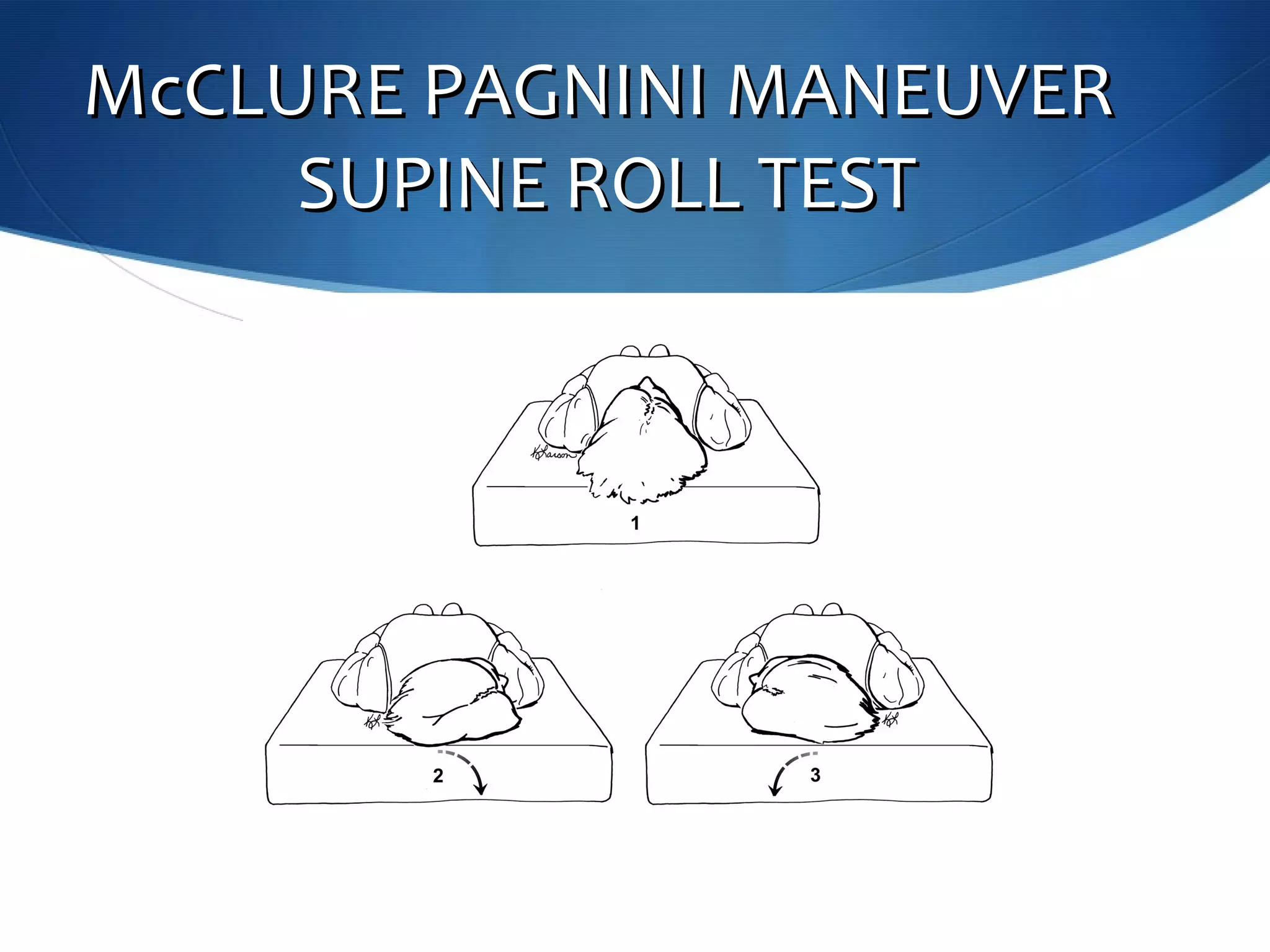
 Pagnini-McClure maneuvre
 Geotropic nystagmus – debris are away from ampulla , side
showing stronger nystagmus is the side involved
 Apogeotropic nystagmus – indicates cupulolithiasis
McCLURE PAGNINI MANEUVERMcCLURE PAGNINI MANEUVER
SUPINE ROLL TESTSUPINE ROLL TEST
McCLURE’S MANEUVRE
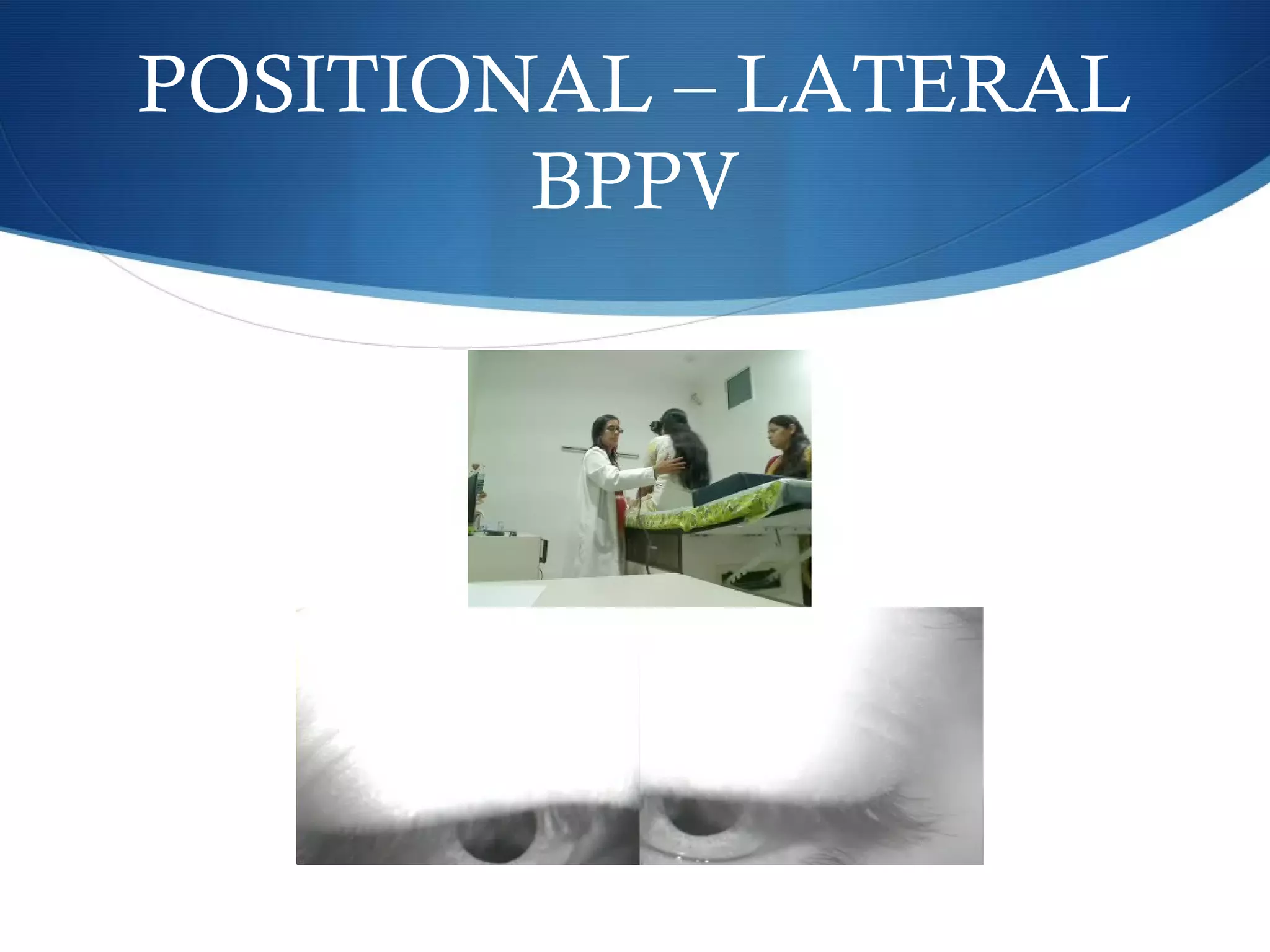
POSITIONAL – LATERAL
BPPV
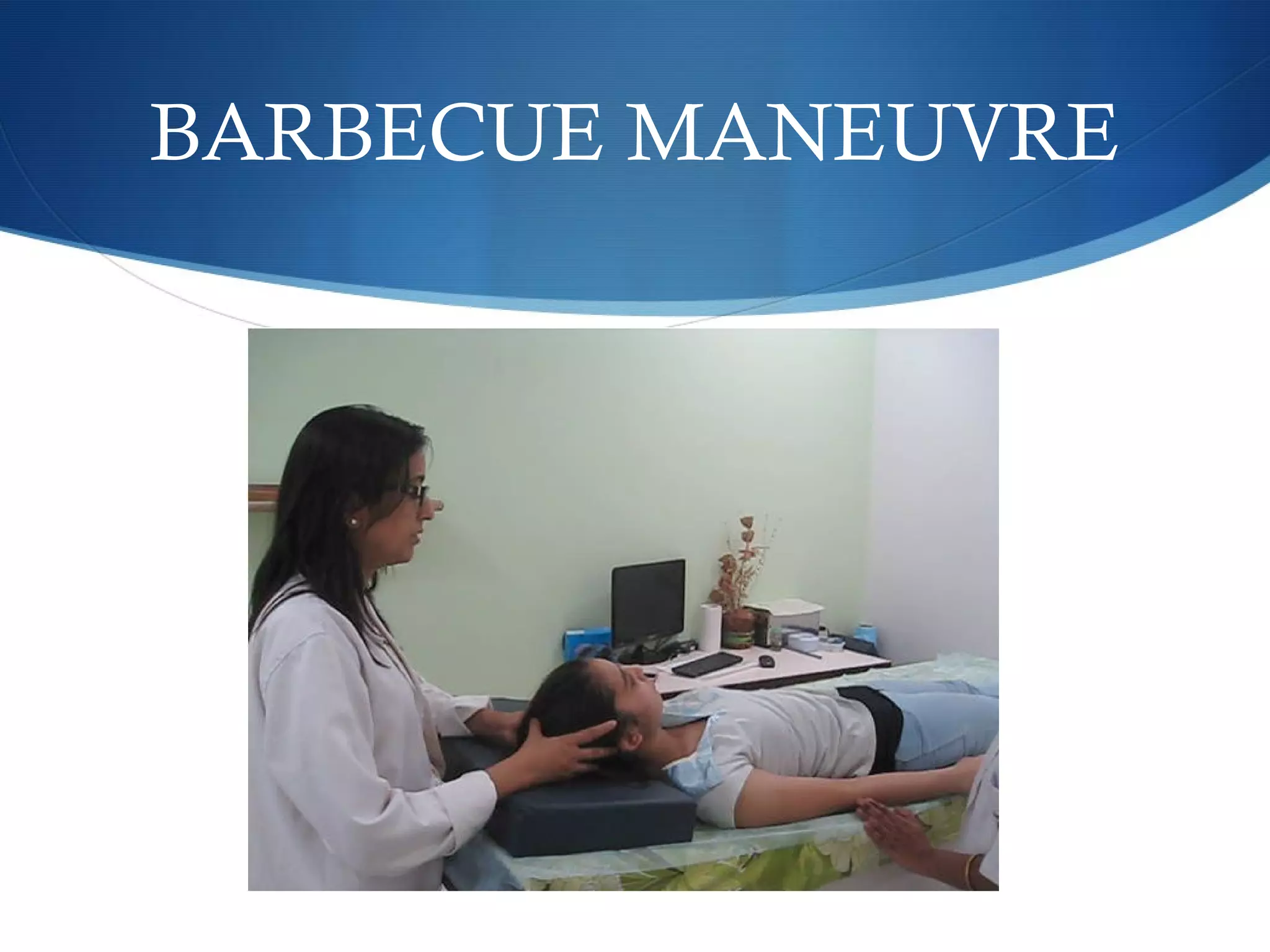
BARBECUE MANEUVRE
GUFONI MANEUVRE
VANUCCHI MANEUVERVANUCCHI MANEUVER
 Forced prolonged positioning
 Sleep in lateral position with healthy ear down for 12 hours.
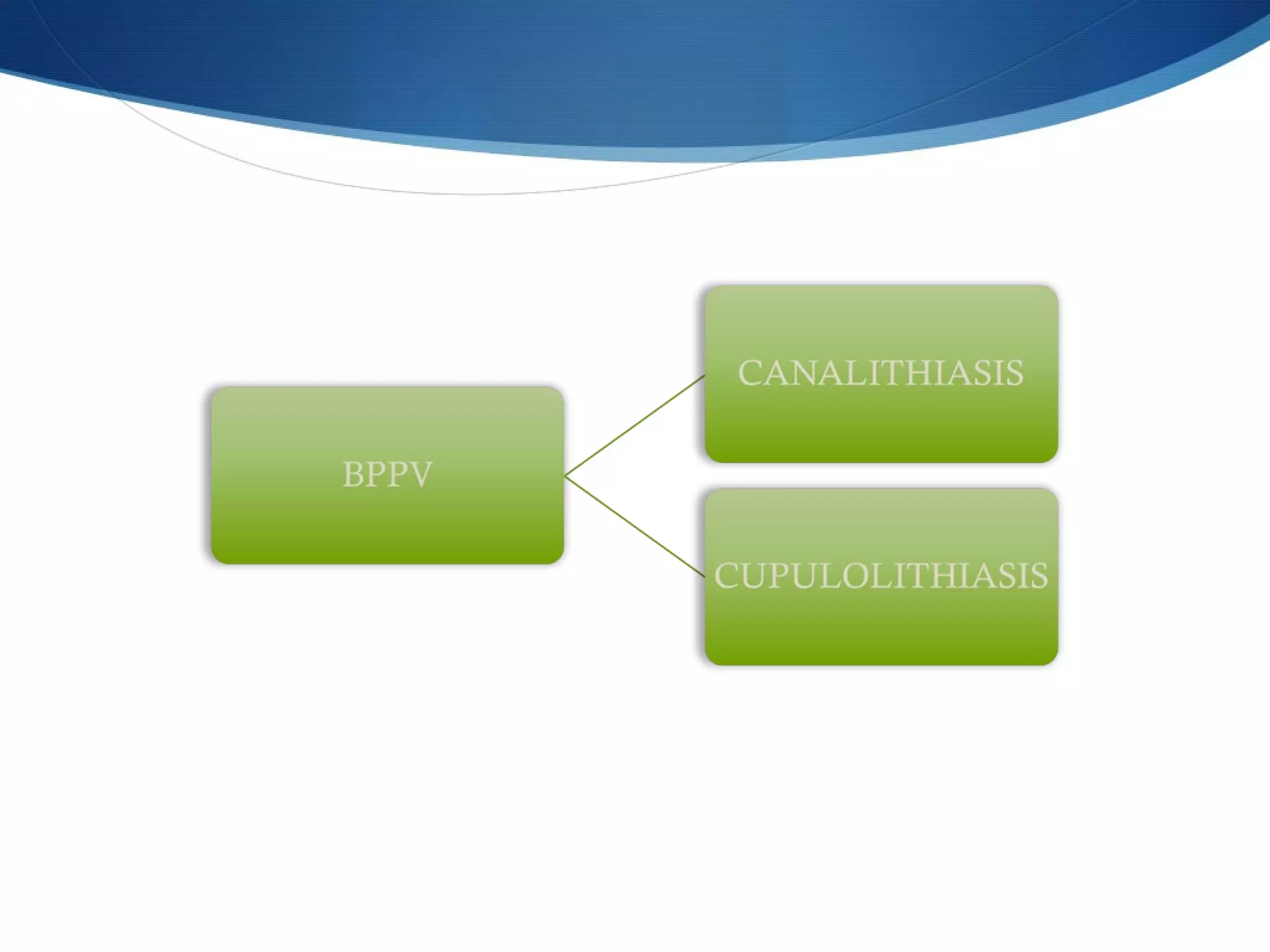
CUPULOLITHIASISCUPULOLITHIASIS
 Coined by Schuknetch
 Rare , more common in horizontal canal
 Caused by otoliths attached to cupula of scc
 When cupula is horizontal no vertigo
 When non-horizontal constant input persistant
dizziness
 Nystagmus : persistant non-fatiguable as long as patient is in
the same position
SUBJECTIVE BPPVSUBJECTIVE BPPV
 No nystagmus is detected but patient feels dizzy on
provocative tests
 PRP beneficial
 Reasons
o Subtle nystagmus
o Fatigued nystagmus
o Inadequate neural signal to stimulate the VOR
CONTRAINDICATIONS OFCONTRAINDICATIONS OF
PARTICLE REPOSITIONINGPARTICLE REPOSITIONING
 Cervical spine problems
 Uncontrolled hypertension
 Retinal detachment

PHARMACOTHERAPY OF
VERTIGO
NO COMMON TREATMENT FOR
ALL PATIENTS.
Therapeutic approach requires recognition of the
pathomechanism
 Detailed history
 Clinical examination
 Neurotological tests
 Imaging
Aim Of Vertigo Therapy
 Elimination of Vertigo
 Enhancement/non-compromise of “Vestibular compensation”
 Reduction of Psychoaffective syndromes
 Nausea and Vomiting
 Anxiety
Thomas Brandt – Vertigo; A mutlisensory system disorder, 2nd
edition. Springer –Verlag- London 2002
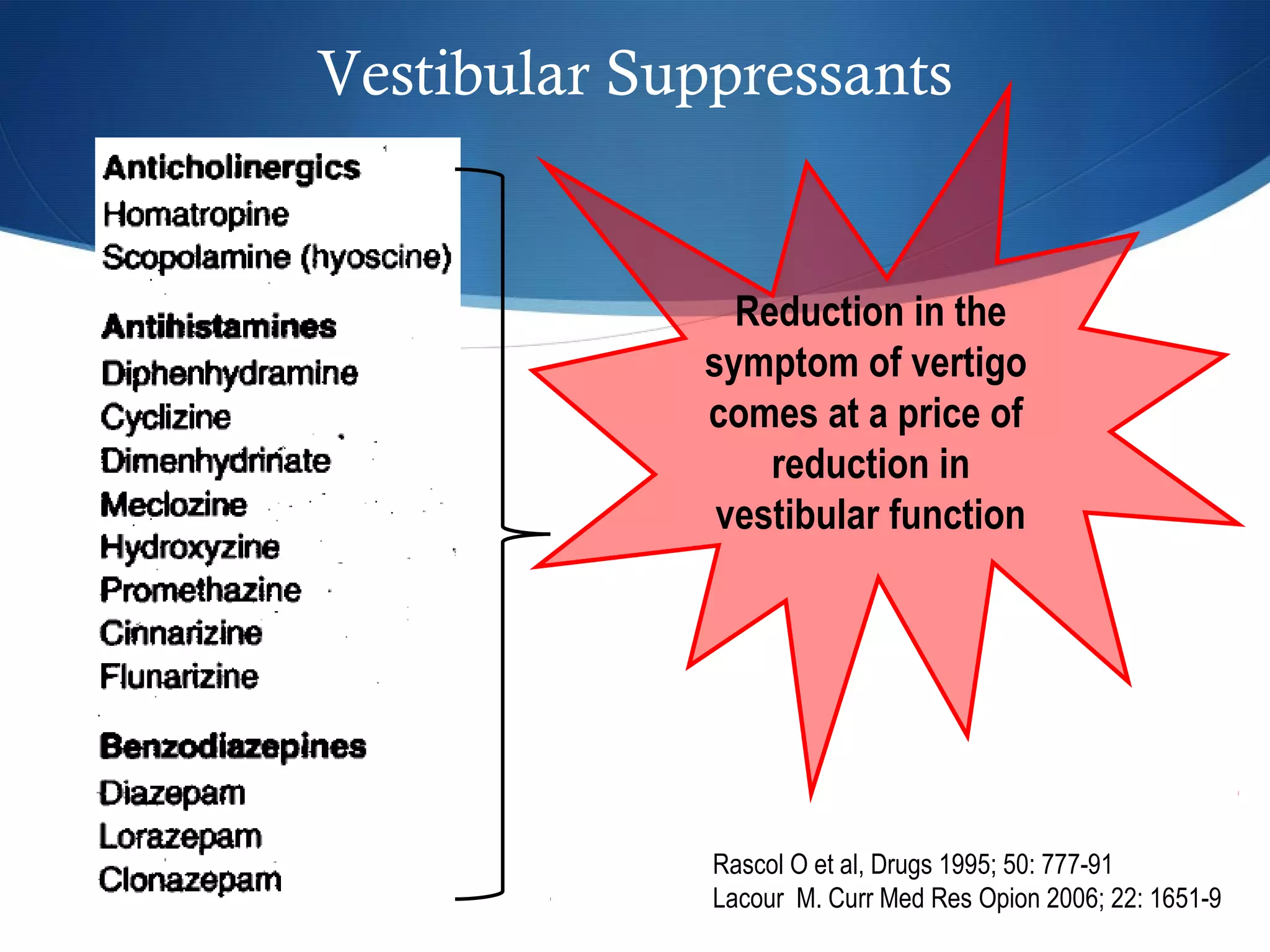
Vestibular Suppressants
Rascol O et al, Drugs 1995; 50: 777-91
Lacour M. Curr Med Res Opion 2006; 22: 1651-9
Reduction in the
symptom of vertigo
comes at a price of
reduction in
vestibular function
Treatment with Vestibular Suppressants
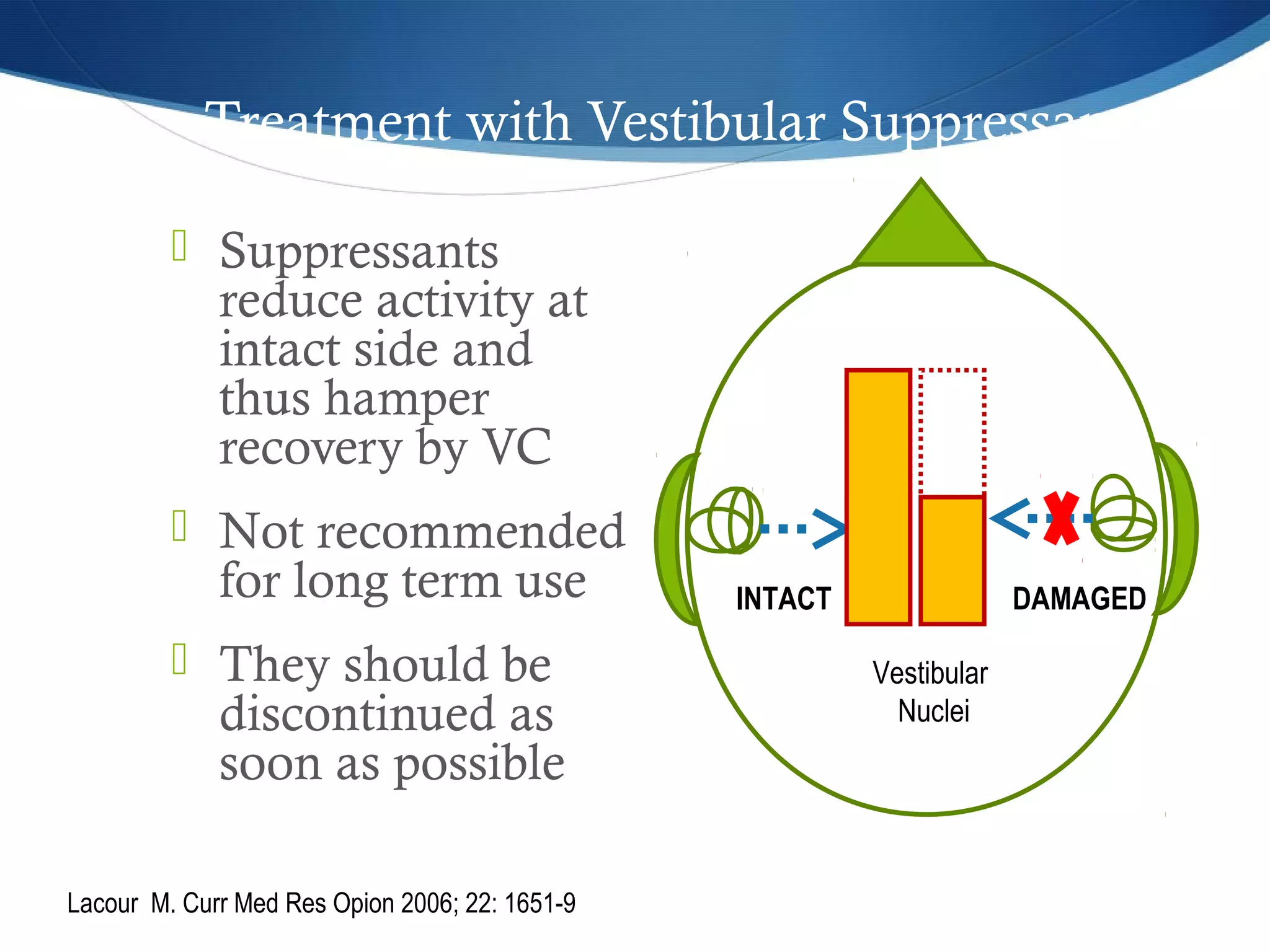
 Suppressants
reduce activity at
intact side and
thus hamper
recovery by VC
 Not recommended
for long term use
 They should be
discontinued as
soon as possible
Lacour M. Curr Med Res Opion 2006; 22: 1651-9
Vestibular
Nuclei
INTACT DAMAGED
Vestibular Suppressants
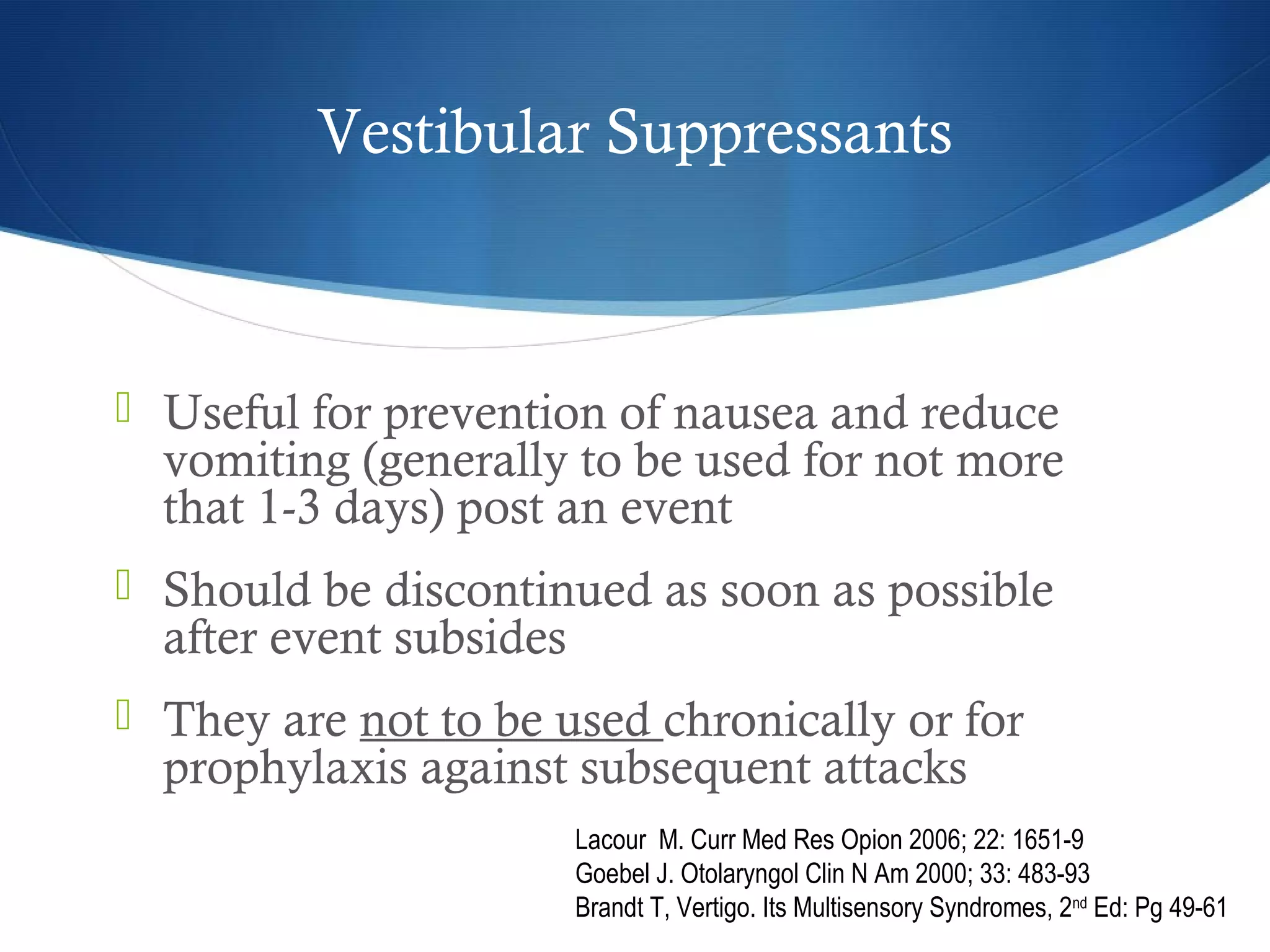
 Useful for prevention of nausea and reduce
vomiting (generally to be used for not more
that 1-3 days) post an event
 Should be discontinued as soon as possible
after event subsides
 They are not to be used chronically or for
prophylaxis against subsequent attacks
Lacour M. Curr Med Res Opion 2006; 22: 1651-9
Goebel J. Otolaryngol Clin N Am 2000; 33: 483-93
Brandt T, Vertigo. Its Multisensory Syndromes, 2nd
Ed: Pg 49-61
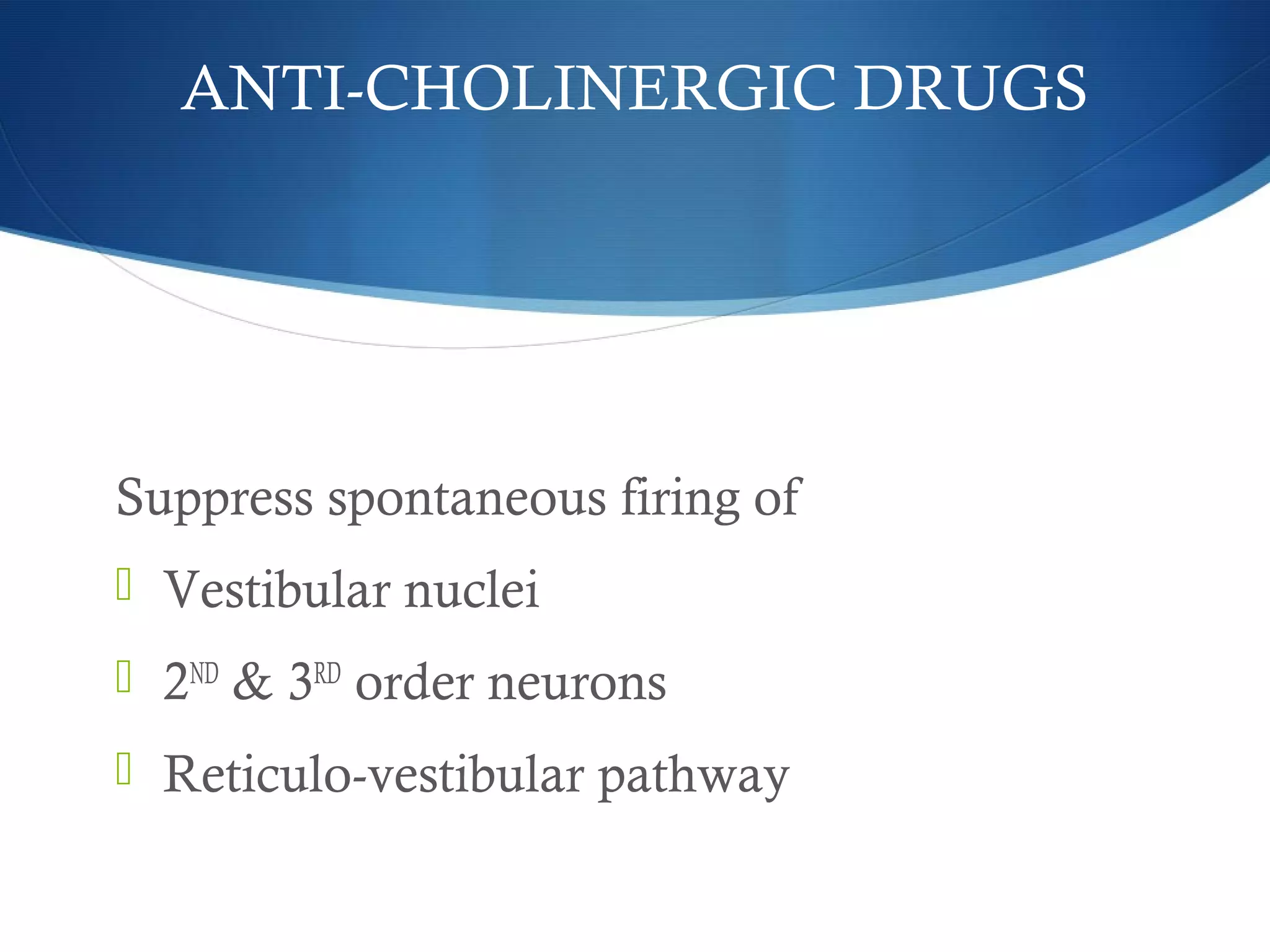
ANTI-CHOLINERGIC DRUGS
Suppress spontaneous firing of
 Vestibular nuclei
 2ND
& 3RD
order neurons
 Reticulo-vestibular pathway
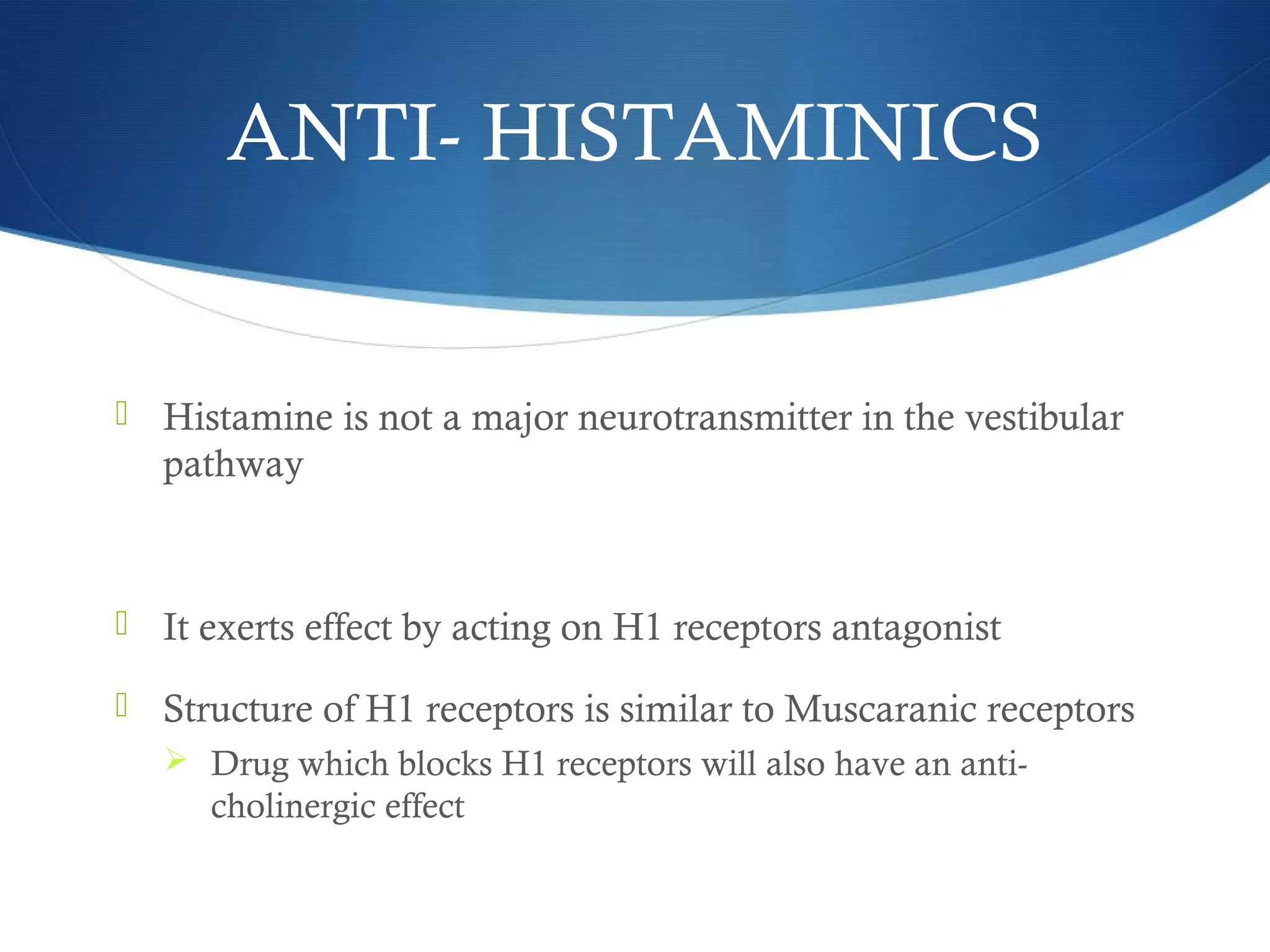
ANTI- HISTAMINICS
 Histamine is not a major neurotransmitter in the vestibular
pathway
 It exerts effect by acting on H1 receptors antagonist
 Structure of H1 receptors is similar to Muscaranic receptors
 Drug which blocks H1 receptors will also have an anti-
cholinergic effect
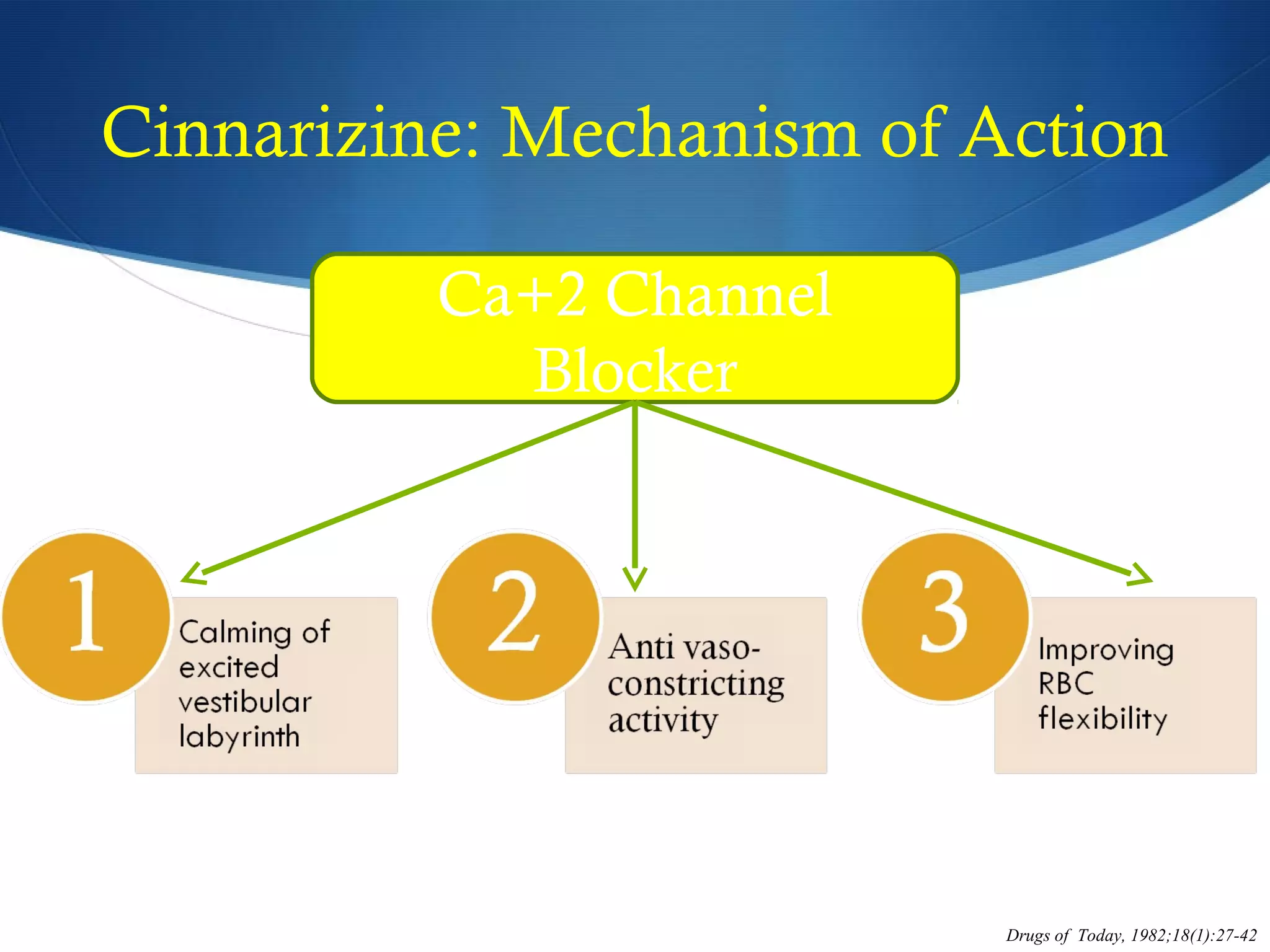
Cinnarizine: Mechanism of Action
Drugs of Today, 1982;18(1):27-42
Ca+2 Channel
Blocker
BETAHISTINE
Historically seen that histamine relieved vertigo.
However had to be given IV and had serious
side effects.
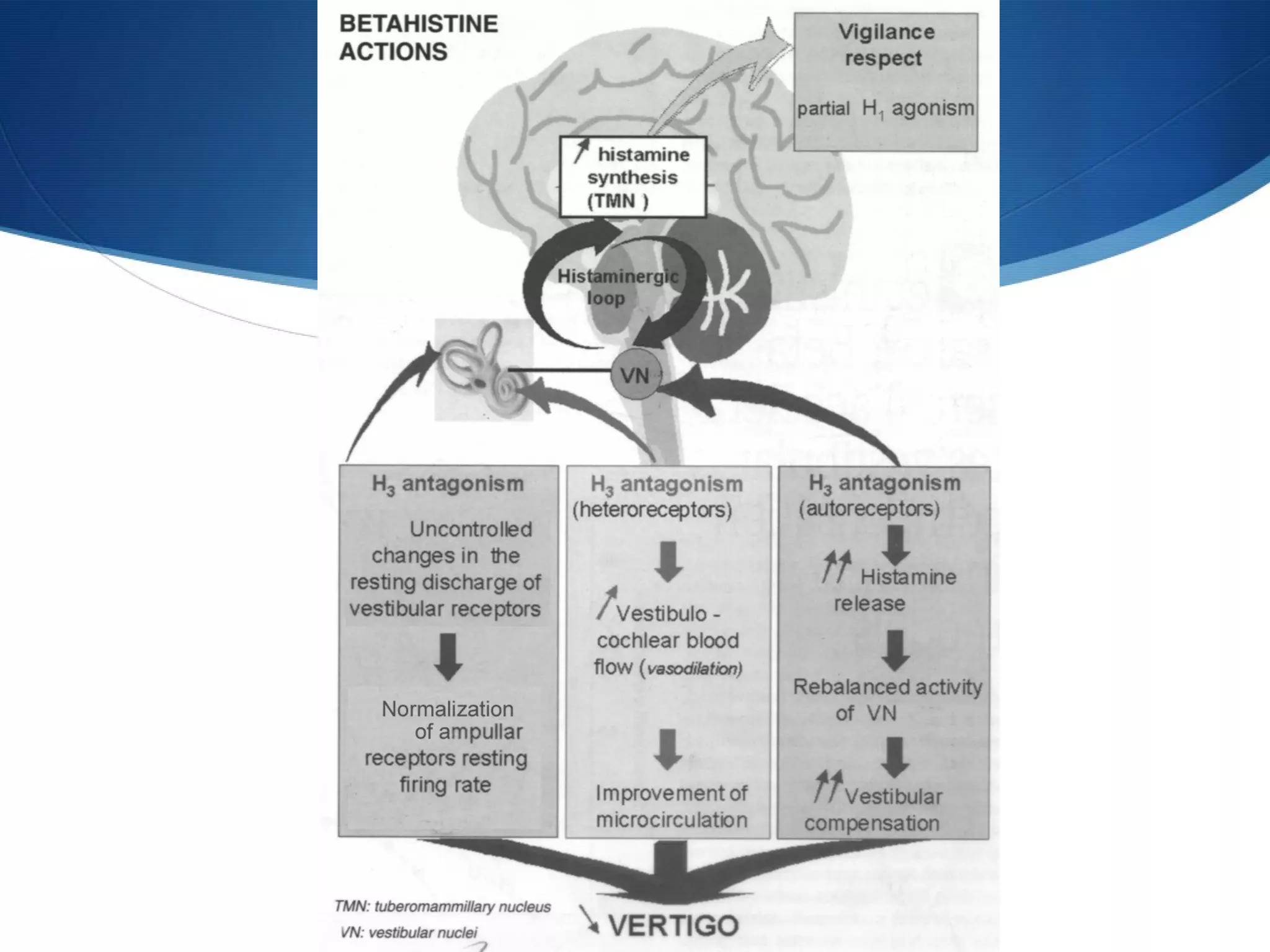
Betahistine is a histamine analogue having the
advantages of histamine like action without its
side effects.
DRUG COMBINATIONS
 Anti-histaminics are H1 receptor antagonists
 Betahistine is H1receptor agonist and H3 receptor antagonist
 Hence these drugs should not be combined.
VESTIBULAR
REHABILITATION
 VRT comprises of a series of maneuvers designed to
stimulate the vestibular system. These movements which in
the initial stages provoke vertigo, are combined with
exercises involving eye movements and postural changes
which encourage vestibular compensation.
TAILORING THE REGIMEN
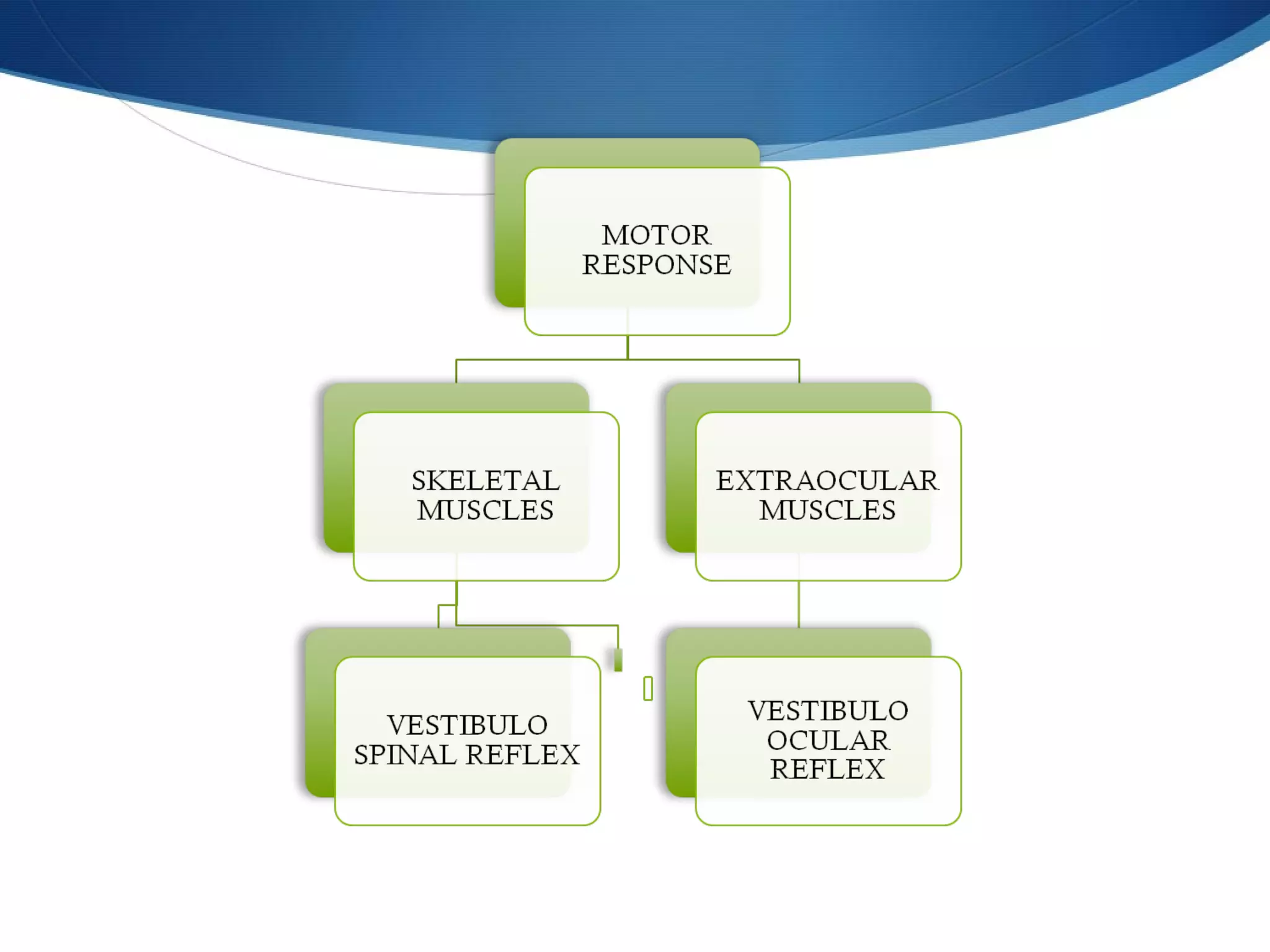
 Vestibulo-ocular system
 Vestibulospinal system
 Otolithic system
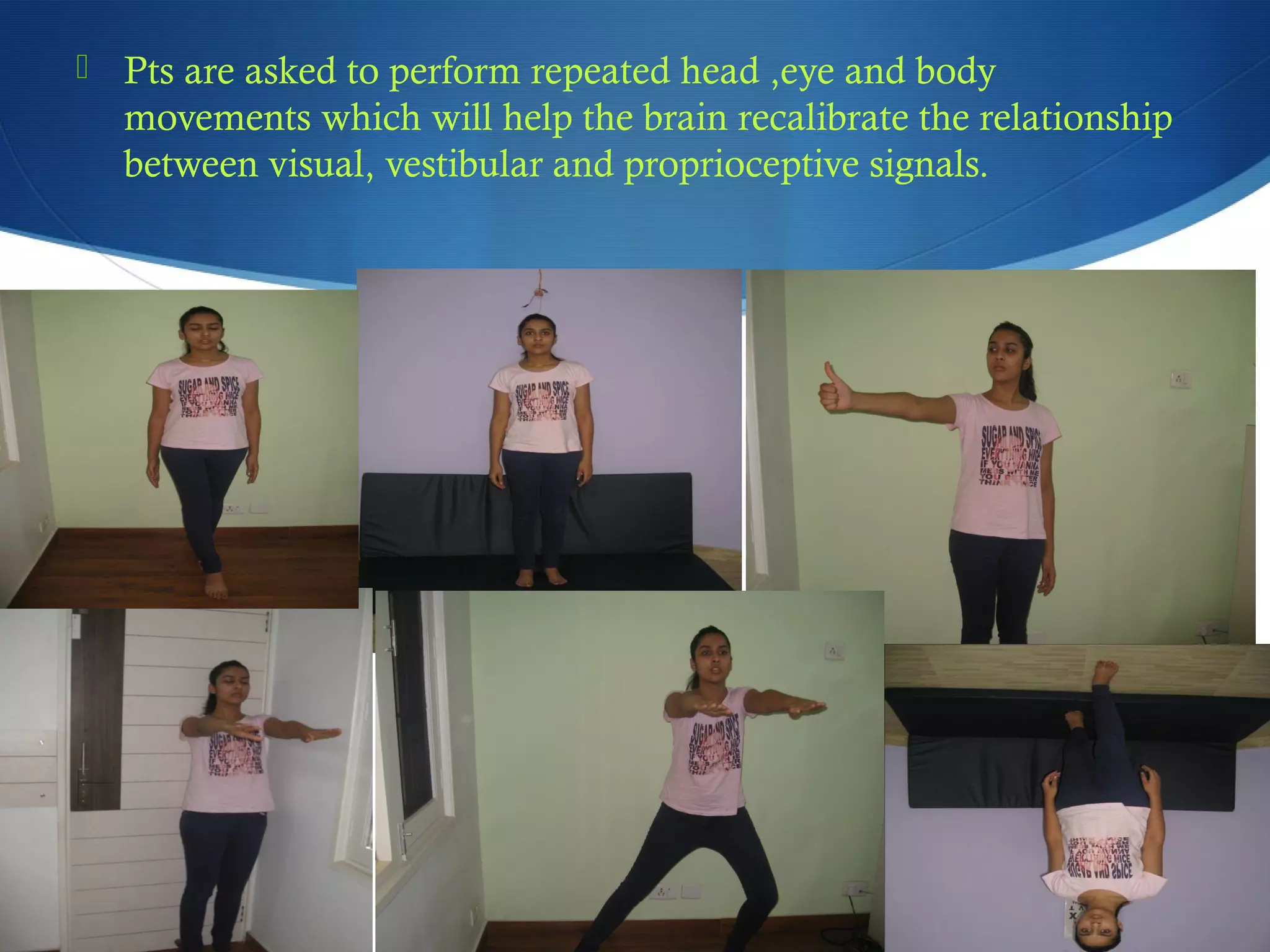
 Pts are asked to perform repeated head ,eye and body
movements which will help the brain recalibrate the relationship
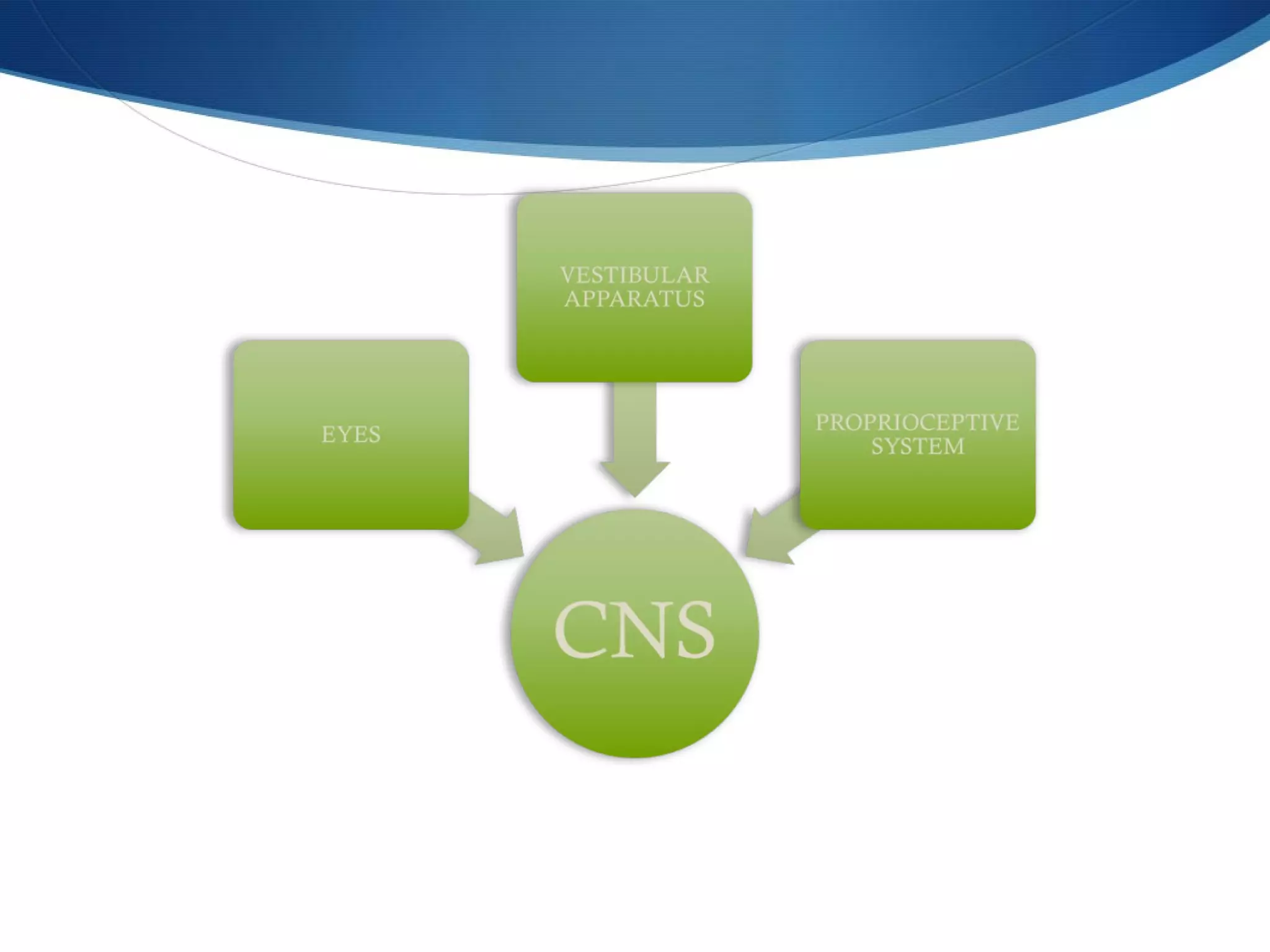
between visual, vestibular and proprioceptive signals.
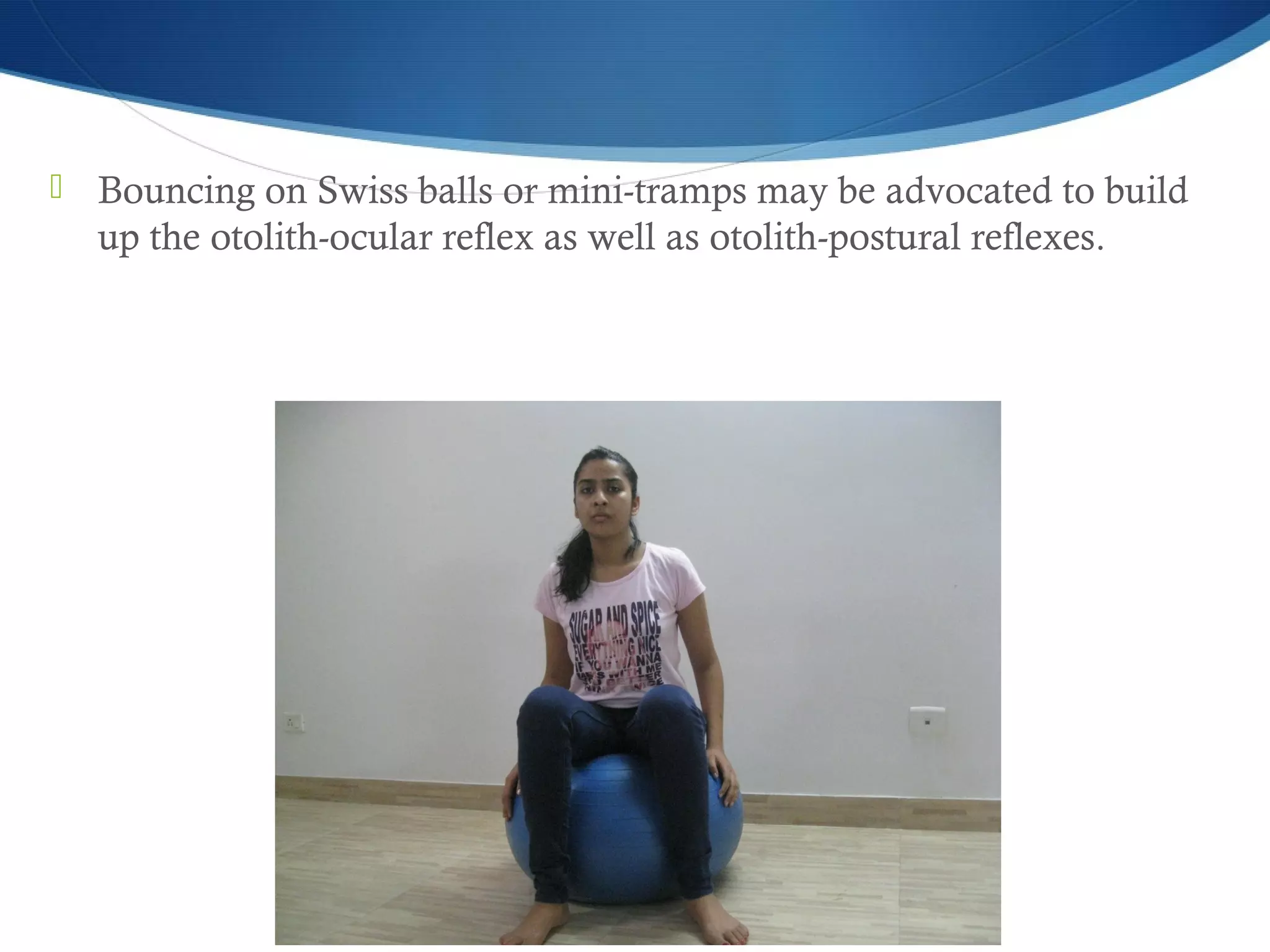
 Bouncing on Swiss balls or mini-tramps may be advocated to build
up the otolith-ocular reflex as well as otolith-postural reflexes.
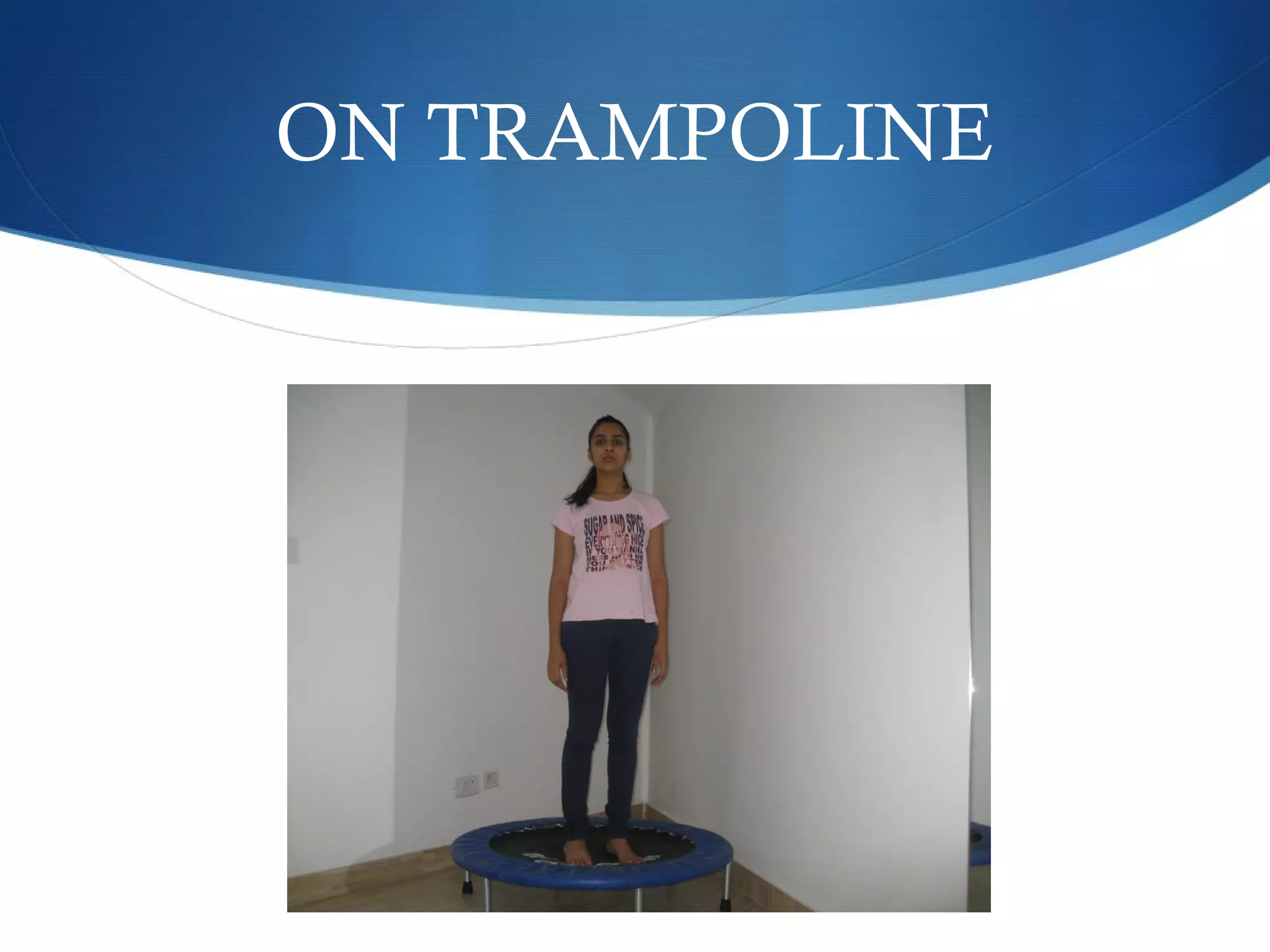
ON TRAMPOLINE
CENTRAL COMPENSATION
 Adaptation – ability to regain spatial orientation
 Substitution – as there is a derangement in function, using
different pathways to maintain equilibrium
 Habituation – repeated maneuvres aimed at stimulating the
sensory mismatch and lead to desensitization.
Vertigo - making it simple

Vertigo - making it simple

  • 1.
     VERTIGO – MAKING ITSIMPLE DR.ANITA BHANDARI CONSULTANT NEUROTOLOGIST VERTIGO AND EAR CLINIC, JAIPUR
  • 5.
  • 6.
    MATTER OF CONCERN Moreamenable to treatment -more sinister consequences
  • 8.
     Seconds –late ototoxicity  Minutes – BPPV, TIA  Hours – Meniere’s disease , Migraine related vertigo  Days – Vestibular neuritis  Months – years - Hysterical
  • 10.
     Spatial orientation Ocular stabilization  Postural control EQUILIBRIUM
  • 13.
     A batteryof tests  Many systems to be evaluated to assess structural and functional integrity NEUROTOLOGICAL EVALUATION
  • 14.
    For An ENTSpecialist,  We look at the ears first.  In vertigo --> eyes are most important
  • 15.
     Otoliths actas gravito-inertial force detectors  SVV is a psychophysical measure of the angle between perceptual vertical and true/gravitational vertical  Also used to measure vestibular rehabilitation  Compensated utricular hypofunction may be detected on dynamic SVV testing. The defect will be unmasked on eccentric rotation because any otolith function asymmetry will be enhanced. SVV
  • 16.
     Pt isasked to adjust the orientation of a luminous bar until they perceive it as vertical  SVV – saccule and its central pathways  SVH – utricle and its central pathways  Pinar et al reported changes in SVV and SVH in >25% pts of chronic dizziness concluding that evaluation of the otolith system is mandatory SUBJECTIVE VISUAL VERTICAL AND HORIZONTAL
  • 17.
    SVV FINDING CONDITION Normalrange Upto 2° deviation Ipsiversive tilt – >2o peripheral vestibular disorder pontomedullary lesion thalamic lesion Controversive Pontomesencephalic lesion parietoinsular vest. lesion Migraine Abnormal, little literature
  • 18.
    CRANIOCORPOGRAPHY  Developed byClaussen [1968]  Assessment of vestibulospinal system  Photographic recording of head and body movement during gait testing  Evaluation includes Romberg, Tandem walking and Unterburger’s test
  • 19.
     Done indark room  Pt is blindfolded  Pt wears a helmet with LED lights  Path of the pt is recorded using an SLR camera  Result depends on vestibular system only as visuals cues cut off – pt is blindfolded and by stepping in one place, the soles intermittently lose contact with the floor thus reducing somatosensory input CCG : PROCEDURE
  • 20.
    PARAMETER NORMAL RANGE- LOWERBORDER NORMAL RANGE- UPPER BORDER Longitudinal displacement 30.03 cm 113.35 cm Lateral sway 5.17 cm 16.15 cm Angular deviation 55.13° (right) 48.37° (left) Body spin 82.21° (right) 82.89° (left) NORMAL PARAMETER OF CCG [CLAUSSEN]
  • 21.
    PATHOLOGY CCG FINDINGS Peripheralvestibular lesions Ipsilateral deviation Brainstem lesion, bilateral peripheral vestibulopathy Enlarged lateral sway, no angular deviation CPA tumors, PICA synd. Contralateral deviation, enlarged sway INTERPRETATIONS OF CCG
  • 22.
  • 23.
  • 24.
  • 25.
     Introduced byHalmagyi and Curthoy  Simple, fast, reliable  Tests scc function – can evaluate all 3 pairs  Measures high freq. vestibular response in 3 dimensions HEAD IMPULSE TESTING
  • 26.
     VHIT –using Video Frenzel glasses  Test for gaze stabilization during rapid translation of head  Assesses the peripheral utricular system and superior vestibular N  A corrective saccade after VHIT indicates hypofunction of same side HEAD IMPULSE TEST
  • 27.
     Subject seatedupright with eyes focused on an fixed object  Unpredictable , low amplitude [10 – 20°] head rotation with high acceleration  Angular VOR generates compensatory eye movements equal in amplitude and opposite in direction to stabilize gaze HIT : PROCEDURE
  • 28.
  • 29.
     Nystagmus indicatesan imbalance in vestibular tone between the 2 sides  Not seen in bilateral vestibular dysfunction HEAD SHAKING TEST
  • 30.
  • 31.
    HEAD SHAKING –DOWN BEATING NYSTAGMUS
  • 32.
     Functional testof VOR  Comparison of visual acuity with head still to VA with head moving  Reduction by 2 lines indicates dysfunction of VOR as seen in bilateral peripheral vestibulopathy  Improvement with rehab will improve DVA  Early sign of vestibular toxicity DYNAMIC VISUAL ACUITY TEST
  • 33.
     BPPV AND PARTICLEREPOSITIONING MANEUVERS
  • 34.
     The ampullacontains the cupula – a gelatinous mass with the same density as the endolymph.Cupula forms an impermeable barrier across the lumen of the ampulla. Hence the particles in scc may only exit via the end with no ampulla.
  • 37.
    POSTERIOR CANAL BPPVPOSTERIORCANAL BPPV  Most common– posterior canal is most gravity dependent in upright and supine position  Once debris enter the post. canal ,the cupula at the shorter most dependent arm trap the debris.  Debris can exit only through the longer arm through the crus commune [non-ampullary]
  • 38.
  • 39.
  • 40.
  • 41.
  • 42.
    SEMONTSEMONT’’S MANEUVERS MANEUVER Liberatory maneuver for pBPPV and cupulolithiasis  Used to overcome otoconia jam after Epley’s maneuver
  • 43.
  • 44.
  • 45.
    BRANDT – DAROFFEXERCISESBRANDT – DAROFF EXERCISES  Used as a home program  Indications o Posterior canal cupulolithiasis o Persistant posterior canal canalithiasis  Mechanism o Dislodge debris attached to cupula o Habituation through central compensation
  • 46.
  • 47.
    BRANDT – DAROFFEXERCISESBRANDT – DAROFF EXERCISES  Things to remember o The exercises may dislodge more otoconia from the utricle causing an increase in symptoms. o May cause multiple canal involvement. o Important to hold for 30 seconds in each position.
  • 49.
    HORIZONTAL SCC BPPVHORIZONTALSCC BPPV  Pagnini-McClure maneuvre  Geotropic nystagmus – debris are away from ampulla , side showing stronger nystagmus is the side involved  Apogeotropic nystagmus – indicates cupulolithiasis
  • 50.
    McCLURE PAGNINI MANEUVERMcCLUREPAGNINI MANEUVER SUPINE ROLL TESTSUPINE ROLL TEST
  • 51.
  • 52.
  • 53.
  • 54.
  • 55.
    VANUCCHI MANEUVERVANUCCHI MANEUVER Forced prolonged positioning  Sleep in lateral position with healthy ear down for 12 hours.
  • 56.
    CUPULOLITHIASISCUPULOLITHIASIS  Coined bySchuknetch  Rare , more common in horizontal canal  Caused by otoliths attached to cupula of scc  When cupula is horizontal no vertigo  When non-horizontal constant input persistant dizziness  Nystagmus : persistant non-fatiguable as long as patient is in the same position
  • 57.
    SUBJECTIVE BPPVSUBJECTIVE BPPV No nystagmus is detected but patient feels dizzy on provocative tests  PRP beneficial  Reasons o Subtle nystagmus o Fatigued nystagmus o Inadequate neural signal to stimulate the VOR
  • 58.
    CONTRAINDICATIONS OFCONTRAINDICATIONS OF PARTICLEREPOSITIONINGPARTICLE REPOSITIONING  Cervical spine problems  Uncontrolled hypertension  Retinal detachment
  • 59.
  • 60.
    NO COMMON TREATMENTFOR ALL PATIENTS. Therapeutic approach requires recognition of the pathomechanism  Detailed history  Clinical examination  Neurotological tests  Imaging
  • 61.
    Aim Of VertigoTherapy  Elimination of Vertigo  Enhancement/non-compromise of “Vestibular compensation”  Reduction of Psychoaffective syndromes  Nausea and Vomiting  Anxiety Thomas Brandt – Vertigo; A mutlisensory system disorder, 2nd edition. Springer –Verlag- London 2002
  • 62.
    Vestibular Suppressants Rascol Oet al, Drugs 1995; 50: 777-91 Lacour M. Curr Med Res Opion 2006; 22: 1651-9 Reduction in the symptom of vertigo comes at a price of reduction in vestibular function
  • 63.
    Treatment with VestibularSuppressants  Suppressants reduce activity at intact side and thus hamper recovery by VC  Not recommended for long term use  They should be discontinued as soon as possible Lacour M. Curr Med Res Opion 2006; 22: 1651-9 Vestibular Nuclei INTACT DAMAGED
  • 64.
    Vestibular Suppressants  Usefulfor prevention of nausea and reduce vomiting (generally to be used for not more that 1-3 days) post an event  Should be discontinued as soon as possible after event subsides  They are not to be used chronically or for prophylaxis against subsequent attacks Lacour M. Curr Med Res Opion 2006; 22: 1651-9 Goebel J. Otolaryngol Clin N Am 2000; 33: 483-93 Brandt T, Vertigo. Its Multisensory Syndromes, 2nd Ed: Pg 49-61
  • 65.
    ANTI-CHOLINERGIC DRUGS Suppress spontaneousfiring of  Vestibular nuclei  2ND & 3RD order neurons  Reticulo-vestibular pathway
  • 66.
    ANTI- HISTAMINICS  Histamineis not a major neurotransmitter in the vestibular pathway  It exerts effect by acting on H1 receptors antagonist  Structure of H1 receptors is similar to Muscaranic receptors  Drug which blocks H1 receptors will also have an anti- cholinergic effect
  • 67.
    Cinnarizine: Mechanism ofAction Drugs of Today, 1982;18(1):27-42 Ca+2 Channel Blocker
  • 68.
    BETAHISTINE Historically seen thathistamine relieved vertigo. However had to be given IV and had serious side effects. Betahistine is a histamine analogue having the advantages of histamine like action without its side effects.
  • 70.
    DRUG COMBINATIONS  Anti-histaminicsare H1 receptor antagonists  Betahistine is H1receptor agonist and H3 receptor antagonist  Hence these drugs should not be combined.
  • 71.
    VESTIBULAR REHABILITATION  VRT comprisesof a series of maneuvers designed to stimulate the vestibular system. These movements which in the initial stages provoke vertigo, are combined with exercises involving eye movements and postural changes which encourage vestibular compensation.
  • 72.
    TAILORING THE REGIMEN Vestibulo-ocular system  Vestibulospinal system  Otolithic system
  • 73.
     Pts areasked to perform repeated head ,eye and body movements which will help the brain recalibrate the relationship between visual, vestibular and proprioceptive signals.
  • 74.
     Bouncing onSwiss balls or mini-tramps may be advocated to build up the otolith-ocular reflex as well as otolith-postural reflexes.
  • 75.
  • 76.
    CENTRAL COMPENSATION  Adaptation– ability to regain spatial orientation  Substitution – as there is a derangement in function, using different pathways to maintain equilibrium  Habituation – repeated maneuvres aimed at stimulating the sensory mismatch and lead to desensitization.