Activity-ISAAC 
Submitted By A18 
Anoop Betigeri 2BV11CS014 
Chaitra Besthar 2BV11CS024 
Megha Byali 2BV11CS045 
Radhika patil 2BV11CS073
WHAT IS STREAM CIPHER !!! 
Key + Nounce = 
Keystream 
Plaintext Xor'd 
With Keystream = 
Ciphertext 
Ciphertext Xor'd 
With same 
keystream=Plaintext
What is ISSAC is…. 
 ISSAC stands for Indirection, Shift, 
Accumulate, Add, and Count. 
 It is a cryptographically secure 
pseudorandom number generator. 
 It is stream cipher designed by Robert 
J. Jenkins Jr in 1996. 
 ISAAC is fast especially when 
optimised and portable to most 
architectures in nearly all 
programming and scripting languages.
How ISSAC came up!! 
● Based on the RC4 stream cipher 
● Basic structure of RC4: 
○ Starts with a 256-byte array, filled 
with the golden ratio, then modified 
with bytes of the key. 
○ Each keystream bit modifies the 
array
Issues addresssed 
RC4 has a few issues, namely dealing with 
bias. 
● Some sequences are more likely to 
occur than others- bias. 
○ This is due to initialization of RC4 to 
avoid short cycles: sequences that will 
result in the keystream repeating earlier 
than expected. 
● First few bytes of the keystream are 
significantly less random and give 
information about the key.
How Expansion Happened!! 
● Robert Jenkins produced a number of 
ciphers attempting to expand on RC4 
○ IA- gives values based on sum of 
values in array rather than individual 
values. Still prone to bias. 
○ IBAA- adds an accumulator (rotating 
value based off array value) to deal with 
bias issues. Does not appear to have 
bias, and short cycles are significantly 
reduced from what would be expected in 
RC4.
ISSAC origin 
The IBAA implementation is taken by 
Robert and he adds a counter 
incremented once per call. 
○ This removes any chance of short 
cycles, as even if the sequence would 
normally cycle, the counter is different 
and thus the sequence is different. 
○ Estimated cycle length is 2^8287 
calls.
Operation.. 
 The ISAAC algorithm has similarities 
with RC4. 
 It uses an array of 256 four-octet integers as 
the internal state, writing the results to 
another 256 four-octet integer array, from 
which they are read one at a time until empty, 
at which point they are recomputed. 
 The computation consists of altering i-element 
with (i⊕128)-element, two elements 
of the state array found by indirection, an 
accumulator, and a counter, for all values of i 
from 0 to 255. 
 Since it only takes about 19 32-bit operations 
for each 32-bit output word, it is very fast on 
32-bit computers.
Cryptanalysis on ISSAC 
 It has been undertaken by Marina 
Pudovkina 
 Her attack can recover the initial state 
with a complexity that is approximated to 
be less than the time needed for 
searching through the square root of all 
possible initial states. 
 In practice this means that the attack 
needs 4.67×10^1240 instead 
of 10^2466. This result has had no 
practical impact on the security of 
ISAAC.
Cryptanalysis contd… 
 In 2006 Jean-Philippe Aumasson discovered 
several sets of weak states. 
 It is not clear if an attacker can tell from just 
the output whether the generator is in one of 
these weak states or not. 
 There was error in last attack made after 
Aumason and the reason was errorneous 
algorithm rather than the real ISAAC. 
 An improved version of ISAAC is proposed, 
called ISAAC+.
Practical usage.. 
Many implementations of ISAAC are so fast that they 
can compete with other high speed PRNGs, even with 
those designed primarily for speed not for security. 
 Only a few other generators of such high quality and 
speed exist in usage. 
ISAAC is used in the Unix tool ”shred” to securely 
overwrite data. 
This makes it suitable for applications where a 
significant amount of random data needs to be 
produced quickly, such solving using the Monte Carlo 
method or for games.
How It happens… 
 The RNG should then be seeded with 
the string "this is my secret key" and 
finally the message "a Top Secret 
secret" should be encrypted on that 
key. 
 Your program's output ciphertext will 
be a string of hexadecimal digits. 
 . Optional: Include a decryption check 
by re-initializing ISAAC and 
performing the same encryption pass 
on the ciphertext.
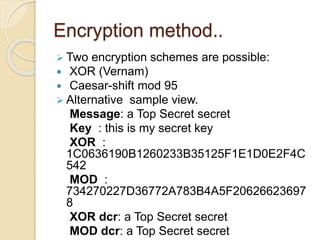
Encryption method.. 
 Two encryption schemes are possible: 
 XOR (Vernam) 
 Caesar-shift mod 95 
 Alternative sample view. 
Message: a Top Secret secret 
Key : this is my secret key 
XOR : 
1C0636190B1260233B35125F1E1D0E2F4C 
542 
MOD : 
734270227D36772A783B4A5F20626623697 
8 
XOR dcr: a Top Secret secret 
MOD dcr: a Top Secret secret
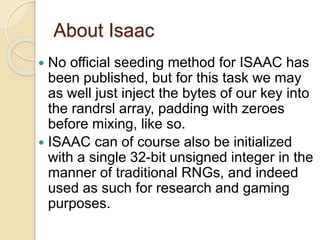
About Isaac 
 No official seeding method for ISAAC has 
been published, but for this task we may 
as well just inject the bytes of our key into 
the randrsl array, padding with zeroes 
before mixing, like so. 
 ISAAC can of course also be initialized 
with a single 32-bit unsigned integer in the 
manner of traditional RNGs, and indeed 
used as such for research and gaming 
purposes.
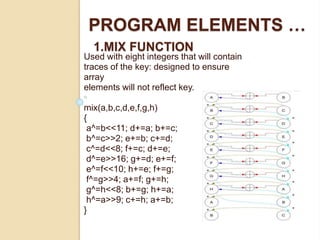
PROGRAM ELEMENTS … 
1.MIX FUNCTION 
Used with eight integers that will contain 
traces of the key: designed to ensure 
array 
elements will not reflect key. 
mix(a,b,c,d,e,f,g,h) 
{ 
a^=b<<11; d+=a; b+=c; 
b^=c>>2; e+=b; c+=d; 
c^=d<<8; f+=c; d+=e; 
d^=e>>16; g+=d; e+=f; 
e^=f<<10; h+=e; f+=g; 
f^=g>>4; a+=f; g+=h; 
g^=h<<8; b+=g; h+=a; 
h^=a>>9; c+=h; a+=b; 
}
PROGRAM ELEMENTS.. 
2.INITIALIZATION 1 
Loads eight elements of the key 
into integers, runs the mix() 
function to randomize them, then 
loads them into eight elements of 
the array. Repeats until key is 
exhausted. 
for (i=0; i<RANDSIZ; i+=8) 
{ 
a+=r[i ]; b+=r[i+1]; c+=r[i+2]; 
d+=r[i+3]; 
e+=r[i+4]; f+=r[i+5]; g+=r[i+6]; 
h+=r[i+7]; 
mix(a,b,c,d,e,f,g,h); 
m[i ]=a; m[i+1]=b; m[i+2]=c; 
m[i+3]=d; 
m[i+4]=e; m[i+5]=f; m[i+6]=g; 
m[i+7]=h; 
}
PROGRAM ELEMENTS- 
3.INITIALIZATION 2 
Routine then runs a second pass 
to mix more thoroughly, 
loading elements of the array 
instead of elements of the key 
into the integers this time. 
for (i=0; i<RANDSIZ; i+=8) 
{ 
a+=m[i ]; b+=m[i+1]; 
c+=m[i+2]; d+=m[i+3]; 
e+=m[i+4]; f+=m[i+5]; 
g+=m[i+6]; h+=m[i+7]; 
mix(a,b,c,d,e,f,g,h); 
m[i ]=a; m[i+1]=b; 
m[i+2]=c; m[i+3]=d; 
m[i+4]=e; m[i+5]=f; 
m[i+6]=g; m[i+7]=h; 
}
Program Elements 
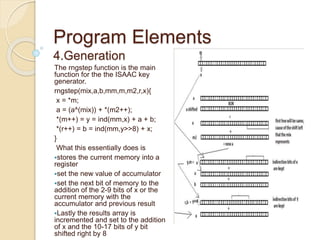
4.Generation 
The rngstep function is the main 
function for the the ISAAC key 
generator. 
rngstep(mix,a,b,mm,m,m2,r,x){ 
x = *m; 
a = (a^(mix)) + *(m2++); 
*(m++) = y = ind(mm,x) + a + b; 
*(r++) = b = ind(mm,y>>8) + x; 
} 
What this essentially does is 
stores the current memory into a 
register 
set the new value of accumulator 
set the next bit of memory to the 
addition of the 2-9 bits of x or the 
current memory with the 
accumulator and previous result 
Lastly the results array is 
incremented and set to the addition 
of x and the 10-17 bits of y bit 
shifted right by 8
Program Elements 
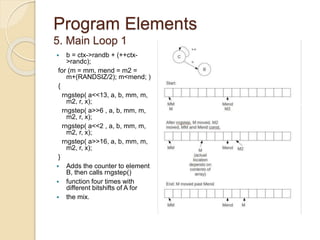
5. Main Loop 1 
 b = ctx->randb + (++ctx- 
>randc); 
for (m = mm, mend = m2 = 
m+(RANDSIZ/2); m<mend; ) 
{ 
rngstep( a<<13, a, b, mm, m, 
m2, r, x); 
rngstep( a>>6 , a, b, mm, m, 
m2, r, x); 
rngstep( a<<2 , a, b, mm, m, 
m2, r, x); 
rngstep( a>>16, a, b, mm, m, 
m2, r, x); 
} 
 Adds the counter to element 
B, then calls rngstep() 
 function four times with 
different bitshifts of A for 
 the mix.
Program Elements: 
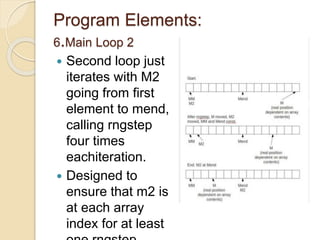
6.Main Loop 2 
 Second loop just 
iterates with M2 
going from first 
element to mend, 
calling rngstep 
four times 
eachiteration. 
 Designed to 
ensure that m2 is 
at each array 
index for at least 
one rngstep.
ISSAC+ 
 To fix some of weaknesses, we modify 
ISAAC’s algorithm, 
 We call the corresponding pseudo-random 
generator ISAAC+. The 
modifications: we add ⊕a to avoid 
the biases observed, perform rotations 
(symbols ≪, ≫) instead of shifts, so as 
to get more diffusion from the state 
bits, and replace an addition by a XOR 
to reduce the linearity
CONCLUSION and FUTURE PLAN 
 Its possible to understand the 
thoroughly as stream cipher was 
introduced in course. 
 ISSAC applications in real life can be 
mapped with the learnt concept. 
 Its implementation can also be made 
easily using C
“For every lock there is a Key… 
It is better to KEEP SAFE YOUR LOCK THAN THE KEY”

Isaac stream cipher

  • 1.
    Activity-ISAAC Submitted ByA18 Anoop Betigeri 2BV11CS014 Chaitra Besthar 2BV11CS024 Megha Byali 2BV11CS045 Radhika patil 2BV11CS073
  • 2.
    WHAT IS STREAMCIPHER !!! Key + Nounce = Keystream Plaintext Xor'd With Keystream = Ciphertext Ciphertext Xor'd With same keystream=Plaintext
  • 3.
    What is ISSACis….  ISSAC stands for Indirection, Shift, Accumulate, Add, and Count.  It is a cryptographically secure pseudorandom number generator.  It is stream cipher designed by Robert J. Jenkins Jr in 1996.  ISAAC is fast especially when optimised and portable to most architectures in nearly all programming and scripting languages.
  • 4.
    How ISSAC cameup!! ● Based on the RC4 stream cipher ● Basic structure of RC4: ○ Starts with a 256-byte array, filled with the golden ratio, then modified with bytes of the key. ○ Each keystream bit modifies the array
  • 5.
    Issues addresssed RC4has a few issues, namely dealing with bias. ● Some sequences are more likely to occur than others- bias. ○ This is due to initialization of RC4 to avoid short cycles: sequences that will result in the keystream repeating earlier than expected. ● First few bytes of the keystream are significantly less random and give information about the key.
  • 6.
    How Expansion Happened!! ● Robert Jenkins produced a number of ciphers attempting to expand on RC4 ○ IA- gives values based on sum of values in array rather than individual values. Still prone to bias. ○ IBAA- adds an accumulator (rotating value based off array value) to deal with bias issues. Does not appear to have bias, and short cycles are significantly reduced from what would be expected in RC4.
  • 7.
    ISSAC origin TheIBAA implementation is taken by Robert and he adds a counter incremented once per call. ○ This removes any chance of short cycles, as even if the sequence would normally cycle, the counter is different and thus the sequence is different. ○ Estimated cycle length is 2^8287 calls.
  • 8.
    Operation..  TheISAAC algorithm has similarities with RC4.  It uses an array of 256 four-octet integers as the internal state, writing the results to another 256 four-octet integer array, from which they are read one at a time until empty, at which point they are recomputed.  The computation consists of altering i-element with (i⊕128)-element, two elements of the state array found by indirection, an accumulator, and a counter, for all values of i from 0 to 255.  Since it only takes about 19 32-bit operations for each 32-bit output word, it is very fast on 32-bit computers.
  • 9.
    Cryptanalysis on ISSAC  It has been undertaken by Marina Pudovkina  Her attack can recover the initial state with a complexity that is approximated to be less than the time needed for searching through the square root of all possible initial states.  In practice this means that the attack needs 4.67×10^1240 instead of 10^2466. This result has had no practical impact on the security of ISAAC.
  • 10.
    Cryptanalysis contd… In 2006 Jean-Philippe Aumasson discovered several sets of weak states.  It is not clear if an attacker can tell from just the output whether the generator is in one of these weak states or not.  There was error in last attack made after Aumason and the reason was errorneous algorithm rather than the real ISAAC.  An improved version of ISAAC is proposed, called ISAAC+.
  • 11.
    Practical usage.. Manyimplementations of ISAAC are so fast that they can compete with other high speed PRNGs, even with those designed primarily for speed not for security.  Only a few other generators of such high quality and speed exist in usage. ISAAC is used in the Unix tool ”shred” to securely overwrite data. This makes it suitable for applications where a significant amount of random data needs to be produced quickly, such solving using the Monte Carlo method or for games.
  • 12.
    How It happens…  The RNG should then be seeded with the string "this is my secret key" and finally the message "a Top Secret secret" should be encrypted on that key.  Your program's output ciphertext will be a string of hexadecimal digits.  . Optional: Include a decryption check by re-initializing ISAAC and performing the same encryption pass on the ciphertext.
  • 13.
    Encryption method.. Two encryption schemes are possible:  XOR (Vernam)  Caesar-shift mod 95  Alternative sample view. Message: a Top Secret secret Key : this is my secret key XOR : 1C0636190B1260233B35125F1E1D0E2F4C 542 MOD : 734270227D36772A783B4A5F20626623697 8 XOR dcr: a Top Secret secret MOD dcr: a Top Secret secret
  • 14.
    About Isaac No official seeding method for ISAAC has been published, but for this task we may as well just inject the bytes of our key into the randrsl array, padding with zeroes before mixing, like so.  ISAAC can of course also be initialized with a single 32-bit unsigned integer in the manner of traditional RNGs, and indeed used as such for research and gaming purposes.
  • 15.
    PROGRAM ELEMENTS … 1.MIX FUNCTION Used with eight integers that will contain traces of the key: designed to ensure array elements will not reflect key. mix(a,b,c,d,e,f,g,h) { a^=b<<11; d+=a; b+=c; b^=c>>2; e+=b; c+=d; c^=d<<8; f+=c; d+=e; d^=e>>16; g+=d; e+=f; e^=f<<10; h+=e; f+=g; f^=g>>4; a+=f; g+=h; g^=h<<8; b+=g; h+=a; h^=a>>9; c+=h; a+=b; }
  • 16.
    PROGRAM ELEMENTS.. 2.INITIALIZATION1 Loads eight elements of the key into integers, runs the mix() function to randomize them, then loads them into eight elements of the array. Repeats until key is exhausted. for (i=0; i<RANDSIZ; i+=8) { a+=r[i ]; b+=r[i+1]; c+=r[i+2]; d+=r[i+3]; e+=r[i+4]; f+=r[i+5]; g+=r[i+6]; h+=r[i+7]; mix(a,b,c,d,e,f,g,h); m[i ]=a; m[i+1]=b; m[i+2]=c; m[i+3]=d; m[i+4]=e; m[i+5]=f; m[i+6]=g; m[i+7]=h; }
  • 17.
    PROGRAM ELEMENTS- 3.INITIALIZATION2 Routine then runs a second pass to mix more thoroughly, loading elements of the array instead of elements of the key into the integers this time. for (i=0; i<RANDSIZ; i+=8) { a+=m[i ]; b+=m[i+1]; c+=m[i+2]; d+=m[i+3]; e+=m[i+4]; f+=m[i+5]; g+=m[i+6]; h+=m[i+7]; mix(a,b,c,d,e,f,g,h); m[i ]=a; m[i+1]=b; m[i+2]=c; m[i+3]=d; m[i+4]=e; m[i+5]=f; m[i+6]=g; m[i+7]=h; }
  • 18.
    Program Elements 4.Generation The rngstep function is the main function for the the ISAAC key generator. rngstep(mix,a,b,mm,m,m2,r,x){ x = *m; a = (a^(mix)) + *(m2++); *(m++) = y = ind(mm,x) + a + b; *(r++) = b = ind(mm,y>>8) + x; } What this essentially does is stores the current memory into a register set the new value of accumulator set the next bit of memory to the addition of the 2-9 bits of x or the current memory with the accumulator and previous result Lastly the results array is incremented and set to the addition of x and the 10-17 bits of y bit shifted right by 8
  • 19.
    Program Elements 5.Main Loop 1  b = ctx->randb + (++ctx- >randc); for (m = mm, mend = m2 = m+(RANDSIZ/2); m<mend; ) { rngstep( a<<13, a, b, mm, m, m2, r, x); rngstep( a>>6 , a, b, mm, m, m2, r, x); rngstep( a<<2 , a, b, mm, m, m2, r, x); rngstep( a>>16, a, b, mm, m, m2, r, x); }  Adds the counter to element B, then calls rngstep()  function four times with different bitshifts of A for  the mix.
  • 20.
    Program Elements: 6.MainLoop 2  Second loop just iterates with M2 going from first element to mend, calling rngstep four times eachiteration.  Designed to ensure that m2 is at each array index for at least one rngstep.
  • 21.
    ISSAC+  Tofix some of weaknesses, we modify ISAAC’s algorithm,  We call the corresponding pseudo-random generator ISAAC+. The modifications: we add ⊕a to avoid the biases observed, perform rotations (symbols ≪, ≫) instead of shifts, so as to get more diffusion from the state bits, and replace an addition by a XOR to reduce the linearity
  • 22.
    CONCLUSION and FUTUREPLAN  Its possible to understand the thoroughly as stream cipher was introduced in course.  ISSAC applications in real life can be mapped with the learnt concept.  Its implementation can also be made easily using C
  • 23.
    “For every lockthere is a Key… It is better to KEEP SAFE YOUR LOCK THAN THE KEY”