

PROFINET
Design
Pete Brown
Siemens Customer
Services
Pete Brown / PROFINET Design
PROFINET is 100% Ethernet
Pete Brown / PROFINET Design
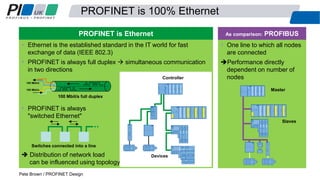
PROFINET is Ethernet
 Ethernet is the established standard in the IT world for fast
exchange of data (IEEE 802.3)
 PROFINET is always full duplex  simultaneous communication
in two directions
 PROFINET is always
"switched Ethernet"
 Distribution of network load
can be influenced using topology
As comparison: PROFIBUS
 One line to which all nodes
are connected
Performance directly
dependent on number of
nodesController
Slaves
Devices
100 Mbit/s full duplex
Switches connected into a line
Master
100 Mbit/s
100 Mbit/s
PROFINET Technology at a glance
3
Pete Brown / Engineering with PROFIsafe
PROFINET
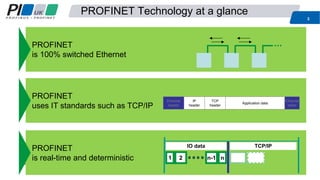
is 100% switched Ethernet
PROFINET
uses IT standards such as TCP/IP
PROFINET
is real-time and deterministic
TCP/IP
n-1 n21
IO data
Ethernet
header
IP
header
TCP
header
Application data
Ethernet
trailer
100 Base TX (Twisted Pair)
4
Pete Brown / PROFINET Design
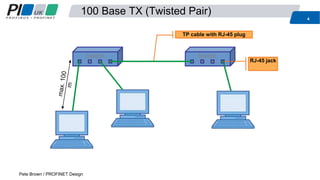
Switch Switch
RJ-45 jack
TP cable with RJ-45 plug
100 Base FX (optical FE)
5
Pete Brown / PROFINET Design
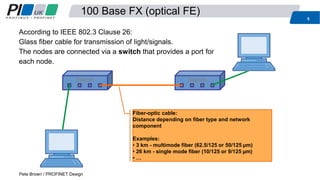
According to IEEE 802.3 Clause 26:
Glass fiber cable for transmission of light/signals.
The nodes are connected via a switch that provides a port for
each node.
Switch Switch
Fiber-optic cable:
Distance depending on fiber type and network
component
Examples:
• 3 km - multimode fiber (62.5/125 or 50/125 µm)
• 26 km - single mode fiber (10/125 or 9/125 µm)
• …
Transfer Media - Comparisons
6
Pete Brown / PROFINET Design
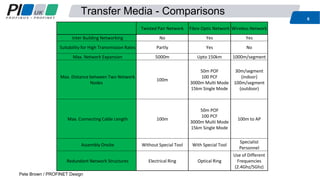
Twisted Pair Network Fibre Optic Network Wireless Network
Inter Building Networking No Yes Yes
Suitability for High Transmission Rates Partly Yes No
Max. Network Expansion 5000m Upto 150km 1000m/segment
Max. Distance between Two Network
Nodes
100m
50m POF
100 PCF
3000m Multi Mode
15km Single Mode
30m/segment
(indoor)
100m/segment
(outdoor)
Max. Connecting Cable Length 100m
50m POF
100 PCF
3000m Multi Mode
15km Single Mode
100m to AP
Assembly Onsite Without Special Tool With Special Tool
Specialist
Personnel
Redundant Network Structures Electrical Ring Optical Ring
Use of Different
Frequencies
(2.4Ghz/5Ghz)
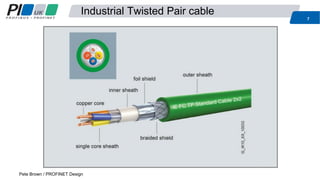
Industrial Twisted Pair cable
7
Pete Brown / PROFINET Design
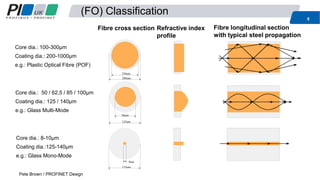
(FO) Classification
8
Pete Brown / PROFINET Design
Core dia.: 100-300µm
Coating dia.: 200-1000µm
e.g.: Plastic Optical Fibre (POF)
Core dia.: 50 / 62,5 / 85 / 100µm
Coating dia.: 125 / 140µm
e.g.: Glass Multi-Mode
Fibre longitudinal section
with typical steel propagation
Refractive index
profile
Fibre cross section
50um
125um
250um
280um
125um
9um
Core dia.: 8-10µm
Coating dia.:125-140µm
e.g.: Glass Mono-Mode
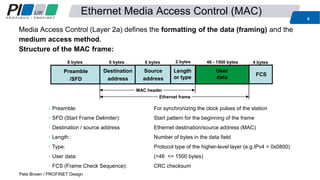
Ethernet Media Access Control (MAC)
9
Pete Brown / PROFINET Design
Media Access Control (Layer 2a) defines the formatting of the data (framing) and the
medium access method.
Structure of the MAC frame:
8 bytes
Ethernet frame
MAC header
Destination
address
Source
address
Length
or type
User
data
FCS
6 bytes 6 bytes 2 bytes 46 - 1500 bytes 4 bytes
Preamble
/SFD
 Preamble: For synchronizing the clock pulses of the station
 SFD (Start Frame Delimiter): Start pattern for the beginning of the frame
 Destination / source address Ethernet destination/source address (MAC)
 Length : Number of bytes in the data field
 Type: Protocol type of the higher-level layer (e.g.IPv4 = 0x0800)
 User data: (>46 <= 1500 bytes)
 FCS (Frame Check Sequence): CRC checksum
Open standard in practice
Pete Brown / PROFINET Design
Implementation in products
 PROFINET is open for every type of standard Ethernet
communication (e.g. TCP/IP)
 See also Web tools
 Openness of PROFINET for every manufacturer of
automation equipment  large and continuously
growing product portfolio
 Simple PROFINET integration using software stack for
device manufacturer
Example applications
 Access to controllers per Web browser
 Standard Ethernet devices such as PCs for saving
measured data and for quality assurance in a machine
 Expansion of an existing infrastructure by additional
PROFINET networks
Real-time
RT IRTEthernet
TCP/UDP
PROFINET applicationsIT applica-
tions
e.g.
 HTTP
 SNMP
 DHCP...
Configuration
diagnostics
Process data
IP
Non-
real-time
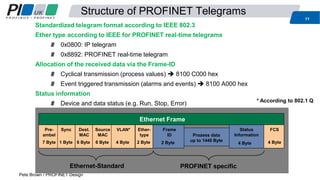
Structure of PROFINET Telegrams
11
Pete Brown / PROFINET Design
Standardized telegram format according to IEEE 802.3
Ether type according to IEEE for PROFINET real-time telegrams
0x0800: IP telegram
0x8892: PROFINET real-time telegram
Allocation of the received data via the Frame-ID
Cyclical transmission (process values)  8100 C000 hex
Event triggered transmission (alarms and events)  8100 A000 hex
Status information
Device and data status (e.g. Run, Stop, Error)
Pre-
ambel
7 Byte
Dest.
MAC
6 Byte
Source
MAC
6 Byte
VLAN*
4 Byte
Frame
ID
2 Byte
FCS
4 Byte
Prozess data
up to 1440 Byte
Sync
1 Byte
Ether-
type
2 Byte
Ethernet Frame
Status
Information
4 Byte
PROFINET specificEthernet-Standard
* According to 802.1 Q
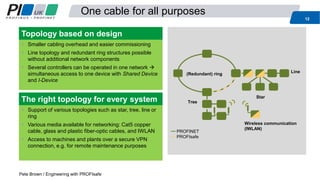
One cable for all purposes
12
Pete Brown / Engineering with PROFIsafe
The right topology for every system
 Support of various topologies such as star, tree, line or
ring
 Various media available for networking: Cat5 copper
cable, glass and plastic fiber-optic cables, and IWLAN
 Access to machines and plants over a secure VPN
connection, e.g. for remote maintenance purposes
Topology based on design
 Smaller cabling overhead and easier commissioning
 Line topology and redundant ring structures possible
without additional network components
 Several controllers can be operated in one network 
simultaneous access to one device with Shared Device
and I-Device
Line
(Redundant) ring
Star
Tree
Wireless communication
(IWLAN)
PROFINET
PROFIsafe
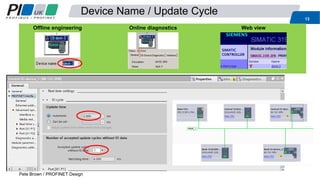
Device Name / Update Cycle
13
Pete Brown / PROFINET Design
Offline engineering Online diagnostics Web view
Any questions? Peter Brown
Product Specialist
Siemens Customer Services
Mobile: 07808 825551
Email: brown.peter@siemens.com

5. PROFINET Network design - Peter Brown

  • 1.
  • 2.
    PROFINET is 100%Ethernet Pete Brown / PROFINET Design PROFINET is Ethernet  Ethernet is the established standard in the IT world for fast exchange of data (IEEE 802.3)  PROFINET is always full duplex  simultaneous communication in two directions  PROFINET is always "switched Ethernet"  Distribution of network load can be influenced using topology As comparison: PROFIBUS  One line to which all nodes are connected Performance directly dependent on number of nodesController Slaves Devices 100 Mbit/s full duplex Switches connected into a line Master 100 Mbit/s 100 Mbit/s
  • 3.
    PROFINET Technology ata glance 3 Pete Brown / Engineering with PROFIsafe PROFINET is 100% switched Ethernet PROFINET uses IT standards such as TCP/IP PROFINET is real-time and deterministic TCP/IP n-1 n21 IO data Ethernet header IP header TCP header Application data Ethernet trailer
  • 4.
    100 Base TX(Twisted Pair) 4 Pete Brown / PROFINET Design Switch Switch RJ-45 jack TP cable with RJ-45 plug
  • 5.
    100 Base FX(optical FE) 5 Pete Brown / PROFINET Design According to IEEE 802.3 Clause 26: Glass fiber cable for transmission of light/signals. The nodes are connected via a switch that provides a port for each node. Switch Switch Fiber-optic cable: Distance depending on fiber type and network component Examples: • 3 km - multimode fiber (62.5/125 or 50/125 µm) • 26 km - single mode fiber (10/125 or 9/125 µm) • …
  • 6.
    Transfer Media -Comparisons 6 Pete Brown / PROFINET Design Twisted Pair Network Fibre Optic Network Wireless Network Inter Building Networking No Yes Yes Suitability for High Transmission Rates Partly Yes No Max. Network Expansion 5000m Upto 150km 1000m/segment Max. Distance between Two Network Nodes 100m 50m POF 100 PCF 3000m Multi Mode 15km Single Mode 30m/segment (indoor) 100m/segment (outdoor) Max. Connecting Cable Length 100m 50m POF 100 PCF 3000m Multi Mode 15km Single Mode 100m to AP Assembly Onsite Without Special Tool With Special Tool Specialist Personnel Redundant Network Structures Electrical Ring Optical Ring Use of Different Frequencies (2.4Ghz/5Ghz)
  • 7.
    Industrial Twisted Paircable 7 Pete Brown / PROFINET Design
  • 8.
    (FO) Classification 8 Pete Brown/ PROFINET Design Core dia.: 100-300µm Coating dia.: 200-1000µm e.g.: Plastic Optical Fibre (POF) Core dia.: 50 / 62,5 / 85 / 100µm Coating dia.: 125 / 140µm e.g.: Glass Multi-Mode Fibre longitudinal section with typical steel propagation Refractive index profile Fibre cross section 50um 125um 250um 280um 125um 9um Core dia.: 8-10µm Coating dia.:125-140µm e.g.: Glass Mono-Mode
  • 9.
    Ethernet Media AccessControl (MAC) 9 Pete Brown / PROFINET Design Media Access Control (Layer 2a) defines the formatting of the data (framing) and the medium access method. Structure of the MAC frame: 8 bytes Ethernet frame MAC header Destination address Source address Length or type User data FCS 6 bytes 6 bytes 2 bytes 46 - 1500 bytes 4 bytes Preamble /SFD  Preamble: For synchronizing the clock pulses of the station  SFD (Start Frame Delimiter): Start pattern for the beginning of the frame  Destination / source address Ethernet destination/source address (MAC)  Length : Number of bytes in the data field  Type: Protocol type of the higher-level layer (e.g.IPv4 = 0x0800)  User data: (>46 <= 1500 bytes)  FCS (Frame Check Sequence): CRC checksum
  • 10.
    Open standard inpractice Pete Brown / PROFINET Design Implementation in products  PROFINET is open for every type of standard Ethernet communication (e.g. TCP/IP)  See also Web tools  Openness of PROFINET for every manufacturer of automation equipment  large and continuously growing product portfolio  Simple PROFINET integration using software stack for device manufacturer Example applications  Access to controllers per Web browser  Standard Ethernet devices such as PCs for saving measured data and for quality assurance in a machine  Expansion of an existing infrastructure by additional PROFINET networks Real-time RT IRTEthernet TCP/UDP PROFINET applicationsIT applica- tions e.g.  HTTP  SNMP  DHCP... Configuration diagnostics Process data IP Non- real-time
  • 11.
    Structure of PROFINETTelegrams 11 Pete Brown / PROFINET Design Standardized telegram format according to IEEE 802.3 Ether type according to IEEE for PROFINET real-time telegrams 0x0800: IP telegram 0x8892: PROFINET real-time telegram Allocation of the received data via the Frame-ID Cyclical transmission (process values)  8100 C000 hex Event triggered transmission (alarms and events)  8100 A000 hex Status information Device and data status (e.g. Run, Stop, Error) Pre- ambel 7 Byte Dest. MAC 6 Byte Source MAC 6 Byte VLAN* 4 Byte Frame ID 2 Byte FCS 4 Byte Prozess data up to 1440 Byte Sync 1 Byte Ether- type 2 Byte Ethernet Frame Status Information 4 Byte PROFINET specificEthernet-Standard * According to 802.1 Q
  • 12.
    One cable forall purposes 12 Pete Brown / Engineering with PROFIsafe The right topology for every system  Support of various topologies such as star, tree, line or ring  Various media available for networking: Cat5 copper cable, glass and plastic fiber-optic cables, and IWLAN  Access to machines and plants over a secure VPN connection, e.g. for remote maintenance purposes Topology based on design  Smaller cabling overhead and easier commissioning  Line topology and redundant ring structures possible without additional network components  Several controllers can be operated in one network  simultaneous access to one device with Shared Device and I-Device Line (Redundant) ring Star Tree Wireless communication (IWLAN) PROFINET PROFIsafe
  • 13.
    Device Name /Update Cycle 13 Pete Brown / PROFINET Design Offline engineering Online diagnostics Web view
  • 14.
    Any questions? PeterBrown Product Specialist Siemens Customer Services Mobile: 07808 825551 Email: brown.peter@siemens.com